Yonsei Medical Journal
Vol. 46, No. 1, pp. 166 - 168, 2005
Yonsei Med J Vol. 46, No. 1, 2005
A case in which a 0.014" wire was broken during the sheath placement in the radial artery for transradial coronary procedure is described here, and a successful retrieval of it using conventional methods is also described. Through the left femoral artery, the 6 Fr guiding catheter was advanced down to the tip of the broken wire at the brachial artery, and the distal part of the broken guidewire was captivated into the guiding catheter. By inflating the balloon catheter inside of the guiding catheter, seized broken guidewire between the inflated balloon and the guiding catheter was removed successfully by withdrawing the whole system en bloc.
Key Words: Radial artery, angioplasty, complication, foreign body
INTRODUCTION
The transradial approach is currently popular for vascular access during percutaneous coronary angiography and intervention.1 One of the diffi- culties with this approach exists in accessing the artery.2 Although arterial puncture is usually sim- ple, sometimes there are difficulties in introducing a 0.035" guidewire through the puncture needle.
One method to overcome this problem is using the floppy tip 0.014" guidewire assisted method.
After the 0.014" guidewire is introduced in the radial artery via catheter needle, the catheter nee- dle is further advanced and the 0.014" guidewire
is replaced by a 0.035" wire while the arterial sheath is placed. This report described a case of a 0.014" wire that broke during sheath placement and a successful percutaneous retrieval.
CASE REPORT
A 68 year old woman had received an inter- vention with stent at the middle segment of the right coronary artery, and she was scheduled for 6 month follow up coronary angiography in order to evaluate the patency of the stented segment.
The previous coronary angiogram and interven- tion were performed using her right radial artery.
Because the right radial artery still had a good pulse according to the positive Allen test, another puncture to the right radial artery was attempted.
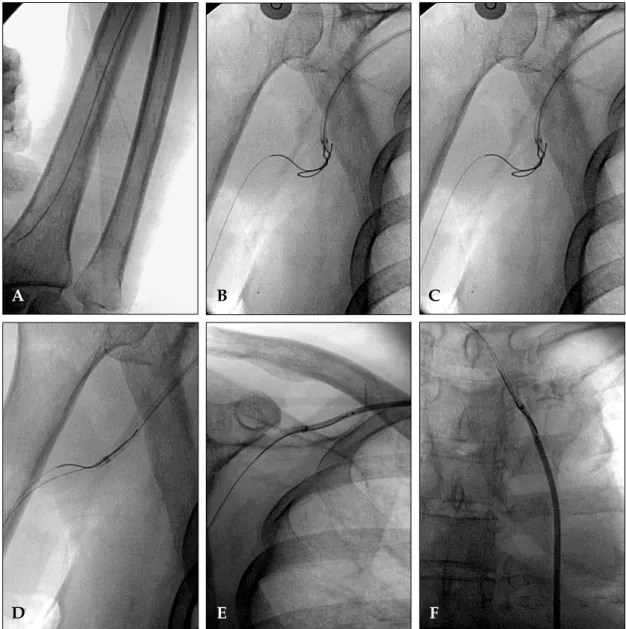
However, there was difficulty in advancing the 0.035" wire via 20 G catheter needle (Sindongbang Co., Korea) after successful puncture of the right radial artery. In this case, a floppy tip 0.014" wire is passed first into the radial artery through the catheter needle, and the arterial sheath was introduced over the 0.014" guidewire with diffi- culty. While trying to advance the arterial sheath, the wire was broken (Fig. 1A).
In order to retrieve the broken guidewire, a 6 Fr sheath was placed in the right femoral artery, and a 6 Fr Judkins right guiding catheter was advanced down to the broken wire tip at the right brachial artery. Retrieval using a snare wire (FSF- 21-300, Cook, Inc., Bloomington, IN, USA) was at- tempted several times, but the attempts were
Broken Guidewire Fragment in the Radio-brachial Artery During Transradial Sheath Placement: Percutaneous
Retrieval via Femoral Approach
Jang-Young Kim, Junghan Yoon, Hyun-Sook Jung, Woo-Jea Kim, Byung-Su Yoo, Seung-Hwan Lee, and Kyung-Hoon Choi
Department of Internal Medicine, Wonju College of Medicine, Yonsei University, Wonju, Korea.
Received June 15, 2004 Accepted July 21, 2004
Reprint address: requests to Dr. Junghan Yoon, Division of Cardiology, Wonju College of Medicine, Yonsei University, 162 Ilsan-dong, Wonju 220-701, Korea. Tel: 82-33-741-1212, Fax: 82- 33-741-1219, E-mail: [email protected]
Guidewire Fragment in Radial Artery 167
Yonsei Med J Vol. 46, No. 1, 2005
unsuccessful in catching the wire (Fig. 1B). During these attempts, the 0.014" guidewire was caught in the inside of the guiding catheter (Fig. 1C). At this moment, we decided to trap the broken guidewire tip inside the guiding catheter, and thus, we introduced the 0.014" Choice PT (Boston Scientific Scimed, MN) guidewire and balloon catheter (MAVERICK 2.5-20 mm, Boston Scientific Scimed, MN) over it (Fig. 1D). The balloon catheter was placed alongside the wire at the distal portion of the guiding catheter, where the balloon catheter
was fully inflated at 4 atm to trap the broken guidewire (Fig. 1E). The whole system was pulled back while the balloon was inflated (Fig. 1F).
DISCUSSION
Accessing the radial artery and sheath place- ment is difficult in some cases.2 Using the 0.014"
wire in case a difficulty arises during the intro- duction of the 0.035" guidewire is one technique
Fig 1.A. A broken 0.014" guidewire retained in a left radio-brachial artery. B. Retrieval using a snare was attempted several times but failed. C. The distal part of the broken 0.014" guidewire inside of the guiding catheter. D. Another 0.014" guide- wire was passed alongside the broken wire. E. Balloon catheter was positioned alongside the broken wire inside of the distal tip of the guiding catheter. F. Balloon was inflated in the guiding catheter and the guiding catheter was withdrawn.
A B C
D E F
Jang-Young Kim, et al.
168
Yonsei Med J Vol. 46, No. 1, 2005
for the successful introduction of the arterial sheath. In our cath lab, we tried the catheter nee- dle, which consists of 2 pieces of an inner steel needle and an outer catheter sheath, for the radial puncture. In case of a difficulty during the 0.035"
guidewire introduction, a 0.014" guidewire is helpful in advancing the catheter needle safely deep inside the radial artery and changed to 035"
guidewire for the introduction of arterial sheath.
And also, the 014" guidewire itself can be used for the introduction of the arterial sheath over it. In our case, we tried to introduce the arterial sheath over the 0.014" guidewire. While trying to intro- duce the arterial sheath, the 0.014" guidewire was broken.
Retained guidewire or a catheter fragment in the circulation causes complications, such as thrombosis, emboli, and sepsis. Thus, nonsurgical removal of the catheter or guidewire is the treat- ment of choice.3 Several methods for a dislodged broken wire have been reported.4-7 Snare loop wire or its modification was the most common technique used.3,4 Other techniques retrieved the intravascular guidewires in the coronary artery or the great vessel using biopsy catheters, hook-tip catheters, basket retrievers, or through surgical removal.4-7 In our case, the guidewire in the brachial artery was removed successfully using the wire-balloon technique after the failure to retrieve it with the snare loop wire technique.
Although the snare-loop device was unsuccessful in catching the fragmented tip of the guidewire,
it aided in introducing the fragment inside the guiding catheter. Finally, we were able to succeed in the retrieval of the broken guidewire using a relatively simple and safe way with an angio- plasty wire and balloon catheter.
REFERENCES
1. Lotan C, Hasin Y, Mosseri M, Rozenman Y, Admon D, Nassar H, Gotsman MS. Transradial approach for coronary angiography and angioplasty. Am J Cardiol 1995;76:164-72.
2. Salgado Fernandez J, Calvino Santos R, Vazquez Rodriguez JM, Vazquez Gonzalez N, Vazquez Rey E, Perez Fernandez R, et al. Transradial approach to coro- nary angiography and angioplasty: initial experience and learning curve. Rev Esp Cardiol 2003;56:152-9.
3. Fisher RG, Ferreyro R. Evaluation of current technique for nonsurgical remoral of intravascular iatrogenic foreign body. Am J Rentgenol 1978;130:541-8
4. Watson LE. Snare loop technique for removal of broken steerable PTCA wire. Cathet Cardiovasc Diagn 1987;13:
44-9.
5. Hartzler GO, Rutherford BD, McConahay DR. Retained percutaneous transluminal coronary angioplasty equip- ment components and their management. Am J Cardiol 1987;60:1260-4
6. Mintz GS, Bemis CE, Unwala AA, Hadjimiltiaddes S, Kimbiris D. An alternative method for transcatheter retrieval of intracoronary angioplasty equipment frag- ments. Cathet Cardiovasc Diagn 1990;20:247-50.
7. Foster Smith K, Garratt K N, Holmes DR Jr. Guidewire transaction during rotational coronary atherectomy due to guide catheter dislodgment and wire kinking. Cathet Cardiovasc Diagn 1995;35:224-7.