• 검색 결과가 없습니다.

Identification of weight-control behaviors practiced by diverse groups of college students

N/A
N/A
Protected

Academic year: 2022

Share "Identification of weight-control behaviors practiced by diverse groups of college students"

Copied!
6
0
0

로드 중.... (전체 텍스트 보기)

전체 글

(1)

ⓒ2007 The Korean Nutrition Society and the Korean Society of Community Nutrition

Identification of weight-control behaviors practiced by diverse groups of college students

Soo-Kyung Lee 1 , Debra Palmer Keenan and Ho Kyung Ryu 3

1

Healthy City Team, Division of Health Promotion, Seoul Metropolitan Government, Seoul 100-739, Korea

2

Department of Nutritional Sciences, Rutgers, The State University of New Jersey, 26 Nichol Ave. New Brunswick, NJ 08901, USA

3

Department of Food Science & Nutrition, Pusan National University, KyungNam 627-706, Korea

Received June 27, 2007; Revised August 2, 2007; Accepted September 1, 2007

Abstract

This study investigated: 1) what weight-related behaviors college students practiced; 2) if the behaviors were performed for weight-related reasons;

and 3) whether the behavioral practices differed by gender, race, and body weight status. This cross-sectional study used a questionnaire to collect information from a non-probability sample of undergraduate students (n=379; 48% men) recruited from large introductory psychology classes. Chi-square tests were conducted to examine simple comparisons, and multiple logistic regression analyses assessed differences. Male students reported adopting significantly fewer weight-related behaviors than females. Most frequently males increased exercise (69.2%), increased fruit and vegetable consumption (50%), skipped meals (46%), cut out sweets and junk foods (40%), and cut out between-meal snacks (35%). Female students most frequently increased exercise (67.4%), skipped meals (63%), increased fruit and vegetable consumption (62%), reduced the amount of food eaten (60%), and cut out between-meal snacks (51%). Negative behaviors were engaged in by only a few participants. Weight-related reasons were a significant factor for weight-related behavior adoption. Multiple logistic regression analyses showed that gender was consistently and significantly associated with the adoption of weight-related behaviors, while race and weight status were less consistently associated. Findings of this study will be helpful to dietitians who counsel college students. Results of this study may support efforts to bring more comprehensive behaviorally-focused health and nutrition interventions to college campuses.

Key Words: Health behaviors, college students, race, gender, body weight

Introduction 10)

Obesity has become one of the most significant public health issues (Healthy People 2010, 2000; Office of the Surgeon Gen- eral, 2001). According to the estimate from the 2001~2002 National Health and Nutrition Examination Survey, 65.7% of adult Americans are considered to be overweight or obese; and, 30.6% are obese (Hodley et al., 2004). This is a significant increase from the last decade (CDC, 1997a). The obesity epide- mic differentially affects racial/ethnic groups. Compared to non- Hispanic white women, non-Hispanic Black women and Mexi- can-American women exhibit a consistently higher prevalence of overweight and obesity (Hodley et al., 2004). This disparity is not evident among adult men. Although Asian Americans are believed to have a lower prevalence of overweight and obesity, there are no nationally representative data on Asian Americans at this time. Despite significant racial/ethnic differences in body weight, racial/ethnic differences in weight-related behaviors have not been well studied. The Healthy People 2010 goals set the target prevalence of obesity at 15% (Healthy People 2010, 2000),

which is approximately half its current prevalence estimate.

Although overweight and obesity have reached epidemic pro- portions, particularly among females from certain racial/ethnic backgrounds, it is encouraging that strong prevention and treatment initiatives for improving these conditions nationally have garnered attention and effort.

Colleges and universities have been recognized as potentially effective settings for health promotion because of their ability to reach a large proportion of young adults (CDC, 1997b; Lowry et al., 2000). The 2000 Census showed that more than one third of young adults, aged 20-24, were enrolled in college (US Census Bureau, 2003). In addition, college often initiates self-sufficient living, i.e., during these years young adults start to build their own lifestyles, making independent choices away from parental influences. Thus, lifestyle behaviors established during the college years could have lasting impacts on students’ health in subsequent years, and interventions performed with college students may result in meaningful, positive, life-long changes in health behaviors.

In 1995, as part of Youth Risk Behavior Surveillance, the

§

Corresponding Author: Debra Palmer Keenan, Tel. 732-932-9853, Fax. 732-932-6522, Email. [email protected]

(2)

Table 1. The weight-related behaviors assessed Increase your exercise levels

Reduce the number of calories you eat Reduce the amount of food you eat Cut out between-meal snacking

Cut out sweets and junk food from your diet Skip meals

Fast or go without food entirely Change type of food you eat Decrease fat intake Eat less meat

Eat less high carbohydrate foods like bread or potatoes Eat low calorie diet foods

Increase your fruits and vegetables Increase the number of cigarettes you smoke Drink fewer alcoholic beverages

Take laxatives Take diuretics

Take appetite suppressants Take diet pills

Vomit after you eat Take liquid diet supplements Go to diet center with food provided Go to weight loss group without food supplied

Center for Disease Control and Prevention examined a repre- sentative sample of college students via the National College Health Survey (CDC, 1997b). The survey assessed a wide range of variables, from smoking to physical activity. The national survey revealed that 20.5% of the college students were overweight, and 73.7% failed to eat five or more fruits and vegetables daily. The data also showed that nearly half of the college students were trying to lose weight and that many students, 54% of the female students and 41% of the male students, reported they participated in both diet and physical activity for weight management (Lowry et al., 2000).

However, limited information is currently available regarding what dietary and physical activity behaviors are practiced among college students specifically for weight-related reasons. The health disparities associated with gender and race, have also not been clearly defined among college students.

Therefore, this study investigated: 1) what weight-related behaviors college students practiced; 2) if the behaviors were performed specifically for weight-related reasons; and 3) whether the behavioral practices differed by gender, race, and body weight status.

Subjects and Methods

This cross-sectional study was conducted after the University Institutional Review Board approved the research protocol.

Sample and data collection

A non-probability sample of 474 college students in a state university on the East coast were recruited from large intro- ductory psychology classes. The participants received one experimental credit for the psychology class for completing the questionnaire. After careful screening of the completed ques- tionnaires, 95 questionnaires were excluded because of missing

values on the main study measures, leaving a total of 379 questionnaires in the analytical sample. The characteristics of those who were excluded did not significantly differ from those who were included.

Measures

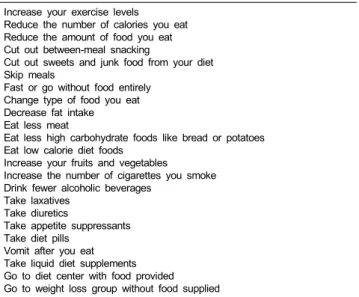
A total of 23 behaviors (Table 1) were selected for assessment, based on their relevance to obesity and to college-aged indi- viduals. Participants were asked to indicate whether they practiced changes in the selected behaviors in the past year. Those who indicated they engaged in the weight-related behaviors were asked if they adopted the behaviors for weight-related reasons.

Body mass index (BMI) was used as the measure of weight status, and calculated using students’ self-reported heights and weights. Body mass index (BMI, weight in Kg/height in m

2

) has been used as an index of adiposity (Gibson, 1990). Individuals with BMIs lower than 18.5 were classified as “underweight”, those with BMIs of 18.5 to 24.9 were classified as “normal,”

those with BMIs of 25 to 29.9 were classified as “overweight,”

and those with BMIs of 30 or over were classified as “obese (WHO, 1995).”

Race was attained by asking if the participants were non- Hispanic white, non-Hispanic African American, American Indian/Alaskan, Hispanic, Asian, or “Other.” Inclusion of “Non- Hispanics” allowed consideration of ethnicity; however, the term

“race” will be used throughout this paper for simplicity. Since there was only one student who identified herself as American Indian/Alaskan, this category was collapsed with the “Other”

category in the logistic regression analysis. Non-Hispanic white was used as a reference category in multiple logistic regressions.

Gender was a dichotomous variable with woman coded as “1,”

compared to the reference category, man.

Controlling variables included parental socioeconomic status, which was indirectly assessed by asking for parents’ educational levels and by having students’ rate their parents’ income levels as low, lower-middle, middle, upper-middle, or high.

Statistical analysis

Descriptive statistics, such as frequencies, t-test, and chi-square tests, were used to characterize the participants and their be- havioral practices. Multiple logistic regressions were conducted to examine if there were significant differences in health behavior changes by gender, ethnicity, and/or body weight status. All ana- lyses were conduced with SAS ver. 8 for Windows (Cary, NC).

Results

Participant characteristics

Approximately equal numbers of female and male students

were included in the analytical sample (Table 2). The average

age of the participants was 19, suggesting most participants were

(3)

Table 2. Participant characteristics

Total (n=379)

Men 182 (48%)

Women 197 (52%) Age (mean years ± SD) 18.95 ± 1.31 19.04 ± 1.38 18.87 ± 1.25 Race (n (%))

Non-Hispanic White

Non-Hispanic African American Hispanic

Asian American American Indian/Alaskan Other

176 (46.81) 23 ( 6.12) 28 ( 7.45) 135 (35.90) 1 ( 0.27) 13 ( 3.46)

93 (51.38) 6 ( 3.31) 12 ( 5.63) 66 (36.47) 0 ( 0.00) 4 ( 2.21)

83 (42.56) 17 ( 8.72) 16 ( 8.21) 69 (35.39) 1 ( 0.51) 9 ( 4.62) Mother’s education (n (%))

Elementary school Middle school

High school Diploma or GED Some vocational/trade school Associate degree

Some college Bachelor’s degree

2 ( 0.53) 10 ( 2.67) 103 (27.47) 29 ( 7.73) 21 ( 5.60) 62 (16.53) 148 (39.47)

2 ( 1.12) 3 ( 1.68) 53 (29.61) 12 ( 6.70) 11 ( 6.15) 37 (20.67) 61 (34.08)

0 ( 0.0 ) 7 ( 3.57) 50 (25.51) 17 ( 8.67) 10 ( 5.10) 25 (12.76) 87 (44.39) Father’s education (n (%))

Elementary school Middle school

High school Diploma or GED Some vocational/trade school Associate degree

Some college Bachelor’s degree

6 ( 1.63) 12 ( 3.25) 81 (22.01) 25 ( 6.79) 17 ( 4.62) 54 (14.67) 173 (47.01)

3 ( 1.71) 5 ( 2.86) 35 (20.00) 13 ( 7.43) 7 ( 4.00) 31 (17.71) 81 (46.29)

3 ( 1.55) 7 ( 3.63) 46 (23.83) 12 ( 6.22) 10 ( 5.18) 23 (11.92) 92 (47.67) Parent’s income level (n (%))

1)

Low Lower middle Middle Upper middle High

13 ( 3.48) 44 (11.76) 161 (43.05) 131 (35.03) 25 ( 6.68)

5 ( 2.78) 24 (13.33) 65 (36.11) 75 (41.67) 11 ( 6.11)

8 ( 4.12) 20 (10.31) 96 (49.48) 56 (28.87) 14 ( 7.22) BMI (mean ± SD)

<18.5

2)

(n (%)) 18.5-25 25-30

<30

23.53 ± 4.62 28 ( 7.99) 242 (63.85) 80 (21.11) 29 ( 7.65)

24.67 ± 5.08

a

9 ( 4.95) 99 (54.40) 54 (29.67) 20 (10.99)

22.48 ± 3.88

b

19 ( 9.64) 143 (72.59) 26 (13.20) 9 ( 4.57) Number of Adopted Behaviors (mean ± SD)

Made no behavior changes (n (%))

5.53 ± 3.84 20 ( 5.28)

4.44 ± 3.29

a

12 ( 6.59)

6.54 ± 4.03

b

8 ( 4.06)

1)

Gender was significantly associated with parents’ income level. (χ

2

=9.63, p=0.0471)

2)

Gender was significantly associated with weight status. (χ

2

=24.99, p<0.0001)

a,b

Significantly different at α=0.05 by t-test

Fig. 1. Percent of participants engaged in the behaviors by gender

Fig. 2. Percent participants engaged in the behaviors for weight-related reasons

freshmen or sophomores, as was expected by drawing a non- probability sample from introductory psychology courses. About half of the participants identified themselves as non-Hispanic white, and approximately one third identified themselves as Asian. Participating students described their parents’ socioe- conomic status as middle or higher with more than 80% in middle or upper income levels and more than 57% of their mother and 62% of their father having a Bachelor’s degree or some college education. Male students were more likely to be overweight or obese than female students, with 30% and 11% reporting heights and weights that classified them as overweight and obese, respectively; compared to 13% and 5% respectively, among the females.

The participants reported they had engaged in, on average, five to six weight-related behaviors in the past year. Female students had engaged in significantly more behaviors than male students.

1) What weight-related behaviors did college students most frequently practice?

Increasing the exercise level was the behavior most frequently

reported by both female (65%) and male (68%) students (Figure

1). All other weight-related behaviors assessed were more

frequently practiced among female students. Skipping meals

(63%), increasing fruit and vegetable consumption (62%),

reducing the amount of food eaten (60%), and cutting out

between-meal snacks (51%) were the next most frequently

reported responses among female students. The order of the most

frequently practiced behaviors reported by male students differed,

and was: increasing fruit and vegetable consumption (50%),

skipping meals (46%), cutting out sweets and junk food from

(4)

Table 3. Logistic regression on the health behaviors

1) 2) 3)

(odds ratio)

Women Racial differences Weight differences

African Americans

Hispanic Asian Others Underweight Overweight Obese

Increase your exercise levels 1.11 0.38* 1.40 0.85 0.63 0.45 2.05* 1.58

Reduce the number of calories you eat 4.59*** 0.24* 1.19 0.55* 1.14 0.26* 3.14*** 3.22*

Reduce the amount of food you eat 4.52*** 0.35* 0.89 0.71 0.95 0.26** 2.99*** 2.49*

Cut out between-meal snacking 3.70*** 0.18** 1.37 0.62 0.56 0.38 2.99*** 5.01***

Cut out sweets and junk food from your diet 1.79* 0.12** 1.04 0.54* 0.46* 0.24* 1.91* 2.12

Skip meals 2.04** 2.32 1.13 1.66* 0.80 1.96 1.09 1.39

Fast or go without food entirely 1.66 1.21 0.57 1.05 2.07 2.59 2.04 2.94*

Change type of food you eat 2.46*** 0.25* 0.93 0.59* 0.86 0.57 2.64*** 1.78

Decrease fat intake 3.15*** 0.11** 0.60 0.64 1.01 0.28* 2.90*** 1.13

Eat less meat 4.02*** 0.53 0.47 1.14 0.52 0.44 1.20 1.48

Eat less high carbohydrate foods like bread or potatoes

§

3.79*** 0.65 0.64 0.64 0.78 0.29 1.76 1.38

Eat low calorie diet foods 5.82*** 0.30 1.16 0.41** 0.98 0.63 2.57** 1.32

Increase your fruits and vegetables 2.16*** 0.42 0.53 0.82 0.58 0.88 1.47 1.61

Increase the number of cigarettes you smoke 1.04 0.50 0.41 0.61 2.66 1.29 0.42 0.68

Drink fewer alcoholic beverages 1.42 0.86 1.33 0.63 1.03 1.34 1.74 2.93*

1)

The behaviors not listed in this table were not able to fit to the logistic models because of few number of participants engaged in the behaviors.

2)

The logistic regression model also controlled for mother’s education, father’s education, and parents’ income.

3)

Referece categories in the regression models were “men,” “white,” and “normal weight.”

§
The validity of the model fit was questionable; however, the gender difference was significant in reduced models. None of African American participants were engaged in the behavior.

* p<0.05; ** p<0.01; *** p<0.001

your diet (40%), and cutting out between-meal snacks (35%).

The weight-related behaviors considered to have negative impacts on health, e.g. vomiting after eating, were adopted by smaller numbers of participants, with percentages mostly lower than 10%.

2) Did college students choose to practice the behaviors for weight-related reasons?

As shown in Figure 2, weight-related reasons were important factors in the adoption of the weight-related behaviors among college students; and consistently, more female students (36

~100%) indicated weight-related behavior adoption rationale than did male students (0~100%). Not surprisingly, the adoption of the negative behaviors, such as taking laxatives or diet pills, were more often associated with weight loss rationale than were the adoption of other behaviors.

3) Did the behavioral practices differ by gender, race, and body weight status?

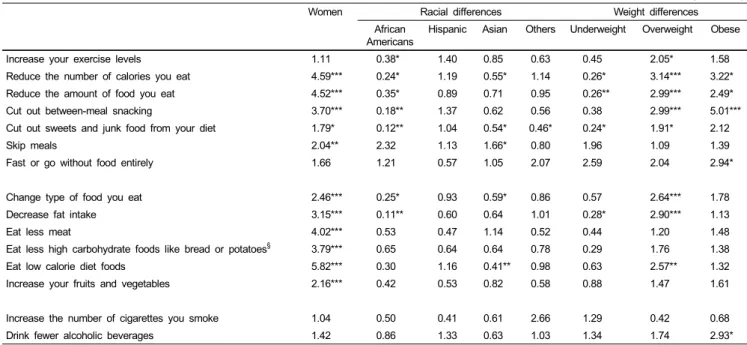
The multiple logistic regressions confirmed consistent gender differences, when controlling for race, body weight status, and parents’ socioeconomic status (Table 3). Parents’ socioeconomic status was assessed by mother’s education, father’s education and parents’ income. Most behaviors studied, with the exceptions of increasing exercise and fasting, were more likely to be practiced by female students than male students. For example, female

students were 4.5 times more likely to reduce the amount of food they ate than were males.

Non-Hispanic white students were more likely to engage in the behavior changes than students of any other race. Non- Hispanic African American students were less likely to engage in many of the weight-related behaviors than non-Hispanic white students. Several significant differences were found with regards to other races, however findings were not consistent.

When “underweight,” “overweight,” and “obese” students were compared to “normal-weight” students, the overweight students showed the most consistent and significant difference in practicing the weight-related behaviors. That is, overweight students were more likely to practice eight behaviors than normal-weight students: and, underweight or overweight students were more likely to practice four or five of the behaviors, respectively (Table 3).

Discussion

This study found that college students were engaged in many

weight-related behavioral practices. Almost all college students

(95%) reported the adoption of at least one behavior in the past

year. A significant number of students reported practicing the

behaviors assessed for weight-related reasons; and, the positive

behaviors were far more frequently practiced than were the

(5)

negative behaviors. Gender differences were found in the types of weight-related behaviors that were practiced among college students. In summary, the behaviors’ adoption among college students differed significantly by gender, race, and body weight status. Further, female and overweight students were more likely to practice the weight-related behaviors, while non-Hispanic African American students were less likely to do so.

The female students not only practiced more weight-related behaviors, but they also cited weight-related reasons more often as their motivation for doing so. The fact that female students were more likely to engage in weight-related behaviors than male students was also found in the National College Health Survey (CDC, 1997b; George & Johnson, 2001; Lowry et al., 2000).

Social pressure to be thin is higher for women than men, which might explain this gender discrepancy, even though the preva- lence of overweight and obesity is lower than it is among male students (McKinley, 1999). Although social pressures exper- ienced by females have been recognized as a negative or dangerous factor for women’s health and should continue to be addressed, health professionals should also recognize that it presents a good opportunity for health promotion. That is, women are more likely to at least attempt health behavior changes; and are, therefore, more receptive to making positive weight-related behavior changes.

Racial disparities in weight-related behavior adoptions were also observed in this study. Non-Hispanic African American students were, in general, less likely to practice the behaviors than non-Hispanic white students, despite their higher prevalence of obesity, i.e., 13% vs. 10% among non-Hispanic whites (10%).

Although the sample of non-Hispanic African American parti- cipants was small (n=23), the findings of this study are consistent with other reports. While July et al. (2003) reported that obesity-prone behaviors were practiced by 50% of African American students, multiple studies suggest that African Americans tend to have more positive body images and are less likely to practice weight management behaviors than white Americans, in spite of a higher prevalence of overweight and obesity (Breotkopf & Berenson, 2004; Lowry et al., 2000).

Asian American students were less likely to adopt certain behaviors. The behaviors practiced were: to reduce the number of calories, to cut out sweets and junk food from their diets, to change the type of food they eat, and to eat low calorie diet foods. No significant differences were noted between Hispanic students and non-Hispanic white students in the behaviors practiced, perhaps due to the small number of Hispanic par- ticipants (n=28). Understanding which behaviors students of each race are more likely to engage in will be helpful in identifying effective intervention strategies for students from diverse back- grounds.

Body weight status was also a significant factor associated with the behavior adoptions. Not surprisingly, the “overweight”

category showed a consistently higher likelihood of adopting the studied behaviors than other body weight categories. What was

not expected was that this study did not find significant differ- ences between the weight-related behavior adoptions between normal-weight students and obese students. One can assume this may be due to the fact that the differences were so small that the statistical power of this sample size was not large enough to capture them. Still, the results of this study suggest that overweight students are more likely to practice various behaviors than normal-weight students. Since this study did not assess current status of each behavior (e.g. number of servingsof fruit and vegetables the students consumed), to what extent the behaviors were practiced is unknown. But, it is possible that overweight students were more likely to adopt weight-related behaviors, yet practiced the behaviors to a lesser degree than normal-weight students.

Notably, almost three quarters of the participants reported having increased their exercise levels. Approximately 75% of the female students who had made this change indicated they had increased their exercise levels for weight-related reasons. Per- haps, the message of the importance of physical activity has been received and is resulting in increased exercise levels among college students. This is encouraging given the fact that a recent national survey showed 26% of adult Americans reported no physical activity (CDC, 2003).

Another notable finding is that over 60% of the female students, and 50% of the male students, reported they had increased their fruit and vegetable consumption. Weight-related reasons for making these changes were cited by significant portions of students, i.e., approximately 60% of the female and 40% of the male students. This is surprising because public health promotion messages promoting fruits and vegetables have not frequently linked fruit and vegetable consumption to weight loss (NCI, 2001).

This study was limited by its cross-sectional study design, making causal inferences difficult. In addition, generalization of the study findings warrants careful consideration, as the study sample was comprised of a non-probability sample, and non- Hispanic African American and Hispanic American students were represented in small numbers. Further, this study did not control for the possible effects of their majors, e.g., students with health- and nutrition-related majors might be more likely to practice weight-related behaviors; however, it is unlikely that this would have had significant impact on the study findings because most participants were lower classmen who were less likely to have declared their majors, or taken many specialized courses.

Although this study captured what “kinds” of weight-related

behaviors were practiced among college students, it did not assess

the “intensity” at which their behaviors were practiced, e.g., how

many servings of fruits and vegetables the students consumed

or the frequency and duration of their “increased exercise.” Since

the last National College Health Survey was conducted almost

10 years ago, it would be useful to assess the current status of

health behaviors among college students. More research is needed

to examine the current status of health behavior practices among

(6)

college students, and to understand more specifically what factors are associated with the initiation and maintenance of health behaviors.

This study’s findings highlight the potential importance of the college years as a good time for health promotion and inter- vention. Not only do colleges and universities provide viable settings for reaching a significant percentage of young adults, the college years appear to be times during which multiple changes are implemented. Other studies have found that body weight changed during students’ first year of college, although not up to 15 pounds as suggested in the popular phrase: “the Freshman 15” (Butler et al., 2004; Graham & Jones, 2002;

Hoffman et al., 2006; Hovell et al., 1985; Huang et al., 2003).

It is noteworthy that every participant in this study reported that they practiced at least one weight-related behavior; and, that in this and other research it has been shown that weight-related rationale are important driving forces for prompting behavioral change (Graham & Jones, 2002). Therefore, colleges and univer- sities should make efforts to create environments and health intervention programs that promote healthier options for weight management.

This study showed that college students were actively engaging in behavior changes for weight-related reasons. Being female was consistently and significantly associated with the adoption of weight-related behaviors, while trends in the effects of race and weight appeared, but were less consistently associated and significant. Understanding specific weight-related behaviors that are more likely to be adopted by students of various backgrounds and physiques will help dietitians who counsel college students.

Findings from this study may support efforts to bring more comprehensive health and nutrition education to college cam- puses to promote healthier lifestyles.

Literature cited

Breitkopf CR & Berenson AB (2004). Correlates of weight loss behaviors among low-income African-American, Caucasian, and Latina women. Obstet Gynecol 103:231-239.

Butler SM, Black DR, Blue CL & Gretebeck RJ (2004). Change in diet, physical activity, and body weight in female college freshman. Am J Health Behav 28:24-32.

Center for Disease Control and Prevention (1997a). Update: prevale- nce of overweight among children, adolescents, and adults-United States, 1998-1994. MMWR Morb Mortal Wkly Rep 46:199-202.

Center for Disease Control and Prevention (1997b). Youth Risk Behavior Surveillance: National College Health Risk Behavior

Survey-United States, 1995. MMWR Morb Mortal Wkly Rep 46:1-54.

Center for Disease Control and Prevention (2003). Prevalence of Physical Activity, Including Lifestyle Activities Among Adults - United States, 2000-2001. MMWR Morb Mortal Wkly Rep 52:

764-769.

George VA & Johnson P (2001). Weight loss behaviors and smoking in college students of diverse ethnicity. Am J Health Behav 25:

115-124.

Gibson R (1990). Principles of nutritional assessment. Oxford University Press, New York. USA

Graham MA & Jones AL (2002). Freshman 15: Valid Theory or Harmful Myth? J Am Coll Health 50:171-173.

Healthy People 2010 (2000). 2

nd

ed. US Department of Health and Human Services. Washington DC. USA

Hedley AA, Ogden CL, Johnson CL, Carroll MD, Curtin LR &

Flegal KM (2004). Prevalence of overweight and obesity among US children, adolescents, and adults. JAMA 291:2847-2850.

Hoffman DJ, Policastro P, Quick V & Lee SK (2006). Changes in body weight and fat mass of men and women in the first year of college: A study of the “Freshman Fifteen” J Am Colle Health 55:41-46.

Hovell MF, Mewborn CR, Randle Y & Fowler-Johnson S (1985).

Risk of excess weight gain in university women: a three-year community controlled analysis. Addict Behav 10:15-28.

Huang TT, Harris KJ, Lee RE, Nazir N, Born W & Kaur H (2003).

Assessing overweight, obesity, diet, and physical activity in college students. J Am Coll Health. 52:83-86.

July F, Hawthorne D, Elliot J & Robinson W (2003). Weight mana- gement behaviors of African American female college students.

ABNF J 14:71-72 [Abstract].

Lowry R, Galuska DA, Fulton JE, Wechsler H, Kann L & Collins JL (2000). Physical activity, food choice, and weight management goals and practices among U.S. College students. Am J Prev Med 18:18-27.

McKinley NM (1999). Ideal weight/ideal women. In: Sobal J, Maurer D (eds). Weighty Issues: Fatness and thinness as social problems.

p.97-115. Aldine de Gruyter, New York. USA

National Cancer Insititute (2004). Monograph: 5 a day for better health program. Issued September 2001. Available at http://www.

5aday.gov/pdf/masimaxmonograph.pdf. Accessed on 7/13/2004.

Office of the Surgeon General (2001). The Surgeon General’s Call to Action to Prevent and Decrease Overweight and Obesity. Public Health Service. Rockville, MD. USA

US Census Bureau: School Enrollment (2004). 2000 Census Brief.

Issued August 2003. Available at http://www.census.gov/prod/

2001pubs/c2kbr01-12.pdf. Accessed on 7/13/2004.

World Health Organization (1995). Physical status: The use and inter-

pretation of anthropometry. WHO Technical Report Series. World

Health Organization, Geneva. Switzerland

수치

Table 1. The weight-related behaviors assessed Increase your exercise levels
Fig. 1. Percent of participants engaged in the behaviors by gender
Table 3. Logistic regression on the health behaviors 1) 2) 3)

참조

관련 문서

The dance department of lo cal universities was the birthplace of modern dance culture in each regi on, and dance groups composed of local university

In the university, the university conducted a survey of 400 persons and college students, conducted a questionnaire survey of 400 people through

This study analysed diverse data on colors and the current statues of actual education, and suggested an emotional coloring program which can motivate

As a result of the distribution of fresh side fruit/vegetable usage according to fresh side fruit/vegetable cluster according to HMR selection attribute

The results of analysis on the difference of psychological happiness according to frequency of participation of external physical activity of female middle school

A study on the relationship between body mass index and the food habits of college students. Keilins respiratory chain concept and its

Third, the analysis of the body-centered vertical speed between male.. and female students showed that male students appeared faster than female students at

영어 : Research on Recognition of Food Additives Contained in Processed Food by Elementary Students