753
β
2-아드레날린성 수용체 유전자 다형성이 원발성 고혈압에 미치는 영향
한림대학교 의과대학 강남성심병원 심장내과학교실,1 관동대학교 의과대학 명지병원 심장내과학교실,2 연세대학교 의과대학 심장혈관병원 심장내과학교실,3 심혈관연구소,4 유전체연구소5
정재헌1·민필기2·박현영4,5·황기철4,5·조은영4,5·정광회4,5·장양수3,4,5
The Effects of the β2-Adrenergic Receptor Gene Polymorphism on the Risk of Essential Hypertension
Jae-Hun Jung, MD1, Pil-Ki Min, MD2, Hyun-Young Park, MD, PhD4,5, Ki-Chul Hwang, PhD4,5, Eun Young Cho, PhD4,5, Kwang-Hoe Chung, PhD4,5 and Yangsoo Jang, MD, PhD3,4,5
1Cardiovascular Division, Department of Internal Medicine, Kangnam Sacred Heart Hospital, Hallym University Medical Center, Seoul,
2Cardiovascular Center, Cardiology Division, Department of Internal Medicine, Myongji Hospital,
Kwandong University College of Medicine, Goyang, 3Cardiovascular Division of Yonsei Cardiovascular Center,
4Cardiovascular Research Institute and 5Cardiovascular Genome Center, Yonsei University College of Medicine, Seoul, Korea
ABSTRACT
Background and Objectives:Considering the physiological importance of the β2-adrenergic receptor (ADRB2) gene, “functional” molecular variations of the gene might cause attenuated vasodilatation, leading to increased total peripheral resistance and; hence, ultimately result in hypertension. Significant evidence has been provided for the pathophysiological involvement of the β2-adrenergic receptor (ADRB2) in hypertension. The genetic variation of the ADRB2 gene, to see if there might be any relationship to essential hypertension, was investigated. Subjects and Methods:One ADRB2 gene polymorphism, Arg16Gly (Arg→Gly variant), was investigated in this study.
The genotypes of Arg16Gly in 318 hypertensive patients and 309 normotensive subjects were analyzed. Results:
No significant differences were found in the allele and genotype frequencies between patients with hypertension and normotensive subjects. There was no association of the ADRB2 polymorphism (Arg16Gly) with hypertension or the other phenotypes measured in our study populations. Conclusion:Our data suggest that ADRB2 Arg16Gly polymorphisms are unlikely to confer the genetic susceptibility for hypertension in the Korean population. However, further investigation is warranted to clarify the relevance of ADRB2 polymorphisms in blood pressure regulation.
(Korean Circulation J 2005;35:753-758)
KEY WORDS:Hypertension;Receptor, adrenergic, beta-2;Polymorphism.
서 론
고혈압은 관동맥질환, 뇌졸중, 신부전의 주요 위험인자이
다. 고혈압이 발생할 수 있는 위험 요인으로는 연령, 비만, 음주, 염분의 과다섭취, 저칼륨 식이, 저칼슘 식이, 스트레스, 카페인 섭취, 여성에서의 피임약 복용 등 다양한 요인이 알 려져 있으며,1) 당뇨병이나 신장 질환, 내분비 이상에 의해 이 차적으로 발생하기도 한다. 많은 연구에서 유전적 요인이 고 혈압의 발생에 영향을 미친다는 보고가 있었으며, 최근의 연 구 결과에 의하면 혈압 조절과 관련된 유전자의 이상에 의 한 발생설도 제시되고 있다.2)3) 고혈압은 복합적인 유전적 특 성 질환으로 다양한 유전자 변이가 복합적으로 질병 발생과 논문접수일:2004년 11월 02일
수정논문접수일:2005년 7월 12일 심사완료일:2005년 08월 26일
교신저자:장양수, 120-752 서울 서대문구 신촌동 134 연세대학교 의과대학 심장혈관병원 심장내과학교실, 심혈관연구소 전화:(02) 361-7049·전송:(02) 393-2041
E-mail:[email protected]
진전에 영향을 미치는 것으로 알려져 있으며, 이러한 유전 적인 영향과 환경적인 영향이 복합적으로 관여하리라 생각 된다. 지금까지 여러 가지 혈압 조절과 관련된 후보 유전자 들의 다형성과 혈압 및 유전율에 대한 많은 연구가 진행되 어 왔으나 아직까지 특정 유전자 변이와 고혈압 발생과의 관 련성에 대해서는 명확한 결론을 내리기에는 어려운 실정이다.
원발성 고혈압과 관련이 있다고 보고된 유전자로는 angio- tensin-converting enzyme(ACE),4) angiotensinogen(AGT),5) α-adducin,6) β2-adrenergic receptor(ADRB2),7) G-pro- tein β3-subunit,8) β-subunit of the epithelial sodium channel(β-ENaC) 등9)이 보고되었으며, 이들 유전자 중 특 히 ADRB2 유전자와 원발성 고혈압과의 관련성에 대해 많은 연구가 진행되어 왔다.7)10-15)
교감신경계는 소디움 평형, 혈관의 저항성, 그리고 심박출 량을 변화시킴으로써 혈압을 조절하는 중요한 역할을 한다.16) ADRB2는 G protein-coupled receptor로서 guanine 뉴클 레오티드와 결합하여 다음 단계의 신호전달을 매개하는 수 용체 군에 속해 있다.17) ADRB2 촉진제(agonists)는 세포내 c-AMP 농도를 증가시켜 평활근 세포의 이완을 통해 현저한 혈관 이완을 유발하며, 그외 다른 혈압 조절 효과로 신장에 서 소디움의 배설과 레닌의 분비를 통해 혈압을 조절하게 된 다.18) ADRB2 유전자의 16번째 아미노산인 arginine이 glycine 으로 치환된 ADRB2 유전자 변이형(Arg16Gly)은 촉진제 매 개 수용체의 하향조절을 유발시킴으로써 혈관의 반응성을 감 소시키게 된다.19)20)
본 연구는 한국인에 있어서 ADRB2에 존재하는 Arg16Gly 유전자 다형성이 원발성 고혈압의 발생에 미치는 영향에 대 해 알아보고자 하였다.
대상 및 방법
대 상
연구 대상자는 연세대학교 의과대학 세브란스병원 유전체 클리닉에 등록된 환자와 일반인들을 대상으로 하였다. 연구 대상자들로부터 설문조사를 통해 인구사회학적인 특성, 기 존 질환의 유무, 약물복용 여부, 흡연력, 음주력, 운동량 등 을 조사하였다. 본 연구는 연세대학교 의과대학 임상연구 심 의위원회의 허가를 받았으며, 모든 참여자로부터 서면 동의 서를 받았다.
혈압은 각각 다른 시기에 외래를 방문하여 5분 이상의 안 정 후 좌위 혈압을 수은 혈압계로 측정하여 얻은 혈압의 평 균값으로 하였다. 고혈압은 외래에서 고혈압을 진단받았거나 장기간 항고혈압제제를 복용하고 있는 경우와 내원시 측정한 혈압이 두 번 이상 모두 수축기 혈압이 140 mmHg 이상 또 는 확장기 혈압이 90 mmHg 이상인 경우로 정의하였다. 본 연구에서는 당뇨병이나 신부전의 과거력이 있는 환자, 그리 고 이차성 고혈압 환자는 제외하였다. 대조군은 측정된 혈
압이 정상 범위이며 항고혈압제제를 복용하지 않는 경우로 하였다.
인체 계측으로 신장과 체중을 측정하고 실제 체중을 키의 제곱으로 나눈 값(kg/m2)을 사용하여 체질량지수(body mass index: BMI)를 구하였다. 허리와 엉덩이 둘레를 측정하여 복 부 비만 지표로써 허리와 엉덩이 둘레비(waist to hip cir- cumference ratio: WHR)를 구하였다.
유전형 변이분석
DNA는 전혈 5 mL에서 DNA isolation kit(Gentra Geno- mic DNA purification kit, Minneapolis, USA)를 이용하여 추출하였다. Sense 5 ’-AAC GGC AGC GCC TTC TTG CTG, antisense 5 ’-GAC GCT CGA ACT TGG CAA TG를 시발체 로 하여 중합효소 연쇄반응 기계(PCR-100PM, MJ Rese- rach Inc., Waltham, MA, USA)를 이용하여 증폭시킨 후 결합되지 않은 시발체(unbound primer) 및 뉴클레오티드를 제거하였다. ADRB2 유전형 분석은 단일염기 확장방법의 ABI Prism SNaPshot ddNTP Primer extension Kit를 이용하 여 분석하였다.21) Single nucleotide polymorphism(SNP) 바 로 앞까지 합성된 SNP primer(5’-TTC TTG CTG GCA CCC AAT-3 ’)를 변성된(denatured) PCR product와 anneal 시 킨 후 4가지 형광색으로 표지된 dideoxynucleotide와 Taq polymerase를 첨가하여 96℃ 10초, 50℃ 5초, 60℃ 30초 조건으로 25회 반복시킨 후 ABI 3700 automatic sequencer 로 분석하였다.
통계 분석
유전형별 고혈압의 빈도의 차이는 χ2 분석법을 이용하였 다. 그 외의 위험인자별 고혈압의 발생 빈도의 차이는 변수 에 따라 χ2 분석법 또는 Student t-검정을 이용하였다. 고 혈압군과 대조군에서 유전형에 따른 위험인자의 비교는 one- way ANOVA를 이용하여 분석하였으며, 단일 검정에서 통계 학적으로 유의한 변수들을 대상으로 다변량 로지스틱 회귀 분석을 시행하였다. 연구 자료는 Windows용 SPSS/PC+ ver- sion 11.0(Statistical package for the social science, SPSS Inc., Chicago, IL, USA)을 이용하여 통계 처리하였으며, p<
0.05일 때 통계적으로 유의한 결과로 해석하였다.
결 과
임상적 특징
고혈압이 있는 환자군은 318명이었고, 대조군은 309명이 었다. 평균 연령은 고혈압 환자군에서 55.1±10.1세로 대조 군의 43.5±10.1세보다 현저하게 높았으며(p<0.0001), 성별 은 남자가 고혈압 환자군에서 50.4%, 대조군에서 33.7%였 다(p<0.0001). 수축기 혈압은 고혈압 환자군에서 127.8±17.0 mmHg였고, 대조군에서는 113.9±11.1 mmHg였으며, 확장기
혈압은 고혈압 환자군에서 80.6±10.9 mmHg였고, 대조군에 서 72.5±7.8 mmHg였다(p<0.0001). BMI는 고혈압 환자군에 서 25.0±2.8 kg/m2, 대조군에서는 23.2±3.1 kg/m2였고, WHR는 각각 0.91±0.06과 0.85±0.07로 고혈압 환자군에서 높았다(p<0.0001). 고혈압 환자군에서 혈중 총 콜레스테롤, 중 성지방, 저밀도 지단백 콜레스테롤 수치는 대조군에 비하여 통 계학적으로 유의하게 높았으며, 혈중 고밀도 지단백 콜레스테 롤 수치는 유의하게 낮았다(p<0.0001)(Table 1).
유전형 분석
ADRB2 유전형의 분포는 Hardy-Weinberg equation에서 벗어나지 않았다(p=0.5011). 고혈압군에서 Arg/Arg, Arg/Gly, Gly/Gly형이 각각 25.5%, 50.3%, 24.2%, 대조군에서 각각 27.5%, 46.9%, 25.6%로 양군 간에 유의한 차이가 없었다.
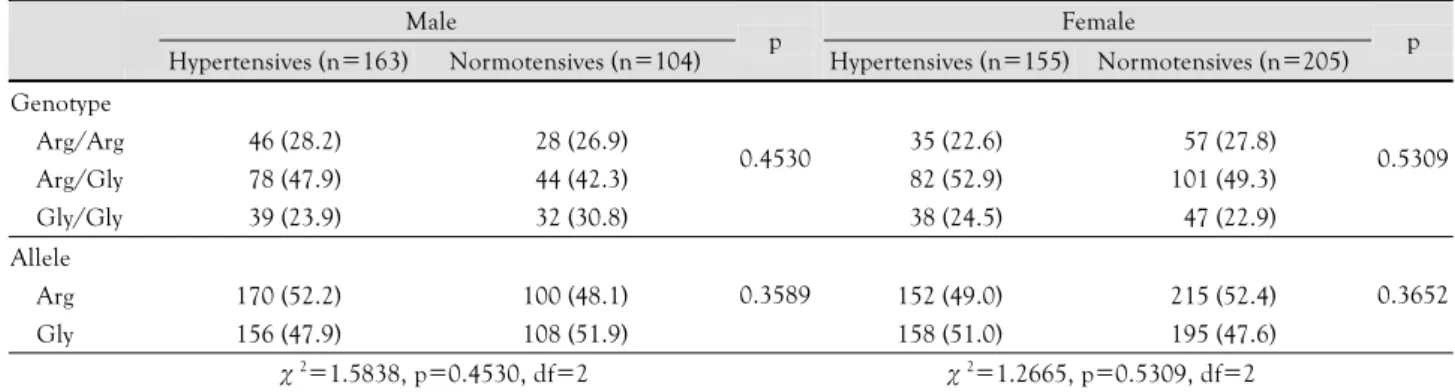
Arg과 Gly allele의 분포에 있어서도 양 군간에 유의한 차이는 없었다(χ2=0.7307, p=0.6940)(Table 2). 성별에 따른 ADRB2 유전형의 분포 비교에서도 양 군간에 차이는 없었다(Table 3).
기존 위험 요인들과의 관련성 분석
고혈압 발생의 위험 인자들로 알려진 연령, BMI, WHR,
그리고 혈중 지질 수치와 ADRB2 Arg16Gly 유전형과의 관 련성을 비교 분석하였다. ADRB2 유전형인 Arg/Arg, Arg/
Gly, Gly/Gly 유전형에 따른 기존 위험 인자들과의 분포 를 비교 분석하였을 때 대조군에서는 유의한 결과를 보이지 않았다. 그러나 고혈압군에서는 연령이 Gly/Gly유전형에서 높았으며(p=0.0461), 중성지방 수치는 Arg/Gly유전형에서 Arg/Arg, Gly/Gly유전형에 비해 유의하게 낮았다(p=0.0077) (Table 4).
단일 검정에서 유전형에 따라 유의한 차이가 있었던 연령, 혈중 중성지방 수치와 단일 검정에서는 유의한 차이를 보이지 는 않았으나 이미 고혈압의 위험 인자로 알려진 성별, 체질량 지수를 공변량으로 고혈압 발생에 미치는 ADRB2 Arg16Gly 유전자 변이의 영향을 다변량 로지스틱 회귀분석을 시행한 결 과 연령, 성별, 체질량지수, 혈중 중성지방 수치의 증가는 고혈압과 밀접한 관련성을 보였으나 ADRB2 Arg16Gly 유전 형은 고혈압 발생의 유의한 인자가 아니었다(Table 5).
고 찰
현재까지 허혈성 심질환 등 몇몇 질환에서 질병 관련 SNP 들이 보고되어 왔으나, SNPs mapping이 복합적 특성을 보 이는 질환의 유전적 원인 규명에 있어서 결정적 단서를 제 공할 수 있는 지는 아직 확실하지 않다.22-24) 고혈압의 발생 과 혈압의 조절에 영향을 미치는 대사 과정에 영향을 주는 SNP의 발견은 혈압 조절에 이용되는 약물의 효과에 영향을 주는 것으로 보고되었다.25)26)
현재까지 ADRB2의 promoter와 coding 부위에서 모두 17 개의 SNP가 보고되었는데,27) 고혈압과의 연관성은 주로 C- 47T, T-20C, A46G(Arg16Gly), C79G(Gln27Glu) 등을 중 심으로 연구가 진행되어 왔다. Kotanko 등10)은 African Ca- ribbeans를 대상으로 한 연구에서 ADRB2 유전형 중 Gly16 allele을 갖는 경우 원발성 고혈압의 발생 위험이 증가한다 고 보고하였는데, 이는 ADRB2 매개 혈관 이완 작용을 저하 시키는 것과 연관되는 것으로 설명되었다. Timmermann 등13) 은 북유럽인들을 대상으로 ADRB2 유전자의 변이형으로 C- 47T, T-20C, A46G(Arg16Gly), C79G(Gln27Glu)의 4가지 변이형에 대한 연구를 시행하여 Gly16 allele을 갖는 경우 고 혈압 및 고혈압의 가족력과도 관련있다고 보고하였다. 또한 Gratze 등28)은 54명의 정상 혈압을 갖는 Caucasians를 대 상으로 한 연구에서 Gly16 allele을 갖는 경우 평균 혈압이 더 높았다고 보고하여 Gly16 allele이 혈압의 증가와 연관된 다고 하였다.
이에 반해 Busjahn 등14)은 twin study를 통해 Arg16 al- lele이 혈압의 상승과 연관이 있다고 보고하여 서로 상충되는 연구 결과를 보고하였으며, Herrmann 등29)은 유럽인을 대 상으로 Timmermann 등13)의 연구와 동일한 4가지 ADRB2 유전자 변이에 대한 분석을 시행한 결과, ADRB2 유전자 다
Table 1. Baseline characteristics of hypertensive and normotensive subjects
Hypertensives (n=318)
Normotensives
(n=309) p
Age (y) 055.1±10.1 043.5±10.1 <.0001 Male (n (%)) 173 (50.4) 104 (33.7) <.0001 SBP (mmHg) 127.8±17.0 113.9±11.1 <.0001 DBP (mmHg) 080.6±10.9 072.5±7.80 <.0001 BMI (kg/m2) 025.0±2.80 023.2±3.10 <.0001 WHR 00.91±0.06 00.85±0.07 <.0001 TC (mg/dL) 216.2±41.7 208.9±39.0 0.0179 TG (mg/dL) 166.0±97.8 118.2±74.5 <.0001 LDL-C (mg/dL) 142.8±37.6 135.8±32.6 0.0212 HDL-C (mg/dL) 041.5±9.20 047.2±10.8 <.0001 SBP: systolic blood pressure, DBP: diastolic blood pressure, DM:
diabetes mellitus, BMI: body mass index, WHR: waist to hip circum- ference ratio, TC: total cholesterol, TG: triglyceride, LDL-C: low density lipoprotein cholesterol, HDL-C: high density lipoprotein cholesterol
Table 2. Genotype and allele frequencies, expressed as n (%), of the ADRB2 Arg16Gly polymorphism in hypertensive and normotensive subjects
Hypertensives (n=318)
Normotensives
(n=309) p
Genotype
Arg/Arg 081 (25.5) 085 (27.5) Arg/Gly 160 (50.3) 145 (46.9) Gly/Gly 077 (24.2) 079 (25.6)
0.6940
Allele Arg 322 (50.6) 315 (51.6) Gly 314 (49.4) 303 (48.4)
0.8229
χ2=0.7307, p=0.6940, df=2
형성과 원발성 고혈압의 관계를 규명하지 못하였다. Kato 등30) 은 일본인에서 고혈압 환자 842명과 대조군 633명을 대상으 로 C-47T, A46G(Arg16Gly), C79G(Gln27Glu)의 3가지 ADRB2 유전자 변이형에 대해 분석을 시행하였으며, 3가지 유 전자 변이 모두에서 고혈압과의 연관성을 규명하지 못하였다.
본 연구에서 한국인을 대상으로 고혈압과 Arg16Gly 다형 성과의 연관성을 분석한 결과 고혈압 발생과의 관련성은 없 었다. 유전형의 분포는 African Caribbeans에서 ADRB2 유 전자와 고혈압의 연관 관계가 있다고 보고한 Kotanko 등10) 의 연구 결과와는 다른 양상을 보였다. African Caribbeans 을 대상으로 한 연구에서 Arg/Arg, Arg/Gly, Gly/Gly 유전 형이 각각 10%, 24%, 66%의 분포를 보였으나, 본 연구에서 는 고혈압 환자군과 정상 혈압을 갖는 대조군에서 Arg/Gly 유전형이 각각 50.3%, 46.9%였고, Arg/Arg과 Gly/Gly 유 전형의 분포는 각각 25.5%와 27.5%, 24.2%와 25.6%였으 며, Arg allele은 고혈압군에서 50.6%, 대조군에서 51.6%
였고, Gly allele은 각각 49.4%와 48.4%로 Gly allele과 Arg allele의 분포가 고혈압군과 대조군에서 유사하였다.
이러한 유전형 분포는 일본인에서 보고했던 것과 유사하며, 영국인과 프랑스인에서 보고되었던 결과와는 다른 분포 양 상이었다.24) 따라서 본 연구의 결과에서 Gly16 allele의 분
포가 적었던 이유는 인종간의 차이에서 비롯될 가능성이 있다.
본 연구의 제한점은 ADRB2 유전자 다형성 중에서 Arg- 16Gly 변이형에 대해서만 연구가 이루어 졌으며, 다른 ADRB2 유전자 다형성은 제외시켜 ADRB2 유전자 다형성과 고혈압 과 연관 관계에 대한 충분한 연구가 이루어 지지 않았다는 것이다. 다변량 로지스틱 회귀분석으로 자료를 보정하였으나 환자군과 대조군간의 연령, 성별 등의 기초적인 자료에 대한 무작위화가 이루어 지지 못하여 생길 수 있는 통계학적인 오 류의 가능성을 배제하지 못한다는 점이다. 고혈압과 ADRB2 유전자 다형성의 연관 관계에 대해서는 다른 유전자 변이형
Table 3. Genotype and allele frequencies, expressed as n (%), of the ADRB2 Arg16Gly polymorphism in hypertensive and normotensive in male and female subjects
Male Female
Hypertensives (n=163) Normotensives (n=104) p
Hypertensives (n=155) Normotensives (n=205) p
Genotype
Arg/Arg 046 (28.2) 028 (26.9) 035 (22.6) 057 (27.8)
Arg/Gly 078 (47.9) 044 (42.3) 082 (52.9) 101 (49.3)
Gly/Gly 039 (23.9) 032 (30.8)
0.4530
038 (24.5) 047 (22.9)
0.5309
Allele
Arg 170 (52.2) 100 (48.1) 152 (49.0) 215 (52.4)
Gly 156 (47.9) 108 (51.9)
0.3589
158 (51.0) 195 (47.6)
0.3652
χ2=1.5838, p=0.4530, df=2 χ2=1.2665, p=0.5309, df=2
Table 4. Comparison of risk factors according to ADRB2 polymorphism
Normotensive Hypertensive
Arg/Arg (n=85) Arg/Gly (n=145) Gly/Gly (n=79) p
Arg/Arg (n=81) Arg/Gly (n=160) Gly/Gly (n=77) p Age, y 043.4±9.90 043.0±10.1 044.4±10.2 0.6244 052.5±10.00 054.8±10.7 056.6±9.20 0.0461 Male, n (%) 28 (32.9) 44 (30.3) 32 (40.5) 0.3024 46 (56.8) 78 (48.8) 39 (50.7) 0.4950 BMI, kg/m2 023.0±3.10 023.0±3.10 023.8±3.20 0.1619 025.1±2.600 024.9±3.00 024.8±2.50 0.8887 WHR 00.86±0.06 00.85±0.08 00.85±0.07 0.5867 00.90±0.060 00.91±0.06 00.91±0.06 0.5781 SBP, mmHg 113.0±10.4 113.8±11.9 115.1±10.4 0.4669
DBP, mmHg 072.6±7.00. 072.4±8.40 072.5±7.80. 0.9903
TC, mg/dL 208.9±40.4 208.8±36.6 209.1±42.2 0.9985 222.2±41.90 212.0±37.7 219.7±45.6 0.1365 TG, mg/dL 128.4±80.4 114.4±73.1 114.0±70.1 0.3292 180.4±118.5 145.5±77.5 175.6±91.1 0.0077 HDL-C, mg/dL 047.1±11.9 047.7±11.0 046.3±9.10. 0.7541 0.42.6±10.90 042.6±8.80 039.6±8.40 0.1067 LDL-C, mg/dL 135.1±36.0 133.4±28.6 141.1±35.3 0.3560 146.3±37.70 141.5±32.4 144.2±41.7 0.6976 BMI: body mass index, WHR: waist to hip circumference ratio, SBP: systolic blood pressure, DBP: diastolic blood pressure, TC: total choles- terol, TG: triglyceride, HDL-C: high density lipoprotein cholesterol, LDL-C: low density lipoprotein cholesterol
Table 5. Results of logistic regression analysis to assess the indepen- dent influence of ADBR2 polymorphism on hypertension
Variables Odds ratio 95% CI p
Arg/Gly vs. Arg/Arg 1.185 0.751-1.870 0.1156 Gly/Gly vs. Arg/Arg 0.762 0.451-1.286 0.1132
Age 1.109 1.087-1.132 <.0001
Sex (male vs. female) 2.242 1.505-3.338 <.0001
BMI 1.110 1.037-1.189 0.0027
TG 1.004 1.001-1.006 0.0015
95% CI: 95% confidence interval, BMI: body mass index, TG: tri- glyceride
에 대한 연구와 환자군 및 대조군의 가족을 대상으로 한 연 구가 이루어져야 할 것으로 생각된다.
요 약
배경 및 목적:
교감신경계는 소디움 평형, 말초혈관의 저항, 심박출량을 변화시킴으로써 혈압을 조절하는데, β2-아드레날린성 수용 체(beta 2 adrenergic receptor, ADRB2) 촉진제는 세포내 c-AMP 농도를 증가시켜 혈관 이완을 유발하고, 신장에서 소디움의 배설과 레닌의 분비를 통해 혈압을 조절한다. 저자 들은 한국인에 있어서 ADRB2 유전자 다형성이 원발성 고 혈압에 미치는 영향에 대해 알아보고자 하였다.
방 법:
본 연구에서는 고혈압이 있는 환자군 318명과 정상 혈압 을 갖는 대조군 309명을 대상으로 유전형 분석을 통하여 ADRB2 유전자 다형성 중 Arg16Gly 변이와 고혈압의 연관 관계를 분석하였다.
결 과:
고혈압군에서 평균 연령이 높았으며, 체질량지수(BMI), 허 리와 엉덩이 둘레비, 혈중 총 콜레스테롤, 중성지방, 저밀도 지단백 콜레스테롤, 고밀도 지단백 콜레스테롤 수치가 대조 군과 비교하여 유의한 차이를 보였다. 유전형 분석 결과 고 혈압군과 대조군 사이에 ADRB2 유전자형의 분포에는 차이 가 없었다.
결 론:
한국인에서 ADRB2 Arg16Gly 변이형은 고혈압과 상관관 계가 없었다. 그러나 ADRB2 유전자와 고혈압의 상관관계를 분석하기 위해서는 ADRB2 유전자내 존재하는 다른 유전자 변이에 대한 연구가 시행되어져야 할 것으로 사료된다.
중심 단어:고혈압;β2-아드레날린성 수용체;다형성.
REFERENCES
1) Joint National Committee on Prevention, Detection, Evaluation, and Treatment of High Blood Pressure. The sixth report of the joint national committee on prevention, detection, evaluation, and treatment of high blood pressure. Arch Intern Med 1997;157:
2413-46.
2) Williams RR, Hunt SC, Hopkins PN, et al. Genetic basis of fa- milial dyslipidemia and hypertension: 15-year results from Utah.
Am J Hypertens 1993;6:319S-27S.
3) Rice T, Vogler GP, Perusse L, Bouchard C, Rao DC. Cardiovas- cular risk factors in a French Canadian population: resolution of genetic and familial environmental effects on blood pressure using twins, adoptees, and extensive information on environmental correlates. Genet Epidemiol 1989;6:571-88.
4) O’Donnell CJ, Lindpaintner K, Larson MG, et al. Evidence for association and genetic linkage of the angiotensin-converting en- zyme locus with hypertension and blood pressure in men but not women in the Framingham Heart Study. Circulation 1998;97:
1766-72.
5) Jeunemaitre X, Soubrier F, Kotelevtsev YV, et al. Molecular basis of human hypertension: role of angiotensinogen. Cell 1992;71:
169-80.
6) Glorioso N, Manunta P, Filigheddu F, et al. The role of alpha- adducin polymorphism in blood pressure and sodium handling regulation may not be excluded by a negative association study.
Hypertension 1999;34:649-54.
7) Svetkey LP, Chen YT, McKeown SP, Preis L, Wilson AF. Preli- minary evidence of linkage of salt sensitivity in black Americans at the β2-adrenergic receptor locus. Hypertension 1997;29:918-22.
8) Siffert W, Rosskopf D, Siffert G, et al. Association of a human G-protein beta3 subunit variant with hypertension. Nat Genet 1998;18:45-8.
9) Baker EH, Dong YB, Sagnella GA, et al. Association of hyperten- sion with T594M mutation in β-subunit of epithelial sodium chan- nels in black people resident in London. Lancet 1998;351:1388-92.
10) Kotanko P, Binder A, Tasker J, et al. Essential hypertension in African Caribbeans associates with a variant of the β2-adreno- ceptor. Hypertension 1997;30:773-6.
11) Svetkey LP, Timmons PZ, Emovon O, Anderson NB, Preis L, Chen YT. Association of hypertension with β2- and α2C10-adre- nergic receptor genotype. Hypertension 1996;27:1210-15.
12) Krushkal J, Xiong M, Ferrell R, Sing CF, Turner ST, Boerwinkle E. Linkage and association of adrenergic and dopamine receptor genes in the distal portion of the long arm of chromosome 5 with systolic blood pressure variation. Hum Mol Genet 1998;7:1379-83.
13) Timmermann B, Mo R, Luft FC, et al. β-2 Adrenoreceptor ge- netic variation is associated with genetic predisposition to essen- tial hypertension: the bergen blood pressure study. Kidney Int 1998;53:1455-60.
14) Busjahn A, Li GH, Faulhaber HD, et al. β-2 Adrenoreceptor re- ceptor gene variations, blood pressure, and heart size in normal twins. Hypertension 2000;35:555-60.
15) Candy G, Samani N, Norton G, et al. Association analysis of β2 adreno ceptor polymorphisms with hypertension in a Black Afri- can population. J Hypertens 2000;18:167-72.
16) Victor RG, Mark AL. The sympathetic nervous system in human hypertension. In: Laragh JH, Brenner BM, editors. Hypertension:
pathophysiology, diagnosis and management. 2nd ed. New York:
Raven Press; 1955. p.863-78.
17) Kobilka BK, Frielle T, Collins S, et al. An introneless gene encoding a potential member of the family of receptors coupled to guanine nucleotide regulatory proteins. Nature 1987;329:75-9.
18) Kotanko P, Hoglinger O, Skrabal F. Beta 2-adreno ceptor den- sity in fibroblast culture correlates with human NaCl sensitivity.
Am J Physiol 1992;263:C623-7.
19) Reihsaus E, Innis M, Maclntyre N, Liggett SB. Mutations in the gene encoding for the beta 2-adrenergic receptor in normal and asthmatic subjects. Am J Respir Cell Mol Biol 1993;8:334-9.
20) Green SA, Turki J, Innis M, Liggett SB. Amino-terminal poly- morphisms of the human β2-adrenergic receptor impair distinct agonist-promoted regulatory properties. Biochemistry 1994;33:
9414-9.
21) Hoogendoorn B, Owen MJ, Oefner PJ, Williams N, Austin J, O’Donovan MC. Genotyping single nucleotide polymorphisms by primer extension and high performance liquid chromatography.
Hum Genet 1999;104:89-93.
22) Ryu SK, Park HY, Im EK, et al. The effects of an aldosterone synthase (CYP11B2) gene polymorphism on the risk of myocar- dial infarction. Korean Circ J 2001;31:1261-6.
23) Choi JH, Zhang SY, Cho YS, et al. Role of 5-HT2A receptor gene T102C polymorphism in coronary artery disease and serum lipid level. Korean Circ J 2003;33:269-76.
24) Kim JH, Jeong JO, Choi SW, Seong IW. Association of prostacy-
clin synthase gene C1117A polymorphism with acute coronary syndrome in Koreans. Korean Circ J 2004;34:761-6.
25) Schelleman H, Stricker BH, de Boer A, et al. Drug-gene interac- tions between genetic polymorphisms and antihypertensive therapy.
Drugs 2004;64:1801-16.
26) Schwartz GL, Turner ST. Pharmacogenetics of antihypertensive drug responses. Am J Pharmacogenomics. 2004;4:151-60.
27) Halushka MK, Fan JB, Bentley K, et al. Pattern of single-nucleo- tide polymorphisms in candidate genes for blood-pressure home- ostais. Nat Genet 1999;22:239-47.
28) Gratze G, Fortin J, Labugger R, et al. β-2 Adrenoreceptor recep- tor variants affect resulting blood pressure and agonist-induced vasodilation in young adult Caucasians. Hypertension 1999;33:
1425-30.
29) Herrmann SM, Nicaud V, Tiret L, et al. Polymorphisms of the β2-adrenoceptor (ADRB2) gene and essential hypertension: the ECTIM and PEGASE studies. J Hypertens 2002;20:229-35.
30) Kato N, Sugiyama T, Morita H, et al. Association analysis of β2- adrenergic receptor polymorphisms with hypertension in Japanese.
Hypertension 2001;37:286-92.