ABSTRACT
Hypertension is a common chronic disease affecting a large section of the general
population. Hypertension is highly prevalent in the elderly because blood pressure (BP) rises with age. The risk of developing hypertension increases with predisposing genes, intrauterine growth retardation, prematurity and childhood obesity. BP is easier to control in the young.
Non-pharmacological treatment through lifestyle changes, such as weight control and leisure-time physical activity, is more likely to be successful in young people. Hypertension in older adults is more difficult to control, requiring the use of more than one antihypertensive drug. Adverse effects and compliance become problematic. Much research is now directed at novel ways of controlling BP such as denervation. The change in definition of hypertension in the American guideline highlights the need to identify and manage hypertension early, at a stage when it is potentially reversible.
Keywords: Hypertension; Blood pressure; Guideline
INTRODUCTION
Hypertension is a common chronic disease affecting a large section of the general population. In the US, about 33.2% of the general population is hypertensive.
1)There are 244.5 million adults with hypertension in China.
2)The prevalence of hypertension in other parts of Asia is also considerable.
3)In South Korea, the prevalence is approximately 30% in adults.
4)In this review, the progression of hypertension from an elevation in blood pressure (BP) to stage 1 and 2 hypertension is discussed, highlighting the role that plays in this process. This offers an opportunity for prevention of hypertension before it develops.
A 2020 VISION OF HYPERTENSION
The epidemiology of hypertension has been carefully documented in the Hong Kong
Cardiovascular Prevalence Study.
5-7)In this population study of healthy people randomly chosen, the prevalence of hypertension was below 2% in young subjects aged 25–34, but the prevalence increased to around 50% in those 65–75 years of age.
8)Premenopausal women have much lower
Review Article
Received: Feb 18, 2020 Accepted: Feb 23, 2020 Correspondence to
Bernard M.Y. Cheung, PhD, FRCP Division of Clinical Pharmacology and Therapeutics, Department of Medicine, The University of Hong Kong, 102 Pok Fu Lam Road, Hong Kong 999077, China.
E-mail: [email protected]
Copyright © 2020. The Korean Society of Cardiology
This is an Open Access article distributed under the terms of the Creative Commons Attribution Non-Commercial License (https://
creativecommons.org/licenses/by-nc/4.0) which permits unrestricted noncommercial use, distribution, and reproduction in any medium, provided the original work is properly cited.
ORCID iDs
Bernard M.Y. Cheung
https://orcid.org/0000-0001-9106-7363 Benjamin Or
https://orcid.org/0000-0002-3662-3125 Yue Fei
https://orcid.org/0000-0002-4622-6377 Man-Fung Tsoi
https://orcid.org/0000-0002-9892-0125
Conflict of InterestThe authors have no financial conflicts of interest.
Author Contributions
Conceptualization: Cheung BMY; Data curation: Or B, Tsoi MF; Formal analysis: Or B, Tsoi MF; Visualization: Or B, Tsoi MF; Writing - original draft: Cheung BMY; Writing - review &
editing: Cheung BMY, Or B, Fei Y, Tsoi MF.
Bernard M.Y. Cheung , PhD, FRCP
1,2,3, Benjamin Or , BSc
1, Yue Fei , PhD
1, and Man-Fung Tsoi , PhD
11
Division of Clinical Pharmacology and Therapeutics, Department of Medicine, The University of Hong Kong, Hong Kong, China
2
State Key Laboratory of Pharmaceutical Biotechnology, The University of Hong Kong, Hong Kong, China
3
Institute of Cardiovascular Science and Medicine, The University of Hong Kong, Hong Kong, China
A 2020 Vision of Hypertension
BP than men but the BP rises sharply with age such that after the menopause, the sex difference in BP is no longer apparent. Studies in the US also show this sex difference in the trajectory in BP.
9)As hypertension is often asymptomatic, many people with are unaware of it and even if they have been told that their BP is elevated, many stop taking medications and miss follow- up appointments. This gives rise to the so-called ‘rule of halves’—half of the people with hypertension are unaware of it, and among those diagnosed, only half take treatment and among those treated, only half of them have good BP control.
10)There are many reasons for the poor control rate. Not checking the BP in apparently healthy people is one of the most important. Therefore, every adult should have his or her BP periodically checked. If the BP is elevated, then rechecking the BP at intervals should be arranged.
Another reason for the poor control of BP is the ineffectiveness of current antihypertensive medications; most patients require more than one drug class to achieve target.
11)This may reflect the multiple pathways involved in BP control. Coupled with the ineffectiveness is the presence of side-effects, which may affect compliance. Measures to improve compliance cited in guidelines include combination pills and once-daily formulations.
12)More novel ways of treating hypertension are being explored, such as renal denervation,
13)splanchnic denervation,
14)ROX coupler,
15)vaccine
16), and antisense DNA.
17)These expensive treatments, not without risks, have the merit of bypassing the need for compliance to take daily medications.
Prevention is better than cure. As BP rises with age, this means that prevention should be started early rather than in old age when hypertension is already common. How early is early?
At the last count, there are over 100 genes involved in BP control.
18)There are so many genes contributing to hypertension that counselling and prenatal diagnosis are not practised.
After all, hypertension is not a life-threatening disease that justifies contraception or abortion. Intrauterine growth retardation increases the risk of the metabolic syndrome and hypertension in later life.
19)Better antenatal care and postnatal care of pre-term infants
20)may prevent cardiovascular diseases including hypertension.
Our own work suggests that childhood obesity is an important determinant of BP in childhood and adolescence.
21)In the United States National Health and Nutrition Examination Survey (NHANES), there is a strong relationship between body mass index (or waist circumference) and BP in children (Figure 1).
22)Unlike in adults, this relationship is not confounded by antihypertensive medications, smoking and alcohol intake.
Clearly, here is the window of opportunity for the prevention of hypertension before BP starts to rise. BP control rates are much higher in the young than in the elderly,
23)so it should be much easier to achieve BP target in the young. Moreover, a large proportion of young hypertensives may respond to lifestyle measures and not require pharmacological treatment.
24)Data from South Korea,
25)as well as the USA,
26)suggest that prehypertension, or what is
now known as stage 1 hypertension, in young adults is already associated with an increase
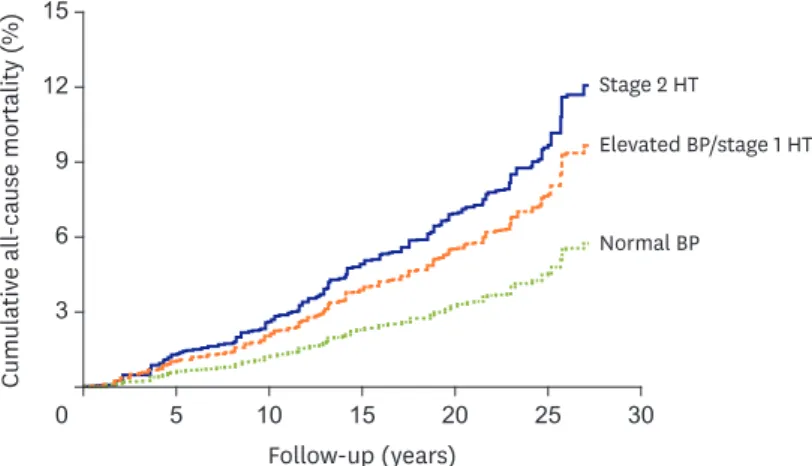
in cardiovascular and mortality risk. We have recently analysed 20-year follow-up data in US
NHANES. Compared to young adults with normal BP (<120/80 mmHg), an elevated BP is
already associated with increased mortality (Figure 2).
27)The current American College of
Cardiology/American Heart Association guideline on the prevention, detection, evaluation
and management of high BP is therefore timely in defining stage 1 hypertension to include
people with a systolic BP of 130–139 mmHg or a diastolic BP of 80–89 mmHg.
28)The guideline
is based on the findings of Systolic Blood Pressure Intervention Trial.
29)We have performed a network meta-analysis on the relationship between outcome and achieved BP in large randomised trials of antihypertensive drugs, and confirmed that an achieved BP of <130/80 mmHg is associated with the best outcome.
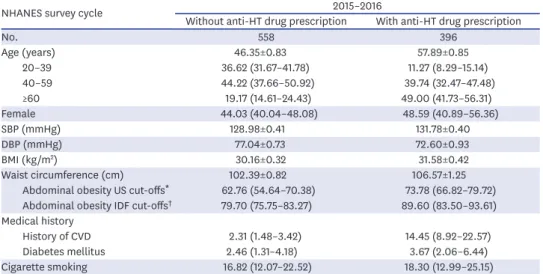
30)In changing the definition of hypertension, the US hypertension guideline makes many people in the general population hypertensive. This may be undesirable in countries that are still struggling to treat stage 2 hypertension, but in countries that have a good health system, it is the next big target to identify people in the community at risk of progression to stage 2 hypertension and cardiovascular events. The characteristics of people with ‘stage 1 hypertension’ are interesting; most of them are male and obese (Table 1).
31)Fortunately, as
160
120
80 140
100
60
40 60 80 100 120 140
Waist circumference (cm)
SBP (mmHg)
Figure 1. Relationship between SBP and body mass index in children in US NHANES 2011–2012. Children aged 8–11,
12–15, and 16–19 years are represented by circles, triangles and squares respectively. The regression lines are shown as solid, dashed and dotted lines respectively.
NHANES = National Health and Nutrition Examination Survey; SBP = systolic blood pressure.
12
6 15
9
0 5 10 15 20 25 30
3
Follow-up (years)
Stage 2 HT
Elevated BP/stage 1 HT
Normal BP
Cumulativ e all -ca use mortality (%)
Figure 2. Kaplan-Meier plot showing the survival curves of US NHANES participants with different levels of BP at
baseline. Participants were categorized as normal BP (SBP <120 mmHg and DBP <80 mmHg); elevated BP (SBP 120–129 mmHg and DBP <80 mmHg); stage 1 HT (SBP 130–139 mmHg or DBP 80–89 mmHg); or stage 2 HT (SBP
≥140 mmHg or DBP ≥90 mmHg). Note the curves for elevated BP and stage 1 HT are superimposable and therefore shown as one curve.
BP = blood pressure; DBP = diastolic blood pressure; HT = hypertension; NHANES = National Health and Nutrition
Examination Survey; SBP = systolic blood pressure.
mentioned above, hypertension at this early stage is easy to control and weight loss is less difficult in young people.
Obesity is a problem that afflicts many parts of the world.
32)It is a huge problem in the US, but it is also a problem among the poor in developing countries. In most Asian countries, US-style fast food may not be the main cause of obesity. Instead, changing from a rural to an urban environment with less physical activity (PA), from physically demanding jobs to office jobs, may be an important underlying factor. We compared leisure-time PA (LTPA) with occupational PA recently, and found that while people who had no PA have the highest mortality rate, adequate LTPA was associated with half the risk of death (Figure 3).
33) Table 1. Characteristics of adult participants with stage I hypertension in NHANES 2015–2016NHANES survey cycle 2015–2016
Without anti-HT drug prescription With anti-HT drug prescription
No. 558 396
Age (years) 46.35±0.83 57.89±0.85
20–39 36.62 (31.67–41.78) 11.27 (8.29–15.14)
40–59 44.22 (37.66–50.92) 39.74 (32.47–47.48)
≥60 19.17 (14.61–24.43) 49.00 (41.73–56.31)
Female 44.03 (40.04–48.08) 48.59 (40.89–56.36)
SBP (mmHg) 128.98±0.41 131.78±0.40
DBP (mmHg) 77.04±0.73 72.60±0.93
BMI (kg/m
2) 30.16±0.32 31.58±0.42
Waist circumference (cm) 102.39±0.82 106.57±1.25
Abdominal obesity US cut-offs
*62.76 (54.64–70.38) 73.78 (66.82–79.72) Abdominal obesity IDF cut-offs
†79.70 (75.75–83.27) 89.60 (83.50–93.61) Medical history
History of CVD 2.31 (1.48–3.42) 14.45 (8.92–22.57)
Diabetes mellitus 2.46 (1.31–4.18) 3.67 (2.06–6.44)
Cigarette smoking 16.82 (12.07–22.52) 18.30 (12.99–25.15)
Data are shown as mean±standard error or percentage (95% CI).
BMI = body mass index; CI = confidence interval; CVD = cardiovascular disease; DBP = diastolic blood pressure;
HT = hypertension; IDF = International Diabetes Federation; NHANES = National Health and Nutrition Examination Survey; SBP = systolic blood pressure.
*
Abdominal obesity is defined as ≥102 cm and ≥88 cm for male and female, respectively;
†Abdominal obesity is defined as ≥94 cm and ≥80 cm for male and female, respectively.
4
2 6 5
3
0 2 4 6 8 10
1
Follow-up (years)
No PA
LTPA=0, OPA≥150 LTPA<150, OPA<150 0<LTPA<150, OPA≥150
LTPA≥150, OPA=0 LTPA≥150, OPA≥150 LTPA≥150, 0<OPA<150
Cumulativ e all -ca use mortality (%)
Figure 3. Kaplan-Meier plot showing the survival curves of each PA group for US NHANES participants aged 18
to 64 years old at baseline. Participants were categorized into groups by their weekly amount of LTPA, OPA, and the tPA. Values for PA are in minutes/week. The groups with LTPA ≥150 minutes/week had higher survival when compared with the group with no PA (all p<0.001).
LTPA = leisure-time physical activity; NHANES = National Health and Nutrition Examination Survey; OPA =
occupational physical activity; PA = physical activity; tPA = total physical activity.
In many parts of Asia, rice is part of the staple diet. While it is inherently low in fat, when boiled, it has a high glycaemic index.
34)Indeed, the blood glucose profile after eating a bowl of rice is like that of an oral glucose test.
35)Before the days of cars, machines and computers, the glucose would be utilised; in modern times, the excess calories are stored as fat.
Hypertension is part of the metabolic syndrome
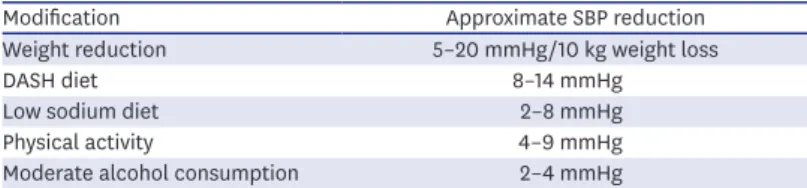
36)and in a large proportion of people with hypertension, obesity is an important underlying cause. Reduction in body weight is the most effective nonpharmacological way of reducing BP (Table 2).
28)37)Bariatric surgery can reduce body weight dramatically and the reduction in BP is also equally impressive.
38)Less drastic ways of reducing body weight, such as orlistat,
39)glucagon-like peptide-1 receptor agonist
40)and sodium-glucose cotransporter-2 (SGLT2) inhibitor,
41)can also reduce BP. By inhibiting the reabsorption of glucose in the proximal convoluted tubules, SGLT2 inhibitors cause a net loss of up to 300 calories a day. This is weight loss without dieting and without exercise!
In addition, there is cardiovascular risk reduction,
42)even in non-diabetics. It would not be surprising if this drug class would earn an indication for use in people with hypertension, who are often obese and have other cardiovascular risk factors.
CONCLUSION
In 2020, detecting and adequately treating hypertension remains an important goal.
Cardiovascular risk assessment and promoting a healthy lifestyle in the young are likely to forestall hypertension and future cardiovascular disease. Preventing or reversing hypertension is no longer an impossible dream.
REFERENCES
1. Centers for Disease Control and Prevention. Hypertension [Internet]. Atlanta (GA): Centers for Disease Control and Prevention; 2018 [cited 2020 Feb 18]. Available from: https://www.cdc.gov/nchs/fastats/
hypertension.htm.
2. Wang Z, Chen Z, Zhang L, et al. Status of hypertension in China: results from the China hypertension survey, 2012–2015. Circulation 2018;137:2344-56.
PUBMED | CROSSREF
3. Cheung BM, Ong KL. The challenge of managing hypertension. In: Finkel ML, editor. Public Health in the 21st Century. Vol. 1. Santa Barbara (CA): Praeger Publishing; 2011. p.117-28.
4. Kim HC, Ihm SH, Kim GH, et al. 2018 Korean Society of Hypertension guidelines for the management of hypertension: part I-epidemiology of hypertension. Clin Hypertens 2019;25:16.
PUBMED | CROSSREF
Table 2. Effect of lifestyle modification on SBP
Modification Approximate SBP reduction
Weight reduction 5–20 mmHg/10 kg weight loss
DASH diet 8–14 mmHg
Low sodium diet 2–8 mmHg
Physical activity 4–9 mmHg
Moderate alcohol consumption 2–4 mmHg
Adapted from The Seventh Report of the Joint National Committee on Prevention, Detection, Evaluation, and Treatment of High Blood Pressure (JNC 7) produced by the National Heart Lung and Blood Institute, US (http://
www.nhlbi.nih.gov/guidelines/hypertension/jnc7full.pdf).
37)DASH = dietary approaches to stop hypertension; SBP = systolic blood pressure.
5. Cheung BM, Wat NM, Man YB, et al. Relationship between the metabolic syndrome and the development of hypertension in the Hong Kong cardiovascular risk factor prevalence study-2 (CRISPS2). Am J Hypertens 2008;21:17-22.
PUBMED | CROSSREF
6. Cheung BM, Wat NM, Tam S, et al. Components of the metabolic syndrome predictive of its development:
a 6-year longitudinal study in Hong Kong Chinese. Clin Endocrinol (Oxf ) 2008;68:730-7.
PUBMED | CROSSREF
7. Cheung BM, Wat NM, Tso AW, et al. Association between raised blood pressure and dysglycemia in Hong Kong Chinese. Diabetes Care 2008;31:1889-91.
PUBMED | CROSSREF
8. Janus ED. Epidemiology of cardiovascular risk factors in Hong Kong. Clin Exp Pharmacol Physiol 1997;24:987-8.
PUBMED | CROSSREF
9. Ong KL, Tso AW, Lam KS, Cheung BM. Gender difference in blood pressure control and cardiovascular risk factors in Americans with diagnosed hypertension. Hypertension 2008;51:1142-8.
PUBMED | CROSSREF
10. Wilber JA, Barrow JG. Hypertension--a community problem. Am J Med 1972;52:653-63.
PUBMED | CROSSREF
11. Kotseva K, Wood D, De Bacquer D, et al. EUROASPIRE IV: a European Society of Cardiology survey on the lifestyle, risk factor and therapeutic management of coronary patients from 24 European countries. Eur J Prev Cardiol 2016;23:636-48.
PUBMED | CROSSREF
12. Williams B, Mancia G, Spiering W, et al. 2018 ESC/ESH guidelines for the management of arterial hypertension. Eur Heart J 2018;39:3021-104.
PUBMED | CROSSREF
13. Bhatt DL, Kandzari DE, O'Neill WW, et al. A controlled trial of renal denervation for resistant hypertension. N Engl J Med 2014;370:1393-401.
PUBMED | CROSSREF
14. Zhen Z, Liao SY, Zhu ZY, et al. Catheter-based splanchnic denervation for treatment of hypertensive cardiomyopathy. Hypertension 2019;74:47-55.
PUBMED | CROSSREF
15. Lobo MD, Ott C, Sobotka PA, et al. Central iliac arteriovenous anastomosis for uncontrolled hypertension: one-year results from the ROX CONTROL HTN trial. Hypertension 2017;70:1099-105.
PUBMED | CROSSREF
16. Nakagami H, Morishita R. Recent advances in therapeutic vaccines to treat hypertension. Hypertension 2018;72:1031-6.
PUBMED | CROSSREF
17. Phillips MI. Gene therapy for hypertension: the preclinical data. Hypertension 2001;38:543-8.
PUBMED | CROSSREF
18. Warren HR, Evangelou E, Cabrera CP, et al. Genome-wide association analysis identifies novel blood pressure loci and offers biological insights into cardiovascular risk. Nat Genet 2017;49:403-15.
PUBMED | CROSSREF
19. Calkins K, Devaskar SU. Fetal origins of adult disease. Curr Probl Pediatr Adolesc Health Care 2011;41:158-76.
PUBMED | CROSSREF
20. Parkinson JR, Hyde MJ, Gale C, Santhakumaran S, Modi N. Preterm birth and the metabolic syndrome in adult life: a systematic review and meta-analysis. Pediatrics 2013;131:e1240-63.
PUBMED | CROSSREF
21. Cheung BM. Hypertension: a weighty problem in children. Postgrad Med J 2017;93:647.
PUBMED | CROSSREF
22. Cheung AJ, Cheung BMY. Association of increased systolic blood pressure in children with obesity and the metabolic syndrome. J Hum Hypertens 2015;29 Suppl1:S15.
23. Ong KL, Cheung BM, Man YB, Lau CP, Lam KS. Prevalence, awareness, treatment, and control of hypertension among United States adults 1999–2004. Hypertension 2007;49:69-75.
PUBMED | CROSSREF
24. Muntner P, Carey RM, Gidding S, et al. Potential U.S. population impact of the 2017 ACC/AHA high blood pressure guideline. J Am Coll Cardiol 2018;71:109-18.
PUBMED | CROSSREF
25. Son JS, Choi S, Kim K, et al. Association of blood pressure classification in Korean young adults according to the 2017 American College of Cardiology/American Heart Association guidelines with subsequent cardiovascular disease events. JAMA 2018;320:1783-92.
PUBMED | CROSSREF
26. Yano Y, Reis JP, Colangelo LA, et al. Association of blood pressure classification in young adults using the 2017 American College of Cardiology/American Heart Association blood pressure guideline with cardiovascular events later in life. JAMA 2018;320:1774-82.
PUBMED | CROSSREF
27. Or B, Tsoi MF, Cheung TT, Cheung BM. Decreased survival in young adults with stage 1 and 2 hypertension in the National Health and Nutrition Examination Survey III. Hong Kong Med J 2020;26 Suppl 1:14.
28. Whelton PK, Carey RM, Aronow WS, et al. 2017 ACC/AHA/AAPA/ABC/ACPM/AGS/APhA/ASH/ASPC/
NMA/PCNA guideline for the prevention, detection, evaluation, and management of high blood pressure in adults: executive summary: a report of the American College of Cardiology/American Heart Association task force on clinical practice guidelines. Hypertension 2018;71:1269-324.
PUBMED | CROSSREF
29. SPRINT Research GroupWright JT Jr, Williamson JD, et al. A randomized trial of intensive versus standard blood-pressure control. N Engl J Med 2015;373:2103-16.
PUBMED | CROSSREF
30. Fei Y, Tsoi MF, Cheung BM. Determining the optimal systolic blood pressure for hypertensive patients: a network meta-analysis. Can J Cardiol 2018;34:1581-9.
PUBMED | CROSSREF
31. Tsoi MF, Fei Y, Cheung TT, Cheung BM. Characteristics of Americans with stage-1 hypertension: United States National Health Nutrition and Examination Survey 2011–2016. Hong Kong Med J 2018;24 Suppl 1:54.
32. Ng M, Fleming T, Robinson M, et al. Global, regional, and national prevalence of overweight and obesity in children and adults during 1980–2013: a systematic analysis for the Global Burden of Disease Study 2013. Lancet 2014;384:766-81.
PUBMED | CROSSREF
33. Or B, Tsoi MF, Cheung TT, Cheung BM. Leisure time, occupational aerobic physical activity, and mortality risk in adults of United States: National Health and Nutrition Examination Survey 2007–2016. Hong Kong Med J 2020;26 Suppl 1:13.
34. Ludwig DS. The glycemic index: physiological mechanisms relating to obesity, diabetes, and cardiovascular disease. JAMA 2002;287:2414-23.
PUBMED | CROSSREF
35. Chan HM, Brand-Miller JC, Holt SH, Wilson D, Rozman M, Petocz P. The glycaemic index values of Vietnamese foods. Eur J Clin Nutr 2001;55:1076-83.
PUBMED | CROSSREF
36. Cheung BM. The cardiovascular continuum in Asia--a new paradigm for the metabolic syndrome. J Cardiovasc Pharmacol 2005;46:125-9.
PUBMED | CROSSREF
37. National Heart, Lung, and Blood Institute (US). The Seventh Report of the Joint National Committee on Prevention, Detection, Evaluation, and Treatment of High Blood Pressure. Bethesda (MD): National Heart, Lung, and Blood Institute; 2004.
38. Vest AR, Heneghan HM, Agarwal S, Schauer PR, Young JB. Bariatric surgery and cardiovascular outcomes: a systematic review. Heart 2012;98:1763-77.
PUBMED | CROSSREF
39. Sharma AM, Golay A. Effect of orlistat-induced weight loss on blood pressure and heart rate in obese patients with hypertension. J Hypertens 2002;20:1873-8.
PUBMED | CROSSREF
40. Wang B, Zhong J, Lin H, et al. Blood pressure-lowering effects of GLP-1 receptor agonists exenatide and liraglutide: a meta-analysis of clinical trials. Diabetes Obes Metab 2013;15:737-49.
PUBMED | CROSSREF
41. Georgianos PI, Agarwal R. Ambulatory blood pressure reduction with SGLT-2 inhibitors: dose-response meta-analysis and comparative evaluation with low-dose hydrochlorothiazide. Diabetes Care 2019;42:693-700.
PUBMED | CROSSREF
42. Fei Y, Tsoi MF, Cheung BMY. Cardiovascular outcomes in trials of new antidiabetic drug classes: a network meta-analysis. Cardiovasc Diabetol 2019;18:112.
PUBMED | CROSSREF