Veterinary Science
http://dx.doi.org/10.4142/jvs.2012.13.4.405
Received: 7 Nov. 2011, Revised: 18 Feb. 2012, Accepted: 19 Apr. 2012
Original Article
*Corresponding author: Tel: +880-91-67401-6 (ext. 2360); Fax: +880-91-61510; E-mail: [email protected]
ⓒ 2012 The Korean Society of Veterinary Science.
This is an Open Access article distributed under the terms of the Creative Commons Attribution Non-Commercial License (http://creativecommons.org/licenses/by-nc/3.0) which permits unrestricted non-commercial use, distribution, and reproduction in any medium, provided the original work is properly cited.
Molecular characterization of two Bangladeshi infectious bursal disease virus isolates using the hypervariable sequence of VP2 as a genetic
marker
Md. Taohidul Islam
1,2,*, Thanh Hoa Le
3, Md. Mostafizur Rahman
4, Md. Alimul Islam
1,5Departments of
1Microbiology and Hygiene, and
2Medicine, Faculty of Veterinary Science, Bangladesh Agricultural University, Mymensingh 2202, Bangladesh
3
Department of Immunology, Institute of Biotechnology, Hanoi 10000, Vietnam
4
Department of Medical Microbiology and Immunology, Faculty of Medicine, National University of Malaysia, Kuala Lumpur 43600, Malaysia
5
School of Sustainable Agriculture, University Malaysia Sabah, Kota Kinabalu 88400, Malaysia
Two Bangladeshi infectious bursal disease virus (IBDV) isolates collected in 2007, termed GB1 and GB3, were subjected to comparative sequencing and phylogenetic analyses.
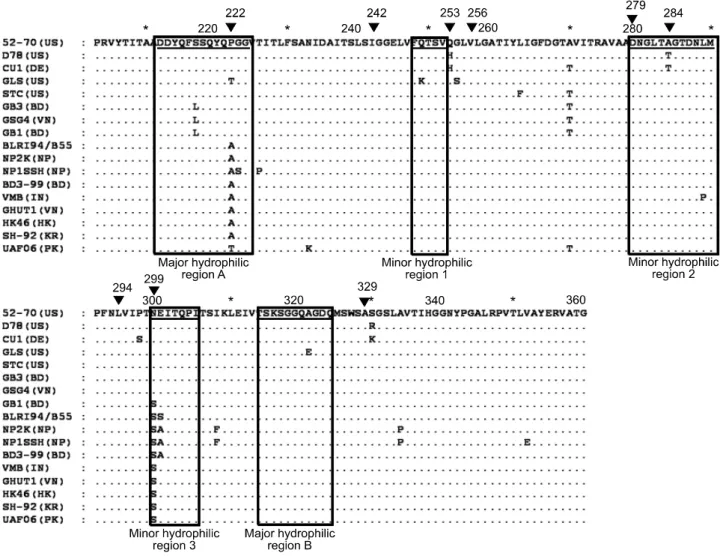
Sequence analysis of a 474-bp hypervariable region in the VP2 gene revealed that among four major amino acid substitutions observed in the strains, two were unique to GB1 and GB3 (Ser217Leu and Ala270Thr) while one substitution was only found in GB1 (Asn299Ser). Among IBDVs from Bangladesh including GB1 and GB3, the rate of identity and homology was around 97∼99%. The amino acid sequences of GB1 and GB3 differ from those of previous Bangladeshi IBDV isolates and contain amino acid substitutions Pro222Ala and Asn299Ser (in GB3 only). Phylogenetic analysis revealed that GB1 and GB3 are grouped with other very virulent IBDVs of European and American origin in contrast to two previously isolated Bangladeshi IBDV strains (GenBank accession Nos. AF362776 and AF260317), which belong to the Asian group. It was concluded that GB1 and GB3 belong to a very virulent group of IBDVs. However, amino acid sequences of GB1 and GB3 differ from those of the other Bangladeshi IBDVs by one or two amino acids encoded in the hypervariable region of the VP2 gene.
Keywords: chickens, infectious bursal disease virus, molecular characterization
Introduction
Infectious bursal disease virus (IBDV), also known as
Gumboro virus [4], has become an economically important pathogen spread throughout the world. The resulting disease can take several forms and has generally been observed as subclinical, classic virulent, or very virulent cases [33]. Among the two distinct serotypes of IBDV [16], serotype 1 strains are pathogenic and cause lytic infection of immature B lymphocytes [23,24]. Gumboro disease caused by serotype 1 viruses usually occurs in 3- to 6-week-old chickens with acute signs of clinical disease [15].
Susceptible chickens younger than 3 weeks old do not exhibit clinical signs but suffer from subclinical infections.
This disease is economically important because it results in severe immunosuppression that develops in young chickens after infection [15]. Currently, there is a co-existence of epidemiologically mixed Gumboro viruses with different levels of pathogenicityin every country of the world [6]. The viruses might spread from different parts of world through trade and other means.
The IBDV is a non-enveloped, icosahedral double-stranded RNA (dsRNA) virus that belongs to the genus Avibirnavirus in the family Birnaviridae [13]. The dsRNA genome consists of two segments, namely A and B [19]. The smaller B segment (approximately 2.9 kb) encodes a single 91-kDa protein, VP1, with RNA-dependent RNA polymerase [29]
and capping enzyme [28] activities. The larger A segment
(approximately 3.3 kb) contains two overlapping open
reading frames (ORFs). The first ORF encodes the
nonstructural protein VP5 (17 kDa). This protein is
nonessential for viral replication and infection [17]. The
second ORF encodes a 110-kDa polyprotein, which is autocatalytically cleaved [12,26] to produce viral proteins VP2 (40 kDa), VP4 (28 kDa), and VP3 (32 kDa). Using sequence analysis and reverse genetics, VP2 from segment A [34,36], VP1 from segment B [14], or both [2,3] have been found to contribute to virulence.
The VP2 gene has a region of about 500 bp encoding approximately 150 amino acids including a major conformational neutralizing antigenic domain situated between amino acids 206 and 350 with two minor hydrophilic peaks [27,32]. This domain is known as a hypervariable region. Due to its characteristic antigenic structure, this region has been most often used for the molecular characterization of IBDV [35]. It has been confirmed that the residues 253 and 284 in VP2 contribute to the cell tropism and virulence of the virus [22].
In Bangladesh, chickens are produced for national consumption and export. The poultry industry is negatively affected by the damage caused by IBDV [1,8].
After initial recognition of IBDV in the country in 1992, studies on characteristics of this immunosuppressive virus and protection of chickens from its damage by vaccination have been conducted [7,8]. In the last two decades, antigenically variant strains have been detected in a number of geographically distinct countries [6]. A molecular and antigenic study of numerous previously isolated Bangladeshi IBDV strains have demonstrated their close similarities with very virulent IBDV (vvIBDV) recognized earlier in Europe, Asia, and Africa [8]. Here, we present updates for the molecular characterization of two recent IBDV isolates from Bangladesh.
Materials and Methods Field viruses
Two IBDV isolates, BML-2/07 designated as GB1 (originating from swollen bursa from a 20-day-old layer chicken in Mymensingh, Bangladesh) and BTB-4/07 designated as GB3 (obtained from severe hemorrhagic bursa from a 17-day-old broiler chicken in Tangail, Bangladesh), were subjected tomolecular characterization in this study.
Genomic RNA extraction
Total genomic RNA and viral RNA was directly isolated from 20% bursal tissue homogenates using a QIAamp Viral RNA Mini Kit (Qiagen, Germany) according to the manufacturer’s instructions. The eluted viral RNA was stored at −80
oC until being used for reverse transcription - polymerase chain reaction (RT-PCR).
RT-PCR
A One Step RT-PCR kit (Qiagen, Germany) was used to amplify the VP2 variable region located in the central area of the VP2 coding region using the primers GF (forward: 5´
GCCCAGAGTCTACACCATA 3´) and GR (reverse: 5´
GATCCTGTTGCCACTCTTTC 3´). The 50-μL reaction mixture contained 10 μL 5× Qiagen One Step RT-PCR reaction mixture, 2 μL of a 10-mM dNTP mix, 2 μL of each primer (10 pmol/μL), 2 μL enzyme mix, 2 μL template RNA, 2.5 μL DMSO, and 27.5 μL nuclease-free water. Reverse transcription was performed on a thermal cycler (Bio-Rad, USA) at 55
oC for 30 min followed by one cycle at 95
oC for 15 sec. This was followed by 35 cycles of denaturation at 94
oC for 20 sec, annealing at 55
oC for 20 sec, and elongation at 72
oC for 1 min. A final extension step was performed at 72
oC for 10 min. The RT-PCR products were then kept at 4
oC until purification.
Amplicon purification, cloning, and DNA sequencing Purification of the amplicons was carried out using a QIAquick Purification Kit (Qiagen, Germany) according to the manufacturer’s instructions. A TA cloning kit (Invitrogen, USA) was then used to clone the VP2 fragment into a pCR2.1-TOPO vector (Invitrogen, USA).
Screening for positive clones was conducted as previously described by Sambrook and Russell [25]. Recombinant plasmid DNA harboring the RT-PCR product was sequenced with an automated 377 ABI DNA Sequencer (Applied Biosystems, USA) using a Big-Dye Terminator Cycle Sequencing Kit (Applied Biosystems, USA).
Data analysis and phylogenetic construction
For each IBDV strain, identical sequencingdata from two positive clones containing the expected VP2 DNA insert were recorded and analyzed. The sequences were edited with SeqEd v1.03 (Applied Biosystems, USA), aligned using AssemblyLIGN v1.9c (Accelrys, USA), and analyzed using the MacVector 8.2 package (Accelrys, USA) with a Macintosh computer system (Apple, USA). Specific identification of sequences was confirmed by comparison with known VP2 sequences in GenBank (National Center for Biotechnology Information, USA). Amino acid sequences were deduced by multiple alignments using GeneDoc (ver.
2.7) [21]. Phylogenetic trees were constructed using the MEGA 4.1 package [30]. Distance matrices were constructed using the Kimura's two-parameter model and trees were constructed using the neighbor-joining (NJ) algorithm. The dataset was resampled 1,000 times using the bootstrap method. Sequences of 15 strains obtained from GenBank were used for comparison (Table 1) and 75 strains were selected for phylogenetic tree construction.
Results
Amino acid sequence analysis of the hypervariable VP2 region of GB1 and GB3 isolates
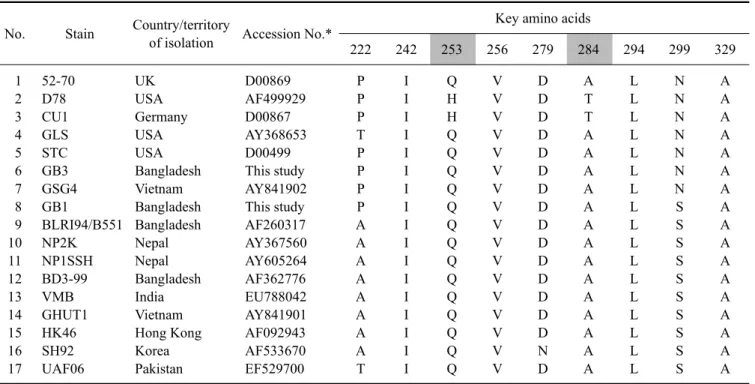
A 474-bp sequence encoding the hypervariable region of
the VP2 protein (position: 606∼1080 bp) from the GB1
Table 1. Key amino acids in the hypervariable region of the VP2 polypeptide of infectious bursal disease virus (IBDV) strains No. Stain Country/territory
of isolation Accession No.* Key amino acids
222 242 253 256 279 284 294 299 329
1 2 3 4 5 6 7 8 9 10 11 12 13 14 15 16 17
52-70 D78 CU1 GLS STC GB3 GSG4 GB1
BLRI94/B551 NP2K NP1SSH BD3-99 VMB GHUT1 HK46 SH92 UAF06
UK USA Germany USA USA Bangladesh Vietnam Bangladesh Bangladesh Nepal Nepal Bangladesh India Vietnam Hong Kong Korea Pakistan
D00869 AF499929 D00867 AY368653 D00499 This study AY841902 This study AF260317 AY367560 AY605264 AF362776 EU788042 AY841901 AF092943 AF533670 EF529700
P P P T P P P P A A A A A A A A T
I I I I I I I I I I I I I I I I I
Q H H Q Q Q Q Q Q Q Q Q Q Q Q Q Q
V V V V V V V V V V V V V V V V V
D D D D D D D D D D D D D D D N D
A T T A A A A A A A A A A A A A A
L L L L L L L L L L L L L L L L L
N N N N N N N S S S S S S S S S S
A A A A A A A A A A A A A A A A A
*GenBank accession number. A: alanine, D: aspartic acid, H: histidine, I: isoleucine, L: leucine, N: asparagine, P: proline, Q: glutamine, S:
serine, T: threonine , V: valine.