Environmental Science
Vol. 32, No. 3, pp. 311-322, August, 2016 http://dx.doi.org/10.7747/JFES.2016.32.3.311
Cryopreservation of Forest Tree Seeds:
A Mini-Review
Saikat Gantait1,*, Suprabuddha Kundu2, Shabir Hussain Wani3 and Prakash Kanti Das4
1AICRP on Groundnut, Directorate of Research, Bidhan Chandra Krishi Viswavidyalaya, Kalyani, Nadia, West Bengal 741235, India
2Department of Agricultural Biotechnology, Faculty of Agriculture, Bidhan Chandra Krishi Viswavidyalaya, Mohanpur, Nadia, West Bengal 741252, India
3Division of Genetics and Plant Breeding, Faculty of Agriculture, Wadura, Sher-E-Kashmir University of Agriculture Sciences and Technology of Kashmir, Jammu and Kashmir 193201, India
4Department of Agricultural Biotechnology, Faculty Centre for Integrated Rural Development and Management, School of Agriculture and Rural Development, Ramakrishna Mission Vivekananda University, Ramakrishna Mission Ashrama, Narendrapur, Kolkata 700103, India
Abstract
Since forest trees form the basis of forest ecosystem, their prolong subsistence is crucial for various flora and fauna.
The foremost challenges to sustain the forest ecosystem comprise of the declining forest tree population accompanied with structural changes due to afforestation and exploitation of forest area, environment changes, pests, pollution, and introgressive hybridization. For ex situ conservation approach, in vitro techniques encompass basic role for conserving tree genetic resources, predominantly where natural propagules like recalcitrant seed might not be appropriate for long-term conservation. The practice includes restricted growth techniques, conventional micropropagation, production and storage of synthetic seeds, and cryopreservation. Even though these practices have been applied chiefly to herbaceous species, but recently, woody species were also focused upon. Key conceptions, challenges and techniques for forest tree seed conservation are discussed briefly in this review with special emphasis on some successful cryopreservation approaches for long-term storage.
Key Words: conservation, desiccation, liquid nitrogen, orthodox seed, recalcitrant seed
Received: January 15, 2016. Revised: April 13, 2016. Accepted: May 6, 2016.
Corresponding author: Saikat Gantait
AICRP on Groundnut, Directorate of Research, Bidhan Chandra Krishi Viswavidyalaya, Kalyani, Nadia, West Bengal 741235, India Tel: 91-33-2582-8407, Fax: 91-33-2582-8407, E-mail: [email protected]
Introduction
Forests, one of the major bio-resources, are economically, ecologically, environmentally, and aesthetically important.
The forestland area is consistently shrinking to meet the in- tensifying world demand for food, timber and other prod- ucts and thus enhances the importance of conservation of the forest resources (Ledig 1988; Rajora and Mosseler 2001). Forest trees are less domesticated as compared with agricultural crop plants and even the seeds formed through breeding program are heterogeneous. Due to this reason,
there is rising interest for creating germplasm banks of seed, meristem, pollen, and cell cultures as the only prob- able means for the long-term storage of genomes and con- servation of the genetic standards of cultivated and wild-growing plants (Pence 1991a; Rao 2004; Panis and Lambardi 2005).
All of the forestlands have a specific function in main- taining the ecological balance of biodiversity. To protect in- digenous species, exotic rapid-growing trees such as Eucalyptus could be transplanted for fuel-wood production (Merkle and Nairn 2005). Generally, in situ and ex situ
management strategies are applied in case of forest trees (Ledig 1986, 1988; Finkeldey and Gregorius 1994). In situ conservation signifies a more evolutionarily approach in comparison to the stationary ex situ conservation method (Finkeldey and Gregorius 1994). For certain tree species where seed storage is always challenging, conservation through tissue culture might be the lone choice since in vitro cultures of tissue and cells and/or cryopreservation might offer exceptional opportunities for the conservation of tree genetic resources (Suranthran et al. 2012; Palanyandy et al.
2013; Sinniah and Gantait 2013; Gantait et al. 2015;
Palanyandy et al. 2015).
Seed storage through cryopreservation is the most profi- cient technique since it provides an organized and ancillary way to maintain the forest germplasm (Linington and Pritchard 2001). Multiple attempts have been successfully made to conserve tree genetic resources through subjecting the seeds or parts of it to ultra-low temperature counting from mid twentieth century (Engstrom 1966) on Pinus sp.
Later on, oil palm (Elaesis guineensis) came into area of in- terest (Grout et al. 1983) and that is still under advance- ment towards its improvement of cryoconservation strat- egies (Suranthran et al. 2012; Palanyandy et al. 2013;
Gantait et al. 2015; Palanyandy et al. 2015). Establishment of cryo-storage protocols was successfully reported on several forest tree seeds such as Astronium urundeuva (Medeiros and Cavallari 1992), Bletilla striata (Hirano et al. 2005), Fraxinus excelsior (Chmielarz 2009a), Prunus avium L.
(Chmielarz 2009b), Betula pendula (Chmielarz 2010), Salix sp. (Popova et al. 2013), Mimusops sp. (Wen et al. 2013), Parkia sp. (Sinniah and Gantait 2013), and most recently in Populus nigra (Michalak et al. 2015).
In the present review an illustration on outlook will be drawn based on the issues and concerns of forest seed con- servation and successful reports developed to combat with those limitations.
Cryopreservation: Principles and Techni- ques
Cryopreservation is the lone procedure accessible to date to conserve the germplasm of problem species safely and cost-efficiently for long period of time. Cryopreservation is based upon the storage of plant materials in liquid nitrogen
(LN) (-196oC). The main principle is conserving the plant material in a viable but dormant stage. At this ultra-low temperature, cell division as well as metabolism remains stagnant without undergoing any kind of physical changes.
Several resources such as dormant seeds or orthodox seeds can be cryopreserved without any pretreatment and demon- strates natural dehydration processes. Mazur (1984) fo- cused on the need to dehydrate the tissue prior to cry- opreservation since the intracellular water forms ice crys- tals, raptures cells and leads to non-viability. In the classical protocols, the desiccation of explants took place both prior to and right through cryopreservation (also called freeze in- duced desiccation), while the more updated techniques em- ploy desiccation prior to cryopreservation. In the classical controlled rate of cooling, (also called two-step freezing or slow controlled-freezing) technique, hydrated tissues are generally preserved. The samples are cooled to about -40oC in gradual rate (frequently 0.1-4oC per min) followed by quick dipping in LN (Gonzalez-Arnao et al. 2008). The plasma-membrane offers a considerable obstruction and evaluates the transfer of ice crystals into the intracellular components of the cells so as to prevent the cell from any kind of freezing injuries inspite of its exposure to such low- er temperature conditions. The excess water present inside a cell is oozed out to the peripheral medium as the temper- ature decreases further, so naturally the intracellular solutes become more concentrated. Controlled cooling practices are commonly complicated as they may require program- mable freezers. The technique is mainly employed for dor- mant buds (Sakai and Nishiyama 1978; Towill and Ellis 2008), apical parts of the species that are cold sensitive (Reed and Uchendu 2008) and undifferentiated cultures (Kartha and Engelmann 1994; Withers and Engelmann 1998).
In the modern techniques, cellular dehydration is carried out just before cryopreservation by introducing the explants to a strenuous cryoprotectant solution and/or air desic- cation, till the majority of freezable cell sap has been pulled out from the cells, which results in vitrification of the aque- ous compartment and thus intracellular ice formation is bypassed. Generally, dehydration step is carried out by di- rectly immersing the explants in LN. This technique is more appropriate for composite organs such as shoot tips, embryos or embryonic axes. This is particularly significant
for cryopreservation of tropical forest tree germplasms, which can now be attempted in tropical countries, provided that basic tissue culture facilities along with a dependable supply of LN. Generally five specific cryopreservation met- hods are practiced namely desiccation, encapsulation-desic- cation, vitrification, encapsulation-vitrification and drop- let-vitrification.
Desiccation method principally utilizes seeds, embryonic axes or zygotic embryos. In case of plant species where seed can be used as a source of germplasms, desiccation is gen- erally carried out by moderate drying in a relatively humid environment by soaking them in saturated salt solutions where as in case of zygotic embryos or embryonic axes des- iccation through the wind action of laminar air flow is much more prevalent and much more effective as it is attained by arid sterilized condensed air, silica gel or saturated salt solutions. Another work reported by Berjak et al. (1989) suggested that for the prevention of desiccation injuries, ul- tra-rapid drying could be an effective choice for cryopre- serving samples with comparatively higher moisture con- tent (MC). Encapsulation-dehydration is a technique based on the production of artificial seeds or synthetic seeds that brings about effective germplasm storage as well as its transport to various other countries. In this practice encap- sulation of plant propagules in calcium alginate, regen- erated in a liquid medium supplemented with sucrose for the period of 1-7 days and then dehydrating up to roughly 20% on the basis of its fresh weight by means of silica gel method followed by rapid cooling. Bonnart and Volk (2010) suggested a modification of this technique by the usage of calcium alginate along with 2M glycerol and 0.5M sucrose as the encapsulating agent and dehydrating it by air-drying instantly. Vitrification is the conversion of ex- cess cell sap present in the cells of the plant material into an amorphous fluid thus avoiding the formation of ice crystals (Fahy et al. 1984). Plant samples are exposed to an inter- mediate concentrated loading solution that comprises of 2M glycerol and 0.4M sucrose (Matsumoto et al. 1994).
Kim et al. (2009) have formulated a series of additional loading solutions, which are found compatible with several plant species like Chrysanthemum. The Plant Vitrification Solutions (PVS) that are generally used includes PVS2 (Sakai et al. 1990) and PVS3 (Nishizawa et al. 1993) which consists of (w/v) 15% ethylene glycol+30% glycerol+
15% DMSO+13.7% sucrose and 50% glycerol+50%
sucrose, respectively. Combining it with encapsulation, the vitrification technique has further been modified. Explants are encapsulated in a calcium alginate matrix and cry- opreserved by a standard vitrification protocol that termed as ‘encapsulation-vitrification’. In spite of several vitrifica- tion techniques, droplet vitrification is a much more ad- vanced approach and most commonly used. In droplet vit- rification the explants are wrapped up in an aluminum foil and immersed freely in LN. The main credit of this techni- que is that the explant remains in contact with LN through- out freezing and then thawing in presence of the unloading solution helps in maintaining a suitable temperature rhythm.
Forest Seeds: Concerns
According to Chin (1988) tree species of tropic and sub-tropic territories for instance cacao, coconut, coffee, citrus, rubber, oil palm and several other forest species, de- velop seeds that are not dehydrated, sheds at elevated levels of MC and become highly sensitive towards freezing thus, cannot be preserved by traditional methods such as low temperature. There are only few species (around 2% of the world flora) that produce ‘intermediate’ seeds (Tweddle et al. 2003), so, conservation of germplasm of these tree spe- cies is of prime significance as even though these seeds are stored using a standard protocol, their viability is com- promised. Intermediate seeds typically comprises of a lim- ited MC regime that limits its tolerance to LN (Dussert et al. 2001). To regulate the pre-cryopreservation treatment to maintain seed MC, use of saturated saline solutions was successful for intermediate seed forming tree species for in- stance coffee (Dussert and Engelmann 2006) and Citrus species (Hor et al. 2005). Nonetheless, species-specific protocol needs to be established for effective cryopre- servation of intermediate seeds (Malik et al. 2010).
Plentiful research has been carried out to augment the competence of conservation procedures such as introducing several field genebanks and also to consider the preserva- tion of the recalcitrant seeds. However, several in vitro and tissue culture techniques have been known for its con- servation properties by maintaining the genetic homoge- neity of the regenerated plantlets from the stored germ- plasms (Engelmann 2012) as these techniques confirmed
the mid-term storage of plant materials ensuring higher germination rates (Bunn et al. 2007). But on the other side for long-term storage of plant germplasms, cryopreservat- ion is the lone technique. A wide range of explants such as seeds, latent buds (in vivo) and cell suspensions, calli, shoot tips, somatic as well as zygotic embryos and embryonic axes (in vitro) have been exploited for cryopreservation. Quite a few factors propose that the immature embryos can be more flexible to work with than the mature embryos because of two significant factors. Firstly, they are of much minute structure than mature embryos and tenders homogeneous cryoprotection, cooling, and thawing in hydrated freezing methods, and further consistent dehydration, which im- proves endurance of the plant cells from freezing injuries (Withers 1979). Secondly, immature embryos are more em- bryogenic in nature than the aged embryos (Pence et al.
1980). In case any freezing injury is caused to the zygotic embryos they can revive themselves instantly due to their high regenerating capabilities. As evidence to this above statement, Pence (1991b) reported that the zygotic embryos of Theobroma cacao L. (Cacao) had the capability to form callus instantly even after undergoing a fast freezing meth- od of preservation.
Issues Regarding Cryopreservation of Fo- rest Tree Seeds
Cryopreservation has been proven effective in conservation of embryos or embryonic axes (Kartha and Engelmann 1994; Engelmann et al. 1995; Pence 1995; Engelmann 1997). As a matter of fact freezing of embryos is an effective approach for any species in case of recalcitrant seeds (Engelmann 1999). Difference between moisture retention and stage of maturity are the two major factors that make the cryopreservation of recalcitrant embryos challenging.
Embryos are widely occupied for cryopreservation since seeds of numerous species are too robust to be iced up directly. Nevertheless, embryos are comprised of multi- faceted tissue compositions that demonstrate susceptible to dehydration and freezing, mostly the radicle portion seem- ing difficult than the plumule portion. Chandel et al. (1995) experimented with Cacao and its various species and con- cluded that embryos are exceedingly susceptible towards desiccation and decrease in their moisture content levels
leads to severe internal injury to the embryo structure.
Lastly, a number of species forming embryos are very rare that makes cryopreservation more complicated. Selection of embryos at the accurate stage is intricate for any experiment as it may determine the formation of ice crystals in an em- bryo (Engelmann et al. 1995; Engelmann 1999).
An Account on Forest Tree Seed Cryo- preservation
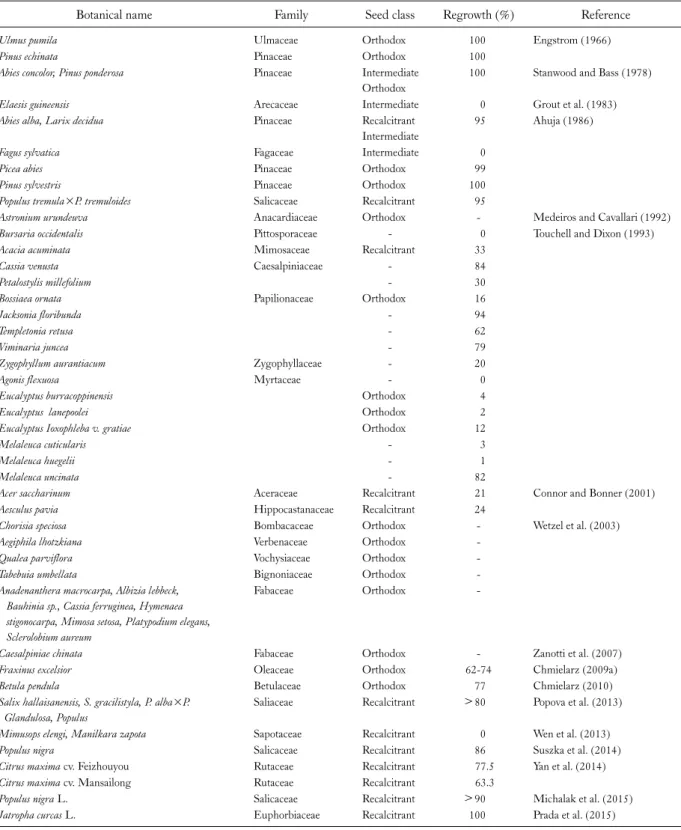
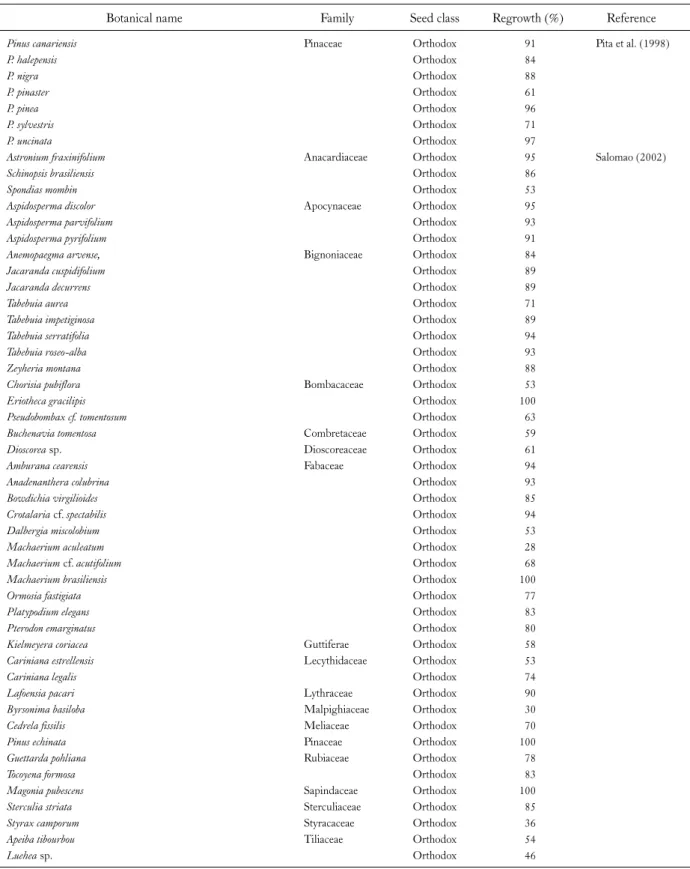
Cryopreservation has been recognized as a prospective tool for forest tree seeds for the long-term storage. There are ample numbers of investigations that have been carried out on in vitro conservation of forest trees using whole seeds, their components, and embryonic axes via several protocols as a move concerning development of appropriate systems for cryopreservation. In the present review, we in- vestigated the responses of the whole seeds to multiple number of cryopreservation protocols. The cryopreservat- ion techniques that have been majorly employed for forest seed conservation are either desiccation or direct exposure to LN and the conclusions are demonstrated in Table 1 and 2.
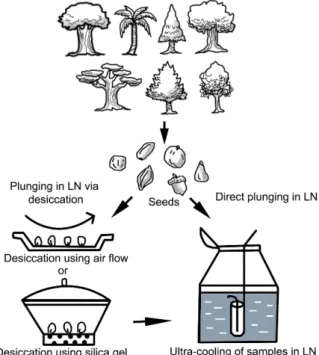
A schematic illustration has also been presented in Fig. 1. It is observed from the information of the tables that the tree species belonging to Fabaceae family is the most common as they respond actively towards desiccation or to direct LN.
Engstrom (1966) and Stanwood and Bass (1978) found more than 99% germination rate in case of Pinus echinata, Ulmus pumila, Abies concolor and Pinus ponderosa.
Following long time presentation, Styles et al. (1982) dem- onstrated cryopreservation for 24 species and calculated their germination percentages after storage of 600 days.
Commonly, no remarkable changes in germination rate took place after 600-day storage in LN. The MC of the seeds taken was less than 10%. Grout et al. (1983) found that in Elaesis guineensis there occurs a significant differ- ence in MC between the whole seed and the embryo and thus consequences in the distress of sub-zero conservation of whole seeds. They concluded that embryos could offer a practical technique for the long-term storage of the germ- plasm of the species. On the other hand, Ahuja (1986) took six species (Abies alba, Fagus sylvatica, Larix deciduas, Picea abies, Pinus sylvestris, and Populus tremula×P.
tremuloides) and found >90% germination except Fagus
Table 1. Examples on Success of Desiccation for Cryopreservation of Forest Seeds (In Chronological Order)
Botanical name Family Seed class Regrowth (%) Reference
Ulmus pumila Ulmaceae Orthodox 100 Engstrom (1966)
Pinus echinata Pinaceae Orthodox 100
Abies concolor, Pinus ponderosa Pinaceae Intermediate
Orthodox
100 Stanwood and Bass (1978)
Elaesis guineensis Arecaceae Intermediate 0 Grout et al. (1983)
Abies alba, Larix decidua Pinaceae Recalcitrant
Intermediate
95 Ahuja (1986)
Fagus sylvatica Fagaceae Intermediate 0
Picea abies Pinaceae Orthodox 99
Pinus sylvestris Pinaceae Orthodox 100
Populus tremula×P. tremuloides Salicaceae Recalcitrant 95
Astronium urundeuva Anacardiaceae Orthodox - Medeiros and Cavallari (1992)
Bursaria occidentalis Pittosporaceae - 0 Touchell and Dixon (1993)
Acacia acuminata Mimosaceae Recalcitrant 33
Cassia venusta Caesalpiniaceae - 84
Petalostylis millefolium - 30
Bossiaea ornata Papilionaceae Orthodox 16
Jacksonia floribunda - 94
Templetonia retusa - 62
Viminaria juncea - 79
Zygophyllum aurantiacum Zygophyllaceae - 20
Agonis flexuosa Myrtaceae - 0
Eucalyptus burracoppinensis Orthodox 4
Eucalyptus lanepoolei Orthodox 2
Eucalyptus Ioxophleba v. gratiae Orthodox 12
Melaleuca cuticularis - 3
Melaleuca huegelii - 1
Melaleuca uncinata - 82
Acer saccharinum Aceraceae Recalcitrant 21 Connor and Bonner (2001)
Aesculus pavia Hippocastanaceae Recalcitrant 24
Chorisia speciosa Bombacaceae Orthodox - Wetzel et al. (2003)
Aegiphila lhotzkiana Verbenaceae Orthodox -
Qualea parviflora Vochysiaceae Orthodox -
Tabebuia umbellata Bignoniaceae Orthodox -
Anadenanthera macrocarpa, Albizia lebbeck, Bauhinia sp., Cassia ferruginea, Hymenaea stigonocarpa, Mimosa setosa, Platypodium elegans, Sclerolobium aureum
Fabaceae Orthodox -
Caesalpiniae chinata Fabaceae Orthodox - Zanotti et al. (2007)
Fraxinus excelsior Oleaceae Orthodox 62-74 Chmielarz (2009a)
Betula pendula Betulaceae Orthodox 77 Chmielarz (2010)
Salix hallaisanensis, S. gracilistyla, P. alba×P.
Glandulosa, Populus
Saliaceae Recalcitrant >80 Popova et al. (2013)
Mimusops elengi, Manilkara zapota Sapotaceae Recalcitrant 0 Wen et al. (2013)
Populus nigra Salicaceae Recalcitrant 86 Suszka et al. (2014)
Citrus maxima cv. Feizhouyou Rutaceae Recalcitrant 77.5 Yan et al. (2014)
Citrus maxima cv. Mansailong Rutaceae Recalcitrant 63.3
Populus nigra L. Salicaceae Recalcitrant >90 Michalak et al. (2015)
Jatropha curcas L. Euphorbiaceae Recalcitrant 100 Prada et al. (2015)
Blank spaces (-) denote the unavailability of information.
Table 2. Examples on Success of Direct Plunging in Liquid Nitrogen (LN) for Cryopreservation of Forest Seeds (In Chronological Order)
Botanical name Family Seed class Regrowth (%) Reference
Pinus canariensis Pinaceae Orthodox 91 Pita et al. (1998)
P. halepensis Orthodox 84
P. nigra Orthodox 88
P. pinaster Orthodox 61
P. pinea Orthodox 96
P. sylvestris Orthodox 71
P. uncinata Orthodox 97
Astronium fraxinifolium Anacardiaceae Orthodox 95 Salomao (2002)
Schinopsis brasiliensis Orthodox 86
Spondias mombin Orthodox 53
Aspidosperma discolor Apocynaceae Orthodox 95
Aspidosperma parvifolium Orthodox 93
Aspidosperma pyrifolium Orthodox 91
Anemopaegma arvense, Bignoniaceae Orthodox 84
Jacaranda cuspidifolium Orthodox 89
Jacaranda decurrens Orthodox 89
Tabebuia aurea Orthodox 71
Tabebuia impetiginosa Orthodox 89
Tabebuia serratifolia Orthodox 94
Tabebuia roseo-alba Orthodox 93
Zeyheria montana Orthodox 88
Chorisia pubiflora Bombacaceae Orthodox 53
Eriotheca gracilipis Orthodox 100
Pseudobombax cf. tomentosum Orthodox 63
Buchenavia tomentosa Combretaceae Orthodox 59
Dioscorea sp. Dioscoreaceae Orthodox 61
Amburana cearensis Fabaceae Orthodox 94
Anadenanthera colubrina Orthodox 93
Bowdichia virgilioides Orthodox 85
Crotalaria cf. spectabilis Orthodox 94
Dalbergia miscolobium Orthodox 53
Machaerium aculeatum Orthodox 28
Machaerium cf. acutifolium Orthodox 68
Machaerium brasiliensis Orthodox 100
Ormosia fastigiata Orthodox 77
Platypodium elegans Orthodox 83
Pterodon emarginatus Orthodox 80
Kielmeyera coriacea Guttiferae Orthodox 58
Cariniana estrellensis Lecythidaceae Orthodox 53
Cariniana legalis Orthodox 74
Lafoensia pacari Lythraceae Orthodox 90
Byrsonima basiloba Malpighiaceae Orthodox 30
Cedrela fissilis Meliaceae Orthodox 70
Pinus echinata Pinaceae Orthodox 100
Guettarda pohliana Rubiaceae Orthodox 78
Tocoyena formosa Orthodox 83
Magonia pubescens Sapindaceae Orthodox 100
Sterculia striata Sterculiaceae Orthodox 85
Styrax camporum Styracaceae Orthodox 36
Apeiba tibourbou Tiliaceae Orthodox 54
Luehea sp. Orthodox 46
Table 2. Continued
Botanical name Family Seed class Regrowth (%) Reference
Roupala montana Proteaceae - - Wetzel et al. (2003)
Bletilla striata Orchidaceae - 23 Hirano et al. (2005)
Astronium fraxinifolium, Myracrodruon urundeuva, Schinopsis brasiliensis
Anacardiaceae Orthodox - Lima et al. (2008)
Aspidosperm apyrifolium Apocynaceae Orthodox 43
Cavanillesia arborea Bombacaceae Orthodox -
Jacaranda brasiliana, Tabebuia aurea, Cordia trichotoma Bignoniaceae Orthodox -
Tabebuia impetiginosa Orthodox 70
Acacia polyphylla, Amburana cearensis, Anadenanthera colubrine, Copaífera langsdorffii, Enterolobium contortisiliquum, Hymenaea courbaril var. stilbocarpa, Lonchocarpus montanus, Machaerium scleroxylon
Fabaceae Orthodox -
Cedrela fissilis Meliaceae Orthodox -
Blank spaces (-) denote the unavailability of information.
Fig. 1. A schematic illustration on two major cryopreservation methods em- bracing ultra-cooling in liquid nitrogen (LN) either through direct ex- posure or via desiccation of forest tree seeds.
sylvatica which lost its viability in LN. Medeiros and Cava- llari (1992) in experimentation on Astronium urundeuva, which is a priceless timber and curative tree, the orthodox seeds were subjected to drying for 24, 48, 72, 96, and 120 h at 25oC and 10-15% relative humidity prior to immersion
in LN; thawing was done for 30 min at room temperature.
Seeds even without desiccation (8.01% MC) survived cryogenic storage, but Medeiros et al. (1992) obtained ex- ceptional germination even after 24, 72, and 96 h drying, subsequent to which, seeds accomplished individual hu- midity contents of 7.13%, 5.89%, and 5.96%. Touchell and Dixon (1993) in their study specified that in dominant fam- ilies of native Australian species conservation using LN is very effective and this was proved by an experiment con- ducted on 90 native western Australian species that com- prised of 84 genera as well as 33 families respectively.
Amongst the 90 species, 68 of them germinated after being stored in liquid nitrogen for two weeks either by direct im- mersion into liquid nitrogen or slow cooling at 0.4oC min-1 at 15% or 35% dimethyl sulphoxide (DMSO). In other case, few other species in Papilionaceae and Myrtaceae family displayed alike germination rates on treatment with 35% DMSO as well as directly soaked into LN but when treated with 15% DMSO showed lower germination rates.
Connor and Bonner (2001) trailed that the initial germina- tion rate in both the silver maple and red buckeye seeds was high, 89% and 94% correspondingly after nine days of des- iccation, but after 11 days, silver maple had reduced to 21%
and red buckeye to 24%. Another experiment conducted by Salomao on the year 2002 did not involve dehydration of seeds before drenching them in liquid nitrogen for three consecutive days and then thawed at a room temperature
(25oC) for another three more days. From this it was con- cluded that all the species that were tested were cryostorage tolerant but many species were found highly sensitive to- wards LN. Although all the seeds of the several tree species studied by Wetzel et al. (2003) were found tolerant to the injuries caused by direct immersion in LN, but in certain exceptional cases of Cassia ferruginea, Platypodium ele- gans, Sclerobium aureum, and Roupala montana the ger- mination rates were lower than the controls.
Influence of seed age
It has been established from the earlier reports that the life of the forest tree seeds significantly depends on the pre- liminary attribute of seed. According to Simpson et al.
(2004), longevity of forest seeds under storage has a pro- portional relationship with the quality of seeds. To ensure the highest genetic and physiological attributes, seeds should be collected at its mature phase for its prior treat- ment as well as long-term storage. This is evident especially in case of those forest tree seeds that require post-harvest ripening (such as Picea glauca) or stimulated desiccation (such as, Shorea roxburghii, S. siamensis) for the com- pletion of their maturation (Panochit et al. 1984; Caron et al.
1992). According to Hirano et al. (2005), when the im- mature seeds of Bletilla striata were directly soaked into LN devoid of pre-treatment, the survival rate was directly pro- portional to the seed age as 0%, 9%, and 23% in the seeds of 2, 3 and 4 months after pollination (MAP), respectively.
But when juvenile seeds of distinctive growth phases (2-4 MAP) were cryopreserved through vitrification, the max- imum resurgence rate (82%) was attained in the seeds of 3 MAP trailed by those of 4 MAP (72%) and 2 MAP (44%). As high as 92% resurgence rate was obtained when under developed seeds of 3 MAP were exposed to vitri- fication solution subsequent a three-day pre-culture in 0.3 M sucrose.
Influence of moisture content
Tarre et al. (2007) established a skilled procedure of cry- opreservation while working with eight Bromeliaceae spe- cies that are native to the Atlantic forest. In that very experi- ment the moisture content of the seeds ranged between 11.2% to 28.2% and required desiccation before immersing them directly into LN, except for Encholirium pedicellatum
(where, seeds were dehydrated to 2.5% of MC). After re- covering the seeds from LN, thawing was carried out at a room temperature (25oC) and the regeneration rates were duly recorded. Another work by Lima et al. (2008) on 19 different species of deciduous Parana River valley in the forest area of Goias (Brazil) demonstrated that without des- iccation, the seeds (MC ranged between 5.7% to 12%) were directly plunged into LN for three days, followed by thawing at room temperatures (25oC). All the species sur- vived in LN but an exception was noticed as regeneration was declined in seeds of H. courbaril having 5.8% MC and Aspidosperma pyrifolium (6.8% MC). Chmielarz (2009a) accounted that storing the dormant seeds of European ash for two years in LN after desiccation ensuring the water content (WC) of 0.06-0.24 g g-1showed no variation in ger- mination rates. In another study by the same researcher (Chmielarz 2009b) on mazzard cherry seeds (Prunus avium L.) it was revealed that desiccation up to an MC of 9.0-16.9% proved to be better for post-freezing regeneration (maximum of >60%) instead of deep desiccation (1.6-7.3%
MC). Chmielarz (2010) reported that Betula pendula seeds could tolerate desiccation over silica gel till the level of 0.02 g g-1 (WC) and sustained germination rate of 77% af- ter 14 days. According to that report, the optimum range of seed WC, within which the seeds tolerate the ultra-low tem- perature of LN was 0.02-0.23 g g-1 and further confirmed that the seeds if dehydrated properly can be stored in LN for about two years with proper after-storage germination rates. Research work carried out on the seeds (10% WC) of both Salix hallaisanensis and S. gracilistyla regenerated with 80% germination rates but were sensitive when their WC was reduced. Salix seeds were observed to be effectively cryopreserved with WC of 0.25 g g-1 without any significant change in after storage regeneration frequencies. Wen et al.
(2013) carried out a detailed comparative study between the embryos of M. zapota and M. elengi and it was observed that M. zapota displayed better tolerance towards dehydration and exposure to LN. Survival and regeneration was better noticed either on the embryonic axes that were chopped off and dehydrated prior cryopreservation treatment or from the embryonic axes extracted from already cryopreserved seeds. Suszka et al. (2014) reported that both fresh and de- siccated seeds of Populus nigra could be preserved using standard cryopreservation techniques for about two years.
In that study the fresh seeds exhibited higher germination rates (90%) than desiccated seeds (86% germination rate).
Michalak et al. (2015) also demonstrated that MC within 0.11-0.17 g g-1 plays an important role in the cry- opreservation of black poplar seeds irrespective of its ori- gin, time of harvesting and the seed quality.
Post-Cryopreservation Regrowth
Growth recovery is a fundamental step for the endurance of the seeds following their exposure to ultra-low temper- ature for a specific period (longest possible). However, post-freezing viability and subsequent germination of seeds chiefly reliant on genotype and age of the seeds, cryopro- tectants employed, degree of freezing and thawing etc.
(Tsukara and Hirosawa 1992). To assess the viability of the germplasms several tests are there. Yet, most commonly used tests are triphenyltetrazolium chloride and flourescein diacetate assays. The consequent step following viability as- sessment is regrowth of germplasm. The researchers fol- lowed different protocols for the post-cryopreservation re- growth and maintenance of the cryopreserved seeds. Touchell and Dixon (1993) after storing the seed in LN thawed quickly by quick dipping into a 40oC water bath and kept at room temperature for 20 min. To break the dormancy of le- gume tree seeds, they were soaked in boiling water and kept overnight to cool. The seeds were then transferred to the ground in a soil comprising composted hardwood saw dust, hardwood fines, and quartz sand in a proportion of 3:1:2 (v/v) and put a thin layer of gravel on top to attain success- ful germination. Muthusamy et al. (2004) propagated the post-freezing re-warmed seeds in a typical germination container having garden soil substrate for in vivo germina- tion following which the seeds were incubated in a growth chamber at 25oC with a 16 h photoperiod. Contrastingly, for in vitro germination, Murashige and Skoog (1962) (MS) basal medium fortified with 30 g l-1 sucrose was used.
The temperature was controlled at 26oC with a 12 h photoperiod. However, Hirano et al. (2005) cultured the cryopreserved immature seeds on 0.2% gellan gum-sol- idified New Dogashima medium (Tokuhara and Mii 1993) supplemented with 0.3 M sucrose at 25oC for as long as 3 days under continuous illumination. Pritchard and Nadarajan (2008) accounted that the dried seeds are prone
to damage at some stage in rehydration during the germina- tion test. Damage was often noticed if the seeds are directly dipped in water. According to them moistening the seeds on wet filter paper overcome the risk to damage. As a better al- ternative, Halmagyi et al. (2010) thawed the samples quickly in liquid MS basal medium (with 30 g l-1 sucrose) (pH 5.7) and shaked the medium for about 10 sec at room temperature. The emerged shoot tips were transferred on a modified semisolid MS medium supplemented with plant growth regulators. Gantait et al. (2015), on the other hand, unloaded the sample in 1.2 M sucrose after quick thawing and then relocated onto double layered sterile filter paper kept on Petri dishes enclosing semi-solid MS medium with 3% (w/v) sucrose and 100 mg l-1 myoinositol devoid of any plant growth regulators. The samples were given dark phase for consecutive 7 days before disclosure to light with a 16 h photoperiod at 26±2oC. Suszka et al. (2014) germi- nated the desiccated seeds in a Jacobsen germinator. Moist filter paper was used to rehydrate the seeds and cool white light was supplied on a 12 h cycle. The temperature was sustained at 23oC and 27oC for 22 h and 2 h per day, respectively. The use of Jacobsen germinator was also de- scribed in the reports of Chmielarz (2010) and Michalak et al. (2015). As per their description, the seeds were thawed by keeping in a water bath at 40oC for 5 min following LN exposure before transferring them in Jacobsen germinator.
They maintained the temperature at 23oC for 22 h and 27oC for 2 h per day and light given in a 12 h cycle ensuring successful regrowth and maintenance.
Conclusion and Prospect
There are several cryopreservation practices established for the protection of forest trees as its conservation is an im- perative issue for the reason since forest trees are less culti- vated than domestic crops, and incorporates genetic vari- ation. Cryopreservation being a lone technique cannot com- pletely provide an efficient solution to this problem but yet can reduce it a certain extent. It serves as an active techni- que for the conservation mainly in case of tree species in- volving the use of whole seeds or its components as explants for germplasm storage. The technique preserves the reser- voirs of germplasm and the escapes the threat to extinction.
It also maintains the biosynthetic characteristics of the
plant. The corresponding tissue features can be conserved in this method that might has been lost during regular in vi- tro maintenance protocols. This technique also helps to easy collect and manages all groups of genetic material around the world. It aids exchange of germplasm internationally since the size of sample material is small and could be trav- elled anywhere in the world. Moreover it reduces the chance of contamination, disease and mutation since the whole pro- cedure is performed aseptically. Overcoming the two crit- ical factors that is seed desiccation and seed moisture con- tent and manipulating their parameters to standardize ef- fective cryopreservation procedures are much focused in today’s research world. A minimum level of damage mech- anisms involved during dehydration of desiccation-sen- sitive tissue is that tolerant tissue can survive easily but sen- sitive tissues fail. The occurrence of desiccation-sensitivity or recalcitrance is not associated with phylogeny since, few families comprised of species that produce seeds with this trait and few other families don’t. In general, perennial, aquatic or rainforest trees hold recalcitrant character.
Hence, future methods should address to resolve this set- back involving reduction of desiccation-derived oxidative stress.
Acknowledgements
Authors acknowledge the library assistance from Bidhan Chandra Krishi Viswavidyalaya, Mohanpur, Nadia, West Bengal, India. We further are thankful to the anonymous reviewers and the editor of this article for their critical com- ments and suggestions on the manuscript.
Conflict of Interest
The authors of this article declare that there is no conflict of interest and no financial gain from it.
References
Ahuja MR. 1986. Short note: storage of forest tree germplasm in liquid nitrogen (-196oC). Silvae Genet 35: 249-251.
Berjak P, Farrant JM, Mycock DJ, Pammenter NW. 1989.
Homoiohydrous (recalcitrant) seeds: the enigma of their desic- cation sensitivity and the state of water in axes of Landolphia kir-
kii Dyer. Planta 186: 249-261.
Bonnart R, Volk GM. 2010. Increased efficiency using the encap- sulation-dehydration cryopreservation technique for Arabido- psis thaliana. Cryo Letters 31: 95-100.
Bunn E, Turner SR, Panaia M, Dixon KW. 2007. The contri- bution of in vitro technology and cryogenic storage to con- servation of indigenous plants. Aust J Bot 55: 345-355.
Caron GE, Wang BSP, Schooley HO. 1992. Variation in Picea glauca seed germination associated with the year of cone colle- ction. Can J Forest Res 23: 1306-1313.
Chandel KPS, Chaudhury R, Radhamani J, Malik SK. 1995.
Desiccation and freezing sensitivity in recalcitrant seeds of tea, cocoa and jackfruit. Ann Bot 76: 443-450.
Chin HF. 1988. Recalcitrant seeds: a status report. International Board for Plant Genetic Resources Institute, Rome, Italy.
Chmielarz P. 2009a. Cryopreservation of dormant European ash (Fraxinus excelsior) orthodox seeds. Tree Physiol 29: 1279-1285.
Chmielarz P. 2009b. Cryopreservation of dormant orthodox seeds of forest trees: mazzard cherry (Prunus avium L.). Ann For Sci 66: 405.
Chmielarz P. 2010. Cryopreservation of conditionally dormant or- thodox seeds of Betula pendula. Acta Physiol Plant 32: 591-596.
Connor KF, Bonner FT. 2001. The effects of desiccation on seeds of Acer saccharinum and Aesculus pavia: recalcitrance in tem- perate tree seeds. Trees 15: 131-136.
Dussert S, Chabrillange N, Rocquelin G, Engelmann F, Lopez M, Hamon S. 2001. Tolerance of coffee (Coffea spp.) seeds to ul- tra-low temperature exposure in relation to calorimetric proper- ties of tissue water, lipid composition, and cooling procedure.
Physiol Plant 112: 495-504.
Dussert S, Engelmann F. 2006. New determinants for tolerance of coffee (Coffea arabica L.) seeds to liquid nitrogen exposure.
Cryo Letters 27: 169-178.
Engelmann F, Dumet D, Chabrillange N, Abdelnour-Esquivel A, Assy-Bah B, Dereuddre J, Duval Y. 1995. Factors affecting the cryopreservation of coffee, coconut and oil palm embryos. Plant Genet Res Newslett 103: 27-31.
Engelmann F. 1997. Importance of desiccation for the cry- opreservation of recalcitrant seed and vegetatively propagated species. Plant Genet Res Newslett 112: 9-18.
Engelmann F. 1999. Alternative methods for the storage of recalci- trant seeds - an update. In: Recalcitrant Seeds (Marzalina M, Khoo KC, Jayanthi N, Tsan FY, Krishnapillay B, eds). IUFRO Seed Symposium 1998, FRIM, Kuala Lumpur, Malaysia, pp 159-170.
Engelmann F. 2012. Germplasm collection, storage and preser- vation. In: Plant biotechnology 2010: Basic aspects and agricul- tural implications (Altman A, Hazegawa PM, eds). Elsevier, pp 255-268.
Engstrom A. 1966. Will deep freeze damage tree seed? Tree Plant Notes 77: 28-29.
Fahy GM, MacFarlane DR, Angell CA, Meryman HT. 1984.
Vitrification as an approach to cryopreservation. Cryobiol 21:
407-426.
Finkeldey R, Gregorius HF. 1994. Genetic resources: selection cri- teria and design. In: Conservation and Manipulation of Genetic Resources in Forestry (Kim ZS, Hattemer HH, eds). Kwang Moon Kag, Seoul, South Korea, pp 322-347.
Gantait S, Sinniah UR, Suranthran P, Palanyandy SR, Subramani- am S. 2015. Improved cryopreservation of oil palm (Elaeis gui- neensis Jacq.) polyembryoids using droplet vitrification ap- proach and assessment of genetic fidelity. Protoplasma 252:
89-101.
Gonzalez-Arnao MT, Panta A, Roca WM, Escobar RH, Engelmann F. 2008. Development and large-scale application of cryopreservation techniques for shoot and somatic embryo cul- tures of tropical crops. Plant Cell Tiss Organ Cult 92: 1-13.
Grout BWW, Shelton K, Pritchard HW. 1983. Orthodox behav- iour of oil palm seed and cryopreservation of the excised embryo for genetic conservation. Ann Bot 52: 381-384.
Halmagyi A, Deliu C, Isac V. 2010. Cryopreservation of Malus cultivars: Comparison of two droplet protocols. Sci Hort 124:
387-392.
Hirano T, Godo T, Mii M, Ishikawa K. 2005. Cryopreservation of immature seeds of Bletilla striata by vitrification. Plant Cell Rep 23: 534-539.
Hor YL, Kim YJ, Ugap A, Chabrillange N, Sinniah UR, Engelmann F, Dussert S. 2005. Optimal hydration status for cryopreservation of intermediate oily seeds: Citrus as a case study.
Ann Bot 95: 1153-1161.
Kartha KK, Engelmann F. 1994. Cryopreservation and germplasm storage. In: Plant Cell and Tissue Culture (Vasil IK, Thorpe TA, eds). Kluwer, Dordrecht, Germany, pp 195-230.
Kim HH, Lee YG, Park SU, Lee SC, Baek HJ, Cho EG, Engelmann F. 2009. Development of alternative loading sol- utions in droplet-vitrification procedures. Cryo Letters 30:
291-299.
Ledig FT. 1986. Conservation strategies for forest gene resources.
For Ecol Manage 14: 77-90.
Ledig FT. 1988. The conservation of diversity in forest trees. Bio Sci 38: 471-479.
Lima VVF, Vieira DLM, Sevilha AC, Salomao AN. 2008.
Germinação de espécies arbóreas de floresta estacional decidual do vale do rio Paraná em Goiás após três tipos de armazena- mento por até 15 meses. Biota Neotrop 8: 89-97.
Linington SH, Pritchard HW. 2001. Gene banks. In: Encyclope- dia of biodiversity (Levin SA, ed). 3rd ed. Academic Press, New York, USA, pp 165-181.
Malik SK, Chaudhury R, Dhariwal OP, Bhandari DC. 2010.
Genetic resources of tropical underutilized fruits in India.
NBPGR, New Delhi, India, pp 168.
Matsumoto T, Sakai A, Yamada K. 1994. Cryopreservation of in vi- tro-grown apical meristems of wasabi (Wasabia japonica) by vit- rification and subsequent high plant regeneration. Plant Cell
Rep 13: 442-446.
Mazur P. 1984. Freezing of living cells: mechanisms and implica- tions. Am J Physiol 247: C125-C142.
Medeiros AC, Czarneski C, Mand Freitas GF. 1992. Criopreser- vação de sementes de aroeira (Astronium urundeuva (Fr. All.) Engl.). Rev Inst Florest 4: 544-547.
Medeiros ACS, Cavallari DAN. 1992. Conservação de germo- plasma de Aroeira (Astronium urundeuva (Fr. All.) Engl.) I.
Germinação de sementes após imersão em nitrogênio líquido (-196oC). Re Bras Sementes 14: 73-75.
Merkle SA, Nairn JC. 2005. Hardwood tree biotechnology. In Vitro Cell Dev Biol Plant 41: 602-619.
Michalak M, Plitta BP, Tylkowski T, Chmielarz P, Suszka J. 2015.
Desiccation tolerance and cryopreservation of seeds of black poplar (Populus nigra L.), a disappearing tree species in Europe.
Eur J For Res 134: 53-60.
Murashige T, Skoog F. 1962. A revised medium for rapid growth and bio assays with tobacco tissue cultures. Physiol Plant 15:
473-479.
Muthusamy J, Staines HJ, Benson EE, Mansor M, Krishnapillay B. 2005. Investigating the use of fractional replication and Taguchi techniques in cryopreservation: a case study using or- thodox seeds of a tropical rainforest tree species. Biodivers and Conserv 14: 3169-3185.
Nishizawa S, Sakai A, Amano Y, Matsuzawa T. 1993. Cryopreser- vation of asparagus (Asparagus officinalis L.) embryogenic sus- pension cells and subsequent plant regeneration by vitrification.
Plant Sci 91: 67-73.
Palanyandy SR, Gantait S, Suranthran P, Sinniah UR, Subramani- am S. 2015. Storage of encapsulated oil palm polyembryoids: in- fluence of temperature and duration. In Vitro Cell Dev Biol Plant 51: 118-124.
Palanyandy SR, Suranthran P, Gantait S, Sinniah UR, Subramani- am S, Aziz MA, Alwee SSRS, Roowi SH. 2013. In vitro devel- opmental study of oil palm (Elaeis guineensis Jacq.) polyembryoids from cell suspension using scanning electron microscopy. Acta Physiol Plant 35: 1727-1733.
Panis B, Lambardi M. 2005. Status of Cryopreservation Technolo- gies in Plant (Crops and Forest Trees). Proc. Int. Workshop
“The Role of Biotechnology for the Characterization and Conservation of Crop, Forestry, Animal, and Fishery Genetic Resources, Turin, pp 43-54.
Panochit J, Wasuwanich P, Hellum AK. 1984. Collection, germina- tion and storage of Shorea siamensis. Miq. seeds. Embryon 1: 1-13.
Pence VC, Hasegawa PM, Janic KJ. 1980. Initiation and Develop- ment of Asexual Embryos of Theobroma cacao L. in vitro. Z.
Pflanzenphysiol 98: 1-14.
Pence VC. 1991a. Cryopreservation of seeds of Ohio native plants and related species. Seed Sci Technol 19: 235-251.
Pence VC. 1991b. Cryopreservation of immature embryos of Theo- broma cacao. Plant Cell Rep 10: 144-147.
Pence VC. 1995. Cryopreservation of recalcitrant seeds. In: Biote-
chnology in agriculture and forestry. Cryopreservation of plant germplasm I (Bajaj YPS, ed). Springer-Verlag, Berlin, Germany, pp 29-52.
Pita JM, Sanz V, Escudero A. 1998. Seed cryopreservation of seven spanish native pine species. Silvae Genetica 47: 220-223.
Popova EV, Kim DH, Han SH, Moltchanova E, Pritchard HW, Hong YP. 2013. Systematic overestimation of Salicaceae seed survival using radicle emergence in response to drying and stor- age: implications for ex situ seed banking. Acta Physiol Plant 35: 3015-3025.
Prada JA, Aguilar ME, Abdelnour-Esquivel A, Engelmann F.
2015. Cryopreservation of seeds and embryos of Jatropha curcas L. Am J Plant Sci 6: 172-180.
Pritchard HW, Nadarajan J. 2008. Cryopreservation of Orthodox (Desiccation Tolerant) Seeds (Reed BM, ed). Plant Cryoprese- rvation: A Practical Guide, pp 485-494.
Rajora OP, Mosseler A. 2001. Challenges and opportunities for conservation of forest genetic resources. Euphytica 118: 197-212.
Rao NK. 2004. Plant Genetic Resources: Advancing in conser- vation and use through biotechnology. Afr J Biotechnol 3:
136-145.
Reed BM, Uchendu E. 2008. Controlled rate cooling. In: Plant cryopreservation: a practical guide (Reed BM, ed). Springer, Berlin, Germany, pp 77-92.
Sakai A, Kobayashi S, Oiyama I. 1990. Cryopreservation of nu- cellar cells of navel orange (Citrus sinensis Osb. var. brasiliensis Tanaka) by vitrification. Plant Cell Rep 9: 30-33.
Sakai A, Nishiyama Y. 1978. Cryopreservation of winter vegetative buds of hardy fruit trees in liquid nitrogen. Hort Sci 13:
225-227.
Salomao AN. 2002. Tropical seed species’ responses to liquid nitro- gen exposure. Braz J Plant Physiol 14: 133-138.
Simpson JD, Wang BSP, Daigle BI. 2004. Long-term seed storage of various Canadian hardwoods and conifers. Seed Sci Tech 32:
561-572.
Sinniah UR, Gantait S. 2013. Cryopreservation of immature Parkia speciosa Hassk. zygotic embryonic axes following desiccation or exposure to vitrification solution. Acta Physiol Plant 35: 2629-2634.
Stanwood PC, Bass LN. 1978. Ultracold preservation of seed germplasm. In: Plant cold hardiness and freezing stress (Li PH, Sakai A, eds). Academic Press, New York, USA, pp 361-371.
Styles ED, Burgess JM, Mason C, Huber BM. 1982. Storage of Seed in Liquid Nitrogen. Cryobiology 19: 195-199.
Suranthran P, Gantait S, Sinniah UR, Subramaniam S, Alwee SSRS, Roowi SH. 2012. Effect of loading and vitrification sol-
utions on survival of cryopreserved oil palm polyembryoids.
Plant Growth Regul 66: 101-109.
Suszka J, Plitta BP, Michalak M, Bujarska-Borkowska B, Tylkowski T, Chmielarz P. 2014. Optimal seed water content and storage temperature for preservation of Populus nigra L.
germplasm. Ann For Sci 71: 543-549.
Tarré E, Pires BBM, Guimarães APM, Carneiro LA, Forzza RC, Mansur E. 2007. Germinabilidade de sementes de espécies en- dêmicas de Encholirium Mart. ex Schult. & Schult. f. and Dyckia Schult. f. species (Bromeliaceae). Acta Bot Bras 21: 777-783.
Tokuhara K, Mii M. 1993. Micropropagation of Phalaenopsis and Doritaenopsis by culturing shoot tips of flower stalk buds. Plant Cell Rep 13: 7-11.
Touchell DH, Dixon KW. 1993. Cryopreservation of seed of Western Australian native species. Biodiversity Conserv 2:
594-602.
Towill LE, Ellis DD. 2008. Cryopreservation of dormant buds. In:
Plant cryopreservation-a practical guide (Reed BM, ed).
Springer Science and Business Media, New York, USA, pp 421-442.
Tsukahara M, Hirosawa T. 1992. Simple dehydration treatment promotes plantlet regeneration of rice (Oryza sativa L.) callus.
Plant Cell Rep 11: 550-553.
Tweddle JC, Dickie JB, Baskin CC, Baskin JM. 2003. Ecological aspects of seed desiccation sensitivity. J Ecol 91: 294-304.
Wen B, Wang X, Tan Y, Song S. 2013. Differential responses of Mimusops elengi and Manilkara zapota seeds and embryos to cryopreservation. In Vitro Cell Dev Biol Plant 49: 717-723.
Wetzel MMVS, Reis RB, Ramos KM. 2003. Metodologia para criopreservação de sementes de espécies florestais nativas. Cir- cular Téc Embrapa 26: 1-5.
Withers LA, Engelmann F. 1998. In vitro conservation of plant ge- netic resources. In: Biotechnology in agriculture (Altman A, ed). Marcel Dekker, New York, USA, pp 57-88.
Withers LA. 1979. Freeze Preservation of Somatic Embryos and Clonal Plantlets of Carrot (Daucus carota L). Plant Physiol 63:
460-467.
Yan Q, Wen B, Zhang N, Yin SH, Ji MY. 2014. Cryopreservation strategies for pomelo seeds from Xishuangbanna, South China.
Seed Sci Technol 42: 202-213.
Zanotti RF, Motta LB, Silva AIS, Leite ITA, Cuzzuol GR. 2007.
Crescimento inicial de plântulas jovens de Caesalpinia echinata Lam. (Pau-Brasil) provenientes de bancos de germoplasma.
Anais do VIII Congresso de Ecologia do Brasil, Caxambu, MG.