| Abstract |
1)PURPOSE: To solve the problems of chronic obstructive pulmonary disease (COPD) patients complaining of muscle fatigue and having limited motor abilities, this study provided the clinical basic data for pulmonary rehabilitation by examining the effects of High·Low-Frequency Neuromuscular Electrical Stimulation (NMES) on the respiratory muscle strength, quadriceps muscle activity, and life quality.
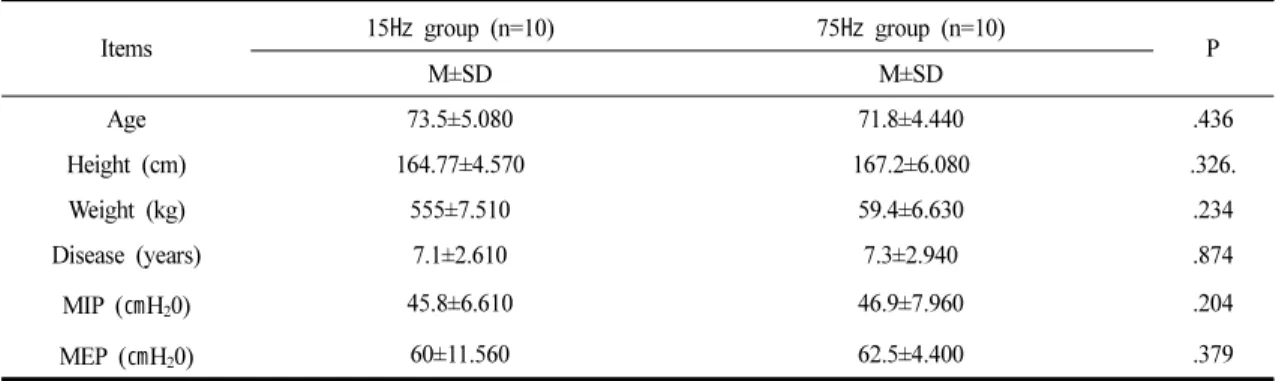
METHODS: Samples were collected from 20 COPD patients and placed randomly in a low-frequency group (n=10) and high-frequency group (n=10). For a pretest, the respiratory muscle strength (MIP, MEP), quadriceps muscle activity (LF, VM, VL), and life quality (SGRQ) were
†Corresponding Author : Jun-Su Park
[email protected], https://orcid.org/0000-0002-7869-5928 This is an Open Access article distributed under the terms of the Creative Commons Attribution Non-Commercial License (http://creativecommons.org/licenses/by-nc/3.0) which permits unrestricted non-commercial use, distribution, and reproduction in any medium, provided the original work is properly cited.
measured. After applying NMES to each group for 30 minutes at a time, five times a week, for four weeks, a posttest was conducted in the same way as the pretest.
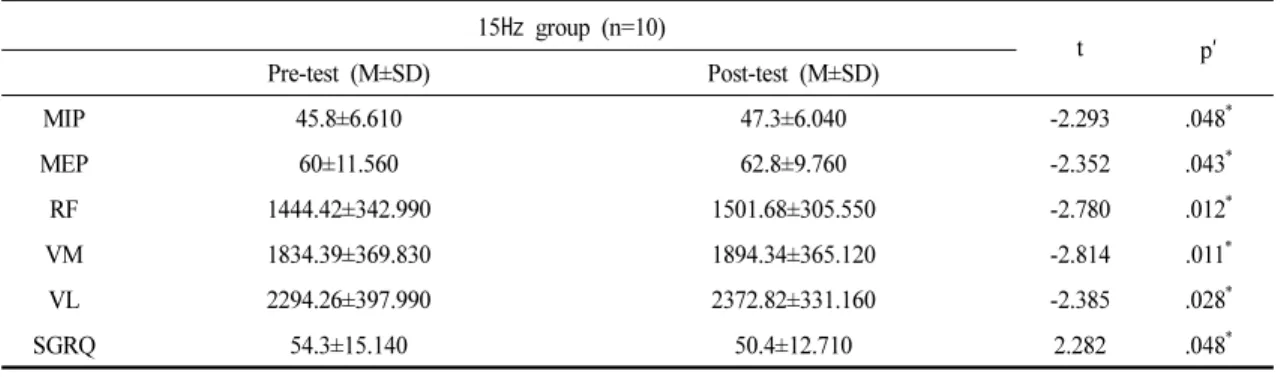
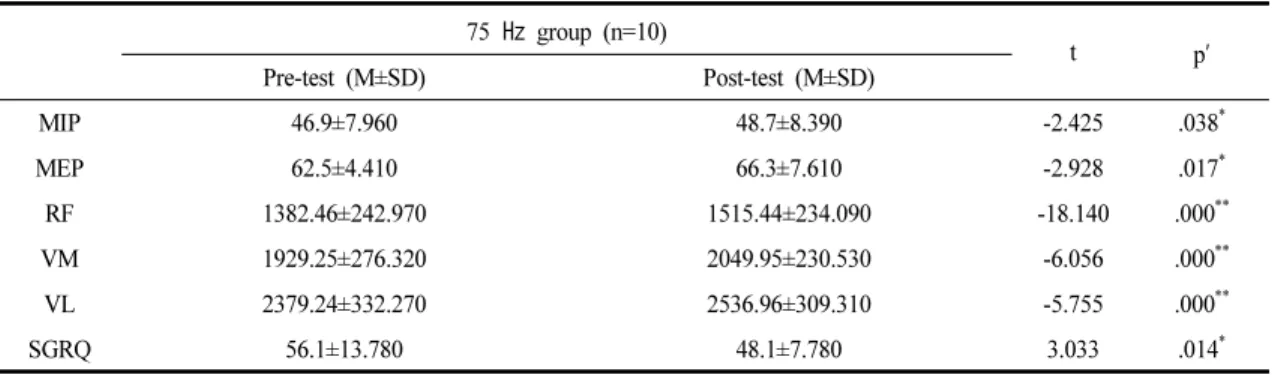
RESULTS: Both groups showed significant differences in the respiratory muscle strength, quadriceps muscle activity, and quality of life within the groups and there were significant differences in the quadriceps muscle activity between the groups.
CONCLUSION: The four-weeks NMES positively influenced the respiratory muscle strength and life quality by enhancing the function of the quadriceps and exercise tolerance. In particular, high-frequency(75 ㎐) NMES was more effective than low-frequency (15 ㎐) NMES. This result can be an alternative means to improve the physical functions of COPD patients clinically in the future.
Key Words: COPD, NMES, Frequency, Quadriceps muscle, Respiratory Strength
Research Article Open Access
주파수에 따른 신경근전기자극치료가 중증 만성폐쇄성폐질환 환자의 호흡근력, 넙다리네갈래근 활성도 및 삶의 질에 미치는 영향