• 검색 결과가 없습니다.

Comparison of the Rehabilitation Program after Rotator Cuff Repair by Time Closed Chain Exercise

N/A
N/A
Protected

Academic year: 2021

Share "Comparison of the Rehabilitation Program after Rotator Cuff Repair by Time Closed Chain Exercise"

Copied!
8
0
0

로드 중.... (전체 텍스트 보기)

전체 글

(1)

Research Article Open Access

회전근개봉합술 후 닫힌사슬운동 적용 시점에 따른 효과 비교

송현승⋅김선엽 1†

대전대학교 대학원 물리치료학과, 1 대전대학교 자연과학대학 물리치료학과

Comparison of the Rehabilitation Program after Rotator Cuff Repair by Time Closed Chain Exercise

Hyun-Seung Song, PT, MS, Suhn-Yeop Kim, PT, PhD 1†

Department of Physical Therapy, The Graduate School of Daejeon University

1 Department of Physical Therapy, College of Natural Science, Daejeon University

Received: September 15, 2014 / Revised: November 7, 2014 / Accepted: November 14, 2014

ⓒ 2014 J Korean Soc Phys Med

| Abstract |

1)

PURPOSE: This study aimed to examine the pain, range of motion (ROM), upper extremity task performance, and functional levels of patients after rotator cuff repair according to the timing of a closed chain exercise thereby presenting basic data for an effective rehabilitation program.

METHODS: The intervention was applied three times per week, one hour per day, for four weeks to 40 participants, 78 of whom had undergone rotator cuff repair. The participants were divided into four groups and assigned to usual general physical therapy and an open chain exercise. Group I consisted of the open chain exercise only. The closed chain exercise was applied to group II after the 4 times, group III after the 7 times, group IV after the 10 times. Measurement were used ROM, visual analogue scale (VAS), box and block test (BBT), and shoulder pain and disability index (SPADI).A

†Corresponding Author : [email protected]

This is an Open Access article distributed under the terms of the Creative Commons Attribution Non-Commercial License (http://creativecommons.org/licenses/by-nc/3.0) which permits unrestricted non-commercial use, distribution, and reproduction in any medium, provided the original work is properly cited.

one-way analysis of variance was conducted to test differences.

RESULTS: There were significant differences in the internal/external rotation between group I and group II. The VAS significantly differed between group II and group I, group III, and group IV. The BBT results of group II and group I were significantly different compared to those of group IV.

The SPADI significantly differed between group II and group I and between group II and group IV.

CONCLUSION: The closed chain exercise was effective for patients following rotator cuff repair from the second week after active exercise was prescribed, verifying its applicability in rehabilitation programs.

Key Words: Close chain exercise, Rotator cuff repair, Rehabilitation

Ⅰ. 서 론

견관절 통증은 흔한 근골격계 질환으로(Ministry of

Labor, 2007), 성인인구의 20% 이상이 평생에 한번 이상

경험하고 있으며 , 이로 인해 수면 장애, 먹기, 씻기, 같은

(2)

1 2 3 4 5 6 7 8 9 10 11 12 EXP1

EXP2 EXP3 EXP4

: Open chain exercise applied : Closed chain exercise applied EXP 1: Open chain exercise applied group

EXP 2: Closed chain exercise applied group from 4 times EXP 3: Closed chain exercise applied group from 7 times EXP 4: Closed chain exercise applied group from 10 times Table 1. Application period to exercise between groups 일상생활을 어렵게 한다 (Burbank, 2008). 견관절 통증의 원인은 충돌증후군, 유착성견관절낭염, 근막통증증후군, 관절염 , 회전근개 파열 같은 질환이 있다(Ostor 등, 2005).

이중 회전근개 파열은 최근 산업체 근골격계 질환 및 레져 활동 인구 증가로 발생이 증가하고 있으며 (Williams 등, 2007), 점차적인 퇴행성 변화로 인한 내적 원인과 외상에 의한 갑작스런 큰 부하 같은 외적 요인에 의해 발생한다 (Boes 등, 2005). 회전근 파열에 대한 치료 방법은 보존적 방법과 수술적인 방법이 있으며, 영상 진단 방법과 의료기술 발전으로 인하여 수술적 처치 빈도가 증가하고 있다(Williams 등, 2007). 회전근개 봉 합술 후 초기에 보조기 착용으로 석화화가 진행되어 관절의 운동기능이 감소되는 특성과 통증으로 인해, 환자는 심리적 불안감으로 부동자세를 취해 기능 감소 와 통증이 증가되는 악순환이 반복된다(Lee 등, 2012).

따라서 통증 감소와 관절가동범위 증진, 근력 및 지구 력에 대한 관리가 필요하다(Kim, 2008).

회전근개 봉합술 후 재활프로그램을 강조하고 있으 나, 개개의 근력 강화와 관절가동범위 증진에 초점을 두고 있다(Kim, 2008). 견관절 기능 회복을 위한 효과적 인 재활프로그램을 제공하기 위해서는 견관절 안정근 들 사이의 균형적인 조절 능력 회복에 초점을 두어야 하며(Ludewig와 Cook, 2000), 이를 위해 개개의 근력 강화보다는 짝힘을 통한 균형 개선이 견관절의 기능 회복에 필요하다(Newman, 2013; William 등, 2007).

그러나 기존의 재활프로그램은 근력강화에 초점을 맞춘 열린사슬운동에 맞춰져 있다(Cohen 등, 2002). 열

린사슬운동은 근위부는 고정된 상태에서 원위부는 자 유롭게 움직이며 관절가동범위가 제한된 환자의 근력 강화를 위해 중요한 역할을 한다(Prentice와 Voight, 2001). 반면, 닫힌사슬운동은 원위부는 고정시킨 상태 에서 근위부와 원위부에서 저항을 동시에 적용할 수 있는 운동으로 근력강화, 지구력 증진뿐 만 아니라 관 절면의 기계적인 압박을 통해 여러 근육의 협응 수축을 일으키며 관절 주위의 구심성 수용체를 자극하여 더 많은 고유감각을 제공하므로 관절의 동적 안정성과 자 세유지에 효과적이다(Prentice와 Voight, 2001). 최근 닫 힌사슬운동을 이용한 재활프로그램을 사용하고 있다 (Ellenbecker 등, 2006). 하지만 기존 연구들에서 수술 후 재활프로그램에서는 열린사슬운동과 닫힌사슬운 동 방법을 회복 기간에 맞춰 복합적으로만 제시하고 있어 견관절 기능회복을 위해 효과적인 닫힌사슬운동 의 적용시점이 필요하다.

이에 본 연구의 목적은 회전근개봉합술 후 환자를 대상으로 한 재활과정에서 닫힌사슬운동 적용 시점에 따른 통증과 관절가동범위 , 상지과제수행력과 기능 수 준의 차이를 확인하고 이를 통해 효과적인 재활프로그 램을 위한 기초자료를 제시하고자 한다.

Ⅱ. 연구 방법

1. 연구대상 및 연구기간

본 연구는 진단방사선과 전문의에 회전근개 파열

(3)

Classification Methods Warming up

(5 min)

1. Stretching the shoulder joint front section and rear portion in a standing position 2. Walking in place moving arms

3. Deep breathing

Resting time (5 min)

Main Exercises (40 min)

Open chain exercise Closed chain exercise

1. External rotation muscle strengthening exercise with a dumbbell in the side-lying position.

2. Scapular protraction and distraction, upward rotation and downward rotation, elevation and depression exercise using dumbbell.

3. Flexion and abduction, extension, internal rotation, external rotation exercises using dumbbells and elastic band (performed with isotonic).

1. External rotation strengthening exercises in a standing position using the wall

2. Push-up plus exercise using wall 3. Push-up plus exercise in quadri position 4. Lifting buttock with both hands in a sitting

position in chair

Resting time (5 min) Cool down

(5 min)

1. Stretching the shoulder joint front section and rear portion in a standing position 2. Walking in place moving arms

3. Deep breathing Table 2. Rehabilitation Program

진단을 받고 수술한 외래 환자 78명 중 중도 탈락자 13명, 선정기준 미달 자 20명, 참여 거부 15명을 제외한 40명을 대상으로 하였다. 대상자 선정은 회전근개 파열 진단을 받은 자 , 수술 후 6주가 경과하고 주치의의 능동 운동 처방을 받은 자로 하였으며, 경추부와 상지에 신 경학적 증상이 있는 자와 견관절 골절로 인한 처치를 받은 자는 제외하였다 . 모든 참여자는 설명을 받고 자발 적으로 동의한 자로 하였다 . 본 연구는 대전대학교 인간 생명연구윤리위원회의 연구심의를 받고 진행하였다.

대상자들은 제비뽑기를 통해 무작위로 10명씩 실험 군 1, 실험군 2, 실험군 3, 실험군 4로 배정하여 4주 간 주 3회, 1일 60분씩 총 12회 진행하였다. 모든 실험군 은 동일하게 일반적인 물리치료(온습포 30분, 경피신 경자극치료 15분, 심부열치료 3분)를 적용하였다. 실험 군 1은 열린사슬운동을 적용하였으며, 닫힌사슬운동 적용을 실험군 2는 4회부터 그리고 실험군 3은 7회부터 그리고 실험군 4는 10회부터 적용하였다(Table 1).

2. 평가도구

1) 견관절 관절가동범위

견관절의 관절가동범위 (range of motion; ROM)는 측

각기(gonoimeter)를 사용하여 굴곡과 신전, 외회전과 내 회전, 외전과 내전에 대한 능동가동범위를 측정 하였 다 . ROM 측정 시 통증이 발현되지 않는 범위에서 3회 측정 후 평균값을 사용하였다. 측정 순서에 의한 영향 을 최소화하기 위해 무작위로 진행하였다.

2) 통증수준

통증수준은 시각적상사척도(visual analogue scale;

VAS)를 사용하여 측정하였으며, VAS는 환자가 느끼 는 통증의 정도를 시각적인 형태로 나타내는 방법으로 10cm자를 이용하여 통증이 전혀 없는 상태가 0cm이고 매우 극심한 통증으로 참을 수 없는 상태를 10cm에 표시 한다. VAS의 검사-재검사 신뢰도(r=.99)와 측정자간 신 뢰도(r=1.00)는 매우 높다(Tashjian 등, 2009).

3) 상지과제수행력

상지과제수행력을 알아보기 위해 상자와 나무토막

검사 (box & block test; BBT)를 사용하였다. BBT는 성인

이나 소아 모두에게 적용 가능한 도구로써, 60초 동안

정사각형의 블록을 한쪽 상자에서 다른 쪽 상자로 옮긴

개수를 점수로 산정하였다(Desrosiers 등, 1994). 1회 연

습 후 1회 측정하여 점수화 하였다.

(4)

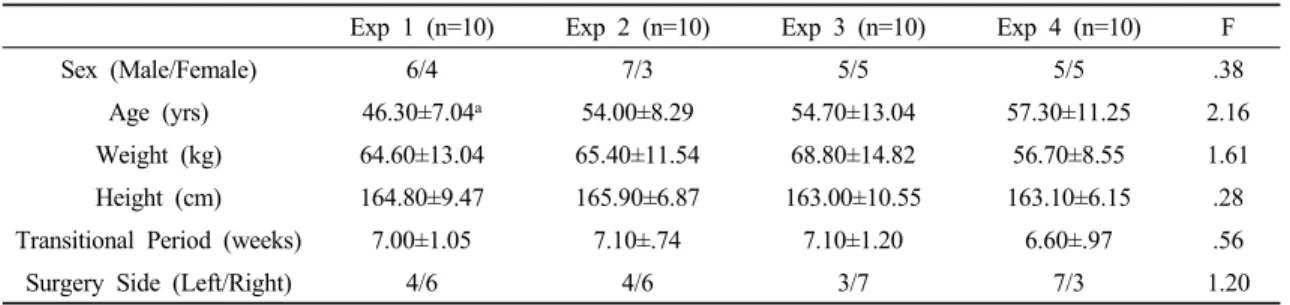
Exp 1 (n=10) Exp 2 (n=10) Exp 3 (n=10) Exp 4 (n=10) F

Sex (Male/Female) 6/4 7/3 5/5 5/5 .38

Age (yrs) 46.30±7.04 a 54.00±8.29 54.70±13.04 57.30±11.25 2.16

Weight (kg) 64.60±13.04 65.40±11.54 68.80±14.82 56.70±8.55 1.61

Height (cm) 164.80±9.47 165.90±6.87 163.00±10.55 163.10±6.15 .28

Transitional Period (weeks) 7.00±1.05 7.10±.74 7.10±1.20 6.60±.97 .56

Surgery Side (Left/Right) 4/6 4/6 3/7 7/3 1.20

a Mean±SD

Exp1: Open chain exercise applied group

Exp2: Closed chain exercise applied group from 4 times Exp3: Closed chain exercise applied group from 7 times Exp4: Closed chain exercise applied group from 10 times Table 3. General characteristics of subjects

Exp 1 (n=10) Exp 2 (n=10) Exp 3 (n=10) Exp 4 (n=10) F Post Hoc

Flexion/

Extension

pre 107.87±12.80 a 112.33±16.33 112.33±13.59 103.86±15.58 .77 post 122.60±12.13 128.83±15.39 128.73±13.02 119.80±12.97 1.14

Dif 14.74±4.09 16.50±4.65 16.39±4.96 15.94±3.81 .80

Abduction/

Adduction

pre 107.90±11.03 110.64±12.05 107.83±12.60 107.07±12.25 .17 post 117.70±11.59 126.10±9.45 122.60±13.13 118.50±10.02 1.22

Dif 9.79±7.37 15.45±5.31 14.77±10.48 11.43±4.48 1.37

Rotation

pre 91.70±4.62 98.30±8.73 91.60±4.14 92.70±4.95 2.84

post 99.60±5.64 111.25±9.41 101.75±3.27 101.58±5.39 6.84

Dif 7.50±5.59 12.95±5.12 10.15±2.70 8.88±2.72 2.99 2>1 *

a Mean±SD, * p<.05

Exp1: Open chain exercise applied group

Exp2: Closed chain exercise applied group from 4 times Exp3: Closed chain exercise applied group from 7 times Exp4: Closed chain exercise applied group from 10 times

Table 4. Comparison of range of motion change between groups in accordance with the applicable time of closed chain exercise

4) 견관절 통증과 기능수준

견관절의 통증과 기능수준을 알아보기 위하여 견관 절 통증과 장애 지수(shoulder pain and disability index;

SPADI, ICC=.64∼.66)를 사용하였다. SPADI는 자가 설 문 방식으로 통증지수 5개, 장애지수 8개 문항으로 구 성되어 있으며 각 문항은 어려움 없음 0점에서 전혀 할 수 없음 10점으로 총점과 백분율로 환산하여 사용할 수 있다(Williams 등, 1995).

3. 중재 방법

본 연구에서 재활프로그램은 Cohen (2002)이 제시한

회전근개 파열 후 재활프로그램을 본 연구 목적에 맞게

수정하여 사용하였다(Table 2). 15회/3세트로 시행하였

고 모든 운동은 통증이 유발되지 않는 범위에서 대상자

의 상태에 맞췄으며, 능력 증진에 따라 난이도를 조절

하였다. 난이도 조절 방법으로 아령은 0.5∼2.5kg으로

0.5kg 단위로 향상시켰으며, 탄력밴드(Thera-band, The

Hygenic Corp, USA)는 색상에 따라 적용하였다. 모든

운동은 3년 이상의 경력을 가진 물리치료사의 감독 하

에 시행하였다.

(5)

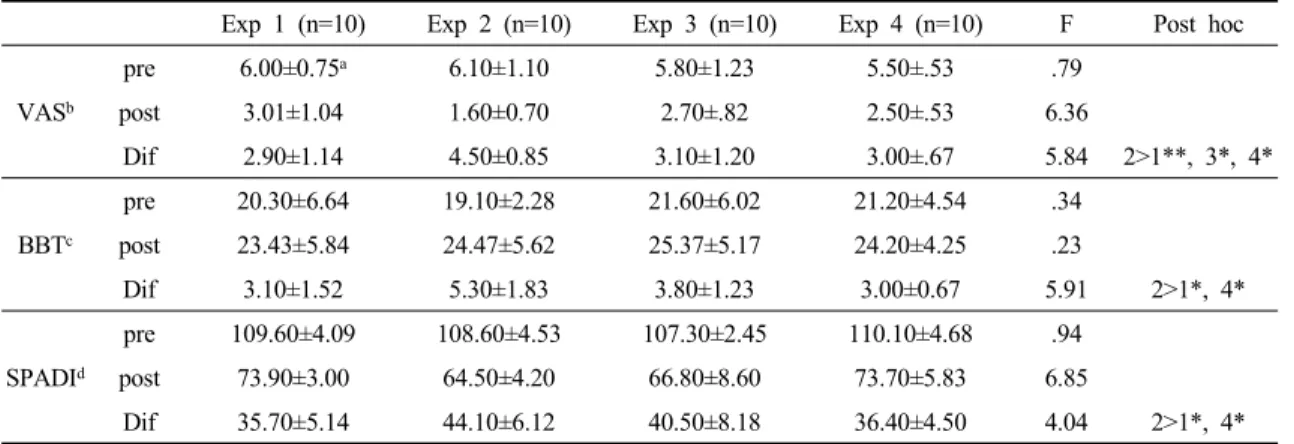
Exp 1 (n=10) Exp 2 (n=10) Exp 3 (n=10) Exp 4 (n=10) F Post hoc VAS b

pre 6.00±0.75 a 6.10±1.10 5.80±1.23 5.50±.53 .79

post 3.01±1.04 1.60±0.70 2.70±.82 2.50±.53 6.36

Dif 2.90±1.14 4.50±0.85 3.10±1.20 3.00±.67 5.84 2>1**, 3*, 4*

BBT c

pre 20.30±6.64 19.10±2.28 21.60±6.02 21.20±4.54 .34

post 23.43±5.84 24.47±5.62 25.37±5.17 24.20±4.25 .23

Dif 3.10±1.52 5.30±1.83 3.80±1.23 3.00±0.67 5.91 2>1*, 4*

SPADI d

pre 109.60±4.09 108.60±4.53 107.30±2.45 110.10±4.68 .94

post 73.90±3.00 64.50±4.20 66.80±8.60 73.70±5.83 6.85

Dif 35.70±5.14 44.10±6.12 40.50±8.18 36.40±4.50 4.04 2>1*, 4*

a Mean±SD, b Visual analogue scale, c Box & black test, d Shoulder pain and disability index Exp1: Open chain exercise applied group

Exp2: Closed chain exercise applied group from 4 times Exp3: Closed chain exercise applied group from 7 times Exp4: Closed chain exercise applied group from 10 times

*p<.05, **p<.01

Table 5. Comparison of VAS and BBT, SPADI change between groups in accordance with the applicable time of closed chain exercises

4. 자료 분석

수집된 자료는 윈도우용 SPSS Ver 17.0 프로그램을 사용하였으며, 그룹 간 측정 항목들 차이에 대한 검정 은 일요인 분산분석(one-way ANOVA)을 사용하였다.

사후검정은 Bonferroni 검정을 실시하였다. 측정 항목 에 대한 통계학적 유의수준은 α=.05로 하였다.

Ⅲ. 연구 결과

1. 연구대상자 특성

연구에 참여한 그룹 내 대상자들의 특성은 Table 3과 같으며 , 동질성 검정에서 모든 항목에서 그룹 간 유의 한 차이는 없었다.

2. 견관절 관절가동범위 차이 비교

관절가동범위는 중재전후 그룹 간 차이비교에서 외 회전 /내회전은 실험군 2가 실험군 1보다 유의하게 향상 되었다(p<.05). 굴곡/신전과 외전/내전은 그룹 간 유의 한 차이가 없었다(Table 4).

3. 통증수준의 차이 비교

VAS는 중재전후 차이비교에서 실험군 2가 실험군 1(p<.01)과 실험군 3(p<.05), 실험군 4(p<.05)보다 유의 하게 감소되었다 . 다른 그룹에서는 유의한 차이가 없었 다(Table 5).

4. 상지과제수행력의 차이 비교

BBT는 중재전후 그룹간 차이비교에서 실험군 2가 실험군 1(p<.01)과 실험군 4(p<.01)보다 유의하게 향 상되었다. 다른 그룹에서는 유의한 차이가 없었다 (Table 5).

5. 견관절 통증과 기능 수준 차이 비교

SPADI는 중재전후 그룹간 차이비교에서 실험군 2와

실험군 1(p<.05) 그리고 실험군 2와 실험군 4(p<.05)에

서 각각 유의하게 감소하였다 . 다른 그룹에서는 유의한

차이가 없었다(Table 5).

(6)

Ⅳ. 고 찰

본 연구는 회전근개봉합술 후 환자를 대상으로 재활 프로그램에서 닫힌사슬운동 적용시점에 따른 차이를 알아본 결과, 열린사슬운동 보다 닫힌사슬운동에서 견 관절 관절가동범위, 통증, 상지과제수행력과 기능에서 차이가 있었고 2주차에서 시작하는 것이 기능개선에 효과적인 것으로 나타났다.

회전근개봉합술에 있어 회전근개 파열의 크기와 파 열의 정도에 따라 수술 후 기능과 만족도 , 기능에 영향 을 미친다(Ellman, 1991)고 하였으나, 이후 연구에서 Burkhart 등(2001)은 파열의 크기가 결과에 영향을 주지 않으며, 국내에서도 전층파열과 부분파열에 있어 기능 의 차이는 없다고 하였다(Park, 2003). 이에 본 연구에서 는 파열의 크기가 결과에 영향을 주지 않는다고 판단하 여 대상자 선정 시 파열 크기를 구분하지 않았으며 통증 조절 및 기능회복을 위한 재활프로그램이 중요하다고 생각하였다.

ROM은 외회전과 내회전만 실험군 2에서 실험군 1보다 유의한 향상이 있었으나 다른 가동범위에서는 유의한 향상이 없었다. Ellenbecker 등(2006)은 봉합술 후 12주경과 환자를 대상으로 근력강화훈련을 적용한 연구에서 가동범위와 근력의 유의한 향상을 보고하였 다 . 본 연구에서도 열린사슬운동과 닫힌사슬운동 모두 에서 가동범위 증가가 나타났다. 이는 모든 그룹에 적 용한 ROM운동이 관절연골에 영양분을 공급하고, 콜 라겐 조직의 정렬 및 재합성에 도움(Wilk와 Arrigo, 1993)을 준 것으로 생각된다. 그리고 Matthew 등(2005) 은 회전근개 불균형 원인이 외회전과 내회전의 근력의 차이, 근육 크기 등으로 제시하였는데 외회전과 내회 전에서 유의한 차이가 있는 것은 본 연구에서 사용한 재활프로그램이 기능 향상을 위한 외회전과 내회전 운동에 초점이 맞춰진 것으로 생각되며 의미가 있다고 하겠다.

VAS는 실험군 2는 실험군 1과 실험군 3, 실험군 4에 서 유의한 차이가 있었다. 이는 닫힌사슬운동 방법으로 적용한 푸쉬업 플러스 운동이(push-up plus) 견갑골의 안정화에 중요한 전거근의 활성화에 영향을 주었고 중

승모근과 하승모근의 작용을 촉진해 견갑골의 안정화 와 상방회전을 원활하게 이루어지도록 한 결과 4회차 적용 그룹이 다른 그룹에 비해 통증 감소에 긍정적 영향 을 준 것으로 생각된다 . BBT는 실험군 2는 실험군 1과 실험군 4에서 유의한 차이가 있었고, SPADI는 실험군 2와 실험군 1과 실험군 4에서 유의한 차이가 있었다.

회전근개 수술 후 환자 37명을 대상으로 ROM과 등척 성 근력, 미국견주관절외과학회 평가도구(American shoulder elbow surgeons rating scale)를 사용하여 6주와 12주 후 비교에서 유의한 향상을 보고한 Ellenbecker 등 (2006)의 연구결과와 같았다. 회전근개는 견관절 안 정화에 중요한 작용을 하는 근육으로 기능회복을 위한 운동은 상지의 기능적 움직임 회복을 위해 반드시 필요 하며(Ginn와 Cohen, 2005), 이러한 어깨관절 근육들은 여러 관절들을 통해 협응된 활동을 생산해내는 복합적 작용들로 운동성이 제공되며 조절된다(Neumann, 2013). 본 연구에서 닫힌사슬에 바탕을 둔 푸쉬업 플러 스 (push-up plus) 운동을 선 자세와 네발기기 자세에서 시행하여 안정화 작용에 필요한 견갑골 주변 근육의 촉진과 상호작용 증진으로 수행력과 기능을 향상 시킨 것으로 생각된다.

회전근개봉합술 후 단순한 증상 회복을 위함이 아니 라 적극적인 재활을 통해 통증 조절과 기능 증진을 이루 어야 한다 . 이를 위해 닫힌사슬과열린사슬 안정화 운동 (Kisner와 Colby, 2012), 회전근개 강화 운동 시 견갑골 안정화 운동과 결합(Kibler 등, 2006)하여 재활 프로그 램을 체계적으로 시행하는 것이 중요하다. 또한 Dodson 등 (2010)은 회전근개봉합술 후 재파열의 위험성을 경 고하였는데 이 역시 재활의 필요성을 강조한 것으로 생각된다.

본 연구의 제한점은 연구 대상자 수가 적어 모든

회전근개 수술 후 환자에게 적용하기 어려우며 , 프로그

램의 효과의 지속 여부를 확인하지 못하였다. 이를 보

완한 재활 프로그램 효과를 알아보는 연구가 필요할

것으로 생각된다.

(7)

Ⅴ. 결 론

본 연구는 회전근개봉합술 후 환자를 대상으로 닫힌 사슬운동 적용 시점에 따른 재활프로그램을 실시하였 고, 중재전후 차이 비교를 통해 관절가동범위와 통증, 상지과제수행력, 기능 수준을 평가하였다. 분석한 결과 관절가동범위는 실험군 2가 실험군 1보다 외회전/내회 전에서(p<.05) 유의하게 향상되었다. VAS는 실험군 2 가 실험군 1(p<.01)과 실험군 3(p<.05), 실험군 4(p<.05) 보다 더 유의하게 감소하였다. 그리고 BBT는 실험군 2가 실험군 1과 실험군 4(p<.01)에서 유의한 향상을, SPADI에서는 실험군 1과 실험군 4(p<.05)에서 유의하 게 감소하였다. 이러한 결과는 회전근개 수술 후 환자 가 능동운동 처방을 받은 후 2주차가 되는 시점부터 닫힌사슬운동을 적용하는 것이 효과적임을 알 수 있었 고 , 이를 통해 재활프로그램으로 적용 가능성을 확인하 였다.

References

Boes MT. McCann PD. Dines DM. Diagnosis and management of massive rotator cuff tears: the surgeon’s dilemma.

Instructional course lectures. 2005;55:45-57.

BurbanK KM. StevenSon JH. Czarnecki GR. et al. Chronic shoulder pain: part II. Treatment. Am Fam Physician.

2008;77(4):493-7.

Burkhart SS. Danaceau SM. Pearce Jr CE. Arthroscopic rotator cuff repair: analysis of results by tear size and by repair technique―margin convergence versus direct tendon-to-bone repair. Arthroscopy: 2001;17(9):905-12.

Cohen BB. Romeo AA. Bach Jr B. Rehabilitation of the shoulder after rotator-cuff repair. Operative Techniques in Orthopaedics. 2002;12(3):218-24.

Desrosiers J. Bravo G. Hebert R. et al. Validation of the Box and Block Test as a measure of dexterity of elderly people: reliability, validity, and norms studies. Arch Phys Med Rehabil. 1994;75(7):751-5.

Dodson CC. Kitay A. Verma NN. et al. The long-term outcome of recurrent defects after rotator cuff repair. Am J Sports Med. 2010;38(1):35-9.

Ellenbecker TS. Elmore E. Bailie DS. Descriptive report of shoulder range of motion and rotational strength 6 and 12 weeks following rotator cuff repair using a mini-open deltoid splitting technique. J Orthop Sports PhysTher. 2006;36(5):326-35.

Ellman H. Surgical treatment of rotator cuff rupture.In Watson Med. Surgical Disorders of the Shoulder. 1991:283-4.

Ginn KA. Cohen, ML. Exercise therapy for shoulder pain aimed at restoring neuromuscular control: a randomized comparative clinical trial. J Rehabil Med.

2005;37(2):115-22.

Kibler WB. Sciascia A. Dome D. Evaluation of apparent and absolute supraspinatus strength in patients with shoulder injury using the scapular retraction test. Am J Sports Med. 2006;34(10):1643-7.

Kim JH. Rehabilitation of Rotator Cuff Repair.The Journal of Korean Arthroscopy. 2008;12(2):82-6.

Kisner C. Colby, L.A. Therapeutic exercise: foundations and techniques. FA Davis. 2012.

Lee BG. Cho N.S. Rhee, YG. Effect of two rehabilitation protocols on range of motion and healing rates after arthroscopic rotator cuff repair: aggressive versus limited early passive exercises. Arthroscopy:

Arthroscopy. 2012;28(1):34-42.

Ludewig PM. Cook T.M. Alterations in shoulder kinematics and associated muscle activity in people with symptoms of shoulder impingement. PhysTher.

2000;80(3):276-91.

Mattew AC. Michael CC. Michael GC. Orthipaedic sports medicine board review manual: Rotator cuff injury.

Orthop Sports Med. 2005;2(2):1-13.

Ministry of Labor.Analysis of the current state of work-related accidents 1998-2006. 2007.

Neumann DA. Kinesiology of the musculoskeletal system:

Foundations for rehabilitation: Elsevier Health

(8)

Sciences. 2013.

Östör A. Richards C. PrevostA. et al. Diagnosis and relation to general health of shoulder disorders presenting to primary care.Rheumatology. 2005;44(6):800-5.

Park JY. Pathology of impingement syndrome and anatomy of the shoulder joint. Orthopedics classroom of DankookMedical University. 2003.

Prentice WE. Voight ML. Techniques in musculoskeletal rehabilitation: McGraw Hill Professional. 2001.

Tashjian RZ. Deloach J. Porucznik CA. et al. Minimal clinically important differences (MCID) and patient acceptable symptomatic state (PASS) for visual analog scales

(VAS) measuring pain in patients treated for rotator cuff disease. J Shoulder Elbow Surg. 2009;18(6):

927-32.

Wilk KE. Arrigo C. Current concepts in the rehabilitation of the athletic shoulder.J Orthop Sports PhysTher.

1993;18(1):365-78.

William GB. Mary BB. Michael J. et al. Patient outcome following rehabilitation for rotator cuff repair surgery.J Orthop Sports PhysTher. 2007;37(6):312-9.

Williams Jr JW. Holleman Jr DR. Simel D. Measuring shoulder function with the Shoulder Pain and Disability Index.

J Rheumatol. 1995;22(4):727-32.

수치

Table 4. Comparison of range of motion change between groups in accordance with the applicable time of closed chain exercise
Table 5. Comparison of VAS and BBT, SPADI change between groups in accordance with the applicable time of  closed chain exercises

참조

관련 문서

Abstract: This study was aimed to investigate the adhesion control standards of pain relieving patch (PRP) drugs and to survey it′s adverse effects on the skin of patients

The purpose of this study was to evaluate the effect of these substances on bone regeneration by applying these materials to bone defects after cyst

The purpose of this study was to evaluate surface changes and abrasion of the implant fixture and TiN coated abutment screw after repeated delivery and

The purpose of this study was to examine the effects of 8 weeks of Zumba dance exercise for obese middle-aged women on blood lipid index and vascular aging.. The subjects of

Comparison of the proportion of permanent teeth extraction according to oral disease by tooth type in the upper jaw ··· 21... Comparison of the proportion of permanent

The purpose and necessity of this study was to investigate the effect of the 8-week GX complex exercise program on the stress index, blood lipid and APG

Purpose: This study was aimed to compare the functional outcomes of the continuous and discontinuous fractures, retrospectively, in multiple thoracolumbar

The purpose of this study is to examine the situation of online classes due to the COVID-19 situation, and to find out the actual situation and