THE LEVEL OF RESIDUAL MONOMER IN INJECTION MOLDED DENTURE BASE MATERIALS
Hyeok-Jae Lee, D.D.S., Chang-Whe Kim, D.D.S., M.S.D, Ph.D., Yung-Soo Kim, D.D.S., M.S.D, Ph.D.
Department of Prosthodontics, Graduate School, Seoul National University
Statement of Problem : The residual monomer of denture base materials causes hypersensitivity on oral mucosa and intereferes with the mechanical properties of the cured resin. The amount of residual monomer is influenced by materials, curing cycle, processing method, and etc.
Purpose : The aim of this study was to investigate the residual methyl methacrylate(MMA) con- tent of injection molded denture base polymer, and to compare this with the self-cured resin and the conventional compression molded heat-cured resin.
Materials and Methods : Disc shaped test specimens (50mm in diameter and 3mm thick) were prepared in a conventional flasking technique with gypsum molding. One autopolymerized denture base resins (Vertex SC. Dentimex. Netherlands) and two heat-cured denture base resins (Vertex RS. Dentimex. Netherlands, Ivocap. Ivoclar Vivadent, USA) were used. The three types of specimens were processed according to the manufacturer's instruction. After polymeriza- tion, all specimens were stored in the dark at room temperature for 7 days. There were 10 spec- imens in each of the test groups. 3-mm twist drills were used to obtain the resin samples and 650mg of the drilled sample were collected for each estimation. Gas chromatography (Agillent 6890 Plus Gas Chromatograph, Agillent Co, USA) was used to determine the residual MMA content of 10 test specimens of each three types of polymer.
Results :The residual monomer content of injection molded denture base resins was 1.057±
0.141%. The residual monomer content of injection molded denture base resins was higher than that of compression molded heat cured resin (0.867±0.169%). However, there was no statistical significant difference between two groups (p >0.01). The level of residual monomer in self cured resin(3.675±0.791) was higher than those of injection molded and compression molded heat cured resins (p<0.01).
Conclusion : With respect to ISO specification pass/fail test (2.2% mass fraction) of residual monomer, injection molding technique(1.057±0.141%) is a clinically useful and safe technique in terms of residual monomer.
Key Words
Residual monomer, Injection molding, Denture base, Gas chromatography
J Korean Acad Prosthodont : Volume 41, Number 3, 2003
A
crylic resin polymers were introduced as a den- ture base material in 1937. Nowadays the majority of dentures are made of heat-cured polymethyl methacrylate(PMMA). Polyme- rization of PMMA can be started by heating the polymer -monomer mix- ture in a water bath, and by chemical activation. The goal of conventional rapid curing of acrylic resins is to completely polymerize the resin without poros- ity. In the conventional rapid curing methods, the monomer molecules are moved by thermal shocks from other molecules and passively moved to poly- mer chain due to external heat. During polymerization the monomer is reduced. As the temperature increas- es, molecular mobility speeds up, leading to more complete polymerization. All acrylic resins con- tain variable residual monomer levels depending on the ambient conditions and the efficiency of heat trans- fer. Flory1characterizes the process as a combination of effective monomer diffusion, exothermic heat, and chain mobility to autoaccelerate the MMA conver- sion to PMMA. Residual monomer may diffuse from acrylic resin to saliva resulting in irritation of allergic side effects.2,3For acrylic resins to induce a primary irritation of sensitization, free monomer must be leached out. Proper processing techniques min- imizes residual monomer in the range of 1-3%which is well tolerated by most individuals.4It has also been reported that a high level of residual monomer is detrimental to mechanical properties of the cured resins.5 Many investigations have demon- strated that residual monomer content varied con- siderably with curing conditions, and the amount of residual monomer was one of the primary factors affecting the properties of denture base materials pro- duced under different curing cycles. There are many factors that influence the level of residual monomer: curing cycle, processing method, thick- ness of denture base, immersion in water, period of usage, surface treatment.6-10In this study the effect of one of molding method, injection molding tech- nique, was investigated.
Compression molded methylmethacrylate has been the standard denture base material for more than 60 years. Undesirable dimensional changes that occur during processing by this method have been thoroughly documented.11More recently, an injec- tion molding technique, the SR-Ivocap System (Ivoclar USA Inc., San Marcos, Calif.) demonstrat- ed some advantages such as minimal changes in ver- tical dimension and enabling the processing a large maxillary obturator12. A continuous pressure in- jection technique has been developed to reduce processing error and increases resin density through layered polymerization of the resin with no processing flash. The use of prepacked liquid/powder cap- sules, a mechanical mixing procedure, and injection of mixed resin into the flask under continuous pressure during processing help produce a ho- mogenous denture. Improved dimensional stabili- ty, better control of polymerization shrinkage, and reduced vertical dimension of occlusion changes have been demonstrated with injection-processed pros- theses compared with those fabricated with the conventional compression molding technique.
Specifications of the continuous pressure injection technique for processing PMMA have been inves- tigated, with hi-gloss polished surfaces and ho- mogeneous structures being attributed to prepacked PMMA capsules and rapid mechanical mixing.
Previous reports on the injection molding system generally regarded with the dimensional accuracy and the opening of the vertical dimension of oc- clusion.13-21But there is few report on residual monomer in injection molding processing meth- ods. One of them reported that there was no sig- nificant difference between conventional heat and pressure technique and an injection molding system at room temperature under pressure (Intopress, Kulzer Co. Germany).22
The aim of this study was to investigate the effect of injection molding on the residual methyl methacry- late (MMA, 2-propenoic acid, 2-methyl-, methyl ester) content of denture base polymer.
MATERIALS AND METHODS 1. Materials
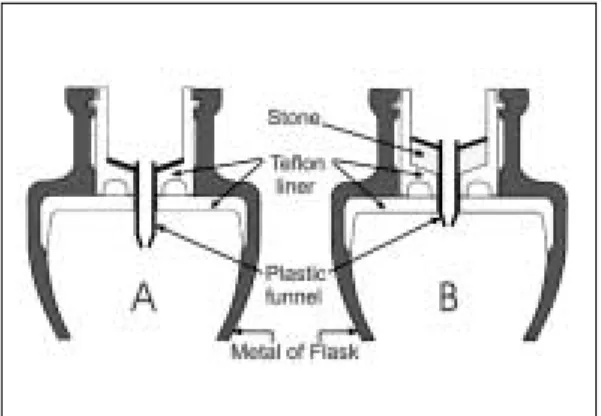
Three denture base resins, specially formulated for polymerization by different methods, were compared under the processing conditions listed (TableⅠ). These included a rapid-polymerized resin Vertex RS, which is not a conventional long cure resin as a con- trol group, because the experimental group Ivocap is a rapid-polymerized resin(Fig. 1).
2. Specimens, Sampling
Baseplate wax, with dimensions of 50mm in di- ameter and 3mm thick was invested in the denture flasks. Ten samples of each resin-polymerization method were prepared independently. The resins were processed according to the manufacturer's recommendation(Table Ⅰ). Finally disc shaped
test specimens were prepared (Fig. 2.a). After poly- merization, all specimens were stored in the dark at room temperature for 7 days. A 3-mm twist drill was used to obtain the samples. The drill was taken slowly through the specimen, and 650mg of the drilled sample were collected for each estimation (Fig.
2.b).
Fig. 1.Schematic drawing of injection molding of SR- Ivocap.
Table I. Denture base materials
Materials Manufacturers Curing modes
P/L ratio mixing time doughing time polymerization Vertex SC Dentimex. Netherlands 7 : 2 10 seconds 5 minutes 20C, 10minutes Vertex RS Dentimex. Netherlands 3 : 1 10 seconds 10 minutes 100C, 20 minutes SR-Ivocap Ivoclar Vivadent USA 20g/30ml 5 minutes 10 minutes 100C, 35 minutes
Fig. 2.a) Specimens. Fig. 2.b) Drill cuttings.
3. Extraction
To extract the residual MMA from the polymers, 650mg of the polymers were weighed and treated with 10ml of acetone. The sample solution was
fluxed by orbital shaker (Seolin. Korea) at room temperature. A 2ml aliquot of each sample solution was transferred to a tube. Then 0.1ml of an internal standard solution of n-butanol in methanol(35mg/ml) was added. Methanol solution was added to the sam-
a) b) c)
Fig. 3.a) Sample solution, b) After precipitation, c) After centrifugation.
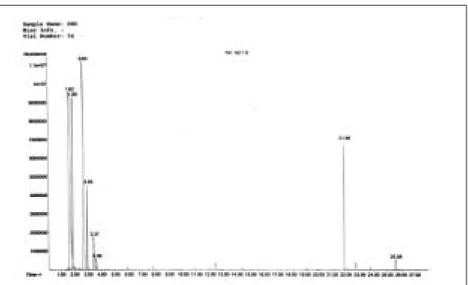
Fig. 4.A typical chromatogram, Peak of butanol(Internal standard) -retention time 2.9min.
monomethylmethacrylate - retention time 3.3min.
Table II. Peak area.
ple solution to a total volume of 10ml for precipitation of dissolved polymer. 5ml of the dissolved polymer slurry were centrifuged at 5000 rpm for 10 min in a centrifuge. A 3ml aliquot of the centrifuged sample solution was transferred to a separate closed 15ml polyprophylen conical tube(Fig. 3).
4. Measurement of MMA concentration from gas chromatographic recordings
The residual MMA content was determined with a gas chromatography(GC) (Agillent 6890 Plus Gas Chromatograph, Agillent Co, USA) (Fig. 4). The chromatographic column was nonpolar (length:
30m; internal diameter: 0.25mm) and the Mass Spectrometer(Agillent 5973 MSD, Agillent co, USA) was used as the detector. Helium was used as the car- rier gas. The concentration of MMA was deter- mined using a standard calibration curve. The total quantity of MMA in the sample solution and in the test specimens was calculated with the pro- portion of internal standard (Table Ⅱ).
5. Determination of residual MMA by the use of internal standards.
Percentage of residual monomer calculated by fol- lowing equation
: AMMA/AI.S.×0.35mg/ml×10/2×10/650×100 (2.69) AMMA = peak area of MMA
AI.S = peak area of internal standard 0.35 = correlation coefficient
10/2 = 2ml aliquot of each sample solution 10 = total volume of 10ml methanol solution.
650 = weight of sample 6. Statistical analysis
The statistical analysis was done by SPSS for window. The mean residual MMA contents were compared by one-way ANOVA in which the pro- cessing method was used as the independent vari- able. And residual MMA content as the depen- dent variable. Scheffe test was used for Post Hoc test.
RESULTS
Calibration solution was shown on Table Ⅱ.
Calibration solutions were produced using stan- dard solutions containing known amounts of monomethylmethacrylate in methanol.
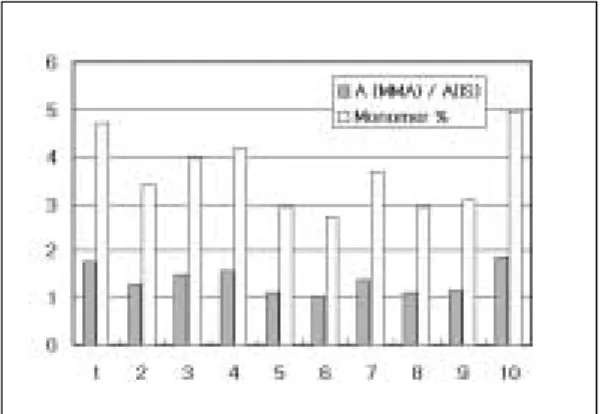
Fig. 5, 6 and 7 shows the residual MMA content in the autopolymerized denture base polymers, compression molded heat-cured resin, and injection molded heat-cured resin. The mean residual MMA content in autopolymerized resins was considerably higher than those of the other two types of resins.
(p<0.01) (Fig. 5, Table Ⅱ). The residual monomer con-
Table III. Calibration solution MMA concent-
AMMA/AI.S. Correlation AMMA/AI.S.
ration(mg/ml) coefficient. *0.35mg/ml
0.02 0.05 0.36 0.017
0.12 0.73 0.33 0.16
0.30 0.88 0.34 0.31
0.60 1.62 0.37 0.56
0.80 2.42 0.33 0.84
Fig. 5.Residual monomer of Vertex SC.
tent in injection molded denture base resins was high- er than those of compression molded heat cured resin, but there was no statistically significant difference between two groups (p>0.01) (Fig. 6, 7, Table Ⅲ).
DISCUSSIONS
Conventionally, when denture curing process was completed, dentures were stored in water.
Vallitu et al23investigated MMA release of chemi-
cal-cured PMMA and heat-cured PMMA in wa- ter. They showed that the amount of residual monomer decreased in water after 1 to 2 days.
Therefore in this study, specimens were stored in dry dark place to prevent monomer loss. In this study, collecting the sample was done by hand drilling.
Austin and Basker24 showed that there is no sig- nificant difference in respective monomer levels when specimens were sampled at four widely dif- ferent drill speeds. It seems that monomer ther-
Fig. 7.Residual monomer of SR-Ivocap.
Fig. 6. Residual monomer of Vertex RS.
Table IV. ANOVA, Post Hoc test ANOVA
Sum of squares df Mean square F Sig.
Between groups 49.250 2 24.625 112.578 0.000
Within groups 5.906 27 0.219
Total 22.155 29
Post Hoc Tests
Mean Difference Std. Error. Sig.
Scheffe SC RS 2.8080 0.2092 0.000
Ivocap 2.6180 0.2092 0.000
RS SC -2.8080 0.2092 0.000
Ivocap -0.1900 0.2092 0.666
Ivocap SC -2.6180 0.2092 0.000
RS 0.1900 0.2092 0.666
mal degradation and evaporation during drilling were negligible. Sadamori et al25investigated the several solvents of MMA. They showed that the suitable sol- vents for extraction of the monomer from cured resin such as ethyl acetate, acetone and methyl ethyl ketone are similar in structure to MMA.
Therefore acetone was used as the solvent for ex- traction in this study. Several physical and chemi- cal methods have been used to measure the level of residual monomer of PMMA resin. McCabe and Basker2, and Dogan et al26used gas-liquid chro- matography to show that the level of the residual monomer is inversely related to the curing time.
Vallitu et al27used high performance liquid chro- matography to investigate water release of residual monomer. Austin and Basker24compared the resid- ual monomer level obtained by gas chromatogra- phy(GC) and IR-spectral analysis (IR) for 12 speci- mens that had been cured for different curing time.
The results range from 0,24 to 6.33% for GC and 0.33 to 5.50% for IR measurements. The agreement for each of the specimens was considered to be acceptable.
Gas chromatography is an established method for determination of residual monomer of denture base polymers in its simplicity and rapidity.28
The residual monomer contents of Vertex SC, RS, & Ivocap agree with previous studies.9,24In these studies, the residual monomer contents are in- fluenced by polymerization time. Generally the residual monomer contents decrease when in- creasing curing time. The two types of heat cured resin(both short cure technic) show higer level of monomer than that of long cure technique.
Polymerization time of Ivocap (35min) is longer than Vertx RS(20min), but residual monomer level of Ivocap was slightly higher (RS-mean 0.867 ,Ivocap-mean 1.057). It may be due to different amount of cross-linking agent ( Ivocap : 5.6%, RS <
5). The cross-linking agents of the denture base polymers may affect the residual monomer con- tent of the polymer. The final conversion of MMA with a cross-linking agent decrease with increasing
content of the cross-linking agent. This is due to the cross-linked main chain segments, which are bound together via the cross-linking agent. A rigid polymer structure thus hinders the conversion of MMA monomers, especially at curing temperatures low- er than glass transition temperature(Tg).29
The residual MMA content of the heat-cured denture base polymers was considerably lower than that of the autopolymerized denture base polymers(Tg-67 to 78 C). This can be explained by the higher curing temperature, which can be as high as the glass transition temperature of the ma- trix phase of the heat cured denture base polymer (Tg- 97 to 100 C). Above the Tg of the polymer, the monomers of the resins have a better ability to polymerize due to higher molecular chain motions and neutralization of the immobilization of MMA in the glassy polymer at higher temperatures30.
The residual MMA content of denture base poly- mers is also influenced by denture thickness. The heat evolved during the polymerization reaction would cause the thicker specimen to reach higher tem- peratures and result in a greater degree of poly- merization and also the reduction in the amount of residual monomer. In this study thickness of spec- imen was 3mm, and mean monomer level was 0.867%, 1.057% respectively, which corresponds with previous studies(4,5mm-mean 0.72%, 3mm-mean 1.1, 1.5mm-mean 1.4 %).31
CONCLUSIONS
In this study, gas chromatography was used to in- vestigate the residual monomer in autopolymerized, compression molded, and injection molded resins.
Based on this study the following conclusion could be made.
1. The residual monomer content of injection mold- ed denture base resins was 1.057±0.141%.
2. The residual monomer content of injection mold- ed denture base resins was higher than that of compression molded heat cured resin(0.867±
0.169%). but there was no statistically signifi- cant difference between two groups (p>0.01).
3. The level of residual monomer in self cured resin(3.675±0.791) was higher than those of in- jection molded and compression molded heat cured resins (p<0.01).
4. With respect to ISO specification pass/fail test (2.2% mass fraction) of residual monomer, injection molding technique (1.057±0.141%) is a clinical- ly useful and safe technique in terms of residual monomer.
REFFERENCES
1. Flory PJ. Statistical Mechanics of chain molecules.
Interscience publishers 1969.
2. McCabe, JF, Basker RM: Tissue sensitivity to acylic resin. Brit dent J 1976;140:347-350.
3. Paul JS, Sreenivas K, Nels OE, Carol AL, Marshall, TL. Cytotoxicity of denture base resins. Int J prosthodont;10:73-77.
4. Ureporn K, Nongluk C, Sittichai K. Release of methyl methacrylate from heat-cured and au- topolymerized resins: cytotoxicity testing relat- ed to residual monomer. Australian Dental Journal 1999;44:25-30.
5. Arab J. Newton JP, Lloyd CH. The effect of an el- evated level of residual monomer on the whiten- ing of a denture base and its physical properties.
J Dent 1989; 17: 189-194.
6. Hrrison A, Huggett R: Effect of the curing cycle on residual monomer levels of acrylic resin denture base polymers. J Dent. 1992;20:370-374.
7. Bartoloni J A, Murchison D F, Wofford D T, Sarkar N K: Degree of conversion in denture base mate- rials for varied polymerization techniques. Journal of Oral Rehabilitation. 2000;27:488-493.
8. Sadamori S, Ganefiyanti T, Hamada T, Arima T:
Influence of thickness and location on the residual monomer content of denture base cured by three processing methods. J Prosthet Dent 1994;72:19-22.
9. Vallitu PK: The effect of surface treatment of den- ture acrylic resin on the residual monomer content and its release into water. Acta Odonto. Scand.
1996;54:188-192.
10. Sadamori S. Hamada T: The usage period of den- tures and their residual monomer contents. J Prosthet Dent 1992;68:374-376.
11. Craig RG Restorative dental materials. 9thedn.
CV Mosby, St. Louis 1993; 514-530.
12. Cotert HS, Cura C, Kesercioglu A. Modified flask- ing technique for processing a maxillary resec- tion obturator with continuous pressure injec- tion. J Prosthet Dent. 2001 Oct;86:438-40.
13. Mahler DB. Inarticulation of complete dentures processed by the compression molding technique.
J Prosthet Dent 1951;1:551-9.
14. Woelfel JB, Paffenbarger GC, Sweeney WT.
Dimensional changes occuring in denture dur- ing processing. J Am Dent Assoc 1960;61:413-30.
15. Anthony DH, Peyton FA. Dimensional accuracy of various denture base materials. J Prosthet Dent 1962;12:67-81.
16. Wesley RC. Henderson D, Franzier QZ, et al.
Processing changes in complete dentures: posterior tooth contacts and pin opening. J Prosthet Dent 1973;29:46-53.
17. Anderson GC, Schulte JK, Arnold TG. Dimensional stability of injection and conventional process- ing of denture base acrylic resin. J Prosthet Dent 1988;60:394-8.
18. Jackson AD, Grisius RJ, Fenster RK, Lang BR.m Dimensional accuracy of two denture base pro- cessing methods. Int J Prosthodont. 1989 Sep- Oct;2:421-8.
19. Strohaver RA. Comparison of changes in vertical dimension between compression and injection molded complete dentures. J Prosthet Dent. 1989 Dec;62:716-8.
20. Nogueira SS, Ogle RE, Davis EL. Comparison of ac- curacy between compression- and injection-mold- ed complete dentures. J Prosthet Dent. 1999 Sep;
82:291-300.
21. Memon MS, Yunus N, Razak AA. Some mechan- ical properties of a highly cross-linked, microwave- polymerized, injection-molded denture base poly- mer. Int J Prosthodont. 2001 May-Jun;14:214-8.
22. Kalipcilar B, Karaagaclioglu L, Hasanreisoglu. U.
Evaluation of the level of residual monomer in acrylic denture base materials having different polymerization properties. Journal of Oral Rehabilitation. 1991;18:399-401.
23. Vallitu PK, Miettinen V, Alakuijala P: Residual monomer content and its release into water from denture base materials. Dent Mater. 1995;11:338-342.
24. Austin AT, Basker RM. The level of residual monomer in acrylic denture base materials. B.
Dent J 1980;18:281-7.
25. Sadamori S, Higeto N, Hamada T, Okuda K: A method of determining residual monomer in acrylic resin using methyl ethyl ketone. Australian Dental Journal. 1990;35:509-13.
26. Dogan A, Bek B, Cevik NN, Usanmaz A. The effect of preparation conditions of acrylic denture base materials on the level of residual monomer, me- chanical properties and water absorption. J Denr 1995;23:313-318.
27. Vallitu PK: Effect of polymerization temperature and time on the residual monomer content of denture base polymers. Eur J Oral Sci 1998;106:
588-593.
28. Douglas WH, Bates JF. The determination of resid- ual monomer in polymethylmethacrylate den-
ture-base resins J. Mater. Sci. 1978;13:2699-2604.
29. Horie K, Otagawa M, Muraoka M, Mita I:
Calorimetric investigation of polymerization reaction.
Ⅴ. Crosslinkined copolymerization of methyl methacrylate with ethylene dimethacrylate. J Polym Sci 1975;13:445-486.
30. Ruyter IE, Oysead H. Conversion in denture base polymers. J Biomed Mater Res 1982;16:741-754.
31. Austin AT, Basker RM. Residual monomer levels in denture bases. Br Dent J. 1982; 153:424-426.
Reprint request to:
DR.CHANG-WHEKIM, D.D.S., M.S.D., Ph.D.
DEPT. OFPROSTHODONTICS,COLLEGE OF DENTISITY, SEOUL NATIONAL UNIV.
28-1 YEONGUN-DONG, CHONGNO-GU, 110-749, SEOUL KOREA [email protected]