106 Korean Chem. Eng. Res., 58(1), 106-112 (2020)
https://doi.org/10.9713/kcer.2020.58.1.106 PISSN 0304-128X, EISSN 2233-9558
MALDI-MS-Based Quantitative Analysis of Bioactive Forms of Vitamin D in Biological Samples
Da-Hee Ahn, Hee-jin Kim, Seong-Min Kim, Sung-Hyun Jo, Jae-Hyun Jeong and Yun-Gon Kim†
Department of Chemical Engineering, Soongsil University, 369, Sangdo-ro, Dongjak-gu, Seoul, 06978, Korea (Received 24 September 2019; Received in revised form 15 October 2019; accepted 18 October 2019)
Abstract − Analyzing vitamin D levels is important for monitoring health conditions because vitamin D deficiency is associated with various diseases such as rickets, osteomalacia, cardiovascular disorders and some cancers. However, vitamin D concentration in the blood is very low with optimal level of 75 nmol/L, making quantitative analysis difficult.
The objective of this study was to develop a highly sensitive analysis method for vitamin D using matrix-assisted laser desorption/ionization time-of-flight mass spectrometry (MALDI-MS). 25-hydroxyvitamin D (25(OH)D), which has been used as an indicator of vitamin D metabolites in human biofluids was chemically derivatized using a secosteroid signal enhancing tag (SecoSET) with powerful dienophile and permanent positive charge. The SecoSET-derivatized 25(OH)D provided good linearity (R2> 0.99) and sensitivity (limit of quantitation: 11.3 fmol). Chemical derivatization of deuterated 25-hydroxyvitamin D3 (d6-25(OH)D3) with SecoSET enabled absolute quantitative analysis using MALDI-MS. The highly sensitive method could be successfully applied into monitoring of quantitative changes of bioactive vitamin D metabolites after treatment with ketoconazole to inhibit 1α-hydroxylase reaction related to vitamin D metabolism in human breast cancer cells. Taken together, we developed a MALDI-MS-based platform that could quantitatively analyze vitamin D metabolites from cell products, blood and other biofluids. This platform may be applied to monitor various diseases associated with vitamin D deficiency such as rickets, osteomalacia and breast cancer.
Key words: Vitamin D metabolites, 25-hydroxyvitamin, MALDI-MS, Chemical derivatization, Quantitative analysis
1. Introduction
Vitamin D is a fat-soluble secosteroid prohormone that plays a crucial role in developing bone and muscle with well-characterized effects on musculoskeletal function. Vitamin D deficiency is related to rickets and osteomalacia [1,2]. Recently, it has been proposed that vitamin D is also associated with diverse diseases such as cardiovascular disorders, some cancers, diabetes, and autoimmune disease [3-5].
Therefore, measuring vitamin D status is important for the diagnosis of various diseases and preventing them. There are diverse vitamin D metabolites in the body (Fig. 1). Among them, 1α,25-dihydroxyvitamin D (1α,25(OH)2D) is a bioactive form [6]. However, 1α,25(OH)2D has a short half time with a low concentration in the serum, making it difficult to analyze its amount. Since 25-hydroxyvitamin D (25(OH)D) has longer half-time and faithfully reflects the concentration of the bioactive form, 25(OH)D has been used as a biomarker for monitoring vitamin D status [7,8].
Nevertheless, the concentration of 25(OH)D in blood circulation is still very low. There have been two conventional methods to analyze vitamin D metabolites: radioimmunoassay (RIA) and enzyme-linked immunosorbent assay (ELISA) [6,7]. However, these methods cannot
distinguish between 25(OH)D and 24,25(OH)2D. Thus, it is difficult to measure the exact concentration of each using these methods. In addition, it is also difficult in terms of cost and time because specific antibody production is required [9]. As a good alternative, liquid chromatography tandem-mass spectrometry (LC-MS/MS) has been a promising candidate in highly sensitive, selective and quantitative measurement of vitamin D molecules [10,11]. However, the ionization efficiency of 25(OH)D is very poor due to its hydrophobic nature and the lack of chargeable group, making it difficult to analyze using LC-MS/MS [12]. A technique for analyzing vitamin D through chemical derivatization of 25(OH)D has been recently developed to address this problem. Cookson-type reagents are powerful dienophiles that can react with conjugated diene groups such as vitamin D metabolites to form Diels-Alder adducts [13,14]. These Diels-Alder adducts from chemical derivatization can improve sensitivity and selectivity of detection by modifying chemical and physical properties of 25(OH)D [15]. Moreover, derivatized compounds have a unique fragment ion, allowing selective quantification from metabolites having similar structures [16,17]. Despite these advantages of LC-MS/MS in quantitative analysis, it has a limitation in handling a large number of biological samples for disease diagnosis due to a complicated analytical procedure.
We developed a platform that can measure the bioactive forms of vitamin D metabolites simply and accurately via selective chemical derivatization using a Cookson-type reagent with secosteroid signal enhancing tag (SecoSET) and matrix-assisted laser desorption/ionization
†To whom correspondence should be addressed.
E-mail: [email protected]
This is an Open-Access article distributed under the terms of the Creative Com- mons Attribution Non-Commercial License (http://creativecommons.org/licenses/by- nc/3.0) which permits unrestricted non-commercial use, distribution, and reproduc- tion in any medium, provided the original work is properly cited.
time-of-flight mass spectrometry (MALDI-MS). SecoSET is a permanently charged Cookson-type reagent that is suitable for mass spectrometry, including MALDI-MS. Therefore, it is possible to quantitatively analyze 25(OH)D (i.e., 25(OH)D3 and 25(OH)D2) through the chemical derivatization using SecoSET. Derivatized 25(OH)D using SecoSET (25(OH)D-SecoSET) showed higher sensitivity, reproducibility, and quantitative linearity (R2>0.99) than non-derivatized 25(OH)D. Moreover, we could quantitatively measure the amount of 1α,25(OH)2D3, the bioactive form, from 25(OH)D in breast cancer cells and monitor changes in the absolute amount 1α,25(OH)2D3 resulting from treatment with ketoconazole, a 1α- hydroxylase inhibitor.
2. Materials and Methods
2-1. Reagents and chemicals
25-hydroxyvitamin D2, 25-hydroxyvitamin D3, a-cyano-4-hydro- xycinnamic acid (CHCA), methyl tert-butyl ether (MTBE), cesium iodide (CSI), trans-2-(3-(4-tert-Butylphenyl)-2-methyl-2-propenylidene]
malononitrile (DCTB), and distilled water were purchased from Sigma-Aldrich (St. Louis, MO, USA). Methanol was obtained from Junsei Chemical (Tokyo, Japan). 1α,25-dihydroxyvitamin D3 and d6-25-hydroxyvitamin D3 were obtained from Cerilliant (Austin, TX, USA). SecoSET vitamin D derivatization kit was obtained from Novilytic (North Webster, IN, USA). Roswell Park Memorial
Institute (RPMI-1640) medium, phosphate-buffered saline (PBS) buffer, Hanks’ Balanced Salt Solution (HBSS), and penicillin- streptomycin (Pen-Strep) were purchased from Gibco (Grand Island, NY, USA). Fetal bovine serum (FBS) was obtained from the American Type Culture Collection (ATCC). Human normal sera were obtained from the Biobank of Kyungpook National University Hospital, a member of Korea Biobank Network (Daegu, Republic of Korea).
2-2. Vitamin D derivatization by SecoSET
Samples were evaporated under nitrogen gas at room temperature (RT). SecoSET derivatization was performed by adding three agents in a series. The dried sample was added 10 μl of DR1 solution (2 mg/
ml in methanol) and vortexed for 10 seconds. Then 10 μl of DR2 solution (2 mg/ml in methanol) was added to the sample followed by vortexing for 60 seconds. Then 10 μl of DR3 (8 mg/ml in distilled water) solution was added and vortexed for 10 seconds. The mixture was then transferred to an appropriate tube for MALDI-MS analysis.
2-3. Sample preparation and vitamin D3 extraction
First, 25 pmol of 25(OH)D3 and various concentrations of d6- 25(OH)D3 (6.3, 12.5, 25 pmol) were spiked into 20 μl of human serum and subsequently mixed with 180 μl of PBS buffer. Then 200 μl of each sample was mixed with 1.5 ml of MTBE for liquid- liquid extraction. After vortex mixing for 10 min, samples were incubated on ice for 20 min. The upper (organic) phase was collected Fig. 1. Overall metabolic pathway of vitamin D3 in the body. Pre-vitamin D3 is photochemically synthesized in the skin response to sunlight
from pro-vitamin D3. The pre-vitamin D3 isomerizes to vitamin D3 and it’s hydroxylated by 25-hydroxylase in the liver. 1α,25-dihy- droxyvitamin D3 of the bioactive vitamin D metabolite is synthesized by 1a-hydroxylase in the kidney.
108 Da-Hee Ahn, Hee-jin Kim, Seong-Min Kim, Sung-Hyun Jo, Jae-Hyun Jeong and Yun-Gon Kim
and then dried under a stream of nitrogen gas. Vitamin D metabolites were extracted from MCF-7 human breast cancer cells after adding 4 ml chloroform-methanol (4:1, v/v) followed by vigorous vortexing.
After centrifuging at 4000 rpm for 10 min at 15 °C, the chloroform phase was collected and then dried under nitrogen gas.
2-4. MALDI-MS analysis
One microliter of SecoSET-labeled sample was spotted onto a stainless steel MALDI plate. After the sample was dried, 1 μl of CHCA matrix solution (10 mg/ml in 70% (v/v) acetonitrile/30% water) was spotted onto a stainless steel MALDI plate and the sample was dried at RT. Quantitative analysis of vitamin D metabolites was conducted using a Microflex LRF MALDI mass spectrometer in reflectron mode (Bruker Daltonics, Bremen, Germany). MALDI spectra results were obtained after scanning a total of 1000 shots from five different spots in positive ion mode. Operating conditions were as follows: accelerating voltage = 20 kV, laser frequency = 60 Hz, ion source 1 voltage = 19 kV, ion source 2 voltage = 16 kV, lens voltage = 9.8 kV, detector gain = 5.8, and laser power = 60–65%. Spectral acquisition and processing were performed with Flex Analysis software version 3.3 (Bruker Daltonics, Bremen, Germany).
2-5. Cell assays
ER-positive human breast adenocarcinoma cell line MCF-7 with a passage number lower than three was obtained from Korean Cell Line Bank. MCF-7 cells were cultured in a Roswell Park Memorial Institute medium (RPMI-1640, Gibco) supplemented with 10% (v/v) fetal bovine serum (FBS, American Type Culture Collection, ATCC) and 1% (v/v) penicillin-streptomycin (P/S, Gibco). These cells were cultured as monolayers at 37 °C in an environment with 5% CO2 and 95%
relative humidity. The medium was refreshed every two days. Cells were collected using 0.25% trypsin and 0.04% EDTA in HBSS (Gibco) and seeded into 24-well plates at density of 1×10⁶ cells/well.
After incubation for 24 hours, 25(OH)D3 (250 nmol/L) was added to MCF-7 cell culture as a substrate. Then 1 mM of N,N’-Diphenyl-p- phenylenediamine (DPPD) as an antioxidant and 19 mM of ketoconazole (inhibitor of 1α-hydroxylase) were added to the sample. The mixture was incubated at 37 °C for 5 hours in an environment with 5% CO2 and 95% relative humidity. Treated cells and media were collected as described above.
2-6. LC-MS/MS analysis
Tandem MS analysis was performed to verify the conjugation of SecoSET to 25(OH)D3 using triple-quadrupole mass spectrometry coupled to an Agilent 6420 Electrospray Ionization-Triple Quadrupole MS equipped with an Agilent 1620 Infinity HPLC system (Agilent Technologies, Santa Clara, CA, USA). Nitrogen gas at a flow rate of 11 L/min and nebulizing gas (N2) at a pressure of 45 psi were used.
The drying gas temperature was maintained at 300 °C. Potential of 4000 V with positive ionization mode was applied to the tip of the capillary. The fragmentor voltage was 130 V and the in-source collision-
induced dissociation (CID) voltage was 60 V. All acquired data were processed using Agilent Mass Hunter software version B.07.00 (Agilent Technologies).
3. Results and Discussion
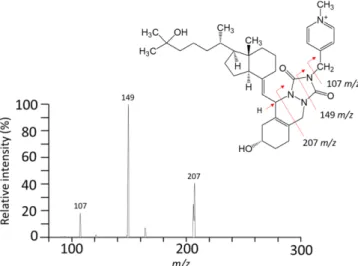
3-1. Analysis of vitamin D metabolites using MALDI-MS Chemical derivatization of vitamin D metabolites is known to have 100 to 1000 folds higher sensitivity than non-derivatized vitamin D in quantitative analysis [18]. As mentioned, SecoSET is a Cookson- type reagent which has powerful dienophile that it can react with a conjugated diene group of vitamin D to form Diels-Alder adducts with permanently positive ion suitable for mass spectrometry. Therefore, we expect that MALDI-MS can be used to quantitatively analyze vitamin D as shown in our previous report [19]. Fig. 2 shows difference between non-derivatized and chemically derivatized hydroxyvitamin D2(25(OH)D2) and D3(25(OH)D3). Unlabeled 25(OH)D2 and 25(OH)D3 are identified at 413 m/z and 401 m/z corresponding to H+ adduct ions of 25(OH)D (i.e., [25(OH)D+H]+) (Fig. 2A and 2C) [20, 21]. After derivatization using SecoSET, peaks of 617 m/z and 605 m/z are assigned to SecoSET labeled- 25(OH)D2 and 25(OH)D3. These peaks of intensity are significantly improved as shown Figs. 2B and 2D. Moreover, we analyzed products of chemical derivatization using liquid chromatography-tandem mass spectrometry (LC-MS/MS) to validate that these peaks were right Diels-alder adducts from reaction of powerful dienophile of SecoSET reagent with s-cis diene of vitamin D (Fig. 3). Abundant fragments of derivatized 25(OH)D3 using SecoSET (SecoSET- 25(OH)D3) at 605 m/z are 107, 149, and 207 m/z as shown in Fig. 3.
The major fragment ion peak at m/z 149 is due to cleavage of triazolidine rings. In addition, fragment ion at m/z 207 corresponded with SecoSET reagent (i.e., [SecoSET]+) and 107 m/z was due to fragment of SecoSET reagents [22]. Therefore, the selective chemical derivatization using SecoSET reagent dramatically improved the quality of MALDI spectra for hydroxyvitamin D.
3-2. Quantitative analysis of vitamin D using heavy labeled vitamin D (d6-25(OH)D3)
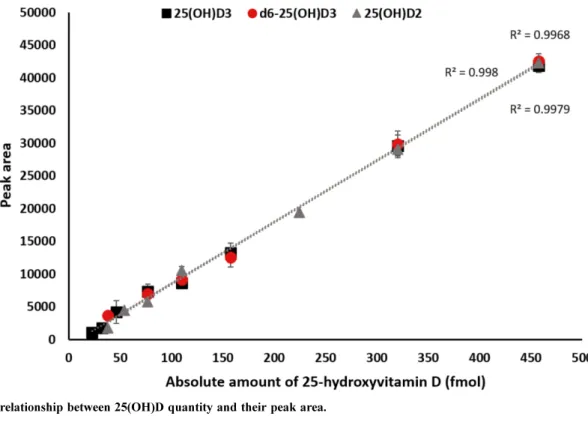
We used heavy labeled 25-hydroxyvitamin D (d6-25(OH)D) to measure the absolute amount of vitamin D metabolites in biological samples. Quantitative linearity, accuracy, and reproducibility based MALDI-MS were validated using different concentrations of SecoSET- derivatized 25(OH)D3, 25(OH)D2, and d6-25(OH)D3. The linearity between the absolute amount of hydroxyvitamin D and peak area is shown in Fig. 4. Linearities of standard calibration curves for SecoSET-25(OH)D3, SecoSET-25(OH)D2, and SecoSET-d6-25(OH)D3 corresponding to their absolute quantities were all excellent (R2 >
0.99), although they are different vitamin D metabolites. Moreover, peak areas of SecoSET-25(OH)D3 and SecoSET-25(OH)D2 were exactly equivalent to those of SecoSET-d6-25(OH)D3. In subsequent experiments, we conducted absolute quantitative analysis of vitamin
D metabolites from biological samples and cells using d6-25(OH)D.
First, 25(OH)D3 and d6-25(OH)D3 were directly spiked into human serum at different molar ratios [25(OH)D3: d6-25(OH)D3 = 1:1, 1:0.5, 1:0.2] followed by extraction using MTBE from complex human serum proteome and metabolome to validate that selective quantitative analysis of vitamin D metabolites was possible. Serum 25(OH)D3 deficiency level is defined at 50 nmol/L [23] and optimal concentration of 25(OH)D3 in serum is 75 nmol/L [24]. After the extraction of small molecules, they were derivatized using SecoSET and then analyzed
by MALDI-MS. We observed remarkable enhancement in spectrum quality without an additional purification step. Fig. 5 shows that the SecoSET-labeled 25(OH)D3 and d6-25(OH)D3 have the exact difference of +6 Da mass by deuterium labeling. The ratio of the area was identical when equal moles of them were spiked (Fig. 5A). As the ratio of spiked moles in human serum was reduced, peak areas also decreased in the same ratio (1:0.5, 1:0.2). Thus, the ratio of peak area represented their theoretical molar ratios. Moreover, we found the limit of quantitation (LOQ) of SecoSET-25(OH)D3 based quantitative method of MALDI-MS. The LOQ of SecoSET-25(OH)D3 was 11.31 fmol per MALDI spot. Thus, this quantitative method using MALDI- MS is sensitive as it can detect vitamin D at femtomole level.
Nevertheless, C-3 epimer of 25(OH)D3 (3-epi-25(OH)D3) can interfere with quantitative analysis of 25(OH)D3 because 3-epi- 25(OH)D3 has identical molecular weight. In addition, its molecular structure in stereochemical configuration is different from 25(OH)D3 at only one site [25], making it difficult to differentiate 25(OH)D3 from 3-epi-25(OH)D3 in mass spectrometry. Thus, the concentration of 25(OH)D3 could be overestimated due to the presence of 3-epi- 25(OH)D3 in serum [26]. However, 3-epi-25(OH)D3 level is about only 2.5 nmol/l when 25(OH)D3 level is at 50 nmol/l which is considered vitamin D deficient [27]. It would not significantly affect clinical interpretation. Misclassification of 25(OH)D3 level only occurs in 9% of infants and 3% of adults [28]. Therefore, 3-epi-25(OH)D3 would not be a problem to apply our quantitative analysis of vitamin D metabolites.
Fig. 3. MS/MS profile of 25(OH)D3-SecoSET.
Fig. 2. MALDI-MS spectra of (A) 25-hydroxyvitamin D2 (25(OH)D2), (B) SecoSET-labeled 25-hydroxyvitamin D2 (25(OH)D2-SecoSET) (C) 25-hydroxyvitamin D3 (25(OH)D3), (D) SecoSET-labeled 25-hydroxyvitamin D3 (25(OH)D3-SecoSET) with 166 pmol quantity on MALDI plate spots.
110 Da-Hee Ahn, Hee-jin Kim, Seong-Min Kim, Sung-Hyun Jo, Jae-Hyun Jeong and Yun-Gon Kim
3-3. Quantitation of vitamin D metabolites level in MCF-7 cells Our quantitative analysis of vitamin D metabolites was then applied to cultured MCF-7 cells, a breast cancer cell line. 1α,25(OH)2D3 is the bioactive form of vitamin D metabolites as mentioned earlier.
It is known that 25(OH)D3 is synthesized to 1α,25(OH)2D3 by 1α- hydroxylase (1α-OHase) in the kidney (Fig. 1) [29,30]. Recently, it has been found that 25(OH)D3 is locally converted to 1α,25(OH)2D3 at an extrarenal site where 1α-OHase is expressed, such as the pancreas, tumor, brain, and skin [31-33]. Especially, 1α-OHase is encoded by gene cytochrome P450 27B1 (CYP27B1). The expression of CYP27B1 is increased in breast and prostate cancers [33-35]. Therefore, we chose MCF-7 cells in this study. We directly added 25(OH)D3 to the culture medium of MCF-7 cells for synthesis of 1α,25-dihydroxyvitamin D3 (1α,25(OH)2D3). After vitamin D metabolites were extracted, derivatization of the sample was conducted using SecoSET. Samples were then quantitatively analyzed by MALDI-MS. The peak area of the internal standard (49 pmol) was used to determine the amount of Fig. 4. A linear relationship between 25(OH)D quantity and their peak area.
Fig. 5. Relative quantitative analysis of 25(OH)D3 with different molar ratios of deuterated 25-hydroxyvitamin D3 (d6-25(OH)D3) in human normal serum. The molar ratio of 25(OH)D3 to d6-25(OH)D3 were (A) 1:1, (B) 1:0.5 and (C) 1:0.2.
Fig. 6. Bar graphs showing the decrease in 25(OH)D level in MCF- 7 cells resulting from ketoconazole treatments. The intensities of 25(OH)D3-SecoSET from natural and ketoconazole-treated MCF-7 cells (each 106 cells) correspond to 62.5 fmol and 28.9 fmol of 25(OH)D3, respectively (***P value<0.004; n=3; differ- ent MCF-7 cells/ketoconazole-treated MCF-7 cells).
1α,25(OH)2D3 (62.5 fmol) in 106 MCF-7 cells (Fig. 6). We also monitored changes of 1α,25(OH)2D3 concentration when MCF-7 cells were treated with ketoconazole, an inhibitor of cytochrome P450 [36,37]. As expected, the amount of 1α,25(OH)2D3 in ketoconazole treated sample was significantly decreased. Results showed that treatment with ketoconazole decreased the amount of 1α,25(OH)2D3 (28.9 fmol) (Fig. 6). Therefore, our method could be applied to monitor changes of vitamin D metabolites in breast cancer cell lines and it may be applicable for diagnosing breast cancer.
4. Conclusion
We developed a highly sensitive platform to quantitatively analyze bioactive vitamin D metabolites based on MALDI-MS. Because vitamin D is at low level in blood circulation, we introduced selective chemical derivatization method (i.e., SecoSET reagent) to improve detection sensitivity. In addition, our method could be applied to detect vitamin D in human serum and cell lysate without chromatographic purification. We also showed that vitamin D metabolites could be quantitatively analyzed at femtomole level using deuterated 25- hydroxyvitamin D. Our vitamin D quantitative analysis platform acquired a rapid and simple procedure compared to previous methods.
It can be used to rapidly monitor diseases like as rickets, osteomalacia, cardiovascular disorders and breast cancer relevant to vitamin D for various human specimens related to disease phenotypes.
Acknowledgment
This work was supported by the Basic Science Research Program through the National Research Foundation of Korea (NRF- 2018R1D1A1B07048185, NRF-2019M2C8A2058418).
References
1. Elder, C. J. and Bishop, N. J., “Rickets,” The Lancet, 383(9929), 1665-1676(2014).
2. Bhan, A., Rao, A. D. and Rao, D. S., “Osteomalacia as a Result of Vitamin D Deficiency,” Endocrinol. Metab. Clin. North Am., 39(2), 321-331(2010).
3. Holick, M. F., “Vitamin D Deficiency,” N. Engl. J. Med., 2007(357), 266-281(2007).
4. Judd, S. and Tangpricha, V., “Vitamin D Deficiency and Risk for Cardiovascular Disease,” Circulation, 117(4), 503-511(2008).
5. Atoum, M. and Alzoughool, F., “Vitamin D and Breast Cancer:
Latest Evidence and Future Steps,” Breast Cancer: Basic and Clini- cal Research, 11, 1-8(2017).
6. Bikle, D. D., “Vitamin D Metabolism, Mechanism of Action, and Clinical Applications,” Cell Chem. Biol., 21(3), 319-329(2014).
7. Seamans, K. M. and Cashman, K. D., “Existing and Potentially Novel Functional Markers of Vitamin D Status: a Systematic Review,” Am. J. Clin. Nutr., 89(6), 1997S-2008S(2009).
8. DeLuca, H. F., “Overview of General Physiologic Features and Functions of Vitamin D,” Am. J. Clin. Nutr., 80(6), 1689S-1696S
(2004).
9. Holick, M. F., “Vitamin D Status: Measurement, Interpretation, and Clinical Application,” Ann Epidemiol, 19(2), 73-78(2009).
10. van den Ouweland, J. M., Beijers, A. M., Demacker, P. N. and van Daal, H., “Measurement of 25-OH-vitamin D in Human Serum Using Liquid Chromatography Tandem-mass Spectrometry with Comparison to Radioimmunoassay and Automated Immu- noassay,” J. Chromatogr. B, 878(15), 1163-1168(2010).
11. Hedman, C. J., Wiebe, D. A., Dey, S., Plath, J., Kemnitz, J. W. and Ziegler, T. E., “Development of a Sensitive LC/MS/MS Method for Vitamin D Metabolites: 1, 25 Dihydroxyvitamin D2&3 Mea- surement Using a Novel Derivatization Agent,” J. Chromatogr.
B, 953(15), 62-67(2014).
12. Yuan, C., Kosewick, J., He, X., Kozak, M. and Wang, S., “Sensi- tive Measurement of Serum 1α, 25-dihydroxyvitamin D by Liquid Chromatography/tandem Mass Spectrometry After Removing Interference with Immunoaffinity Extraction,” Rapid Commun.
Mass Spectrom., 25(9), 1241-1249(2011).
13. Higashi, T., Yokota, M., Goto, A., Komatsu, K., Sugiura, T., Ogawa, S., Satoh, M. and Nomura, F., “A Method for Simultaneous Determination of 25-Hydroxyvitamin D3 and Its 3-Sulfate in Newborn Plasma by LC/ESI-MS/MS after Derivatization with a Proton-Affinitive Cookson-Type Reagent,” Mass Spectorm., 5(2), S0051-S0051(2016).
14. Ogawa, S., Ooki, S., Morohashi, M., Yamagata, K. and Higashi, T., “A Novel Cookson-type Reagent for Enhancing Sensitivity and Specificity in Assessment of Infant Vitamin D Status Using Liquid Chromatography/tandem Mass Spectrometry,” Rapid Com- mun. Mass Spectrom., 27(21), 2453-2460(2013).
15. Ogawa, S., Kittaka, H., Shinoda, K., Ooki, S., Nakata, A. and Higashi, T., “Comparative Evaluation of New Cookson-type Reagents for LC/ESI-MS/MS Assay of 25-hydroxyvitamin D3 in Neonatal Blood Samples,” Biomed. Chromatogr., 30(6), 938- 945(2016).
16. Higashi, T. and Shimada, K., “Application of Cookson-type Reagents for Biomedical HPLC and LC/MS Analyses: a Brief Overview,”
Biomed. Chromatogr., 31(1), e3808(2017).
17. Qi, B. L., Liu, P., Wang, Q. Y., Cai, W. J., Yuan, B. F. and Feng, Y. Q., “Derivatization for Liquid Chromatography-mass Spec- trometry,” Trac Trend. Anal. Chem., 59, 121-132(2014).
18. Aronov, P. A., Hall, L. M., Dettmer, K., Stephensen, C. B. and Hammock, B. D., “Metabolic Profiling of Major Vitamin D Metab- olites Using Diels-alder Derivatization and Ultra-performance Liquid Chromatography-tandem Mass Spectrometry,” Anal. Bio- anal. Chem., 391(5), 1917-1930(2008).
19. Kim, K. J., Kim, H. J., Park, H. G., Hwang, C. H., Sung, C., Jang, K. S., Park, S. H., Kim, B. G., Lee, Y. K. and Yang, Y. H., “A MALDI- MS-based Quantitative Analytical Method for Endogenous Estrone in Human Breast Cancer Cells,” Sci. Rep., 6, 24489(2016).
20. Adamec, J., Jannasch, A., Huang, J., Hohman, E., Fleet, J. C., Pea- cock, M., Ferruzzi, M. G., Martin, B. and Weaver, C. M., “Develop- ment and Optimization of an LC-MS/MS-based Method for Simultaneous Quantification of vitamin D2, vitamin D3, 25- hydroxyvitamin D2 and 25-hydroxyvitamin D3,” J. Sep. Sci., 34(1), 11-20(2011).
21. Vogeser, M., Kyriatsoulis, A., Huber, E. and Kobold, U., “Can- didate Reference Method for the Quantification of Circulating
112 Da-Hee Ahn, Hee-jin Kim, Seong-Min Kim, Sung-Hyun Jo, Jae-Hyun Jeong and Yun-Gon Kim
25-hydroxyvitamin D3 by Liquid Chromatography-tandem Mass Spectrometry,” Clin. Chem., 50(8), 1415-1417(2004).
22. Kim, J. H., Woenker, T., Adamec, J. and Regnier, F. E., “Simple, Miniaturized Blood Plasma Extraction Method,” Anal. Chem., 85(23), 11501-11508(2013).
23. Holick, M. F., Binkley, N. C., Bischoff-Ferrari, H. A., Gordon, C. M., Hanley, D. A., Heaney, R. P., Murad, M. H. and Weaver, C. M., “Evaluation, Treatment, and Prevention of Vitamin D Defi- ciency: an Endocrine Society Clinical Practice Guideline,” J. Clin.
Endocrinol. Metab., 96(7), 1911-1930(2011).
24. Bischoff-Ferrari, H. A., Giovannucci, E., Willett, W. C., Dietrich, T.
and Dawson-Hughes, B., “Estimation of Optimal Serum Con- centrations of 25-hydroxyvitamin D for Multiple Health Out- comes,” Am. J. Clin. Nutr, 84(1), 18-28(2006).
25. Lensmeyer, G., Poquette, M., Wiebe, D. and Binkley, N., “The C-3 Epimer of 25-hydroxyvitamin D3 is Present in Adult Serum,” J.
Clin. Endocrinol. Metab., 97(1), 163-168(2012).
26. Carter, G., Jones, J., Shannon, J., Williams, E., Jones, G., Kaufmann, M. and Sempos, C., “25-Hydroxyvitamin D assays: Potential Interfer- ence from Other Circulating Vitamin D Metabolites,” J. Steroid.
Biochem. Mol. Biol., 164, 134-138(2016).
27. Keevil, B., “Does the Presence of 3-epi-25OHD3 Affect the Rou- tine Measurement of Vitamin D Using Liquid Chromatography Tandem Mass Spectrometry?,” Clin. Chem. Lab. Med., 50(1), 181-183(2012).
28. Strathmann, F. G., Sadilkova, K., Laha, T. J., LeSourd, S. E., Born- horst, J. A., Hoofnagle, A. N. and Jack, R., “3-epi-25 Hydroxyvita- min D Concentrations are Not Correlated with Age in a Cohort of Infants and Adults,” Clin. Chim. Acta., 413(1-2), 203-206(2012).
29. Henry, H. L., “Regulation of Vitamin D metabolism,” Best Pract.
Res. Clin. Endocrinol. Metab., 25(4), 531-541(2011).
30. Jones, G., Prosser, D. E. and Kaufmann, M., “Cytochrome P450- mediated Metabolism of Vitamin D,” J. Lipid Res., 55(1), 13- 31(2014).
31. Townsend, K., Banwell, C. M., Guy, M., Colston, K. W., Mansi, J. L., Stewart, P. M., Campbell, M. J. and Hewison, M., “Autocrine Metabolism of Vitamin D in Normal and Malignant Breast Tis- sue,” Clin. Cancer Res., 11(9), 3579-3586(2005).
32. Hewison, M., Zehnder, D., Chakraverty, R. and Adams, J. S.,
“Vitamin D and Barrier Function: a Novel Role for Extra-renal 1α-hydroxylase,” Mol. Cell. Endocrinol., 215(1-2), 31-38(2004).
33. Zehnder, D., Bland, R., Williams, M. C., McNinch, R. W., Howie, A. J., Stewart, P. M. and Hewison, M., “Extrarenal Expression of 25-hydroxyvitamin D3-1α-hydroxylase,” J. Clin. Endocrinol.
Metab., 86(2), 888-894(2001).
34. Diesing, D., Cordes, T., Fischer, D., Diedrich, K. and Friedrich, M., “Vitamin D-metabolism in the Human Breast Cancer Cell Line MCF-7,” Anticancer Res., 26(4A), 2755-2759(2006).
35. Cordes, T., Diesing, D., Becker, S., Fischer, D., Diedrich, K. and Friedrich, M., “Expression of Splice Variants of 1α-hydroxylase in Mcf-7 Breast Cancer Cells,” J. Steroid Biochem. Mol. Biol., 103(3-5), 326-329(2007).
36. Geng, S., Zhou, S. and Glowacki, J., “Effects of 25-hydroxyvitamin D3 on Proliferation and Osteoblast Differentiation of Human Mar- row Stromal Cells Require CYP27B1/1α-hydroxylase,” J. Bone.
Miner. Res., 26(5), 1145-1153(2011).
37. Nguyen, M., Boutignon, H., Mallet, E., Linglart, A., Guillozo, H., Jehan, F. and Garabedian, M., “Infantile Hypercalcemia and Hypercalciuria: New Insights into a Vitamin D-dependent Mecha- nism and Response to Ketoconazole Treatment,” J. Pediatr. 157(2), 296-302(2010).