D I A B E T E S & M E T A B O L I S M J O U R N A L
This is an Open Access article distributed under the terms of the Creative Commons At- tribution Non-Commercial License (http://creativecommons.org/licenses/by-nc/3.0/) which permits unrestricted non-commercial use, distribution, and reproduction in any medium, provided the original work is properly cited.
Factors Influencing Physical Activity Behavior among Iranian Women with Type 2 Diabetes Using the
Extended Theory of Reasoned Action
Alireza Didarloo1, Davoud Shojaeizadeh2, Hassan Eftekhar Ardebili2, Shamsaddin Niknami3, Ebrahim Hajizadeh4, Mohammad Alizadeh5
1Department of Health and Social Medicine, Urmia University of Medical Sciences, School of Medicine, Urmia,
2Department of Health Education, Tehran University of Medical Sciences, School of Public Health, Tehran,
3Department of Health Education, 4Department of Biostatistics, Tarbiat Modares University, School of Medical Sciences, Tehran,
5Department of Nutrition and Biochemistry, Urmia University of Medical Sciences, School of Medicine, Urmia, Iran
Background: Findings of most studies indicate that the only way to control diabetes and prevent its debilitating effects is through the continuous performance of self-care behaviors. Physical activity is a non-pharmacological method of diabetes treatment and because of its positive effects on diabetic patients, it is being increasingly considered by researchers and practitioners. This study aimed at determining factors influencing physical activity among diabetic women in Iran, using the extended theory of reasoned action in Iran.
Methods: A sample of 352 women with type 2 diabetes, referring to a Diabetes Clinic in Khoy, Iran, participated in the study.
Appropriate instruments were designed to measure the desired variables (knowledge of diabetes, personal beliefs, subjective norms, perceived self-efficacy, behavioral intention and physical activity behavior). The reliability and validity of the instruments were examined and approved. Statistical analyses of the study were conducted by inferential statistical techniques (independent t–test, correlations and regressions) using the SPSS package.
Results: The findings of this investigation indicated that among the constructs of the model, self efficacy was the strongest pre- dictor of intentions among women with type 2 diabetes and both directly and indirectly affected physical activity. In addition to self efficacy, diabetic patients’ physical activity also was influenced by other variables of the model and sociodemographic factors.
Conclusion: Our findings suggest that the high ability of the theory of reasoned action extended by self-efficacy in forecasting and explaining physical activity can be a base for educational intervention. Educational interventions based on the proposed mod- el are necessary for improving diabetics’ physical activity behavior and controlling disease.
Keywords: Diabetes mellitus; Motor activity; Self efficacy; Theory of reasoned action
Corresponding author: Davoud Shojaeizadeh
Department of Health Education, Tehran University of Medical Sciences School of Public Health, Tehran, Iran
E-mail: [email protected]
INTRODUCTION
Diabetes is one of the most serious chronic diseases in the worldwide. There were estimated to be 285 million adults with diabetes in 2010 of which 90 to 95 percent had type 2 diabetes.
This number will continue to increase globally due to an aging population, population growth, urbanization and the high prevalence of obesity and sedentary lifestyles [1]. Iran is one of the Middle Eastern countries that have been affected by this condition. Considering Iran’s growing elderly population, a pISSN 2233-6079 · eISSN 2233-6087
rapid increase in the prevalence of this disease is expected. It has been reported that 2% of Iran’s population has diabetes and the prevalence of diagnosed diabetes for those over the age of 30 years is estimated to be 7.3% [2]. In addition, this prob- lem is affecting even younger age groups, increasingly striking young adults and even adolescents [3]. Controlling blood sug- ar levels and maintaining them in an optimal range is essential for disease control and prevention of the debilitating compli- cations [3,4]. To achieve this goal, it is necessary for patients to comply with diabetes treatment methods such as taking rec- ommended diabetes medications, lifestyle changes, regular exercise and regular blood glucose monitoring [5].
Regular physical activity is one of the most important fac- tors for creating, maintaining and improving health. It has also been emphasized as one of the 15 priorities for improving health [6]. Physical activity plays a key role in the management of type 2 diabetes and glycemic control [7]. Physical activity reduces insulin resistance [8]; decreases blood sugar; increases the number of receptors and sensitivity of cells to insulin con- centration in tissue; diminishes fat tissue, weight and blood pressure; increases physical fitness and can aid in both preven- tion and management of 2 type diabetes [9]. Despite the posi- tive effects of physical activity on different dimensions of dia- betics’ health, most diabetic patients have low levels of mobili- ty compared with non-diabetic individuals (34% vs. 40%, re- spectively) [10]. Diabetic women’s participation in physical activity is very low and is often further reduced with increas- ing age. Only 14 to 16 percent of women aged 45 to 75 years participate in recommended levels of physical activity [11].
Low levels of physical activity in diabetic patients may be a function of individual, social and psychological factors. Un- derstanding and identifying those factors aids health services providers designing appropriate interventions for promoting physical activity behavior among diabetics. Due to difficulties in creating and maintaining physical activity behavior and its complexity, the use of behavior change theories and models is necessary [12]. These theories and models identify factors af- fecting targeted behaviors and determine the relationships of these factors with the given behavior [13].
Since the earliest days of the theory of planned behavior (TPB), there has been a degree of uncertainty concerning the relationship between Ajzen’s perceived behavioral control and Bandura’s self-efficacy construct. Both constructs concern con- trol over the execution of a behavior: the perceived ease and difficulty of performing a behavior (perceived behavioral con-
trol, PBC) and the belief that one is capable of performing the behavior (self-efficacy) [14,15]. Additionally, congruent with Ajzen’s argument that self efficacy and PBC are synonymous, several researchers have incorporated measures of self-efficacy within the TPB framework. Nevertheless, Ajzen and Madden’s (1986) and Ajzen’s (1991) description of the relationship be- tween PBC and behavior as a proxy of control and a reflection of skills and ability suggests the existence of two separate pro- cesses of control. The first is related to Bandura’s self-efficacy construct (1977), the second to perceived controllability of the behaviors.
In 1977, Armitage and Conner suggest the existence of two processes of control, internal and external, discriminable but not independent of each other. According to these authors, be- ing very confident of one’s abilities to perform a behavior may lead to underestimation of external control; likewise, the pres- ence of external facilitating conditions may boost self-efficacy perceptions. The lack of clarity in the conceptual and opera- tional definitions of PBC and self-efficacy within TPB research makes it problematic to draw conclusions about which could be the most appropriate construct in this framework. Further- more, the existence of overlap between the constructs among these theories made it difficult to compare them.
On the other hand, consistent across many studies, there is a strong relationship between self-efficacy and intention [16,17].
People are more likely to intend a behavior when they feel they are able to perform it. Also, several studies have suggested strong relationships between self-efficacy and health behavior [17]. Recent studies have reported an association between self- efficacy and adherence to physical activity behavior in diabet- ics [18]. On the basis of the above documents and the lack of clarity in the conceptual and operational definition of the PBC construct within the TPB framework, we decided to design and test a new version of the theory of reasoned action (TRA) in order to identify predictors of physical activity behavior among Iranian women with type 2 diabetes.
TRA, one of the most successful theories of behavior change, has demonstrated its efficiency in predicting and determining various health behaviors.
This theory claims that the intention to perform a behavior is explained by an incorporation of attitudes and subjective norms. Attitudes including belief in a particular behavior lead to certain outcomes and subjective norms contain social pres- sures that one receives from others for engaging in a given be- havior. Intentional behavior is then considered to be a func-
tion of one’s intentions, which are a reflection of attitudes to- ward the behavior and the perceived social norms [19].
Since behaviors that are not fully volitional are also influ- enced by the individual’s perception of his or her ability to perform the behavior, the TRA would not be sufficient to ex- amine the relationships of health beliefs with the intention to perform physical activity in diabetic patients. To account for this, the TRA has been further developed by adding several constructs that involve perceptions of control over behavior.
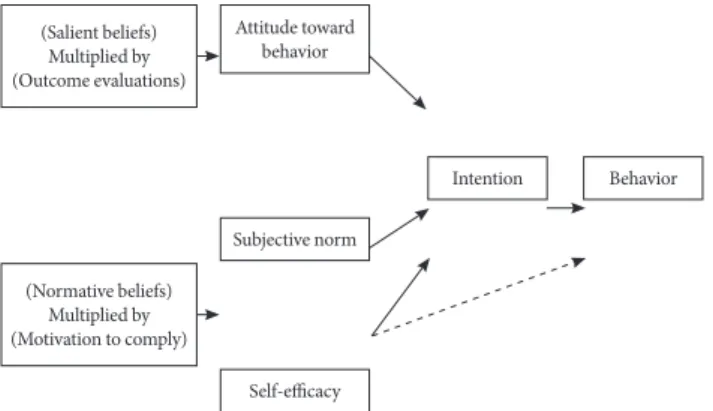
This study proposed an extension of the TRA that includes self-efficacy as a third determinant of behavioral intention, in addition to the subjective norm and attitude toward the be- havior constructs proposed in the original theory (Fig. 1). Self- efficacy beliefs reflect people’s thoughts about their capability to perform certain behaviors and influence the activities that individuals choose to approach as well as their motivation and persistence in presence of obstacles [20].
Our theoretical framework postulates that self-efficacy may also directly affect physical activity behavior (represented by the broken line in Fig. 1). The theoretical base of this relation is supported by Bandura’s assertion that, besides the motiva- tional component of self-efficacy, highly efficacious people are more likely to persevere in their attempts in performing a be- havior in situations presenting barriers to performance attain- ment, while inefficacious individuals tend to give up quickly [20].
According to the proposed model, diabetic patients will in- tend to adhere to physical activity if they believe that such ad- herence will be associated with more positive outcomes than negative outcomes, and if they believe that referents with whom they are motivated to comply (physicians, spouse, family, and friends) think that they should try to adhere to such behaviors.
Individuals will succeed in their attempts if they have suffi- cient self-efficacy to master the tasks or successfully execute the behaviors required to produce the expected outcome.
In present research, the purpose of the investigation was to test a composite model, namely the extended theory of rea- soned action, by adding a self-efficacy construct to understand and predict physical activity behavior in Iranian women with type 2 diabetes. It is hoped that this might contribute to exist- ing knowledge and help to enhance women’s health.
METHODS
The current study is a cross-sectional survey designed to ex- amine and understand factors that influence the adherence to physical activity behavior among Iranian women with type 2 diabetes.
A sample consisting of 352 women with type 2 diabetes re- ferring to the Diabetic Clinic in Khoy, Iran was recruited for the current research. Inclusion criteria for the study participa- tion were women: 1) diagnosed with type 2 diabetes, 2) living in Khoy, Iran, 3) aged between 18 to 65 years, and 4) having been diagnosed as diabetic patients for at least 6 months. Par- ticipants with gestational diabetes, ulcers on their feet or pro- gressive cardiovascular conditions were excluded.
To collect data, we developed a self-administered question- naire using two manuals related to constructing questionnaires based on the theory of planned behavior [21,22] and the scales of previous studies. This measurement instrument included seven subscales: sociodemographic characteristics (12 items), knowledge of diabetes (11 items), attitude toward behavior (4 items), subjective norms (4 items), self-efficacy (4 items), be- havioral intention (2 items) and behavioral performance (2 items). Response categories for each item relating to the pro- posed model variables include a 5-point Likert scale ranging from 1 (strongly disagree) to 5 (strongly agree) and a 5-point Likert scale ranging from 1 (strongly unimportant) to 5 (strong- ly important).
Attitude toward physical activity was indirectly measured by a four-item scale comprising: two items related to behav- ioral beliefs and two items regarding the evaluation of behav- ioral outcomes.
Subjective norms concerning physical activity behavior were indirectly measured by a four-item scale including: two items related to normative beliefs and two items related to motiva- tion to comply.
(Salient beliefs) Multiplied by (Outcome evaluations)
(Normative beliefs) Multiplied by (Motivation to comply)
Attitude toward behavior
Subjective norm
Intention Behavior
Self-efficacy
Fig. 1. The extended theory of reasoned action applied to phys- ical activity behavior.
Self-efficacy toward physical activity was assessed using statements such as: “I am able to do physical activity every day,”
and “I think I’m able to take extra physical activities when the doctor advises me to do so,” etc.
Behavioral Intention was measured with the following statements: “I intend to perform physical activity regularly within the coming month,” and “I will plan to engage in extra physical activity three times per week if my doctor advises me to do so.”
To assess levels of diabetes self-management, we used the Summary of Diabetes Self-Care Activities Measure [23]. Re- spondents reported the number of days they performed rec- ommended physical activities over the past 7 days. Items from this scale assessed provider advice regarding physical activity adherence.
Knowledge of diabetes was assessed using 11 items. Each correct response was scored 2, and each “don’t know” response, 0, with the response category ranging from 0 to 22. The subse- quent results were based on the mean knowledge derived from 11 questions, each with a maximum point of 2 and a minimum point of 0.
To test clarity and content validity, the self-administered questionnaire was shown to a panel of experts consisting of five professors of health education, two nursing professors, one nutrition professor, one diabetes specialist, and one test designer. They evaluated each item for its distinctiveness, un- derstandability, and appropriateness for the purpose of the study, and final revisions were made based on their comments.
To evaluate reliability, instruments were completed by 352 dia- betic patients and Cronbach’s alpha for each of the question- naires was calculated. Internal consistency of the knowledge questionnaire, including items related to diabetes care princi- ples, methods of diabetes control and the importance of physi- cal activity behavior was assessed and its Cronbach’s alpha was 0.77. Similarly, the reliability of other surveys using internal consistency was studied and Cronbach’s alpha values for atti- tude, subjective norms, self-efficacy, behavioral intention and physical activity behavior in the questionnaires were computed and confirmed (0.85, 0.83, 0.78, 0.92, and 0.95, respectively).
After assessing the psychometric characteristics of the in- struments, the questionnaires were completed by study sub- jects. Since most participants were illiterate, or poorly educat- ed, their questionnaires were filled out by trained and experi- enced interviewers. After collecting, organizing and classify- ing data with SPSS software version 16.0 (SPSS Inc., Chicago,
IL, USA), statistical analysis was performed using descriptive and inferential statistical methods (central indexes, t-test, cor- relation and regression). In this study, a P value of less than 0.05 was considered significant.
Before the study, an informed consent form was obtained from of all of the participants and all ethical principles were considered in all phases of the research.
RESULTS
Characteristics of sample
Nearly 50.9% of the participants were between 44 to 56 years old. Slightly more than half of the research subjects (53%) were illiterate, 93.2% had no formal jobs outside of except house- keeping, and the remaining (6.8%) had part time jobs. About ninety-one percent of participants were currently married and approximately half of the women had a moderate monthly in- come. In this survey, most diabetic women were obese (40.1%) and overweight (46.9%). Most of the participants (62.2%) had diabetes for 1-10 years. Approximately three-fourths of sub- jects (74.4%) in this study were being treated by oral hypogly- cemia agents, 22.2% of cases were using other therapeutic methods and the remaining participants (3.4%) were not re- ceiving any treatment. Approximately two-thirds of the par- ticipants (63.1%) were visited by their physicians every 1 to 2 months, and the rest less frequently. According to the results of the present project, about 78.1% of the participants had not previously participated in any formal instructional meetings.
The majority of subjects (72.4%) reported acquiring diabetes- related information from health professionals.
Bivariate and multivariate analysis
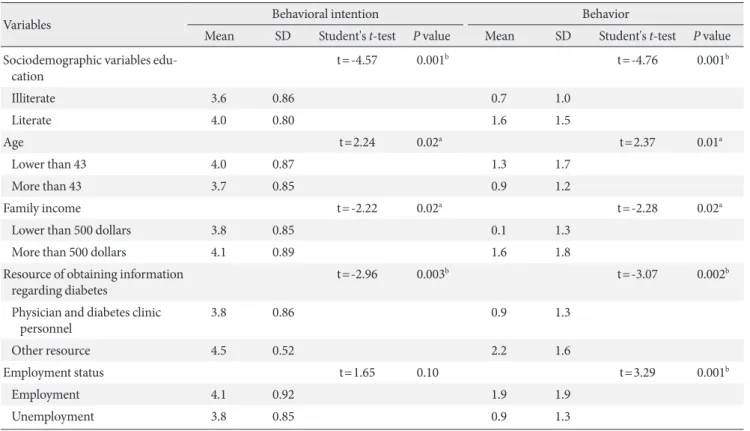
The most important point in this study is that a factor is con- sidered as predictor when it is significant both in bivariate analyses and in the final model of regression analysis. First, the Kolmogrov Smirnov statistical test was used to evaluate the normality of the study variables. According to findings of the above test (normal distribution of data), we utilized paramet- ric tests for data analysis. The t-test and Pearson correlation coefficient indicated that there exists a significant difference between intention with regard to age, education level, income, resources of knowledge, knowledge level, attitude, subjective norms and self-efficacy (P<0.05). However behavior was in- fluenced by education level, age, income, resources of knowl- edge, employment status, knowledge, attitude, self-efficacy,
and behavioral intention (P<0.05) (Tables 1 and 2).
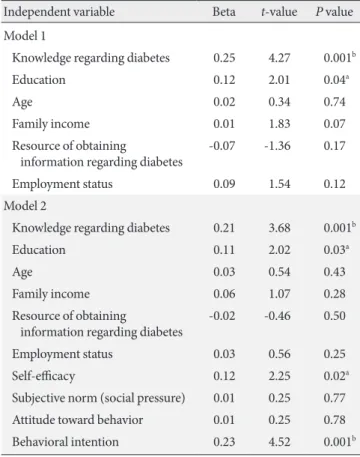
In order to confirm the significance of the results of the bi- variate analyses and explore real predictors, two models of re- gression analysis also were carried out on intention and be- havior. In the first model, significant demographic variables in the bivariate analyses were entered into a multiple linear re- gression equation and their effect, as independent variables, on intention and behavior was evaluated. In the regression re-
lated to intention, only education level remained and the re- maining variables were excluded from the regression equation and thereby the predictive ability of education level was con- firmed (P<0.05) (Table 3). However in the behavior-related regression analysis, knowledge and education level remained in the multiple linear regression equation and their influence was demonstrated (P<0.01, P<0.05, respectively) (Table 4).
In the second model, significant demographic variables from the previous analyses, along with variables of the hypothesized model were entered into the regression equation and their ef- fects on the main dependent variables (intention and behav- ior) were examined. In the final model, only education level along with attitude, subjective norms and self-efficacy remained in the regression equation and their impact was confirmed and maintained for behavioral intention (P<0.05) (Table 3).
However based on the results of final model of regression anal- ysis related to behavior, variables such as knowledge, educa- tion level, self-efficacy and behavioral intention remained in the regression equation and their significant relationships to behavior were confirmed (P<0.05) (Table 4).
Table 1. Univariate predictors of dependent variables of the proposed model in the current study (n=352)
Variables Behavioral intention Behavior
Mean SD Student's t-test P value Mean SD Student's t-test P value Sociodemographic variables edu-
cation t=-4.57 0.001b t=-4.76 0.001b
Illiterate 3.6 0.86 0.7 1.0
Literate 4.0 0.80 1.6 1.5
Age t=2.24 0.02a t=2.37 0.01a
Lower than 43 4.0 0.87 1.3 1.7
More than 43 3.7 0.85 0.9 1.2
Family income t=-2.22 0.02a t=-2.28 0.02a
Lower than 500 dollars 3.8 0.85 0.1 1.3
More than 500 dollars 4.1 0.89 1.6 1.8
Resource of obtaining information
regarding diabetes t=-2.96 0.003b t=-3.07 0.002b
Physician and diabetes clinic
personnel 3.8 0.86 0.9 1.3
Other resource 4.5 0.52 2.2 1.6
Employment status t=1.65 0.10 t=3.29 0.001b
Employment 4.1 0.92 1.9 1.9
Unemployment 3.8 0.85 0.9 1.3
SD, standard deviation.
aP<0.05, bP<0.01 is significant.
Table 2. Results of correlation matrix between independent variables and depedent variables (n=352)
Variable 1 2 3 4 5 6
1. Diabetes knowledge 1 2. Attitude toward
physical activity 0.01b 1 3. Diabetes self-efficacy 0.08 0.39b 1 4. Subjective norms 0.02 0.40b 0.24b 1 5. Behavioral intention 0.18b 0.27b 0.26b 0.25b 1 6. Physical activity behavior 0.33b 0.11a 0.16b 0.06 0.35b 1
aP<0.05, bP<0.01 is significant.
DISCUSSION
Understanding and determining effective factors for influenc- ing participation of diabetic patients in exercise programs based on behavior change theory, is essential and beneficial for health professionals. Unfortunately in Iran, health professionals do not care take behavior change theory into account when de- signing educational plans regarding diabetes and most of these plans are not successful. Since physical activity is a difficult and complex behavior and requires a variety of skills and com- petencies, the TRA is not sufficient for examining the relation- ship of health beliefs with intention to comply with physical activity in diabetic patients. As a result, the TRA has been ex- tended by adding self-efficacy, which involves perceptions of control over behavior. This extended TRA seems more suit- able for predicting factors effective for influencing physical ac- tivity in diabetics.
The current study revealed that self-efficacy is the strongest predictor of intention to perform physical activity and indi- rectly affects behavior (β=0.246, P<0.01). Intention to per- form specific health behaviors is influenced by an individual’s self-efficacy beliefs. The stronger diabetic patients’ self-efficacy
beliefs are, the more reliably they will perform health behav- iors [15]. One study using constructs of the different theories shows that the effect of self-efficacy on a given behavior through intention is stronger than other psychological and social fac- tors and this is consistent with our results [24].
A study using TPB in the field of blood donation strongly supported self-efficacy as a good predictor of intentions. This investigation demonstrated the importance of self-efficacy in support of blood donation, but also stressed the importance of including self-efficacy in the theory of planned behavior [25].
Another study testing the TPB for predicting breast self-exam- ination provided empirical support for separating the two constructs of self-efficacy and perceived behavioral control, and demonstrated that self-efficacy predicts intention to per- form breast self-examination and actual behavior better than other structures particularly perceived behavioral control [26].
Self-efficacy not only has an indirect effect on physical activity, but it also affects physical activity directly. Our study demon- strated its direct effect on behavior based on regression analy- Table 3. Results of multiple regression analysis on behavioral
intention (n=352)
Independent variable Beta t-value P value Model 1
Knowledge regarding diabetes 0.08 1.40 0.16
Education 0.22 3.63 0.001b
Age 0.08 1.55 0.12
Family income 0.10 1.91 0.06
Resource of obtaining
information about diabetes -0.10 -1.78 0.08 Model 2
Knowledge regarding diabetes 0.08 1.47 0.14
Education 0.13 2.14 0.02a
Age -0.04 -0.76 0.44
Family income 0.09 1.69 0.09
Resource of obtaining
information about diabetes -0.06 -1.05 0.29
Self-efficacy 0.25 4.29 0.001b
Subjective norm (social pressure) 0.13 2.27 0.02a Attitude toward behavior 0.12 1.98 0.04a
aP<0.05, bP<0.01 is significant.
Table 4. Results of multiple regression analysis on physical activity behavior (n=352)
Independent variable Beta t-value P value Model 1
Knowledge regarding diabetes 0.25 4.27 0.001b
Education 0.12 2.01 0.04a
Age 0.02 0.34 0.74
Family income 0.01 1.83 0.07
Resource of obtaining
information regarding diabetes -0.07 -1.36 0.17
Employment status 0.09 1.54 0.12
Model 2
Knowledge regarding diabetes 0.21 3.68 0.001b
Education 0.11 2.02 0.03a
Age 0.03 0.54 0.43
Family income 0.06 1.07 0.28
Resource of obtaining
information regarding diabetes -0.02 -0.46 0.50
Employment status 0.03 0.56 0.25
Self-efficacy 0.12 2.25 0.02a
Subjective norm (social pressure) 0.01 0.25 0.77 Attitude toward behavior 0.01 0.25 0.78
Behavioral intention 0.23 4.52 0.001b
aP<0.05, bP<0.01 is significant.
sis results (β=0.115, P<0.05). One study examining the TPB on helmet use behavior revealed that self-efficacy was the strongest predictor of intention compared with other constructs of the theory, which is also consistent with our study findings [16], and our findings have also been supported by various ad- ditional studies [27,28]. These results confirm the influence of self-efficacy in theory and theory-driven interventions. There- fore, if self-efficacy is used in extending theories and designing interventions, it will increase the ability of these programs to change behavior.
Social pressure or subjective norm is another theoretical framework construct that showed significant positive correla- tion with physical activity behavior through intentions (β=
0.126, P=0.05). This demonstrates that social pressure is able to predict intention to engage in physical activity. This result is in concordance with results of a study by Omondi et al. They found a positive and significant correlation between subjective norms and intention to perform physical activity in diabetic patients (β=0.38, P<0.05), and they suggested that the greater the pressures of the patients’ wives, family members, their friends, physicians and health experts for performing health behaviors, the greater the patients’ adherence rate [29]. A study conducted by the Blue [30] examining determining factors af- fecting diabetics’ intention to perform physical activity and healthy eating, revealed that the patients’ subjective norms correlated with their intention.
In addition to studies by Omondi and Blue, other studies based on TPB, Trost et al. [31] and Symons Downs & Hausen- blas [32] have confirmed the presence of an association be- tween subjective norms and intentions. All of the above results were consistent with the results of our study.
Although this study, explored the relationship between sub- jective norms and the intention to perform physical activity behavior, a review of studies based on TPB, indicates that sub- jective norm has always been a weaker predictor compared with attitude and perceived behavioral control.
In Bozionelos’s theory-based study on exercise behavior [33], no significant relationship was detected between subjec- tive norm and behavioral intention. These findings were con- trary to the results of this aspect of our study. The basis of these conflicting results in studies examining subjective norms can be found in differences between health behavior practices due to individual, social and cultural characteristics of study sub- jects. In 2004, Ajzen and Fishbein cited that the relative im- portance of subjective norms, attitudes and perceived behav-
ioral control in predicting intentions may change from one behavior to another or from one society to another. However, the results of this study indicated that subjective norm an ef- fect on physical activity through intentions and it should be considered in designing educational interventions.
Intention to perform physical activity in diabetic patients is influenced not only by social pressures and self-efficacy, but also by attitude [34]. In the current study, regression analysis results (β=0.120, P<0.05) demonstrated that a relatively posi- tive attitude towards physical activity behavior among diabet- ics was the factor that most encouraged patients to adopt this behavior. When people feel that a behavior may lead to posi- tive health outcomes, it is more likely to be adopted and main- tained. This finding was supported by the results of previous research regarding the effects of attitudes on health behaviors.
For example, in 1996, a study by Van Ryn et al. [35] showed that diabetic women who had more positive attitudes towards physical activity in comparison with women with negative or weak positive attitudes attempted more physical activity. In addition, a 2001, study by Surit [36] confirmed our study find- ings regarding attitude. They concluded that there is a signifi- cant positive correlation between attitude towards self-care and diabetics’ behaviors. Therefore, according to the results of this study and previous studies, attitudes like self-efficacy and subjective norms were indirect predictors of physical activity behavior and should be considered in the design of education- al programs.
Based on the results of this study, both constructs of the suggested model predict and explain physical activity in dia- betic women through behavioral intention both indirectly and directly. Behavioral intention or motivation had better predic- tive strength in comparison with other constructs of the mod- el (β=0.234, P<0.001). The high predictive strength of behav- ioral intention was consistent with findings in a study by Sut- ton [37] which found that the intention to perform a specific behavior is the first and the best behavior predictor. The results this present study support that finding. In addition to the de- sired model variables, experiences and personal characteris- tics as external factors of the proposed model can also affect rates of physical activity in diabetic women and can both di- rectly and indirectly explain and predict them. In this study, knowledge has a direct relationship with the desired behavior (β=0.213, P<0.001) and was the second best predicting factor of behavior after behavioral intention. This relationship indi- cates that the more knowledge diabetics have about their treat-
ment methods, particularly with regard to the importance of physical activity, the more likely they may be to adopt health behaviors and maintain them.
In order for a diabetic patient to be successful in caring about his/her disease, he/she must have sufficient knowledge about health promoting behaviors. Therefore, knowledge re- garding disease management should be considered as an im- portant treatment factor. Research results by Jiang et al. [38], confirm the importance of the link between disease manage- ment knowledge and health behavior promotion.
A literature review shows that, although individual aware- ness about diabetes and its treatment methods is necessary, it is not sufficient on its own. A study by Chan and Molassiotis [39] suggests that although providing adequate knowledge for diabetics is important for enhancing self-care behaviors, per- sonal beliefs and other psycho-social factors should also be considered in treating this disease. In this study, level of edu- cation was also considered as a predictor of physical activity, as it affects behavior both directly and indirectly, and this re- sult is consistent with other studies [40]. Therefore, the higher the diabetics’ level of education, the better they will under- stand the importance of health-related issues and improve their health by adopting positive health behaviors.
Although this study provides important information about the relationships between physical activity and individual and environmental factors, several limitations should be consid- ered. First, a cross-sectional design was used to describe the relationship between variables. The main characteristic of cross-sectional design is that all data are collected at one time period, thereby limiting the ability to identify cause-and-effect relationships between variables. Second, results cannot be generalized beyond the study sample and therefore can be generalized only to populations with similar features. Third, the data of this study were collected using a self-reported questionnaire. Participants may underestimate or overesti- mate their physical activity behavior, which may have affected the study findings.
Overall, the present study highlighted the relative impor- tance of constructs of the suggested model, especially the con- struct of self-efficacy, and their relationship with behavioral intention and physical activity. Therefore, it is essential to con- sider these relationships when designing educational interven- tions to promote physical activity behavior in women with type 2 diabetes. For example, in order to increase motivation or intention to perform physical activity among diabetic pa-
tients, health care providers should first focus on the diabetics’
self-efficacy, then intervene in subjective norms, attitudes and other factors. Since health care providers can increase the per- ceived physical activity self- efficacy of diabetics, they should use instructional methods such as verbal persuasion, emo- tional motivation, modeling and previous successful experi- ences in the field of physical activity. The more the self-efficacy of patients improves after educational interventions, the great- er will be their adherence to self-care behaviors, such as physi- cal activity, which in turn will lead to better diabetes control.
CONFLICTS OF INTEREST
No potential conflict of interest relevant to this article was re- ported.
ACKNOWLEDGMENTS
We would like to thank the patients, their family members, in- terviewers, and personnel of Diabetes Clinic of Khoy Madani Hospital who participated in this study and all people who kindly helped us in conducting this research, especially in col- lection of the data. In addition, we acknowledge the official support of Tehran University of Medical Sciences.
REFERENCES
1. Shaw JE, Sicree RA, Zimmet PZ. Global estimates of the preva- lence of diabetes for 2010 and 2030. Diabetes Res Clin Pract 2010;87:4-14.
2. Delavari A, Mahdavi-Hezaveh A, Noroozinajad A, Yarahmadi SH. A national design for the prevention and control of diabe- tes. Tehran: Disease Management Center, Ministry of Health and Medical Education, Iran; 2004.
3. Centers for Disease Control and Prevention: 2005 National di- abetes fact sheet. Available from: http://www.cdc.gov/diabetes/
pubs/estimates05.htm#prev (accessed 2006 June 1).
4. Lim S, Kim DJ, Jeong IK, Son HS, Chung CH, Koh G, Lee DH, Won KC, Park JH, Park TS, Ahn J, Kim J, Park KG, Ko SH, Ahn YB, Lee I. A nationwide survey about the current status of glycemic control and complications in diabetic patients in 2006:
The Committee of the Korean Diabetes Association on the Ep- idemiology of Diabetes Mellitus. Korean Diabetes J 2009;33:
48-57.
5. Gochman DS. Handbook of health behavior research, II. Pro-
vider determinants. New York: Plenum Press; 1997. Chapter 6, The history and meaning of patient compliance as an ideology;
p109-24.
6. Sechrist KR, Walker SN, Pender NJ. Development and psycho- metric evaluation of the exercise benefits/barriers scale. Res Nurs Health 1987;10:357-65.
7. Canadian Diabetes Association Clinical Practice Guidelines Expert Committee. Canadian Diabetes Association 2003 clini- cal practice guidelines for the prevention and management of diabetes in Canada. Can J Diabetes 2003;27(Suppl 2):S1-152.
8. Bhaskarabhatla KV, Birrer R. Physical activity and type 2 dia- betes: tailoring exercise to optimize fitness and glycemic con- trol. Phys Sportsmed 2004;32:13-7.
9. Larijani B. Exercise and diabetes. Tehran: Tehran University of Medical Sciences; 2003. p13.
10. Ford ES, Herman WH. Leisure-time physical activity patterns in the U.S. diabetic population. Findings from the 1990 Na- tional Health Interview Survey--Health Promotion and Dis- ease Prevention Supplement. Diabetes Care 1995;18:27-33.
11. Costanzo C, Walker SN, Yates BC, McCabe B, Berg K. Physical activity counseling for older women. West J Nurs Res 2006;28:
786-801.
12. Yamaguchi Y, Miura S, Urata H, Himeshima Y, Yamatsu K, Otsuka N, Nishida S, Saku K. The effectiveness of a multicom- ponent program for nutrition and physical activity change in clinical setting: short-term effect of PACE+ Japan. Int J Sport Health Sci 2003;1:229-37.
13. Nutbeam D, Harris E. Theory in a nutshell: a practical guide to health promotion theories. 2nd ed. Sydney: McGraw-Hill; 2004.
14. Kulh J, Beckman J. Action control: from cognition to behavior.
Heildberg: Springer, 1985. From intentions to actions: a theory of planned behavior; p11-39.
15. Bandura A. Self-efficacy: toward a unifying theory of behav- ioral change. Psychol Rev 1977;84:191-215.
16. Godin G, Kok G. The theory of planned behavior: a review of its applications to health-related behaviors. Am J Health Pro- mot 1996;11:87-98.
17. Strecher VJ, DeVellis BM, Becker MH, Rosenstock IM. The role of self-efficacy in achieving health behavior change.
Health Educ Q 1986;13:73-92.
18. Brinson D. The self-management of type2 diabetes: changing exercise behaviors for better health [master’s thesis]. [Christ- church]: University of Canterbury; 2007. p296-8.
19. Rothman AJ. Toward a theory-based analysis of behavioral maintenance. Health Psychol 2000;19(1 Suppl):64-9.
20. Bandura A. Self-efficacy mechanism in human agency. Am Psychol 1982;37:122-47.
21. Francis JJ, Eccles MP, Johnston M, Walker A, Grimshaw J, Foy R, Kaner EF, Smith L, Bonetti D. Constructing questionnaires based on the theory of planned behaviour: a manual for health services researchers. Newcastle upon Tyne: Centre for Health Services Research, University of Newcastle; 2004. p1-40.
22. Ajzen I: Constructing a TPB questionnaire: conceptual and methodological considerations. Available from: http://www.
people.umass.edu/aizen/contact.html (cited 2011 Jul 26).
23. Toobert DJ, Hampson SE, Glasgow RE. The summary of dia- betes self-care activities measure: results from 7 studies and a revised scale. Diabetes Care 2000;23:943-50.
24. Rovniak LS, Anderson ES, Winett RA, Stephens RS. Social cognitive determinants of physical activity in young adults: a prospective structural equation analysis. Ann Behav Med 2002;
24:149-56.
25. Giles M, McClenahan C, Cairns E, Mallet J. An application of the theory of planned behaviour to blood donation: the im- portance of self-efficacy. Health Educ Res 2004;19:380-91.
26. Norman P, Hoyle S. The theory of planned behavior and breast self-examination: distinguishing between perceived control and self-efficacy. J Appl Soc Psychol 2004;34:694-708.
27. Ma WF, Lane HY, Laffrey SC. A model testing factors that in- fluence physical activity for Taiwanese adults with anxiety. Res Nurs Health 2008;31:476-89.
28. Walker SN, Pullen CH, Hertzog M, Boeckner L, Hageman PA.
Determinants of older rural women’s activity and eating. West J Nurs Res 2006;28:449-68.
29. Omondi DO, Walingo MK, Mbagaya GM, Othuon LO. Un- derstanding physical activity behavior of type 2 diabetics using the theory of planned behavior and structural equation mod- eling. Int J Hum Soc Sci 2010;5:1-8.
30. Blue CL. Does the theory of planned behavior identify diabe- tes-related cognitions for intention to be physically active and eat a healthy diet? Public Health Nurs 2007;24:141-50.
31. Trost SG, Saunders R, Ward DS. Determinants of physical ac- tivity in middle school children. Am J Health Behav 2002;26:
95-102.
32. Symons Downs D, Hausenblas HA. The theories of reasoned action and planned behavior applied to exercise: a meta-ana- lytic update. J Phys Act Health 2005;2:76-97.
33. Bozionelos G, Bennett P. The theory of planned behavior as predictor of exercise: the moderating influence of beliefs and personality variables. J Health Psychol 1999;4:517-29.
34. Fishbein M, Ajzen I. Belief, attitude, intention and behavior:
an introduction to theory and research. Menlo Park: Addison- Wesley; 1975. p15-45.
35. Van Ryn M, Lytle LA, Kirscht JP. A test of the theory of planned behavior for two health-related practices. J Appl Soc Psychol 1996;26:817-83.
36. Surit P. Health beliefs, social support, and self-care of behav- iors of older Thai persons with non-insulin-dependent diabe- tes mellitus (NIDDM) [dissertation]. [Washington, DC]:
Catholic University of America; 2001.
37. Baum A, Newman S, Weinman J, West R, McManus C. Cam- bridge handbook of psychology, health and medicine. Cam- bridge: Cambridge University Press; 1997. Theory of planned
behavior; p177-9.
38. Jiang YD, Chuang LM, Wu HP, Shiau SJ, Wang CH, Lee YJ, Juang JH, Lin BJ, Tai TY. Assessment of the function and effect of diabetes education programs in Taiwan. Diabetes Res Clin Pract 1999;46:177-82.
39. Chan YM, Molassiotis A. The relationship between diabetes knowledge and compliance among Chinese with non-insulin dependent diabetes mellitus in Hong Kong. J Adv Nurs 1999;
30:431-8.
40. Salmon J, Owen N, Bauman A, Schmitz MK, Booth M. Lei- sure-time, occupational, and household physical activity among professional, skilled, and less-skilled workers and homemakers. Prev Med 2000;30:191-9.