INTRODUCTION
Lung cancer is the second most commonly diagnosed can- cer in men and women. It is the most common cause of cancer death in both men and women around the world, accounting
Demographic and Socioeconomic Factors
for Renouncing Further Active Therapy for Patients with Brain Metastasis of Non-Small Cell Lung Cancer
Gyuseo Jung1, Seok-Hyun Kim2, Tae Gyu Kim3, Young Zoon Kim1
1Division of Neuro-Oncology and Department of Neurosurgery, Samsung Changwon Hospital, Sungkyunkwan University School of Medicine, Changwon, Korea
2Division of Hematology and Medical Oncology, Department of Internal Medicine, Samsung Changwon Hospital, Sungkyunkwan University School of Medicine, Changwon, Korea
3Department of Radiation Oncology, Samsung Changwon Hospital, Sungkyunkwan University School of Medicine, Changwon, Korea
Received February 25, 2019 Revised July 12, 2019 Accepted September 3, 2019 Correspondence
Young Zoon Kim
Division of Neuro-Oncology and Department of Neurosurgery, Samsung Changwon Hospital, Sungkyunkwan University School of Medicine,
158 Paryong-ro, Masanhoewon-gu, Changwon 51353, Korea Tel: +82-55-233-5241 Fax: +82-55-233-8070 E-mail: [email protected]
Background As patients with brain metastasis (BM) of non-small cell lung cancer (NSCLC) have dismal prognosis, some of them decide to discontinue further treatment for BM. The objective of this study was to determine factors for renouncing further active therapy in patients with BM of NSCLC, focusing on their demographic and socioeconomic status.
Methods Medical records of 105 patients with radiological diagnosis of BM of NSCLC for the recent 11 years at authors’ institution were retrospectively reviewed. Clinical features as well as demo- graphic and socioeconomic characteristics such as marriage status, cohabiting family members, reli- gious affiliations, educational background, and economic responsibility were reviewed.
Results Median overall survival (OS) was 13.84 (95% CI: 10.26-17.42) years in 67 patients (group A) who underwent active treatment (radiotherapy and/or chemotherapy) and 4.76 (95% CI:
3.12-6.41) years in 38 patients (group B) who renounced active treatment. Less patients were unmar- ried (p=0.046), more cohabitating family members (p=0.008), and economically independent (p=0.014) in group A than those in group B. Similarly, the unmarried, and none cohabitating family members had short OS (5.17 and 7.38 years, respectively). In multivariate analysis for predisposing factors of OS in these patients, the following demographic and socioeconomic factors had independent significance:
marriage status and cohabitating family members.
Conclusion This study suggests that demographic and socioeconomic status as well as clinical factors could influence the decision of further active treatment and prognosis of patients with BM of NSCLC.
Key Words Brain metastasis; Prognosis; Socioeconomics; Non-small cell lung cancer;
Palliative care; Demography.
for up to 13% of all cancer deaths in women and 23% of all can- cer deaths in men [1]. The incidence and mortality of lung can- cer continue to rise worldwide [2,3]. The lung is recently expect- ed to be the most common cancer site in Korea [4]. Specially, non-small cell lung cancer (NSCLC) makes up approximately 85% to 90% of all lung cancer cases [1]. Metastatic disease is diagnosed at some point in approximately 57% of all patients with NSCLC [5]. Among those with metastasis of NCSLC, 30–
50% of patients will be diagnosed with brain metastases (BMs) during their disease, with rising frequency because of the avail-
This is an Open Access article distributed under the terms of the Creative Commons Attribution Non-Commercial License (https://creativecommons.org/licenses/by-nc/4.0) which permits unrestricted non-commercial use, distribution, and reproduction in any medium, provided the original work is properly cited.
Copyright © 2019 The Korean Brain Tumor Society, The Korean Society for Neuro- Oncology, and The Korean Society for Pediatric Neuro-Oncology
ability of novel imaging techniques and improved survival rates [6].
In fact, BMs are the most common tumors of the central ner- vous system (CNS) with significant morbidity and mortality [7,8]
as well as devastating neurologic complications of systemic can- cers [9]. BMs are reported to occur initially in 20% of patients with NSCLC [7], 10–20% with advanced NSCLC [10], 40–50%
in those with stage III lung adenocarcinoma [11], 20–40% in those with anaplastic lymphocyte kinase (ALK)-rearranged NSCLCs [11], and 45–70% in those with ALK-rearranged NSCLCs who have been pretreated with an appropriate tyrosine kinase inhibitor [10]. Although the treatment for patients with BMs of NSCLC depends largely on the prognosis and a balance be- tween potential benefit of the treatment modality versus known risks to the patient [12], the outcome is still uniformly dismal.
For example, patients who are provided the best supportive care due to their poor condition, including systemic corticosteroids, have a median overall survival (OS) of <2 months at best. For pa- tients with multiple BMs, whole brain radiation therapy (WBRT) is a traditional standard of care. Stereotactic radiosurgery (SRS) such as gamma knife radiosurgery is also an effective option when there are a limited number of metastases [13-15]. Over- all, radiotherapy is effective in controlling symptoms associat- ed with BMs [16]. However, it is difficult for patients to survive longer than 7 months after diagnosis of BM [12]. Unlike other metastatic sites of cancers, BMs can make survival short due to decreased performance status of cancer patients [17]. These neurological sequelae make it hard to treat patients more com- prehensively. Therefore, many patients with BM of systemic cancer and their family members are reluctant to let them re- ceive further treatment. Besides these medical conditions, oth- er factors can influence the decision of discontinuing treatment for patients. However, few studies have focused on non-medi- cal condition such as socioeconomic and demographic factors for renouncing further treatment.
Thus, the primary objective of this study was to compare so- cioeconomic and demographic features between patients de- termining to receive further active treatment for BM and those renouncing further treatment to estimate the prognostic role of these factors in patients with BM of NSCLC. This study also evaluated OS in patients with BM of NSCLC, determined prog- nostic factors influencing OS in patients with BM of NSCLC, and validate results according to known prognostic factors.
MATERIALS AND METHODS
A retrospective study was conducted of patients with radio- logical diagnosis of BM from NSCLC based on MRI at our in- stitute from January 2007 to December 2017. Their NSCLCs were histopathologically confirmed at the time of diagnosis of
BM or before. After diagnosis of BM of NSCLCs, our multi- disciplinary team explained the prognosis and outcome of the disease to the patients based on the literatures and began to establish the plans to treat patients according to the National Comprehensive Cancer Network (NCCN) guideline under con- sidering patient’s condition after conversion with patients and their family members. However, some patients and/or their family chose not to undergo our planned active treatment due to several reasons.
On the base of their choice, patients who underwent active treatment were categorized as group A, and those who renounced active treatment for the disease were categorized as group B.
Patients in group A decided to receive active therapeutic mo- dalities such as surgical resection and subsequent adjuvant radiotherapy and chemotherapy if possible. On the contrary, patients in group B decided to receive mainly supportive care including corticosteroid, hyperosmolar, analgesics, and anti- epileptic medication.
Thus, all patients with BM of NSCLC during the period were recruited in this retrospective study. They were analyzed in terms of patient’s clinical features, tumor’s radiological features, demographic characteristics, and socioeconomic status using medical records including nursing charts.
Clinical assessment of patients
Analysis was performed using clinical data of patients in group A who received active treatment and those of patients in group B who chose supportive treatment. Clinical variables included age, gender, Karnofsky Performance Scale (KPS) score, status of NSCLC, interval between the time of diagnosis of BM and NSCLC, Recursive Partitioning Analysis (RPA) class at the time of diagnosis and Graded Prognostic Assessment (GPA) score. In this study, KPS scores were determined as described by Karnofsky et al. [18], whereby patients with a score of 70 or more were capable for caring for themselves and patients with a score of less than 70 required assistance to conduct activities of daily life. RPA class was determined using the modified Ra- diation Therapy Oncology Group (RTOG) method [19] and GPA score was assessed based on age, KPS, extracranial me- tastasis, and number of BMs using the method of the largest data [20].
Radiological features of BM and NSCLC
Brain lesion parameters examined included number of en- hanced mass in the brain and time of diagnosis of BM. The num- ber of BM was counted as the mass with enhancement with gadolinium in T1 weighted MRI. In terms of the interval be- tween the time of BM and NSCLC, BM diagnosed ≤2 months from NSCLC diagnosis was considered synchronous and that diagnosed >2 months from the time of NSCLC diagnosis was
RESULTS
Clinical features of patients
Among a total 121 patients with BM of NSCLC, our study ultimately enrolled 105 patients with BM of NSCLC. Sixteen patients were excluded from this study because of insufficient medical data. Of these 105 patients, 67 (group A) received ac- tive treatment for the BM of NSCLC, and 38 (group B) renounced active treatment but received supportive care.
Mean age of all patients was 67.9 years (64.1 years in group A and 74.6 years in group B; p=0.024). It ranged from 34.5 to 91.2 years (34.5 to 91.2 years in group A and 54.3 to 87.0 years in group B) (Table 1). There were 57 males and 48 females. Six- ty-one (58.1%) patients had a relatively good performance with KPS ≥70. Fifteen (14.3%) patients were categorized as RPA class I and 26 (24.7%) patients were categorized as RPA class III.
Twenty-one (20.0%) patients had GPA score 0–1. Forty-seven (44.8%) patients had GPA class 1.5–2.5. Twenty-nine (27.6%) patients had GPA score 3. Eight (7.6%) patients had GPA score 3.5–4.0. The detail clinical data showing comparative results between group A and B was summarized in Table 1.
Major therapeutic modalities of BM were surgical resection in 23 (34.3%) patients, WBRT alone in 16 (23.8%) patients, SRS alone in 5 (7.5%) patients, WBRT plus SRS in 17 (25.4%) pa- tients, and salvage chemotherapy in 6 (9.0%) patients (Table 1).
Radiologic characteristics of BM and NSCLC
Fifty (47.6%) patients had multiple BMs of number >3. Eighty- three (79.0%) patients had extracranial metastases. Sixty-five (61.9%) patients had stable NSCLC. Thirty-three (31.4%) BMs were found at the same time as NSCLC. The detail radiologi- cal data showing comparative results between group A and B was summarized in Table 1.Demographic and socioeconomic environment of patients with BM of NSCLC
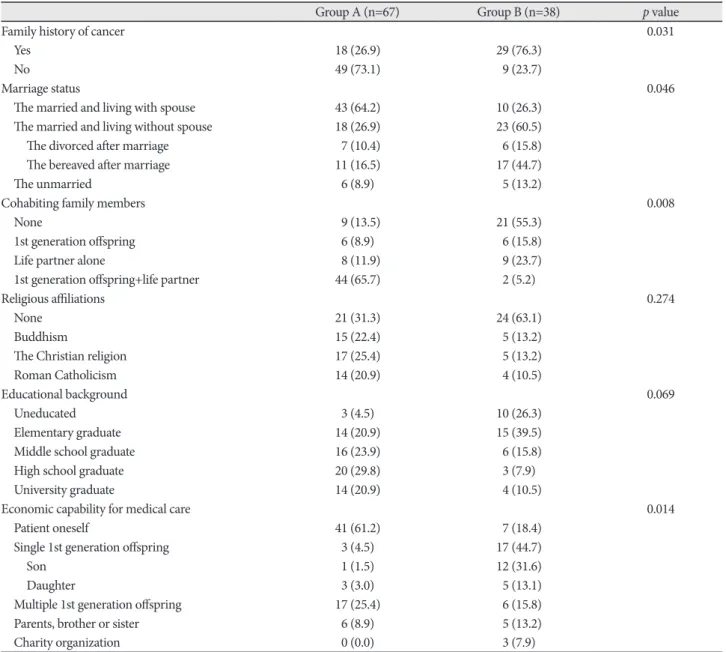
Forty-seven (44.8%) patients had family history of cancer.
In group A, 61 (91.0%) of 67 patients were married. Of these, 43 (64.2%) patients lived with their spouses. In group B, 33 (86.8%) of 38 patients were married. Of these, 10 (26.3%) lived with their spouses. The proportion of patients living with their spouses was significantly less in group B (p=0.046) (Table 2).
Only 9 (13.5%) patients lived alone in group A. However, 21 (55.3%) patients had no cohabitating family members in group B (p=0.008). Especially, as many as 44 patients (65.7%) in group A lived with their son and/or daughter and spouses while only 2 (5.2%) patients in group B did (p=0.008). Forty-one (61.2%) patients in group A had an independent economic capability to pay for the medical care while only 7 (18.4%) patients in group B had such capability (p=0.014). Additionally, multiple 1st gen- defined as metachronous. Extracranial metastasis was estimat-
ed by abdominal and chest CT scan as well as positron emis- sion tomography (PET)-CT performed at the time of diagno- sis of BMs. The status of NSCLC was determined as stable in the metachronous metastasis if there was no interval change of the cancer on the radiographical study. It was considered unstable in the metachronous metastasis if there was growth of the cancer and for all cases of synchronous metastasis.
Demographic and socioeconomic characteristics of patients
Family history of cancer was examined. Marriage status was classified as married or unmarried. In addition, cohabiting fam- ily members were identified and 1st generation offspring were separately categorized as sons and daughters. Among those family members, those who had economic responsibility for treatment were also identified. Social factors included patient religious affiliations and educational backgrounds.
Survival analysis and statistical analysis
Medical records of clinical history, demographic and socio- economic history, family environment, and radiographic re- ports of all study subjects were analyzed. Date of death was con- firmed and recorded. OS was defined as the time from date of diagnosis of BM till death. The date of brain biopsy, if performed, or the date of MRI study was recorded as the date of diagnosis.
Statistical analyses were performed using SPSS ver. 20.0 (IBM Corp., Armonk, NY, USA). Differences between sub- groups were analyzed with Student’s t-test for normally distrib- uted continuous values and Mann-Whitney U-test for non- normally distributed continuous values. Chi-square test was used to analyze categorical variables. OS was calculated accord- ing to the Kaplan-Meier method. Comparisons among groups were performed with log-rank tests. Variables that were sig- nificantly associated with OS of NSCLC patients with BM in univariate analyses were examined in multivariate analysis. Sev- eral additional variables associated with OS in the literature were also included in the multivariate analysis. In this analysis, Cox proportional hazards regression model was used to assess in- dependent effects of specific factors on OS and define hazard ratios of significant covariates. Two-sided p-values <0.05 were considered statistically significant.
Ethical statement
The Institutional Review Board (IRB) of Sungkyunkwan Uni- versity Samsung Changwon Hospital approved the study pro- tocol (IRB number: SCMC 2018-12-006). All studies were con- ducted according to guidelines of the Declaration of Helsinki for biomedical research. Informed consent was waived due to its retrospective nature.
eration offspring shared the fee of medical care for 17 (25.4%) patients in group A and 6 (15.8%) patients in group B. However, in the case that only one son or daughter of the patient bore totally the cost of medical care, there were more patients (n=17, 44.7%) in group B than those (n=3, 4.5%) in group A. There was no significant difference in religious affiliation or educational background between groups A and B (Table 2). The detail de- mographic and socioeconomic data showing comparative re- sults between group A and B was summarized in Table 2.
Follow-up and OS of patients
Follow-up duration ranged from 1.56 months to 18.37 months.
During the follow-up period, 73 (69.5%) patients died. The me- dian length of OS was 10.56 months [95% confidence interval (CI): 7.13–14.21 months]. The median OS of patients who were treated with active therapeutic modality for BM (group A) was 13.84 months (95% CI: 10.26–17.42 months). The medi- an OS of patients who renounced the further active treatment for BM (group B) was 4.76 months (95% CI: 3.12–6.41 months) (p<0.001) (Table 3).
Univariate analysis for predisposing factors of OS of patients with BM of NSCLC
In terms of clinical factors, the following variables were sig- Table 1. Clinical characteristics of the patients with BM of NSCLC
Total (n=105) Group A (n=67) Group B (n=38) p value
Mean age (years) 67.9 (34.5–91.2) 64.1 (34.5–91.2) 74.6 (54.3–87.0) 0.024
Male:female 57:48 35:32 22:16 0.486
KPS 0.017
<70 44 (41.9) 24 (35.8) 20 (52.6)
≥70 61 (58.1) 43 (64.2) 18 (47.4)
Number of BM 0.651
Single 27 (25.7) 19 (28.4) 8 (21.1)
Oligometastasis (2–3) 28 (26.7) 17 (25.4) 11 (28.9)
Multiple (>3) 50 (47.6) 31 (46.3) 19 (50.0)
Extracranial metastasis 0.073
Yes 83 (79.0) 49 (73.1) 34 (89.5)
No 22 (21.0) 18 (26.9) 4 (15.8)
Status of NSCLC 0.708
Stable 65 (61.9) 42 (62.7) 23 (60.5)
Unstable 40 (38.1) 25 (37.3) 15 (40.5)
Time interval of BM 0.041
Synchronous (≤2 months) 33 (31.4) 27 (40.3) 6 (15.8)
Metachronous (>2 months) 72 (68.6) 40 (59.7) 32 (74.2)
RPA class 0.009
I 15 (14.3) 15 (22.4) 0 (0.0)
II 64 (61.0) 45 (67.2) 19 (50.0)
III 26 (24.7) 7 (10.4) 19 (50.0)
GPA score 0.004
0–1 21 (20.0) 17 (25.4) 4 (10.5)
1.5–2.5 47 (44.8) 38 (56.7) 9 (23.7)
3.0 29 (27.6) 10 (14.9) 19 (50.0)
3.5–4.0 8 (7.6) 2 (3.0) 6 (15.8)
Major treatment of BM
Surgical resection 23 (21.9) 23 (34.3) -
WBRT alone 16 (15.2) 16 (23.8) -
SRS alone 5 (4.8) 5 (7.5) -
WBRT plus SRS 17 (16.2) 17 (25.4) -
Salvage chemotherapy 6 (5.7) 6 (9.0) -
Variables are presented as mean (range) or number (%). BM, brain metastasis; GPA, Graded Prognostic Assessment; KPS, Karnofsky Perfor- mance Scale; NSCLC, non-small cell lung cancer; RPA, Recursive Partitioning Analysis; SRS, stereotactic radiosurgery; WBRT, whole brain radiotherapy
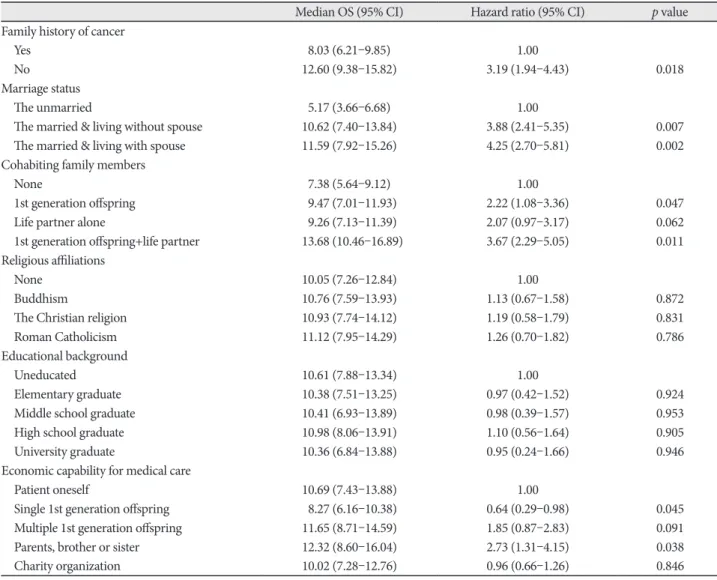
cohabitation with 1st generation offspring with spouse togeth- er (vs. none; p=0.011), independent economic capability for medical care (vs. dependent economic capability for medical care on single 1st generation offspring; p=0.045), and econom- ic capability for medical care by direct family members such as parents, brothers, and sisters (vs. independent economic ca- pability for medical care; p=0.038) (Table 4). However, religious affiliation or educational background was not associated with OS in univariate analysis.
Multivariate analysis for predisposing factors of OS of patients with BM of NSCLC
Multivariate analysis using the Cox proportional hazard re- gression model for survival demonstrated that the following fac- nificantly associated with longer OS: age <65 years (vs. ≥65
years; p=0.048), KPS ≥70 (vs. <70; p=0.001), stable NSCLC (vs.
unstable NSCLC; p=0.019), synchronous metastasis (vs. meta- chronous metastasis; p=0.042), RPA class I (vs. class III; p<
0.001), GPA score 3.5–4.0 (vs. score of 0–1; p<0.001), and active treatment (vs. conservative treatment; p<0.001) (Table 3). How- ever, gender, number of BMs, or extracranial metastasis was not significantly associated with OS in univariate analysis.
In terms of demographic and socioeconomic factors, the fol- lowing variables were significantly associated with longer OS:
absence of family history of cancer (vs. presence; p=0.018), mar- ried but living without spouse (vs. unmarried; p=0.007), mar- ried and living spouse (vs. unmarried; p=0.002), cohabitation with 1st generation offspring without spouse (vs. none; p=0.047),
Table 2. Summaries of demographic and socioeconomic environment of the patients
Group A (n=67) Group B (n=38) p value
Family history of cancer 0.031
Yes 18 (26.9) 29 (76.3)
No 49 (73.1) 9 (23.7)
Marriage status 0.046
The married and living with spouse 43 (64.2) 10 (26.3)
The married and living without spouse 18 (26.9) 23 (60.5)
The divorced after marriage 7 (10.4) 6 (15.8)
The bereaved after marriage 11 (16.5) 17 (44.7)
The unmarried 6 (8.9) 5 (13.2)
Cohabiting family members 0.008
None 9 (13.5) 21 (55.3)
1st generation offspring 6 (8.9) 6 (15.8)
Life partner alone 8 (11.9) 9 (23.7)
1st generation offspring+life partner 44 (65.7) 2 (5.2)
Religious affiliations 0.274
None 21 (31.3) 24 (63.1)
Buddhism 15 (22.4) 5 (13.2)
The Christian religion 17 (25.4) 5 (13.2)
Roman Catholicism 14 (20.9) 4 (10.5)
Educational background 0.069
Uneducated 3 (4.5) 10 (26.3)
Elementary graduate 14 (20.9) 15 (39.5)
Middle school graduate 16 (23.9) 6 (15.8)
High school graduate 20 (29.8) 3 (7.9)
University graduate 14 (20.9) 4 (10.5)
Economic capability for medical care 0.014
Patient oneself 41 (61.2) 7 (18.4)
Single 1st generation offspring 3 (4.5) 17 (44.7)
Son 1 (1.5) 12 (31.6)
Daughter 3 (3.0) 5 (13.1)
Multiple 1st generation offspring 17 (25.4) 6 (15.8)
Parents, brother or sister 6 (8.9) 5 (13.2)
Charity organization 0 (0.0) 3 (7.9)
Variables are presented as number (%).
tors were independently associated with longer OS: age <65 years (vs. ≥65 years, 95% CI: 1.28–3.42; p=0.046), KPS ≥70 (vs. <70, 95% CI: 2.24–6.52; p=0.009), stable NSCLC (vs. un- stable, 95% CI: 1.85–5.89; p=0.020), RPA class I (vs. class II, 95% CI: 1.62–4.96; p=0.026 and vs. class III, 95% CI: 3.25–9.83;
p<0.001), RPA class II (vs. class III, 95% CI: 1.51–3.73; p=0.041), GPA score of 0–2.5 (vs. score of 3.0–4.0, 95% CI: 4.08–9.39;
p<0.001), active treatment (vs. conservative, 95% CI: 5.73–13.63;
p<0.001), married (vs. unmarried, 95% CI: 1.47–4.85; p=0.026), absence of family history of cancer (vs. presence, 95% CI: 1.43–
4.19; p=0.038), and presence of cohabiting family members (vs. absence, 95% CI: 1.70–5.46; p=0.017) (Table 5). However, economic capability for medical care which showed significant
association with OS in univariate analysis was not associated with OS in multivariate analysis. Kaplan-Meier survival curve analysis and log-rank test revealed the same results (Fig. 1).
DISCUSSION
Our retrospective study examined demographic and socio- economic factors of patients with BM of NSCLC who renounced further active treatment for their disease. We found that family history of cancer, marriage status, composition of cohabitating family members, and economic capability for medical care seemed to have influence on the decision of renouncing further active treatment. Exclusively, a better supported family com- Table 3. Univariate analysis for clinical predisposing factors of OS in the patients
Clinical factors Median OS (95% CI) Hazard ratio (95% CI) p value
Age (years)
≥65 9.47 (7.56–11.38) 1.00
<65 12.39 (9.25–15.53) 2.21 (1.13–3.29) 0.048
Gender
Male 10.21 (7.98–12.44) 1.00
Female 10.96 (8.36–13.56) 1.27 (0.69–1.85) 0.805
KPS
<70 7.32 (5.68–8.96) 1.00
≥70 12.89 (9.71–16.07) 4.36 (2.52–6.21) 0.001
Number of BM
Multiple 9.02 (6.82–11.22) 1.00
Single+oligometastasis 11.95 (9.05–14.85) 1.84 (0.83–2.85) 0.346
Extracranial metastasis
Yes 10.11 (8.14–12.08) 1.00
No 12.23 (9.37–15.09) 1.62 (0.88–2.36) 0.482
Status of NSCLC
Unstable 7.76 (6.21–9.31) 1.00
Stable 12.27 (10.19–14.35) 3.51 (1.74–5.28) 0.019
Time interval of BM
Metachronous (>2 months) 9.33 (7.28–11.38) 1.00
Synchronous (≤2 months) 13.21 (9.98–163.44) 2.46 (1.29–3.63) 0.042
RPA class
III 5.76 (4.49–7.03) 1.00
II 10.42 (7.64–13.21) 3.08 (1.54–4.62) 0.026
I 19.43 (15.62–23.24) 5.37 (2.80–7.94) <0.001
GPA score
0–1 3.92 (3.12–4.72) 1.00
1.5–2.5 8.97 (7.22–10.72) 2.74 (1.56–3.92) 0.037
3.0 15.45 (11.13–19.77) 4.26 (2.63–5.89) 0.002
3.5–4.0 20.38 (15.62–25.14) 7.58 (4.63–10.53) <0.001
Major treatment of BM
Conservative treatment 4.76 (3.12–6.41) 1.00
Active treatment 13.84 (10.26–17.42) 9.43 (5.71–13.05) <0.001
BM, brain metastasis; CI, confidence interval; GPA, Graded Prognostic Assessment; KPS, Karnofsky Performance Scale; NSCLC, non-small cell lung cancer; OS, overall survival; RPA, Recursive Partitioning Analysis
Table 4. Univariate analysis for demographic and socioeconomic predisposing factors of OS in the patients
Median OS (95% CI) Hazard ratio (95% CI) p value
Family history of cancer
Yes 8.03 (6.21–9.85) 1.00
No 12.60 (9.38–15.82) 3.19 (1.94–4.43) 0.018
Marriage status
The unmarried 5.17 (3.66–6.68) 1.00
The married & living without spouse 10.62 (7.40–13.84) 3.88 (2.41–5.35) 0.007
The married & living with spouse 11.59 (7.92–15.26) 4.25 (2.70–5.81) 0.002
Cohabiting family members
None 7.38 (5.64–9.12) 1.00
1st generation offspring 9.47 (7.01–11.93) 2.22 (1.08–3.36) 0.047
Life partner alone 9.26 (7.13–11.39) 2.07 (0.97–3.17) 0.062
1st generation offspring+life partner 13.68 (10.46–16.89) 3.67 (2.29–5.05) 0.011
Religious affiliations
None 10.05 (7.26–12.84) 1.00
Buddhism 10.76 (7.59–13.93) 1.13 (0.67–1.58) 0.872
The Christian religion 10.93 (7.74–14.12) 1.19 (0.58–1.79) 0.831
Roman Catholicism 11.12 (7.95–14.29) 1.26 (0.70–1.82) 0.786
Educational background
Uneducated 10.61 (7.88–13.34) 1.00
Elementary graduate 10.38 (7.51–13.25) 0.97 (0.42–1.52) 0.924
Middle school graduate 10.41 (6.93–13.89) 0.98 (0.39–1.57) 0.953
High school graduate 10.98 (8.06–13.91) 1.10 (0.56–1.64) 0.905
University graduate 10.36 (6.84–13.88) 0.95 (0.24–1.66) 0.946
Economic capability for medical care
Patient oneself 10.69 (7.43–13.88) 1.00
Single 1st generation offspring 8.27 (6.16–10.38) 0.64 (0.29–0.98) 0.045
Multiple 1st generation offspring 11.65 (8.71–14.59) 1.85 (0.87–2.83) 0.091
Parents, brother or sister 12.32 (8.60–16.04) 2.73 (1.31–4.15) 0.038
Charity organization 10.02 (7.28–12.76) 0.96 (0.66–1.26) 0.846
CI, confidence interval; OS, overall survival
Table 5. Multivariate analysis for predisposing factors of OS in the patients using Cox regression model
Hazard ratio (95% CI) p value
Age (≥65 years vs. <65 years) 2.35 (1.28–3.42) 0.046
KPS (≥70 vs. <70) 4.38 (2.24–6.52) 0.009
Status of NSCLC (stable vs. unstable) 3.87 (1.85–5.89) 0.020
Time interval of BM (synchronous vs. metachronous) 2.16 (0.84–3.48) 0.073
RPA class
(I vs. II) 3.29 (1.62–4.96) 0.026
(I vs. III) 6.54 (3.25–9.83) <0.001
(II vs. III) 2.62 (1.51–3.73) 0.041
GPA score (0–2.5 vs. 3.0–4.0) 6.74 (4.08–9.39) <0.001
Treatment of BM (active vs. conservative) 9.68 (5.73–13.63) <0.001
Marriage status (married vs. unmarried) 3.16 (1.47–4.85) 0.026
Family history of cancer (no vs. yes) 2.81 (1.43–4.19) 0.038
Cohabiting family members (presence vs. absence) 3.58 (1.70–5.46) 0.017
Economic capability for medical care (patient’s oneself vs. other’s help) 1.92 (0.88–2.96) 0.102 BM, brain metastasis; CI, confidence interval; GPA, Graded Prognostic Assessment; KPS, Karnofsky Performance Scale; NSCLC, non-small cell lung cancer; OS, overall survival; RPA, Recursive Partitioning Analysis
munity system to patients, for example, more family members who help the patient emotionally and economically, makes the patient to receive further treatment for the disease more active- ly. It can be a unique characteristic of Korean culture for family
members to support patients in all aspects of life. It is an osten- sible aspect that if more family members are around the patient, more supports can be given to the patient. However, emotional support provided by more family members can play an active
Fig. 1. Kaplan-Meier survival curves of overall survival for patients with brain metastasis of non-small cell lung cancer according to (A) groups (Group A vs. Group B), (B) marriage status (married vs. unmarried), (C) family history of cancer (presence vs. absence), (D) cohabi- tating family member (presence vs. absence), and (E) economic capability to pay for medical care (dependent vs. independent).
0
Overall survival probability
Time to death (month) 5
Log-rank, p<0.001
Group A
Group B
10 15 20 25
1.0 0.8 0.6 0.4 0.2 0.0
A
0
Overall survival probability
Time to death (month) 5
Log-rank, p=0.516
Economic
dependency Economic
independency
10 15 20 25
1.0 0.8 0.6 0.4 0.2
0.0
E
0
Overall survival probability
Time to death (month) 5
Log-rank, p=0.041
Family history (+)
Family history (-)
10 15 20 25
1.0 0.8 0.6 0.4 0.2
0.0
C 0
Overall survival probability
Time to death (month) 5
Log-rank, p=0.038
Cohabitating family member (+) Cohabitating
family member (-)
10 15 20 25
1.0 0.8 0.6 0.4 0.2
0.0
D
0
Overall survival probability
Time to death (month) 5
Log-rank, p=0.029
Unmarried
Married
10 15 20 25
1.0 0.8 0.6 0.4 0.2 0.0
B
data of 10 patients with NSCLC at our institute, the mean cost of annual medical fee from initial step of NSCLC diagnosis to BM was 6,362,000 Korean won (KRW) (range: 3,785,000 to 14,055,000 KRW) that was paid by the patient. Despite there are many variations in medical condition of individual patient and the Registry Project for Seriously Ill Patients of the Korean National Health Insurance supports part of the cost, the finan- cial burden is not a simple problem to the patient. Total amount of medical cost for patients with NSCLC (sum of patient’s bur- den and government’s coverage) was 46,278,000 KRW on av- erage for the 10 patients with NSCLC. There was no Korean report about the economic burden on the patient in searchable database. One American study reported that the mean cost for medical care of patients with NSCLC was 184,872 US dollars (203,359,200 KRW in exchange rate of 1 dollar to 1,100 KRW) [26]. Actually, among the 41 patients with independent capa- bility for medical care in group A, 39 (95.1%) patients had pri- vate insurance for health to cover most of the cost. Although it is necessary for systemic approach to reduce the economic burden for medical care, hospice consultation can be consid- ered as a way of resolution. Referral to hospice consultation may reduce the economic burden by lowering intensive care unit admission rates, lowering out-of-hospital death rates, and de- creasing the use of chemotherapy within 1 month prior to death without affecting the overall survival of patients with lung can- cer [27].
This study has some limitations. First, our data were analyzed based on medical records retrospectively. Thus, there is limi- tation when interpreting our results. As mentioned above, emo- tional support for patients might affect their depression. How- ever, such data were not included as there was no information for the diagnosis of depression. Second, this was not a random- ized study. Thus, it was impossible for authors to exclude bias that the treatment team might have depending on how strong- ly they encouraged patients to pursue active treatment. Third, the diagnosis of BM was based on radiological impression rather than histopathological impression. Although the incidence is thought to be low, other malignant brain tumors such as high- grade glioma or primary CNS lymphoma, not BM, might have been included in this study. Finally, as our data were based on results from a single institute in Korea, these results cannot be generalized. Data from a multi-center study should be inves- tigated to validate our results.
Conclusively, the present study suggests that demographic and socioeconomic status such as family history of cancer, mar- riage status, cohabitating family members, and economic capa- bility to pay for medical care could influence the decision of further active treatment and prognosis of patients with BM of NSCLC, in addition to clinical factors. However, this study shows a certain hypothesis that emotional support originated from part in the background because patients with cancer can suffer
from depression. Depression is a common form of psychologi- cal distress observed in people with cancer. Most studies have reported that the prevalence of depression in oncological pop- ulations ranges from 15% to 30%, with variations attributable to different screening tools and diagnostic criteria across stud- ies [21]. Recent results support the hypothesis that a variety of psychological interventions may be effective in promoting re- silience to stress and reinforcing social support, including stan- dard cognitive behavioral therapy and mindfulness-based ther- apy with multimodal approaches such as psychoeducational interventions, anticipatory guidance, and measures of psycho- social support [22]. Although emotional support provided by family members is not systemic or specialized compared to psychosocial support provided by a special physician such as psychiatrist, it can be more comfortable and familiar to the pa- tient. Additionally, dietary support can be much effective for the patient if there is rich information about their preference for the taste. Data also indicate that a diet enriched with aforemen- tioned elements may exert protective effect against the devel- opment of depressive symptoms [23]. In fact, most replicated clinical data on dietary recommendations for the prevention of depression indicate that increased consumption of fruit, veg- etables, legumes, whole-grain cereals, nuts, seeds, fish rich in omega-3 polyunsaturated fatty acids, and limitation of the in- take of processed-foods, ‘fast’ foods, and commercial bakery goods has benefits [23].
Other factors that can improve emotional stress include ex- ercise and good sleep. Effective physical activity plays a vital role in improving physical fitness in cancer survivors. It is con- sidered as a key factor of lifestyle interventions. It can also re- verse negative treatment-related side effects [24]. The prevalence of poor sleep quality is common among cancer populations, affecting up to 50% of cancer survivors. It is 2-fold or 3-fold of that in the general community [25].
Unfortunately, the present study did not have any information on depression of enrolled patients. According to the unique Ko- rean culture, more family members who have direct and close contact with the patient might provide more support for the pa- tient in every aspect of the life. Thus, emotional support should be able to reduce depression of the patient. However, random- ized clinical trials are mandatory to prove such hypothesis.
In terms of economic support, there was a significant differ- ence in economic capability to pay for medical care between groups A and B. Financial burden is thought to be one of im- portant factors affecting the decision of further active treatment in cancer patients. Although the Registry Project for Seriously Ill Patients of the Korean National Health Insurance supports 95% of medical fee for treating cancer, the cost is still too heavy burden to patients and their family. According to unpublished
demographic and socioeconomic status could influence the decision of further treatment for the disease by controlling de- pression in cancer patients. As this study was a retrospective analysis based on medical records of patients from a single in- stitute, multi-institute and randomized clinical trials are need- ed in the future for validation.
Conflicts of Interest
The authors have no potential conflicts of interest.
Acknowledgments
We thank Drs. Young Min Kim and Mi-Ok Sunwoo (Department of Radiology, Samsung Changwon Hospital) for their review of radiological images, and Dr. Young Wook Kim (Department of Biostatistics, Samsung Changwon Hospital) for assistance with the statistical analysis.
REFERENCES
1. Jemal A, Bray F, Center MM, Ferlay J, Ward E, Forman D. Global can- cer statistics. CA Cancer J Clin 2011;61:69-90.
2. Malvezzi M, Bertuccio P, Levi F, La Vecchia C, Negri E. European can- cer mortality predictions for the year 2013. Ann Oncol 2013;24:792-800.
3. International Agency for Research on Cancer, World Health Organiza- tion. Cancer fact sheets: estimated cancer incidence, mortality and prevalence worldwide in 2012. Globocan 2012 (Accessed November 8, 2018, at: http://gco.iarc.fr/today/data/pdf/fact-sheets/cancers/cancer- fact-sheets-11.pdf.)
4. Jung KW, Won YJ, Kong HJ, Lee ES. Prediction of cancer incidence and mortality in Korea, 2018. Cancer Res Treat 2018;50:317-23.
5. National Cancer Institute. Cancer stat facts: lung and bronchus cancer.
Surveillance, Epidemiology and End Results Program (Accessed No- vember 8, 2018, at: https://seer.cancer.gov.)
6. Preusser M, Winkler F, Valiente M, et al. Recent advances in the biolo- gy and treatment of brain metastases of non-small cell lung cancer:
summary of a multidisciplinary roundtable discussion. ESMO Open 2018;3:e000262.
7. Barnholtz-Sloan JS, Sloan AE, Davis FG, Vigneau FD, Lai P, Sawaya RE. Incidence proportions of brain metastases in patients diagnosed (1973 to 2001) in the Metropolitan Detroit Cancer Surveillance Sys- tem. J Clin Oncol 2004;22:2865-72.
8. Kohler BA, Ward E, McCarthy BJ, et al. Annual report to the nation on the status of cancer, 1975-2007, featuring tumors of the brain and oth- er nervous system. J Natl Cancer Inst 2011;103:714-36.
9. DeAngelis LM, Posner JB. Intracranial metastases. In: DeAngelis LM, Posner JB, editors. Neurologic complications of cancer. New York: Ox- ford University Press; 2009. p. 141-93.
10. Toyokawa G, Seto T, Takenoyama M, Ichinose Y. Insights into brain metastasis in patients with ALK+ lung cancer: is the brain truly a sanc- tuary? Cancer Metastasis Rev 2015;34:797-805.
11. Mamon HJ, Yeap BY, Jänne PA, et al. High risk of brain metastases in surgically staged IIIA non-small-cell lung cancer patients treated with surgery, chemotherapy, and radiation. J Clin Oncol 2005;23:1530-7.
12. Sperduto PW, Kased N, Roberge D, et al. Summary report on the
graded prognostic assessment: an accurate and facile diagnosis-specif- ic tool to estimate survival for patients with brain metastases. J Clin Oncol 2012;30:419-25.
13. Tsao MN, Xu W, Wong RK, et al. Whole brain radiotherapy for the treatment of newly diagnosed multiple brain metastases. Cochrane Database Syst Rev 2012;1:CD003869.
14. Reck M, Popat S, Reinmuth N, De Ruysscher D, Kerr KM, Peters S;
ESMO Guidelines Working Group. Metastatic non-small-cell lung cancer (NSCLC): ESMO Clinical Practice Guidelines for diagnosis, treatment and follow-up. Ann Oncol 2014;25 Suppl 3:iii27-39.
15. Chang WS, Kim HY, Chang JW, Park YG, Chang JH. Analysis of ra- diosurgical results in patients with brain metastases according to the number of brain lesions: is stereotactic radiosurgery effective for mul- tiple brain metastases? J Neurosurg 2010;113 Suppl:73-8.
16. Rosen LS, Gordon D, Tchekmedyian NS, et al. Long-term efficacy and safety of zoledronic acid in the treatment of skeletal metastases in pa- tients with nonsmall cell lung carcinoma and other solid tumors: a randomized, Phase III, double-blind, placebo-controlled trial. Cancer 2004;100:2613-21.
17. Dayan A, Koca D, Akman T, Oztop I, Ellidokuz H, Yilmaz U. The fac- tors that have an impact on the development of brain metastasis in the patients with breast cancer. J Cancer Res Ther 2012;8:542-8.
18. Karnofsky DA, Abelmann WH, Craver LF, Burchenal JH. The use of the nitrogen mustards in the palliative treatment of carcinoma. With particular reference to bronchogenic carcinoma. Cancer 1948;1:634- 19. Li J, Wang M, Won M, et al. Validation and simplification of the Radia-56.
tion Therapy Oncology Group recursive partitioning analysis classifi- cation for glioblastoma. Int J Radiat Oncol Biol Phys 2011;81:623-30.
20. Sperduto PW, Chao ST, Sneed PK, et al. Diagnosis-specific prognostic factors, indexes, and treatment outcomes for patients with newly diag- nosed brain metastases: a multi-institutional analysis of 4,259 patients.
Int J Radiat Oncol Biol Phys 2010;77:655-61.
21. Cardoso G, Graca J, Klut C, Trancas B, Papoila A. Depression and anxiety symptoms following cancer diagnosis: a cross-sectional study.
Psychol Health Med 2016;21:562-70.
22. Zhang MF, Wen YS, Liu WY, Peng LF, Wu XD, Liu QW. Effectiveness of mindfulness-based therapy for reducing anxiety and depression in patients with cancer: a meta-analysis. Medicine (Baltimore) 2015;94:
e0897.
23. Opie RS, Itsiopoulos C, Parletta N, et al. Dietary recommendations for the prevention of depression. Nutr Neurosci 2017;20:161-71.
24. Gokal K, Wallis D, Ahmed S, Boiangiu I, Kancherla K, Munir F. Effects of a self-managed home-based walking intervention on psychosocial health outcomes for breast cancer patients receiving chemotherapy: a randomised controlled trial. Support Care Cancer 2016;24:1139-66.
25. Savard J, Morin CM. Insomnia in the context of cancer: a review of a neglected problem. J Clin Oncol 2001;19:895-908.
26. Ganguli A, Henk H, Teitelbaum A, Ray S. PCN39 Burden of brain metastasis in an metastatic non-small cell lung cancer (NSCLC) popu- lation. Value Health 2011;14:A440-1.
27. Yoo SH, Keam B, Kim M, Kim TM, Kim DW, Heo DS. The effect of hospice consultation on aggressive treatment of lung cancer. Cancer Res Treat 2018;50:720-8.