This study reports the effectiveness of traditional Korean medicine in treating tetraplegia and respiratory symptoms (including dyspnea) after traumatic cervical spinal cord injury surgery. The patient was treated with complex Korean medical treatment including electroacupuncture, pharmacopuncture, and herbal medicine. The manual muscle test (expanded Medical Research Council system) was used to measure the patient’s muscle strength. The Korean version of the modified Barthel index and the functional independent measure were used to evaluate the patient’s independence in performing daily activities. Following 2 hospitalizations and treatments, the patient’s muscle strength improved > 4+ score for all joints, and the Korean version of the modified Barthel index and functional independent measure scores increased from 26 to 79 and 56 to 95, respectively. Symptoms of dyspnea, coughing, and sputum gradually improved and finally disappeared during hospitalization. This study suggests complex Korean medicine treatment may be effective in the rehabilitation of post-surgical cervical spinal cord injury patients.
©2020 Korean Acupuncture & Moxibustion Medicine Society. This is an open access article under the CC BY- NC-ND license (http://creativecommons.org/licenses/by-nc-nd/4.0/).
Article history:
Submitted: June 27, 2020 Revised: July 28, 2020 Accepted: August 03, 2020 Keywords:
dyspnea, electroacupuncture, herbal medicine, Korean traditional medicine, spinal cord injury, tetraplegia
https://doi.org/10.13045/jar.2020.00213 pISSN 2586-288X eISSN 2586-2898
Case Report
Improvement of Tetraplegia and Respiratory Symptoms with Complex Korean Medicine Treatment After Traumatic Cervical Spinal Cord Injury: A Case Report
Eunbyul Cho 1, *, Hyeonjun Woo 2 , Nam geun Cho 1
1 Department of Acupuncture and Moxibustion Medicine, College of Korean Medicine, Wonkwang University, Iksan, Korea 2 Department of Rehabilitation Medicine of Korean Medicine, College of Korean Medicine, Wonkwang University, Iksan, Korea
ABSTRACT
Journal of Acupuncture Research
Journal homepage: http://www.e-jar.org
Introduction
Most spinal cord injuries (SCI) are caused by trauma resulting from traffic accidents and falls, and frequently occur in people
< 40 years [1]. Cervical SCI constitute a large proportion of all SCI, commonly affecting C5, C6, and C4 in descending order.
SCI mainly impairs motor and sensory function, but in severe cervical SCI cases insufficient respiratory function could occur due to paralysis in the respiratory muscles, decreased lung capacity, and reduced capacity to cough. If the spinal cord is compressed due to the posterior displacement of bone fragments or an intervertebral disc, surgery with an anterior approach can remove the compression caused by the injury [2].
Few cervical SCI cases treated with Korean medicine have been published. Song reported a case of improvement in tetraplegia and neurogenic bladder following Korean medicine treatment for cervical SCI [3], and Choi reported improvement in a patient’s
muscle strength, gait status, and reduced level of pain [4]. However, respiratory symptoms occurring after cervical SCI have rarely been reported. More research into different Korean medicine treatments, their efficacy, and prognosis for patients with cervical SCI is needed.
In this study, we report a case of tetraplegia and respiratory symptom following surgery for SCI, and show improvement in the conditions with complex Korean medicine treatment.
Case Report
The patient was informed of the collection and use of personal information necessary for the study, and informed consent was obtained. This was a retrospective study based on medical records, and was approved by the Institutional Review Board of the Wonkwang University Korean Medicine Hospital (no.:
WKUIOMH-2020-04).
* Corresponding author. Nam geun Cho
Department of Acupuncture and Moxibustion Medicine, College of Korean Medicine, Wonkwang University, Iksan, Korea E-mail: [email protected]
ORCID: Eunbyul Cho http://orcid.org/0000-0003-3431-1109, Hyeonjun Woo http://orcid.org/0000-0003-1614-2145, Nam geun Cho https://orcid.org/0000-0002-6778-9160
©2020 Korean Acupuncture & Moxibustion Medicine Society. This is an open access article under the CC BY-NC-ND license (http://creativecommons.org/licenses/by-nc-
nd/4.0/).
The patient was a 73-year-old male, admitted to the Wonkwang University Hospital after he slipped in the bathroom on August 18
th, 2019. He was diagnosed with C3/4 SCI and cervical spinal stenosis by cervical (C)-spine X-ray and C-spine magnetic resonance imaging (MRI) investigations. The C-spine MRI revealed a diffuse high T2 signal at C4 body level of the spinal cord suggesting acute contusion, and moderate central spinal stenosis at C3/4/5/6 due to disc bulging and bilateral uncovertebral joint hypertrophy (Fig. 1). The patient underwent right anterior cervical discectomy and fusion surgery for C3/4/5 on August 19
th, 2019 (Fig.
2). Postoperatively, he was treated with analgesic medication, O2 inhalation and antibiotic injections.
On August 30
th, 2019, he was admitted to the Wonkwang University Korean Medicine Hospital and was hospitalized until November 13
th, 2019. After discharge, he experienced worsening of tetraplegia and general weakness. He was hospitalized again from January 17
thto February 28
th, 2020.
He had a history of hypertension and diabetes diagnosed 10 years ago. He continued to take medications prescribed by the Wonkwang University Hospital during his hospitalization at the Korean Medicine Hospital.
Clinical findings and diagnostic focus
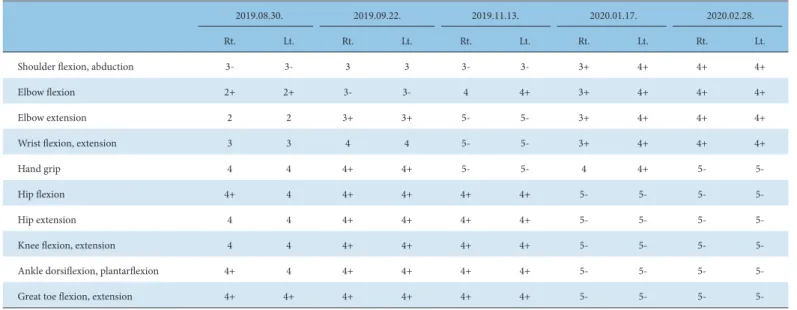
The manual muscle test, the functional independent measure (FIM), and the Korean version of the modified Barthel index (K-MBI) were used to evaluate the patient's progress. The manual muscle test measures muscle strength (Grades 0-5) according to the expanded Medical Research Council system (Table 1) [5].
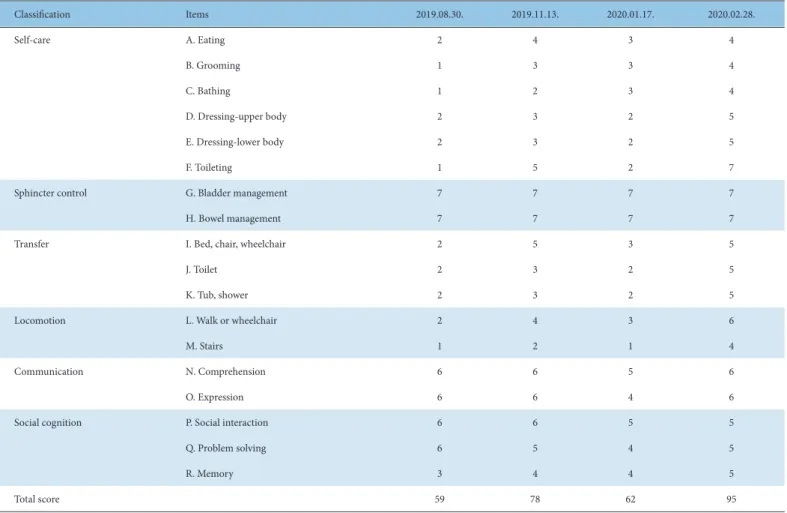
The K-MBI evaluates independence in performing daily activities using 5 grades, depending on the degree of assistance [6]. The FIM evaluates the degree of impairment in physical and cognitive function, and comprises of 18 items (scores 1-7) based on dependence [7].
On August 30
th, 2019, the muscle strengths of the upper extremities were shoulder flexion (3−/3−), elbow flexion (2+/2+), and elbow extension (2/2). The K-MBI and the FIM scores were 29 and 56, respectively. According to the American Spinal Injury Association Impairment Scale, this patient was given a Grade D classification as sensory function was preserved at all neurological levels, and motor function was ≥ 3 in most of the key muscles [2].
Gasping occurred when the patient lay in a supine position for >
1 minute, and coughing occurred approximately 3-4 times/day with white sputum. Sputum formation and the globus pharyngeus sensation were reported postoperatively. Radiculopathy, bowel and bladder control problems were not present. The patient’s neurological examination results were pupil reflex (3+/3+), Babinski’s sign (−/−), Hoffmann sign (+/+), ankle clonus (−/−), and deep tendon reflexes of C5 (+/++), C6 (+/++), C7 (++/++), L4 (++/++), and S1 (++/++).
Therapeutic interventions
Single-use acupuncture needles (stainless steel 0.30 × 30 mm, Woojin acupuncture Inc., Boryeong, Korea) were inserted to a depth of about 10 mm at acupoints LI4, TE5, LI11, GB34, ST36, GB39, and LR3 once per day. Electrostimulation was performed bilaterally at TE5-LI11 or GB34-GB39 by an electric stimulator (STN-110, Stratek, Anyang, Korea). Electroacupuncture stimulation was performed for 15 minutes with 120 Hz continuous wave, and the current intensity was increased according to the patient’s level of tolerance. Acupuncture treatment was performed by a specialist in acupuncture and moxibustion medicine (> 20 years of clinical experience) and residents with clinical experience (> 1 year).
Hominis placenta pharmacopuncture (C1-JH, Jaseng, Namyangju,
Fig 1. Patient's cervical spine magnetic resonance imaging(T2) (Sagittal, Axial at C4 body level) on August 18, 2019.
Fig 2. Patient’s cervical spine X-ray (A) lateral view on August 18, 2019 (B) anteriorposterior, lateral view after surgery (August 19, 2019).
Grade Degree of strength
5 Normal strength
5- Equivocal, barely detectable weakness 4+ Definite but slight weakness
4 Able to move the joint against combination of gravity and some resistance
4- Capable of minimal resistance
3+ Capable of transient resistance but collapses abruptly
3 Able to move through full range against gravity without resistance to the movement
3- Able to move against gravity but not through full range 2 Able to move with gravity eliminated
1 Flicker of movement
0 No movement
Table 1. Expanded Medical Research Council Scale for the Manual Muscle Test.
(A) (B)
Korea) was performed 8 times during the first hospitalization, approximately once every 2 weeks to both SI10 and PC2.
Disposable 29-gauge × 38 mm sterile needles (Sungshim Medical Co., Bucheon, Korea) were used to inject each acupoint with 0.5 mL of hominis placenta solution to a depth of 0.5-1 cm. The patient was prescribed Dokhwalgisaeng-tang-Gami (120 mL, 3 times/day, 1 hour after eating) to aid the recovery from SCI. Macmundong- tang soft extract (Hamsoa Pharmaceutical Co.) was prescribed to relieve the patient’s cough, production of sputum, and globus pharyngeus sensation from September 10
th, 2019 to September 25
th, 2019. Since the patient’s coughing and production of sputum were effectively reduced after taking Macmundong-tang, Liriope platyphylla, the main ingredient of Macmundong-tang, was added to the herbal medication treatment list on September 26
th, 2019 (Table 2).
Moxibustion was performed 5 times/week on the patient’s abdomen, and dry cupping was performed on the back-shu points
once daily to promote blood circulation.
The patient was treated with foot-bath (FZ600A, Koreagat, Wanju, Korea) therapy 5 times/week for 20 minutes or with 30 minutes of lower-body sauna 3-4 times/week using a lower-body sauna device (UTH-SN2, GS Sauna, Gimhae, Korea) during the first admission. The patient was treated with physical and occupational therapy 6 times/week, in consultation with the Department of Rehabilitation Medicine.
Outcomes
The K-MBI score increased to 43 with improvements in ambulation on September 8
th, 2019. On November 13
th, 2019, the muscle strength of the elbow joints increased in flexion (4/4+) and extension (5−/5−). The K-MBI and the FIM scores increased to 71 and 78, respectively, and he was able to walk for 2 minutes without the use of a device for assistance.
Composition
(1
sthospitalization*) Dose (g) Composition
(2
ndhospitalization
†) Dose (g)
Radix of Astragalus membranaceus 16 Ramulus of Loranthus parasiticus Merr. 16
Ramulus of Loranthus parasiticus Merr. 12 Radix of Aralia continentalis Kitagawa 12
Radix of Aralia continentalis Kitagawa 12 Cortex of Eucommia ulmoides Oliver 12
Cortex of Eucommia ulmoides Oliver 12 Fructus of Chaenomeles sinensis 12
Sclerotium of Poria cocos Wolf 12 Sclerotium of Poria cocos Wolf 12
Radix of Panax ginseng 12 Steamed radix of Rehmannia glutinosa 12
Rhizoma of Cnidium officinale Makino 12 Radix of Panax ginseng 12
Radix and rhizoma of Glycyrrhiza uralensis Fischer 8 Rhizoma of Cnidium officinale Makino 12
Ramulus of Cinnamomum cassia Presl 8 Radix of Achyranthes japonica Nakai 8
Fructus of Chaenomeles sinensis 8 Radix of Angelica gigas Nakai 8
Radix of Angelica gigas Nakai 8 Germinated Fructus of Hordeum vulgare Linna var.
hexastichon Aschers 8
Steamed radix of Rehmannia glutinosa 8 Radix of Peucedanum japonicum Thunberg 8
Radix of Achyranthes japonica Nakai 8 Radix of Paeonia lactiflora Pallas 8
Germinated Fructus of Hordeum vulgare Linna var. hexastichon
Aschers 8 Fructus of Crataegus pinnatifida Bunge 8
Radix of Peucedanum japonicum Thunberg 8 Massa Medicata Fermentata 8
Radix of Paeonia lactiflora Pallas 8 Radix and rhizoma of Glycyrrhiza uralensis Fischer 6
Fructus of Crataegus pinnatifida Bunge 8 Ramulus of Cinnamomum cassia Presl 6
Massa Medicata Fermentata 8 Radix of Gentiana macrophylla 6
Radix of Gentiana macrophylla 8 Radix and rhizoma of Asiasarum heterotropides 4
Fructus of Cornus officinalis Siebold et Zuccarini 8
Tuber of Liriope platyphylla Wang et Tang 8
Flos of Carthamus tinctorius Linne 6
*1
sthospitalization was from August 18
th, 2019 to November 13
th, 2019 (76 days).
†