Land Based Test of Ballast Water Treatment System by Ozonation
Sung-Jin Park1․Seung-Je Yoon1․In-Soo Kim†
(Received October 13, 2009; Revised February 2, 2010; Accepted April 27, 2010)
Abstract:This study is currently giving priority to developing the ship's ballast water treatment system using ozone (Ozone BWTS). The Ozone BWTS was tested in a full scale land‐based mobile barge to evaluate performance according to the IMO G8 Guidelines. Test cycles using the mobile‐barge were conducted in seawater and brackish water in the vicinity of the Port of Busan and Nakdong River, Republic of Korea. All tests were conducted according to the requirements of the G8 Guidelines.
Test results show that the Ozone BWTS meets the Ballast Water Performance Standard contained in Regulation D-2 of the IMO Ballast Water Management Convention, as well as all of the operational, safety, and environmental testing requirements of the G8 Guidelines, as required for type approval of IMO. The study results show that the Ozone BWTS is capable of meeting the Ballast Water Performance Standard under Regulation D-2 of the International Convention for the Control and Management of Ships’ Ballast Water and Sediments, and also the more stringent standards being proposed under US legislation.
Key words:Land Based Test, Ballast Water Treatment System, Ozonation, IMO G8
†Corresponding Author (Dept. of Environmental Engineering, Korea Maritime University,) E-mail : [email protected], Tel : 051-410-4416
1 NK.Co.Ltd
1. Introduction
Ballast water is necessary for many functions related to the trim, stability, maneuverability, and propulsion of large oceangoing vessels (National Research Council 1996). Vessels take on, discharge, or redistribute water during cargo loading and unloading, as they take on and burn fuel, as they encounter rough seas, or as they transit through shallow coastal waterways. Typically, a vessel takes on ballast water after its cargo is unloaded in one port to compensate for the weight
imbalance, and will later discharge that water when cargo is loaded in another port. This transfer of ballast water from
“source” to “destination” ports results in the movement of many organisms from one region to the next. In this fashion, it is estimated that more than 7000 species are moved around the world on a daily basis (Carlton 1999).
As known “introduced”, “invasive”,
“exotic”, “alien”, or “aquatic nuisance species”, nonindigenous species (NIS) are organisms that have been transported by human activities to a region where they
did not occur historically, and have established reproducing populations in the wild (Carlton 2001). Once established, NIS can have serious human health, economic and environmental impacts in their new environment. In marine, estuarine and freshwater environments, NIS may be transported to new regions through various human activities including aquaculture, the aquarium and pet trade, and bait shipments (Cohen and Carlton 1995, Weigle et al. 2005). In coastal habitats commercial shipping is an important transport mechanism, or
“vector,” for invasion.
To remove the NIS in the ballast water, there are several methods or processes through all around world. The ozone ballast water treatment system (Ozone BWTS) were used in this studies for land based test of ballast water.
Although ozone has an extremely short half‐life (5.8 seconds in seawater, 30 minutes in freshwater and 30 to 50 minutes in gaseous form), it is one of the most powerful oxidizing agents produced effectively neutralizing endo‐toxins, viruses, bacteria, fungi and organic material extremely rapidly. For this reason ozone has been widely used in the medical sterilization and water treatment industries for many years. Its adaptation for use in ballast water treatment has been under investigation by various parties for some time.
Based on R&D results and literature review to date, this study is currently giving priority to developing the BWTS using ozone. The ozone ballast water treatment system is composed of five
integrated modules, fitted into a ship’s ballast water system, follow as oxygen generator, ozone generator, side stream ozone injector, TRO neutralizer and monitoring & control system.
In the Ozone BWTS, a percentage of the aquatic species in influent ballast water are killed by direct contact with the ozone, as it is injected into the influent ballast water. The remainder are killed or neutralized in the ballast system, when the ozone reacts with bromine ions and bromide that occur naturally in seawater to form hypobromous acid, hypobromite ions, bromoform and bromate ions, all highly effective disinfectants in their own right.
The Ozone BWTS treats ballast during uptake – at the start of the voyage. The ozone and bromine/bromide by‐products collectively know as Total Residual Oxidants (TRO) disintegrate extremely rapidly (seconds, hours or days depending on the compound). It is therefore highly unlikely that there will be any TROs remaining in the ship’s ballast after a typical voyage of several days to weeks.
This will ensure that there is no pollution of receiving waters, when the treated ballast water is discharged.
The study results show that the Ozone BWTS is capable of meeting (and exceeding) the Ballast Water Performance Standard under Regulation D-2 of the International Convention for the Control and Management of Ships’ Ballast Water and Sediments, and also the more stringent standards being proposed under US legislation.
2. Materials and Methods
2.1 Testing Scheme
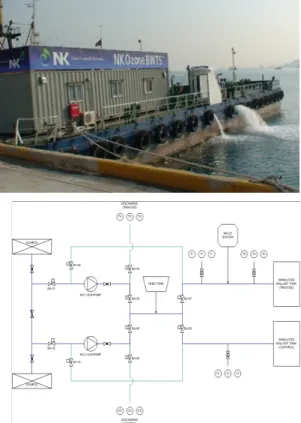
The land‐based tests were performed at two different sites with more than 10 PSU difference in salinity, as required by the G‐8 guidelines. The test locations were Busan port (saline concentration of 32~35 PSU) for seawater, and down stream of Nakdong river (saline concentration of 15~22 PSU) near Busan for brackish water. Use of the mobile barge for the land‐based tests facilitated moving the test system between these environments. Arrangement of ballast
Ci = [influent control water], T0 = [instantly treated water], Ti = [influent water before treated], T5= [treated water after 5 days], C5
= [control water after five days].
Figure 1: The mobile barge used for full‐scale land testing of the Ozone BWTS and arrangement of sampling points for the land based tests.
line and sampling points for the land‐
based tests are as shown in Figure 1.
2.2 Equipment of Ozone BWTS
The Ozone BWTS is composed of five integrated modules (the neutralizer system has been added since the original application): oxygen generator, ozone generator, ozone injector, neutralizer system and monitoring & control system.
The quantity of ozone required to treat a ship's ballast water is determined by the flow rate at which the ballast water is taken on-board the ship. The faster the water is taken on-board, the greater the amount of ozone that is required to treat it. The total number of cubic meter of ballast water carried by the ship is, in-of-itself irrelevant. The system is designed to require between 1.0 mg/L and 2.5 mg/L of ozone to effectively treat the ballast water. Stoichiometric (fixed) ratios are such that the concentration of TRO (HOBr/OBr-) is a maximum of 7.5 mg/L.
Based on laboratory testing, it has been determined that the following quantities of ozone are required to attain the indicated ozone concentration levels in ballast water.
The ozone injector is based on a purpose‐built, patented ‘side‐stream injector’. This diverts incoming ballast water from the main ballast pipes into a
‘side‐stream’, where it is injected with ozone before re‐entering the main ballast stream. The side‐stream injector ensures a high killrate through optimal saturation of the incoming ballast. The side‐stream injector also ensures a restricted dosage area – compared to trying to inject ozone
into the large volumes of the ballast tanks. This eliminates potential for corrosion, by concentrating the Ozone in the injector area only, which is made from high grade, non‐corroding stainless steal.
The monitoring and control system again uses standard, off‐the‐shelf technology, and includes a variety of sensors, alarms, meters, valves and switches connected to central control software, and integrated with the ship’s overall ballast management system. This allows all aspects of the system to be monitored and controlled, and for all data on system operation to be kept electronically and printed as required by inspectors. The system includes safety alarms and automatic cut‐off switches.
There are also several items of ancillary equipment which support these modules:
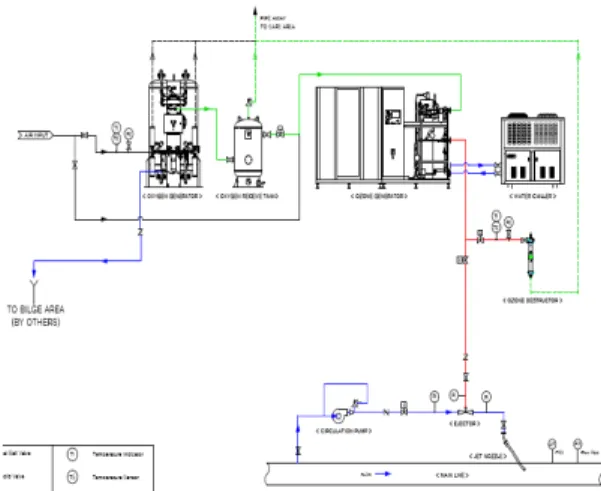
power supply unit (PSU) to provide overall power to the system; compressor to feed air to the oxygen generator (in some cases this can be based on the ship’s existing air compressors); refrigerated dryer (RD) to de‐humidify air being fed to the oxygen generator; Chiller for the closed loop cooling system (CLCS), which keeps the ozone generator cool; and ozone destruct system (ODS) to convert any unused ozone back to oxygen before release to the atmosphere. The overall layout of the Ozone BWTS is shown in Figure 2.
Dissolved oxygen (DO), pH, salinity, turbidity and water temperature were measured by a portable multi‐probe (YSI multi‐probe) at every sampling time and point. Also Total suspended solid (TSS), particulate dissolved carbon (POC) and
dissolved organic carbon (DOC) concentrations were determined for every sampling points. The analytical methods used in this study are performed in accordance with standard methods.
Figure 2: Schematic of overall Layout of the Ozone BWTS
3. Results and Discussions
3.1 Influent water quality and various dose of ozone A combination of indigenous harvested organisms and cultured surrogate species was added to fulfill the influent biological water quality criteria (organism concentrations). Before injection of test organisms to feed tank, cell concentrations were estimated with a Hemacytometer under a microscope (×400) by UNESCO method (UNESCO, 2003), to ensure that influent organism concentrations complied with Part 2 – 2.3.19 of the G8 Guidelines.
The ballast water used in the tests was collected by the test barge in Busan port and Nakdong river eustuary. Measured salinities varied by less than 1.0 PSU in each test cycle. Water quality data in the tested water are showed in Figure 3.
Up: sea water
Down: brackish water
Figure 3: Measurements of temperature, pH, salinity, dissolved oxygen (DO), turbidity, POC, DOC and TSS in the test water (up: sea water, down: brackish water)
Figure 4 shows all TRO concentration declined over time in the tests.
Logarithmic decay lines were applied to all of the TRO data from ozone system.
Figure 4: TRO concentration of treated ballast water over the sampling period.
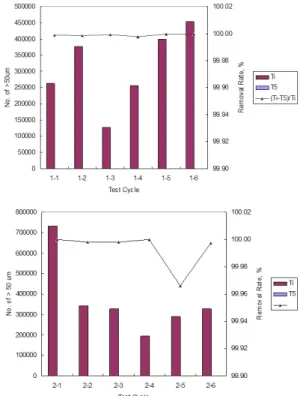
Figure 5: Number of viable organisms over 50 microns in the Ozone BWTS
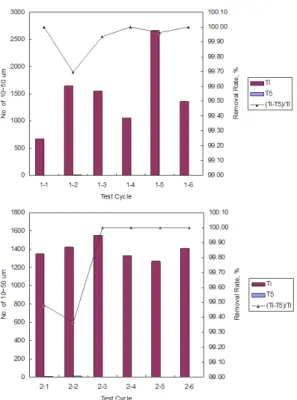
Figure 6: Number of viable organisms between 10 and 50 microns in the Ozone BWTS
Figure 7: Number of total viable bacteria in the effluent of the Ozone BWTS
Figure 5, 6 and 7 indicate that ozonation resulted in rapid, high removal rate in the test organisms at all ozone treatment concentrations. The ozone concentrations at over 2.0 mg/L had significantly higher removal rate in viable
organisms as compared to each of their controls.
Most of the results were as expected for the TRO concentrations that were achieved by the ozone system. One area of interest is the significant regrowth or rebound effect of the microbial population.
Its initial decline for both levels of ozonation reached the 99% reduction level, with a significant rebound occurring within 48 hours of the initial sampling.
This rapid replacement of the microbial population may be facilitated by the increased zooplankton additions and not based solely on the initial surviving microbial reproduction capabilities. This will be further analyzed with other trials without zooplankton introduction. The zooplankton live dead analysis shows a significant decline in survival within the first two sampling points (12hr, 24hr) and no regrowth from 5 days later. There was a reduction of all of the sample tanks abundance. However, there still is a statistical difference between the control and the two ozone concentrations with the reduced abundance.
The measurement of the TRO throughout the test can only be assumed to be the concentration at that sampling point and an initial concentration is difficult to determine due to the method of setting up the tanks. TRO is a measurement of the residual oxidant.
Once the oxidant demand (both chemical and biological demands) of the water has been met, we are able to determine an initial TRO. The experimental design, due to the later addition of the zooplankton, does not allow for an easily determined moment for the calculation of
an initial TRO. We could sample the water before the addition of zooplankton, but that would overestimate the ozone concentration. We could also sample the water directly after the addition of the zooplankton, but we would be unable to determine a stable TRO level without considering the flux of both the biological and chemical oxidant demands of the added zooplankton and water.
3.2 Quantification of viable organisms.
Land‐based test results for the quantification of viable organisms(≥
50µm) to assess compliance of the Ozone BWTS with the IMO D-2 Ballast Water Performance Standard are presented in Figure 8.
Figure 8: Abundance of viable organisms (≥ 50 µm) at each sampling location (up: sea water, down:
brackish water)
Figure 9: Abundance of viable organisms (10 ~ 50 µm) at each sampling location (up: sea water, down:
brackish water)
Figure 10: Identification and quantification of viable bacteria group at each sampling location
4. Conclusions
The Ozone BWTS was tested in a full scale land‐based mobile barge to evaluate performance according to the IMO G8 Republic of Korea.
Guidelines. Test cycles using the obile were conducted in seawater and brackish water in the vicinity of the Port of Busan and Nakdong
All tests were conducted according to the requirements of the G8 Guidelines
This test can give us an indication of what to expect with a latent toxicity experiment on board the ship in relation to biological abundance, and TRO reduction rates over time without additional tank interactions. This study is unabormance according to the IMO G8 Guidelines. Test cycles using the mobile‐
barge were conducted in seawater and brackish water in the vicinity of the Port of Busan and Nakdong le to determine a direct initial TRO concentration for these effects but does give us a better understanding of the range in which the initial TRO (ozone concentration) is necessary for these effects.
Result from the test of ozone’s biological efficacy and minimum concentration required to reduce organism densities indicated that ozone was able to reduce organism densities with a minimal ozone concentration 2.0 mg/L for the organisms observed. The Ozone BWTS meets the Ballast Water Performance Standard contained in Regulation D‐2 of the IMO Ballast Water Management Convention, as well as all of the operational, safety, and environmental testing requirements of the G8 Guidelines, as required for type approval of IMO.
References
[1] National Research Council (NRC).
Stemming the Tide: Controlling
Introductions of Nonindigenous Species by Ships' Ballast Water, Vol. National Academy Press, Washington D.C., 1996.
[2] Carlton, J. T. “The scale and ecological consequences of biological invasions in the world’s oceans. InInvasive Speciesand Biodiversity Management”, O. Sandulund, P. Schei, and A. Viken (Eds) Kulwer Academic Publishers. Dordrecht, Netherlands. pp. 195-212, 1999.
[3] Carlton, J.T. Introduced Species in US Coastal Waters, Pew Ocean Commission, 2001.
[4] Cohen, A.N. and J.T. Carlton.
Nonindigenous aquatic species in a United States estuary: A case study of the biological invasions of the San Francisco Bay and Delta, U.S. Fish and Wildlife Service, 1995.
[5] Weigle, S.M., L.D. Smith, J.T. Carlton, and J. Pederson. “Assessing the risk of introducing exotic species via the live marine species trade”, Conservation Biology, 19(1): pp. 213-223, 2005.
[6] UNESCO. G.M Hallegraeff, D.M Anderson, A.D Cembella (eds), Chapter 4. Estimating cell numbers. In: Manual on Harmful Marine Microalge. Paris, IOC-UNESCO. (IOC Monographs on oceanographic methodology), pp.
99~129, 2003.
[7] MEPC (Marine Environment Protection Committee). 2005. “Guidelines for approval of ballast water management systems (G8)”. MEPC 53/24/Add.1.
Annex 3 –Resolution.125(53). Adopted on July 22, (2005).
Author Profile
Sung-Jin Park
He graduated Korea Maritime University.
After receiving his Masters and Doctorate degrees in Environmental Engineering in 2001 and 2009 respectively, he joined NK Company in Busan, Korea. He is currently working in R&D center of NK Company as Principal Research Engineer, responsible for developing ballast water treatment system.
Seung-Je Yoon
He received his the BS and MS degree in biotechnology and engineering from Pukyong National University in 2004 and 2006, respectively. He currently works at NK Company as a Senior Research Engineer.
In-Soo Kim
He graduated KMU and received his M Eng. & Dr. Eng. from Dong-A Univ. He is currently a professor in Division of Environmental Engineering at Korea Maritime University in Busan, Korea