중풍 환자의 변비에 대한 경락 마사지의 효과: 체계적 문헌 고찰
이은남*․강중원**․이명수**
*동아대학교 의과대학 간호학과
**한국한의학연구원 표준화연구본부
목적 : 이 연구의 목적은 중풍 환자의 변비에 대한 증상완화요법으로서의 경락 마사지에 대해 그 임상적 인 근거를 평가하기 위함이다.
방법 : 본 연구에서는 언어적인 제한 없이 12가지의 데이터베이스에서 개시부터 2010년 4월까지의 문헌 을 검색했다. 변비가 있는 중풍 환자를 경락 마사지로 치료한 모든 형태의 임상 연구를 대상으로 하여, 플라 시보 대조군 연구나 약물요법 또는 무처치 대조군 연구의 경우를 본 연구에 포함하였으며, 증례 보고나 사 례군 연구는 제외하였다. 모든 임상 연구의 방법론적인 질은 Cochrane의 risk of bias analysis를 이용하여 평가하였다.
결과 : 전체적으로 세 편의 비무작위 배정 대조군 연구와 한 편의 비대조군 관찰 연구가 포함되었다. 모 든 연구들은 높은 수준의 risk of bias를 보였다. 세 편의 비무작위 배정 대조군 연구들은 경락 마사지의 효 과를 무처치군과 비교하였는데, 중풍 환자의 변비에 대해 경락 마사지의 긍정적인 효과를 나타내었으며, 한 편의 비대조군 관찰 연구 역시 긍정적인 결과를 보였다. 하지만 모든 연구들은 bias에 노출되어 있었다.
결론 : 경락 마사지가 중풍 환자의 변비에 대해 효과적인 치료법이라는 것을 보여주기에는 현재의 근거가 부족하며, 모든 연구들은 높은 수준의 risk of bias를 가지고 있기 때문에 더욱더 엄격한 연구가 요구된다.
핵심단어 : 경락 마사지, 중풍, 변비, 체계적 문헌 고찰
1)
Meridian Massage Therapy for Treating Constipation in Patients with Stroke: a Systematic Review
Lee Eun-nam
*, Kang Jung-won
**and Lee Myeong-soo
***
Department of Nursing, College of Medicine, Dong-A University
**
Division of Standard Research, Korea Institute of Oriental Medicine
*Lee Eun-nam. was supported by the Dong-A University research fund
․Acceptance : 2010. 5. 6. ․Adjustment : 2010. 5. 25. ․Adoption : 2010. 5. 25.
․Corresponding author : Lee Myeong-soo, Division of Standard Research, Korea Institute of Oriental Medicine, 483 Exporo Yuseong-gu Daejeon, 305-811, Republic of Korea
Tel : 82-42-868-9266 E-mail : [email protected]
국문초록
Original Article
Ⅰ. Introduction
Chronic constipation in the elderly is a prevalent problem. The prevalence in stroke patients is higher than normal elderly1). Constipation in stroke patients may be caused by many factors including old age, drug therapies, and physical inactivity. Such factors have a negative impact on the patient’s quality of life and restrict their social activities. Currently no optimal therapeutic solution exists for this condition.
Complementary and alternative medicine(CAM) is increasingly used for treatment of gastrointestinal diseases2,3), and massage is an alternative therapy frequently used to treat constipation. Massage therapy, which can be defined as a method of manipulating the soft tissue throughout the body using pressure and traction4), can be considered as an alternative treatment for constipation. Many variations of massages exist, and most cultures have developed their own techniques.
The literature contains one systematic review of massage on constipation5). The results of this review are insufficient to conclude its effectiveness.
Considering that meridian massage is closely related to classic massage, it seems pertinent to evaluate the effectiveness of this therapy under these conditions. Currently, no systematic review of meridian massage for constipation in stroke patients is available. Hence, the aim of this study is to summarize and critically evaluate the evidence for or against the effectiveness of meridian massage as a symptomatic treatment for constipation in stroke patients.
Ⅱ. Methods
1. Data sources
The following databases were searched from their inception through to April 2010 : MEDLINE, AMED, EMBASE, CINHAL, five Korean Medical
Databases(Korean Studies Information, DBPIA, Korea Institute of Science and Technology Information, KoreaMed, and Research Information Centre for Health Database), Chinese Medical Databases (CNKI), and The Cochrane Library 2010, Issue 2.
The search terms used were “massage OR meridian massage” AND “constipation or obstipation or costiveness” AND “stroke OR cardiovascular disease”
in Korean, Chinese, and English. Reference lists of all obtained papers were searched. We also performed electronic searches of relevant journals (Focus on Alternative and Complementary Therapies and Forschende Komplementarmedizin up to April 2010). Additionally, reference lists of all obtained papers were searched, and our own files were manually searched as well. Hardcopies of all po- tentially relevant articles were obtained and read in full.
2. Study selection
All prospective clinical studies of any type of meridian massage therapy for constipation in stroke patients were included. We excluded case studies, case series, and qualitative studies. Articles were excluded if they were concerned with reflexology, hand massage, lymph drainage or other forms of massage without stimulation of the meridian. We also excluded case studies. Trials in which one type of massage was compared to another type and studies that failed to provide detailed results were also excluded. No language restrictions were im- posed. Hard copies of all articles were obtained and read in full.
3. Data extraction, quality, and validity assessment
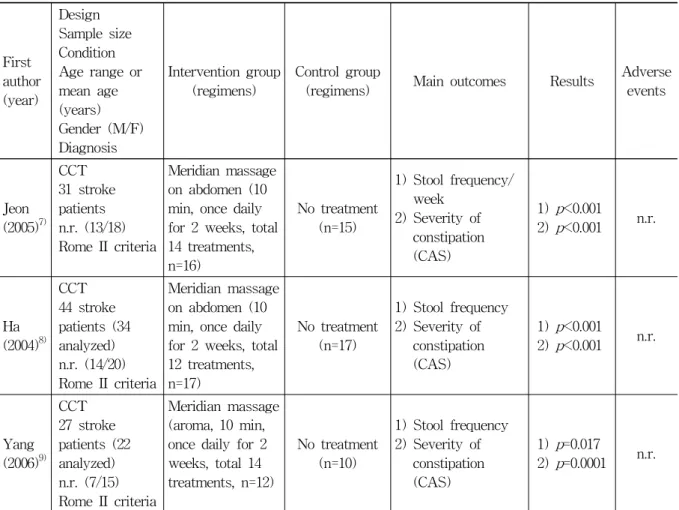
All articles were read by two independent reviewers(ENL and MSL), who extracted data from the articles according to predefined criteria (Table 1). Risk of bias was assessed using the Cochrane classification in four criteria : randomization, blinding, withdrawals, and allocation concealment6). Consi-
First author (year)
Design Sample size Condition Age range or mean age (years) Gender (M/F) Diagnosis
Intervention group (regimens)
Control group
(regimens) Main outcomes Results Adverse events
Jeon (2005)7)
CCT 31 stroke patients n.r. (13/18) Rome II criteria
Meridian massage on abdomen (10 min, once daily for 2 weeks, total 14 treatments, n=16)
No treatment (n=15)
1) Stool frequency/
week 2) Severity of
constipation (CAS)
1) p<0.001
2) p<0.001 n.r.
Ha (2004)8)
CCT 44 stroke patients (34 analyzed) n.r. (14/20) Rome II criteria
Meridian massage on abdomen (10 min, once daily for 2 weeks, total 12 treatments, n=17)
No treatment (n=17)
1) Stool frequency 2) Severity of
constipation (CAS)
1) p<0.001
2) p<0.001 n.r.
Yang (2006)9)
CCT 27 stroke patients (22 analyzed) n.r. (7/15) Rome II criteria
Meridian massage (aroma, 10 min, once daily for 2 weeks, total 14 treatments, n=12)
No treatment (n=10)
1) Stool frequency 2) Severity of
constipation (CAS)
1) p=0.017
2) p=0.0001 n.r.
CCT : non-randomized controlled trials. UOS : uncontrolled observational study. CAS : Constipation Assessment Scale.
n.r : not reported. N/A : not applicable.
Table 1. Summary of Clinical Studies of Meridian Massage for Constipation in Patients with Stroke
dering that it is impossible to blind therapists to the use of massage, we assessed patient and as- sessor blinding separately. Disagreements were re- solved by discussion between the two reviewers (ENL and MSL). There was no disagreement bet- ween the two reviewers regarding the risk of bias.
Ⅲ. Results
1. Study description
Our search identified 16 potentially relevant studies, of which four met our inclusion criteria. Key data of the included studies are summarized in Table 17-10). Three7-9) were nonrandomised controlled clinical trials (CCTs), and one10) was an uncontrolled observa-
tional study (UOS). All trials originated in Korea.
2. Risk of bias
All the included trials had a high risk of bias.
Furthermore, all the included trials failed to report incomplete outcome measures and allocation conceal- ment. None of the studies described any attempt to blind the assessors, and none mentioned any ad- verse events.
3. Description of individual studies
Jeon and Jung7) conducted a CCT assessing the effectiveness of abdominal meridian massage on symptoms of constipation patients. Thirty one patients were divided non-randomly into two parallel groups : abdominal meridian massage(n=16) and no treat-
ment(n=15). At the end of the treatment period, the experimental group showed more improvement in stool frequency and symptom severity as com- pared with the no-treatment group.
Ha8) conducted a CCT to test the therapeutic effect of abdominal meridian massage on con- stipation in stroke patients. Forty four patients were divided into two parallel groups: abdominal meridian massage group(n=22) and no-treatment group(n=22), but 5 patients were dropped out respectively in both experiemental group due to early discharge(n=2), condition aggravation(n=2) and treatment refusal(n=1) and control group due to early discharge(n=4) and condition aggravation(n=1).
The stool frequency and severity of symptoms were improved in the experimental group compared with the control.
Yang et al.9) evaluated the effect of meridian massage with aroma on the constipation of stroke patients. They allocated 27 patients into two parallel groups: meridian massage(n=14) and no-treatment (n=13), but there were two dropouts due to con- dition aggravation(n=1) and early discharge(n=1) in experimental group and three dropouts due to early discharge in control group. The frequency of bowel movement and CAS(constipation assessment scale) were significantly different between the experi- mental and control groups.
The one UOS10) included in the present study assessed the effects of meridian massage on constipation in stroke patients. This study found that meridian massage therapy improved stool frequency and severity of constipation.
Ⅳ. Discussion
Few clinical trials have tested the effects of meridian massage for constipation in stroke patients, and none of the existing trials were methodo- logically rigorous. All the included trials showed favorable effects of meridian massage therapy for constipation in patients with stroke. However, the
number of trials, their quality, and the total sample size are too low to allow firm conclusions.
All included trials had a high risk of bias. None of them were randomized or controlled and are therefore open to selection bias and false positive results. Low-quality trials(high risk of biased trials) are more likely to overestimate the effect size11,12). None of the RCTs described attempts to blind patients or assessors, dropouts and withdrawals, or allocation concealment. In addition, all trials failed to report details regarding ethical approval. Thus, the reliability of the evidence presented here is clearly limited. Two CCTs8,9), small unpublished theses, had not gone through a formal peer review process. One UOS10)showed favorable effects. Unfor- tunately, such data are highly susceptible to bias;
hence, they provide little useful information on the specific effects of meridian massage as a ther- apeutic intervention for constipation in stroke patients.
It has been repeatedly noted that trials origin- ating from China and Korea are rarely, if ever, negative13). The absence of negative results is a largely unexplained phenomenon. Whatever the causes, it does not increase our confidence in these studies.
Comparing meridian massage with no-treatment generated favourable effects on at least one outcome measure. Due to their design(A+B versus B) all included CCTs were unable to demonstrate specific therapeutic effects14). It is conceivable that with such a design(A+B versus B), the experimen- tal treatment seems effective, even if it is, in fact, a pure placebo: the nonspecific effects of A are likely to generate a positive result even in the absence of specific effects of A.
A possible mechanism of using meridian massage to relieve chronic constipation is that stimulation with pressure or massage on acupuncture points increases the circulation of qi and relieves qi- blockage. This helps the digestion of food and absorption of water, and increases the bowel mo- vement. However, this theory can be established before actual effectiveness of meridian massage is demonstrated. However, none of these theories have
been confirmed as yet.
Limitations of our systematic review pertain to the potential incompleteness of the evidence revi- ewed. We aimed to identify all studies on the subject. The distorting effects of publication bias and location bias on systematic reviews and meta- analysis are well documented15,16). Further limitations include the paucity and the often suboptimal quality of primary data. Additionally, all included clinical trials that reported positive results came from Korea, one of the countries that produce virtually no negative results―a fact that casts some doubt on the validity of such data13). Collectively, these facts seriously limit the conclusiveness of our systematic review.
Future studies should emphasize adequate methods to permit RCTs and the use of pilot trials to help prepare appropriate RCTs. Long-term studies are also needed to determine the longevity of treatment effects. Moreover, a cost-analysis should be con- sidered.
Ⅴ. Conclusion
The evidence that meridian massage is an effective treatment for constipation is inconclusive.
Even though the trial data are unanimously posi- tive, too many important caveats exist to draw firm conclusions.
Ⅵ. References
1. Su Y, Zhang X, Zeng J, Pei Z, Cheung RT, Zhou QP, Ling L, Yu J, Tan J, Zhang Z. New-onset constipation at acute stage after first stroke:
Incidence, risk factors, and impact on the stroke outcome. Stroke. 2009 ; 40 : 1304-9.
2. Tillisch K. Complementary and alternative med- icine for functional gastrointestinal disorders.
Gut. 2006 ; 55 : 593-6.
3. Tillisch K. Complementary and alternative medi- cine for gastrointestinal disorders. Clin Med.
2007 ; 7 : 224-7.
4. Ernst E, Pittler MH, Wider B, Boddy K. The desktop guide to complementary and alternative medicine. Philadelphia, PA : Mosby Elserviser.
2006.
5. Ernst E. Abdominal massage therapy for ch- ronic constipation : A systematic review of controlled clinical trials. Forsch Komplement- armed. 1999 ; 6 : 149-51.
6. Higgins JPT, Altman DG. Assessing risk of bias in included studies, In : Julian PTH, Green S(eds). Cochrane handbook for systematic re- views of interventions. West Sussex, England : Wiley-Blackwell. 2008 : 187-241.
7. Jeon SY, Jung HM. The effects of abdominal meridian massage on constipation among cva patients. J Korean Acad Nurs. 2005 ; 35 : 135- 42.
8. Ha WC. The effects of abnominal meridian massage on the constipation of cva patients.
Department of Nursing, Vol Master. Busan : Pusan National University. 2004.
9. Yang YH. The effect of aromatherapy-meridian massage on the relief of constipation and the reduction of stress in patients with stroke. De- partment of Nursing, Vol Master. Seoul : Kyung Hee University. 2006.
10. Kim DS, Choi IJ, Hwa WC, Lee HZ, Park NH.
The effect of abdominal meridian massage on constipation and depression of hemiplegic patients.
Clin Nurs Res. 2004 ; 10 : 70-81.
11. Day SJ, Altman DG. Statistics notes: Blinding in clinical trials and other studies. BMJ. 2000 ; 321 : 504.
12. Schulz KF, Chalmers I, Hayes RJ, Altman DG.
Empirical evidence of bias. Dimensions of meth- odological quality associated with estimates of treatment effects in controlled trials. JAMA.
1995 ; 273 : 408-12.
13. Vickers A, Goyal N, Harland R, Rees R. Do certain countries produce only positive results?
A systematic review of controlled trials. Control
Clin Trials. 1998 ; 19 : 159-66.
14. Ernst E, Lee MS. A trial design that generates only “positiv” results. J Postgrad Med. 2008 ; 54 : 214-6.
15. Ernst E, Pittler MH. Alternative therapy bias.
Nature. 1997 ; 385 : 480.
16. Rothstein HR, Sutton AJ, Borenstein M. Publi- cation bias in meta-analysis, In : Rothstein HR, Sutton AJ, Borenstein M(eds). Publication bias in meta-analysis. Chichester, West Sussex : Wiley.
200.