• 검색 결과가 없습니다.

Effects of Lumbar Stabilization Using Pressure Biofeedback Unit During Hip Abduction in Side-Lying in Patients With Low Back Pain

N/A
N/A
Protected

Academic year: 2021

Share "Effects of Lumbar Stabilization Using Pressure Biofeedback Unit During Hip Abduction in Side-Lying in Patients With Low Back Pain"

Copied!
8
0
0

로드 중.... (전체 텍스트 보기)

전체 글

(1)

Effects of Lumbar Stabilization Using Pressure Biofeedback Unit During Hip Abduction in Side-Lying in Patients With Low Back Pain

Young-taek Seo, MSc, PT, Seung-chul Chon, PhD, PT

Dept. of Physical Therapy, College of Medical Science, Konyang University

Abstract  

Background: Lumbar stabilization (LS) improve the thickness of the quadratus lumborum (QL) muscle and muscle activity of the gluteus medius (GM) muscle during hip abduction in a side-lying position in patients with low back pain (LBP).

Objects: The purpose of this study was to assess the effects of LS on muscle thickness of QL and muscle activity of GM during hip abduction in side-lying in patients with LBP.

Methods: The study included 32 patients with LBP, who were randomly divided into the control group and experimental group, each with 16 patients. All subjects performed 35° preferred hip abduction (control group) and 35° hip abduction with LS (experimental group) during side-lying. An ultrasonography and a surface electromyography were used to measure the thickness of the QL muscle, and the muscle activities of the GM muscle respectively. Independent t-test was used to compare the muscle thickness of the QL and the muscle activity of the GM muscle, respectively.

Results: Anterio-posterior diameter in the muscle thickness of QL muscle was decreased significantly in hip abduction with LS more than in preferred hip abduction (p<.001), but medio-lateral diameter in the muscle thickness of QL muscle was not significantly different between in preferred hip abduction and in hip abduction with LS (p=.06). The muscle activity of GM was increased significantly in hip abduction with LS more than in preferred hip abduction (p<.001).

Conclusion: These findings suggest that hip abduction with LS could be recommended as a hip abduction for LS and a prevention unwanted compensatory pelvic lateral tilting movement.

Key Words: Gluteus medius; Hip abduction; Quadratus lumborum; Ultrasonography.

Introduction

One of the causes of the low back pain (LBP) is an instability of the lumbar segment (Panjabi, 2003).

This instability can cause disequilibrium in the move- ment of lumbar system (Comerford and Mottram, 2001). The disequilibrium with decreasing joint mobi- lity of the lower extremity in LBP could be observed during the activities of sitting, standing and walking.

And, the improper control of joint mobility in the spine and lower extremities, could cause the pain of the lumbo-pelvic-hip complex (Hoffman et al, 2011).

The dysfunctional movement of the gluteus medius (GM) muscle is related to several musculoskeletal

disorders of the lumbo-pelvic-hip complex (O’Sullivan et al, 2010). According to previous research, the GM muscle in patients with chronic LBP was weak and rapidly fatigued (Arab and Nourbakhsh, 2010). For example, the height difference in hip joint and pain around the hip joint in patients with LBP is caused by weakness of the GM muscle (Sahrmann, 2002).

Additionally, weakness of the GM muscle can cause

the lateral bending of the trunk during one leg stand-

ing (Neumann, 2010). Thus, rehabilitation management

of the muscles around the hip joint should be consid-

ered a strategic approach in lumbar stabilization

(Nelson-Wong and Callaghan, 2010). Specifically, im-

proving the function of the GM muscle will improve

Corresponding author: Seung-chul Chon [email protected]

(2)

Parameters Control group (n

1

=16) Experimental group (n

2

=16) t p

Age (year) 28.9±4.3

a

30.6±10.4 .622 .539

Height (㎝) 168.3±7.2 163.3±7.2 -1.961 .059

Weight (㎏) 64.7±15.7 58.1±10.3 -1.410 .169

VAS

b

2.5±.5 2.6±.6 .307 .761

ODI

c

10.4±1.5 10.3±1.1 -.399 .693

a

mean±standard deviation,

b

visual analogue scale,

c

Oswestry disability index.

Table 1. Demographic and clinical characteristics of the patients (N=32) neuromuscular coordination of the lumbo-pelvic-hip

complex and prevent LBP (Fredericson et al, 2000).

Janda et al (1996) report that compensatory move- ments such as hip flexion, hip external rotation and pelvic lateral tilting should not occur until the hip joint reaches 40° of abduction. When the GM muscle is weakened, a synergist such as the quadratus lumbo- rum (QL) muscle can be used to compensate and pel- vic lateral tilting can occur (Comerford and Mottram, 2001). Similarly, the muscle activity of the QL muscle is increased due to excessive use, it may cause lumbar lateral flexion by pelvic elevation, which results in in- stability or impairment of the lumbo-pelvic-hip com- plex system (Sahrmann, 2002).

Most of the studies related to core stability meas- urements have been conducted with the subjects in a supine position. In previous studies, hip abduction measurements in a side-lying position using pressure biofeedback unit (PBU) have been finitely presented in patients with LBP. Therefore, research related to the hip abduction mechanisms underpinning the ef- fects of core stability to the selective recruitment of the GM muscle associated excluding the compensa- tory movement of the QL muscle in a side-lying po- sition is much needed.

This study was undertaken to determine the addi- tive effect of core stability and hip abduction in a side-lying position for LBP patients. To quantita- tively investigate the mechanism of core stability on muscle thickness and associated muscle activity, our study has been undertaken for patients with LBP using the real-time ultrasound (US) imaging techni- que and electromyography (EMG) technique. Our ba-

sic hypothesis was that the decrease in size of the QL muscle and increase in amplitude in the GM mus- cle would significantly improve in the experimental group (which performed both the hip abduction and core stability exercises) than the control group (which performed the hip abduction alone).

Methods

Subjects

A convenience sample of thirty-two patients with LBP was recruited from local private center (Daejeon, South Korea). All the procedures were explained to the subjects, and each subject signed an informed consent form. General characteristics of the subjects are pre- sented (Table 1). The inclusion criteria were as follows:

(1) persistent LBP for at least 3 months (Airaksinen et al, 2006), (2) average pain intensity over the last 2 weeks

<3 point on 10 point of Visual Analogue Scale, (3) 10~

25 point on 50 point of Oswestry Disability Index, (4)

failure of the abdominal draw in maneuver (ADIM) for-

mal test (considered “failure” when the participant was

unable to reduce and maintain a 5~10 ㎜Hg difference

in the PBU during 10 seconds in the side-lying ADIM

formal test) (von Garnier et al, 2009). The exclusion

criteria were as follows: (1) below good grade of GM

muscle on manual muscle testing, (2) diagnosis of other

neurologic disorders that may affect this study, (3) se-

vere cardiovascular diseases, (4) osteoporosis, structural

deformity, systemic inflammatory disease, and nerve

root compression that could affect the experimental

tests (Powers et al, 2008).

(3)

Figure 1. Preferred hip abduction. Figure 2. Hip abduction with lumbar stabilization.

Procedure

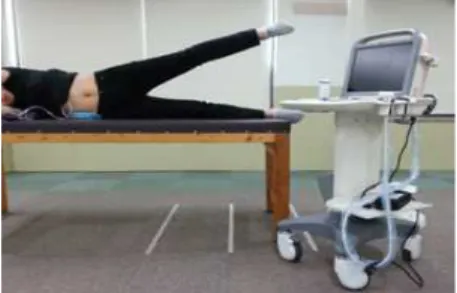
Each subject was positioned in a side-lying position with their non-dominant knee joints slightly flexed. All subjects were right leg dominant. They were positioned straight on a manual table. The lumbar spine was in a neutral position. Two positions were assessed: (1) pre- ferred hip abduction (PHA) (Figure 1) and hip abduc- tion with lumbar stabilization (HALS) (Figure 2). The PHA position involves a 35° abduction of the dominant hip while side-lying. The HALS position is an ADIM using a PBU with a 35° abduction of the dominant hip while side-lying (Cynn et al, 2006). The EMG activity and US thickness were measured in the GM and QL muscles, respectively, while performing the hip abduc- tion of the dominant lower extremity while side-lying.

The non-dominant lower extremity could be slightly flexed at the knee joints. The subject was asked to perform a hip abduction while side-lying with the dom- inant lower extremity in the preferred condition, with and without the PBU. A digital inclinometer (Dualer IQ Inclinometer, J-Tech Medical, Heber city, USA) was used to determine the 35° angle for hip abduction. To control the individual variability in hip abduction range, a target bar was placed at the level of 35° of hip ab- duction (Cynn et al, 2006). In the lumbar stabilization condition, the PBU was placed between the therapeutic table, which has a firm mattress, and the subject’s lum- bar spine in the side-lying position. The PBU was in- flated until the pressure level was approximately 40 ㎜Hg, at which point the target pressure was determined.

Pressure changes of 5 ㎜Hg were allowed to account for changes induced by respiration (Cynn et al, 2006).

Prior to testing, all subjects were trained for ap-

proximately 10 min to familiarize themselves with the PHA and HALS positions, until they demonstrated proficiency. When the hip was placed at 35° of abduction, the participants maintained the ADIM posture and normal respiration. At 2/3 of the participant’s normal expira- tion they were asked to hold the position for 5 seconds.

US images of the QL muscle were collected during this 5 seconds period. There was a 5 min rest between each trial. The subjects were not provided with any biofeed- back regarding their performance or results for any trials.

After a 30 min rest, an electrode was attached to collect EMG data from the GM muscle. The subjects were asked to perform the PHA and HALS positions in the same manner. All examinations were conducted by the same researcher.

Ultrasonography and data processing This study used US equipment (Achievo CST, V2U Healthcare, Pte, Ltd. Midview city, Singapore).

Using a 3.5 ㎒ convex transducer, the thicknesses of

the QL muscle on the dominant side was measured

during the PHA and HALS periods. The thickness of

the QL muscle was measured by US imaging due to

muscle depth in this study. To measure the QL

muscle, the transducer was moved laterally from the

transverse plane at the L3 level until an image was

obtained (Reeve and Dilley, 2009). The thickness of

the QL muscle was measured at the medio-lateral

(M-L) and anterio-posterior (A-P) diameters at the

widest point (Desmoulin and Millner, 2007) (Figure

3). The location of the transducer head was marked

so that the identical placement would be used for all

measurements. All US images were collected at the

(4)

Figure 3. Measurement of quadratus lumborum

muscle thickness. Figure 4. Placement of EMG electrodes on

gluteus medius.

end of the posture while the subject was holding his or her breath after expiration, and the images were stored. Each measurement was repeated thrice and the average was used.

Surface EMG recording and data processing EMG was recorded using the TeleMyo 2400T Direct Transmission System (DTS), and analysis was completed using Myo-research software (Noraxon Inc., Scottsdale, AZ, USA). EMG channel recorded the muscle activity of the dominant side GM muscle.

The surface EMG measurement for the GM muscle was used due to the superficial location in this study.

The skin was shaved with a razor and cleaned with rubbing alcohol to minimize the effects of contamination.

Disposable Ag-AgCl surface electrodes were posi- tioned at an inter-electrode distance of 2 ㎝. EMG data were collected over the proximal third of the distance between the iliac crest and the greater tro- chanter ipsilateral to the dominant side GM muscle (Criswell, 2010) (Figure 4). The sampling frequency of raw EMG signals was 1000 ㎐. A band-pass filter (20∼500 ㎐) and notch filter (60 ㎐) were used.

EMG data were converted to root mean square (RMS) values. The mean RMS at the maximal vol- untary isometric contraction (MVIC) was recorded from each subject for 5 seconds, thrice, with a 5 min rest interval. The GM muscle was contracted as hard as possible in a manual muscle-testing position (Kendall et al, 2005). The data were expressed as a percentage of the MVIC (%MVIC), and the mean val- ue of three trials was used for data analysis.

Statistical analysis

The descriptive statistics including the means and standard deviations were used in general characteristics.

Independent t-test was used to determine significant differences in muscle thicknesses of the QL muscle and muscle activity of the GM muscle between PHA (control group) and HALS (experimental group). The alpha level of statistical significance was set at .05.

All the data were analyzed using the SPSS version 18.0 (SPSS Inc., Chicago, IL, USA).

Results

The independent t-tests revealed that the A-P thickness of QL muscle was significantly decreased in experimental group (HALS) compared with control group (PHA) (p<.001), however, the M-L thickness of QL muscle was not significantly decreased in ex- perimental group (HALS) compared with control group (PHA) (p=.06) (Table 2).

The independent t-tests showed that the muscle ac- tivity of GM muscle was significantly increased in ex- perimental group (HALS) compared with control group (PHA) (p<.001) (Table 3).

Discussion

This study demonstrated whether core stabilization

could improve the thickness of the QL muscle and

muscle activity of the GM muscle during hip abduc-

(5)

Muscle thickness Control group (n

1

=16) Experimental group (n

2

=16) t p

QL (A-P)

a

1.53±.34

b

1.38±.31 6.35 <.001*

QL (M-L)

c

3.91±.65 3.77±.70 1.96 .06

a

quadratus lumborum (anterio-posterior),

b

mean±standard deviation,

c

quadratus lumborum (medio-lateral), *p<.05.

Table 2. Comparison of muscle thicknesses of quadratus lumborum muscle between control group (preferred hip abduction) and experimental group (hip abduction with lumbar stabilization) (Unit=㎝)

Muscle Control group (n

1

=16) Experimental group (n

2

=16) t p

GM

a

38.10±12.55

b

47.90±12.44 -5.28 <.001*

a

gluteus medius,

b

mean±standard deviation, *p<.05.

Table 3. Comparison of EMG muscle activity of gluteus medius muscle between control group (preferred hip abduction) and experimental group (hip abduction with lumbar stabilization) (Unit=%MVIC)

tion in a side-lying position in patients with LBP. As anticipated, the thickness of the QL muscle was sig- nificantly decreased and the activity of the GM muscle was significantly increased in the experimental group (HALS) compared to the control group (PHA) as a function of the core stability effect. Intervention re- lated changes in altered muscle thickness were suc- cessfully quantified by US imaging technique. This morphological decrease in muscle thickness was paral- leled with increased EMG muscle activity of GM mus- cle during HALS. Such functional improvements were corroborated by pelvic elevation instigated by the acti- vation of the QL muscle without core stabilization.

Core stabilization plays a key role in various posi- tions such as quadruped, prone on elbow, push up, bridging and side-lying during the performance of activities of daily living in patients with LBP (Zazulak et al, 2007). In particular, core stabilization must be actively present when performing any task that in- volves hip abduction in side-lying in patients with LBP. Namely, the core stabilizer muscles must be able to obtain the correct pattern like a length and muscle activity, which to stabilize the proximal at- tachment region of the lower extremity muscles such as the QL and GM. Therefore, the correct QL and GM muscle functions are needed to achieve core sta- bilization during hip abduction in a side-lying position.

The changes in muscle thickness were successfully quantified with US imaging. This morphological im-

provement in muscle thickness was paralleled by an increase in muscle activity of the GM muscle during hip abduction in a side-lying position. US imaging is useful for evaluating muscle size by measuring the change in static and dynamic movement during mus- cle contraction (Kiesel et al, 2007). Real-time US is relatively inexpensive, safe, and comfortable, and hence has been widely advocated for in the diagnostic ex- amination of morphological changes in the muscles or muscular pathology (McMeeken et al, 2004). Teyhen (2006), emphasized that US is a non-invasive clinical method. Furthermore, to our knowledge, previous imag- ing studies have been limitedly attempted to elucidate the clinical progress associated with core stability in patients with LBP.

Surface EMG has primarily been used to monitor the superficial trunk muscles, such as the rectus ab- dominis and external oblique (Dickstein et al, 2004).

There are limitations to measuring the activity of the

deep core muscles such as the transverse abdominis,

multifidus, and QL muscles. Fine-wire EMG can be

used to observe the precise activity of deep muscles

and provide more accurate measurements. However,

this is an invasive method that can cause pain and

inflammation (Hodges and Richardson, 1997). In ad-

dition, Cynn et al (2006), reported that the QL mus-

cle could be measured with surface EMG, though the

cross-talk frequency will be higher due to the deep

location of the QL muscle.

(6)

The QL (A-P) thickness measured with US imag- ing, was 1.53 ㎝ and 1.38 ㎝ during PHA and HALS, respectively. The QL (M-L) thickness was 3.91 ㎝ and 3.77 ㎝ during PHA and HALS, respectively.

Consequently, the muscle thickness was decreased by approximately 10% during HALS. These results in- dicate that core stabilization may be provided a neu- tral pelvic tilt during hip abduction in a side-lying position under the HALS condition. The muscle ac- tivity of the GM muscle measured by surface EMG, was 38 %MVIC and 47 %MVIC during PHA and HALS, respectively. The muscle activity of the GM muscle was increased by approximately 24% during HALS. These results indicate that core stabilization is able to decrease the compensatory action of the QL muscle while selectively facilitating GM muscle activ- ity under the HALS condition. Similarly, Cynn et al (2006), reported that the muscle activity of the GM muscle demonstrated an 84% improvement in the group that performed core stability. As the activity of the QL muscle was increased in the PHA condition without core stability, the angle of pelvic lateral tilt likely also increased. During a core stabilization movement, this may be partly caused by the in- hibition of a superficial global muscle such as the QL muscle as well as the activation of the core muscles.

Our results confirm the hypothesis that core stabili- zation during hip abduction in a side-lying position can reduce QL muscle activity and ipsilateral pelvic tilt, resulting in increased the muscle activity of the GM muscle. Previous studies have recommended a treatment protocol that includes relaxation to decrease the activity of the QL muscle and exercise to facilitate the recruitment of the GM muscle (Cynn et al, 2006).

Namely, lumber core stabilization technique used here could stabilize the pelvis and recruit the GM muscle without compensation from the QL muscle. Therefore, we suggest that core stabilization while side-lying is useful in protocols designed to prevent motor control dysfunction by reducing the muscle activity of the QL muscle and strengthening the GM muscle.

Specifically, core stability stabilizes the proximal

segment such as the trunk, and activates the mobi- lity of the distal parts such as the pelvic limb (Carroll et al, 2006). The mobility of the limbs with- out core stability can cause instability of the prox- imal area, the appropriate movement cannot be per- formed (Comerford and Mottram, 2001). As lumbo- pelvic stability is improved via increased the muscle activity of the GM muscle, the substitution action of the QL muscle is inhibited. This is associated with the PBU as it is applied. Additionally, the surface EMG data of this study are consistent with the find- ings of Cynn et al (2006), who studied the effect of core stabilization on muscle activity of the GM mus- cle during hip abduction in a side-lying position in patients with LBP.

This study has some limitations that should be ad- dressed in a larger clinical study. First, the GM mus- cle could not be measured on the US image because the attachment region at the greater trochanter of the femur was obscured on the medial side during hip abduction. Second, the US image technique used to measure the entire shape of the muscle had a limited viewing angle as measured; when the QL muscle was not flexed there is some difficulty in obtaining an im- age in the same position when the measuring position is moved. Third, US images were not measured be- tween men and women in this research despite of sex difference on the thickness of QL muscle. Lastly, the results of this study cannot be generalized to other populations due to the limited sample size and re- search design. Therefore, further studies are war- ranted to assess deep muscle activity during hip ab- duction training while side-lying with core stabiliza- tion and to determine the direct benefit and selective muscle facilitation associated with core stabilization.

Conclusion

This study was designed to examine the effect of

HALS method of core stabilized without compensa-

tory movement in patients with LBP. The results

(7)

show that the thickness of the QL muscle was de- creased and the activity of the GM muscle was in- creased during the performance of hip abduction in the side-lying position in patients with LBP with core stabilization achieved using a PBU. Our findings suggest that hip abduction movements require core stabilization to prevent unwanted compensatory ac- tion by the QL muscle and to selectively facilitate the GM muscle.

References

Airaksinen O, Brox JI, Cedraschi C, et al. Chapter 4.

European guidelines for the management of chron- ic nonspecific low back pain. Eur Spine J. 2006;

15 suppl 2:S192-S300.

Arab AM, Nourbakhsh MR. The relationship between hip abductor muscle strength and iliotibial band tightness in individuals with low back pain.

Chiropr Osteopat. 2010;18:1. http://dx.doi.org/10.1186/

1746-1340-18-1

Carroll TJ, Herbert RD, Munn J, et al. Contralateral effects of unilateral strength training: Evidence and possible mechanisms. J Appl Physiol (1985).

2006;101(5):1514-1522.

Comerford MJ, Mottram SL. Movement and stability dysfunction-contemporary developments. Man Ther 2001;6(1):15-26.

Criswell E. Cram’s Introduction to Surface Electromyography. 2nd ed. Sudbury, MA, Jones

& Bartlett Publishers, 2010:353-369.

Cynn HS, Oh JS, Kwon OY, et al. Effects of lumbar stabilization using a pressure biofeedback unit on muscle activity and lateral pelvic tilt during hip abduction in sidelying. Arch Phys Med Rehabil.

2006;87(11):1454-1458.

Desmoulin G, Milner T. Lumbar mechanics from ul- trasound imaging. Can Acoust. 2007;35(2):61-68.

Dickstein R, Shefi S, Marcovitz E, et al. Anticipatory postural adjustment in selected trunk muscles in post stroke hemiparetic patients. Arch Phys Med

Rehabil. 2004;85(2):261-267.

Fredericson M, Cookingham CL, Chaudhari AM, et al.

Hip abductor weakness in distance runners with iliotibial band syndrome. Clin J Sport Med.

2000;10(3):169-175.

Hodges PW, Richardson CA. Contraction of the ab- dominal muscles associated with movement of the lower limb. Phys Ther. 1997;77(2):132-142.

Hoffman SL, Johnson MB, Zou D, et al. Effect of classification-specific treatment on lumbopelvic motion during hip rotation in people with low back pain. Man Ther. 2011;16(4):344-350. http://dx.doi.org/

10.1016/j.math.2010.12.007

Janda V, Frank C, Liebenson C. Evaluation of Muscular Imbalance. In: Liebenson C ed. Rehabilitation of the Spine: A practitioner’s manual. 1st ed. Baltimore, Lippincott Williams & Wilkins, 1996.

Kendall FP, McCreary EK, Provance PG, et al.

Muscles: Testing and function with posture and pain. 5th ed. Baltimore, Lippincott Williams &

Wilkins, 2005:186-429.

Kiesel KB, Uhl TL, Underwood FB, et al. Measurement of lumbar multifidus muscle contraction with re- habilitative ultrasound imaging. Man Ther. 2007;

12(2):161-166.

McMeeken JM, Beith ID, Newham DJ, et al. The re- lationship between EMG and change in thick- ness of transversus abdominis. Clin Biomech (Bristol, Avon). 2004;19(4):337-342.

Nelson-Wong E, Callaghan JP. Changes in muscle activation patterns and subjective low back pain ratings during prolonged standing in response to an exercise intervention. J Electromyogr Kinesiol.

2010;20(6):1125-1133. http://dx.doi.org/10.1016/j.jelekin.

2010.07.007

Neumann DA. Kinesiology of the hip: A focus on mus- cular actions. J Orthop Sports Phys Ther. 2010;40(2):

82-94. http://dx.doi.org/10.2519/jospt.2010.3025 O’Sullivan K, Smith SM, Sainsbury D. Electromyographic

analysis of the three subdivisions of gluteus

medius during weight-bearing exercises. Sports

Med Arthrosc Rehabil Ther Technol. 2010;2:17.

(8)

This article was received February 1, 2016, was re- viewed February 1, 2016, and was accepted May 3, 2016.

http://dx.doi.org/10.1186/1758-2555-2-17

Panjabi MM. Clinical spinal instability and low back pain. J Electromyogr Kinesiol. 2003;13(4):371-379.

Powers CM, Beneck GJ, Kulig K, et al. Effects of a single session of posterior-to-anterior spinal mobi- lization and press-up exercise on pain response and lumbar spine extension in people with nonspecific low back pain. Phys Ther. 2008;88(4):485-493.

http://dx.doi.org/10.2522/ptj.20070069

Reeve A, Dilley A. Effects of posture on the thickness of transversus abdominis in pain-free subjects.

Man Ther. 2009;14(6):679-684. http://dx.doi.org/

10.1016/j.math.2009.02.008

Sahrmann S. Diagnosis and Treatment of Movement Impairment Syndrome. 1st ed. St Louis, Mosby, 2002:168-184.

Teyhen D. Rehabilitative ultrasound imaging sympo- sium San Antonio, TX, May 8-10, 2006. J Orthop Sports Phys Ther. 2006;36(8):A1-A3.

von Garnier K, Köveker K, Rackwitz B, et al.

Reliability of a test measuring transversus ab- dominis muscle recruitment with a pressure bio- feedback unit. Physiotherapy. 2009;95(1):8-14.

http://dx.doi.org/10.1016/j.physio.2008.10.003 Zazulak BT, Hewett TE, Reeves NP, et al. Deficits in

neuromuscular control of the trunk predict knee in-

jury risk: A prospective biomechanical-epidemiologic

study. Am J Sports Med. 2007;35(7):1123-1130.

수치

Table  1.  Demographic and clinical characteristics of the patients (N=32)neuromuscular coordination of the lumbo-pelvic-hip
Figure  1.  Preferred hip abduction. Figure  2.  Hip abduction with lumbar stabilization.
Figure  3.  Measurement of quadratus lumborum
Table  2.  Comparison of muscle thicknesses of quadratus lumborum muscle between control group (preferred hip abduction) and experimental group (hip abduction with lumbar stabilization) (Unit=㎝)

참조

관련 문서

Changes in functional physical fitness, after the experiment compared to before the experiment in the group of exercise, showed a significant difference in

In the change of physical strength, The exercise group showed statistically significant differences in muscle strength(right), muscle strength(left),

First, after the Group Art Therapy, the scale of hopelessness depression in the test group decreased significantly in comparison with that before the group

In the region of Auerbach’s plexus (AP) of small intestine, the staining intensity of the ICC-IR cells was reduced in the HFD group compared to the control group.. The numbers

In this group of high-risk patients with severe COVID-19 pneumonia, treatment with lenzilumab was associated with a significantly shorter time to clinical improvement compared

1 John Owen, Justification by Faith Alone, in The Works of John Owen, ed. John Bolt, trans. Scott Clark, &#34;Do This and Live: Christ's Active Obedience as the

In conclusion, the sling stabilization exercise program for middle-aged women with non-specific low back pain was found to be effective in improving

The thickness of crose-sectional is decreased, the roughness of top surface is decreased as a function of the oxygen gas flow rate was increased.. The structure and