Reliability of the Korean Version of the Trunk Impairment Scale in Patients With Stroke
Hyun-du Seo, M.Sc., P.T.
Dept. of Rehabilitation Medicine, Korea University Guro Hospital Nam-joe Kim, Ph.D., P.T.
Dept. of Physical Therapy, The Graduate School, Sahmyook University Yi-jung Chung, Ph.D., P.T.
Dept. of Physical Therapy, College of Health Welfare, Sahmyook University
Abstract1)
The purpose of this study was to establish the reliability of the Trunk Impairment Scale (TIS) trans- lated into Korea in patients with stroke. It also aims to score the quality of trunk movement and to be a tool for the treatment. The TIS consists of three subscales that static sitting balance, dynamic sitting bal- ance and co-ordination. The TIS score ranges from a minimum of 0 to a maximum of 23. Twenty-five stroke patients (13 males, 12 females) were examined by two physiotherapists. Interrater and test-retest reliability were assessed. Kappa and weighted kappa values for the items of the trunk assessment of the TIS ranged from .67 to 1.00. Intraclass correlation coefficients for interrater and test-retest agreement were .95 and .97. Cronbach alpha coefficients for internal consistency range from .87 to .97. The TIS provide re- liable assessments for the trunk and are valid scales for measuring trunk performance in patients with stroke. TIS can be used as a guideline for treatment and the assessment of quality of trunk activity.
Key Words: Reliability; Stroke; Trunk Impairment Scale.
Introduction
Balance is defined as the ability to keep the bary- center in the basal surface and to keep balance in the process of physical movement (Nashner, 1990). In the case of patients with hemiplegia caused by stroke, asymmetric postures, abnormal trunk balance, weight-movement defect and the problems of kinetic factors for daily living are observed (Bobath, 1990;
Carr and Shepherd, 1985). Thus, in regards to pa- tients with stroke, it is very important to evaluate trunk control and to cure its problem (Hsieh et al, 2002). Pope (1996) reported that a frequently occur- ring problem is postural incompetence and instability in sitting is related to malalignment of body segments. Karatas et al (2004) reported that the trunk muscle is impaired after stroke and also trunk para- lysis and restriction arise in daily living. Bohannon et al (1995) reported that during activities of daily liv-
ing, proper functioning of the trunk depends on a va- riety of interacting factors. Problems at the level of impairment, such as loss of muscle strength and mo- bility or an increase or decrease in muscle tone, can reflect in the functional performance of the trunk.
Rehabilitative factors are extensively included in tools to evaluate the function of patients with stroke.
It was reported that Berg Balance Scale (BBS), Timed Up & GO (TUG) Test, Barthel Index, Functional Reach Test and Dynamic Gait Index are usually used for evaluation (An et al, 2007).
However, most literature concerning motor re- habilitation after stroke focuses on the upper and lower extremity. Trunk rehabilitation receives little attention (Moreland and Thomson, 1994; Moreland et al, 1998; van der Lee JH et al, 2001b). Davies (1990) associates the loss of selective control in the trunk with problems of breathing, speech, balance, gait, arm and hand function. Sitting balance is also reported as Corresponding author: Yi-jung Chung [email protected]
a predictor of motor and functional recovery after stroke (Kwakkel et al, 1996; Loewen and Anderson, 1990; Sandin and Smith, 1990; Wade et al, 1983).
The Sitting Balance Scale developed by Nieuwboer et al (1995) showed poor reliability, especially for the items evaluating the quality of trunk activity.
According to Collin and Wade (1990), The Trunk Control Test, a standardized measure with good psy- chometric properties, has been available since 1990 for use with people who have had a stroke. Franchignoni et al (1997) maintained that the Trunk Control Test is a quick and reliable measure with predictive validity.
The Trunk Control Test, however, does not reflect the quality of trunk movement. Because the trunk movement consists of appropriate shortening and lengthening of the trunk, selective movements of the upper and lower parts of the trunk, and moving the trunk without compensations into account (Collin and Wade, 1990). Nevertheless, there are few tools to ex- tensively measure the post-stroke damage of the trunk.
To correct these problems, Verheyden et al (2004) developed the Trunk Impariement Scale (TIS) to evaluate trunk motor impairment for stroke patients.
Fujiware et al (2004) studied the correlation with the Trunk Control Test. The result was that the TIS correlated with the Trunk Control Test (r=.91).
Verheyden et al (2005) compared stroke patients and control groups to evaluate the decision of the TIS.
The TIS total score was compared with both the Barthel Index (r=.86), by means of the Spearman rank correlations for determining construct validity, and the Trunk Control Test for concurrent validity.
As the results, the sub-scale and total TIS scores showed significant differences between stroke pa- tients and healthy individuals (p<.0001). Then, Verheyden et al (2007) studied the validity of the TIS for patients with parkinson's disease.
Winzeler-Mercay and Mudie (2002) reported that recent literature confirms the impairment of trunk muscles after stroke and shows the correlation be- tween paretic trunk muscles and limitations in daily activities. They also reported several studies indicat-
ing trunk function us a significant predictor of motor and functional recovery after stroke.
To sum up, trunk balance is very important in the rehabilitation of patients with stroke. Thus, the ne- cessity of tools to evaluate trunk mobility and its stability has been raised. The purpose of this study is to introduce the TIS into Korea, as well as to prove its reliability. In addition, this study is ex- pected to be a guideline on the qualitative ob- servation of trunk movements and the trunk align- ment of patients with stroke.
Methods Subjects
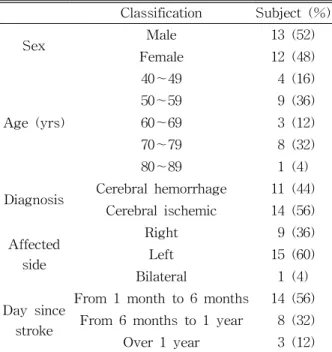
Patients were recruited through direct contact at a K university hospital and gathered stroke inpatients and outpatients on a volunteer basis with physiotherapy. Twenty-five stroke patients (13 fe- male and 12 male) were included in study. The par- ticipants consisted of 11 patients with cerebral hem- orrhage, 14 patients with ischemia with cerebral ves- sel’s problems, 9 patients with right hemiplegia, 15 patients with left hemiplegia, 1 patient with quadriplegia. Their onset range is divided into 1 month to 6 months (14 patients), 6 months to 1 year (8 patients), and over 1 year (3 patients) and are evaluate for this lap (Table 1).
Procedures
Translation
The procedure used to produce the Korean version of the TIS was the forward translation method. This step is the translation into Korean of the original version of the TIS. English-Korean translators, two physiotherapists with years of experiences, were involved. Each translator independently translated the TIS and then, compared and discussed the result with a professor and a language expert, until a com- mon version was reached.
Classification Subject (%)
Sex Male 13 (52)
Female 12 (48)
Age (yrs)
40~49 4 (16)
50~59 9 (36)
60~69 3 (12)
70~79 8 (32)
80~89 1 (4)
Diagnosis Cerebral hemorrhage 11 (44) Cerebral ischemic 14 (56) Affected
side
Right 9 (36)
Left 15 (60)
Bilateral 1 (4)
Day since stroke
From 1 month to 6 months 14 (56) From 6 months to 1 year 8 (32)
Over 1 year 3 (12)
Table 1. Patient characteristics of subject (N=25)
Measurement System and Measured Tasks The TIS consist of three subscales: static sitting bal- ance, dynamic sitting balance and co-ordination. Each subscale contains between three and ten items. The TIS total score ranges from a minimum of 0 to a maximum of 23. There are 3 subscales: static sitting balance with 3 categories and a total of 7 points, dynamic sitting balance, with 10 categories and 10 total points, and co-ordination with 4 items and 6 total points.
The subjects of study include that if patients can sitting position, they participate in this study. Further data collection to define the population consisted of patient’s age, sex, height, affected side, type of stroke, days after stroke (Fugl-Meyer et al, 1975;
Mahoney and Barthel, 1965). The therapist who ex- amined the patient also explained the patient about the proceeding of this study and have taken in- formed consent from the patient and approval for the study was obtained with written permission to par- ticipate from a primary care physician.
For the reliability study, each patient was exam- ined twice. On one occasion, two physiotherapists scored the TIS concurrently but independently. On another occasion, one of the therapists assessed the
patient alone. The therapist who examined the patient alone also instructed the patient when both observers were scoring simultaneously. The two observations were always on the same day, separated by 1 or 2 hours of recovery time. During that time no treat- ment was offered. The observations were planned every half hour, so at least two different patients were evaluated before seeing the same patient again.
To further minimize recall bias, the observers filled in the score sheet but did not add up the scores.
Allocation of the patients to the observers as well as the order of the two observations were randomized.
Each observer examined twice time a group of 25 pa- tients, amounting to 25 patients in total. In this study, every item of the scale was performed three times to avoid a possible scoring bias if a patient reached the maximum score after one or two attempts.
Statistical Analysis
Statistical analysis was performed using Windows SPSS version 12.0 for window. Test-retest reliability was measured by comparing the results of the therapists who examined the patient twice. To de- termine inter-rater reliability, the results of the both therapists who observed the patient simultaneously were compared. Test-retest and interobserver reli- ability were determined for all scale items. Kappa and weighted kappa values were calculated for di- chotomous and ordinal scales, respectively. The agreement rate was also determined with regard to all items. In respect to the subtotal of 3 scopes and the total score of TIS, test-retest reliability and in- ter-rater reliability were evaluated by intraclass cor- relation coefficients ICC (3,1). Cronbach’s alpha was calculated to check whether the subtotal is contra- dictory to the total.
Results
As kappa value or weighted kappa value was on the range between .67 and 1.00 in most items,
Item Test-retest agreement Inter-observer agreement
Valuea %b Value %
Static sitting balance
1. Keep sitting balance 1.00 100% 1.00 100%
2. Keep sitting balance with legs crossed 1.00 100% 1.00 100%
3. Keep sitting balance while legs crossed .93c 96% .53c 72%
Dynamic sitting balance
1. Touch seat with right elbow (task achieved or not) 1.00 100% .73 88%
2. Touch seat with right elbow (trunk movement) 1.00 100% .93 96%
3. Touch seat with right elbow (compensation strategies) .67 80% .67 80%
4. Touch seat with left elbow (task achieved or not) 1.00 100% 1.00 100%
5. Touch seat with left elbow (trunk movement) .93 96% .93 96%
6. Touch seat with left elbow (compensation strategies) .93 96% .87 92%
7. Lift right side of pelvis from seat (task achieved or not) 1.00 100% .93 96%
8. Lift right side of pelvis from seat (compensation strategies) .53 72% .73 84%
9. Lift left side of pelvis from seat (task achieved or not) .93 96% .93 96%
10. Lift left side of pelvis from seat (compensation strategies) .93 96% .73 84%
Co-ordination
1. Rotate shoulder girdle 6 times .93c 96% .60c 76%
2. Rotate shoulder girdle 6 times within 6 seconds 1.00 100% .67 80%
3. Rotate pelvic girdle 6 times .73c 88% .73c 88%
4. Rotate pelvic girdle 6 times within 6 seconds 1.00 100% .93 96%
aValue of the calculated kappa.
bPercentage of agreement.
cPresented as weighted kappa statistic.
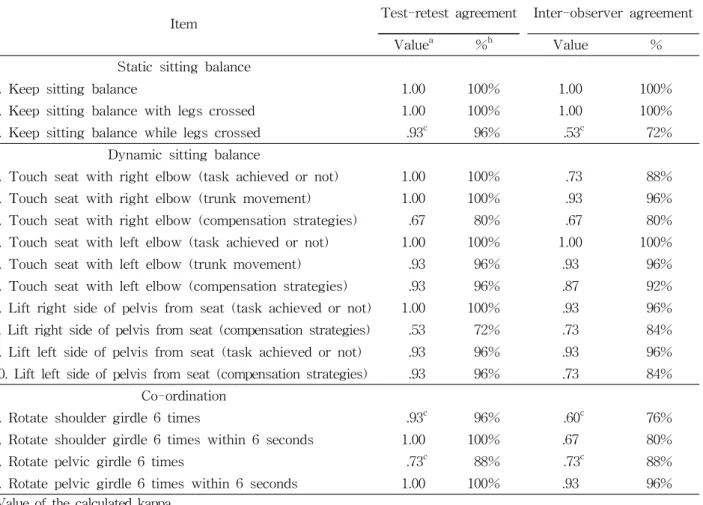
Table 2. Test-retest and Inter-observer agreement of scores on items of the Trunk Impairment Scale in 25 patients with stroke
test-retest reliability showed high agreement. Also, test-retest agreement rate was on the range between 80 and 100% (Table 2). But in the item 8 in the dy- namic sitting balance (.53), test-retest agreement was insufficient and also the agreement rate in- dicated 72%. As regards inter-rater agreement, kappa value or weighted kappa value was on the range be- tween .60 and 1.00 and the agreement rate was 76 to 100%. In the case of the item 3 in the dynamic sitting balance (.53), inter-rater agreement was not sufficient and also the agreement rate was 72%.
Intraclass Correlation Coefficient (ICC) was applied to the 3 scopes of TIC. In the case of the static sitting
balance, test-retest agreement and inter-rater agree- ment indicated .79 and .97 respectively. In the case of the dynamic sitting balance, test-retest agreement and inter-rater agreement indicated .90 and .93 respectively. In coordination, two factors indicated .77 and .96 respectively. Likewise, ICC was applied to the total score of TIS and as a result test-retest agree- ment and inter-rater agreement indicated .97 and .95 respectively (Table 3). Cronbach’s alpha was calcu- lated to check whether the subtotal is contradictory to the total, and internal consistency was .87 to .99.
Test-retest agreement Inter-observer agreement
Static sitting balance .79 .97
Dynamic sitting balance .90 .93
Co-ordination .77 .96
Trunk Impairment Scale .97 .95
Table 3. Intraclass correlation coefficient (ICC) for test-retest and inter-observer agreement
Discussion
The purpose of this study is to prove the reli- ability of the TIS and its usability. In kappa value and weighted kappa value, test-retest agreement and inter-rater agreement were between .53 and 1.00 in most items. In items 1 and 2 of the static sitting balance, kappa values were 1.00 all. This value may be the result of subjects being able to sit, and so it suggested that it was very easy to perform those items. On the other hand, many subjects could not get scores in item 1 and 3 of coordination, though weighted kappa value was .60 to .93. It suggests that it is difficult for patients with stroke to perform them (Verheyden et al, 2004). Verheyden et al (2006b) who applied the TIS to patients with multi- ple sclerosis, reported that kappa value indicated .8 7~1.00 in items 1 and 2 of the static sitting balance.
However, they reported that kappa value was no more than .55 to .60 in items 3 and 8 of the dynam- ic sitting balance. Also, in this study, kappa value showed similar results: Test-retest agreement and inter-rater agreement were .53~.73 in items 3 and 8 of the dynamic sitting balance.
Likewise, Niewboer et al (1995), who observed the post-stroke dynamic sitting balance, reported that its reliability got lower. Such results suggest the diffi- culty of evaluating actions and raters’ experiences affect results. It is very difficult for patients with stroke to conduct symmetric trunk movement, but it is reasonable to include it in the TIS. The TIS can be a guideline for medical treatment. In addition, convalescents and patients with severe stroke need to be researched separately to evaluate the reliability of items 1 and 2 of the dynamic sitting balance and
items 2, 3 and 4 of coordination (Verheyden et al, 2004). In this study, inter-rater agreement was .93 to .97, and test-retest agreement was .77 to .90 in ICC (Intraclass Correlation Coefficients) to the 3 scopes of the TIS. Accordingly, inter-rater agreement was higher than test-retest agreement. These results were similar to those reported of Verheyden et al (2004). According to their report, the TIS ICC value indicated .99 and .96, respectively, in inter-rater agreement and test-retest agreement. It also in- dicated .97 and .95, respectively, in two factors.
Patients who suffered traumatic brain injury, the TIS ICC value indicated .95 and .88, respectively, in in- ter-rater agreement and test-retest agreement (Verheyden et al, 2006a).
This value can be attributed to raters simultaneously scoring patients; therefore, biases and variability could be minimized. Also, test-retest reliability might be low- ered by the variability that arises in the process that patients undergo during examinations (Verheyden et al, 2004). Actually, test-retest errors were higher than in- ter-rater ones. ven der Lee JH et al (2001a) reported that inter-rater measurements were similar to the limi- tation of agreement recorded by Action Research Arm Test and Brunnstorm-Fugl-Meyer Assessment Scale.
In this study, Cronbach’s alpha to the TIS indicated .8 7~.99 and so high reliability was derived. The result was different from the report of Verheyden et al (2004) that Cronbach’s alpha indicated .65~.89.
Hatcher and Stepanski (1994) maintained that even an alpha coefficient less than .70 to .60 can be used.
Resultantly, .97 means that it has high reliability.
With regard to the TIS, test-retest kappa value was between .53 and 1.00 and inter-rater kappa value was between .67 and 1.00. Nieuwboer et al (1995)
reported that test-retest kappa value and inter-rater kappa value were between .20 and 1.00 regarding the TIS. However, the total score of the TIS is very reliable. When Motor Assessment Scale was .99 in sitting balance, the spearman rho correlation co- efficient was .76 in the trunk control test (Collin, 1990). Franchignoni et al (1997) reported that Cronbach’s alpha indicated .83 and .86, respectively.
Benaim et al (1999) found that the internal con- sistency of the postural analysis scale of patents with stroke is .95. The additional purpose of the TIS is to score the quality of trunk movements as it can be a guideline for medical treatment. The 4 tasks of the dynamic sitting balance are suitable to evaluate bilateral trunk contraction or extension (Verheyden et al, 2004). In this study, trunk coordination, static sit- ting balance and dynamic sitting balance were con- sidered in the TIS. Consequently, it is expected to be a guideline for medical treatment, though all trunk functions may not be evaluated.
Conclusion
The study was aimed at the clinical examination of post-stroke trunk impairment, and introducing translation. The Trunk Impairment Scale (TIS) to Korean. To do so, static sitting balance, dynamic sitting balance, and coordination were measured with regard to 25 patients from rehabilitation medicine de- partment of a university hospital ‘K,’ located in Seoul. The degrees of impairment were objectified as well. In addition, the intra-rater reliability and the inter-rater reliability were ascertained in respect to every item. As a result, the kappa value was estab- lished between .67 and 1.00, and the weighted kappa value was between .60 and 1.00 in the test-retest agreement and the inter-rater agreement. Generally, they showed high agreement. The test-retest agree- ment rate was 80 to 100% and also the inter-rater agreement rate was 76 to 100%. In regards to every item of TIS, the test-retest ICC was between .77
and .90 and the inter-rater ICC was between .93 and .97. And in the total score of TIS, the test-retest ICC and the inter-rater ICC indicated .97 and .95, respectively. In sum, evaluating trunk impairments of patients with stroke, the static sitting balance, the reliable results were derived in the dynamic sitting balance and coordination. These results are consid- ered to be useful for medical treatment as well as evaluating trunk movements.
References
An SH, Park CS, Lee HJ. Correlation Between Balance, Walking Test and Functional Performance in Stroke Patients: BBS, TUG, Fugl-Meyer, MAS-G, C·MGS, and MBI. Physical Therapy Korea.
2007;14(3):64-71.
Benaim C, Perennou DA, Villy J, et al. Validation of a standardized assessment of postural control in stroke patients. The postural assessment scale for stroke patients (PASS). Stroke. 1999;30:1862-1868.
Bobath B. Adult Hemiplegia: Evalution and treatment. 3rd ed. London, Butter-worth Heinnmann, 1990:11-19.
Bohannon RW. Recovery and correlates of trunk muscle strength after stroke. Int J Rehabil Res.
1995;18(2):162-167.
Bohannon RW, Cassidy D, Walsh S. Trunk muscle strength is impaired multidirectionally after stroke. Clin Rehabil. 1995;9(1):47-51.
Carr JH, Shepherd RB, Nordholm L, et al.
Investigation of a new motor assessment scale for stroke patients. Phys Ther. 1985;65(2):175-180.
Collin C, Wade D. Assessing motor impairment after stroke: A pilot reliability study. J Neurol Neurosurg Psychiatry. 1990;53(7):576-579.
Davies PM. Problems associated with the loss of se- lective trunk activity in hemiplegia. In: Right in the Middle: Selective trunk activity in the treat- ment of adult hemiplegia. Germany, Berlin, Springer-Verlag, 1990:31-65.
Franchignoni FP, Tesio L, Ricupero C, et al. Trunk
control test as an early predictor of stroke re- habilitation outcome. Stroke. 1997;28(7):1382-1385.
Fugl-Meyer AR, Jἅἅkὃ L, Leyman I, et al. The post-stroke hemiplegic patient. A method for evaluation of physical performance. Scand J Rehabil Med. 1975;7(1):13-31.
Fujiware T, Liu M, Tsuji T, et al. Development of a new measure to assess trunk impairment after stroke (Trunk Impairment Scale). Am J Phys Med Rehabil. 2004;83(9):681-688.
Hsieh CL, Sheu CF, Hsueh IP, et al. Trunk contol as an early predictor of comprehensive activities of daily living function in stroke patients.
Stroke. 2002;33(11):2626-2630.
Hatcher L, Stepanski EJ. Assessing scale reliability with coefficient alpha. In: A Step-by Step Approach to Using SAS System for Univariate and Multivariate Statistics. Cary, NC, SAS Institute Inc. 1994:505-516.
Karatas M, Cetin N, Bayramoglu M, et al. Trunk muscle strength in relation to balance and func- tional disability in unihemispheric stroke patients.
Am J Phys Med Rehabil. 2004;83(2):81-87.
Kwakkel G, Wagenaar RC, Kollen BJ, et al.
Predicting disability in stroke a critical review of the literature. Age Ageing. 1996;25(6):479-489.
Landis RJ, Koch GG. The measurement of observer agreement for categorical data. Biometrics.
1977;33(1):159-174.
Loewen SC, Anderson BA. Predictors of stroke out- come using objective measurement scales.
Stroke. 1990;21(1):78-81.
Mahoney F, Barthel D. Functional evaluation: The Barthel index. Md State Med J. 1965;14:61-65.
Moreland JD, Thomson MA. Efficacy of electromyo- graphic biofeedback compared with conventional physical therapy for upper-extremity function in patients following stroke: A research overview and meta-analysis. Phys Ther. 1994;74(6):544-547.
Moreland JD, Thomson MA, Fuoco AR.
Electromyographic biofeedback to improve lower extremity function after stroke: A meta-analysis.
Arch Phys Med Rehabil.1998;79(2):134-140.
Nashner, LM. Sensory, neuromuscular and biomechanical contribution to human balance. In: Duncan PW, ed.
Balance: Proceedings of the APTA Form.
Alexandria, APTA Publication. 1990.
Nieuwboer A, Feys H, De Weerdt W, et al. Developing a clinical tool to measure sitting balance after stroke: A reliability study. Physiotherapy.
1995;81(8):439-445.
Pope PM. Postural management and special seating.
In: Neurological Physiotherapy: A problem-solv- ing approach. New York, Churchill Livingstone Inc., 1996.
Sandin KJ, Smith BS. The measure of balance in sitting in stroke rehabilitation prognosis. Stroke.
1990;21(1):82-86.
van der Lee JH, Beckerman H, Lankhorst GJ, et al.
The responsiveness of the Action Research Arm test and the Fugl-Meyer assessment in chronic stroke patients. J Rehabil Med. 2001a;33(3):110-13.
van der Lee JH, Snels IAK, Beckerman H, et al.
Exercise therapy for arm function in stroke pa- tients: A systematic review of randomized con- trolled trials. Clin Rehabil. 2001b;15(1):20-31.
Verheyden G, Hughes J, Jelsma J, et al. Assessing motor impairment of the trunk in patients with traumatic brain injury: Reliability and validity of Trunk Impairment Scale. South African Jounal of Physiotherapy. 2006a;62(2):23-28.
Verheyden G, Nieuwboer A, Mertin J, et al. The Trunk Impairment Scale: A new tool to measure motor impairment of the trunk after stroke. Clin Rehabil. 2004;18(3):326-334.
Verheyden G, Willems AM, Ooms L, et al. Validity of the Trunk Impairment Scale as a measure of trunk performance in people with Parkinson's disease.
Arch Phys Med Rehabil. 2007;88(10):1304-1308.
Verheyden G, Nieuwboer A, Feys H, et al.
Discriminant ability of the Trunk Impairment Scale: A comparison between stroke patients and healthy individuals. Disabil Rehabil.
2005;27(17):1023-1028.
This article was received October 16, 2008, and was accepted November 3, 2008.
Verheyden G, Nuyeus G, Nieuwboer A, et al.
Reliability and validity of trunk assessment for people with multiple sclerosis. Phys Ther.
2006b;86(1):66-76.
Wade DT, Skilbeck CE, Hewer RL. Predicting Barthel ADL score at 6 months after an acute stroke.
Arch Phys Med Rehabil. 1983;64(1):24-28.
Winzeler-Mercay U, Mudie H. The nature of the ef-
fects of stroke on trunk flexor and extensor muscles during work and at rest. Disabil Rehabil. 2002;24(17):875-886.
정적인 앉기 균형
1. 시작 자세
환자가 넘어지거나, 팔을 지지 하지 않으면 10초 동안 시작 자세를 유지하지
못함. □0
환자가 10초 동안 시작자세를 유지 할 수 있음. □2
만약 이 항목에서 0점이면 TIS 총점은 0점
2. 시작 자세
치료사는 환측 다리 위에 건측 다리를 교차시킴
환자가 넘어지거나, 팔을 지지 하지 않으면 10초 동안 앉은 자세를 유지하지
못함. □0
환자가 10초 동안 앉은 자세를 유지 할 수 있음. □2
3. 시작 자세
환자는 환측 다리 위에 건측 다리를 교차시킴
환자가 넘어짐. □0
환자가 침대나 책상 위에서 팔의 지지 없이는 다리들을 교차시키지 못함. □1
환자가 다리들을 교차시키지만 몸통이 10 ㎝ 이상 뒤로 하거나, 손을 이용하
여 교차시킴. □2
환자가 몸통을 움직이거나 손을 움직이지 않고도 다리를 교차시킴. □3
총 정적인 앉기 균형 /7
동적인 앉기 균형
1. 시작 자세
환자는 환측 팔꿈치를 침대나 테이블에 접촉하고 (환측의 단축과 건측의 신장) 시작 자세로 되돌아옴.
환자가 넘어짐, 상지의 지지가 필요하거나 팔꿈치가 침대나 테이블에 접촉하지
못함. □0
환자가 도움 없이 능동적으로 움직이고, 팔꿈치가 침대나 테이블에 접촉함. □1
만약 이 항목에서 0점이면 2, 3 항목은 0점 처리
2. 1번 항목을 반복
환자가 실행하지 못하거나 반대로 실행함 (환측 신장, 건측 단축) □0
환자가 적절한 단축/신장을 실행함 □1
만약 이 항목에서 0점이면 3 항목은 0점 처리
3. 1번 항목을 반복
환자가 대상 작용을 보임.
(1)상지를 이용 (2)반대편 고관절 외전 (3)고관절 굴곡 (4)무릎 굴곡 (5)발이 미끄러짐
□0
환자가 대상 작용 없이 수행함. □1
4. 시작자세
환자는 건측 팔꿈치를 침대나 테이블에 접촉하고 (건측의 단축과 환측의 신장) 시작 자세로 되돌아옴.
환자가 넘어짐, 상지의 지지가 필요하거나 팔꿈치가 침대나 테이블에 접촉하지
못함. □0
환자가 도움 없이 능동적으로 움직이고, 팔꿈치가 침대나 테이블에 접촉함. □1
만약 이 항목에서 0점이면 5, 6 항목은 0점 처리
5. 4번 항목을 반복 환자가 실행하지 못하거나 반대로 실행함 (건측 신장, 환측 단축) □0
환자가 적절한 단축/신장을 실행함 □1
6. 4번 항목을 반복
환자가 대상 작용을 보임.
(1)상지를 이용 (2)반대편 고관절 외전 (3)고관절 굴곡 (4)무릎 굴곡 (5)발이 미끄러짐
□0
환자가 대상 작용 없이 수행함. □1
올린 후(환측의 단축과 건측 신장) 시작 자세로 되돌아옴
□1
만약 이 항목에서 0점이면 8 항목은 0점 처리
8. 7번 항목을 반복
환자가 대상 작용을 보임.
(1)상지를 이용
(2)동측 발을 밀기(뒤꿈치가 바닥에서 떨어짐) □0
환자가 대상 작용 없이 수행함. □1
9. 시작 자세
환자는 침대나 테이블로부터 건측 골반을 올린 후(건측 단축과 환측 신장) 시작 자세로 되돌아옴
환자가 실행하지 못하거나 반대로 실행함 (건측 신장, 환측 단축) □0
환자가 적절한 단축/신장을 실행함 □1
만약 이 항목에서 0점이면 10 항목은 0점 처리
10. 9번 항목을 반복
환자가 대상 작용을 보임.
(1)상지를 이용
(2)동측 발을 밀기(뒤꿈치가 바닥에서 떨어짐) □0
환자가 대상 작용 없이 수행함. □1
총 동적인 앉기 균형 /10
협응성
1. 시작 자세
환자는 윗 몸통을 6번 회전 하며 (어깨를 앞 방향으로 3번 움직이게 함), 첫째 환측으로 움직여야 하고 시작 자세에서 머리는 고정되어야 함.
환측으로 3번 움직이지 못함. □0
회전시 비대칭적임. □1
회전시 대칭적임. □2
만약 이 항목에서 0점이면 2 항목은 0점 처리
2. 1번 항목을 6초 이내 반복 회전시 비대칭적임. □0
회전시 대칭적임. □1
3. 시작 자세
환자는 아랫 몸통을 6번 회전 하며 (무릎을 앞 방향으로 3번 움직이게 함), 첫째 환측으로 움직여야 하고 시작 자세에서 머리는 고정되어야 함.
환측으로 3번 움직이지 못함. □0
회전시 비대칭적임. □1
회전시 대칭적임. □2
만약 이 항목에서 0점이면 4번 항목은 0점 처리
4. 3번 항목을 6초 이내 반복 회전시 비대칭적임. □0
회전시 대칭적임. □1
총 협응성 점수 /6