learning and problem solving abilities in children6.
Treacher Collins syndrome (TCS) is an autosomal domi- nant, craniofacial disease with an incidence of approximately 1 in 50,000 live births7. The clinical findings in patients with TCS include zygomatic and mandibular hypoplasia, abnor- malities of the outer ear and inner ear bones, cleft palate, cho- anal atresia and eyelid abnormalities8. Abnormal anatomy in the upper airway increases the risk of OSAS. Therefore, the prevalence of OSAS tends to be high in patients with TCS9.
In recent years, distraction osteogenesis has become the preferred treatment of choice for airway obstruction in pa- tients with congenital syndromes such as TCS and Pierre Robin syndrome10. Distraction osteogenesis prevents upper airway obstruction by advancing the mandible anteriorly and removing the tongue base from the oropharynx.
The purpose of this case report was to present the surgical treatment of obstructive sleep apnea using distraction osteo- genesis in a child with TCS.
II. Case Report
A 10-year-old girl with TCS presented to our clinic with her parents for respiratory distress and insomnia. The clini- cal examination revealed symmetrically underdeveloped
I. Introduction
Obstructive sleep apnea syndrome (OSAS) is characterized by recurrent obstruction of the upper airway during sleep. It is a major health problem that affects 2% to 4% of children and adults, and ultimately influences multiple organ systems1. It is typically diagnosed using lateral cephalometry, computed tomography and polysomnography2. Partial or complete ob- struction of the upper airway during sleep decreases oxygen saturation, causes sleep disruption, and adversely affects pa- tients’ physical and psychological health1,3. OSAS is common among patients with craniofacial deformities4. In children, it can lead to growth retardation, aggression, hyperactivity, at- tention-deficit disorder, cognitive function disorders and poor socialization5. Furthermore, OSAS can suppress memory, Ahmet Altan
Department of Oral and Maxillofacial Surgery, Faculty of Dentistry, Gaziosmanpasa University, Ali Sevki Erek Yerleskesi, Tokat 60100, Turkey TEL: +90-5057013189 FAX: +90-3562124225
E-mail: [email protected]
ORCID: http://orcid.org/0000-0003-2041-6364
This is an open-access article distributed under the terms of the Creative Commons Attribution Non-Commercial License (http://creativecommons.org/licenses/by-nc/4.0/), which permits unrestricted non-commercial use, distribution, and reproduction in any medium, provided the original work is properly cited.
CC
Management of obstructive sleep apnea in a Treacher Collins syndrome patient using distraction osteogenesis of the mandible
İbrahim Damlar1, Ahmet Altan2, Berk Turgay3, Soydan Kiliç3
1Private Practice, 2Department of Oral and Maxillofacial Surgery, Faculty of Dentistry, Gaziosmanpaşa University, Tokat,
3Department of Oral and Maxillofacial Surgery, Faculty of Dentistry, Mustafa Kemal University, Hatay, Turkey
Abstract(J Korean Assoc Oral Maxillofac Surg 2016;42:388-392)
In this study, we present the surgical treatment of obstructive sleep apnea in a child with Treacher Collins syndrome. A 10-year-old girl with a past history of Treacher Collins syndrome presented to our clinic with her parents for respiratory distress and insomnia. The patient was referred to a sleep laboratory where she was diagnosed with obstructive sleep apnea, which was a consequence of her Treacher Collins syndrome. The patient underwent mandibular distraction osteogenesis under general anesthesia. The mandible was expanded by 15 mm using internal bilateral distractors. After distrac- tion osteogenesis, the patient’s respiratory problems resolved, and she was able to sleep comfortably. Distraction osteogenesis was an effective method of advancing the mandible, increasing the upper airway space and ultimately preventing obstructive sleep apnea syndrome in patients with Treacher Collins syndrome.
Key words: Distraction osteogenesis, Obstructive sleep apnea, Treacher Collins syndrome, Mandibulofacial dysostosis
[paper submitted 2016. 2. 20 / revised 1st 2016. 5. 18, 2nd 2016. 6. 12 / accepted 2016. 7. 6]
Copyright Ⓒ 2016 The Korean Association of Oral and Maxillofacial Surgeons. All rights reserved.
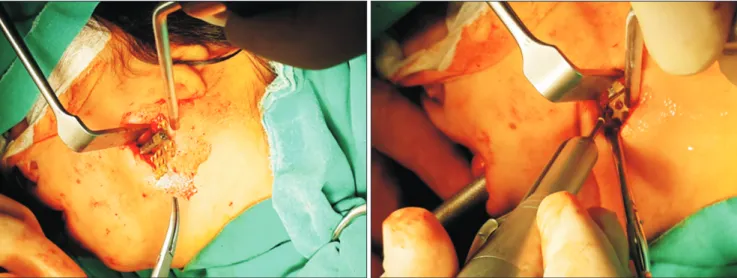
be perpendicular to the mandibular corpus.(Fig. 3) A mono- cortical incision was made in the section corresponding to the mandibular canal in order to protect the inferior alveolar nerve. An osteotomy was then completed using chisels. Dis- tractors were placed (Fig. 4), and the wound was closed pri- marily with resorbable sutures. The same procedure was per- formed on both sides of the mandible. There were no surgical or neurological complications encountered during the opera- tion. The patient was treated with cefamezin (500 mg, twice a day) and intramuscular diclofenac sodium (once a day) for one week. After one week, the distraction was performed to provide 1 mm expansion per day. A 15-mm expansion was provided in the mandible using internal bilateral distractors.
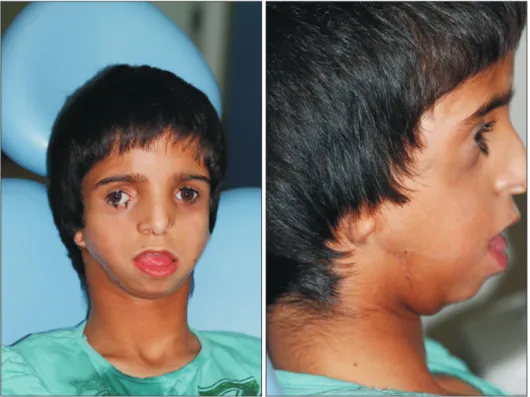
After a three-month latent phase (Fig. 5), the distractors were removed through the same incision site under general anes- thesia. After distraction osteogenesis, the patient’s respiratory problems resolved. She was able to position her tongue in her mouth, and could sleep comfortably. The patient was doing well at her one-year follow-up examination.(Fig. 6)
We obtained the written consent from the patient’s legal zygomatic bones, depressed palpebral fissures with a partial
absence of eyelashes in the lower eyelids.(Fig. 1) There was also mandibular hypoplasia. The patient’s tongue was protruding outside of her mouth, as she could not close her mouth due to mandibular micrognathia. There was posterior maxillary vertical hypoplasia, as well as a significantly in- creased occlusal plane angle. The external ear development was abnormal. The patient had hearing problems. The patient was diagnosed with obstructive sleep apnea, which was likely a result of her TCS.
After a radiological examination (Fig. 2), mandibular dis- traction osteogenesis was planned. A submandibular incision was performed under general anesthesia. The mandibular corpus was revealed by blunt dissection. An osteotomy was performed with piezo surgery from the front of the ramus to
Fig. 1. The patient with Treacher Collins syndrome.
İbrahim Damlar et al: Management of obstructive sleep apnea in a Treacher Collins syndrome patient using distraction osteogenesis of the mandible. J Korean Assoc Oral Maxillofac Surg 2016
Fig. 2. Preoperative three-dimensional computed tomography.
İbrahim Damlar et al: Management of obstructive sleep apnea in a Treacher Collins syndrome patient using distraction osteogenesis of the mandible. J Korean Assoc Oral Maxillofac Surg 2016 Fig. 3. Osteotomy with piezo surgery.
İbrahim Damlar et al: Management of obstructive sleep apnea in a Treacher Collins syndrome patient using distraction osteogenesis of the mandible. J Korean Assoc Oral Maxillofac Surg 2016
patients with craniofacial deformities than there is in those without such anatomical abnormalities4. OSAS can cause growth retardation, attention deficits, or cognitive function disorders in children5. Children with OSAS also experience reduced learning and problem-solving abilities compared to those of children without OSAS6. OSAS increases the risk of cardiovascular and metabolic complications for both children and adults7. Therefore, the diagnosis and treatment of OSAS are very important.
Severe cases of obstructive sleep apnea in children are treated with a permanent tracheostomy. There are many mor- bidities of long-term tracheostomies, including tracheomala- cia, chronic bronchitis, throat tightness and dislocation of the tracheostomy tube13. Therefore, it can be difficult to care for patients with tracheostomy13. Distraction osteogenesis is the preferred treatment method in patients with obstructive sleep gardian.
III. Discussion
TCS is a rare congenital, craniofacial condition with an incidence of 1 in 50,000 live births7. TCS is characterized by a convex facial profile, prominent nasal dorsum, retrusive lower jaw and zygomatic bone, and hypoplastic mandible8,11. The external ears may also be absent, malformed or misposi- tioned. Hypoplasia of varying degrees may also be seen in the external ear canals and middle ear bones, leading to hearing loss12. The diagnosis of TCS is performed with the help of a detailed clinical evaluation and molecular genetic tests11. The patient in this case had already been diagnosed with TCS, and had the characteristic clinical features.
There is increased prevalence of obstructive sleep apnea in
Fig. 4. Positioning of distraction.
İbrahim Damlar et al: Management of obstructive sleep apnea in a Treacher Collins syndrome patient using distraction osteogenesis of the mandible. J Korean Assoc Oral Maxillofac Surg 2016
Fig. 5. Three-dimensional computed tomography after distraction osteogen- esis.
İbrahim Damlar et al: Management of obstructive sleep apnea in a Treacher Collins syndrome patient using distraction osteogenesis of the mandible. J Korean Assoc Oral Maxillofac Surg 2016
tion. In addition to head and neck computed tomography, three-dimensional tomography is used to evaluate mandibular distraction and its effects on airway volume10,17. The use of plain radiography is not as effective as three-dimensional to- mography because it only provides two-dimensional images.
We did not detect any relapse at the one-year follow-up of our patient using computed tomography.
In this study, distraction osteogenesis was effective in ad- vancing the mandible, increasing the upper airway space and eliminating OSAS in our patient with TCS.
Conflict of Interest
No potential conflict of interest relevant to this article was reported.
ORCID
İbrahim Damlar, http://orcid.org/0000-0003-1453-5391 Ahmet Altan, http://orcid.org/0000-0003-2041-6364 Berk Turgay, http://orcid.org/0000-0003-1386-9306 Soydan Kiliç, http://orcid.org/0000-0002-1552-4232
References
1. Akre H, Øverland B, Åsten P, Skogedal N, Heimdal K. Obstructive sleep apnea in Treacher Collins syndrome. Eur Arch Otorhinolar- yngol 2012;269:331-7.
apnea due to mandibular shortness13,14. Other procedures, including orthognathic surgery, rib grafts, sternoclavicular grafts, and total joint prostheses have also been used to recon- struct the major facial and TMJ deformities associated with TCS15. In this case study, the patient was performed success- fully by distraction osteogenesis. We preferred distraction osteogenesis to avoid mandible relapse.
Mandibular advancement for the treatment of OSAS was initially performed using bilateral external distracters10. Ex- ternal devices are advantageous because of their ease of use, manipulation and versatility. However, external devices also create aesthetic, social problems and produce scars. These devices have reduced retention period and an increased re- lapse incidence compared to those of internal devices16. In this study, we performed distraction osteogenesis using inter- nal devices in the treatment of obstructive sleep apnea. We considered an extraoral multi-vector distractor. However, we deferred the use of this device in our patient, because we be- lieved that she would be bothered by the device, potentially compromising the treatment. Therefore, we chose an intraoral distractor device. We were unable to perform orthognathic surgery in this patient. Internal distractors increase patient comfort, increase device stability during the treatment and provide better bone quality over those of external devices10.
Long term follow-up examinations are indicated in these patients in order to evaluate the effects of mandibular growth, airway relapse, and the need for additional surgical interven-
Fig. 6. One year after the end of treat- ment.
İbrahim Damlar et al: Management of obstructive sleep apnea in a Treacher Collins syndrome patient using distraction osteogenesis of the mandible. J Korean Assoc Oral Maxillofac Surg 2016
2. Jin SM, Lee HS, Ryu HH, Ryu SH, Shin DY, Kim CH, et al. Ret- rospective study on the airway obstruction aspects of computed tomography and lateral cephalometry and the correlation of poly- somnography in obstructive sleep apnea patients. J Korean Assoc Oral Maxillofac Surg 2012;38:295-304.
3. Okşayan R, Sökücü O, Uyar M, Topçuoğlu T. Effects of eden- tulism in obstructive sleep apnea syndrome. Niger J Clin Pract 2015;18:502-5.
4. Hoeve LJ, Pijpers M, Joosten KF. OSAS in craniofacial syndromes:
an unsolved problem. Int J Pediatr Otorhinolaryngol 2003;67 Suppl 1:S111-3.
5. Rosen CL, Storfer-Isser A, Taylor HG, Kirchner HL, Emancipator JL, Redline S. Increased behavioral morbidity in school-aged chil- dren with sleep-disordered breathing. Pediatrics 2004;114:1640-8.
6. Hoeve HL, Joosten KF, van den Berg S. Management of obstruc- tive sleep apnea syndrome in children with craniofacial malforma- tion. Int J Pediatr Otorhinolaryngol 1999;49 Suppl 1:S59-61.
7. Østertun Geirdal A, Øverland B, Heimdal K, Storhaug K, Asten P, Akre H. Association between obstructive sleep apnea and health- related quality of life in individuals affected with Treacher Collins syndrome. Eur Arch Otorhinolaryngol 2013;270:2879-84.
8. Posnick JC, Ruiz RL. Treacher Collins syndrome: current evalu- ation, treatment, and future directions. Cleft Palate Craniofac J 2000;37:434.
9. Plomp RG, Bredero-Boelhouwer HH, Joosten KF, Wolvius EB, Hoeve HL, Poublon RM, et al. Obstructive sleep apnoea in Treach-
er Collins syndrome: prevalence, severity and cause. Int J Oral Maxillofac Surg 2012;41:696-701.
10. Rachmiel A, Emodi O, Rachmiel D, Aizenbud D. Internal man- dibular distraction to relieve airway obstruction in children with severe micrognathia. Int J Oral Maxillofac Surg 2014;43:1176-81.
11. Mohan RP, Verma S, Agarwal N, Singh U. Treacher Collins syn- drome: a case report. BMJ Case Rep 2013. doi: 10.1136/bcr-2013- 009341.
12. Posnick JC. Treacher Collins syndrome: perspectives in evaluation and treatment. J Oral Maxillofac Surg 1997;55:1120-33.
13. Rachmiel A, Emodi O, Aizenbud D. Management of obstructive sleep apnea in pediatric craniofacial anomalies. Ann Maxillofac Surg 2012;2:111-5.
14. Morovic CG, Monasterio L. Distraction osteogenesis for obstruc- tive apneas in patients with congenital craniofacial malformations.
Plast Reconstr Surg 2000;105:2324-30.
15. Wolford LM, Perez DE. Surgical management of congenital defor- mities with temporomandibular joint malformation. Oral Maxillo- fac Surg Clin North Am 2015;27:137-54.
16. Diner PA, Kollar E, Martinez H, Vazquez MP. Submerged intra- oral device for mandibular lengthening. J Craniomaxillofac Surg 1997;25:116-23.
17. Kaban LB, Seldin EB, Kikinis R, Yeshwant K, Padwa BL, Troulis MJ. Clinical application of curvilinear distraction osteogenesis for correction of mandibular deformities. J Oral Maxillofac Surg 2009;67:996-1008.