건강한 소아 청소년에서의 정상 수면구조에 대한 연구
경북대학교 의학전문대학원 소아청소년과학교실1, 부산성모병원 소아청소년과2, 경북대학교 의학전문대학원 신경과학교실3
권순학
1・구윤모
2・이호원
3・서혜은
2*This work was supported by Biomedical Research Institute grant, Kyungpook National University Hospital (2011) and it was presented as a poster at annual meeting of The Korean Society for Brain and Neural Science (2012).
Submitted: 19 June, 2014 Revised: 22 September, 2014 Accepted: 24 September, 2014
Correspondence to Hyeeun Seo, MD, PhD
Department of Pediatrics, Busan St. Mary’s Medical Center, 25-14, Yongho-ro 232 beon-gil, Namgu, Busan 608-838 Korea
Tel: +82-51-933-7982, Fax: +82-51-932-8600 E-mail: [email protected]
Normal Polysomnographic Characteristics in Korean Children and Adolescents
Purpose: The objective of this study was to describe polysomnographic charateristics in normal children and adolescents in Korea. Little is known regarding sleep architecture in Korean children.
Methods: We conducted a prospective study and examined sleep architecture, respiratory parameters, arousals, and periodic limb movement index during sleep (PLMS) in healthy children and adolescents for 2 consecutive days.
Results: The study population consisted of 29 subjects and 15 subjects (52%) were male. Ages ranged from 5-16 years, with a mean of 11.6±.7 years. The average total sleep time (TST) was 438±35.6 min, and the mean sleep efficiency was 90.9±17.7%.
The distribution of sleep stages as percentage of TST was as follows: stage N1, 6.6±2.9%; stage N2, 54.2±5.8%; stage N3, 21.1±6.7%; and stage R, 18.1±5.4%. The wake after sleep onset (WASO) was 2.0±2.9% of TST. The total arousal index (TAI) was 7.6±2.2. The current study findings are similar to those of previous studies in Western countries except longer stage N2 sleep and higher WASO.
Conclusion: This is the first report of normal polysomnography values in Korean children. In order to accurately diagnose sleep disorders, normative sleep reference values are essential and our findings will provide fundamental data for pediatric sleep research.
Key Words: Sleep, Architecture, Polysomnography, Children, Adolescent, Reference value
Soonhak Kwon, MD1, Yun-mo Gu, MD2, Ho-won Lee, MD3, Hyeeun Seo, MD, PhD2
1Department of Pediatrics, School of Medicine, Kyungpook National University, Daegu, Korea.
2Department of Pediatrics, Busan St. Mary’s Medical Center, Busan, Korea, 3Department of Neurology, School of Medicine, Brain Science and Engineering Institute, Kyungpook National University, Daegu, Korea
Introduction
Sleep is an essential physiologic process to maintain and repair brain plasticity and synaptic circuits1) and plays an important role in memory consolidation and learning2,3). Not only for development but also for growth, there is a growing interest in pediatric sleep. Sleep disorders in children and adolescents could result in irre
versible and grave adverse effects on cognition and school performance4,5). Polysomnography (PSG) has enabled us to diagnose various sleep disorders and to understand sleep architecture. However, there are few normative reference values in children and adolescents; thus, interpretation of abnormal PSG and ac
curate diagnosis of sleep disorders are still challengeable issues in pediatric sleep medicine. PSG is expensive and requires sufficient qualified human resources and time for analysis. In addition, it is a vexatious diagnostic tool for children. In addi
Copyright © 2014 by The Korean Child Neurology Society
http://www.cns.or.kr
tion, several studies of normative sleep variables for children were based on PSG results, so they may not represent general population and cannot exclude first night effects.
MontgomeryDowns et al6) showed useful nocturnal polysom
nographic reference values from a large group of healthy children, but most subjects were Caucasian or AfricanAmerican. The pur
pose of the present study was to characterize normal polysom
nographic reference values in Korean healthy children and ado
lescents to verify the ethnic distinction of East Asian children and teenagers compared to studies done in western countries. In this prospective cohort study design, we examined sleep architecture, respiratory parameters, arousals, and periodic limb movement index during sleep (PLMS) in healthy children and adolescents between the ages of 516 years for 2 consecutive days.
Materials and methods
1. Participants
Normal healthy Korean children and adolescents ranging in age 5 and 16 years were included in this study. We put an ad col lecting volunteers for sleep study to local schools, churches, hospitals, and haphazardly recruited the study population. Sub
jects who were assessed as being normal by clinical history and physical examination were included. And we divided the subjects into two groups by age and gender.
2. Exclusion criteria
A sleep questionnaire translated in the Korean language was given to the candidates and their parents in the outpatient clinic to evaluate symptoms of sleep disorders. Subjects were excluded from the study if they had snoring, uncomfortable sleep, abnormal behavior during sleep, sleep apnea, craniofacial anomalies, obe
sity, growth retardation, chronic medical illness or any established genetic disorders.
3. Overnight polysomnography
Polysomnography was performed for 2 consecutive days. The subjects were studied in the sleep laboratory of the Kyungpook National University Medical Center. Digital polysomnography (Beehive Millennium; Glass–Telefactor Corp., Providence, RI, USA) was used during the time when the subjects were asleep.
Electrodes and sensors were attached according to the universal instruction. Electrodes for electroencephalography were attached to F4, C4, and O2 based on the international 10/20 system elect
rode of placement. Electrodes for electrooculogram were attached to the upper part and lower part of each eye, laterally, 1 cm away
from the lateral canthus; electrodes for electromyogram were attached to the mandibular muscle and tibialis anterior bilaterally. A microphone to measure the snoring sound was attached to the occipital area, and a nasal crosssectional barometer to measure nasal airflow was attached to the entrance of nasal cavity. Sensors detecting differences in temperature were attached between the nose and the lips to measure oral airflow. Electrodes for electro
cardiogram were attached to the allocated places (modified lead II position), and sensors to detect thoracic breathing and abdo
minal breathing were attached to the most active areas. Oximetry was connected to the index finger of the left hand. Using an in
frared video camera, each subject was monitored by a sleep te
chnician. All polysomnogram was scored by a single experienced sleep technologist and reviewed by the principal investigator.
Sleep stages, respiratory parameters, arousals and PLMS were determined by the criteria of the standards of American Academy of Sleep Medicine (AASM)7). We examined the subjects for two consecutive days and analyzed the results obtained from the second night in order to minimize the first night effect
4. Statistics
Statistical analysis was performed using PASW statistical soft
ware, version 18.0 (IBM, Somers, NY, USA). The average values of the two groups classified according to the age and gender were compared using the MannWhitey U test or ttest.
5. Ethics statement
This study was approved by the Institutional Review Board for clinical research at Kyungpook National University Hospital.
Writ ten informed consent was obtained from each participant.
Results
1. Demographics
Ages ranged from 5.216.4 years, with a mean of 11.6±3.7 years.
The study population consisted of 29 subjects and 15 subjects (52%) were male. The age distribution of the subjects is shown in Fig. 1.
2. Sleep Architecture
The average total sleep time (TST) was 438.0±35.6 min, and the mean sleep efficiency was 90.9±17.8%. The distribution of sleep stages as percentage of TST was as follows: stage N1, 6.6±
2.9%; stage N2, 54.2±5.9%; stage N3, 21.1±6.7%; and stage R, 18.1±5.4%. The wake after sleep onset (WASO) was 2.1±2.6% of TST. The total arousal index (TAI) was 7.6±2.2. Parameters of
sleep architecture are presented in Table 1.
3. Ethnic Differences in Sleep Architecture, Respiratory Parameters and PLMS
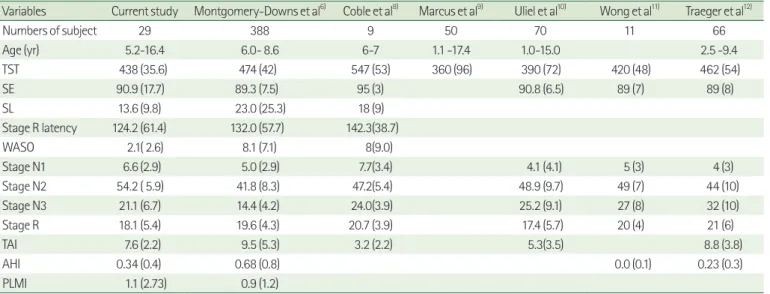
As shown in Table 2, the current study findings regarding sleep architecture and respiratory parameters are similar to those of previous studies in Western countries. We report a higher per
centage of stage N2 sleep, lower WASO than previous results;
however, the difference is not significant.
4. Effects of Age and Gender on Sleep
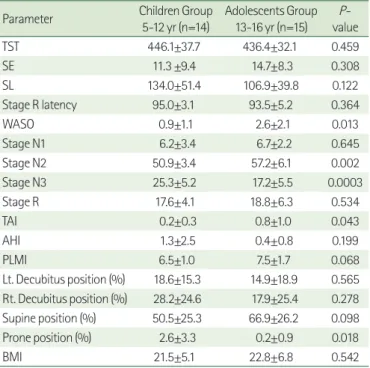
We divided 29 subjects into two groups by age or gender to evaluate the effects of age and gender. The younger age group showed decreased WASO, stage N2 sleep, apneahypopnea index (AHI) and increased stage N3 sleep compared to the adolescents group. Regarding sleep position, we found that younger partici
pants slept more in the prone position (Table 3). But, males and females did not differ by age; however, females had an increased stage R latency comparing to males (P=0.024) (Table 4).
5. Respiratory parameters
A total of 78 apneas and hypopneas were observed in eighteen of 29 subjects. Fortynine of 78 respiratory events were central apneas, and there were 2 obstructive apneas, 1 mixed apnea and 26 obstructive hypopneas. The most common respiratory event was central apnea (62.8%), which was followed by obstructive hypopnea (33.3%) (Table 5).
Table 1. Polysomnographic Characteristics of 29 Subjects of Current Study
Parameter Mean±SD Range
TST* (min) 438.0±35.6 373-514
Sleep efficiency (%) 90.9±17.8 86-99
Sleep latency (min) 13.6±9.8 3.5-30
Stage R† latency (min) 124.2±61.4 44-199.5 Wake after sleep onset (%) 2.1±2.6 0.1-11.9
Stage N1 (%) 6.6±2.9 2.1-12.2
Stage N2 (%) 54.2±5.9 45.2-74.5
Stage N3 (%) 21.1±6.7 11.5-34.9
Stage R† (%) 18.1± 5.4 9.7-29
Data are displayed as mean value±standard deviation.
*total sleep time
†rapid eye movement sleep
Fig. 1. Here shows the age distribution and the numbers of subjects per age group who performed polysomnography.
Table 2. Polysomnographic Values for the Current Study and Previous Studies
Variables Current study Montgomery-Downs et al6) Coble et al8) Marcus et al9) Uliel et al10) Wong et al11) Traeger et al12)
Numbers of subject 29 388 9 50 70 11 66
Age (yr) 5.2-16.4 6.0- 8.6 6-7 1.1 -17.4 1.0-15.0 2.5 -9.4
TST 438 (35.6) 474 (42) 547 (53) 360 (96) 390 (72) 420 (48) 462 (54)
SE 90.9 (17.7) 89.3 (7.5) 95 (3) 90.8 (6.5) 89 (7) 89 (8)
SL 13.6 (9.8) 23.0 (25.3) 18 (9)
Stage R latency 124.2 (61.4) 132.0 (57.7) 142.3(38.7)
WASO 2.1( 2.6) 8.1 (7.1) 8(9.0)
Stage N1 6.6 (2.9) 5.0 (2.9) 7.7(3.4) 4.1 (4.1) 5 (3) 4 (3)
Stage N2 54.2 ( 5.9) 41.8 (8.3) 47.2(5.4) 48.9 (9.7) 49 (7) 44 (10)
Stage N3 21.1 (6.7) 14.4 (4.2) 24.0(3.9) 25.2 (9.1) 27 (8) 32 (10)
Stage R 18.1 (5.4) 19.6 (4.3) 20.7 (3.9) 17.4 (5.7) 20 (4) 21 (6)
TAI 7.6 (2.2) 9.5 (5.3) 3.2 (2.2) 5.3(3.5) 8.8 (3.8)
AHI 0.34 (0.4) 0.68 (0.8) 0.0 (0.1) 0.23 (0.3)
PLMI 1.1 (2.73) 0.9 (1.2)
Data are displayed as mean value (standard deviation).
TST, total sleep time, SE, sleep efficiency, SL, sleep latency, Stage R, rapid eye movement sleep, WASO, wake after sleep onset, TAI, total arousal index, AHI, apnea hypopnea index, PLMI, periodic limb movement index.
Discussion
This is the first report of normal polysomnography values in Korean children and adolescents. We report normative reference PSG values for normal healthy children and adolescents from 29 subjects in Korea. Compared with previous studies in western countries, our samples of this study showed similar results of sleep architectures except WASO and stage N2 sleep. In contrast with previous studies, which had their normative sleep variables for children based on the PSG results, this study examined normal healthy children and adolescents without any symptoms of sleep disturbance. In addition, we examined the subjects for two con
secutive days and analyzed the results obtained from the second night in order to minimize the first night effect which is used to refer to a series variation of sleep parameters due to maladaptation or discomfort in unfamiliar sleeping environment. With the respect to effect of age on sleep, the adolescents group showed increased WASO and AHI and decreased stage N3 sleep compared to the children group.
Sleep is extremely important for everyday living. Recently there has been increasing recognition of the significance of sleep dis
orders due to evidence regarding the consequences of the dis
orders. Sleep disturbance predisposes children and adolescents not only to psychological issues such as attention deficit, cognitive dysfunction, negative behavioral outcomes and poor social inte
gration but also to growth retardation and obesity. There is a growing interest in normal healthy sleep according to the increased recognition of negative effects of sleep problems on growth, cognition and learning. Most of the volunteers applied for the study were identified to have a healthy sleep pattern through objective sleep tests.
PSG is considered the best tool for the diagnosis of sleep dis
orders and to make an accurate diagnosis of sleep disorders, it is very important to identify the normal reference values6,812). But these were the result of the Westerners, so we need to examine the Korean children to identify the effect of ethnicity for sleep architecture. There were differences in sleep architectures among White, Black, American Indian, Asian American and Hispanic in adults13,14). For example, Profant et al. found that Blacks sleep longer Table 3. Effects of Age in Polysomnographic Values.
Parameter Children Group 5-12 yr (n=14)
Adolescents Group 13-16 yr (n=15)
P- value
TST 446.1±37.7 436.4±32.1 0.459
SE 11.3 ±9.4 14.7±8.3 0.308
SL 134.0±51.4 106.9±39.8 0.122
Stage R latency 95.0±3.1 93.5±5.2 0.364
WASO 0.9±1.1 2.6±2.1 0.013
Stage N1 6.2±3.4 6.7±2.2 0.645
Stage N2 50.9±3.4 57.2±6.1 0.002
Stage N3 25.3±5.2 17.2±5.5 0.0003
Stage R 17.6±4.1 18.8±6.3 0.534
TAI 0.2±0.3 0.8±1.0 0.043
AHI 1.3±2.5 0.4±0.8 0.199
PLMI 6.5±1.0 7.5±1.7 0.068
Lt. Decubitus position (%) 18.6±15.3 14.9±18.9 0.565 Rt. Decubitus position (%) 28.2±24.6 17.9±25.4 0.278 Supine position (%) 50.5±25.3 66.9±26.2 0.098 Prone position (%) 2.6±3.3 0.2±0.9 0.018
BMI 21.5±5.1 22.8±6.8 0.542
Data are displayed as mean value±standard deviation.
TST, total sleep time, SE, sleep efficiency, SL, sleep latency, Stage R, rapid eye movement sleep, WASO, wake after sleep onset, TAI, total arousal index, AHI, apnea hypopnea index, PLMI, periodic limb movement index, BMI, body mass index.
Table 4. Effects of Gender in Polysomnographic Values
Parameter Male Group
(n=15) Female Group
(n=14) P-value
TST 434.3±37.7 442.6±39.3 0.543
SE 11.7±9.6 15.6±9.8 0.289
SL 96.1±41.0 132.8±41.3 0.024
Stage R latency 94.5±3.9 93.9±3.4 0.623
WASO 2.4±2.1 1.7±3.0 0.518
Stage N1 6.5±2.7 6.6±3.3 0.933
Stage N2 55.0±7.2 53.3±4.1 0.428
Stage N3 20.7±6.8 22.9±3.9 0.308
Stage R 18.9±6.1 17.2±4.7 0.401
TAI 0.4±0.4 0.3±0.4 0.252
AHI 1.4±2.4 0.8±2.4 0.522
PLMI 7.9±2.5 7.2±1.9 0.392
Lt. Decubitus position (%) 17.2±18.9 16.10±15.5 0.869 Rt. Decubitus position (%) 18.0±28.8 28.2±26.3 0.281 Supine position (%) 63.9±28.0 53.7±25.1 0.312 Prone position (%) 0.9±1.8 1.9±3.3 0.317
BMI 21.3±2.1 20.9±4.3 0.521
Data are displayed as mean value±standard deviation.
TST, total sleep time, SE, sleep efficiency, SL, sleep latency, Stage R, rapid eye movement sleep, WASO, wake after sleep onset, TAI, total arousal index, AHI, apnea hypopnea index, PLMI, periodic limb movement index, BMI, body mass index.
Table 5. Respiratory Parameters in Polysomnographic Values.
Parameter Number of Subject
Number of event
Index (N/hr)
Index range (N/hr) Obstructive apnea n=1 2 0.009±0.1 0-0.261
Mixed apnea n=1 1 0.005±0.03 0-0.142
Central apnea n=15 49 0.230±0.3 0-0.963 Obstructive hypopnea n=10 26 0.125±0.2 0-0.849 Data are displayed as mean value±standard deviation.
but not as deeply, indicating less restorative sleep14). However, studies assessing ethnic differences in sleep are limited, especially in pediatric populations. O’Brien et al. reported ethnic differences in PLMS in children and increased PLMS among Caucasian children than AfricanAmerican children15). In this study East Asian children and adolescents were shown to have a PLMS was 1.1. Abnormal dopaminergic regulation or iron metabolism seemed to be the major cause of PLMS, but still, the etiology of PLMS is unknown16,
17). In addition, previous studies as well as the current study are mere observations, so further explanations remain to be deter
mined. Distinctions in the structure of the palate and mandible according to race could cause differences in respiratory parame
ters, so further research is needed to determine the ethnic effects on sleep architecture. We did not make a direct comparison bet
ween different ethnic groups, thus it’s difficult to estimate statistical significance. However, there were no significant differences in the results compared to previous studies in other countries.
It is known that increasing age is associated with poor sleep architecture, as measured by decreased percentage of rapid eye movement (REM) sleep, sleep efficiency as well as increased arousals18,19). The younger age group showed decreased WASO, stage N2 sleep, AHI and increased stage N3 sleep compared to the adolescents group. This shows that children have better sleep architecture than adolescents.
Several studies suggested sex differences in sleep architecture in adults that increased stage N1 sleep in men and increased deep sleep in women20,21). The current research was targeted at children and adolescent, and as expected, this study showed no obvious difference between male and female except stage R latency.
A sleep questionnaire was used for the screening of sleep dis
orders; there were no subjects who had abnormal sleep problems such as snoring, sleep apneas, uncomfortable sleep, abnormal behavior during sleep or excessive daytime sleepiness. As a result, their polysomnographic values did not deviate significantly com
pared to previous studies. Thus, we conclude sleep questionnaire is a very useful screening tool for sleep disorders.
In summary, in order to accurately diagnose sleep disorders, normative sleep reference values are essential. The present study showed that the sleep architecture of Korean children is similar to previous studies. The small sample size is thought to be the limitation of this study, so larger scale studies are needed. In ad
dition, further studies are needed regarding genetic, biological or cultural sleep differences on sleep architectures in children to verify whether distorted sleep architectures or sleep hygiene affect daytime activities as well as treatment options.
요약
목적: 수면은 인간의 기본 기능을 수행하는 필수적인 생리현상으로 특히 성장과 발달을 지속하고 있는 소아에 있어서 뇌의 성장과 발달에 중추적인 기능을 하는 중요한 과정이다. 수면 다원화 검사를 통해서 수 면을 분석할 수 있게 되었으나, 정상 수면에 대해, 특히 소아 영역에서 는 아직 정확하게 밝혀진 바가 적으며, 몇몇 연구에서 정상 소아의 수 면 구조에 대해 분석한 연구가 있으나 이는 모두 서양에서 연구된 것 으로 한국인 소아에 적용하기에 한계가 있다. 본 연구는 수면 질환이 없는 정상 한국인 소아청소년을 대상으로 하여 수면다원검사를 시행 하여 수면 구조 및 특성을 이해하고자 한다.
방법: 본 연구는 전향적인 연구로 지원자를 모집하여 시행하였다. 경 북대학교병원 및 대구지역의 초등학교와 중학교, 고등학교에 연구지 원자 모집공고를 내어 지원자를 모집하였으며, 수면 설문지 및 검진을 통해 수면장애 및 다른 질환이 없는 건강한 소아청소년을 대상으로 이 틀간 수면다원화 검사를 시행하여, 둘째날의 수면검사 결과를 분석하 였다.
결과: 대상자들의 연령은 5세에서 16세 (mean±SD, 11.6±3.68)였 다. 남자는 14명이었고, 여자는 15명이었다. 총수면시간은 438.0±
35.6분, 입면잠복기는 13.6±9.76분, 렘수면잠복기는 124.2±61.36분, 수면효율은 90.9±17.75%, 입면후각성은 2.1±2.59%였다. 각 수면단 계가 차지하는 비율은 N1 수면은 6.6±2.93%, N2 수면은 54.2±5.85
%, N3 수면은 21.1±6.69%, 렘수면은 18.1±5.40%였다. 무호흡저호 흡지수는 0.34±0.39 였고, 주기적사지운동지수 1.1±2.73 이었고 총 각성지수는 7.6±2.20 이었다.
결론: 본 연구는 정상 한국인 소아청소년의 수면구조를 확인한 첫 연구로서, 서양에서 이루어진 연구결과들과 비교적 유사한 결과를 보 였는데, 이는 향후 한국인 소아청소년의 수면연구에 기초자료로 유용 하게 사용될 것으로 생각된다. 그러나 연구대상자의 수가 적어 더 많 은 수를 대상으로 한 연구가 필요할 것으로 생각된다.
References
1) Walker MP. Sleep, memory and emotion. Prog Brain Res 2010;
185:49-68.
2) Stickgold R, James L, Hobson JA. Visual discrimination learning requires sleep after training. Nat Neurosci 2000;3:1237-8.
3) Potkin KT, Bunney WE Jr. Sleep improves memory: the effect of sleep on long term memory in early adolescence. PLoS One 2012;7:e42191.
4) Gozal D. Sleep-disordered breathing and school performance in children. Pediatrics 1998;102:616-20.
5) Astill RG, Van der Heijden KB, Van Ijzendoorn MH, Van Someren EJ. Sleep, cognition, and behavioral problems in school-age child- ren: a century of research meta-analyzed. Psychol Bull 2012;138:
1109-38.
6) Montgomery-Downs HE, O'Brien LM, Gulliver TE, Gozal D. Poly-
somnographic characteristics in normal preschool and early school-aged children. Pediatrics 2006;117:741-53.
7) Iber C, Ancoli-Israel S, Chesson AL, Jr., Quan SF. for the American Academy of Sleep Medicine. The AASM manual for the scoring of sleep and associated events: rules, terminology and technical specifications. 1st ed. Westchester, IL: American Academy of Sleep Medicine; 2007.
8) Coble PA, Kupfer DJ, Taska LS, Kane J. EEG sleep of normal healthy children. Part I: Findings using standard measurement methods.
Sleep 1984;7:289-303.
9) Marcus CL, Omlin KJ, Basinki DJ, Bailey SL, Rachal AB, Von Pech- mann WS, et al. Normal polysomnographic values for children and adolescents. Am Rev Respir Dis 1992;146:1235-9.
10) Uliel S, Tauman R, Greenfeld M, Sivan Y. Normal polysomno- graphic respiratory values in children and adolescents. Chest 2004;125:872-8.
11) Wong TK, Galster P, Lau TS, Lutz JM, Marcus CL. Reliability of scoring arousals in normal children and children with obstructive sleep apnea syndrome. Sleep 2004;27:1139-45.
12) Traeger N, Schultz B, Pollock AN, Mason T, Marcus CL, Arens R.
Polysomnographic values in children 2-9 years old: additional data and review of the literature. Pediatr Pulmonol 2005;40:22- 30.
13) Redline S, Kirchner HL, Quan SF, Gottlieb DJ, Kapur V, Newman A. The effects of age, sex, ethnicity, and sleep-disordered breathing on sleep architecture. Arch Intern Med 2004;164:406-18.
14) Profant J, Ancoli-Israel S, Dimsdale JE. Are there ethnic differences in sleep architecture? Am J Hum Biol 2002;14:321-6.
15) O'Brien LM, Holbrook CR, Faye Jones V, Gozal D. Ethnic difference in periodic limb movements in children. Sleep Med 2007;8:240-6.
16) Ruottinen HM, Partinen M, Hublin C, Bergman J, Haaparanta M, Solin O, et al. An FDOPA PET study in patients with periodic limb movement disorder and restless legs syndrome. Neurology 2000;
54:502-4.
17) Beard JL. Iron status and periodic limb movements of sleep in children: a causal relationship? Sleep Med 2004;5:89-90.
18) Prinz PN, Vitiello MV, Raskind MA, Thorpy MJ. Geriatrics: sleep disorders and aging. N Engl J Med 1990;323:520-6.
19) Dijk DJ, Duffy JF, Czeisler CA. Age-related increase in awakenings:
impaired consolidation of nonREM sleep at all circadian phases.
Sleep 2001;24:565-77.
20) Hume KI, Van F, Watson A. A field study of age and gender diffe- rences in habitual adult sleep. J Sleep Res 1998;7:85-94.
21) Kobayashi R, Kohsaka M, Fukuda N, Honma H, Sakakibara S, Koyama T. Gender differences in the sleep of middle-aged indi- viduals. Psychiatry Clin Neurosci 1998;52:186-7.