측두하악장애의 수기치료에 관한 국내외 임상 연구 고찰
노해린⋅김민영⋅박소현*⋅정윤규⋅최영일⋅김문준†
부천자생한방병원 한방재활의학과, 부천자생한방병원 침구과*, 중화한방병원 한방재활의학과†
A Review of Recent Clinical Studies for Manual Therapy on Temporomandibular Joint Disorder
Hae-rin Ro, O.M.D., Min-young Kim, O.M.D., So-hyun Park, O.M.D.*, Yun-gyu Jeong, O.M.D., Young-il Choi, O.M.D., Moon-joon Kim, O.M.D.
†Department of Oriental Rehabilitation Medicine, Bu-Cheon Jaseng Hospital of Oriental Medicine, Department of Acupunture &
Moxibustion, Bu-Cheon Jaseng Hospital of Oriental Medicine*, Department of Oriental Rehabilitation Medicine, Joong-Hwa Hospital of Oriental Medicine
†RECEIVED September 17, 2013 REVISED October 1, 2013 ACCEPTED October 2, 2013
CORRESPONDING TO Hae-rin Ro, Medical Office of Bu-cheon Jaseng Hospital, 414, Sang-dong, Wonmi-gu, Bucheon 420-030, Korea
TEL (032) 320-8834 FAX (032) 320-8712 E-mail [email protected]
Copyright © 2013 The Society of Korean Medicine Rehabilitation
Objectives The aim of this review is to investigate clinical studies for manual therapy on Temporomandibular Joint Disorder and to propose for the better method of studies in the future.
Methods We investigated recent clinical studies for manual therapy on Temporoman- dibular Joint Disorder via searching Pubmed, KISS, KISTI, KERIS, KMBASE and National Assembly Library. 21 domestic and overseas articles were analyzed and the journals, the authors, the published years, countries, methods, periods, techniques of chiropractic, out- come measures, and purpose of those articles were examined.
Results Studies on manual therapy were mainly published via Cranio. The diagnostic criteria that most frequently adopted in the overseas articles were research diagnostic cri- teria for temporomandibular disorders, The technique of chiropractic that most frequently adopted in the articles was passive traction and translation of TMJ. Many of the studies were researched for effectiveness of the manual therapy as the secondary treatment.
Conclusions Reviewing the recent clinical studies for manual therapy on tempor- omandibular joint disorder and figuring out the strong points and weak points of those studies are necessary to future studies. It is anticipated that this review would benefit the in-depth treatments for temporomandibular joint disorder in terms of Korean medicine. (J Korean Med Rehab 2013;23(4):129-141)
Key words Chiropractic, Manual therapy, Temporomandibular joint disorder, Manipulation, Chuna manual treatment, Pubmed
서론»»»
측두하악장애는 저작근 또는 측두하악관절에서의 통증 을 특징으로 하는 근골격통증질환1)이다. 주된 임상 증상 으로는 두통, 안면통, 악관절이나 악관절 운동시의 통증, 악관절 운동의 제한, 하악의 편위, 딸깍하는 소리, 하악의
잠김, 탈구 등의 기능이상, 치아의 파손, 외상성 교합, 이 갈기, 이악물기 등의 구강악습관 등이 나타나게 된다2).
측두하악장애의 원인은 일반적으로 교합 및 관절을 포 함하는 해부학적 요인, 근신경 요인, 그리고 심리적 요인 등과 같은 다원성 원인이 받아들여지고 있으며, 이러한 기여요인에는 교합상태이상, 외상, 정서적 스트레스, 이상
기능활동 등이 포함된다3).
측두하악장애의 성공적인 치료는 이러한 기여요인들을 발견하고 조절하는데 달려 있으며, 치료의 목표는 관절 운동의 회복 및 통증의 완화를 통한 정상적인 일상생활의 복귀이다. 이를 위한 치료 방법으로는 비침습적인 치료와 수술요법을 포함한 침습적인 치료로 나누어 볼수 있는데, 일차적으로 비침습적, 비수술적 치료를 시행 후 호전이 없을 경우에 침습적, 수술적 치료를 시행하는 것이 측두 하악 장애 치료의 원칙으로 받아들여지고 있다4).
측두하악 장애의 비수술적 치료법으로는 환자교육, 행 동조절, 물리치료, 약물치료, 교합안정장치, 침구치료, 수 기요법 등이 사용되고 있으며, 이 중 수기요법(manual therapy)은 시술자가 환자와 직접 접촉하는 치료 중에서 가장 많이 이용되는 것으로 관절 가동술, 수기법 (manipulation)과 마사지를 포함하며, 각 나라의 전통적 인 언어, 문화적인 관습에 따라 고유한 명칭으로 표현되 나 국내에서는 추나의학으로 불리고 있으며 한의학계를 중심으로 다양한 방면의 치료에 사용되고 있다5).
측두하악장애의 추나치료에 관해서는 국내에서 송6), 진18) 등에 의해 그 치료 효과가 보고 된 바 있으나, 아직 양적인 면에서 부족한 실정이며 무작위 대조군 실험 (randomized controlled trial)과 같이 임상 연구로서 가치 가 있는 연구의 진행이 더욱 많이 필요하다고 사료된다.
이에 저자는 2005년 이후의 국내외 임상연구 분석을 통하여, 측두하악장애 치료를 위한 수기요법의 임상적 활 용 및 효과에 대해 살펴보고 이러한 내용을 바탕으로 향 후 표준화된 임상에의 적용과 적극적인 연구의 진행에 도 움이 될 수 있도록 하고자 한다.
재료 및 방법»»»
1. 논문 검색
영문 문헌 검색은 미국국립의학도서관의 논문 및 자료 검색엔진인 Pubmed를 기본 대상으로 하였으며, 국내 문 헌 검색은 KISS 한국학술정보학회지, KISTI 과학기술학회 마을, KERIS 학술연구정보서비스, 한국의학논문 데이터베 이스, 국회도서관검색서비스를 통해 임상논문을 검색하였 다. 검색어는 ‘Temporomanbibular Disorder’, ‘manipu-
lation’을 기본 검색어로 하고 ‘TMD’, ‘TMJ’, ‘chiroprac- tic’, ‘manual therapy’ 등을 추가로 검색하여 논문을 취 합하였다. 최근 연구 위주로 살펴보기 위하여 2005년 1월 1일 이후로 발표된 임상 논문만을 대상으로 하였으며 다 른 제한은 주지 않았다.
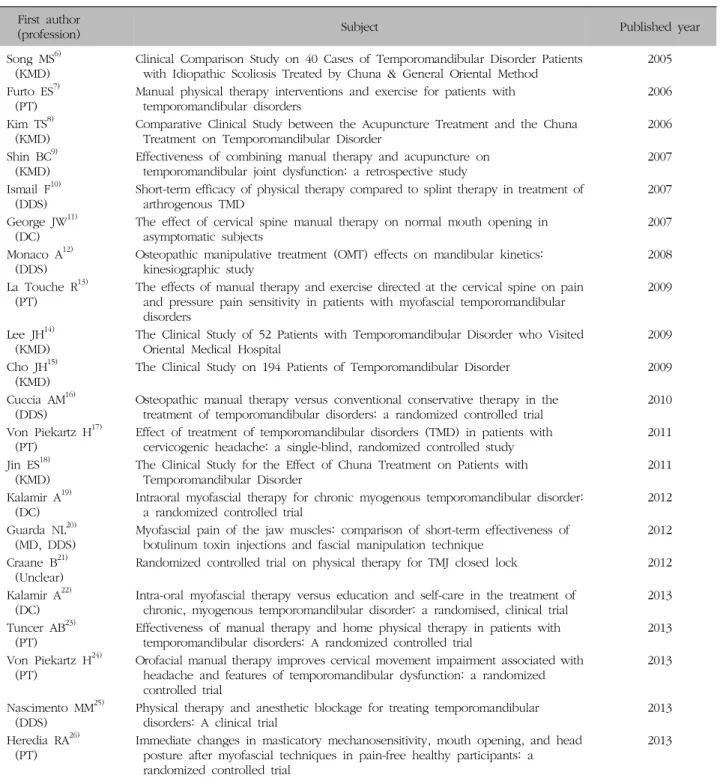
검색을 통해 나온 논문들 중 중복되거나 환자 수가 극 히 적은 Case report 형태의 논문은 제외시켰으며, 측두 하악장애의 수기치료에 대한 임상연구이면서 본 연구에 앞서 시행된 Pilot 연구의 경우는 포함시켰으며 수기치료 를 위주로한 비수술 치료의 유효성을 평가한 논문 또한 포함하였다. 그 결과 국외 논문이 총 16편, 국내 논문이 총 5편 검색되어 총 21편의 논문을 검색하여 원문을 찾아 연구하였다(Table I).
2. 연구 방법
총 21편의 논문에 대하여 게재지, 발표연도, 1저자의 직업 및 발표 국가, 연구 디자인, 진단기준 및 병인, 참여 환자수 및 연구기간, 사용기법을 조사한 후 각 논문을 연 구 목적별로 분류하여 내용을 살펴보았다.
결과»»»
1. 게재지 및 발표 연도
총 21편의 논문 중 The Journal of Craniomandibular Practice에 3편으로 가장 많이 게재되었으며, Journal of Oral Rehabilitation, Journal of Manipulative and Physio- logical Therapeutics, Journal of Bodywork and Move- ment Therapies, 대한침구학회지, 척추신경추나의학회지 에 각 2편, 나머지 저널에 각 1편 씩으로 총 14종의 저널 에 게재되었다.
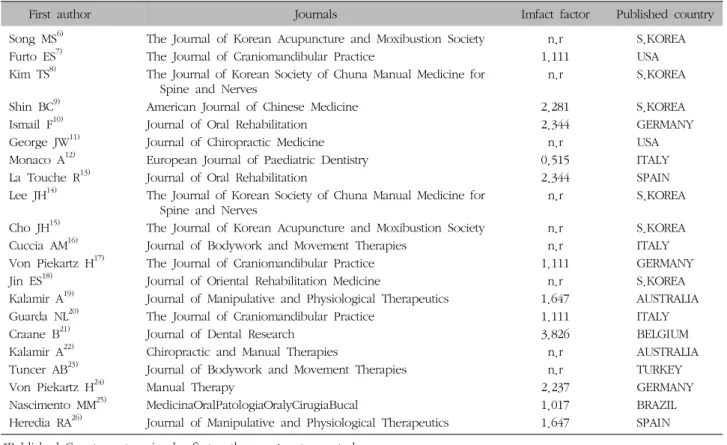
그 중 서울대학교 중앙도서관(http://library.snu.ac.kr) 에서 제공하는 ‘SCI, SCIE, SSCI, A&HCI 2013년 5월분 저널리스트’ 목록을 기준으로 SCI (Science Citation Index) 혹은 SCIE (Science Citation Index Expended)에 포함되 는 저널에 실린 논문들은 총 12편(63%)으로, 이 논문들을 중심으로 Journal Citation Report (JCR) edition 2012 (http://www.isiknowledge.com/JCR)을 통해 Impact Fac-
First author
(profession) Subject Published year
Song MS
6)(KMD)
Clinical Comparison Study on 40 Cases of Temporomandibular Disorder Patients with Idiopathic Scoliosis Treated by Chuna & General Oriental Method
2005 Furto ES
7)(PT)
Manual physical therapy interventions and exercise for patients with temporomandibular disorders
2006 Kim TS
8)(KMD)
Comparative Clinical Study between the Acupuncture Treatment and the Chuna Treatment on Temporomandibular Disorder
2006 Shin BC
9)(KMD)
Effectiveness of combining manual therapy and acupuncture on temporomandibular joint dysfunction: a retrospective study
2007 Ismail F
10)(DDS)
Short-term efficacy of physical therapy compared to splint therapy in treatment of arthrogenous TMD
2007 George JW
11)(DC)
The effect of cervical spine manual therapy on normal mouth opening in asymptomatic subjects
2007 Monaco A
12)(DDS)
Osteopathic manipulative treatment (OMT) effects on mandibular kinetics:
kinesiographic study
2008 La Touche R
13)(PT)
The effects of manual therapy and exercise directed at the cervical spine on pain and pressure pain sensitivity in patients with myofascial temporomandibular disorders
2009
Lee JH
14)(KMD)
The Clinical Study of 52 Patients with Temporomandibular Disorder who Visited Oriental Medical Hospital
2009 Cho JH
15)(KMD)
The Clinical Study on 194 Patients of Temporomandibular Disorder 2009 Cuccia AM
16)(DDS)
Osteopathic manual therapy versus conventional conservative therapy in the treatment of temporomandibular disorders: a randomized controlled trial
2010 Von Piekartz H
17)(PT) Effect of treatment of temporomandibular disorders (TMD) in patients with
cervicogenic headache: a single-blind, randomized controlled study 2011 Jin ES
18)(KMD)
The Clinical Study for the Effect of Chuna Treatment on Patients with Temporomandibular Disorder
2011 Kalamir A
19)(DC)
Intraoral myofascial therapy for chronic myogenous temporomandibular disorder:
a randomized controlled trial
2012 Guarda NL
20)(MD, DDS)
Myofascial pain of the jaw muscles: comparison of short-term effectiveness of botulinum toxin injections and fascial manipulation technique
2012 Craane B
21)(Unclear)
Randomized controlled trial on physical therapy for TMJ closed lock 2012 Kalamir A
22)(DC)
Intra-oral myofascial therapy versus education and self-care in the treatment of chronic, myogenous temporomandibular disorder: a randomised, clinical trial
2013 Tuncer AB
23)(PT)
Effectiveness of manual therapy and home physical therapy in patients with temporomandibular disorders: A randomized controlled trial
2013 Von Piekartz H
24)(PT)
Orofacial manual therapy improves cervical movement impairment associated with headache and features of temporomandibular dysfunction: a randomized controlled trial
2013
Nascimento MM
25)(DDS)
Physical therapy and anesthetic blockage for treating temporomandibular disorders: A clinical trial
2013 Heredia RA
26)(PT)
Immediate changes in masticatory mechanosensitivity, mouth opening, and head posture after myofascial techniques in pain-free healthy participants: a randomized controlled trial
2013
KMD: korean medicine doctor, DC: doctor of chiropractic, MD: medical doctor, DDS: doctor of dental surgery, PT: physical therapist.
Table I. First Authors and Their Professions, and the Subjects, and Published Year of 21 Thesis
tor를 살펴본 결과 Journal of Dental Research21)가 3.826 으로 가장 높았고, European Journal of Paediatric Dentistry12)가 0.515로 가장 낮았다(Table II).
발표 연도는 2005, 2008, 2010년 각 1편 씩 발표 되었
으며, 2006, 2011년에 각 2편, 2007, 2009, 2012년에 각 3 편, 2013년에 총 5편이 발표되어 측두하악장애의 수기치 료에 대한 연구는 꾸준히 진행되고 있으며 최근 들어 더 증가하고 있는 추세로 보인다.
First author Journals Imfact factor Published country Song MS
6)The Journal of Korean Acupuncture and Moxibustion Society n.r S.KOREA
Furto ES
7)The Journal of Craniomandibular Practice 1.111 USA
Kim TS
8)The Journal of Korean Society of Chuna Manual Medicine for
Spine and Nerves n.r S.KOREA
Shin BC
9)American Journal of Chinese Medicine 2.281 S.KOREA
Ismail F
10)Journal of Oral Rehabilitation 2.344 GERMANY
George JW
11)Journal of Chiropractic Medicine n.r USA
Monaco A
12)European Journal of Paediatric Dentistry 0.515 ITALY
La Touche R
13)Journal of Oral Rehabilitation 2.344 SPAIN
Lee JH
14)The Journal of Korean Society of Chuna Manual Medicine for Spine and Nerves
n.r S.KOREA
Cho JH
15)The Journal of Korean Acupuncture and Moxibustion Society n.r S.KOREA
Cuccia AM
16)Journal of Bodywork and Movement Therapies n.r ITALY
Von Piekartz H
17)The Journal of Craniomandibular Practice 1.111 GERMANY
Jin ES
18)Journal of Oriental Rehabilitation Medicine n.r S.KOREA
Kalamir A
19)Journal of Manipulative and Physiological Therapeutics 1.647 AUSTRALIA
Guarda NL
20)The Journal of Craniomandibular Practice 1.111 ITALY
Craane B
21)Journal of Dental Research 3.826 BELGIUM
Kalamir A
22)Chiropractic and Manual Therapies n.r AUSTRALIA
Tuncer AB
23)Journal of Bodywork and Movement Therapies n.r TURKEY
Von Piekartz H
24)Manual Therapy 2.237 GERMANY
Nascimento MM
25)MedicinaOralPatologiaOralyCirugiaBucal 1.017 BRAZIL
Heredia RA
26)Journal of Manipulative and Physiological Therapeutics 1.647 SPAIN
*Published Country=categorize by first author, n.r: not reported.
Table II. Journals and Impact Factors and Published Countries* of 21 Thesis
Fig. 1. Types of studies.
2. 1저자의 직업 및 발표 국가
1저자가 중복된 2편의 논문17,19,22,24)
을 포함하여 1저자 의 직업을 살펴 보았을 때, KMD가 6명(32%), PT가 5명 (26%), DDS가 4명(21%), DC가 2명(11%), 복수면허자 (MD,DDS), 확인불명(Unclear)가 각 1명(5%)으로 집계되 었다(Table I).
1저자를 기준으로 발표 국가를 살펴보았을 때, 국내 논 문 5편을 제외한 국외 논문 16편 중 독일, 이탈리아가 각 3편, 미국, 스페인, 호주 각 2편, 벨기에, 브라질, 한국, 터 키가 각 1편 발표하여 주로 유럽(56%) 등지에서 활발한 연구가 진행되고 있는 것으로 보여진다(Table II).
3. 연구 디자인
총 21편의 논문 중 무작위대조군실험이 14편(67%), 비 무작위대조군실험이 2편(9%), 비대조군실험이 1편(5%), 증례보고가 4편(19%)이었다(Fig. 1).
4. 진단 기준 및 병인
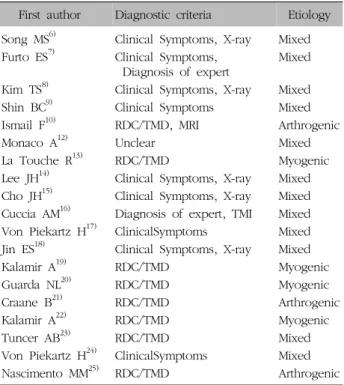
증상이 없는 일반인을 대상으로 진행한 연구 두편11,26) 을 제외한 19편의 논문에서 측두하악관절 장애의 진단에 사용한 진단 기준을 중복된 것을 나누어 살펴 보았을때, 악관절 통증, 악관절 잡음, 개구 장애 등 임상증상을 통한 진단이 9편(47%), 악관절장애연구용진단기준(Research Diagnostic Criteria for Temporomandibular Disorders;
RDC/TMD)27)을 통한 진단이 8편(42%), X-ray를 통한 진 단이 5편(26%), 의사 및 치과의사 등 전문가의 진단으로
First author Diagnostic criteria Etiology Song MS
6)Clinical Symptoms, X-ray Mixed Furto ES
7)Clinical Symptoms,
Diagnosis of expert
Mixed Kim TS
8)Clinical Symptoms, X-ray Mixed
Shin BC
9)Clinical Symptoms Mixed
Ismail F
10)RDC/TMD, MRI Arthrogenic
Monaco A
12)Unclear Mixed
La Touche R
13)RDC/TMD Myogenic
Lee JH
14)Clinical Symptoms, X-ray Mixed Cho JH
15)Clinical Symptoms, X-ray Mixed Cuccia AM
16)Diagnosis of expert, TMI Mixed Von Piekartz H
17)ClinicalSymptoms Mixed Jin ES
18)Clinical Symptoms, X-ray Mixed
Kalamir A
19)RDC/TMD Myogenic
Guarda NL
20)RDC/TMD Myogenic
Craane B
21)RDC/TMD Arthrogenic
Kalamir A
22)RDC/TMD Myogenic
Tuncer AB
23)RDC/TMD Mixed
Von Piekartz H
24)ClinicalSymptoms Mixed
Nascimento MM
25)RDC/TMD Arthrogenic
TMI: temporomandibular index.
Table IV. Diagnostic Criteria and Etiology of 19 Thesis
Group I Muscle disorders, including myofascial pain (Ia) and myofascial pain with limited man- dibular opening (Ib)
Group II Disc displacement with reduction (IIa) and disc displacement without reduction, with limited mandibular opening (IIb) or with- out limited mandibular opening (IIc) Group III Arthralgia, arthritis and arthrosis of the TMJ Table III. Axis I Group of Reserch Diagnostic Criteria for Temporomandibular Disorders
언급된 논문이 2편(11%), MRI, TMI16), 확인불명이 각 1 편(5%)으로 집계되었다(Table III, IV).
치료 대상으로 제한한 병인으로는 원인 분류에 대한 특별한 언급이 없거나 관절성, 근육성 측두하악장애 환자 둘 다를 대상으로 한 논문이 12편(63%), 근육성이 4편 (21%), 관절성이 3편(16%)으로 집계되었다(Table IV).
5. 사용기법 및 연구 기간
치료에 사용되어진 수기 기법을 확인해 보면 Passive traction and translation of TMJ가 8편(38%), Intraoral masticatory muscle relaxaion이 5편(24%), HVLA가 4편 (19%), Joint mobilization, Myofascial trigger-point mas- sage가 각 3편(14%), Myofascial release therapy가 2편 (10%)에서 사용 되었고, 그 외에 Non-thrust tempor- omandibular manipulation, stretches to the surrounding cervical musculature, detoning massage, ART, MET, cranial-sacral therapy 등의 기법이 각 1편(5%)의 빈도로 사용되었다.
후향적 연구로 진행되어 치료 기간 및 관찰 기간이 정 확히 명시되지 않은 논문 두편14,15)을 제외한 19편의 논문 에서 조사한 치료 기간은 1회 치료가 3편(16%), 2~4주 내외 치료가 6편(32%), 4~8주 내외 치료가 8편(42%), 12 주, 24주 치료가 각 1편(5%)으로 집계되었다.
관찰 기간의 경우, 치료 종료 후 1주 이내가 9편(47%), 2주 이내가 1편(5%), 8주 이내가 1편(5%), 12주 이내가 2 편(11%), 24주 이내가 3편(16%), 24주 이상이 3편(16%) 이었다(Table V).
6. 연구 목적별 논문 분석
1) 수기치료의 유효성 평가
George11)는 증상이 없는 일반인들을 대상으로 ART군 과 HVLA군, 대조군으로 나누어 두경부 추나치료를 시행 한 후 최대 개구력을 측정한 결과 정상인에서는 유의할만 한 개구력의 차이가 없다고 보고하며, 추후 개구 장애가 있는 환자들을 대상으로 추가 연구가 진행되어야 할 필요 성이 있다고 보고하였다.
Monaco12)는 외상 과거력이 있으며 비특이적인 TMD 증상을 가진 어린이 환자들을 대상으로 kinesiograph를 이용해 추나치료 전후 악관절의 최대 개구력 및 개폐시 속도를 비교한 RCT를 진행한 결과 6개월 관찰시 추나치 료군이 대조군에 비해 최대 개구력(p<.07)및 개폐시 속 도(p<.03)에 있어 유의할만한 효과를 나타내었다고 보고 하였다.
Heredia26)는 증상이 없는 일반인들을 대상으로 수기치 료군과 플라시보 대조군으로 나누어 1회 수기치료 시행 직후의 압력통증역치, 최대개구력, Craniovertebral angle 을 측정한 결과 시술자의 손이 피험자의 악관절 부위에
First author Technique of chiropractic Treatment periods Follow up periods
Song MS
6)HVLA 5 weeks
(10 sessions)
End of treatment Furto ES
7)Non-thrust temporomandibular manipulation,
Stretches to the surrounding cervical musculature
1 treatment 2 weeks Kim TS
8)Passive traction and translation of TMJ 3 weeks
(6 sessions)
End of treatment
Shin BC
9)Intraoral masticatory muscle relaxaion 4 weeks
(8~12 sessions)
End of treatment Ismail F
10)Passive traction and translation of TMJ,
Detoning massage 12 weeks
(12 sessions) End of treatment
George JW
11)ART, HVLA 1 treatment End of treatment
Monaco A
12)Unclear 8 weeks 24 weeks
La Touche R
13)Joint mobilization, Cranio-cervical stabilization 5 weeks (10 sessions)
12 weeks Lee JH
14)Passive traction and translation of TMJ Case by case Case by case
Cho JH
15)HVLA Case by case Case by case
Cuccia AM
16)HVLA, MET, Myofascial release, Cranial-sacral therapy 24 weeks 32 weeks Von Piekartz H
17)Passive traction and translation of TMJ 3~6 weeks
(6 sessions)
24 weeks Jin ES
18)Passive traction and translation of TMJ,
Intraoral masticatory muscle relaxaion
4 weeks (8 sessions)
End of treatment Kalamir A
19)Intraoral masticatory muscle relaxaion 5 weeks
(10 sessions)
1 year
Guarda NL
20)Myofascial trigger-point massage 2~4 weeks
(3 sessions)
12 weeks Craane B
21)Joint mobilization
Myofascial trigger-point massage
6 weeks (9 sessions)
52 weeks Kalamir A
22)Intraoral masticatory muscle relaxaion 5 weeks
(10 sessions)
6 weeks Tuncer AB
23)Intra-and extra-oral masticatory muscle relaxaion,
Stabilization of TMJ, Passive traction and translation of TMJ
4 weeks (12 sessions)
End of treatment
Von Piekartz H
24)Passive traction and translation of TMJ 3~6 weeks (6 sessions)
24 weeks Nascimento MM
25)Joint mobilization, Massage of masticatory muscles,
Passive traction and translation of TMJ
8 weeks (8 sessions)
End of treatment
Heredia RA
26)Myofascial release therapy 1 treatment End of treatment
ART: active release technique, HVLA: high velocity low-amplitude thrust technique, MET: muscle energy technique.
Table V. Technique of Chiropractic and Periods of Treatment and Follow up of 21 Thesis
First author Participants Experimental group Control group Outcome measures Results George JW
11)Asymptomatic participant ART (n=34), HVLA (n=34) NT (n=33) MMO Ineffective Monaco A
12)Children with history
of trauma
OMT (n=14) NT (n=14) MMO, MOV Effective
Heredia RA
26)Asymptomatic participant Myofascial therapy (n=23) Placebo (n=24) PPT, maximal VMO, Craniovertebral angle
Ineffective
NT: no treatment, OMT: osteopathic manipulative treatment, MMO: maximal mouth opening (by range of motion scale
11), by kine- siographic recording
12)), MOV: maximal mouth opening velocity, PPT: pressure pain threshold (by mechanical pressure algometer), VMO: vertical mouth opening.
Table VI. Summary of Clinical Studies Concerning Effectiveness of Manual Therapy
First author Participants Experimental group Control group Outcome measures Results
Kim TS
8)n.s CT (n=15) ACT (n=16) Ai, mCMI (MM, TN) AC was more effective than CT in MM, CT was more effective than AC in TN
Cuccia AM
16)n.s OMT (n=25) CCT (n=25) VAS, MOV, ROM* OMT group reruired significantly less medication than CCT group
Kalamir A
19)n.s IMT (n=31) IMTESC (n=31)
NT (n=31) 11-point self-reported graded chronic pain scale (RP, OP, CP, OR), GRC
Both IMT and IMTESC is effctive, with IMTESC being superior to IMT at 1 year Guarda NL
20)n.s Botulinum toxin
injections (n=15)
Fascial manipulation (n=15)
VAS, ROM** Almost equally effective Kalamir A
22)n.s IMT (n=23) ESC (n=23) 11-point self-reported
graded chronic pain scale (RP, OP, CP, OR)
IMT is superior to ESC over the short-term
n.s: non-specific TMD patients, ACT: acupuncture treatment, CT: chuna treatment, Ai: anamnestic dysfunction index, mCMI:
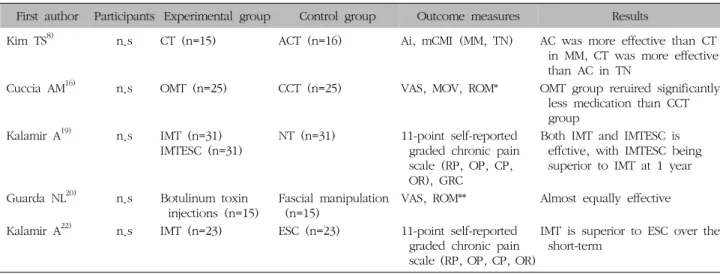
Modified Craniomandibular Index, MM: mandibular movement, TN: temporomanbibular joint noise, CCT: conventional conservative treatment, VAS: visual analogue scale, ROM*: lateral movement of the head around its axis, IMT: intraoral myofascial therapy, IMTESC: IMT plus education and self-care exercise, RP: pain at rest, OP: opening pain, CP: clenching pain, OR: opening range, GRC: Global reporting of change, ROM**: jaw range of motion (maximum mouth opening, protrusion, right and left laterotrusion).
Table VII. Summary of Comparative Studies on the Effect of Manual Therapy and Other Treatments
치료적인 압박 없이 올려두기만 했던 대조군과 치료군에유의할만한 차이점이 없다고 보고하였다(Table VI).
2) 타 치료법과의 치료효과 비교
Kim8)은 31명의 환자를 침치료군과 추나치료군으로 나 누어 치료 효과를 비교한 결과, 악관절 운동성 향상은 침 치료군에서, 악관절 잡음감소면에서는 추나치료군에서 호 전이 유의성 있게 차이가 있었으나, 종합적인 호전도에 있어서는 침치료군의 호전도가 추나치료군의 호전도에 비해 높은 것으로 보고하였다.
Cuccia16)은 50명의 환자를 추나치료군과 종래의 보존 적 치료(구강장치, 스트레칭 운동, TENS 등)군으로 나누 어 6개월간 치료를 시행하였고, 연구 진행 도중 필요시에 NSAID 및 근이완제 복용을 겸할 수 있도록 하였다. 그 결과 두 치료군 모두 통증, 최대 개구력, 상부경추 ROM 의 호전도는 비슷하게 나타났으나, 추나 치료군이 보존적 치료 군해 비해 확실히 적은 양의 약물 복용을 필요로 하 였다고 보고하였다(p<.001).
Kalamir19)은 93명의 근육성 TMD환자를 수기치료군, 수기치료 및 자가운동(등척성 이완 스트레칭)군, 대조군 으로 나누어 연구를 진행한 결과 6개월 까지는 수기치료 군 및 수기치료에 운동을 병행한 군이 통증에 있어서 대 조군에 비해 비슷하게 유효한 효과를 나타내었으나, 1년
간의 경과관찰시 수기치료 군에 비해 수기치료에 자가운 동을 병행한 군이 더욱 뛰어난 효과를 나타내었다고 보고 하였다(p<.001).
또한 2013년 동 저자가 46명의 근육성 TMD 환자를 수 기치료군과 자가운동군으로 나누어 진행한 RCT에서는22) 5주간의 치료 후 수기치료가 자가운동에 비해 통증에 있 어 뛰어난 효과를 보여(p<.001), 단기적인 치료에서는 수기치료가 자가운동에 비해 우수한 효과를 나타내었다 고 보고하였다.
Guarda20)은 근육성 TMD환자에 있어 측두근 및 교근 에 보톡스 주사 1회를 시행한 보톡스치료군과 2~4주간 총 3회의 수기치료를 시행한 수기치료군의 통증 및 악관 절 운동성을 비교한 RCT를 시행하여 3개월간 경과추시한 결과, 두 군의 치료 효과는 거의 비슷했으며, 자각적인 통 증 감소면에서는 수기치료군이, 악관절 운동성 증가면에 서는 보톡스치료군이 조금 더 효과적이었으나 통계적인 유의성은 없다고 보고하였다(Table VII).
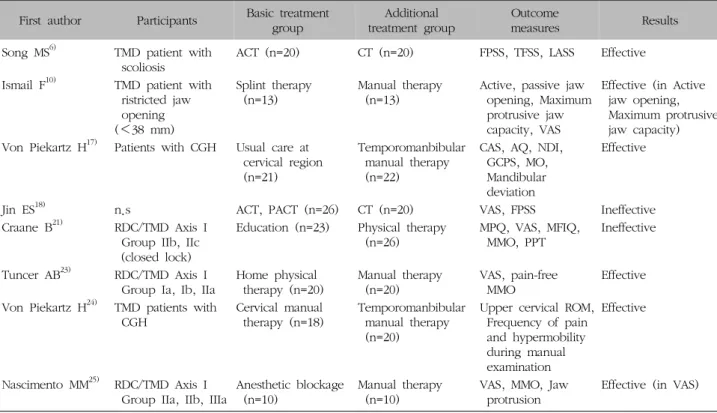
3) 타 치료법에 추가 시술시 치료효과 향상 비교 Song6)은 척추측만증을 동반한 TMD환자에게 공통으로 침치료를 시행하고, 실험군은 침치료에 추나치료를 병행 하여 시행한 후 통증 호전 및 악관절기능을 평가한 결과 실험군이 대조군에 비해 유의하게 뛰어난 효과를 나타내
First author Participants Basic treatment group
Additional treatment group
Outcome
measures Results
Song MS
6)TMD patient with scoliosis
ACT (n=20) CT (n=20) FPSS, TFSS, LASS Effective Ismail F
10)TMD patient with
ristricted jaw opening (<38 mm)
Splint therapy (n=13)
Manual therapy (n=13)
Active, passive jaw opening, Maximum protrusive jaw capacity, VAS
Effective (in Active jaw opening, Maximum protrusive jaw capacity) Von Piekartz H
17)Patients with CGH Usual care at
cervical region (n=21)
Temporomanbibular manual therapy (n=22)
CAS, AQ, NDI, GCPS, MO, Mandibular deviation
Effective
Jin ES
18)n.s ACT, PACT (n=26) CT (n=20) VAS, FPSS Ineffective
Craane B
21)RDC/TMD Axis I Group IIb, IIc (closed lock)
Education (n=23) Physical therapy (n=26)
MPQ, VAS, MFIQ, MMO, PPT
Ineffective
Tuncer AB
23)RDC/TMD Axis I Group Ia, Ib, IIa
Home physical therapy (n=20)
Manual therapy (n=20)
VAS, pain-free MMO
Effective Von Piekartz H
24)TMD patients with
CGH
Cervical manual therapy (n=18)
Temporomanbibular manual therapy (n=20)
Upper cervical ROM, Frequency of pain and hypermobility during manual examination
Effective
Nascimento MM
25)RDC/TMD Axis I Group IIa, IIb, IIIa
Anesthetic blockage (n=10)
Manual therapy (n=10)
VAS, MMO, Jaw protrusion
Effective (in VAS)
PACT: pharmacopuncture treatment, FPSS: facial pain score scale, TFSS: temporomanbibular function score scale, LASS: the limi- tation of activity score scale, CGH: cervicogenic headache, CAS: colored analogical scale, AQ: anamnestic questionnaire, NDI: neck disability index (dutch version), CPGS: chronic pain grade status (dutch version), MPQ: McGill pain questionnaire, MFIQ: man- dibular function impairment questionnaire.
Table VIII. Summary of Clinical Studies Concerning Effectiveness of Additional Manual Therapy
었다고 보고하였다.Ismail10)은 38 mm 이하의 개구 제한을 보이는 관절성 TMD환자들에게 공통으로 스플린트 치료를 시행하고, 실 험군은 그에 수기치료를 더하여 시행한 결과 능동 개구 력, 최대 전방 운동력에서 실험군이 대조군에 비해 유의 하게 향상된 치료 효과를 나타내었다고 보고하였다(p
<.05).
Von Piekartz17)는 ICHD-II (International Classifica- tion of Headache Disorders)에 의해 경추성두통으로 진 단 받은 43명의 환자들을 대상으로 공통으로 경추부 수기 치료를 시행하고, 실험군에는 악관절 수기치료를 병행하 여 시행한 후 만성통증척도 및 경부장애도, 개구량을 평 가한 결과 실험군에서 대조군에 비해 유의한 정도의 두통 및 경부장애 감소가 나타났으며 실험에 참가한 환자들 중 44.1%가 TMD를 함께 가지고 있는 것으로 진단되었다고 보고하여. 만성 경추성두통 환자의 치료에 악관절 수기치 료를 병행하는 것이 효율적일 수 있음을 알 수 있다.
또한 동 저자가 2013년24) 경추성 두통과 TMD를 함께
진단 받은 38명의 환자들을 대상으로 진행한 RCT에서도 6개월 경과 관찰시 경추부 수기치료에 악관절 수기요법 을 병행한 실험군의 통증 감소 및 상부경추의 ROM증가 가 대조군에 비해 유의성 있게 뛰어난 것으로 보고하였다 (p<.05).
Jin18)이 46명의 환자에 공통으로 침, 황련약침치료를 적용하고 대조군에 추나치료를 추가하여 시행한 결과 두 군 모두 VAS및 FPSS감소를 보였으며 각 군의 치료효과 비교시 실험군의 수치 감소 폭이 더 크지만, 두 군간에 통계적으로 유의한 차이는 없는 것으로 나타났다고 보고 하였다.
Craane21)는 비정복성관절원판변위(closed lock)상태의 TMD 환자들을 대상으로 공통 치료로 악관절 이완유지법, 비기능적 치아접촉 및 과도한 입벌림을 피하는 방법등을 교육하고, 실험군은 그에 추가하여 6주간 수기요법을 실 시한 결과, 교육은 확실히 효과를 나타내었으나 추가적인 수기요법의 효과는 불명확하다고 보고하였다.
Tuncer23)이 근원성 및 정복성 관절원판변위 상태의
First author Participants Intervention Outcome measures Results Furto ES
7)n.s (n=15) Manual therapy, Condylar
remodeling exercise
TMD Disability index, PSFS, NPRS, Body diagram
Effective
Shin BC
9)n.s (n=49) Manual therapy, Acupuncture VAS, MMO Effective
La Touche R
13)n.s (n=19) Manual therapy VAS, PPT, Active pain-free mouth opening
Effective
Lee JH
14)n.s (n=52) Chuna therapy, Acupuncture Unclear Effective
Cho JH
15)n.s (n=19) Chuna therapy, Acupuncture, Pharmacopuncture
VNRS, Five-point likert scale Effective
PSFS: patient specific functional scale, NPRS: numeric pain rating scale, VNRS: verbal numerical rating scale.
Table IX. Summary of Clinical Studies Concerning Effectiveness of Conservative Treatment Including Manual Therapy
TMD환자를 대상으로 공통 치료로 호흡 운동 및 이완법,자세 교정, 악관절 저항 운동 등 가정운동치료를 시행하 고, 실험군은 그에 추가하여 주 3회 한달간 수기요법을 시행한 결과 실험군이 대조군에 비해 VAS (p<.001) 및 통증없이 가능한 최대 개구량(p=0.009)에서 유의성 있게 뛰어난 효과를 나타내었다고 보고하였다.
Nascimento25)이 정복성 또는 비정복성관절원판변위 상 태의 TMD 환자를 대상으로 공통 치료로 이개측두신경 (auriculotemporal nerve)에 1 ml의 bupivacaine 0.5%로 통증 차단 주사치료를 주 1회 총 8주간 시행하고, 실험군 에는 이에 더하여 수기치료를 시행한 결과 실험군이 대조 군에 비해 VAS 감소에 있어 유의성 있게 뛰어난 효과 (p=0.027)를 나타내었고, 최대 개구량 및 악관절 전방 움 직임 호전에는 두 군간에 유의한 차이가 없었다고 보고하 며 통증차단 주사와 수기치료를 함께 시행하는 것이 TMD환자의 통증 조절에 효과적인 것으로 볼 수 있다고 보고하였다(Table VIII).
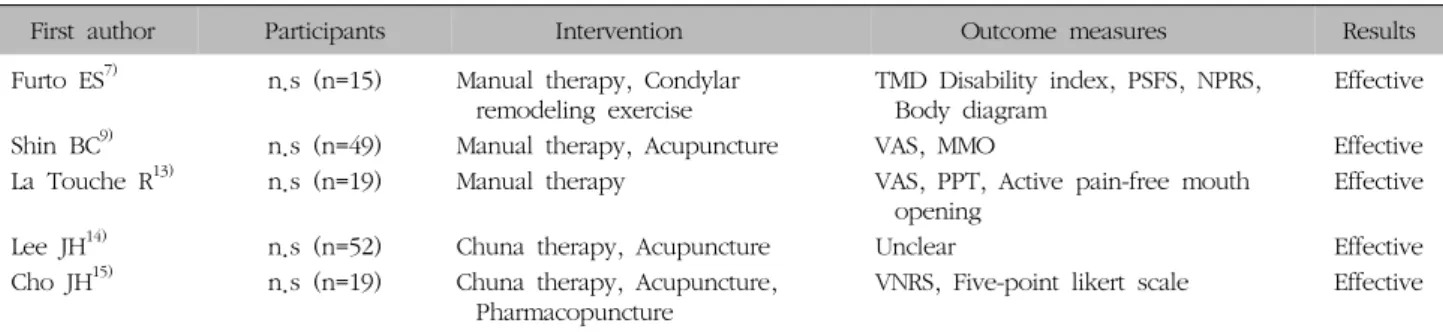
4) 수기치료를 위주로한 보존적 치료의 유효성 평가 수기치료를 위주로한 비수술 통합치료를 TMD환자에 적용하여 유효한 효과를 보고한 연구는 21편 중 5편으로, Furto7)는 수기치료와 과두재형성운동(condylar remodel- ing exercise program)을, Shin9), Lee14), Cho15)은 추나치 료와 침치료를, La Touche13)는 수기치료를 이용하여 TMD환자를 치료하고 통증 및 최대개구량 등에 유의성 있는 결과를 보고 하였다(Table IX). 다만 그 연구가 증
례보고7,9,14,15) 및 비대조군 연구13)로 디자인 되어 근거 피
라미드(evidence pyramid, http://library.downstate.edu/
EBM2/2100.htm)에 의거해 TMD환자에 있어 추나치료 및 이를 포함한 비수술 통한 치료의 임상적 근거로 사용하기
에는 부족한 면이 있어 추후 더 발전된 연구가 진행되어 야 할 것으로 사료된다.
고찰»»»
하악관절은 두개골의 측두골과 하악골의 과두가 만나 서 이루는 관절로, 외이도 전방에 위치하고 ball joint와 유사한 구조를 하고 있으며, 이를 구성하는 두 골의 구조 중간에 섬유조직으로 구성된 디스크가 위치하고 있다. 이 는 인체의 관절들 중에서 지속적으로 가장 많이 사용되는 관절 중의 하나로서 저작, 연하 뿐 아니라 말하는 과정에 서도 사용되며 이러한 기능을 위해 하루 2,000회 이상을 움직이며 약 3.5톤의 압력을 치아 조직에 가하게 된다28).
측두하악장애의 원인은 크게 외상, 해부학적 요인, 병 리학적 요인, 정신, 사회적 요인으로 나누어 볼 수 있는 데, 외상에는 직접적인 외상과 간접적인 외상이 있으며 직접적 외상으로는 교통사고와 운동중의 사고 등을 들 수 있고, 간접적 외상은 head-forward posture와 같은 좋지 않은 자세와 이 갈기 등과 같은 비기능성 습관에 의해 하 악과두에 과도한 스트레스가 장기간 가해지는 것을 의미 하며, 측두하악장애 환자 대부분에서 간접적인 외상의 소 견이 나타난다. 해부학적 요인으로는 부정교합 등을 들 수 있고, 내분비 장애, 대사성 장애, 류마티스성 장애 등 의 전신질환에 의하여 이차적으로 유발되는 측두하악장 애는 병리학적인 요인에 포함된다. 정신, 사회적 요인으 로는 과도한 스트레스, 우울증 등의 정신적 혹은 정서적 장애를 들 수 있는데 이러한 요인이 악관절 장애를 유발 하거나 심화시키는 것은 사실이지만, 스트레스 만으로 측 두하악장애가 발생하게 되는 것은 아니다29).
측두하악장애로 진단하는 필요조건은 악관절이나 저작 근의 통증, 관절잡음, 개구장애 또는 턱운동이상의 주요 증상 중 적어도 한 개 이상이 발현해야 한다. 가장 흔한 증상은 통증이며, 그 외 하악의 운동 제한, 관절잡음(단순 관절음, 거대관절음, 염발음)과 같은 증상이 관찰된다30). 진단 기준 중 측두하악장애 환자를 위한 연구 진단 기준 (RDC/TMD)은 측두하악장애 환자를 객관적이고 표준화 된 방법으로 진단하기 위해 만들어진 것으로 1992년 Dworkin31) 등에 의해 소개된 이래 전 세계 많은 언어들 로 번역되어 측두하악장애의 진단과 연구에 사용되고 있 다.
측두하악장애의 증상은 유동적이거나 일시적일 수 있 어 때로는 적극적인 치료 없이 완화되기도 한다. 따라서 수술이나 광범위한 교합치료등과 같은 비가역적인 치료 방법은 측두하악장애의 초기 치료법으로 피해야하며, 행 동조절, 약물치료, 교합안정장치, 침치료, 수기치료와 같 은 보존적 치료를 초기치료로 시행하는 것을 치료의 원칙 으로 삼아야 한다.
이 중 수기치료(manual therapy)는 국내에서는 추나수 기요법, 추나치료 등으로 통용되고 있으며 양적 요소인 기능(function)과 음적 요소인 구조(structure)간의 계통적 상호관련성을 기초로 인체의 불균형한 근골격계 구조를 정형의학적 방법으로 회복하고 기능적 균형을 회복하도 록 하는 치료법 중의 하나로, 추간판 탈출증, 근육과 인대 의 염좌성 및 증후군성 질환, 신경성 근육통, 두통, 불면 증, 마비질환의 운동 질환 등 다방면에서 활용되고 있다.
특히 하악관절의 기능부전 뿐만 아니라 전신적인 근골격 계의 불균형 및 정신생리적인 면도 함께 고려하여야 하는 측두하악장애의 병인적 특성상 수기치료를 측두하악장애 의 치료에 적용하여 유효한 효과를 거두는 임상 연구 결 과가 최근 국내외에서 꾸준히 이루어지고 있다.
이에 측두하악장애의 수기치료 연구의 국내외 최근 동 향을 파악하여 추후 진행될 연구 및 임상에의 활용에 도 움이 되고자 Pubmed, KISS, KISTI, KERIS, 등에서 ‘Tem- poromanbibular Disorder’, ‘manipulation’을 기본 검색 어로 하고 2005년 이후 발간된 임상논문들을 중 국외 논 문 16편, 국내 논문 5편 총 21편의 논문을 선별하였다.
게재지에 따라 분류해 보면 The Journal of Cranio- mandibular Practice에 3편으로 가장 많이 게재 되었고, 총 14종의 학회지에 게재되었다. 발행연도를 살펴보았을
때 2013년이 5편으로 가장 발표가 많았고, 해마다 꾸준히 연구가 진행되고 있으며 점차 증가하고 있는 추세로 보인 다. 1저자의 직업을 살펴보았을 때, 국외에서는 PT와 DDS의 발표가 가장 많았고, 국내에서는 모든 연구가 KMD에 의해 진행되었다. 1저자를 기준으로 국가별로 분 류해 보면 국내 논문을 제외한 16편의 논문 중 독일, 이 탈리아를 포함한 유럽에서 총 9편의 논문이 발간되어, 유 럽 등지에서 가장 연구가 활발히 진행되고 있음을 알 수 있었고, 그 외 미국, 호주, 브라질, 터키 등의 국가에서도 연구가 진행됨을 확인하여 여러 분야의 학계와 다양한 국 가에서 연구가 진행되고 있음을 알 수 있었다.
진단기준 및 병인을 살펴보았을 때 국외 논문의 과반 수 이상에서 RDC/TMD를 진단 기준으로 채택하였고, 특 히 증상이 발현된 환자들을 대상으로 한 SCI 및 SCIE 급 의 임상논문 9편 중 6편에서 RDC/TMD를 진단 기준으로 채택해 RDC/TMD가 국제적인 측두하악장애의 진단 기준 으로써 신뢰받고 있음을 확인할 수 있었다. 그에 반해 국 내 논문은 5편 모두 임상 증상 및 단순방사선 촬영을 진 단 기준으로 채택하였고 관절성 및 근육성의 병인의 구분 에 대해 언급한 논문은 아직 없어, 추후 진단의 객관성 확보 및 연구의 표준화를 위하여 RDC/TMD 등 국제적으 로 통용되는 진단기준의 사용 및 병인의 분류도 고려해 보아야 할 것으로 사료된다.
사용한 주요 수기 기법으로는 Passive traction and translation of TMJ가 8편으로 가장 빈도가 높았고, 그 외 에 Intraoral masticatory muscle relaxaion, HVLA, Joint mobilization, Myofascial trigger-point massage가 다용되 었으며, 이는 국내 임상가에서 측두하악장애의 치료에 신 연이행기법 및 외측 익돌근 추법 등이 다용되고 있는 것 과 비슷한 경향성을 보이고 있다. 다만 다수의 연구에서 여러 가지 수기기법을 함께 적용하여 환자를 치료하여, 추후 각각의 기법에 따른 적응증 및 효능을 분류하여 밝 히는 데 있어 추가적인 연구가 진행되어야 할 것으로 사 료된다.
치료 기간은 4주에서 8주 내외의 치료가 가장 많이 적 용되었고, 관찰 기간은 치료 종료 후 1주 이내가 9편이었 으나 12주에서 최대 1년까지 관찰 기간을 가진 논문이 8 편으로 다수의 연구에서 즉각적인 치료 효과 뿐만 아니라 장기적인 효과 및 통증의 재발 여부까지 평가하여 수기치 료의 유효성을 검증하고자 했음을 확인 할 수 있었다.
연구 목적별로 분류해보면 수기치료의 유효성을 평가 한 논문, 다른 치료법과의 치료효과를 비교한 논문 및 다 른 치료법에 추가적인 시술로서의 수기치료의 효과를 검 증한 논문, 수기치료를 위주로 한 비수술 통합치료의 유 효성을 검증하고자 한 논문 등 다양한 방변으로 임상 연 구가 이루어지고 있음을 알 수 있었고, 특히 다른 치료법 에 추가적인 시술로서의 수기치료의 효과를 검증한 논문 이 8편으로, 치료의 주된 수단으로써라기 보다는 보조적 인 치료 수단으로써의 수기치료의 유용성에 대해 평가하 고자 하는 연구 경향을 확인 할 수 있었다.
국내외 연구 경향을 비교하여 살펴 보았을 때, 국외에 서는 수기치료가 측두하악장애의 주요한 비수술 치료방 법 중 하나로 인식되어 의학계 및 치의학계, 물리치료학 계 등 다양한 학계에서 연구되어지고, 각 학계의 공동 연 구 또한 다수 진행되고 있는 반면에, 국내에서는 한의학 계외의 다른 학계에서는 보조적인 치료수단으로서 간단 히 언급되거나 거의 언급되지 않았고, 공동 연구 또한 전 무한 것으로 조사되었다. 추후 국내에서도 더욱 발전된 임상 연구 및 홍보가 진행되어 보존적 치료 수단으로써의 추나치료의 인식을 재고시킬 필요성이 있는 것으로 사료 된다. 더불어 구강내 장치 및 통증 차단 주사 등 타 비수 술 치료 수단과의 병행 치료 효과 연구를 고려하는 것 또 한 세계적인 비수술 치료의 흐름에 비추어 볼 때 발전적 인 의미가 있을 것으로 사료된다.
또한 국내 한의학계에서 발표된 5편의 논문 중 대부분 이 추나치료 단독이 아닌 비수술통합치료 중 하나로써의 효과를 검증하는 연구를 진행하였고, 조사 대상에서 제외 된 논문들 중 1~3예의 증례보고 형식으로 발표된 논문들 이 대부분이었다. 추후 추나치료의 독자적인 효과 검증을 위한 무작위 대조군 실험 등 임상 연구로서 가치가 있는 연구가 추가적으로 진행되어야 할 것으로 사료된다.
본 연구를 진행하면서 살펴본 바 국외 논문을 Pubmed 검색으로 제한하여 중국이나 일본 등의 다른 국가에서의 연구를 고려하지 않았다는 점, 2005년 이전의 논문은 살 피지 않아 그 이전의 연구 경향성까지 살펴보지는 못했다 는 점 등의 한계점이 보이는 것으로 사료된다.
최근 측두하악장애 환자가 증가함에 따라 그 치료에 대한 관심이 높아지는 상황에서 수기치료 및 한의학의 고 유한 추나치료가 측두하악장애의 치료에 어떻게 적용되
고 있는지에 대해 SCI 및 SCIE 급의 수준 높은 논문들을 비롯한 국내외 논문들의 임상 연구 동향을 살펴보고, 국 내외 연구를 비교 고찰함으로써 이를 바탕으로 측두하악 장애에 대한 추나수기치료연구의 설계 및 진행에 도움을 제공하고, 체계적인 임상에의 적용에 도움을 줄 수 있을 것으로 사료된다.
결론»»»
측두하악장에에 대한 수기치료 연구의 동향을 파악하 기 위해 Pubmed, KISS, KISTI, KERIS 등에서 ‘Temporo- manbibular Disorder’, ‘manipulation’을 기본 검색어로 하고 2005년 이후 발간된 임상논문들을 중 국외 논문 16 편, 국내 논문 5편 총 21편의 논문을 선별하여 고찰한 결 과 다음과 같은 결론을 얻었다.
1. 측두하악장애의 수기치료에 대한 연구는 여러 분야 의 학계와 다양한 국가에서 진행되고 있으며, 연구는 점 차 활발해 지고 있는 추세이고, 국제적인 진단 기준으로 는 Research Diagnostic Criteria for Temporomandibular Disorders가 가장 다용 되고 있었다.
2. 다용되는 수기 기법은 Passive traction and trans- lation of TMJ 및 Intraoral masticatory muscle relaxaion 등으로 추후 각각의 기법에 대한 적응증 및 유효성에 대 한 연구가 발전되어야 할 것으로 보이며, 다수의 논문에 서 12주에서 최대 1년까지 관찰 기간을 가져 수기치료의 효과 뿐 아니라 통증의 재발 여부까지 평가하여 수기치료 의 유효성을 검증하고자 했음을 알 수 있었다.
3. 연구 목적을 살펴보았을 때 수기치료의 유효성 평가 및 다른 치료법과의 치료효과 비교 등 다양한 방면으로 수기치료의 효과를 검증하고자 하였으며, 다수의 논문에 서 다른 치료법에 추가적인 시술로써의 수기치료의 효과 를 검증하고자 하여 보조적인 치료 수단으로써의 수기치 료의 유용성에 대해 평가하고자 하는 연구 경향을 확인 할 수 있었다.
4. 추후 국제적으로 통용되는 진단기준의 사용 및 병인 의 분류에 대한 개선, 타 학계와의 공동 연구 및 추나수 기치료의 독자적인 효과 검증을 위한 연구 등의 지속적인 연구 진행이 필요할 것으로 사료된다.