Received October 11, 2019 Revised November 08, 2019 Accepted December 16, 2019 Corresponding author Hansol Hur
120, Irwon-ro, Gangnam-gu, Seoul, Republic of Korea Tel : +82-2-569-2615 E-mail: [email protected]
Ⓒ The Society of Sasang Constitutional Medicine.
All rights reserved. This is an open acess article distributed under the terms of the Creative Commons attribution Non-commercial License (http:// creativecommons.org/licenses/by-nc/3.0/)
태음인 비만의 치료에 대한 임상 논문 분석
허한솔*․강오석1
1경희우리부부한의원 원장
Abstract
A Review Study of Treatments for Taeeumin Obesity
Hansol Hur*․O-seok Kang1
1
Kyunghee woori bubu Oriental Clinic
Objectives
The purpose of this study is to analyze how obesity of Taeeumin have been treated.
Methods
We searched clinical studies from the databases including Koreanstudies Information Service System(KISS), Oriental medicine Advanced Searching Integrated System(OASIS), Research Information Sharing Service(RISS), National Discovery for Science Leader(NDSL), Korea Citation Index(KCI) and pubmed with the keywords relevant to treatment of Taeeumin obesity.
Results
A total of 14 studies were analyzed. Herbal medicines were mostly used, and the most frequently used prescription was Taeeumjowi-tang. And concurrent therapies such as diet therapy, exercise therapy, electroacupuncture were performed.
Several evaluation methods were used, and patient’s body weight was the most used.
Conclusion
Through this literature review, we could find out tendencies of Korean medicine treatments of obesity of taeeumin up to date and some points that may have clinical significance.
Key Words
: Taeeumin, sasang constitution, obesity, Literature reviewⅠ. 緖論
비만은 건강에 악영향을 미칠 수 있는 범위로 지방 이 축적된 의학적 상태를 가리킨다
1. 우리나라에서도 비만 유병률이 증가하는 추세로 최근의 2017년 국민 건강영양조사에서 체질량지수(kg/m
2) 기준으로 25 이 상인 백분율을 조사한 19세 이상의 비만 유병률은 34.8%(표준오차 0.8%)로
21998년의 25.8%(표준오차 0.6%)에 비해 큰 폭으로 증가하였다
3. 비만의 병인으 로는 의원성 원인, 과도한 음식 섭취, 신경 내분비성 원인, 심리적, 유전적 원인 등이 있는데, 특히 섭식 조절과 에너지의 비정상적 소모가 주요한 요소가 된 다
4. 비만의 한의학적 치료와 관련하여 사상체질 중 태음인의 약재와 처방이 많이 이용되고 있는데
5, 사상 의학에서 태음인은 가장 체격이 크고 肌肉이 풍부하 며, 肝大肺小한 성질로 吸聚之氣가 크고 呼散之 氣가 부족하여 비만해지기 쉽다고 볼 수 있다
6. 임상 적으로 비만인의 약 70%가 태음인이라는 연구결과가 있으며
7, 류 등이 1,164명의 환자를 대상으로 한 연구 에서는 과체중군에서 태음인이 78.03%의 분포를 보 이고 비만군에서 태음인이 95.30%의 분포를 나타낸 다고 하였다
8. 황 등의 연구에서는 2000년 이후 비만 치료에 사용되는 처방 및 본초에 대한 문헌 고찰 결과 국내 논문에서 사상처방이 가장 빈용되며 이들 중 태 음인 처방이 가장 다용되었음을 밝혔다
9. 태음인 처방 을 이용한 비만 연구에 대한 분석도 이루어졌으나 태 음인을 대상으로 한 임상치료에 관련된 연구는 28편 의 논문 중 4편만이 해당되어 일부분만 다루어졌을 뿐이었다
10. 현재도 비만에 대한 많은 관심과 연구가 진행 중으로, 비만의 다수를 차지하는 태음인비만의 임상치료에 대한 현재까지의 연구의 경향을 분석함과 함께 방향성을 찾아보고자 하였다.
Ⅱ. 硏究對象 및 方法
본 연구에서는 국내외 논문을 대상으로, 한국학술 정보(KISS), 전통의학정보포털(OASIS), 한국교육학술 정보원(RISS), 국가과학기술정보센터(NDSL), 한국학 술지인용색인(KCI), pubmed를 이용하여 2019년 10월 에 검색어 ‘태음인 AND 비만’, ‘태음 AND 비만’ ‘사상 AND 비만’, ‘사상체질 AND 비만’, ‘한의 AND 비만’,
‘한방 AND 비만’, ‘sasang AND obesity’, ‘sasang AND constitution AND obesity’ ‘taeeum AND obesity’
‘taeeumin AND obesity’가 제목이나 주제어에 포함된 연구를 검색하였다. 논문의 발행 시기에는 제한을 두 지 않았다. 이 중 실험연구, 문헌연구, 태음인을 대상 으로 하지 않거나 임상치료가 포함되지 않은 논문 등 을 제외하고 연구내용이 태음인의 비만에 대한 임상 치료인 논문을 선정하였다. 선정된 논문을 대상으로 연도별 발표동향, 체질진단 방법, 사용된 처방, 연구에 사용된 중재법, 평가도구에 대해서 분석하였다.
Ⅲ. 結果
1. 대상 연구의 선정
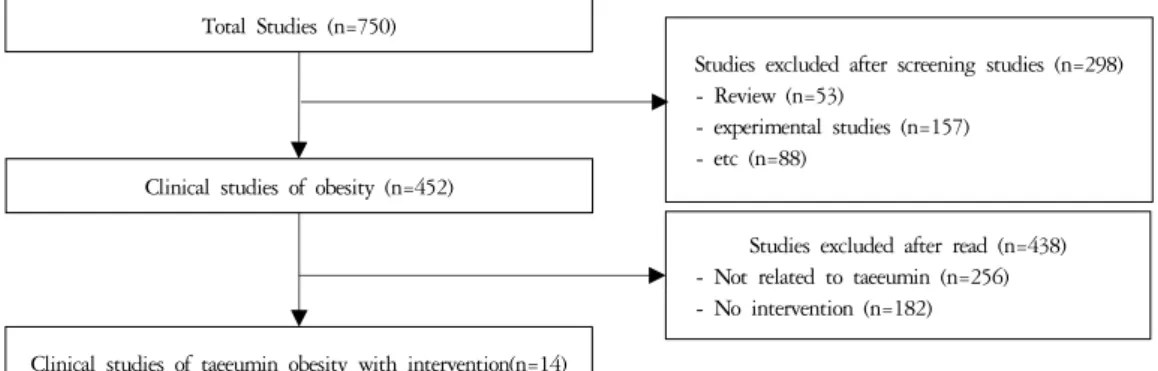
검색어를 통해 1차적으로 750건의 연구논문을 검
색하였다. 제목과 초록을 확인하고 필요할 경우 원문
을 검토하여 실험연구 157건, 문헌연구 53건, 치료에
대한 내용이 아닌 연구 182건, 태음인을 대상으로 하
지 않는 논문 256건, 기타 88건의 태음인 비만 임상치
료에 대한 내용이 없는 논문을 배제한 결과 최종적으
로 태음인 비만의 임상치료와 관련된 14편의 논문을
선별하였다(Figure 1). 태음인 비만치료 연구를 정리한
내용은 Table 4, 5와 같다.
2. 연도별 논문 수
선별된 14편의 연구는 1996년에서부터 2014년까 지 발표되었으며, 2005년에 4편, 2011년에 3편으로 가장 많이 발표되었으며 1998년에 2편이 발표되었다.
1996년, 2001년, 2004년, 2012, 2014년에 각 1편씩 발 표되었다. 총 14편의 연구 중 1편이 증례보고였으며, 7건은 타 체질군과 함께 진행된 연구였고, 나머지 6건 은 태음인만을 대상으로 한 연구였다. 그 중 宋
11등은 태음인으로 확정된 절식요법 시행 환자를 대상으로 증상에 따라 열태음인과 한태음인으로 구분하여 약물 투약 후 대조하였다. 증례보고 1편에서는 환자 4례를 보고하였고, 그 외 연구는 최대 712명의 태음인 환자 군에서 진행되었으며, 총 14편의 논문에서의 태음인 환자 수는 1,359명이었다(Figure 2).
3. 연구대상의 체질진단 방법에 대한 분석 선별된 14편의 연구에서 태음인의 체질을 분류 하는데 사용한 방법 중 가장 많이 사용된 방법은 Questionnaire of Sasang Constitiution Classification (QSCC) 로 9편의 연구에서 사용되었다. 그 외의 연구 에서는 東醫壽世保元에 의거하여 체형기상, 용모 사기, 성정, 소증 등을 확인하여 진단하는 방법을 3편, 사상체질과 의뢰를 1편, 고12의 설문지를 1편, 도식화 분류
13를 1편, 제마21을 1편, 절진을 통한 진단방법을 1편에서 사용하였다.
Figure 2. Study trend of taeeumin obesity by year
Studies excluded after screening studies (n=298) - Review (n=53)
- experimental studies (n=157) - etc (n=88)
Total Studies (n=750)
Clinical studies of obesity (n=452)
Clinical studies of taeeumin obesity with intervention(n=14)
Studies excluded after read (n=438) - Not related to taeeumin (n=256) - No intervention (n=182)
Figure 1. Flowchart of study selection process
4. 연구에 사용된 처방에 대한 분석
처방 분석 시, 가감이 가해진 처방은 기본방의 처방 명으로 계산하였고, 치료 중 비만이 아닌 다른 질환이 나 증상에 대해 투약된 처방은 계산하지 않았다. 총 14편의 연구 중 太陰調胃湯이 7편, 淸肺瀉肝湯이 3편, 調胃升淸湯이 2편, 熱多寒少湯, 淸血降氣 湯, 承氣調胃湯, 體減薏苡仁湯, 태음비만탕, 葛 根疎肝湯이 1편씩에서 사용되었다(Table 1).
Herbal Medicine Number of Studies
Taeeumjowi-tang 7
Cheongpyesagan-tang 3
Chowiseungcheng-tang 2
Yeoldahanso-tang 1
Cheonghyulgangki-tang 1
Seunggijowi-tang 1
Chegamuiyiin-tang 1
Taeumbiman-tang 1
Galgeunsogan-tang 1
Table 1. Herbal Medicine Used in Studies about Taeeumin Obesity
5. 연구에 사용된 중재법에 대한 분석
14 편의 연구 중 비만 치료에 사용된 중재법 중 가장 많이 사용된 것은 한약이었으며 12편의 연구에서 사용 되었다. 투약 외의 중재에 대하여 언급되지 않은 연구 가 3편이었으며, 활용된 기타 중재는 식이요법 10편, 운동요법 9편, 전침치료 5편, 부항 3편, 일반침 2편, 물리치료 2편, 이침 2편, 체질교육 1편이었다(Table 2).
Intervention Number of Studies
Herbal medicine 12
Diet therapy 10
Exercise therapy 9
Electroacupuncture 5
Cupping 3
Auricular Acupuncture 2
Acupuncture 2
Physical therapy 2
Constitutional education 1
Table 2. Interventions Reported Used in Studies about Taeeumin Obesity
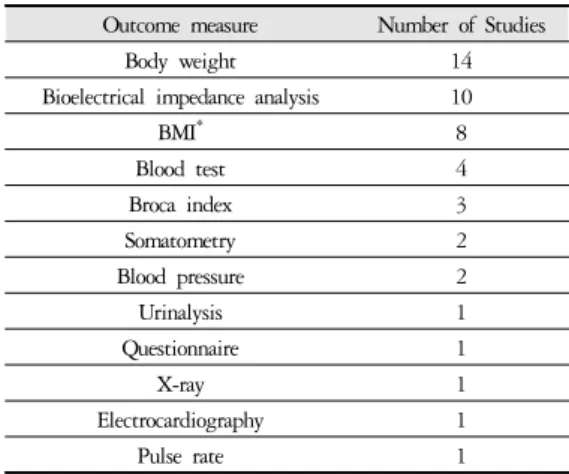
6. 연구에 사용된 평가도구에 대한 분석 14 편의 연구에서 체중이 사용되었다. 연구 중 10편 에서 체성분분석이 사용되어 체지방량, 체지방률, 신 장, 근육량 등이 측정되었다. Body Mass Index(BMI) 수치는 8편에서, 비만도는 3편에서 활용되었다. 4편의 연구에서는 혈액검사를 시행하여 콜레스테롤, 간 수 치 등을 분석하였고 2편에서는 피하지방 두께와 신체 부위별 둘레 등의 신체 계측을 시행하였으며, 1편에서 는 혈압과 맥박수 측정이, 1편에서는 소변검사, 설문 검사가, 다른 1편에서는 X-ray, 심전도검사가 시행되 었다(Table 3).
Outcome measure Number of Studies
Body weight 14
Bioelectrical impedance analysis 10
BMI
*8
Blood test 4
Broca index 3
Somatometry 2
Blood pressure 2
Urinalysis 1
Questionnaire 1
X-ray 1
Electrocardiography 1
Pulse rate 1
Table 3. Outcome Measurement Used in Studies about Taeeumin Obesity
*
BMI = Body Mass Index
Ta bl e 4. Cha rac te rist ic s of Publ is hed St ud ie s o f T reat m ent of T aeeu m in Obesi ty 1
stAu th or (y ea r) Nu m b er o f T aee u m in P ati en ts C ri teria o f s asan g co nsti tu tio n di agno si s Inter ven ti on O u tcom e M easu re m en ts H erb al M ed ici ne Et c. Ki m (1996 )
7292 Go ’s Qu es ti on na ir e
12, D iag ram m in g c ateg orizatio n T ae eu m jo w i- ta ng A ur ic ul ar A cupun ct u re B od y w ei ght B lo od test So ng (1998)
1165 C ons ul t t o D ept . of Sa sa ng C on st ituti on al M edi ci ne T aee u m jo w i-ta ng C he ongp ye sa ga n- ta ng A ur ic ul ar A cupun ct u re A cupun ct u re C uppi ng D iet th era p y E xerci se th erap y
B od y w ei ght B io el ectri cal i m pe da nce a nal ysi s B lo od test Hw an g (1998)
1414 Q SC C I I
*-
D iet th era p y P h ys ical th erap y C uppi ng El ec tr oa cupunc tu re B od y w ei ght BM I
‡B io el ectri cal i m pe da nce a nal ysi s Ja ng (2001)
1533 Q SC C
†T ae eu m jo w i- ta ng El ec tr oa cupunc tu re
B od y w ei ght BM I
‡B io el ectri cal i m pe da nce a nal ysi s B ro ca i nd ex Ki m (2004)
16102 Q SC C I I
*T aee u m jo w i-ta ng C h ow is eungc he ng- ta ng Y eo lda ha ns o- ta ng C he ongp ye sa ga n- ta ng
- B od y w ei ght B io el ectri cal i m pe da nce a nal ysi s Se o (2005)
1715 Q SC C I I
*C h ow is eungc he ng- ta ng El ec tr oa cupunc tu re D iet th era p y E xerci se th erap y
B od y w ei ght BM I
‡B io el ectri cal i m pe da nce a nal ysi s B lo od test So ma to me tr y B lo od p ressu re& pu lse r ate Ry u (2005 )
8712 Q SC C I I
*C heg am ui yi in -tan g El ec tr oa cupunc tu re D iet th era p y E xerci se th erap y
B od y w ei ght BM I
‡B io el ectri cal i m pe da nce a nal ysi s Yo o (2005)
1814 Q SC C I I
*- C on sti tu ti on al ed ucati on D iet th era p y E xerci se th erap y
B od y w ei ght BM I
‡B io el ectri cal i m pe da nce a nal ysi s B lo od test So ma to me tr y B ro ca i nd ex
*
Q SC C II = Q u es ti on n ai re o f S asan g C on st itu ti on C lass if icati on I I
†Q SC C = Q u es tio n na ire o f S as an g C on stitu tio n C la ss ific at io n
‡B M I = B ody M as s I nde x 1
stAu th or (y ea r) Nu m b er o f T aee u m in P ati en ts C ri teria o f s asan g co nsti tu tio n di agno si s Inter ven ti on O u tcom e M easu re m en ts H erb al M ed ici ne Et c. Lee (2005)
1914 D iag nos e ba se on D ongu is us eb ow on, O ne o f pati ent’ s p ar ent i s taeeum in T aeu m bi m an -tan g -
B od y w ei ght BM I
‡B io el ectri cal i m pe da nce a nal ysi s B lo od test So ma to me tr y B ro ca i nd ex Lee (2011)
2027 Q SC C
†U nsp ec ifie d D ie t th er ap y B od y w ei ght BM I
‡B io el ectri cal i m pe da nce a nal ysi s Ki m (2011)
2125 D iag nos e ba se on D ongui su se bow on , QS C C I I
*T aee u m jo w i-ta ng -
B od y w ei ght BM I
‡B io el ectri cal i m pe da nce a nal ysi s B lo od test Q u es ti onna ir e B lo od p ressu re, Ur in al ys is Pa rk (2011)
224 D iag nos e ba se on D ongui su se bow on QS C C I I
*T aee u m jo w i-ta ng C he ongh yul ga ngki -t ang C he ongp ye sa ga n- ta ng Se unggi jo w i- ta ng
D iet th era p y E xerci se th erap y B od y w ei ght Li m (2012)
2323 Z em a21 T ae eu m jo w i- ta ng A cupun ct u re P h ys ical th erap y C uppi ng D iet th era p y E xerci se th erap y
B od y w ei ght B io el ectri cal i m pe da nce a nal ysi s Ha n (2014)
2419 P u ls e d ia gn os is G al ge un so ga n -t ang El ec tr oa cupunc tu re D iet th era p y E xerci se th erap y
B od y w ei ght B io el ectri cal i m pe da nce a nal ysi s
Ta bl e 5. Re sul ts of St udi es of T re at m ent of T ae eum in O besi ty 1
stA u th or ( year) Re su lt s Ki m (1996)
770 .2 % o f o bese p ati en ts w ere ta ee u m in . B ody w ei ght w as de cr ea se d 2. 08± 2. 88kg a ft er 16 w ee ks of t he t re at m ent . T aeu m in p atien ts s ho w ed m ore w eig ht lo ss. In b loo d test, p ati en ts sh ow ed el ev ate d f ree f atty aci d a nd tri g ly ceri de. Song (1998)
11T here w as n o si gn if ic an t c h an ge i n b od y w ei gh t, to tal ch ol estero l, tri g ly ceri de a nd L D L -ch ol esterol . T here w as si gn if ica n t d ecrease i n p erce n t of b od y f at. T here w as si gn if ica n t i ncrease i n b asal m etab ol ism rate a nd l ean b od y m ass. Hw an g (1998)
14T he r educ ti on r at e of w ei ght i n So ya ng in w as hi ghe r t ha n t ha t i n T ae eu m in . O n t h e r ef ee d ing da ys , w ei gh t o f T ae eu m in r educ ed bu t th at o f So ya ng in i ncreased . A fter fastin g t h er ap y, B M I re du ce d to n orm al ra ng e. R educ ti on of B M I i n So ya ng in w as hi ghe r t ha n t ha t of T ae eu m in . T he r educ ti on of f at pe rc en ta ge i n So ya ng in w as hi ghe r t ha n t ha t i n T ae eu m in . T he i ncre m en t of f at-f ree p ercen ta ge i n So ya ng in w as h ig he r th an th at i n T aeeu m in . Ja ng (2001)
15Fr om 70 .4 ± 11 .4 t o 64. 9+ -8 .7kg, m ea n b ody w ei ght w as s ign if ic ant ly de cr ea se d . Fr om 27 .2 ± 3 .2 t o 24. 6+ -2 .7 , m ea n b ody B M I w as s igni fi ca n tl y de cr ea se d. Fr om 116 .7 ± 13 .9 t o 104. 4 12. 1, m ea n obe si ty de gr ee w as s ign if ic ant ly de cr ea se d . Fr om 32 .1 ± 6 .8 t o 27. 4± 7. 5, pe rc en t body f at w as s igni fi ca n tl y de cr ea se d. Fr om 0 .9 0± 0 .0 6 to 0 .8 6± 0. 06 , w aist-h ip rat io w as sig ni fi ca n tl y d ecre ased . Ki m (2004)
16T he r educ ti on r at e of w ei ght i n T ae eu m in w as hi ghe r t ha n t ha t i n S oya ngi n a nd Soe u m in. A s tr eatm en t p erio d s te nd ed t o in cre ase, T ae u m in an d S oe u m in p atien ts s ho w ed a larg e d eclin e o f b od y fat, w here as S oeu m in p atie nts s ho w ed t he o pp osite re actio n. T he de cr ea se of w ei ght hi p r at io w as l ed by T ae um in w it h 0. 03 a nd t he n c am e Soe um in a nd S oya ngi n w it h a 0 .02 r at io. A s tr eatm en t w as t ak en lo ng er T aeu m in p atie n ts sh ow ed g reater p ro gress i n d ecreasi ng th ei r w ei gh t h ip rati os . Se o (2005)
17In 20 P at ie nt s bod y w ei ght de cr ea se d 4. 15± 2. 38kg. B ody w ei ght de cr ea se d 4. 47± 2. 51kg i n T ae eu m in , 3 .20± 0kg i n Soe um in , a nd 2 .50± 1 .93kg i n Soya ngi n . B ody f at w as de cr ea se d 3. 16± 1. 25% . B U N , C reati ni ne, G O T a nd G P T w ere i ncreased w ith in n orm al ran ge . T her e w ere a dv ers e ev en t o f au to no m ic h yp eractiv it y( 11 p atien ts), g astro in te stin al sy m p to m s(7 p atien ts) a nd o th ers(3 p atien ts). Ry u (2005)
8T he g ro up o f T aeeu m w as m ore o bese a nd less r ed uc ed in b od y fat m ass a nd % b od y fat in to ol s o f p erc en t rat es o f t h e c han ge s t han o th er ty pe o f S asa ng c on stitu tio n . Yo o (2005)
18T he a n th ro p om etri c m easu rem en t of su b sc ap ul ar sk in fo ld th ic kn ess w as re du ce d af ter 4 w eek s o f th e co n sti tu ti on -b ase d e du cati on pr og ra m . T he bod y c om po si ti on i ndi ca te s r educ ti on i n de gr ee o f obe si ty, pe rc en t body fa t, a nd f at d is tr ibut io n. T he re w as i nc re as e i n he ig ht , to ta l b od y w ater, so ft le an m ass, a nd le an b od y m ass. Fo r b io ch em ic al in d ic ates, H D L -ch ol est ero l w as in cre ased sig ni fi ca n tl y. A ST a nd A LT d ecr ease d . T he re w as a s ign if ic ant r edu ct io n i n B M I a nd r el at iv e body w ei gh t.
1
stA u th or ( year) Re su lt s Le e (2005)
19T he s ho rt term effects o f T aee u m bi m an -tan g o n o bese c h ild re n is w eig h t l oss. It d id n ot ca u se an y sig ni fica n t c h an ge s in th e s ub ject 's liv er, h earts, a nd k id ne ys , a nd clin ica lly d an ge ro us sid e effects o r w ith d raw al sy m p tom s. Le e (2011)
20W eig h t, b od y fat, b od y fat rat e, B M I w er e d ecr ease d sig ni fica n tly . T he re w as sta ti stic al ly s ig n ifi ca nt d iffe re nc e in th e lo ss o f w eig h t, B M I b et w ee n T ae eu m in a nd o th ers. D ecrem en t o f b od y fat r ate is n ot st ati st ic all y sig ni fica n t b etw ee n T ae eu m in a nd o th ers. Ki m (2011)
21W eig h t, b od y fat, b od y fat rat e, B M I, a nd W aist- H ip R atio w ere d ecreas ed sig ni fi ca n tl y. Fr om 169 .00± 19 .95 t o 160. 08± 22. 52m g/ dL , t ot al c ho le st er ol l eve l s igni fi ca n tl y de cr ea se d( p< 0 .0 5 ). SG O T s ign if ic ant ly de cr ea se d . Su pe ro xi de d ism ut ase, cata lase, g lu tath io n p ero xi de si gn if ica n tl y i ncreased . 8- hydr ox y- 2' -d eo xy gua n os inc e a nd m al ondi al de hyde s ign if ic ant ly de cr ea se d . Pa rk (2011)
22C as e 1 sh ow ed a de cr ea se of 12. 7 kg i n 84 da ys , C as e 2 a de cr ea se of 8. 9 kg i n 39 da ys , C as e 3 a de cr ea se of 33 kg in 250 da ys , a nd C as e 4 a de cr ea se of 29. 3 kg i n 155 da ys . Li m (2012)
23W ei gh t, body f at v ol u m e, m us cl e v ol u m e, a bdo m en f at r at e w er e de cr ea se d i n a ll gr oup s. T he re w as no s igni fi ca n t di ff er en ce be tw ee n T ae eu m in a nd ot he rs . Ha n (2014)
24B ody w ei ght w as de cr ea se d 4. 13± 1. 28kg. Ske le ta l m u sc le m as s w as de cr ea se d 1. 26± 1. 12kg. B ody f at m as s w as de cr ea se d 2. 66± 1. 22kg. P er ce n t b ody f at r educ ti on w as 2± 1. 82% . A bdo m ina l c ir cu m fe re nc e r educ ti on w as 3 .86± 1 .36c m . B U N : bl oo d ur ea ni tr oge n, G O T : gl ut am ic o xa la ce ti c t ra n sa m in as e, G P T : g lut am ic py ru va te t ra n sa m in as e, H D L -c ho le st er ol : hi gh de n si ty l ipopr ot ei n c h ol es te ro l, LD L -c ho le st er ol : l ow de n sity lip op ro tein ch ol est ero l, A ST : asp artat e am in otra n sf er ase , A LT : a la n in e a m in ot ra ns fe ra se , S G O T : s er u m g lu ta m ic -o xa lo aceti c tran sam in aes
Ⅳ. 考察
항비만 약물에 관한 연구는 신진대사 촉진, 식욕 억제, 세로토닌계 자극, 지방 소화의 지연 등의 기전 및
25, 제지방 체중이나 수분이 아닌 지방의 감소로 체 중 감소가 일어남을 증명하고 치료하고자 하는 연구 들이 진행되고 있다
26. 그러나 비만의 약물치료는 많 은 약물들이 시도되었으나 대부분 효과가 없거나 부 작용으로 인하여 사용이 중단되었다
27. 비교적 안전한 약제로 알려졌던 sibutramine도 심혈관질환 고위험군 에서 사용하는 경우 심혈관계 부작용이 높아지는 것 으로 나타나 2010년에 사용이 중지되었다
28.
한의학에서는 비만이 肥, 肥胖, 肥人, 肉人, 肥貴 人 등으로 표현됐다. 한의학 문헌과 근래의 학설을 검토해보면, 비만의 원인은 稟賦, 膏粱厚甘味의 과 식, 氣虛, 水濕, 濕痰, 內傷七情 등으로 요약될 수 있으며, 肺의 宣發肅降, 脾의 運化輸布 및 腎의 蒸發氣化와 같은 臟腑機能의 失調와 밀접한 관련 이 있는 것을 알 수 있다
29.
비만의 치료와 관련하여 四象體質 중 太陰人의 藥材와 處方이 많이 이용되고 있다
29. 1990 년도에서 부터 1999년까지 발표된 한국에서 비만에 쓰인 한약 에 관한 논문 24편 중 사상처방이 가장 많이 쓰인 것으 로 나타났고
30, 또한 황
9등의 2000년 이후 비만 치료에 사용된 처방 및 본초에 대한 문헌연구에서도 국내 논 문에서 가장 빈용되는 처방은 四象處方이었으며, 이 들 중 태음인 처방이 가장 많았다.
본 분석에서 선별된 연구들에서는 태음인을 확정 할 때 QSCCII, QSCC, 東醫壽世保元에 의거한 진단 방법, 사상체질과 의뢰, 고
12의 설문지, 제마21
23, 절진 등 다양한 진단방법이 사용되었다. 이 중 고의 설문지 는 QSCC의 원형이 된 설문지로 QSCC와 연속성을 가 진다고 볼 수 있다. 제마21이나 절진을 사용하여 진단 하는 방법은 기존 사상체질 진단의 방법에 해당하지 않는다. QSCCII와 東醫壽世保元에 따라 체형기상, 용모사기, 성정, 소증 등을 확인하여 진단하는 방법은 2015년 발표된 사상체질병증 임상진료지침의 권고기
준에 포함되어있는 내용으로
31, 추가적인 임상연구들 이 시행된다면 이에 해당하는 내용을 바탕으로 태음 인의 진단에 있어서 일정 수준 이상의 통일성을 확보 하는 것이 필요할 것으로 보인다.
본 분석에서 선별된 총 14편의 논문에서 중 가장 많은 빈도로 사용된 약물은 太陰調胃湯이었다. 太 陰調胃湯은 肝大肺小한 臟腑形局을 가진 태음인 의 질병 중 胃脘受寒表寒病에 쓰이는 처방으로 薏 苡仁, 乾栗, 蘿葍子, 五味子, 麥門冬, 石菖蒲, 桔 梗, 麻黃으로 구성된다
11. 기존 황
9등의 2000년 이후 비만 치료에 사용되는 본초에 대한 문헌연구에서 5회 이상 사용된 한약물을 빈도별로 제시하였을 때 薏苡 仁, 當歸, 甘草, 蘿葍子, 川芎, 桔梗, 麻黃 순으로 나타났으며, 이중 薏苡仁, 蘿葍子, 桔梗, 麻黃 4개 의 약물이 太陰調胃湯과 겹치는 것을 확인할 수 있 다. 東武遺稿에 薏苡仁은 “開肺之胃氣而 消食 進食”, 桔梗은 “壯肺而 有外攘之力”, 麻黃은 “解 肺之表邪”라 하였고, 蘿葍子는 下氣定喘 消食化 痰 하는 약으로 모두 약화된 肺-胃脘의 呼散之力을 보강, 소통시켜주는 태음인의 保命之主를 돕는 약물
이다
32,33. 太陰調胃湯의 임상적 효과와 안정성에 관
해서도 연구가 이루어진 바 있는데, 무작위배정, 이중 맹검, 위약-대조군 임상시험에서 12주간 투약하여 체 중, 허리둘레, Waist-Hip Ratio, 총콜레스테롤, LDL 콜 레스테롤 감소와 식이장애 검사에서의 변화를 나타내 는 효과를 보였으며 심각한 이상 반응을 나타내지 않 았고 간 기능, 신장기능의 지표검사에서 유의한 변화 가 없었다
34. 사용된 9종의 한약 중 기존 사상체질에 따라 사용된 처방인 太陰調胃湯, 調胃升淸湯, 熱 多寒少湯, 淸肺瀉肝湯, 淸血降氣湯, 承氣調胃 湯에 공통적으로 사용된 약재는 蘿葍子, 桔梗으로 모두 태음인의 呼散之力을 돕는 역할을 하는 것으로 볼 수 있다.
처방별로 사상변증을 분류하자면 胃脘受寒表寒
病에 해당하는 처방은 太陰調胃湯, 調胃升淸湯이
사용되었으며 肝受熱裏熱病에 해당하는 처방으로
는 熱多寒少湯, 淸肺瀉肝湯, 淸血降氣湯이 사용
되었고, 承氣調胃湯은 表裏兼病에 사용되었다
11,16
. 體減薏苡仁湯
8, 태음비만탕
19, 葛根疎肝湯
24은 비만증 치료를 위해 만들어진 처방으로 기존 사상 처방이 아니며 사상체질병증의 변증에 따라 사용되지 않았다. 처방의 선택에 있어서 다수의 연구에서는 체 질진단 후 어떤 태음인 체질병증으로 진단하여 처방 하였는지에 대한 설명이 없었다. 비만치료를 위하여 내원하는 경우 별도의 現證을 호소하지 않고 체중과 체지방 감량을 위하여 내원하기 때문일 것으로 보인 다. 황
14등의 연구에서는 환자의 증상에 따라 寒太陰 人과 熱太陰人으로 분류하여 처방을 각기 太陰調 胃湯과 淸肺瀉肝湯으로 나누어 투약하였고, 박
22등의 증례보고에서는 환자마다 사상변증을 시행하여 太陰人 胃脘受寒表寒病으로 진단한 2명에게는 太陰調胃湯을, 太陰人 肝受熱裏熱病으로 진단 한 1명에게는 淸血降氣湯, 淸肺瀉肝湯을, 太陰人 胃脘寒과 肝熱을 겸한 表裏兼病으로 진단한 1명 에게는 承氣調胃湯을 처방하여 모두 유효한 체중감 량을 이루었다. 김
16의 연구에서는 태음인 환자를 表 證과 裏證으로 분류하여 처방을 달리하여 유효한 체 중감량을 이루었다.
선별된 14건의 논문에서 황
14, 유
18의 연구를 제외하 고 모두 비만의 치료를 위한 한약이 투약되었으며, 그 외의 중재로는 식이지도가 10건, 운동지도가 9건으 로 가장 많이 사용되었다. 비만의 원인이 잘못된 식습 관이나 활동 부족이라는 가정하에 비만의 유발요인을 바람직한 행동으로 변화하도록 수정해나가는 치료법 인 행동수정과 운동과 식이조절을 함께하는 것이 더 효과적이라는 연구결과와 부합한다
35. 전침은 5건의 연구에서 사용되었는데, 전류가 흐르면 열의 발생을 통해 중성지방을 글리세린과 지방산으로 가수분해하 여 제거하는 원리로 시행되었다
36. 일부 연구는 내원 하여 지속적인 치료를 받았음에도 투약 이외의 치료 에 대한 언급이 되어있지 않아 기록이 되지 않았을 가능성이 있을 것으로 추정된다.
본 분석에서 선별한 연구들에서 치료 효과를 평가 하기 위하여 사용된 수단 중 가장 많이 사용된 것은
체중측정으로 14건 모두에서 사용되었다. 그 뒤로는 12건의 논문에서 사용된 체성분검사, 그다음으로는 BMI가 많이 활용되었다. BMI는 체중(Kg)을 키(m)의 제곱 값으로 나눈 수치로 아시아인에서는 BMI를 23 이하로 유지할 것을 권장하고 있다
37. 기존 연구에서 BMI 수치가 높을수록 죽상동맥경화성 심질환 또는 암으로 인한 사망률이 높아진다는 보고가 있다
38. 또 한 기존의 여러 연구결과에서 태음인에서 타 체질에 비하여 높은 BMI 수치가 나타나는 경향이 있음이 밝 혀진 바 있다
17. 또한 체성분분석에 따른 체지방량과 체지방률의 측정은 단순한 체중의 감량뿐만이 아닌 건강의 측면에서 감량이 적절하게 이루어졌는지를 확 인하는 의미가 있다. 체성분검사를 통하여 측정 가능 한 지표 중 체지방량이나 체지방율의 비교는 체성분 검사를 활용한 모든 논문에서 사용되었다.
선별된 연구 중 타 체질군과 함께 진행된 연구에서 김
7, 김
16, 서
17, 이
20의 연구에서는 타 체질군에 비하여 태음인의 체중 감소가 가장 현저하게 보였으며, 류
8, 황
14
, 임
23의 연구에서는 태음인이 타 체질군에 비하여 적은 체중 감소를 보였으며, 김
16의 연구에서는 체질 별로 체중 감소의 차이가 유의하게 나타나지 않았다.
김
7, 서
17, 임
23의 연구에서 太陰調胃湯을 투약하였 고, 김
16의 연구에서는 환자별로 변증을 통하여 처방 을 투약하여 체질별 투약한 처방이 달랐으며, 류
8의 연구에서는 體減薏苡仁湯이 투여되었다. 김
7, 서
17, 임
23의 연구에서는 太陰調胃湯을 투약하였으나 체 질진단의 방법으로 김
7, 서
17의 연구에서는 가이드라 인
31에 포함된 방법으로 체질진단이 시행되었고 태음 인이 더 많은 체중감소를 보였으나 임
23의 연구에서는 제마21을 활용하여 진단하였고 태음인이 더 적은 체 중감소를 보였다. 이를 통하여 가이드라인에 따라 태 음인으로 진단된 비만 환자에 태음인 처방인 태음조 위탕을 투약하는 경우 타 체질에 비하여 효과적인 체 중 감소가 이루어졌으나 해당 방식에 포함되지 않은 진단법으로 진단한 환자에 투약한 경우 유사한 결과 가 나오지 않은 것을 확인하였다.
본 분석의 한계점으로는 첫 번째로는 태음인을 대
상으로 한 임상 논문만을 대상으로 하였으나 태음인 의 진단에 있어서 과거 논문들의 진단방법이 통일되 지 않았다는 점이고, 두 번째로는 환자에게 투약한 한약의 종류나 몇 명에게 어떤 약을 투약했는지에 대 한 세부적인 내용이 빠진 논문들이 포함되어있다는 점이다. 이는 분석에 있어서 한계점이 될 수 있지만, 치료 효과가 있었다면 대략적으로라도 어떤 처방이 사용되었는지 분석에 포함하는 것이 방향성을 확인하 는 데 도움이 될 것으로 보았으며, 태음인의 비만에 대한 임상 논문이 많지 않아 최대한 많은 논문을 포함 하여 분석하는 것이 추후 연구에 도움이 될 것으로 보았다. 세 번째로는 비만 치료의 특성상 식이조절과 운동요법이 치료결과에 많은 영향을 미치기 때문에 투약을 비롯한 한방치료만의 결과를 평가하기 어려운 부분이다. 네 번째로는 체질진단이 시행된 연구의 수 가 적다는 점으로, 기존 연구들 중 태음인 처방을 비만 에 활용하는 임상연구에서도 태음인의 진단을 시행하 지 않고 처방을 적용하는 경우가 많아 태음인 비만의 치료에 대한 연구가 부족한 부분이다. 기존의 문헌연 구에서 10건의 태음인 처방을 이용한 비만 임상연구 중 태음인을 대상으로 하는 연구는 4건에 불과하였다
10
. 또한, 가장 최근의 태음인을 대상으로 한 비만의 치료에 관한 연구가 2014년에 발표되어 태음인 체질 병증 임상진료지침이 2015년 발표된 후 해당 내용이 적용된 최신 연구가 아직 이루어지지 않았다. 추후 태음인을 적절하게 진단하고 사상체질변증을 통하여 치료하는 추가적인 증례와 연구가 필요할 것으로 보 인다.
Ⅴ. 結論
태음인의 비만에 대한 임상 논문을 분석, 정리하여 향후 연구에 도움이 될 수 있는 기초자료를 마련하고 자 총 14편의 논문을 분석하여 다음과 같은 결론을 얻었다.
1. 총 14편의 연구 중 1건이 증례보고였으며, 7건이 타 체질군과 함께 진행된 연구였으며 나머지 6건 은 태음인만을 대상으로 한 연구였다. 총 태음인 환자 수는 1359명이었다.
2. 총 9종의 처방이 원래의 처방 또는 가감방의 형 식으로 이용되었다. 태음조위탕이 가장 많은 논 문에서 사용되었다.
3. 한약 투여 외의 중재로는 식이요법이 가장 많이 사용되었으며 운동요법, 전침이 그에 이어 활용 되었다.
4. 평가방법으로 가장 많이 사용된 것은 체중이었 으며, 체성분분석과 BMI가 그 뒤를 이었다.
Ⅵ. References