ISSN 2234-3806 • eISSN 2234-3814
http://dx.doi.org/10.3343/alm.2016.36.3.281 www.annlabmed.org 281
Ann Lab Med 2016;36:281-283
http://dx.doi.org/10.3343/alm.2016.36.3.281
Letter to the Editor
Clinical Microbiology
Two Cases of Clostridium tertium Infection and
Successful Identification of the Organism by Matrix- Assisted Laser Desorption-Ionization Time-of-Flight Mass Spectrometry Analysis
Yumiko Joichi, A.D.1,2, Shizuo Kayama, D.D.S.1, Ikue Hayashi, Ph.D.1,3, Makoto Onodera, B.S.E.1,2, Maki Furushimo, A.D.2, Yumiko Koba, M.S.1,2, Michiya Yokozaki, M.D.1,4, Hiroki Ohge, M.D.1,5, and Motoyuki Sugai, D.D.S.1
Project Research Center for Nosocomial Infectious Diseases1, Hiroshima University; Section of Infection Diseases2, Laboratory Division of Clinical Support, Hiroshima University Hospital; Research Facility3, Hiroshima University Faculty of Dentistry; Division of Laboratory Medicine4, Hiroshima University Hospital;
Department of Infectious Diseases5, Hiroshima University Hospital, Hiroshima, Japan
Dear Editor,
Clostridium tertium is an endospore-forming anaerobic gram–
positive bacillus. This organism is aerotolerant and is easily de- colorized in Gram-stained smears, often leading to mistaken identification as a gram-negative organism. The major risk fac- tors for C. tertium bacteremia are hematological disease, intesti- nal mucosal injury, and history of exposure to β-lactam antibiot- ics (such as the third and fourth generation cephalosporins) where fever and leukopenia are often seen in patients [1]. We report two cases of C. tertium isolated from blood culture, one of which was successfully identified by using matrix-assisted laser desorption-ionization time-of-flight mass spectrometry (MALDI- TOF MS) analysis and subsequent 16S ribosomal DNA se- quencing.
Case 1. A man in his 50s collapsed at home, became hypo- thermic with shock, and was hospitalized. On day 2 after hospi- talization, two sets of blood cultures were taken, and antimicro- bial treatment began with tazobactam/piperacillin (TAZ/PIPC) (2.25g ×4/day). On day 3, he died and an aerobic isolate from
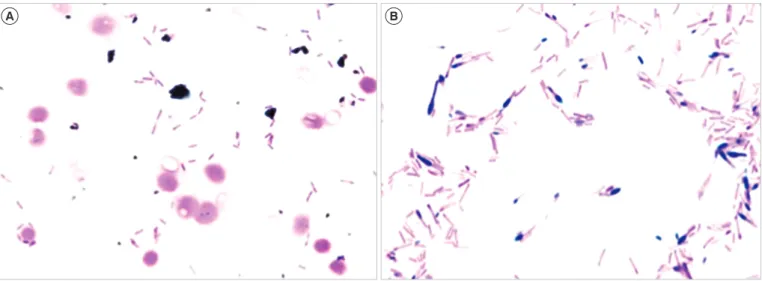
the blood cultures became positive (BacT/Alert3D; bioMérieux, Tokyo, Japan) where gram-negative bacilli were recovered and sub-cultured aerobically at 35˚C for 24 hr (Fig. 1A). Shiny colo- nies (about 1 mm in diameter) grew on blood agar plates, but not on BTB agar plates. Further, anaerobical culture of blood on Brucella HK agar plates at 35˚C for 48 hr yielded gray colonies (about 3 mm in diameter). Gram stain showed spore-forming gram-variable bacilli (Fig. 1B). We therefore suspected Clostrid- ium species. The organism was identified as C. tertium on the basis of the results of an automated identification apparatus (VI- TEK2 Compact; Sysmex bioMérieux), an identification kit (Rap ID ANAII; Amuko, Tokyo, Japan), and negative catalase test re- sults. Later examination by MALDI-TOF MS-Biotyper (Bruker Daltonics, Yokohama, Japan) confirmed the organism as C. ter- tium with an identification log score 2.030 (2.000-2.299: secure genus identification and probable species identification). Antibi- otic susceptibility showed that the minimum inhibitory concen- tration (MIC) value against C. tertium was 8 μg/mL for TAZ/PIPC, 16 μg/mL for cefotaxime (CTX), and 1 μg/mL for metronidazole.
Received: September 15, 2015 Revision received: January 3, 2016 Accepted: January 29, 2016 Corresponding author: Yumiko Joichi
1-2-3 Kasumi, Minami-ku, Hiroshimashi, Hiroshima 734-8551, Japan Tel: +81-82-257-5546, Fax: +81-82-257-5546
E-mail: [email protected]
© The Korean Society for Laboratory Medicine.
This is an Open Access article distributed under the terms of the Creative Commons Attribution Non-Commercial License (http://creativecommons.org/licenses/by-nc/3.0) which permits unrestricted non-commercial use, distribution, and reproduction in any medium, provided the original work is properly cited.
Joichi Y, et al.
Identification of Clostridium tertium by TOF-MS analysis
282 www.annlabmed.org http://dx.doi.org/10.3343/alm.2016.36.3.281 Case 2. A man in his 60s had been diagnosed as having
acute myelogenous leukemia and hospitalized for chemother- apy. Two days after beginning chemotherapy, he presented with fever (38.0˚C) and his leukocyte count declined to 1.3×10⁹/L.
We began an antimicrobial treatment with cefepime (CFPM) (1g ×4/day) which proved ineffective. Three blood cultures gave negative results. On day 14 after the start of the chemotherapy, two sets of blood cultures were taken; and the antimicrobial therapy was changed to meropenem (MEPM) (1g ×3/day). On day 16, one of the two sets of aerobic blood cultures grew Gram-variable bacilli similar to Case 1, leading us again to sus- pect a Clostridium species. Antibiotic susceptibility tests showed MICs for CTX at ≧32 μg/mL, ceftriaxone at ≧32 μg/mL, cefozo- pran at 16 μg/mL, MEPM at ≦0.25 μg/mL, and vancomycin (VCM) at ≦1 μg/mL. The antimicrobial treatment regimen was then supplemented with VCM (1g ×3/day). Blood was aerobi- cally cultured and colonies similar to Case 1 grew on blood, chocolate, and Brucella HK agar plates but not on BTB agar plates. VITEK2 compact and Rap ID ANA II analyses reported the presence of the test strain as C. clostridioforme; however, we doubted that report for several reasons. C. clostridioforme is anaerobic, so it can be mistaken for a gram-negative bacillus similar to C. tertium. Further, C. clostridioforme is usually sus- ceptible to β-lactam antibiotics. The clinical strain formed endo- spores in anaerobic culture while C. clostridioforme does not form endospores but rather a so-called ‘football-form’ in Gram stains [1].
Consequently, we performed further identification using MALDI-TOF MS-Biotyper (Bruker Daltonics). That analysis re-
ported the clinical strain as C. tertium with an identification log score of 2.030. Sequencing of the 16S rDNA gene showed com- plete identity to C. tertium. C. tertium was considered a patho- genic bacterium in the case because it had been isolated from blood culture and because of the neutropenia. C. tertium is re- sistant to the third and fourth generation cephalosporins and aminoglycosides, and VCM and/or imipenem are often used therapeutically to treat C. tertium infection [2, 3]. MEPM and VCM were administered for seven days and the patient survived.
Given the difficulties in differentiating between the several Clostridium species, our work underscores the necessity of us- ing a variety of techniques to assist clinical identification. Our study suggests identification of bacterial species by combining MALDI-TOF MS with 16S rRNA gene sequencing provides a re- liable means to obtain rapid identification of pathogens in the clinical setting, removing the ambiguity around poorly differen- tiable strains such as those of Clostridium species.
Authors’ Disclosures of Potential Conflicts of Interest
No potential conflicts of interest relevant to this article were re- ported.
Acknowledgments
The authors thank Jim Nelson for his editorial assistance. This study was supported by institutional grant for RCNID.
Fig. 1. Light microscope observation of Gram stain preparations. (A) Gram stain of aerobic blood cultures showed Gram-negative bacilli (×1,000). (B) Gram stain of colonies on Brucella HK agar plates showed an oval spore on the end of gram-variable bacilli (×1,000).
A B
Joichi Y, et al.
Identification of Clostridium tertium by TOF-MS analysis
http://dx.doi.org/10.3343/alm.2016.36.3.281 www.annlabmed.org 283
REFERENCES
1. Miller DL, Brazer S, Murdoch D, Reller LB, Corey GR. Significance of Clostridium tertium bacteremia in neutropenic and nonneutropenic pa- tients: review of 32 cases. Clin Infect Dis 2001;32:975-8.
2. Steyaert S, Peleman R, Vaneechoutte M, De Baere T, Claeys G, Ver- schraegen G. Septicemia in neutropenic patients infected with Clostridi- um tertium resistant to cefepime and other expanded-spectrum cepha- losporins. J Clin Microbiol 1999;37:3778-9.
3. Speirs G, Warren RE, Rampling A. Clostridium tertium septicemia in patients with neutropenia. J Infect Dis 1988;158:1336-40.