J Korean Surg Soc 2013;84:261-266 http://dx.doi.org/10.4174/jkss.2013.84.5.261
ORIGINAL ARTICLE
JKSS JKSS JKSS
Journal of the Korean Surgical Society pISSN 2233-7903ㆍeISSN 2093-0488
Received January 14, 2013, Reviewed March 5, 2013, Accepted March 11, 2013 Correspondence to: Yoon-Jung Boo
Division of Pediatric Surgery, Department of Surgery, Korea University College of Medicine, 73 Inchon-ro, Seongbuk-gu, Seoul 136-705, Korea Tel: +82-2-920-6844, Fax: +82-2-928-1631, E-mail: [email protected]
cc Journal of the Korean Surgical Society is an Open Access Journal. All articles are distributed under the terms of the Creative Commons Attribution Non-Commercial License (http://creativecommons.org/licenses/by-nc/3.0/) which permits unrestricted non-commercial use, distribution, and reproduction in any medium, provided the original work is properly cited.
Analysis of the occupational stress of Korean surgeons:
a pilot study
Sang-Hee Kang, Yoon-Jung Boo, Ji-Sung Lee
1, Woong-Bae Ji, Byoung-Eun Yoo, Ji-Young You
Departments of Surgery and 1Medical Statistics, Korea University College of Medicine, Seoul, Korea
Purpose: Surgeons serve one of the most challenging and stressful professions. Ineffective control of occupational stress leads to burnout of the surgeon. The aim of this study was to obtain preliminary data on the sources and the degree of stress of sur- geons and to determine the feasibility of the survey. Methods: A total of 63 surgeons in our three affiliated hospitals were en- rolled in this study. Fifty-five questions were used to assess the demographics, characteristics and Korean occupational stress scale (KOSS), which were prepared and validated by the National Study for Development and Standardization of Occupational Stress. Results: Forty-seven of the 63 surgeons participated in this study (74.6%). The mean KOSS score of the survey was 50.9 ± 8.55, which was significantly higher than that of other professions (P < 0.01). Drinking and smoking habits were not related to the KOSS score. Doing exercise was related to a low KOSS score in terms of low KOSS total score (P < 0.01). Average duty hours (P < 0.01) and night duty days per week (P = 0.01) were strongly related to higher KOSS in the line- ar regression analysis. Conclusion: This is the first study to evaluate job stress of surgeons in Korea. This study showed that Korean Surgeons had higher occupational stress than other Korean professions. A larger study based on this pilot study will help generate objective data for occupational stress of Korean Surgeons by performing a survey of the members of the Korean Surgical Society.
Key Words: Occupational stress, Surgeon, Workload, Korean occupational stress scale (KOSS)
INTRODUCTION
The number of young doctors wanting to be surgeons has continuously decreased in Korea, and the declining rate has been getting progressively worse year by year. In addition, the number of dropouts during surgical training has also increased yearly [1]. There are many factors to consider with regard to this problem; some reasons are un- favorable working conditions and occupational stress of Korean surgeons. The decreasing number of surgeons has
caused a vicious circle, leading to a further increase in the existing surgeons’ workload and risk of errors.
Occupational stress is considered to result from a com- bination of high demands with low decision latitude in the workplace [2]. Harmful physical and emotional responses occur when the requirements of a job do not match the ca- pabilities, resources, or needs of the worker. Surgeon is a uniquely specialized occupation with heavy workload that comes with great responsibility with situations in- volving life and death. Surgeons are expected to cope with
unwritten norms such as coming in early and staying late, working nights and weekends, doing high volume of pro- cedures simultaneously, and keeping personal matters aside [3]. This unhealthy overwork has been frequently mistaken as a dedicated duty of a competent surgeon.
However, if the stress from this situation is not adequately controlled, it could lead to surgeons’ physical and mental distress as well as increased risk of medical errors [4].
Several studies have reported the adverse effect of occupa- tional stress of medical caregivers, including surgeons [4-6]. However, in Korea, no report has been conducted on surgeons’ occupational stress or burnout despite tremen- dous problems regarding surgeons’ high workload that have been building up over the years.
Therefore, it is imperative to adequately evaluate the level of occupational stress of Korean surgeons. Previously, a National Study for the Development and Standardization of Occupational Stress was conducted in order to develop and standardize the Korean occupational stress scale (KOSS) [7]. Using this validated scale and large scaled da- ta, we were able to effectively evaluate the KOSS and stress factors related to surgeons and compared the results with other specialized professions which were previously eval- uated in a large number of Korean workers.
Before conducting the survey, we investigated 63 sur- geons in our three affiliated hospitals as a pilot study. The aim of this study was to obtain preliminary data on the sources and the degree of stress of surgeons and to eval- uate the feasibility of the survey.
METHODS
Participants
The population consisted of general clinicians in the de- partment of surgery at three university affiliated hospitals. More specifically, the participants included pro- fessors (n = 25), fellows (n = 21) and surgical residents (n = 17). We obtained all their e-mail addresses which were permitted to be used for correspondence. Participation was elective and all responses were anonymous.
Data collection
Surgeons were surveyed by e-mail during the period of 10 days in April 2012. The cover letter stated the purpose of the survey which is better understanding the factors that contribute to occupational stress among surgeons. By fol- lowing the link in the e-mail, participants were able to ac- cess the survey website.
Fifty-five questions were used to assess the demo- graphics, characteristics and KOSS, which were prepared and validated by the National Study for Development and Standardization of Occupational Stress. A full version of the KOSS was used to measure occupational stress [7]. It consisted of the following eight subscales using factor analysis and validation process: physical environment (3 items), job demand (8 items), insufficient job control (5 items), interpersonal conflict (4 items), job insecurity (6 items), organizational system (7 items), lack of reward (6 items), and occupational climate (4 items) (Suppl. 1). The survey included 43 validated questions on a 4 point Likert scale [7] and 11 independent variable questions. The in- dependent variable questions were made up of individual characteristics: gender, position, subspecialty, average du- ty hours per week, average night duty days per week, and personal habits. At the end of the survey, participants could check their own stress score and then compare their score with the average scores of other specialized jobs.
Statistical analysis
The occupational stress scale was measured by KOSS.
Internal consistency was also calculated as Cronbach's alpha. The KOSS score are expressed as mean ± standard deviation. The baseline demographic and health behavior variables were compared using Student’s t-test or one-way variance of analysis for KOSS score. To evaluate the rela- tion between night duty-day or duty hours and KOSS score, simple linear regression was performed.
To compare surgeon’s stress scale with other scales of specialized jobs, we performed one sample t-test based on the researched report by the Korea Occupational Safety and Health Agency (2005) [8,9]. All analyses were per- formed using IBM SPSS ver. 20.0 (IBM Co., Armonk, NY, USA), and a P-value<0.05 was considered statistically significant.
Fig. 1. Comparison Korean occupational stress scale (KOSS) of surgeons with other professions: one asterisk indicates statistical significance (*P<0.05).
Fig. 2. Relation of Korean occupational stress scale with gender.
Characteristic No. (%) KOSS score, mean ± SD P-value Gender
Men Women
39 (82.9) 8 (17.1)
50.0 ± 8.0 55.3 ± 10.1
0.115
Position Professor Fellow Resident
17 (36.2) 15 (31.9) 15 (31.9)
48.3 ± 7.5 51.0 ± 8.6 53.8 ± 9.2
0.193
Subspecialty Pediatric surgery
Breast and endocrine surgery Gastroenterology surgery Hepatobiliary surgery Colorectal surgery Transplantation Unspecialized (including
resident)
1 (2.1) 9 (19.1)
4 (8.5) 7 (14.9) 10 (21.2) 2 (4.2) 14 (29.8)
59.9 49.3 ± 12.0
50.5 ± 8.7 48.8 ± 11.0
48.4 ± 5.2 47.8 ± 0.4 54.6 ± 6.8
0.486
Marital status Married Single
31 (66.0) 16 (34.0)
49.5 ± 9.2 53.7 ± 6.5
0.111
Drinking per week <1‒2 days >1‒2 days
34 (72.3) 13 (27.7)
51.3 ± 9.2 49.9 ± 6.7
0.639
Smoking habit Never been smoker Quit
Current smoker
20 (42.6) 9 (19.1) 18 (38.3)
51.9 ± 9.9 47.0 ± 9.3 51.7 ± 6.1
0.324
Exercise per week None
More than 1‒2 days
27 (57.4) 20 (42.6)
54.5 ± 7.3 46.0 ± 7.7
0.000
Hobby
Having hobby Having no hobby
28 (59.6) 19 (40.4)
49.5 ± 8.4 52.9 ± 8.6
0.181
KOSS, Korean occupational stress scale; SD, standard deviation.
Table 1. Personal characteristics
RESULTS
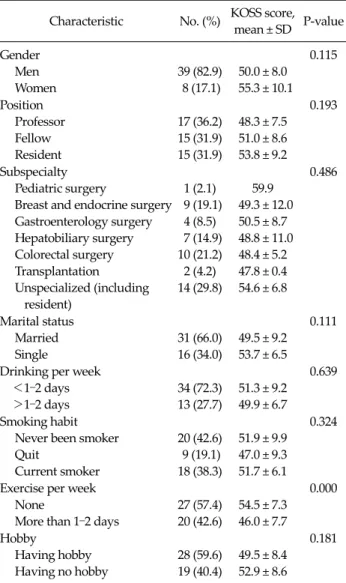
Among 63 surgeons who received the survey mail, 47 participants completed the questionnaire. The response rate was 74.6% (47/63). The mean overall KOSS of the par- ticipants was 50.9 ± 8.55, which is significantly higher than other professions (P<0.01). Among the eight subscale of occupational stress, surgeons showed higher scale than other specialized jobs in terms of physical environment, job demand, organizational system, and occupational cli- mate (Fig. 1).
Characteristics of the participants are summarized in Table 1. Women seemed to have higher KOSS in general,
but it did not show statistical significance (Fig. 2). With re- spect to career characteristics, residents showed higher overall KOSS, though not statistically significant. In detail, fellows than professors, residents than fellows had more stress about insufficient job control (P<0.01) (Fig. 3).
There was no difference in the analysis of KOSS by subspecialty.
Drinking and smoking habits were not significantly re- lated to occupational stress. However, surgeons with a hobby showed lower KOSS especially in lack of reward than those who did not have a hobby (P<0.01). Further- more, doing exercise showed a strong relation to KOSS subscales, most subscales were lower in the group who
Fig. 3. Relation of Korean occupational stress scale with position:
one asterisk indicates statistical significance (*P<0.05).
Fig. 4. Relation of Korean occupational stress scale with hobby (A) and exercise (B): one asterisk indicates statistical significance (*P<0.05).
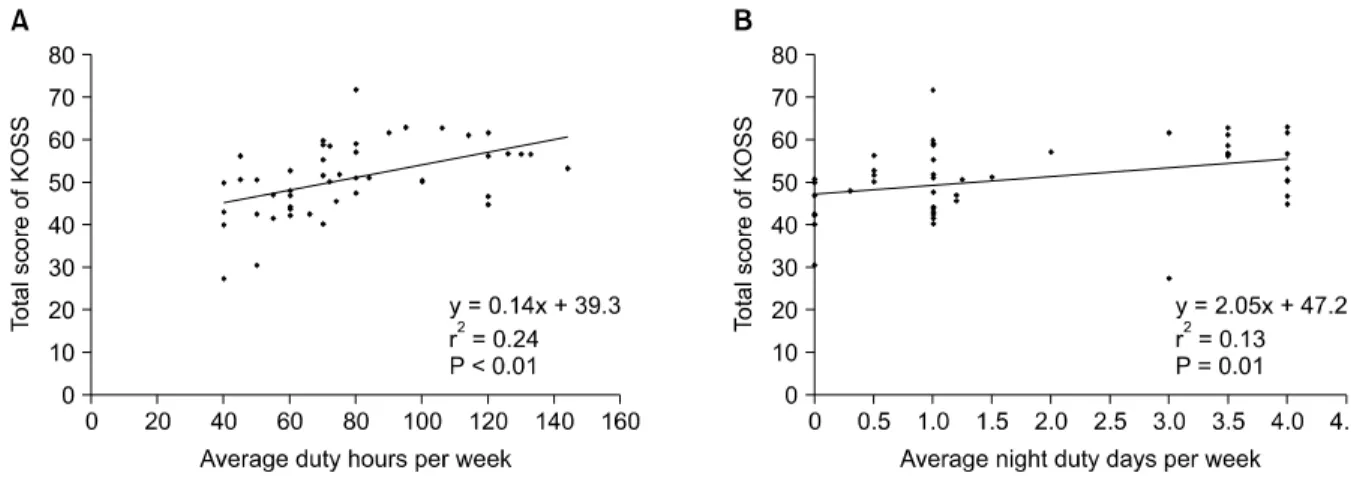
Fig. 5. Linear regression analysis of average duty hours (A) and duty days (B) per week. KOSS, Korean occupational stress scale.
didn’t regular exercise, except for two subscales; job in- security and interpersonal conflict (Fig. 4) (physical envi-
ronment, P<0.01; job demand, P = 0.02; insufficient job control, P<0.01; organized system, P = 0.02; lack of re- ward, P<0.01; occupational climate, P = 0.04).
Average duty hours (P<0.01) and night duty days per week (P<0.01) were strongly related to higher KOSS in the linear regression analysis (Fig. 5).
DISCUSSION
This study is the first report to analyze occupational stress of Korean surgeons. The aim of the study was to ob- tain preliminary data on the sources and the degree of stress of surgeons and to determine the feasibility of the survey before conducting a larger study. We used vali- dated questions developed by the National Study for
Development and Standardization of Occupational Stress (NSDSOS Project: 2002-2004) [8]. The questionnaire is called the KOSS which is considered to be unique and vali- dated barometer for stress in Korean employees [7]. In ad- dition, we added some questions that were related to pro- fessional characteristics and personal life style.
The mean KOSS score was significantly higher that of other specialized jobs. Among the eight subscales of occu- pational stress, surgeons showed a higher scale in physical environment, job demand, organizational system, and oc- cupational climate. This means that surgeons have rela- tively more stress due to difficult physical environment, higher job demand, organizational injustice and dis- comfort in their occupational climate. This result is not surprising considering the fact that surgeons usually work in the operating room and the emergency department for a long time where they frequently face challenges of life or death situations. Organization injustice and discomfort in the occupational climate may be caused by the deep-root- ed unfavorable medical circumstances for Korean sur- geons such as the apprentice like training system and un- fair treatment from their hospital due to low medical in- surance fee. Discomfort in the occupational climate seems to be a particular stress factor that is generally present in Korean occupational culture, which is caused by the hier- archical and authoritarian system, collectivism, and gen- der discrimination. We should keep an eye on this finding and try to control this factor because discomfort in the oc- cupational climate was found to be a powerful predictor of depression in Korean employees [9]. Based on the analysis according to the job position, residents had more stress re- garding insufficient job control than professors and fellows. That is probably due to shortage of surgical resi- dents, work overload and authoritarian atmosphere of the apprentice like training system of Korea.
Stress is a reaction to the demands being made on an individual. Occupational stress is comprised of complex conditions and is described as the sum of physical, mental and psychological responses to work that are transformed into emotional reactions [10]. Therefore, the individual’s ability to cope with such demands is also important factors in the experience of occupational stress. Surgeons usually do not have much time to manage their stress due to their
high workload, therefore, as a way of using spare time and dealing with stress, drinking and smoking are regarded as common habits of Korean surgeons. However, drinking and smoking habits were not related to low score in the KOSS. This intriguing result suggests that drinking and smoking could not be an effective strategy for controlling stress. As a self-care strategy to deal with occupational stress, having a hobby and doing exercise seem to be effective. Having a hobby and doing regular exercise were significantly related to the low KOSS in our study. Many previous reports also suggest the positive effect of exercise and using personal wellness promotion strategies [11-13].
On the basis of this preliminary result, we are planning to investigate on strategies to control one’s own physical, mental, psychological wellness and analyze the relation to the level of surgeon’s stress in a future study.
Our result also showed that increasing hours and in- creasing night on call duty are associated with higher KOSS score. This is consistent with other previous reports [14]. There is no clear cut of hours or night duty to prevent increasing distress, but surgeons who worked on call 2 nights or more per week, and those who worked 80 hours or more per week showed a greater incidence of distress in a previous study [3,15]. We should focus on these factors in a further study involving a larger population to ad- equately analyze the relationship between the level of stress and working hours of surgeons.
This pilot study has limitations such as the small sample size and selection bias. These preliminary results may not be conclusive but can give us many meaningful clues evi- denced by internal consistency. Consistent with our ex- pectation, surgeons have higher occupational stress than other professions. Long working hours, night duty, and in- dividual strategy in dealing with stress were found as fac- tors related to a higher stress scale. The next phase of this study is to expand the results to the member of the Korean Surgical Society and generate a much greater number of responses. A larger number of participants would allow us to evaluate the KOSS score and potential factors of stress more objectively.
CONFLICTS OF INTEREST
No potential conflict of interest relevant to this article- was reported.
ACKNOWLEDGEMENTS
This study was supported by the Korean Surgical Society.
SUPPLEMENTARY MATERIALS
Supplementary material can be found via http://the- surgery.or.kr/src/sm/jkss-84-261-s001.pdf.
REFERENCES
1. Kim SK. How to save surgical residents in crisis. J Korean Surg Soc 2009;76:207-14.
2. Rosenthal T, Alter A. Occupational stress and hypertension.
J Am Soc Hypertens 2012;6:2-22.
3. Balch CM, Freischlag JA, Shanafelt TD. Stress and burnout among surgeons: understanding and managing the syn- drome and avoiding the adverse consequences. Arch Surg 2009;144:371-6.
4. Shanafelt TD, Balch CM, Bechamps G, Russell T, Dyrbye L, Satele D, et al. Burnout and medical errors among American
surgeons. Ann Surg 2010;251:995-1000.
5. West CP, Tan AD, Habermann TM, Sloan JA, Shanafelt TD.
Association of resident fatigue and distress with perceived medical errors. JAMA 2009;302:1294-300.
6. West CP, Drefahl MM, Popkave C, Kolars JC. Internal med- icine resident self-report of factors associated with career decisions. J Gen Intern Med 2009;24:946-9.
7. Chang SJ, Koh SB, Kang D, Kim SA, Kang MG, Lee CG, et al. Developing an occupational stress scale for Korean employees. Korean J Occup Environ Med 2005;17:297-317.
8. Cho JJ. Study for evaluation of validity and relability to Korean occupational stress scale. Incheon: Occupational Safety and Health Research Institute, Korea Occupational Safety and Health Agency; 2005.
9. Cho JJ, Kim JY, Chang SJ, Fiedler N, Koh SB, Crabtree BF, et al. Occupational stress and depression in Korean employees.
Int Arch Occup Environ Health 2008;82:47-57.
10. LaPorta LD. Occupational stress in oral and maxillofacial surgeons: tendencies, traits, and triggers. Oral Maxillofac Surg Clin North Am 2010;22:495-502.
11. Shanafelt TD, Oreskovich MR, Dyrbye LN, Satele DV, Hanks JB, Sloan JA, et al. Avoiding burnout: the personal health habits and wellness practices of US surgeons. Ann Surg 2012;255:625-33.
12. Swetz KM, Harrington SE, Matsuyama RK, Shanafelt TD, Lyckholm LJ. Strategies for avoiding burnout in hospice and palliative medicine: peer advice for physicians on ach- ieving longevity and fulfillment. J Palliat Med 2009;12:
773-7.
13. Weiner EL, Swain GR, Wolf B, Gottlieb M. A qualitative study of physicians' own wellness-promotion practices.
West J Med 2001;174:19-23.
14. Balch CM, Shanafelt TD, Dyrbye L, Sloan JA, Russell TR, Bechamps GJ, et al. Surgeon distress as calibrated by hours worked and nights on call. J Am Coll Surg 2010;211:609-19.
15. Balch CM, Shanafelt TD. Burnout among surgeons: wheth- er specialty makes a difference. Arch Surg 2011;146:385-6.