Ann Hepatobiliary Pancreat Surg 2018;22:416-418
https://doi.org/10.14701/ahbps.2018.22.4.416
Case Report
Acute haemoperitoneum due to small bowel metastases from hepatocellular carcinoma in a long term
survivor following previous rupture
Vishal G Shelat1, Danilo Medina Giron2, and Aung Myint Oo1
1Department of General Surgery, Tan Tock Seng Hospital,
2Department of Pathology, Tan Tock Seng Hospital, Singapore
We report a 75-year old patient, presenting with acute abdomen and hemorrhagic shock. He provided history of right hemihepatectomy performed 5 years ago, for ruptured hepatocellular carcinoma on a background of Hepatitis B virus associated liver cirrhosis. A computerized tomography scan showed 5 cm-sized mass exophytic lesion, in the small bowel with haemoperitoneum. An emergency laparotomy and small bowel resection, with primary anastomosis was performed. Histology showed Hep Par 1 stain reactive cells, on the serosal surface of the small bowel. A final diagnosis of metastatic hepatocellular carcinoma was made. (Ann Hepatobiliary Pancreat Surg 2018;22:416-418)
Key Words: Haemoperitoneum; Hepatocellular carcinoma; Metastasis; Rupture
Received: February 18, 2018; Revised: September 1, 2018; Accepted: September 3, 2018 Corresponding author: Vishal G Shelat
Department of General Surgery, Tan Tock Seng Hospital, 308433, Singapore Tel: +65-635-77807, Fax: +65-635-77809, E-mail: [email protected]
Copyright Ⓒ 2018 by The Korean Association of Hepato-Biliary-Pancreatic Surgery
This is an Open Access article distributed under the terms of the Creative Commons Attribution Non-Commercial License (http://creativecommons.org/
licenses/by-nc/4.0) which permits unrestricted non-commercial use, distribution, and reproduction in any medium, provided the original work is properly cited.
Annals of Hepato-Biliary-Pancreatic Surgery ∙ pISSN: 2508-5778ㆍeISSN: 2508-5859
INTRODUCTION
Metastasis of hepatocellular carcinoma (HCC) to the gastrointestinal tract, is rare with an incidence of 4-12%
in autopsy series.1 Gastrointestinal metastasis can present electively as abdominal pain, vomiting, and stool occult blood positive or emergently, as bleeding from the gastro- intestinal tract.2 Extraluminal bleeding presenting with he- moperitoneum is rare and unreported, on a background of prior history of rupture with long-term survivorship. We report the first case of HCC metastasis to the ileum, pre- senting with acute haemoperitoneum and haemorrhagic shock.
CASE
A 75-year-old gentleman presented to the emergency unit, with sudden onset lower abdominal pain for 24 hours. Pain was continuous, and associated with vomiting and diarrhea. He had history of hepatitis B liver cirrhosis and right hemihepatectomy, for a ruptured HCC five years
ago. Six monthly ultrasound and alpha-fetoprotein surveil- lance was performed, which did not show recurrence. On examination, blood pressure was 90/55 mmHg, heart rate was 59 beats per minute (he was on beta-blocker), and he was saturating at 100% on room air. Abdominal exami- nation revealed right iliac fossa tenderness, with guarding.
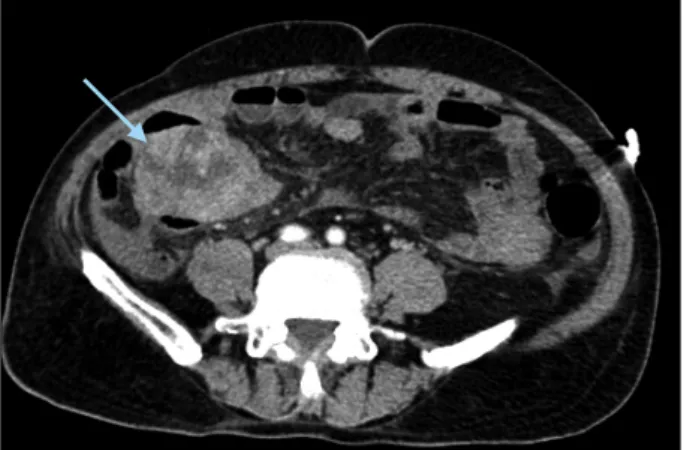
Full blood count showed haemoglobin 9.7 g/dL, total white cell count at 20×109/L, urea 11.1 mmol/L and crea- tinine 174 umol/L. Liver function test and coagulation profile were unremarkable. After intravenous hydration, a computerized tomography (CT) scan of the abdomen and pelvis was performed, which revealed a 5 cm enhancing mass adherent to the small bowel in the right flank, with associated hemoperitoneum (Fig. 1). Patient underwent emergency exploratory laparotomy and 5×4 cm-sized sol- id tumor was found, arising from the serosal surface of the ileum, 20 cm from ileocecal valve with associated 1200 ml of hemoperitoneum and clots. Segmental small bowel resection with stapled primary anastomosis, was performed. Histology showed invasion of small intestine serosa by HCC and Hepatocyte Paraffin 1 stains, con-
Vishal G Shelat, et al. Small bowel metastases 417
Fig. 1. Computed tomography showing a 5 cm-sized enhanc- ing mass (arrow) in the right flank adherent to small bowel.
Fig. 2. Microphotography showing low power magnification showing normal intestinal mucosa (black arrow) and deposits of hepatocellular carcinoma on serosal surface (yellow ar- row).
Fig. 3. Immunohistochemical stain finding: Hep Par 1 stain confirming presence of hepatocytes.
firmed presence of hepatocytes (Fig. 2, 3). Patient had an uneventful recovery, and a staging CT scan of the thorax, did not reveal pulmonary metastases. After a multi- disciplinary meeting, a follow-up plan for surveillance was decided. At 6 months of follow-up, patient has devel- oped right 10th rib metastasis with chest wall pain, and this is treated symptomatically with local radiation. Liver function test, coagulation profile, alpha-fetoprotein, and CT scan of abdomen are unremarkable. He remains well and symptom free at 8 months follow-up, without ad- juvant treatment.
DISCUSSION
HCC is 5th most common cancer globally, and the 3rd most common cancer-related death.3 Liver dysfunction, rupture, and metastases are the three terminal outcomes which determine survivorship. Earlier, patients with rup- ture of HCC, were only offered best supportive palliative
care; however surgical palliation is accepted as an option, in appropriately selected patients as observed with our pa- tient, who survived 5 years after hepatic resection follow- ing a rupture. Extra-hepatic metastasis from HCC is com- monly encountered in lung, lymph nodes, bones, heart, and adrenal glands. Gastrointestinal tract metastases are uncommon. Within the gastrointestinal tract, the most common site of metastasis is the stomach, followed by du- odenum and colon.4 Gastrointestinal tract bleeding from HCC metastasis, has been described in the upper and low- er gastrointestinal tract, and can present as occult or frank intraluminal bleeding.5,6 However intra-peritoneal rupture of HCC metastasis to the ileum, causing acute hemoper- itoneum with shock, is the first to be reported in literature.
Various mechanisms of HCC metastasis, to the gastro- intestinal tract have been proposed: direct invasion from a contiguous HCC, hematogenous metastasis and peri- toneal seeding.4 In our case, the most likely route of meta- stasis, was via peritoneal seeding following previous rupture. This is supported by the fact that tumor re- currence, was on the serosal surface of the ileum, as seen intraoperatively and from histopathological examination.
Our patient developed rib metastasis at follow up after laparotomy, and it is possible that repeat rupture, has made patient vulnerable for hematogenous dissemination and rib metastasis.
In the largest case series published on metastatic HCC to the gastrointestinal tract, interval of metastasis from ini- tial diagnosis of HCC was up to 24.3 months.7 Our patient had an unusual late presentation of recurrence, given his index presentation as rupture was 5 years ago. It is inter- esting that despite 6 monthly transabdominal ultrasound scans, and alpha-fetoprotein surveillance, the tumor was
418 Ann Hepatobiliary Pancreat Surg Vol. 22, No. 4, November 2018
undetected. This highlights the fact that clinical examina- tion of abdomen is equally important, to detect abdominal mass, and focused liver ultrasound can miss distant lesions. A high index of suspicion is required, in a patient with previously diagnosed HCC who presents to the emer- gency room with acute abdomen. Metastatic HCC patients can benefit from palliative surgery, in appropriate context as highlighted in our report.
REFERENCES
1. Nakashima T, Okuda K, Kojiro M, Jimi A, Yamaguchi R, Sakamoto K, et al. Pathology of hepatocellular carcinoma in Japan. 232 consecutive cases autopsied in ten years. Cancer 1983;51:863-877.
2. Chen LT, Chen CY, Jan CM, Wang WM, Lan TS, Hsieh MY, et al. Gastrointestinal tract involvement in hepatocellular carcino-
ma: clinical, radiological and endoscopic studies. Endoscopy 1990;22:118-123.
3. Ahmed S, de Souza NN, Qiao W, Kasai M, Keem LJ, Shelat VG. Quality of life in hepatocellular carcinoma patients treated with transarterial chemoembolization. HPB Surg 2016;2016:
6120143.
4. Lin CP, Cheng JS, Lai KH, Lo GH, Hsu PI, Chan HH, et al.
Gastrointestinal metastasis in hepatocellular carcinoma: radio- logical and endoscopic studies of 11 cases. J Gastroenterol Hepa- tol 2000;15:536-541.
5. Humbert P, Sarmiento J, Boix J, Planas R, Quintero E, Franquet T, et al. Hepatocellular carcinoma presenting with bleeding due to duodenal perforation by the tumor. Endoscopy 1987;19:37-38.
6. Yang PM, Sheu JC, Yang TH, Chen DS, Yu JY, Lee CS, et al. Metastasis of hepatocellular carcinoma to the proximal jeju- num manifested by occult gastrointestinal bleeding. Am J Gas- troenterol 1987;82:165-167.
7. Park MS, Kim KW, Yu JS, Kim MJ, Yoon SW, Chung KW, et al. Radiologic findings of gastrointestinal tract involvement in hepatocellular carcinoma. J Comput Assist Tomogr 2002;26:95- 101.