Effects of Home-Based Pulmonary Rehabilitation with a Metronome-Guided Walking Pace in Chronic Obstructive Pulmonary Disease
Despite documented efficacy and recommendations, pulmonary rehabilitation (PR) in chronic obstructive pulmonary disease (COPD) has been underutilized. Home-based PR was proposed as an alternative, but there were limited data. The adequate exercise intensity was also a crucial issue. The aim of this study was to investigate the effects of home-based PR with a metronome-guided walking pace on functional exercise capacity and health- related quality of life (HRQOL) in COPD. The subjects participated in a 12-week home- based PR program. Exercise intensity was initially determined by cardiopulmonary exercise test, and was readjusted (the interval of metronome beeps was reset) according to sub- maximal endurance test. Six-minute walk test, pulmonary function test, cardiopulmonary exercise test, and St. George’s Respiratory Questionnaire (SGRQ) were done before and after the 12-week program, and at 6 months after completion of rehabilitation. Thirty- three patients participated in the program. Six-minute walking distance was significantly increased (48.8 m; P = 0.017) and the SGRQ score was also improved (-15; P < 0.001) over the six-month follow-up period after rehabilitation. There were no significant differences in pulmonary function and peak exercise parameters. We developed an effective home-based PR program with a metronome-guided walking pace for COPD patients. This rehabilitation program may improve functional exercise capacity and HRQOL.
Key Words: Pulmonary Disease, Chronic Obstructive; Rehabilitation; Exercise Test; Quality of Life
Sung-soon Lee,1,* Changhwan Kim,2,* Young-Soo Jin,3 Yeon-Mok Oh,4 Sang-Do Lee,4 Yun Jun Yang,5 and Yong Bum Park2
1Department of Internal Medicine, Inje University College of Medicine, Busan; 2Department of Pulmonary and Critical Care Medicine, Hallym University Kangdong Sacred Heart Hospital, Seoul;
3Sports and Health Medicine Center and
4Department of Pulmonary and Critical Care Medicine, Asan Medical Center, University of Ulsan College of Medicine, Seoul; 5Department of Family Medicine, Inje University College of Medicine, Busan, Korea
*Sung-soon Lee and Changhwan Kim contributed equally to this work.
Received: 23 October 2012 Accepted: 27 February 2013 Address for Correspondence:
Yong Bum Park, MD
Department of Pulmonary and Critical Care Medicine, Hallym University Kangdong Sacred Heart Hospital, 150 Seongan-ro, Gangdong-gu, Seoul 134-701, Korea
Tel: +82.2-2225-2754, Fax: +82.2-478-6925 E-mail: [email protected]
This study was supported by a grant from the Korea Healthcare Technology R&D Project, Ministry of Health & Welfare, Republic of Korea (A102065).
http://dx.doi.org/10.3346/jkms.2013.28.5.738 • J Korean Med Sci 2013; 28: 738-743 Respiratory Diseases
INTRODUCTION
Chronic obstructive pulmonary disease (COPD) is character- ized by a pathological rate of decline in lung function with age, and, as a result, patients with COPD often complain of dyspnea and exercise intolerance (1). Exercise limitation, a very signifi- cant contributor to the poor quality of life of these patients, has been traditionally explained by the increased work of breathing and dynamic hyperinflation that results from the airflow limita- tion. However, several studies have clearly shown that skeletal muscle dysfunction is a very significant contributor to exercise limitation in these patients (2). Skeletal muscle dysfunction also contributes significantly to weight loss, a poor prognostic factor in patients with COPD (3). Thus, appropriate treatment of skel- etal muscle dysfunction should be a priority in the clinical mana-
gement of COPD, and currently, this is based mostly upon re- habilitation programs, nutritional support and, perhaps, oxy- gen therapy (4).
Pulmonary rehabilitation (PR) is multidisciplinary and com- prehensive intervention for patients with chronic respiratory diseases who are symptomatic and often have decreased daily life activities. It is designed to reduce symptoms, optimize func- tional status, increase participation, and reduce health care costs through stabilizing or reversing systemic manifestations of the disease (5). Although pulmonary function did not change after PR, significant improvements in functional exercise ca- pacity, dyspnea, and health-related quality of life (HRQOL) were consistently observed in various studies (6-11).
However, in spite of documented efficacy and strong recom- mendations, PR is largely underutilized because most programs
have been carried out on an inpatient or outpatient basis (12).
Inpatient programs are expensive, and in outpatient programs the subject must go to the hospital several days a week. Another problem is the long-term maintenance of benefits once the hospital-based PR program has been completed, since gains achieved diminish progressively if training is abandoned (13).
For these reasons, home-based PR was proposed as an alterna- tive to outpatient rehabilitation. However, there were limited data on the effectiveness of home-based PR (14-18). There was also a concern about determination and adjustment of the ex- ercise intensity during conducting a home-based PR program (17, 19).
Thus, the aim of the present study was to investigate the ef- fects of a 12-week home-based PR program with a metronome- guided walking pace on functional exercise capacity and HRQOL in patients with COPD of 3 university hospital-based centers.
MATERIALS AND METHODS Study design and patient selection
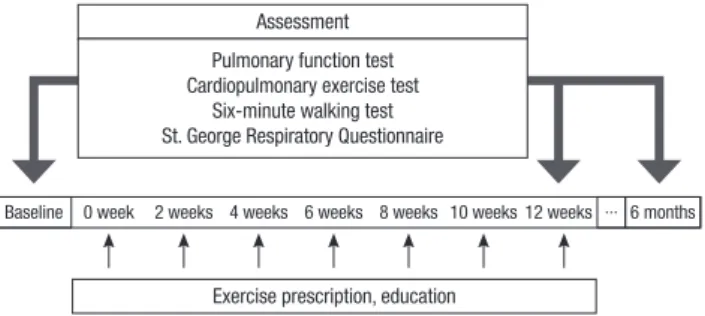
This study was a multicenter, prospective, observational clinical trial. The subjects participated in a 12 weeks home-based PR program. The following evaluations were carried out at enroll- ment (initial visit), 12 weeks (immediately after the program), and 6 months after completion of rehabilitation: 1) pulmonary function tests; 2) cardiopulmonary exercise test; 3) six-minute walking test; 4) St. George’s Respiratory Questionnaire (SGRQ) (Fig. 1).
We recruited patients from the pulmonary clinics of three university hospital-based centers. Patients were eligible for par- ticipation if they had stable COPD, that is, no change in medi- cation and symptoms for 3 months before the study; were 40 yr or older; were current or former smokers of at least 10 pack- years; and had an FEV1 less than 80% of the predicted value and FEV1/FVC ratio less than 0.70. Those with cardiovascular insta- bility, musculoskeletal or neurologic disorders that would in- hibit exercise, or previous attendance at pulmonary rehabilita- tion were excluded.
Because all patients were diagnosed with COPD ranging from moderate to very severe according to the Global Initiative for
Chronic Obstructive Lung Disease (GOLD) guidelines, they re- ceived optimal pharmacologic therapy including one or more long-acting inhaled bronchodilator in accordance with recom- mendations of the treatment guidelines.
Home-based exercise program
The home-based PR program was composed of aerobic exer- cise (walking), muscle strength training, education, respiratory muscle training, and stretching. Exercise intensity (walking speed) was determined by cardiopulmonary exercise test, and target intensity was 60% of the maximum work rate achieved during the test. To guarantee walking speed, we gave each pa- tient a metronome that beeped at preset intervals, individual- ized to each patient’s target intensity. Patient was instructed to walk with metronome in hands and synchronize steps with metronome beep.
Patients visited each clinic every 2 weeks for 12 weeks. At each visit, the exercise intensity was readjusted according to re- peated sub-maximal endurance tests. Muscle strength training was done with elastic bands, and Threshold® (Respironics, Par- sippany, NJ, USA) inspiratory muscle trainer was used for respi- ratory muscle training. Compliance was assessed by daily exer- cise diary.
Outcomes and measurements
One of our primary outcomes for effectiveness was the differ- ences from baseline in HRQOL after 12-week home-based re- habilitation as measured by SGRQ. We used the Korean version of the questionnaire which was validated in a Korean research (20). The total score range from 0 to 100, with a lower score rep- resenting a better HRQOL. A change in score of 4 units is con- sistent with a clinically relevant change in the patient.
To examine changes of functional exercise capacity, the other primary outcome of our study, six-minute walking distance was measured twice at the beginning and once at the end of 12-week rehabilitation and 6 months according to established criteria (21). We used the better of the first two six-minute walking dis- tances as the baseline value.
Patients also completed pulmonary function tests and car- diopulmonary exercise tests using the bicycle ergometer (Sen- sorMedics Corp., Yorba Linda, CA, USA) at enrollment, 12 weeks, and 6 months.
Statistical analysis
All statistical analyses were performed using the statistical soft- ware package SPSS v12.0.1 (SPSS Inc., Chicago, IL, USA). Com- parison of the outcomes of each assessment moment (at en- rollment, 12 weeks, and 6 months) was performed with repeat- ed measures analysis of variance (ANOVA). The last observa- tion carried forward method was used for missing data. A value of P ≤ 0.05 was considered statistically significant.
Exercise prescription, education
Baseline 0 week 2 weeks 4 weeks 6 weeks 8 weeks 10 weeks 12 weeks ∙∙∙ 6 months Assessment
Pulmonary function test Cardiopulmonary exercise test
Six-minute walking test St. George Respiratory Questionnaire
Fig. 1. Home-based pulmonary rehabilitation protocol.
Ethics statement
The study was approved by the Kangdong Sacred Heart Hospi- tal institutional review board (Approval No. 06-3) and institu- tional review boards of other 2 hospitals. All of the patients pro- vided written informed consent.
RESULTS
General characteristics
Thirty-three patients were enrolled from the participating cen- ters and began the home-based PR program. However, six pa- tients dropped out during rehabilitation due to a lack of moti- vation (n = 3), or COPD exacerbation (n = 3). Twenty-seven patients finally completed the home-based PR program and
measurements at 12 weeks.
The general characteristics and overall measurements of twen- ty-seven participants are summarized in Table 1. The mean age was 66 yr, and there was only one woman included. The mean body mass index (BMI) was 21.6 ± 3.3 kg/m2. In the baseline spirometry, mean FEV1 was 1.27 ± 0.51 L/min (48.7% of pre- dicted) and mean FVC was 2.96 ± 0.82 L/min (77.9% of predict- ed). The patients had moderate to very severe COPD according to the GOLD guidelines. Of these, 48.1% were classified as GOLD II (moderate COPD), 37.0% as GOLD III (severe COPD), and 14.8% as GOLD IV (very severe COPD). The mean pre-rehabili- tation six-minute walking distance was 512.1 ± 197.1 meters.
Initial maximal workload (Wmax) and peak oxygen uptake (VO2
max) were measured as low as 80.8 ± 28.9 W and 17.3 ± 5.4 mL/
kg/min, respectively.
Primary outcomes
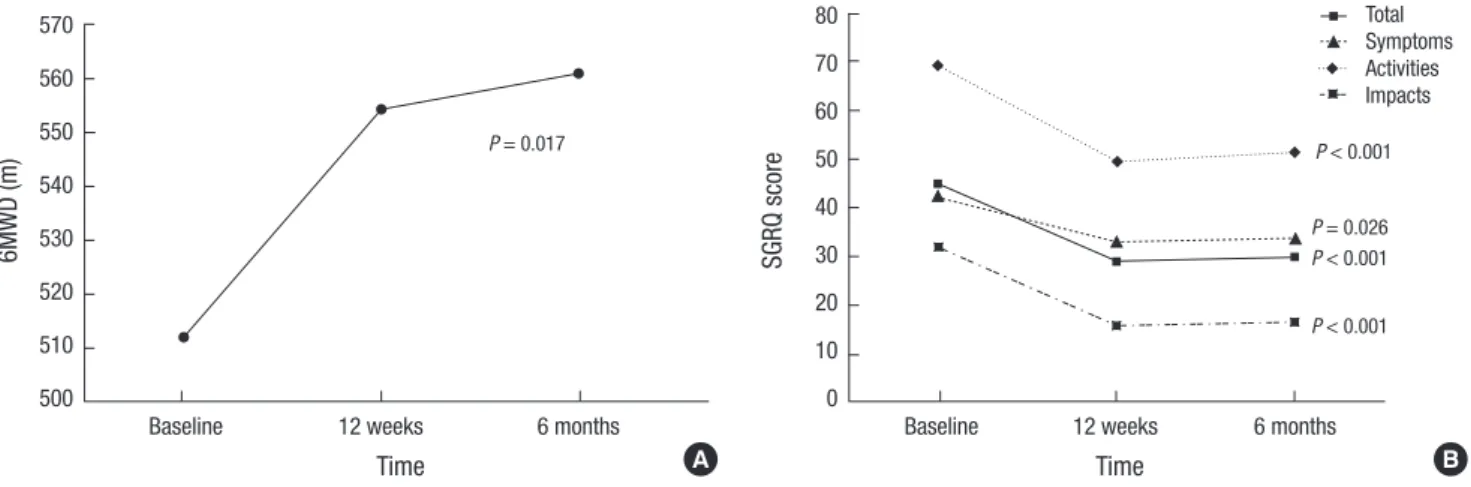
The comparisons of measurements at enrollment, 12 weeks, and 6 months after completion of rehabilitation showed that our home-based PR strategy was associated with statistically and clinically significant improvements in six-minute walking distance (P = 0.017) and total SGRQ score (P < 0.001). We also observed significant differences for symptoms (P = 0.026), ac- tivities (P < 0.001), and impacts domain of SGRQ (P < 0.001).
The improvement of SGRQ scores greatly exceeded minimum clinically important difference (less than -4.0). These effects of rehabilitation on functional exercise capacity and HRQOL last- ed over 6 months (Fig. 2).
Secondary outcomes
Pulmonary functions estimated by forced expiratory volume in 1 second and forced vital capacity were slightly increased in number after home-based pulmonary rehabilitation. Statisti- cally, however, there were no significant differences in pulmo- nary functions over the six-month follow-up period (Table 2).
Table 1. General characteristics and baseline measurements of study patients
Parameters Measured values
Age (yr) 66.2 ± 7.8
Men : Women (No.) 26 : 1
BMI (kg/m2) 21.6 ± 3.3
Pulmonary function FEV1 (L/min) FEV1 (% predicted) FVC (L/min) FVC (% predicted) DLCO (% predicted)
1.27 ± 0.51 48.7 ± 16.5 2.96 ± 0.82 77.9 ± 17.2 74.4 ± 22.5 SGRQ score
Total Symptoms Activities Impacts
44.9 ± 15.9 42.4 ± 16.8 69.3 ± 23.9 31.8 ± 16.0
6MWD (m) 512.1 ± 197.1
Peak exercise parameters VO2 max (mL/kg/min)
Wmax (W) 17.3 ± 5.4
80.8 ± 28.9
Values are given as the mean ± SD. BMI, body mass index; FEV1, forced expiratory volume in 1 second; FVC, forced vital capacity; DLCO, Diffusion lung capacity for car- bon monoxide; 6MWD, six-minute walking distance; SGRQ, St. George Respiratory Questionnaire; VO2 max, maximal oxygen uptake; Wmax, maximal workload.
Fig. 2. Improved pulmonary and physical functions by exercise. (A) Six-minute walking distance (6MWD) and (B) St. George’s Respiratory Questionnaire (SGRQ) score differenc- es from baseline to 6 months after completion of rehabilitation.
6MWD (m)
Time
Baseline 12 weeks 6 months
570 560 550 540 530 520 510 500
P = 0.017
SGRQ score
Time
Baseline 12 weeks 6 months
80 70 60 50 40 30 20 10 0
P < 0.001
P = 0.026 P < 0.001 P < 0.001 Total Symptoms Activities Impacts
A B
Meanwhile, one of twenty-seven participants did not want to do the cardiopulmonary exercise test again, so twenty-six pa- tients finally completed the exercise test after rehabilitation.
However, changes in peak exercise parameters assessed by max- imal oxygen uptake and maximal workload also did not reveal any clinical significance (Table 2).
DISCUSSION
PR is an increasingly popular and effective option for patients with moderate to very severe COPD. Rehabilitation aims to pre- vent deconditioning and allow the patient to cope with their disease, and is individually tailored and designed to optimize each patient’s physical and social performance and autonomy (22, 23).
PR leads to statistically significant and clinically meaningful improvements in HRQOL and functional exercise capacity, and reduces dyspnea (6-11). However, a report suggested that a re- habilitation program consisting of exercise and education twice a week for 8 weeks had no effect on functional exercise capacity and well being in patients with moderate COPD (24). Another studies showed a deterioration in functional exercise capacity and HRQOL over 12 months after completion of PR (13), and the improvements achieved through a hospital-based training could be maintained when supported by home-based or re- gional healthcare-based training programs (25, 26).
In these aspects, home-based PR was examined for the ef- fectiveness in several studies (14-18). In 1996, Wijkstra et al. first reported the effects of home rehabilitation in several patients with COPD. The rehabilitation group did not show any improve- ment in exercise tolerance and cardiocirculatory parameters, but a small improvement in exertional dyspnea comparing with no rehabilitation group (14). However, another small con- trolled trial of home-based rehabilitation group versus standard medical treatment group revealed significant improvement of exercise tolerance, dyspnea, and HRQOL in the home rehabili- tation group (16). Direct comparisons of the effects of the hos- pital-based outpatient rehabilitation and home-based rehabili- tation also showed that home-based programs were not inferi-
or to hospital-based program to improve dyspnea and health status (15, 18). Although limited data, home-based program was not inferior to center-based program, and appeared to be superior in terms of the adherence to exercise.
This study was meaningful that we confirmed the effective- ness of home-based PR in improving functional exercise capac- ity and quality of life with our own rehabilitation program. Ex- ercise intensity was determined individually using the result of cardiopulmonary exercise test, and was readjusted according to sub-maximal endurance tests at each visit. Especially, we used metronome to guarantee this exercise intensity in the ac- tual exercise. To date, only one recent research used a metro- nome to maintain the prescribed walking speed during home- based PR, and better improvement of exercise capacity was shown in the group walking paced by a metronome rather than the group walking a prescribed distance in a given period of time (19). Furthermore, our rehabilitation program consisted of not only aerobic exercise (walking), but also muscle strength training, education, respiratory muscle training, and stretching.
We think that we developed an effective and convenient home- based PR program for COPD patients.
Meanwhile, 18% of participants dropped out of our study. The reasons for dropping out were lack of motivation and COPD ex- acerbation. The rate of COPD exacerbation (9.1%) was less than or similar to that of other studies concerning home-base PR (16, 17). Three patients complained of being exhausted after cardio- pulmonary exercise test and decided not to continue. These patients declined to take part in the present study because of the inappropriate perception of the necessity for exercise test and the benefits of rehabilitation program, not because of their medical conditions. Thus, although comparison cannot be made with a control group, these dropouts probably did not induce the attrition bias. Measurement of maximal oxygen uptake in COPD patients has been traditionally used to determine the ex- ercise intensity in the pulmonary rehabilitation. Therefore, to provide home-based pulmonary rehabilitation program more easily, the development of other method that can replace the cardiopulmonary exercise test is needed. More detailed infor- mation for motivation of the patients will also be helpful to re- duce the dropout rate during rehabilitation program.
The present study had several limitations. First, the number of patients was relatively small. Second, only one female patient was included. Therefore, the results cannot be generalized to female COPD patients, since a previous study suggests that gen- der might influence COPD manifestations (27). Third, this study was an uncontrolled, observational study. A further study in a larger patient sample with a control group is warranted to clari- fy the results of the present study.
In summary, our home-based PR program could improve functional exercise capacity and HRQOL, and these effects last- ed over 6 months after completion of rehabilitation. The use of Table 2. Changes in pulmonary function and peak exercise parameters according to
the study interventions from baseline to 6 months after completion of rehabilitation
Outcomes Baseline 12 weeks 6 months P value
Pulmonary function FEV1 (L/min) FEV1 (% predicted) FVC (L/min) FVC (% predicted)
1.27 ± 0.51 48.7 ± 16.5 2.96 ± 0.82 77.9 ± 17.2
1.30 ± 0.52 48.8 ± 17.9 3.09 ± 0.74 79.0 ± 20.1
1.32 ± 0.53 49.2 ± 18.7 3.10 ± 0.85 80.2 ± 19.4
0.239 0.671 0.155 0.407 Peak exercise parameters
VO2 max (mL/kg/min) Wmax (W)
17.3 ± 5.4 80.8 ± 28.9
16.3 ± 5.1 81.0 ± 32.1
17.0 ± 5.6 79.8 ± 31.3
0.540 0.637 Values are given as the mean ± SD. FEV1, forced expiratory volume in 1 second; FVC, forced vital capacity; VO2 max, maximal oxygen uptake; Wmax, maximal workload.
a metronome for home-based rehabilitation may be an effec- tive and convenient method to maintain the exercise intensity.
ACKNOWLEDGMENTS & DISCLOSURE
C. Kim, Y. B. Park, Y-S Jin, Y. J. Yang, and S-S Lee have no con- flicts of interest to disclose. Y-M. Oh has been an investigator in industry-sponsored studies (MSD Korea, AstraZeneca Korea, Boehringer Ingelheim Korea, Handok and GlaxoSmithKline) and in university-sponsored studies (Asan Institute for Life Sci- ence, University of Ulsan College of Medicine). YMO has par- ticipated as a speaker at scientific meetings organized and fi- nanced by pharmaceutical companies (Handok, Pfizer Korea, GlaxoSmithKline, AstraZeneca Korea, MSD Korea, and Boeh- ringer Ingelheim Korea) and a magazine company (Korea Doc- tors’ Weekly). YMO developed an educational presentation for a pharmaceutical company (Diachi Sankyo Korea). S-D. Lee serves as a consultant to GlaxoSmithKline and Nycomed, and has participated as a speaker at scientific meetings organized and financed by various pharmaceutical companies (GlaxoS- mithKline, AstraZeneca Korea, Nycomed and Boehringer In- gelheim).
REFERENCES
1. Barnes PJ. Chronic obstructive pulmonary disease. N Engl J Med 2000;
343: 269-80.
2. Skeletal muscle dysfunction in chronic obstructive pulmonary disease:
a statement of the American Thoracic Society and European Respirato- ry Society. Am J Respir Crit Care Med 1999; 159: S1-40.
3. Landbo C, Prescott E, Lange P, Vestbo J, Almdal TP. Prognostic value of nutritional status in chronic obstructive pulmonary disease. Am J Respir Crit Care Med 1999; 160: 1856-61.
4. Agustí AG, Noguera A, Sauleda J, Sala E, Pons J, Busquets X. Systemic ef- fects of chronic obstructive pulmonary disease. Eur Respir J 2003; 21: 347- 60.
5. Nici L, Donner C, Wouters E, Zuwallack R, Ambrosino N, Bourbeau J, Carone M, Celli B, Engelen M, Fahy B, et al. American Thoracic Society/
European Respiratory Society statement on pulmonary rehabilitation.
Am J Respir Crit Care Med 2006; 173: 1390-413.
6. Troosters T, Gosselink R, Decramer M. Short- and long-term effects of outpatient rehabilitation in patients with chronic obstructive pulmo- nary disease: a randomized trial. Am J Med 2000; 109: 207-12.
7. Ries AL, Make BJ, Lee SM, Krasna MJ, Bartels M, Crouch R, Fishman AP; National Emphysema Treatment Trial Research Group. The effects of pulmonary rehabilitation in the national emphysema treatment trial.
Chest 2005; 128: 3799-809.
8. Lacasse Y, Goldstein R, Lasserson TJ, Martin S. Pulmonary rehabilita- tion for chronic obstructive pulmonary disease. Cochrane Database Syst Rev 2006; (4): CD003793.
9. Bestall JC, Paul EA, Garrod R, Garnham R, Jones RW, Wedzicha AJ. Long- itudinal trends in exercise capacity and health status after pulmonary rehabilitation in patients with COPD. Respir Med 2003; 97: 173-80.
10. Pitta F, Troosters T, Probst VS, Langer D, Decramer M, Gosselink R. Are patients with COPD more active after pulmonary rehabilitation? Chest 2008; 134: 273-80.
11. Güell R, Casan P, Belda J, Sangenis M, Morante F, Guyatt GH, Sanchis J.
Long-term effects of outpatient rehabilitation of COPD: a randomized trial. Chest 2000; 117: 976-83.
12. Brooks D, Sottana R, Bell B, Hanna M, Laframboise L, Selvanayagara- jah S, Goldstein R. Characterization of pulmonary rehabilitation pro- grams in Canada in 2005. Can Respir J 2007; 14: 87-92.
13. Brooks D, Krip B, Mangovski-Alzamora S, Goldstein RS. The effect of postrehabilitation programmes among individuals with chronic obstruc- tive pulmonary disease. Eur Respir J 2002; 20: 20-9.
14. Wijkstra PJ, van der Mark TW, Kraan J, van Altena R, Koëter GH, Postma DS. Long-term effects of home rehabilitation on physical performance in chronic obstructive pulmonary disease. Am J Respir Crit Care Med 1996;
153: 1234-41.
15. Strijbos JH, Postma DS, van Altena R, Gimeno F, Koëter GH. A compari- son between an outpatient hospital-based pulmonary rehabilitation pro- gram and a home-care pulmonary rehabilitation program in patients with COPD: a follow-up of 18 months. Chest 1996; 109: 366-72.
16. Hernández MT, Rubio TM, Ruiz FO, Riera HS, Gil RS, Gómez JC. Results of a home-based training program for patients with COPD. Chest 2000;
118: 106-14.
17. Puente-Maestu L, Sánz ML, Sánz P, Cubillo JM, Mayol J, Casaburi R.
Comparison of effects of supervised versus self-monitored training pro- grammes in patients with chronic obstructive pulmonary disease. Eur Respir J 2000; 15: 517-25.
18. Maltais F, Bourbeau J, Shapiro S, Lacasse Y, Perrault H, Baltzan M, Her- nandez P, Rouleau M, Julien M, Parenteau S, et al. Effects of home-based pulmonary rehabilitation in patients with chronic obstructive pulmo- nary disease: a randomized trial. Ann Intern Med 2008; 149: 869-78.
19. Pomidori L, Contoli M, Mandolesi G, Cogo A. A simple method for home exercise training in patients with chronic obstructive pulmonary disease:
one-year study. J Cardiopulm Rehabil Prev 2012; 32: 53-7.
20. Kim YS, Byun MK, Jung WY, Jeong JH, Choi SB, Kang SM, Moon JA, Han JS, Nam CM, Park MS, et al. Validation of the Korean version of the St.
George’s respiratory questionnaire for patients with chronic respiratory disease. Tuberc Respir Dis 2006; 61: 121-8.
21. ATS Committee on Proficiency Standards for Clinical Pulmonary Func- tion Laboratories. ATS statement: guidelines for the six-minute walk test.
Am J Respir Crit Care Med 2002; 166: 111-7.
22. British Thoracic Society Standards of Care Subcommittee on Pulmo- nary Rehabilitation. Pulmonary rehabilitation. Thorax 2001; 56: 827-34.
23. Pulmonary rehabilitation: joint ACCP/AACVPR evidence-based guide- lines: ACCP/AACVPR Pulmonary Rehabilitation Guidelines Panel: Amer- ican College of Chest Physicians: American Association of Cardiovas- cular and Pulmonary Rehabilitation. Chest 1997; 112: 1363-96.
24. Ringbaek TJ, Broendum E, Hemmingsen L, Lybeck K, Nielsen D, An- dersen C, Lange P. Rehabilitation of patients with chronic obstructive pulmonary disease: exercise twice a week is not sufficient! Respir Med 2000; 94: 150-4.
25. Behnke M, Taube C, Kirsten D, Lehnigk B, Jörres RA, Magnussen H.
Home-based exercise is capable of preserving hospital-based improve- ments in severe chronic obstructive pulmonary disease. Respir Med 2000;
94: 1184-91.
26. Moullec G, Ninot G, Varray A, Desplan J, Hayot M, Prefaut C. An inno- vative maintenance follow-up program after a first inpatient pulmonary rehabilitation. Respir Med 2008; 102: 556-66.
27. Martinez FJ, Curtis JL, Sciurba F, Mumford J, Giardino ND, Weinmann
G, Kazerooni E, Murray S, Criner GJ, Sin DD, et al. Sex differences in se- vere pulmonary emphysema. Am J Respir Crit Care Med 2007; 176: 243- 52.