Prognostic Value of Renal Function for Cardiac Events in Patients Without Significant Stenosis on Coronary Computed
Tomography Angiography
This study was conducted to determine clinical parameters predicting future major adverse cardiovascular events (MACEs) in patients without significant stenosis on coronary computed tomographic angiography (CCTA). A total of 625 patients with suspected coronary artery disease (CAD) who underwent CCTA that revealed insignificant (< 50%) CAD was reviewed in three cardiac centers. The MACEs including cardiac death, non-fatal myocardial infarction (MI), unstable angina and late (> 90 days after CCTA)
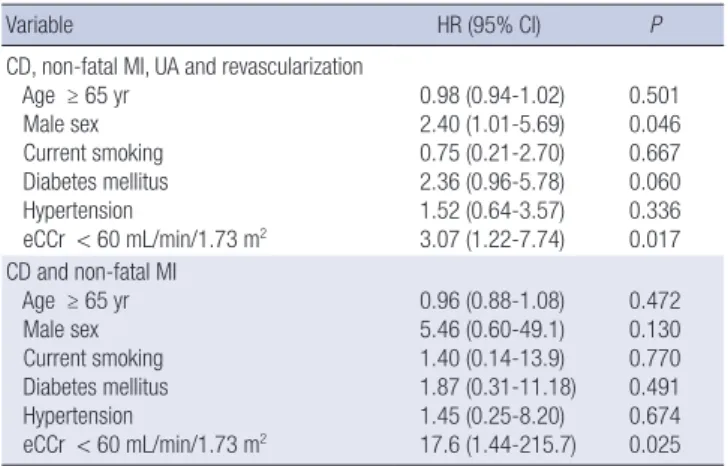
revascularization were assessed. During the mean follow-up period of 819 ± 529 days (median 837 days), there were 28 cases of MACEs (4.5%). In multivariable Cox regression analysis, independent predictors for MACEs were male sex (hazard ratio [HR], 2.40; 95%
confidence interval [CI], 1.01-5.69; P = 0.046) and low estimated creatinine clearance (eCCr) (< 60 mL/min/1.73 m2) (HR, 3.07; 95% CI, 1.22-7.74; P = 0.017). Low eCCr was the only independent predictor for hard events including cardiac death and MI (HR, 17.6, 95% CI, 1.44-215.7; P = 0.025). In conclusion, renal function is an independent predictor for cardiovascular events among patients without significant CAD by CCTA. Careful monitoring and preventive strategy are warranted in patients with impaired renal function even without significant CAD.
Keywords: Creatinine Clearance; Coronary Artery Disease; Multidetector Computed Tomography; Prognosis
Hack-Lyoung Kim,1,4 Yong-Jin Kim,2,4 Yeonyee E. Yoon,3,4 Seung-Pyo Lee,2,4 Hyung-Kwan Kim,2,4 Goo-Yeong Cho,3,4 Joo-Hee Zo,1,4 Dong-Ju Choi,3,4 and Dae-Won Sohn2,4
1Division of Cardiology, Boramae Medical Center, Seoul; 2Division of Cardiology, Seoul National University Hospital, Seoul; 3Division of Cardiology, Seoul National University Bundang Hospital, Seongnam; 4Department of Internal Medicine, Seoul National University College of Medicine, Seoul, Korea
Received: 26 February 2015 Accepted: 21 May 2015 Address for Correspondence:
Yong-Jin Kim, MD
Division of Cardiology, Department of Internal Medicine, Seoul National University College of Medicine, Seoul National University Hospital, 101 Daehak-ro, Jongno-gu, Seoul 110-744, Korea
Tel: +82.2-2072-1963, Fax: +82.2-2072-2577 E-mail: [email protected]
http://dx.doi.org/10.3346/jkms.2015.30.9.1273 • J Korean Med Sci 2015; 30: 1273-1278
INTRODUCTION
Coronary computed tomography angiography (CCTA) is an emerging technique that allows high diagnostic accuracy for the detection of coronary artery disease (CAD) and high nega- tive predictive value for the exclusion of CAD (1-3). In addition, negative result in CCTA provides reassuring prognostic infor- mation. No obstructive lesion in CCTA has been shown to be associated with very low adverse event rates (4-6). Recent study with a large cohort of 23,854 patients demonstrated that annu- alized mortality was 0.22% in subjects without evident CAD by CCTA (4). However, there have been limited studies focusing on clinical outcomes of subjects without obstructive CAD by CCTA. Accordingly, prognostic factors determining future events in this population remain unclear. This study was conducted to assess the clinical outcomes and parameters determining the cardiovascular events in subjects without obstructive CAD on CCTA.
MATERIALS AND METHODS Study subjects
Retrospective analysis was performed with data from three dif- ferent CCTA registries that have been launched to assess clini- cal utility of CCTA involving three cardiac centers in Korea (Seoul National University Hospital, Seoul; Seoul National University Bundang Hospital, Seongnam; and Boramae Medical Center, Seoul). Between November 2004 and November 2010, all study patients underwent CCTA because they were suspected of hav- ing CAD. Patients who had at least one of following criteria were excluded: 1) previous myocardial infarction (MI) and/or coro- nary revascularization, 2) inadequate image quality, and 3) in- sufficient clinical information for the study analysis. After ex- clusion, a total of 1,857 patients remained. Among them, 454 (24.4%), 171 (9.2%), and 1,232 (66.3%) had no (0% stenosis), non- obstructive (1%-49% stenosis) and obstructive (≥ 50% stenosis) CAD, respectively. In this study, a total of 625 with no or non- obstructive CAD by CCTA was analyzed. Information on base-
line clinical characteristics, including cardiovascular risk factors and type of symptoms, was obtained by reviewing patients’ medi- cal records. Hypertension was defined as documented history of high blood pressure or use of anti-hypertensive medications.
Diabetes mellitus was defined by diagnosis of Diabetes mellitus made previously by a physician or use oral hypoglycemic agents or insulin. Dyslipidemia was defined as known but untreated dyslipidemia or current treatment with lipid lowering agents (4).
The pretest pro bability of CAD was determined by age, sex and the nature of chest pain during initial presentation (7). The pre- test probabilities were classified as low (< 10%), intermediate (10%-90%) and high (> 90%). Chest pain was classified as typi- cal, atypical and non-cardiac. Typical chest pain was defined as chest pain that was 1) substernal, 2) provoked by exertion or emotional stress, and 3) relieved by rest and/or nitroglycerin.
Chest pain was classified as atypical if two of these features were present, and non-cardiac if one or none of these features were present (8). Renal function was estimated by estimated creati- nine clearance (eCCr), which was calculated using the Cock- croft-Gault equation: eCCr (mL/min/1.73 m2) = (140-age) × wei- ght (kg)/serum creatinine (mg/dL)/72 × (0.85 for females) ×1.73 m2/body surface area (BSA), and BSA calculated as follows: BSA
= weight (kg)0.425 × hei ght (cm)0.725× 0.007184 (9).
CCTA protocols
All CCTAs were obtained using 16-slice (18.4%) or 64-slice (81.6%) CT scanners (Somatom Definition; Siemens Medical Solutions, Forchheim, Germany and Brilliance 64; Philips, Best, the Neth- erlands). Details of CT scan protocol have been described in previous studies (10, 11). Before CCTA, all patients with an av- erage heart rate of > 65 beats/min received oral metoprolol 50- 100 mg in the absence of contraindications, and were given sub- lingual nitroglycerin 0.2-0.6 mg immediately before scanning.
During image acquisition, 60-80 mL of contrast was injected, followed by a saline flush. Helical scan data was obtained using the retrospective ECG-gating protocol. Image acquisition was prescribed to include the coronary arteries, left ventricle and proximal ascending aorta. All CCTA results were transferred to an external three dimensional workstation, and analyzed inde- pendently by two experienced radiologists. Coronary athero- sclerotic lesions were classified by severity of luminal stenosis, graded as no CAD (0% luminal stenosis) and non-obstructive CAD (1%-49% stenosis) and obstructive CAD (≥ 50% stenosis).
Patient-based analysis was performed.
Clinical events
The primary clinical endpoint was time to composite events consisting of cardiac death, non-fatal MI, unstable angina and late (≥ 90 days after CCTA) revascularization. Secondary clini- cal endpoint was time to composite of hard cardiac events con- sisting of cardiac death and non-fatal MI. Patients with stable
clinical features undergoing an early elective revascularization within 90 days after CCTA were excluded from survival analysis (12, 13). Patient follow-up data were gathered by two observers blinded to the results of CCTA using hospital records or standar- dized telephone interviews for patients with a follow-up loss of more than recent six months. If a patient could not be reached even by a phone, information on death was obtained from the Korean Ministry of Public Administration and Security. Cause of death was identified. Cardiac death was defined as death in the setting of MI, ventricular arrhythmia, decompensated heart failure or cardiogenic shock. Sudden unexplained death was also considered as cardiac death. Noncardiac death was death not related to cardiac disease. MI was defined based on the fol- lowing criteria: typical chest pain, elevated cardiac enzyme lev- els, and typical changes in electrocardiogram (ECG) (14). Un- stable angina was defined as acute chest pain regardless of the presence of ECG abnormalities, and negative cardiac enzyme levels (14). The first event was considered as the event of the patient. When two or more events were recorded at the same day, the most serious event was considered as the event of the patient in the following order: cardiac death, non-fatal MI, un- stable angina and revascularization.
Statistical analysis
Categorical variables are presented as frequencies with percent- ages and continuous variables are presented as mean ± stan- dard deviation. Categorical variables are evaluated using the chi-square test and continuous variables are evaluated using a Student’s t-test. Cox proportional hazards analysis was used to assess predictors of clinical events. Age, sex, body mass index (BMI), smoking status, diabetes mellitus and hypertension con- sidered as confounders should be adjusted. The event rates ac- cording to the eCCr, categorized as ≥ 90 mL/min/1.73 m2, 60- 89 mL/min/1.73 m2 and < 60 mL/min/1.73 m2, was estimated by the chi-square test of linear by linear association. To assess the cut-off value of eCCr as a predictor of events, receiver oper- ating characteristic (ROC) curve analysis was used. Cumulative event free survival was assessed using the Kaplan-Meier meth- od and compared using the log-rank test. A two tailed P value of < 0.05 was considered statistically significant. All data were analyzed using SPSS for Windows 18.0 (IBM Co., Armonk, NY, USA).
Ethics statement
The study protocol was approved by the institutional review board (IRB) of each hospital (IRB No. at Boramae Medical Cen- ter: 06-2011-222). Informed consent was exempted by the IRB due to anonymous information collection and retrospective study design.
RESULTS
Baseline characteristics of study subjects
Baseline clinical characteristics of study subjects are shown in Table 1. Their mean age was 62.5 ± 10.3 yr (range, 25 to 85 yr) and 52.5% of the patients were male. About a half of patients had hypertension (53.1%) and diabetes mellitus (47.5%). Most of patients (84.6%) had intermediate pretest probability of CAD.
Mean eCCr was 64.7 ± 18.5 mL/min/1.73 m2.
Clinical parameters predicting events
Cardiovascular events were evaluated during follow-up period of 819 ± 529 days (median 837 days). There were four cases of cardiac death (0.6%), three cases of non-fatal MI (0.5%), 11 cas- es of unstable angina (1.8%) and 11 cases of late revasculariza- tion (1.8%). Primary composite events including cardiac death, non-fatal MI, unstable angina and late revascularization occurr- ed in 28 patients (4.5%), and composite hard events including cardiac death and non-fatal MI occurred in seven patients (1.1%).
Annualized all- and hard-event rates were 2.00% and 0.49%, re- spectively. Fifteen patients (2.4%) were died, and mean annual- ized death rate was 1.06% (Table 2). Clinical parameters pre- dicting cardiovascular events were assessed using multivariable
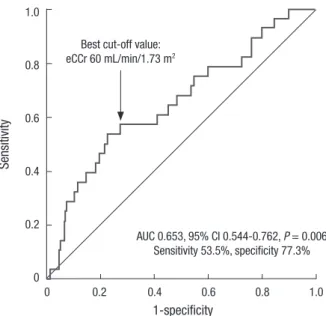
Cox regression analyses (Table 3). Independent predictors for primary composite cardiac events were male sex (hazard ratio [HR], 2.40; 95% confidence interval [CI], 1.01-5.69; P = 0.046) and low eCCr (< 60 mL/min/1.73 m2) (HR, 3.07; 95% CI, 1.22- 7.74; P = 0.017). Diabetes mellitus had a marginal significance in this model (P = 0.060). eCCr was the only independent pre- dictor for secondary composite hard events (HR, 17.6; 95% CI, 1.44-215.7; P = 0.025). Primary composite event rates propor- tionally increased with decrease of eCCr: event rates were 1.3%, 3.2%, and 7.6% in subjects with eCCr ≥ 90 mL/min/1.73 m2, 60-89 mL/min/1.73 m2 and < 60 mL/min/1.73 m2, respectively (P = 0.006) (Fig. 1). In ROC curve analysis, the sensitivity and specificity for detection of primary composite cardiac events were 53.5% and 77.3%, respectively with eCCr 60 mL/min/1.73 m2 as the best cut-off value (Fig. 2). In Kaplan-Meier survival curve, cumulative primary and secondary composite event free survival rates were significantly lower in patients with low eCCr (< 60 mL/min/1.73 m2) compared to those with high eCCr (≥ 60 mL/min/1.73 m2) (log-rank P < 0.05 for each) (Fig. 3).
Table 1. Baseline characteristics of study patients
Characteristic Value (n = 625)
Age (yr) 62.5 ± 10.3
Male sex, No. (%) 328 (52.5)
Body mass index (kg/m2) 24.8 ± 3.3
Current smoking, No. (%) 120 (19.2)
Hypertension, No. (%) 332 (53.1)
Diabetes mellitus, No. (%) 297 (47.5)
Pretest probability, No. (%) Low ( < 10%) Intermediate (10%-90%) High ( > 90%)
72 (11.5) 529 (84.6) 24 (3.8)
Total cholesterol (mg/dL) 184 ± 39
LDL-cholesterol (mg/dL) 108 ± 32
HDL-cholesterol (mg/dL) 48 ± 13
Triglyceride (mg/dL) 149 ± 87
eCCr (mL/min/1.73 m2) 64.7 ± 18.5
LDL, low-density lipoprotein; HDL, high-density lipoprotein; eCCr, estimated creatinine clearance.
Table 2. Major adverse cardiovascular events
Event No. (%)
Total death 15 (2.4)
Cardiac death 4 (0.6)
Non-fatal MI 3 (0.5)
UA 11 (1.8)
Late revascularization 11 (1.8)
CD, non-fatal MI, UA and late revascularization 28 (4.5)
CD and non-fatal MI 7 (1.1)
MI, myocardial infarction; UA, unstable angina; CD, cardiac death.
Table 3. Independent predictors for events
Variable HR (95% CI) P
CD, non-fatal MI, UA and revascularization Age ≥ 65 yr
Male sex Current smoking Diabetes mellitus Hypertension
eCCr < 60 mL/min/1.73 m2
0.98 (0.94-1.02) 2.40 (1.01-5.69) 0.75 (0.21-2.70) 2.36 (0.96-5.78) 1.52 (0.64-3.57) 3.07 (1.22-7.74)
0.501 0.046 0.667 0.060 0.336 0.017 CD and non-fatal MI
Age ≥ 65 yr Male sex Current smoking Diabetes mellitus Hypertension
eCCr < 60 mL/min/1.73 m2
0.96 (0.88-1.08) 5.46 (0.60-49.1) 1.40 (0.14-13.9) 1.87 (0.31-11.18) 1.45 (0.25-8.20) 17.6 (1.44-215.7)
0.472 0.130 0.770 0.491 0.674 0.025 HR, hazard ratio; CI, confidence interval; CD, cardiac death; MI, myocardial infarction;
UA, unstable angina; eCCr, estimated creatinine clearance.
Fig. 1. Clinical outcome according to renal function.
Primary composite event rates (%)
Estimated creatinine clearance (mL/min/1.73 m2)
≥ 90 60-89.9 < 60
8 7 6 5 4 3 2 1 0
P = 0.006
1.3
3.2
7.6
DISCUSSION
The present study demonstrated that rate of cardiovascular events including cardiac death, non-fatal MI, unstable angina and late revascularization was 4.5%, and cardiac death and non-fatal MI was 1.1% during follow-up period of 819 ± 529 days (median 837 days) in patients without significant CAD on CCTA. The re- nal function assessed by eCCr was an independent predictor of adverse cardiovascular events in this population. To the best of
our knowledge, this is the first report showing the prognostic significance of renal function among patients without signifi- cant CAD. The results of the present study suggest that careful monitoring and preventive strategy is necessary for individuals with renal impairment even without significant CAD.
It has been reported that annualized cardiovascular event rate is much lower in individuals without obstructive CAD than those with by CCTA. Min et al. (4) demonstrated favorable out- comes with a 0.22% annualized death rate in patients without CAD. Chow and colleagues showed that annual cardiovascular rates were 0.26% for patients with no CAD, 0.87% for those with non-obstructive CAD, and 4.61% for those with obstructive CAD on CCTA (15). Russo et al. (16) reported excellent prognosis in patients with normal coronary artery with an annualized inci- dence rate of 0.88% and in patients with mild CAD with 3.89%.
Lin et al. (17) demonstrated that individuals with no CAD on CCTA had a favorable intermediate-term prognosis with annu- alized mortality rate 0.34%. In a meta-analysis, the annualized event rate was 11.9% among patients with insignificant CAD and 0.4% for those without CAD on CCTA (18). Our study re- sults are in line with these previous results showing that annu- alized all- and hard-event rates were 2.00% and 0.49%, respec- tively.
Compared to obstructive CAD, the prognostic factors in pa- tients with insignificant CAD evaluated by CCTA has not been well studied. Recently, there was a report investigating 2,583 patients with non-obstructive CAD on CCTA (17). In that study, traditional risk factors including old age, male sex, hyperten- sion, diabetes mellitus, dyslipidemia and smoking status were independent predictors for cardiovascular events. However, they Fig. 2. ROC curve analysis showing cut-off value of eCCr predicting cardiovascular
events. ROC, receiver operating characteristic; eCCr, estimated creatinine clearance;
AUC, area under curve; CI, confidence interval.
Sensitivity
1-specificity
0 0.2 0.4 0.6 0.8 1.0 1.0
0.8
0.6
0.4
0.2
0
Best cut-off value:
eCCr 60 mL/min/1.73 m2
AUC 0.653, 95% CI 0.544-0.762, P = 0.006 Sensitivity 53.5%, specificity 77.3%
Fig. 3. Kaplan-Meier curve showing event free survival rates of clinical outcomes according to renal function. (A) Primary composite event rates and (B) hard event rates. CD, cardiac death; MI, myocardial infarction; UA, unstable angina; Revasc., revascularization; eCCr, estimated creatinine clearance.
Event free survival rates (%)
Follow-up (day)
0 500 1,000 1,500 2,000
100
95
90
85
80
CD, non-fatal MI, UA and Revasc.
Log-rank P = 0.009
eCCr ≥ 60 mL/min/1.73 m2
eCCr < 60 mL/min/1.73 m2
No. at risk
eCCr ≥ 60 mL/min/1.73 m2
415 306 172 56 4 eCCr < 60 mL/min/1.73 m2
210 161 96 35 0
Event free survival rates (%)
Follow-up (day)
0 500 1,000 1,500 2,000
100
95
90
85
80
CD and non-fatal MI
Log-rank P = 0.004
eCCr ≥ 60 mL/min/1.73 m2
eCCr < 60 mL/min/1.73 m2
No. at risk
eCCr ≥ 60 mL/min/1.73 m2
415 299 190 54 9
eCCr < 60 mL/min/1.73 m2
210 173 106 38 1
A B
did not evaluate the prognostic impact of renal function in that study. The present study showed that male sex and impaired renal function were independent predictors in subjects without significant CAD.
Chronic kidney disease (CKD) is an independent risk factor of cardiovascular disease (19, 20). Greater prevalence of tradi- tional cardiovascular risk factors and uremia associated conse- quencies such as volume overload, anemia, and oxidative stress have been known to contribute to the poor cardiovascular out- comes (19). However, high rates of sudden cardiac death and coronary events in CKD patients without known CAD or after complete revascularization could not be fully understood by these factors (16, 18, 21, 22). In this regard, the important role of non-obstructive vulnerable plaque has been suggested as an- other mechanism how CKD increases the risk (23-25). Wada et al. (26) reported that CKD accelerates the formation of vulnera- ble plaque and increases the frequency of plaque disruption.
Baber et al. (22) characterized coronary atherosclerotic plaque morphology in CKD patients using intravascular ultrasound and de monstrated that CKD patients have plaque composed of greater necrotic core and less fibrous tissue prone to rupture.
Si milarly, Hayano et al. (27) demonstrated that impaired renal function was related to higher percentage of lipid volume with- in the neointima after stent implantation leading to an increas- ed risk of late stent failure. In addition, it has been reported that impaired renal function causes decreased number of smooth muscle cells within the plaque that may cause loss of fibrous cap of plaque (28). Other studies showed that CKD enhanced carotid artery calcification and reduced collagenous plaque that may lead to plaque instability and rupture (29, 30).
Besides retrospective design, this study has several limitations.
First, we could not provide information on plaque composition or nature that might suggest the clue explaining the high event rates in patients with renal impairment. Second, information regarding management following CCTA was not available. Med- ications such as aspirin or statin and life style changes might af- fect clinical outcomes. Also, information on type of medical treat- ment in patients with diabetes was missing in our study.
The present study shows that renal function is an indepen- dent predictor for cardiovascular events among patients with- out significant CAD by CCTA, and suggests that careful moni- toring and preventive strategy are warranted in patients with impaired renal function even without significant CAD.
DISCLOSURE
All authors have no conflicts of interest to declare.
AUTHOR CONTRIBUTION
Conception and coordination of the study: Kim HL, Kim YJ. De-
sign of ethical issues: all authors. Acquisition of data: Kim HL, Kim YJ, Cho GY, Zo JH. Data review: all authors. Statistical anal- ysis: Kim HL, Kim YJ. Manuscript preparation: Kim HL, Kim YJ.
Manuscript approval: all authors.
ORCID
Hack-Lyoung Kim http://orcid.org/0000-0002-6703-1472 Yong-Jin Kim http://orcid.org/0000-0002-1366-432X Yeonyee E. Yoon http://orcid.org/0000-0002-8479-9889 Seung-Pyo Lee http://orcid.org/0000-0002-5502-3977 Hyung-Kwan Kim http://orcid.org/0000-0001-7950-2131 Goo-Yeong Cho http://orcid.org/0000-0002-7067-5535 Joo-Hee Zo http://orcid.org/0000-0003-1417-1049 Dong-Ju Choi http://orcid.org/0000-0003-0146-2189 Dae-Won Sohn http://orcid.org/0000-0002-1092-3285
REFERENCES
1. Meijboom WB, Meijs MF, Schuijf JD, Cramer MJ, Mollet NR, van Mieg- hem CA, Nieman K, van Werkhoven JM, Pundziute G, Weustink AC, et al. Diagnostic accuracy of 64-slice computed tomography coronary an- giography: a prospective, multicenter, multivendor study. J Am Coll Car- diol 2008; 52: 2135-44.
2. Miller JM, Rochitte CE, Dewey M, Arbab-Zadeh A, Niinuma H, Gottlieb I, Paul N, Clouse ME, Shapiro EP, Hoe J, et al. Diagnostic performance of coronary angiography by 64-row CT. N Engl J Med 2008; 359: 2324-36.
3. Budoff MJ, Dowe D, Jollis JG, Gitter M, Sutherland J, Halamert E, Scher- er M, Bellinger R, Martin A, Benton R, et al. Diagnostic performance of 64-multidetector row coronary computed tomographic angiography for evaluation of coronary artery stenosis in individuals without known cor- onary artery disease: results from the prospective multicenter ACCURA- CY (Assessment by Coronary Computed Tomographic Angiography of Individuals Undergoing Invasive Coronary Angiography) trial. J Am Coll Cardiol 2008; 52: 1724-32.
4. Min JK, Dunning A, Lin FY, Achenbach S, Al-Mallah M, Budoff MJ, Ca- demartiri F, Callister TQ, Chang HJ, Cheng V, et al.; CONFIRM Investi- gators. Age- and sex-related differences in all-cause mortality risk based on coronary computed tomography angiography findings results from the International Multicenter CONFIRM (Coronary CT Angiography Evaluation for Clinical Outcomes: An International Multicenter Regis- try) of 23,854 patients without known coronary artery disease. J Am Coll Cardiol 2011; 58: 849-60.
5. Min JK, Shaw LJ, Devereux RB, Okin PM, Weinsaft JW, Russo DJ, Lip- polis NJ, Berman DS, Callister TQ. Prognostic value of multidetector cor- onary computed tomographic angiography for prediction of all-cause mortality. J Am Coll Cardiol 2007; 50: 1161-70.
6. Andreini D, Pontone G, Mushtaq S, Bartorelli AL, Bertella E, Antonioli L, Formenti A, Cortinovis S, Veglia F, Annoni A, et al. A long-term prognos- tic value of coronary CT angiography in suspected coronary artery dis- ease. JACC Cardiovasc Imaging 2012; 5: 690-701.
7. Gibbons RJ, Chatterjee K, Daley J, Douglas JS, Fihn SD, Gardin JM, Grun- wald MA, Levy D, Lytle BW, O’Rourke RA, et al. ACC/AHA/ACP-ASIM
guidelines for the management of patients with chronic stable angina:
executive summary and recommendations. A Report of the American College of Cardiology/American Heart Association Task Force on Prac- tice Guidelines (Committee on Management of Patients with Chronic Stable Angina). Circulation 1999; 99: 2829-48.
8. Abidov A, Rozanski A, Hachamovitch R, Hayes SW, Aboul-Enein F, Co- hen I, Friedman JD, Germano G, Berman DS. Prognostic significance of dyspnea in patients referred for cardiac stress testing. N Engl J Med 2005;
353: 1889-98.
9. Kim HL, Park IY, Choi JM, Hwang SM, Kim HS, Lim JS, Kim M, Son MJ.
A decline in renal function is associated with loss of bone mass in Korean postmenopausal women with mild renal dysfunction. J Korean Med Sci 2011; 26: 392-8.
10. Choi EK, Chun EJ, Choi SI, Chang SA, Choi SH, Lim S, Rivera JJ, Nasir K, Blumenthal RS, Jang HC, et al. Assessment of subclinical coronary ath- erosclerosis in asymptomatic patients with type 2 diabetes mellitus with single photon emission computed tomography and coronary computed tomography angiography. Am J Cardiol 2009; 104: 890-6.
11. Moon JH, Park EA, Lee W, Yin YH, Chung JW, Park JH, Lee HY, Kang HJ, Kim HS. The diagnostic accuracy, image quality and radiation dose of 64-slice dual-source CT in daily practice: a single institution’s experi- ence. Korean J Radiol 2011; 12: 308-18.
12. Hadamitzky M, Freissmuth B, Meyer T, Hein F, Kastrati A, Martinoff S, Schömig A, Hausleiter J. Prognostic value of coronary computed tomo- graphic angiography for prediction of cardiac events in patients with suspected coronary artery disease. JACC Cardiovasc Imaging 2009; 2:
404-11.
13. van Werkhoven JM, Schuijf JD, Gaemperli O, Jukema JW, Boersma E, Wijns W, Stolzmann P, Alkadhi H, Valenta I, Stokkel MP, et al. Prognos- tic value of multislice computed tomography and gated single-photon emission computed tomography in patients with suspected coronary ar- tery disease. J Am Coll Cardiol 2009; 53: 623-32.
14. Anderson JL, Adams CD, Antman EM, Bridges CR, Califf RM, Casey DE Jr, Chavey WE 2nd, Fesmire FM, Hochman JS, Levin TN, et al.; Ameri- can College of Cardiology; American Heart Association Task Force on Practice Guidelines (Writing Committee to Revise the 2002 Guidelines for the Management of Patients With Unstable Angina/Non ST-Eleva- tion Myocardial Infarction); American College of Emergency Physicians;
Society for Cardiovascular Angiography and Interventions; Society of Thoracic Surgeons; American Association of Cardiovascular and Pul- monary Rehabilitation; Society for Academic Emergency Medicine.
ACC/AHA 2007 guidelines for the management of patients with unstable angina/non ST-elevation myocardial infarction: a report of the American College of Cardiology/American Heart Association Task Force on Prac- tice Guidelines (Writing Committee to Revise the 2002 Guidelines for the Management of Patients With Unstable Angina/Non ST-Elevation Myo- cardial Infarction): developed in collaboration with the American Col- lege of Emergency Physicians, the Society for Cardiovascular Angiogra- phy and Interventions, and the Society of Thoracic Surgeons: endorsed by the American Association of Cardiovascular and Pulmonary Reha- bilitation and the Society for Academic Emergency Medicine. Circula- tion 2007; 116: e148-304.
15. Chow BJ, Wells GA, Chen L, Yam Y, Galiwango P, Abraham A, Sheth T, Dennie C, Beanlands RS, Ruddy TD. Prognostic value of 64-slice cardiac computed tomography severity of coronary artery disease, coronary ath-
erosclerosis, and left ventricular ejection fraction. J Am Coll Cardiol 2010;
55: 1017-28.
16. Russo V, Zavalloni A, Bacchi Reggiani ML, Buttazzi K, Gostoli V, Barto- lini S, Fattori R. Incremental prognostic value of coronary CT angiogra- phy in patients with suspected coronary artery disease. Circ Cardiovasc Imaging 2010; 3: 351-9.
17. Lin FY, Shaw LJ, Dunning AM, Labounty TM, Choi JH, Weinsaft JW, Koduru S, Gomez MJ, Delago AJ, Callister TQ, et al. Mortality risk in symptomatic patients with nonobstructive coronary artery disease: a prospective 2-center study of 2,583 patients undergoing 64-detector row coronary computed tomographic angiography. J Am Coll Cardiol 2011;
58: 510-9.
18. Bamberg F, Sommer WH, Hoffmann V, Achenbach S, Nikolaou K, Conen D, Reiser MF, Hoffmann U, Becker CR. Meta-analysis and systematic re- view of the long-term predictive value of assessment of coronary athero- sclerosis by contrast-enhanced coronary computed tomography angiog- raphy. J Am Coll Cardiol 2011; 57: 2426-36.
19. Foley RN, Parfrey PS, Sarnak MJ. Clinical epidemiology of cardiovascu- lar disease in chronic renal disease. Am J Kidney Dis 1998; 32: S112-9.
20. Na KY, Kim CW, Song YR, Chin HJ, Chae DW. The association between kidney function, coronary artery disease, and clinical outcome in patients undergoing coronary angiography. J Korean Med Sci 2009; 24: S87-94.
21. Go AS, Chertow GM, Fan D, McCulloch CE, Hsu CY. Chronic kidney disease and the risks of death, cardiovascular events, and hospitalization.
N Engl J Med 2004; 351: 1296-305.
22. Baber U, Stone GW, Weisz G, Moreno P, Dangas G, Maehara A, Mintz GS, Cristea E, Fahy M, Xu K, et al. Coronary plaque composition, mor- phology, and outcomes in patients with and without chronic kidney dis- ease presenting with acute coronary syndromes. JACC Cardiovasc Imag- ing 2012; 5: S53-61.
23. Virmani R, Burke AP, Farb A, Kolodgie FD. Pathology of the vulnerable plaque. J Am Coll Cardiol 2006; 47: C13-8.
24. Ehara S, Kobayashi Y, Yoshiyama M, Shimada K, Shimada Y, Fukuda D, Nakamura Y, Yamashita H, Yamagishi H, Takeuchi K, et al. Spotty calci- fication typifies the culprit plaque in patients with acute myocardial in- farction: an intravascular ultrasound study. Circulation 2004; 110: 3424-9.
25. Falk E, Shah PK, Fuster V. Coronary plaque disruption. Circulation 1995;
92: 657-71.
26. Wada M, Ueda Y, Higo T, Matsuo K, Nishio M, Hirata A, Asai M, Nemo- to T, Kashiyama T, Murakami A, et al. Chronic kidney disease and coro- nary artery vulnerable plaques. Clin J Am Soc Nephrol 2011; 6: 2792-8.
27. Hayano S, Ishii H, Ichimiya S, Kanashiro M, Watanabe J, Suzuki S, Yo- shikawa D, Maeda K, Matsubara T, Murohara T. Renal dysfunction and atherosclerosis of the neointima following bare metal stent implantation.
Am J Nephrol 2013; 38: 58-65.
28. Kockx MM, Herman AG. Apoptosis in atherogenesis: implications for plaque destabilization. Eur Heart J 1998; 19: G23-8.
29. Pelisek J, Assadian A, Sarkar O, Eckstein HH, Frank H. Carotid plaque composition in chronic kidney disease: a retrospective analysis of patients undergoing carotid endarterectomy. Eur J Vasc Endovasc Surg 2010; 39:
11-6.
30. Pelisek J, Hahntow IN, Eckstein HH, Ockert S, Reeps C, Heider P, Luppa PB, Frank H. Impact of chronic kidney disease on carotid plaque vulner- ability. J Vasc Surg 2011; 54: 1643-9.