• 검색 결과가 없습니다.

Study on the Morphological Parameters and Evolution of Caragana microphylla Lam. Nebkhas in Inner Mongolia, China

N/A
N/A
Protected

Academic year: 2021

Share "Study on the Morphological Parameters and Evolution of Caragana microphylla Lam. Nebkhas in Inner Mongolia, China"

Copied!
7
0
0

로드 중.... (전체 텍스트 보기)

전체 글

(1)

156

F OREST S OCIETY

Study on the Morphological Parameters and Evolution of Caragana microphylla Lam. Nebkhas in Inner Mongolia, China

Yan Na

1

*, Hasi Eerdun

1

, Park Ki-Hyung

2

, Xia Xian-Dong

1

and Chun Kun-Woo

3

1

College of Resources Science and Technology, Beijing Normal University, Beijing 100875, China

2

College of Soil and Water Conservation & Desertification Combating, Beijing Forestry University, Beijing 100083, China

3

College of Forest and Environmental Sciences, Kangwon National University, Chuncheon 200-701, Korea

Abstract : Nebkhas are widely distributed in farming-pastoral zones, typical grassland and desert margins.

In the southeast of the Inner Mongolia Plateau, it is mainly distributed at the leeward of cultivated land and alluvial fan, severe deterioration rangeland and around residential points. Through the field measurement and statistical analysis of Caragana microphylla Lam. Nebkhas morphological parameters (length, width and height of Nebkhas are included), the results show that there were close correlations between the Nebkhas morphological parameters. The ranges of height and width of Nebkhas changed dramatically and have reached up to 11.44 m and 7.97 m respectively, however, the change range of height was relatively smaller and just 1.09 m. The morphological parameters change of the same type Nebkhas in the same region was large ranging from 0.56 m in height, 3.56 m in width to 6.96 m in length, while the morphological characteristics of the same type Nebkhas in different regions were much similar. A correlation between length and width was significantly positive, but the correlations between height and length, and between height and width were much more complicated. It can be concluded that the Nebkhas in Zhengxiangbai Banner and Taipusi Banner were at the initially growing stage, while the Nebkhas in Huade County belonged to a transitional stage from the growing phase to the stabilizing phase. The changing regularity of distance between Nebkhas in along-wind direction was not consistent.

Key words : nebkhas, morphological parameters, evolution

Introduction

Nebkhas are a type of landform formed from sand deposition within and around them, when shrubs dis- courage the movement of aeolian sandy flow in the arid, semiarid and semi-humid desert regions (Tengberg, 1995).

Nebkhas are widely distributed in Africa Sahelian region, Southwest America, Arabian Peninsula and like places (Nickling and Wolfe, 1994; Tengberg and Chen, 1998; Langford, 2000). In China, it is mainly distributed in farming-pastoral zones, typical grassland and desert margins. The Nebkhas morphology is characterized by convex sand piles covered by shrub plants. The top of mound is smooth and the slope is gentle. However, as the effective factors, for example, the wind conditions, change in different regions, it changes a little (Yue et al. , 2005). The vertical (i.e. height) and horizontal scales

(i.e. length and width) of Nebkhas change a lot, ranging from several to several tenth centimeters and several tenth centimeters to several meters respectively (Wu et al. , 2006). After the 1970s, with the popular attention to aeolian landform, desertification process and desertifica- tion problem (Wu, 1993a; Wu, 1993b; Zhu, 1994), the study to the morphology, deposition and evolution of Nebkhas which are one of the most important manifes- tation and geomorphic type of desertification is started in individual area. But it is not mature, and a lot of prob- lems need to be solved (Tengberg and Chen, 1998; Hesp and Mclachlan, 2000; Su et al ., 2002; Zhao et al ., 2003).

At present, there is not sufficient evidence to prove the relationship between the appearance of Nebkhas to ter- rain, plants, land utilization and so on; the aerodynamics, formation and evolution of Nebkhas are still in its qual- itative description and hypothesis stage; the weights of effective factors to the formation of Nebkhas and whether Nebkhas have indicative significance of land degradation and sandy desertification are still in discus-

*Corresponding author

E-mail: [email protected]

(2)

sion (Gile, 1975; Mensching and Ibrahim, 1977; Hesp, 1981; Clemmensen, 1986; Marston, 1986; Ahlcrona, 1988; Thomas and Tsoar, 1990; Kocurek et al. , 1992;

Tengberg, 1994; Khalaf et al ., 1995). Especially in China, Nebkhas haven’t investigated systematically except some qualitative description and biomass research (Li et al ., 2007; Liu and Zhao, 2007; Wu et al. , 2008). The Nebkhas research degree is lower.

In order to discuss the relationship between Nebkhas’

morphological parameters quantitatively and reveal the law of its distribution and evolution, morphological parameters of 703 Caragana microphylla Lam. Nebkhas in Southeast Inner Mongolia (Zhengxiangbai Banner, Taipusi Banner and Huade County are included) and dis- tance change between Nebkhas in along-wind direction were measured and analyzed. Then, the general charac- teristics of Nebkhas’ morphological parameters, the rela- tionship between each parameters, the law of distance change between Nebkhas in along-wind direction and the evolution and development of Nebkhas in study area were discussed.

Methods and Materials

The study area is located in Zhengxiangbai Banner, Taipusi Banner and Huade County, the southeast part of Inner Mongolia (Figure 1). It has a cold, dry and semi- arid continental climate. Annual mean temperature is 0.7-2.4. The mean annual precipitation is 200-400 mm.

The yearly average wind speed is 3-5 m/s and the annual gale days are 20 to 80 days. Landform is characterized by low mountains , hills and basins among them. Most of surface sediments are gravel residual-slope accumulation type. Shrub accumulation is main part of aeolian deposit and the minor part is barrier sedimentary processes caused by buildings. Chestnut soil and light chestnut soil are the main zonal soils. There are plenty of natural vegetation types including Leymus chinensis , Stipa Baicalensis , Astragalus membranaceus , Carex tristachya , Stipa grandis , Glycyrriza Uralensis , Cleistogenes squarrosa and so on.

Three classic regions are separately located in Zhengx- iangbai Banner, Taipusi Banner and Huade County. The alluvial fan, cultivated land and degraded grassland are in its windward direction orderly. S-shaped line transect method was adopted in field investigation (Figure 2). It means in each classic region data were measured along-wind and upwind. High precision GPS (Magellan eXplorist600), steel measuring tape and compass were used to measure Car- agana microphylla Lam. Nebkhas’ morphological parame- ters and distance between Nebkhas in along-wind direction.

Each datum was measured 3-5 times and mean value was used. The data were analyzed through software SPSS.

Results

1. The overall characteristics

The morphological parameters statistic results of 703 Caragana microphylla Lam. Nebkhas in three classic regions are shown in Table 1. On the whole, the length of Nebkhas changes between 0.57-12.01 m; the width changes between 0.03-8.01; and the height changes between 0.03-1.12 m. In the classic region of Zhengx- iangbai Banner, the ranges of length, width and height are 0.87-12.01 m, 0.03-8.01 m and 0.05-1.12 m respec- tively; In the classic region of Taipusi Banner, the length, width and height are in the ranges of 0.62-11.35 m, 0.45-7.12 m and 0.03-1.09 m orderly; and in the region of Huade County, they are in the ranges of 0.57- 7.54 m, 0.48-4.05 m and 0.04-0.60 m. In each classic region the ranges of length, width and height decreased in turn. The length and width changed relatively greatly, whereas the height changed relatively smaller. The mor- phological variation range of the same type Nebkhas in the same region changed widely with a std. deviation up to 1.97 m. The morphological characteristics of the same type Nebkhas in different regions had remarkable simi- larity in range, minimum, maximum, mean, std. devia- tion and so on.

The distance change between Nebkhas in along-wind direction in different classic regions is shown in Figure 3. In Taipusi Banner and Zhengxiangbai Banner, there is an obviously decreasing trend of the distance between Figure 1. Geographical position of study area.

Figure 2. Schematic diagram of investigation method. S-

shaped line transect method was adopted and data were

measured along-wind and upwind (Surveyed in July 2008).

(3)

Nebkhas along downwind direction. However, in Huade County the distance has a tendency toward rising slightly. Therefore, a certain and consistent change law could not exist to the distance of Nebkhas in along-wind direction in different classic regions because of the dif- ferent environmental conditions. The three classic regions are located in Zhengxiangbai Banner, Taipusi Banner and Huade County and their windward are alluvial fan, cultivated land and degraded grassland separately. For this reason, environmental factors such as sand source, wind speed, soil, terrain and water condition were var- ious in different regions. Moreover, these environmental

factors affected the development and distribution of Nebkhas (Hesp, 1981; Cooke et al ., 1993; Ahnert, 1994;

Thorn and Welford, 1994). However, the restrictive fac- tors were not the same in different regions. As a result, the distribution varied in three classic regions.

2. The relationship between morphological parameters The Nebkhas frequency distributions of length, width and height basically corresponded to normal distribution by SPSS testing. Thus, Pearson correlations were used to analyze the relationship between morphological param- eters (Table 2). Through the analysis, significant linear Figure 3. Distance change between Nebkhas in along-wind direction in different classic regions. Different line types represent different rows of Nebkhas in along-wind direction. The distances between Nebkhas are decreasing along downwind direction in Taipusi Banner and Zhen- gxiangbai Banner. However, a slightly rising trend is in Huade County.

Table 1. Statistical table of Caragana microphylla Lam. Nebkhas’ morphological parameters. (Unit: m)

  Morphological

Parameters Range Minimum Maximum Mean Std. Deviation

Zhengxiangbai Banner (N=205)

Length 11.14 0.87 12.01 3.12 1.97

Width 7.97 0.03 8.01 2.37 1.18

Height 1.07 0.05 1.12 0.24 0.14

Taipusi Banner (N=244)

Length 10.73 0.62 11.35 2.85 1.71

Width 6.67 0.45 7.12 2.37 1.39

Height 1.06 0.03 1.09 0.21 0.15

Huade County (N=254)

Length 6.96 0.57 7.54 2.15 1.19

Width 3.56 0.48 4.05 1.73 0.84

Height 0.56 0.04 0.60 0.20 0.11

Sum Total (N=703)

Length 11.44 0.57 12.01 2.68 1.68

Width 7.97 0.03 8.01 2.14 1.19

Height 1.09 0.03 1.12 0.22 0.14

(4)

relations have been shown between different morpholog- ical parameters. Among them, the correlation between length and width is the best one and its correlation coef- ficient is up to 0.893; next comes the correlation between width and height and its correlation coefficient is 0.787; the last one is the correlation between length and height and its correlation coefficient is 0.737. There- fore, it can be concluded that there were significant lin- ear relations between length, width and height and they increased synchronously (Khalaf et al ., 1995).

However, after the partial correlations it can be seen that when the relationship of two morphological param- eters were analyzed, the third one could not be omitted (Table 3). Only the third morphological parameter’s

influence was rejected, the results were more convinc- ing. Through the partial correlations, the prodigious lin- ear relation still existed in the relationship between length and width whose correlation coefficient is up to 0.751. Nevertheless, there were slight linear correlations between length and height and between height and width. And their correlation coefficients are 0.122 and 0.424 respectively. As a consequence, the conclusion from the Table 2 should be modified necessarily. There was a synchronous relationship between length and width, but an obvious direct relationship didn’t exist between height and length and between height and width.

The morphological parameters including length, width and height of 703 Caragana microphylla Lam. Nebkhas in three classic regions are shown in Figure 4. There was an obvious corresponding relationship between length and width. They increased and decreased synchronously.

However, there were some inconsistencies between height and length or width, for example points a, b and c in Figure 4.

3. Regression analysis

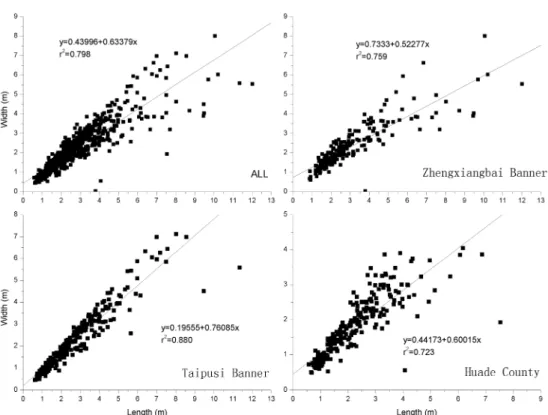
Through the regression analysis between length and width of 703 Caragana microphylla Lam. Nebkhas in three classic regions, the results obtained show that there was an obvious positive correlation between length and width (Figure 5). In the three classic regions, the linear equations can account for more than 70% of the vari- Table 2. Pearson correlations.

L W H

Length 1 .893(**) .737(**)

Width .893(**) 1 .787(**)

Height .737(**) .787(**) 1

** Correlation is significant at the 0.01 level (2-tailed).

Table 3. Partial correlations.

Control Variables Correlated Variables Correlation Coefficient

Height Length - Width .751

Width Length - Height .122

Length Height - Width .424

Figure 4. Comparison of length, width and height in different classic regions. The length and width are increasing or

decreasing synchronously. However, the typical points a, b and c are examples of inconsistency between height and length

or width.

(5)

ance. Meanwhile, the square sum of regression is much larger than the square sum of residual and the residual shows a visible normal distribution. Thus, the equations were fitted excellently. It further confirms that there was

an perfect positive correlation between length and width of Nebkhas.

Based on the investigation of the morphological parame- ters of 703 Caragana microphylla Lam. Nebkhas in three Figure 5. Regression analysis between height and width. As the length increases, the width appears linear growth.

Figure 6. Relationship between vertical scale and horizontal scale. The solid line represents a non-linear regression analysis

and the dashed lines are the 95% confidence limit. As the horizontal scale (i.e. average of length and width) increases, the

vertical scale (i.e. height) appears second-order polynomial growth except a slightly decreasing trend at the end in Huade

County.

(6)

classic regions, the second-order polynomial functions between horizontal scale (i.e. average of length and width) and vertical scale (i.e. height) which were found to best fit on Nebkhas size from study area are shown in Figure 6. The vertical scale increases with the size of the horizontal scale in all three classic regions. In both Zhengxiangbai Banner and Taipusi Banner, the fit- ted trend curves go up over the entire time domain. In Huade County, however, the fitted trend curve rises in the beginning. Thereafter, it becomes flatter somewhat and a slightly decreasing trend appears later. In the three classic regions, the equations can account for more than 58% of the variance. The results of fitted equations were relatively good, although the scattering of the height was apparent as the horizontal scale was increasing. Actually, it is easy to understand, because as Nebkhas grew, more local factors influenced the shape (Tengberg, 1998) such as local wind, microcli- mate, the sediment supply, changes in soil bulk density, plant porosity and growth rate, and the interaction between these factors.

Discussion

After the regression analysis of Nebkhas morpholog- ical parameters in Tunisia, Tengberg (1998) proposes that the morphological development of Nebkhas can be divided into three phases which are a growing phase, a stabilizing phase and a degrading phase. In the growing phase, height increases in direct proportion to length and width on the condition that sand source supply is suffi- cient and there is a higher degree of positive relationship between vertical scale and horizontal scale. Then, when Nebkhas is developing into a certain stage, the limited sand source and the Nebkhas system in the lowland between sandy dunes strengthen the turbulence and accelerate the wind speed which enhances the erosion to Nebkhas. As a result, the height of Nebkhas is in a sta- bilizing erosion-accumulation dynamic equilibrium stage.

The height comes to a steady state as length and width are increasing. Finally, as sand source reduces even dis- appears, groundwater lowers, or shrubs died, Nebkhas are suffering intensive erosion, that the height is gradu- ally decreasing and the horizontal scale is continuously increasing. The Nebkhas have a tendency to die out gradually. So, at the second and third stage, the vertical scale and height are not significantly related. The three phases of Nebkhas morphological development are in accord with quadratic polynomial function: H=AL-BL

2

, where H is the dune height, L is the horizontal compo- nent of Nebkhas (i.e. the average of length and width) and A and B are constants. Figure 6 shows that the equations between vertical scale and horizontal scale fit-

ted in three classic regions were coincident to equations mentioned above. Meanwhile, it can be seen that, in classic regions of Zhengxiangbai Banner and Taipusi Banner, the positive correlation between the height and the horizontal scale was strong. Thus, it can be deduced that the Nebkhas in the regions were in their growing phase. However, in Huade County, the curve rises at first, then becomes gentle and tends to go down. It dem- onstrates that the majority of Nebkhas in the region were in their growing phase, at the same time a small part was in their stabilizing phase. Accordingly, the morphological development of Nebkhas in Huade belonged to a transi- tional stage from the growing phase to the stabilizing phase.

Conclusions

Through the field investigation and laboratory analysis of 703 Caragana microphylla Lam. Nebkhas in three classic regions (Zhengxiangbai Banner, Taipusi Banner and Huade County are included), it shows that:

1. The Nebkhas were densely distributed on the lee- ward side of cultivated land and alluvial fan and around serious degraded grassland and residential points;

2. The ranges of length and width changed relatively greatly, however, the change range of height was rela- tively smaller;

3. The variable amplitude of the same type Nebkhas' morphology in the same region was large;

4. A big similarity of the morphological characteristics existed among the same type Nebkhas in different regions;

5. There was an excellent positive correlation between length and width, whereas the relationship between height and length or width was slightly uncertain;

6. In the all three classic regions, there was a quadratic curvilinear correlation between the height and the hori- zontal scale;

7. And the change law of distances between Nebkhas in along-wind direction was not obvious and consistent.

Though the positive relationship between length and width is proved undoubtedly, the relationship between height and length or width, the distribution law of Nebkhas, the change law of distances between Nebkhas in along-wind direction, and the restriction of various environmental factors to each morphological parameter still need to be further researched and discussed. They all play an extremely important role in the formation and evolution of Nebkhas.

Acknowledgments

This research is supported by Natural Science Foun-

dation of China (NSFC 40771020).

(7)

References

1. Ahlcrona, E. 1988. The impact of climate and man on the land transformation in Central Sudan - Application of remote sensing. Medd. Lunds Univ. Geogr. Inst. Avh.

103: 140.

2. Ahnert, F. 1994. Equilibrium, scale and inheritance in geomorphology. Geomorphology 11: 125-140.

3. Clemmensen, L.B. 1986. Storm-generated eolian sand shadows and their sedimentary structures, Vejers Strand Denmark. J. Sediment. Petrol. 56: 520-527.

4. Cooke, R.U. Warren, A. and Goudie, A.S. 1993. Desert Geomorphology. UCL Press, London, pp.526.

5. Gile, L.H. 1975. Holocene soils and soil-geomorphic relations in an arid region of southern New Mexico.

Quat. Res. 5: 321-360.

6. Hesp, P.A. 1981. The formation of shadow dunes. J.

Sediment. Petrol. 51: 101-112.

7. Hesp, P. and Mclachlan, A. 2000. Morphology, dynam- ics, ecology and fauna of Arctotheca populifolia and Gazania rigens nabkha dunes. Journal of Arid Environ- ments. 44(2): 155-172.

8. Khalaf. F.I., Misak, R. and Al-Dousari. A. 1995. Sed- imentological and morphological characteristics of some nabkha deposits in the northern coastal plain of Kuwait, Arabia. J. Arid Environ. 29: 267-292.

9. Kocurek, G., Townsley, M., Yeh, E., Havholm, K. and Sweet, M.L. 1992. Dune and dune-field development on Padre Island, Texas, with implications for interdune deposition and water-table-controlled accumulation. J.

Sediment. Petrol. 62:. 622-635.

10. Langford, R.P. 2002. Nabkha (coppice dune) fields of south-central New Mexico, U.S.A. Journal of Arid Environments. 46(1): 25-41.

11. Li, Z.Z., Wu, S.L. and Wang, X.F. 2007. Bio-geomor- phologic growth process of Tamarx nabkha in the Hotan River Basin of Xinjiang. Journal of Geographi- cal Sciences. 62(5): 462-470 (in Chinese, with English abstract).

12. Liu, B. and Zhao, W.Z. 2007. Morphological charac- teristics and spatial heterogeneity of Nitraria sphaero- carp Nebkhas in deseart-oasis ecotone. Chinese Journal of Applied Ecology. 18(12): pp. 2814-2820 (in Chinese, with English abstract).

13. Marston, R.A. 1986. Maneuver-caused wind erosion impacts, South Central New Mexico. In: Nickling, W.G.

(Ed.), Aeolian Geomorphology. Allen and Unwin, Bos- ton. MA, pp. 273-290.

14. Mensching, H. and Ibrahim, F. 1977. The problem of desertification in and around arid lands. In: Mensching.

H., Hohnholz. J. (Eds.), Applied Science and Develop- ment, 10: 7-43.

15. Nickling, W.G. and Wolfe, S.A. 1994. The morphology and origin of Nabkhas, Region of Mopti, Mali, West Africa. Journal of Arid Environments. 28(1): 13-30.

16. Su, Y.Z., Zhao, H.L. and Zhang, T.H. 2002. Influencing mechanism of several shrubs and subshrubs on soil fer- tility in Keerqin sandy land. Chinese Journal of Applied Ecology. 13(7): 802-806 (in Chinese, with English abstract).

17. Tengberg, A. 1994. Nebkhas - their spatial distribution, morphometry, composition and age - in the Sidi Bouzid area. central Tunisia. Z. Geomorphol. 38: 311-325.

18. Tengberg, A. 1995. Nebkha dunes as indicators of wind erosion and land degradation in the Sahel zone of Burkina Faso. Journal of Arid Environments. 30(3): 265- 19. Tengberg, A. and Chen, D. 1998. A comparative anal- 282.

ysis of Nebkhas in central Tunisia and northern Burkina Faso. Geomorphology. 22(2): 181-192.

20. Thorn, C.E. and Welford, M.R. 1994. The equilibrium concept in geomorphology. Ann. Assoc. Am. Geogr. 84:

666-696.

21. Thomas, D.S.G. and Tsoar. H. 1990. The geomorpho- logical role of' vegetation in desert dune systems. In:

Thomes, J.B. (Ed.). Vegetation and Erosion. John Wiley.

London, pp. 471-489.

22. Wu, S.L., Li, Z.Z. and Hui, J. 2008. The morpholog- ical characteristics and growth mode of nabkhas in the basin of Hotan River, Xinjiang. Geographical Research.

27(2): 314-322 (in Chinese, with English abstract).

23. Wu, S.L, Li, Z.Z. and Xiao, C.X. 2006. Research progress on nabkhas and research significance. Journal of Desert Research. 26(5): 734-738 (in Chinese, with English abstract).

24. Wu, Z. 1993a. New progresses in the geomorphological research of sandy deserts in China. Geographical Research. 12(1): 10-17 (in Chinese, with English abstract).

25. Wu, Z. 1993b. New progresses in the aeolian geomor- phological and sedimentary research of coastal area in China. Advance of Earth Sciences. 08(2): 59-61(in Chinese, with English abstract).

26. Yue, X.L., Hasi, Zhuang and Y.M. 2005. Studies on sandy grassland Nebkhas. Journal of Desert Research.

25(5): 738-743 (in Chinese, with English abstract).

27. Zhao, W.Z., He, Z.B. and Li, Z.G. 2003. Biological mechanism of sandy desertification in grassland recla- mation area in North China. Advance of Earth Sci- ences. 18(2): 257-262 (in Chinese, with English abstract).

28. Zhu. Z.D. 1994. Current situation and prospect of land desertification problem. Geographical Research. 13(1):

104-111 (in Chinese, with English abstract).

(Received December 4, 2008; Accepted January 12, 2009)

수치

Figure 2. Schematic diagram of investigation method. S- S-shaped line transect method was adopted and data were measured along-wind and upwind (Surveyed in July 2008)
Table 1. Statistical table of  Caragana microphylla Lam.  Nebkhas’ morphological parameters
Figure 4. Comparison of length, width and height in different classic regions. The length and width are increasing or decreasing synchronously
Figure 6. Relationship between vertical scale and horizontal scale. The solid line represents a non-linear regression analysis and the dashed lines are the 95% confidence limit

참조

관련 문서

Therefore, the present study aimed to (i) investigate the effect of surfactant on the solubility of valsartan and (ii) improve the dissolution profiles of valsartan

In this study, the dislocation group had a wider width of AEB (p<0.05), and the posterior slope (TR angle) of the AER and the average of AEB were smoother (p<0.05) compared

Objects ofthi s research are uni ts rel ated to the anti -bi as educati on i n the 7th mi ddl e schoolKorean Language educati on curri cul um,and 211 mi ddl e school

The purpose of this study is to analyze the effects of sports marketing strategy fit on organizational attitude and organizational citizenship behavior

5) After GBR, the membrane was removed i n i ni ti al ti me, the usage of nonabsorbabl e membrane and autogenous bone resul ted i n the mostfavorabl e bone formati

Comparison of pain scale between the conventional and 2-step needle insertion technique according to the injection area ··· 11... The combination of pain scale and

Second, expertise and attitude, which are subfactors of leader image, had a static impact on psychological benefits, which are subfactors of exercis

At first, I arranged the current conditions and function of container terminal in the port of Busan through the existing literature study on the function