http://dx.doi.org/10.12925/jkocs.2016.33.4.777
표면 반응 분석법에 의한 곤드레 블랜칭 최적 공정 확립 및 항산화 능에 미치는 영향
조현선
1․하유진
2․김연태
1․강길남
1․유선균
2✝1충청남도산림환경연구소
✝2중부대학교 식품생명과학과
(2016년 10월 31일 접수; 2016년 12월 20일 수정; 2016년 12월 28일 채택)
Optimization of Blanching Process of Cirsium setidens by Response Surface Methodology and Influence of Blanching on Antioxidant Capacity
Hyeon Seon Jo1․Yoo Jin Ha2․Yeon Tae Kim1․Gil Nam Kang1․Sun Kyun Yoo2✝
1
Chungcheongnam-do Forest Environment Research Institute, Chungnam, Korea
✝2
Department of Food and Biotechnology, Joongbu University. Chungnam, Korea (Received October 31, 2016; Revised December 20, 2016; Accepted December 28, 2016)
요 약 : 본 연구는 표면 반응 분석법을 이용하여 곤드레 데치기 최적 공정 조건을 확립하고 각각의 공정으로부터 생산된 곤드레 추출물로부터 총 페놀 화합물, 플라보노이드의 함량, DPPH 라디칼 소거능 을 분석하였다. 최적 공정 확립을 위한 데치기 공정 범위로 온도는 70℃ - 99℃, 시간은 70 - 170 sec.
로 하였다. 데치기 공정 후 총 페놀 함량의 범위는 13.00 - 35.48 mg/g 이고 최대 예측 총 페놀함량은 35.48 mg/g, 총 페놀 함량의 경향을 보면 데치기 온도에 따라 급격히 감소하다가 증가하는 것으로 보 여 지므로 온도에 의해 더 많은 영향을 받는 것으로 나타난다. 플라보노이드의 함량의 범위는 2.31 - 8.38 mg/g 이고 최대 예측 플라보노이드 함량은 8.38 mg/g 이었다. 플라보노이드 함량의 경향을 보면 데치기 시간에 따라 서서히 증가하다가 급격히 감소하는 것으로 보여 지므로 시간에 의해 더 많은 영향 을 받는 것으로 나타났다. DPPH 라디칼 소거능의 범위는 42.10 - 67.14%이고 최대 예측 DPPH 라디 칼 소거능은 67.14%로 측정 되었다. DPPH의 경향을 보면 데치기 온도에 따라 증가하다가 급격히 감소 하는 것으로 보여 지므로 온도에 의해 더 많은 영향을 받는 것으로 나타난다. 따라서 데치기 공정 최적 조건은 온도 85℃와 시간 150
sec.
로 결정되었다.주제어 : 데치기, 곤드레, 페놀화합물, 플라보노이드, 표면반응 분석법
Abstract : The purpose of this research was the optimization of
Cirsium setidens
blanched at various conditions by response surface methodology. Conducted to investigate the change ofCirsium setidens
DPPH radical scavenging activity, total phenolic compounds and flavonoids during the blanching processes. With two parameters such as blanching time and temperature, response
✝
Corresponding author
(E-mail: [email protected])
surface methodology and central composite design was used to study the combined effect of blanching time (70 to 170 seconds) and blanching temperature (70 to 99℃). The changes of DPPH radical scavenging activity, phenolic compounds, and flavonoids on blanching process conditions such as temperature and time were evaluated. After blanching, total phenolic compound was determined from 13.00 to 35.48 mg/ml. total flavonoids was determined from 2.31 to 8.38 mg/ml.
DPPH radical scavenging activity was determined from 42.10 to 67.14 %. The optimum conditions were determined to be blanching temperature of 85℃ and blanching time of 150 sec.
Keywords : Blanching, Cirsium setidens, Phenolic compounds, Flavonoids, Response surface methodology
1. 서 론
생체 내에서 생성되는 활성산소종(reactive oxygen species, ROS)은 노화와 성인병의 주요 원인 중에 하나로, 체내 ROS 저감 및 조절이 가 능한 항산화제의 관심은 점차 증가하고 있다[1].
식품첨가물로 사용 중인 합성항산화제들은 탁월 한 항산화 활성 및 경제성 때문에 많이 이용되어 왔으나, 최근 식품첨가물에 대한 안전성 논란으로 인하여 합성항산 화제와 비교하여 우수한 활성을 가지며 안전성이 확보된 천연항산화제의 개발이 요구되고 있다[2, 3] 천연물로부터 다양한 건강기 능성을 나타내는 부작용이 적은 소재의 개발이 이루어지고 있으며, 산채에는 다양한 기능성을 나 타내는 페놀성 화합물들의 생리활성 성분들을 포 함하고 있어 주목을 받고 있다[4].
곤드레(
Cirsium setidens
)는 고려엉겅퀴라고도 불리며 국화과의 다년생 야생 초본으로서 한방에 서는 지상부 또는 뿌리를 약용으로 이용해 왔으 며, 지상부는 개화기에 수확하고 뿌리는 가을철에 채취하여 말려서 경혈, 지혈, 소종의 효능으로 토 혈, 혈뇨, 대하, 간염 및 고혈압 등의 치료에 사 용한다고 알려져 있다[5].곤드레는 식이섬유, 비타민 및 무기질이 함유 되어 있으며 매월 5월에 채취하여 식용으로 이용 된다[6]. 연한 어린잎과 부드러운 줄기는 데쳐서 나물이나 국으로 이용하고 말려서 묵나물로 사용 한다[7]. 줄기는 껍질을 벗겨내어 튀김, 무침, 볶 음, 데침 등으로 요리하며 특유의 향미가 있어 차로도 사용 한다[8]. 또한 곤드레를 이용하여 두 부 제조[6], 떡 제조[9], 양조간장 개발[5], 건강 음료 개발[10] 등이 시도된 바 있다. 따라서 점차 고려엉겅퀴의 수요량이 증가되어 고려엉겅퀴의
생육촉진 및 재배환경 개선에 대한 연구도 진행 되고 있다[11, 12].
최근 산채와 관련된 연구결과에 의하면 국화과 에 속하는
Cirsium
속 식물은 이러한 항산화 성 분인 페놀성 화합물을 포함하고 있고[13],Cirsium
속에 들어있는 silymarin은 간 보호작용 [14, 15], 알코올 유도 지질의 산화예방[16]과 알 코올성 간경화 보호 효과[17] 등에 생리활성이 보고되고 있다.Cirsium
속에 폴리페놀 성분을 비롯하여 식이섬유, 무기질 및 비타민 등이 함유 되어 있어 항암활성을 비롯한 다양한 생리활성과 항비만 효능도 보고되어 지고 있다[18-24]. 그러 나 데치기 처리는 제품을 연화시키거나, 데치기 공정 중 색, 질감, 맛 및 향의변화, vitamin C 등 수용성 영양성분의 파괴, 지용성 carotenoid의 산 화 등의 문제와 같은 제품의 손실을 발생시킨다 [25]. 그러므로 고품질의 나물류를 동결채소 형태 로 가공, 유통시키기 위해서는 데치기 중 발생하 는 품질 변화에 대한 안정적인 유지 기술이 필요 하다.따라서 본 연구에서는 곤드레에 표면 반응 분 석법을 이용하여 데치기 최적 공정 조건을 확립 하고 확립된 공정으로 생산된 곤드레 로부터 추 출물을 제조하여 총 페놀 화합물, 플라보노이드의 함량, DPPH 라디칼 소거능을 분석하여 데치기 공정이 항산화 활성에 미치는 영향을 연구하였다.
2. 재료 및 방법
2.1. 실험재료본 실험에서 사용한 곤드레는 2015년 충청남 도 부여에서 수확 된 것을 구입하여 즉시 이물질
X
i Independent variables Level-1.41 -1 0 +1 +1.41
X
1 Temperature (℃) 70 75 85 95 99X
2 Time (sec.) 70 90 120 150 170Table 1. Levels of independent variables such as reaction temperature and time substrate concentration in central composit design Box-Benken design
을 제거하고 신선한 것을 선별하여 시료로 사용 하였다.
2.2. 곤드레 데치기 최적 공정
곤드레 데치기 공정의 최적 조건을 구하기 위 하여 표면반응 분석법(response surface methodology)을 적용하였다. 모든 실험 계획은 2 개의 독립변수 즉, 데치기의 온도와 데치는 시간 을 각각 85℃ 와 120 sec.의 조건으로 center run을 5번 반복을 포함하여 총 13개의 처리조합 으로 구성을 하였다. 중심합성법(Central composit design)은 세 가지의 중요한 절차에 따 라 진행이 되는데, 첫째는 계획된 실험 (designed experiment)에 따라 통계적으로 실험을 수행하고, 둘째는 수식 모델의 계수 (coefficients of model) 를 구하고, 셋째는 모델의 적합성을 판정하는 것 으로 진행이 된다.
통계적인 계산을 원활하기 위하여 독립 변수를 다음과 같이 표준화 (code)하여 사용을 하였다.
세 개의 변수들을 각각
X
1 (℃),X
2 (sec.
)로 하 였다. 표준화의 값들은 다음과 같은 공식에 의하 여 구 할 수 있고 그 값을 Z로 하였다.
--- (1)X
0 는 표준화 값의 중심 값이고 X 는 표준화 값 이다.△X
는 1 단위만큼의 증가 또는 감소하는 값의 크기이다. 실험결과에 대한 분석은 표면 반 응 분석법으로 사용을 하였으며 최적 공정 조건 을 나타내는 다중 회귀식은 다음과 같다.
---- (2)여기서
Y
는 predicted response 이고 본 실험처 럼 5개의 변수가 있을 경우에는 k값이 5가 되고궁극적으로 다음과 같은 식으로 표현된다.
--- (3) 실험 후에 확정 된 결과들의 통계분석은 Design Expert (Couresy: Stat-ease Inc.,Statistics Made Easy, Minneapolis, USA)를 사용하였다. 독립변 수들의 값의 선택은 예비 실험에서 얻은 결과로 부터 선택을 하여X
1 (℃)는 70℃ (-1.41), 75℃(-1), 85℃ (0), 95℃ (+1), 99℃ (+1.41) 로 정 하고,
X
2 (sec.
)는 70 (-1.41), 90 (-1), 120 (0), 150 (+1), 170 (+1.41) 로 하였다(Table 1).2.3. 총 페놀 화합물 함량
페놀류 화합물의 정량은 gallic acid(Sigma Aldrich Co., USA)를 표준물질로 하여 Folin- Ciocalteu reagent(FCR)발색 방법으로 분석하였 다[26]. 표준물질들은 20, 40, 60, 80, 100 mg/L 로 제조를 하였다. 총 페놀함량 분석은 100 μL 샘플 용액을 1.5 mL Na2CO3 (20 g/100 mL), 500 μL FCR, 6 mL DIW와 혼합한 후 상온에 서 2 hr 반응을 시키고 765 nm에서 흡광도를 측 정하였다. 총 페놀화합물 함량은 건조시료 g 당 gallic acid(GAE)의 양으로 평가하였다.
2.4. 총 플라보노이드 함량
총 플라보노이드의 함량은 hesperidin(Sigma Aldrich Co., USA)를 표준물질로 하여 aluminium chloride 비색법을 이용하여 측정하였 다[27], 표준물질들은 20, 40, 60, 80, 100 mg/L 로 제조를 하였다. 총 플라보노이드의 함량의 정 량은 0.5 mL 샘플용액, 1.5 mL 95% methanol, 0.1 mL 10% aluminium chloride(Sigma Aldrich Co., USA), 0.1 mL 1 M NaOH, 2.8 mL DIW 를 혼합한 후 상온에서 30
min.
반응을 시키고Process No.
Tempertature Time Total phenolic compounds Total flavonoids DPPH
(℃) (
sec
.) (mg/g) (mg/g) (%)1 75 90 25.20 5.26 62.15
2 95 90 23.49 6.46 50.81
3 75 150 35.48 2.35 57.92
4 95 150 13.00 2.93 54.83
5 70 120 34.00 4.67 56.62
6 99 120 21.00 7.12 42.10
7 85 70 21.25 5.49 62.58
8 85 162 22.06 3.25 67.14
9 85 120 18.00 7.29 62.18
10 85 120 17.04 8.15 61.60
11 85 120 15.07 8.38 60.88
12 85 120 18.50 7.91 59.63
13 85 120 16.20 7.94 60.98
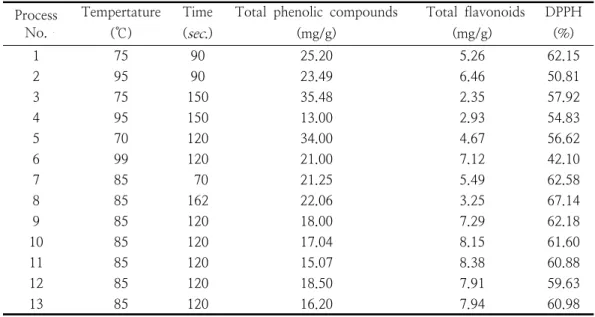
Table 2.
Cirsium setidens
total phenolic compounds, flavonoids and DPPH radical scavenging activity (%) of independent variables in centrall composit design415 nm에서 흡광도를 측정하였다. 총 플라보노 이드 함량은 건조시료 g 당 hesperidin 양으로 평 가하였다.
2.5. DPPH radical scavenging activity 활성 측정
Blois등[28]의 방법에 따라 DPPH에 대한 전자 공여능을 측정하였다. 추출된 시료를 일정한 농도 로(10%) 증류수에 용해한 후 시료가 포함된 용 액 2 mL와 DPPH(0.2 mM) 용액 0.5 mL를 혼 합 하였다. 혼합물은 30
min.
간 실온에서 암실 보관한 후 517 nm에서 흡광도를 측정 하였다.대조구로는 ascorbic acid를 이용하였으며 시료와 동일한 조건으로 측정하였다. DPPH radical scavenging activity는 아래의 식에 의해 값을 산 출하였다.
DPPH radical scavenging activity (%) = [(B−A)/B]×100
A: 시료 첨가시의 흡광도, B: 시료 무 첨가시의 흡광도
3. 결과 및 고찰
3.1. 곤드레 데치기 최적 공정
곤드레 데치기의 최적 조건요인들인 온도와 시 간의 실험변수에 대하여 Central composit design 으로 실험을 설계하여 얻어진 실험결과 즉, 총 페놀함량, 플라보노이드, DPPH를 Table 2에 나타내었다. 총 페놀 함량의 범위는 13.00 - 35.48 mg/g이고 최대 예측 총 페놀함량은 35.48 mg/g, 플라보노이드는 함량의 범위는 2.31 - 8.38 mg/g 이고 최대 예측 플라보노이드 함량은 8.38 mg/g, DPPH 라디칼 소거능의 범위는 42.10 - 67.14%이고 최대 예측 DPPH 라디칼 소거능은 67.14%로 측정 되었다.
실험결과를 이용한 회귀식 대한 분산분석의 결 과는 반응표면분석법에 의해 수립된 모델의 적합 성 여부를 알려준다. 다중반응표면 최적화는 다수 의 반응변수를 최적화하는 입력변수의 조건을 찾 는 것을 목적으로 한다[29]. quadratic 회기 모델 의 분석 결과는 Table 3에 나타내었다. 모델 결 정계수(determination coefficient)
R
2 값은 실험 값(observed value)와 예측값(predicted value)과 상호연관(correlation) 정도를 보여주는데 총 페놀 함량 0.98, 플라보노이드 0.93, DPPH는
0.97 이 므로 총 페놀함량은 3.2%, 총 플라보노이드는 7.8%, DPPH는 3.3% 범위에서 설명되지 않는다 는 것을 보여준다. 적합결여(lack of fit) 테스트Source DF Sum of squares
Total phenolic compoundsa Total flavonoidsa DPPHa
Model 5 540.53b 49.75b 306.33b
Residual 7 12.21 3.91 19.09
Lack of Fit 3 4.60 3.25 15.49
Pure Error 4 7.61 0.66 3.60
Cor Total 12 552.75 53.67 325.43
a Coefficients of correlation (
R
2) of total phenolic compounds, flavonoids and DPPH radical scavenging activity were 0.98, 0.93, 0.97.b Significant at 5% level.
Table 3. Analysis of variance(ANOVA) for fitted second-order polynomial model and lack of fit for
Cirsium setidens
Factor
Coefficient Total phenolic
compounds (mg/g)
Total flavonoids
(mg/g)
DPPH radical scavenging activity
(%)
Intercept 16.96 7.93 61.05
Linear
Time -5.32 0.65 -4.37
Temperature 0.11 -1.20 0.78
Quadratic
Time 5.19 -1.24 -6.01
Temperature 2.27 -2.00 1.73
Interactions
Time×Temperature -5.19 -0.15 2.06
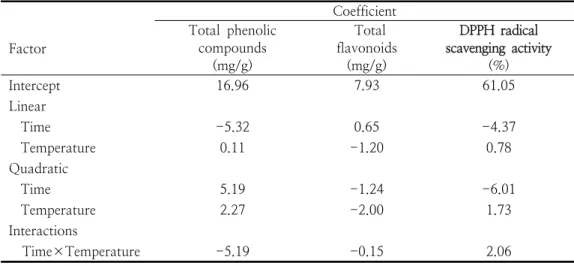
Table 4. Estimated coefficient for the filled second oder polynomial representing the relationship between the responses (changes of total phenolic compounds, flavonoids, and DPPH radical scavenging activity) and process variables (blanching time and temperature)
검정에서는 유의성이 나타나지 않아 본 실험에 사용한 모델이 매우 적절함을 알 수 있다.
Table 4에서는 모델의 회귀계수를 나타내는 것 으로 총 페놀함량, 플라보노이드, DPPH 라디칼 소거능에 대한 2가지 요인 즉 온도, 시간들에 대하여 크게 영향을 받는 것으로 나타났다 (
p
<0.05). 본 실험 결과는 온도, 시간에 대한 영 향은 1차, 2차, 교호항(cross product term)에서 유의성이 나타나 요인들이 단독 또는 교호적으로 영향을 미침을 알 수 있다. 이들에 대한 회귀식 은 Table 5에 있다.3.2. 총 페놀 함량 변화에 대한 데치기 온도와 시간의 영향
데치기 온도와 시간에 따른 총 페놀 함량의 최 적 표면 반응 분석결과는 Fig. 1에서 보여 진다.
데치기 온도 75℃와 150 sec. 반응하였을 때 총 페놀 함량의 최대값이 나타났고, 온도 95℃와 150 sec. 반응하였을 때는 총 페놀 함량의 최소 값이 나타났다. 온도는 70℃- 85℃까지 서서히 감소하다가 90 sec. 이후에는 증가하기 시작하는 결과를 보여주었다. 시간은 온도와는 다르게 70 - 162 sec. 까지 꾸준히 증가하는 결과를 보여주 었다. 반면에 Kim 등[30]은 감태의 데치기 처리
Fig. 1. Contour and 3D plots of response surface. Effect of blanching conditions of temperature (℃) and blanching time (sec.) on total phenolic compounds containing in
Cirsium setidens.
Responses Second oder polynomial equations
R
2Total phenolic compounds (mg/g)
Y=
16.96-5.32X
1+0.11X
2+5.19X
12+2.27X
22-5.19X
1X
2 0.98Total flavonoids (mg/g)
Y=
7.93+0.65X
1-1.20X
2-1.24X
12-2.00X
22-0.15X
1X
2 0.93DPPH radical scavenging activity (%) Y= 61.05-4.37
X
1+0.78X
2-6.01X
12+1.73X
22+2.06X
1X
2 0.97X
1: Temperature (℃) andX
2:
Time (sec.)Table 5. Polynomial equations calculated by response surface program
시간이 길어지면서 총 페놀함량이 유의적으로 감 소하였고 보고하였다. 총 페놀 함량의 범위는 13.00 - 35.48 mg/g 으로 나타났다. 본 논문과 비슷하게 Oboh 등[31] 및 Chae 등[32]은 95℃
로 데침 처리된 참나물과 같은 녹색 채소는 총 페놀 함량이 2 - 3.7배 이상 증가하였다고 보고 하였고, Roy 등[33]은 95℃ 데쳐진 브로콜리의 총 페놀 함량 18% 증가하였다고 보고하였다. 또 한 Mayer-Miebach 등[34]은 endive잎을 저온에 서 10 min. 간 데쳤을 때 총 페놀 함량이 무처리 대조군에 비해 약 5% 정도 증가한다고 보고하였 다. 열처리에 의해 총 페놀 함량이 증가하는 것 은 식물 세포벽에 공유 결합되어 있는 불용성 화 합물의 유리되어 용출이 용이해지거나, 일부 고분
자 화합물이 저분자 폴리페놀로 전환되어 증가한 것으로 보고하였다[35, 36].
3.3. 총 플라보노이드 함량 변화에 대한 데치기 온도와 시간의 영향
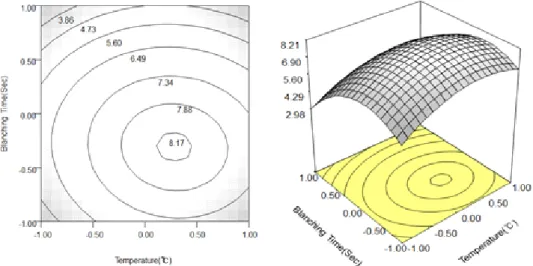
데치기 온도와 시간에 따른 플라보노이드 함량 의 최적 표면 반응 분석결과는 Fig. 2에서 보여 진다. 데치기 온도 8℃ 와 120 sec. 반응하였을 때 플라보노이드의 최대값이 나타났고, 온도 7 5℃ 와 150 sec. 반응하였을 때는 플라보노이드 함량의 최소값이 나타났다. 온도는 70 - 90℃까 지 증가하다가 95℃ 이후에는 감소하는 결과를 보여주었다. 시간은 온도와 비슷하게 70 - 110 sec. 까지 증가하다가 120 sec. 이후에는 감소하
Fig. 3. Contour and 3D plots of response surface. Effect of blanching conditions of temperature (℃) and blanching time (sec.) on DPPH compounds containing in
Cirsium setidens
.Fig. 2. Contour and 3D plots of response surface. Effect of blanching conditions of temperature (℃) and blanching time (sec.) on total flavonolic compounds containing in
Cirsium setidens
.는 결과를 보여주었다. 플라보노이드 함량의 범위 는 2.35 - 8.38 mg/g 으로 나타났다. Lee 등 [37]은 95℃로 데친 엽경채류와 차류 중의 플라 보노이드 함량은 녹차가 44.7 mg/g 으로 가장 높았으며, 근대는 10.7 mg/g, 부추 6.18 mg/g, 케일 15.9 mg/g 으로 보고하였다. 곤드레는 부추 와 비슷한 함량을 보이며 다른 채소에 비해 함량
이 낮았다. 본 논문과 비슷하게 Kim 등[30]은 9 5℃에서 수분 데침 처리된 녹색채소는 플라보노 이드 함량이 약간 낮았다. 반면에 130℃에서 2시 간 동안 고온고압 조건에서 열처리된 녹색채소는 플라보노이드 함량이 증가하였다. Chae 등[32]은 참나물의 데치기 처리 온도와 시간이 높을수록 플라보노이드 함량이 높게 측정되었다는 보고와
Fig. 4. Perturbation plots of response surface. Effect of blanching conditions of temperature (℃) and blanching time (sec.) on
Cirsium setidens.
A, B, and C represent total phenolic compounds, flavonoids, and DPPH radical scavenging activity, respectively.
유사한 결과이다.
3.4. DPPH 라디칼 소거능에 대한 데치기 온도와 시간의 영향
데치기 온도와 시간에 따른 DPPH 라디칼 소 거능의 최적 표면 반응 분석결과는 Fig. 3에서 보 여 진다. DPPH 라디칼 소거능은 데치기 온도는 70 - 75℃ 까지 증가하다가 75℃ 이후에는 감소 하는 결과를 보여주었다. 시간은 온도와 상반된 결과로 70 - 120 sec
.
까지 서서히 감소하다가 120 sec. 이후에는 서서히 증가하는 결과를 보여 주었다. 반면에 Kim 등[30]은 데친 감태는 시간 이 길어질수록 radical 소거능이 계속 감소하였고 보고를 하였다. 본 논문에서 DPPH 라디칼 소거 능의 범위는 42.10 - 67.14 % 으로 나타났다.Chae 등[32]은 데친 참나물의 DPPH 라디칼 소 거능은 38.71%로 데치기 전보다 4.3배의 높은 DPPH 라디칼 소거 활성을 보여주었다.
3.5. 데치기 온도 및 시간의 변화에 따른 DPPH 라디칼 소거능, 총 페놀함량 및 플라보노이드 양의 변화
곤드레 데치기 온도와 시간에 따른 총 페놀 함 량, 플라보노이드, DPPH 라디칼 소거능의 경향 은 Fig. 4에서 보여 진다. 총 페놀 함량의 경향을 보면 데치기 온도에 따라 급격히 감소하다가 증 가하는 것으로 보여 지고, 시간에 따라서는 서서
히 감소하다가 서서히 증가하는 것으로 보여 진 다. 따라서 총 페놀 함량은 온도에 의해 더 많은 영향을 받는 것으로 보여 진다. 플라보노이드 함 량의 경향을 보면 데치기 온도에 따라 증가하다 가 서서히 감소하는 것으로 보여 지고, 시간에 따라서는 서서히 증가하다가 급격히 감소하는 것 으로 보여 진다. 따라서 플라보노이드 함량은 시 간에 의해 더 많은 영향을 받는 것으로 보여 진 다. DPPH 라디칼 소거능의 경향을 보면 데치기 온도에 따라 증가하다가 급격히 감소하는 것으로 보여 지고, 시간에 따라서는 서서히 감소하다가 서서히 증가하는 것으로 보여 진다. 따라서 DPPH 라디칼 소거능은 온도에 의해 더 많은 영 향을 받는 것으로 보여 진다.
4. 결 론
본 연구는 식용 가능한 야생 식물인 곤드레를 표면 반응 분석법을 이용하여 데치기 최적 공정 조건을 확립하고 확립된 공정으로 데친 곤드레를 추출하여 총 페놀 화합물, 플라보노이드의 함량, DPPH 라디칼 소거능을 분석하여 항산화 활성을 연구하였다. 곤드레 데치기 공정의 최적 조건을 구하기 위하여 표면반응 분석법을 이용하여 수행 하였고 모든 실험 계획은 2개의 독립변수 즉, 데 치기의 온도와 데치는 시간을 각각 85℃, 120
sec.
의 조건으로 center run을 5번 반복을 포함 하여 총 13개의 처리조합으로 구성을 하였다. 데 치기 공정 범위로 온도는 70 - 99℃, 시간은 70 - 170 sec. 로 하였다.데치기 처리 후 총 페놀 함량의 범위는 13.00 - 35.48 mg/g 이고 최대 예측 총 페놀함량은 35.48 mg/g, 플라보노이드는 함량의 범위는 2.31 - 8.38 mg/g 이고 최대 예측 플라보노이드 함량 은 8.38 mg/g, DPPH 라디칼 소거능의 범위는 42.10 - 67.14%이고 최대 예측 DPPH 라디칼 소거능은 67.14%로 측정 되었다.
총 페놀 함량의 경향을 보면 데치기 온도에 따 라 급격히 감소하다가 증가하는 것으로 보여 지 고, 시간에 따라서는 서서히 감소하다가 서서히 증가하는 것으로 보여 진다. 따라서 총 페놀 함 량은 온도에 의해 더 많은 영향을 받는 것으로 보여 진다. 플라보노이드 함량의 경향을 보면 데 치기 온도에 따라 증가하다가 급격히 감소하는 것으로 보여 지고, 시간에 따라서는 서서히 증가 하다가 서서히 감소하는 것으로 보여 진다. 따라 서 플라보노이드 함량은 시간에 의해 더 많은 영 향을 받는 것으로 보여 진다. DPPH 라디칼 소거 능의 경향을 보면 데치기 온도에 따라 증가하다 가 급격히 감소하는 것으로 보여 지고, 시간에 따라서는 서서히 감소하다가 서서히 증가하는 것 으로 보여 진다. 따라서 DPPH 라디칼 소거능은 온도에 의해 더 많은 영향을 받는 것으로 보여 진다. 따라서 데치기 공정 최적 조건은 온도 8 5℃와 시간 150 sec. 로 결정되었다.
감사의 글
본 논문은 “산림청 임업연구개발사업 연구비 보조”에 의하여 이루어졌으며 이에 감사드립니다.
References
1. H. Wiseman, Dietary influences on membrane function; importance in protection against oxidative damage and disease,
J Nutr Biochem
, 7, 2-15 (1996).2. D. H. Shin, The study course and movement of natural antioxidant,
Food Sci Ind,
30, 14-21 (1997).3. E. N. Frankel, Antioxidants in lipid foods and their on food quality,
Food Chem
, 57, 51-55 (1996).4. R. A. Larson, The antioxidants of higher plants,
Phytochemistry
, 27, 969-978 (1988).5. I. J. Kang, S. S. Ham, C. K. Chung, S. Y.
Lee, D. H. Oh, K. P. Choi, J. J. Do, Development of fermented soysauce using
Cirsium setidens Nakai
and comfrey,J Korean Soc Food Sci Nutr
, 26, 1152-1158 (1997).6. S. Y. Chang, J. H. Song, Y. S. Kwak, M.
J. Han, Quality characteristics of Gondre tofu by the level of
Cirsium setidens
powder and storage,Korean J Food Culture
, 27, 737-742 (2012).7. J. T. Suh, S. Y. Ryu, W. B. Kim, K. S.
Choi, B. H. Kim, Improvement of gemination rate by low temperature and development of effective shading cultivation of
Cirsium setidens
under rain shelter in highland,Korean J Plant Res
, 9, 151-156 (1996).8. S. H. Lee, Y. S. Jin, S. I. Heo, T. H.
Shim, J. H. Sa, D. S. Choi, M. H. Wang, Composition analysis and antioxidative activity from different organs of
Cirsium setidens Nakai
,Korean J Food Sci Technol
, 38, 571-576 (2006).9. H. E. Im, H. K. Yoe, S. Y. Chang, M. J.
Han, Quality characteristics of Gondregaedduck by the level of
Cirsium setidens
and storage,Korean J Food Culture
, 27, 400-406 (2012).10. S. S. Ham, S. Y. Lee, D. H. Oh, S. H.
Kim, J. K. Hong, Development of beverages drinks using mountain edible herbs,
J Korean Soc Food Sci Nutr
, 26, 92-97 (1997).11. M. J. Park, J. K. Choi, M. Kakishima, H.
D. Shin, First report of rust disease caused by Puccinia nishidana on
Cirsium setidens
,Plant Pathol J,
27, 297 (2011).12. K. C. Lee, H. S. Noh, J. W. Kim, S. S.
Han, Physiological responses of
Cirsium
setidens
andPleurospermum camtschaticum
under different shading treatments,J Bio-Env Con
, 21, 153-161 (2012).13. N. Morita, M. Shimizu, M. Arisawa, Two new flavone glycosides from
Cirsium lineare
,Phytochemistry
, 12, 421-423 (1973).14. H. M. Rauen, H. Schriewer, The antihepatotoxic effect of silymarin on liver damage in rats induced by carbon tetrachloride, d-galactosamine and allyl alcohol,
Arzneimittelforschung
, 21, 1194-1201 (1971).15. M. Mourelle, P. Muriel, L. Favari, T.
Franco, Prevention of CCl4-induced cirrhosis by silymarin, Fundam Clin Pharmacol, 3, 183-191 (1989).
16. M. Ingelman-Sundberg, I. Johansson, K. E.
Penttilä, H. Glaumann, K. O. Lindros, Centrilobular expression of ethanol- inducible cytochrome P450 (IIE1) in rat liver,
Biochem Biophys Res Commun
, 157, 55-60 (1988).17. P. Ferenci, B. Dragosics, H. Dittrich, H.
Frank, L. Benda, H. Lochs, S. Meryn, W.
Base, B. Schneider, Randomized controlled trial of silymarin treatment in patients with cirrhosis of the liver,
J Hepatol
, 9, 105-113 (1989).18. S. H. Lee, Y. S. Jin, S. I. Heo, T. H.
Shim, J. H. Sa, D. S. Choi, M. H. Wang, Composition analysis and antioxidative activity from different organs of
Cirsium setidens Nakai
,Korean J Food Sci Technol
, 38, 571-576 (2006).19. J. Surh, J. O. Kim, M. H. Kim, J. C. Lee, B. Y. Lee, M. Y. Kim, H. W. Yang, S.
Yun, H. R. Jeong, Nutritional properties, as food resources for menu development, of cubed snailfish, shaggy sea raven, and two kinds of wild vegetables that are staple products in Samcheok,
Korean J Food Cookery Sci
, 25, 690-702 (2009).20. W. B. Lee, H. C. Kwon, O. R. Cho, K.
C. Lee, S. U. Choi, N. I. Baek, K. R. Lee, Phytochemical constituens of
Cirsium
setidens Nakai
and their cytotoxicity against human cancer cell lines,Arch Pharm Res
, 25, 628-635 (2002).21. Y. M. Yoo, J. H. Nam, M. Y. Kim, J.
Choi, H. J. Park, Pectolinarin and pectolinarigenin of
Crisium setidens
prevent the hepatic injury in rats caused by D-galactosamine via an antioxidant mechanism,Biol Pharm Bull
, 31, 760-764 (2008).22. W. B. Lee, H. C. Kwon, O. R. Cho, K.
C. KC, S. U. Choi, N. I. BaekI, K. R.
Lee, Phytochemical constituents of
Crisium setidens Nakai
and their cytotoxicity against human cancer cell lines,Arch Pharm Res
, 25, 628-635 (2002).23. M. J. Ahn, S. J. Hur, E. H. Kim, S. H.
Lee, J. S. Shin, M. K. Kim, J. A.
Uchizono, W. K. Whang, D. S. Kim, Scopoletin from
Cirsium setidens
increases melanin synthesis via CREB phosphorylation in B16F10 cells,Korean J Physiol Pharmacol
, 18, 307-311 (2014).24. Y. J. Lee, D. B. Kim, J. S. Lee, J. H.
Cho, B. K. Kim, H. S. Choi, B. Y. Lee, O. H. Lee, Antioxidant activity and anti-adipogenic effects of wild herbs mainly cultivated in Korea,
Molecules
, 18, 12937-12950 (2013).25. J. W. Jeong, S. W. Jeong, K. J. Park, Changes in internal pressure of frozen fruits by freezing methods,
Korean J Food Preserv,
10, 459-465 (2003).26. V. Dewanto, X. Wu, K. K. Adom, R. H.
Liu, Thermal processing enhances the nutritional values of tomatoes by increasing total antioxidant activity,
J Agri Food Chem
, 50, 3010-3014 (2002).27. E. S. Saleh, A. Hameed, Total phenolic contents and free radical scavenging of certain Egyptian ficus species leaf samples,
Food Chem
, 114, 1271-1277 (2008).28. M. S. Blois, Antioxidant determinations by the use of a stable free radical, Nature, 18, 1000 (2004).
29. I. J. Jung, A Weighted Mean Squared
Error Approach Based on the Tchebycheff Metric in Multiresponse Optimization,
Journal of the Korea Academia-Industrial cooperation Society
, 16, 97-105 (2015).30. S. Y. Kim, Y. M. Lee, J. B. Kim, D S.
Park, J. S. Go, H. R. Kim, Comparison of Physicochemical Properties and Antioxidant Activity between Raw and Heat-Treated Vegetables,
The Korean Journal of Community Living Science
, 25, 5-18 (2014).31. G. Oboh, Effect of blanching on the antioxidant properties of some tropical green leafy vegetables,
Swiss Society of Food Science and Technology
, 38, 513–517 (2005).32. H. S. Chae, S. H. Lee, H. S. Jeong, W. J.
Kim, Antioxidant Activity and Physicochemical Characteristics of
Pimpinella brachycarpa Nakai
with Treatments Methods,Korean J. Food &
Nutr
, 26, 125-131 (2013).33. M. K. Roy, L. R. Juneja, S. Isobe, T.
Tsushida, Steam processed broccoli (
Brassica oleracea
) has higher antioxidant activity in chemical and cellular assay systems,Food Chemistry
, 114, 263-269 (2009).34. E. Mayer-Miebach, U. Gartner, B.
Grobmann, W. Wolf, Influence of low temperature blanching on the content of valuable substances and sensory properties in ready-to-use salads,
J Food Engineering
, 56, 215-217 (2003).35. L. Bravo, Polyphenols: Chemistry, dietary sources, metabolism and nutritional significance Nutrition Reviews, 56, 317-333 (1998).
36. Y. Choi, S. M. Lee, J. Chum, H. B. Lee, J. Lee, Influence of heat treatment on the antioxidant activities and polyphenolic compounds of Shiitake (
Lentinus edodes
) mushroom,Food Chem
, 99, 381-387 (2006).37. J. M. Lee, E. S. Son, S. S. Oh, D. S.
Han, Contents of total flavonoid and biological activities of edible plants,