• 검색 결과가 없습니다.

Determination of Heavy metals on the non-woven in wet wipes using ICP-MS

N/A
N/A
Protected

Academic year: 2021

Share "Determination of Heavy metals on the non-woven in wet wipes using ICP-MS"

Copied!
9
0
0

로드 중.... (전체 텍스트 보기)

전체 글

(1)

http://dx.doi.org/10.12925/jkocs.2016.33.1.195

Determination of Heavy metals on the non-woven in wet wipes using ICP-MS

Sung-Min Choi

*

ㆍJin-Kun Song

**

ㆍSang-Jin Kim

**,***,✝

*

PCAM Korea, 12, Techno 11-ro, Yuseong-gu, Daejeon 34036, Korea

**

Chemolee Lab Corporation, 3820 Conflans Rd, Irving, TX 75061, USA

***

Department of Cosmetic Science, Daejeon Health Sciences College, 21, Chungjeong-ro, Dong-gu, Daejeon 34504, Korea

(Received February 16, 2016; Revised March 18, 2016; Accepted April 1, 2016)

Abstract : Heavy metals have been analyzed on the non-woven from the 24 kinds of wet wipes and 8 kinds of mask packs. The following materials used in the non-woven according to each product are: rayon+polyester for the 12 wet wipe products, rayon+PET for the 5 wet wipe products, and rayon, cotton, rayon+polyester+cotton, pulp+polypropylene for the rest of the wet wipe products. No further information on the materials was found on the 3 wet wipes and 8 mask packs. However, polyester may be applied for the non-woven in wet wipes, because PET is part of the polyester group. The heavy metals analysis in the 24 kinds of wet wipes and 8 kinds of mask packs revealed the following: arsenic was found from 47.14±1.13 to 71.75±1.64 ㎍/L on the 3 products, the amount of nickel in the 2 products were 261.26±5.14 and 1,242.63±43.71 ㎍ /L, 53.69±1.45 and 103.52±2.02 ㎍/L on the 2 mask packs. It was also revealed that lead was detected from 7.23±0.32 to 55.67±1.46 ㎍/L on the 6 wet wipes, antimony was ranged from 187.86±5.24 to 19,558.35±3,537.30 ㎍/L on the 12 wet wipes, and 5.25±0.25 and 8,936±55.22

㎍/L on the 2 mask packs. No cadmium, mercury, or thallium were detected from all the products. A high concentration of antimony might come from antimony trioxide, which was used as a catalyst when manufacturing the polyester. Therefore, it is strongly recommended that a non-woven used for cosmetic purposes should not use heavy metals as a catalyst when manufacturing, and it’s important to clarify which materials are used in non-woven.

Keywords : Wet wipes, mask pack, non-woven, heavy metals, ICP-MS

1. Introduction

The MFDS (Ministry of Food and Drug Safety) recently announced that the cosmetics has been covered and broadened its area of



Corresponding author (E-mail: [email protected])

application from skin and hair to teeth and

oral mucosa, based on the definition of

cosmetic issued by the Cosmetic Act. As a

result, toothpaste, oral care products, and wet

wipe for baby and restaurant use are regulated

as cosmetics [1]. “Cosmetics” are defined as

goods used by applying, rubbing and spraying

or in similarly applying to the human body in

(2)

order to increase attractiveness by cleanse or beautify the body, brighten the appearance, and maintain or improve the health of skin and hair. All of which have insignificant effects on the human body as defined in subparagraph 1 of Article 2 of the Cosmetic Act [2]. Companies that manufacture the wet wipes used for the human body are required to institute and practice quality control, safety regulation, indication of which raw materials are used, and advertisement according to the Cosmetic Act [3]. The wet wipe is a moisturized non-woven used for cleaning the human body [4] and consists of liquid and solid phases. The major role of the liquid phase is to clean and supply moisture to the human body, especially for infants; preserve the product, supply the fragrance according to the customer’s needs, and improve product quality. The major ingredient of the liquid phase would be one or more of the followings: plant extracts, including aloe, chamomile, peppermint, jojoba, eucalyptus, olive, lavender, lime, green tea, tea tree oil, and propylene glycol, butylene glycol, hexylene glycol, citric acid, tocopherol, sodium benzoate, panthenol, shea butter, glyceryl caprylate, lecithin, dimethicone, cyclopentasiloxane, and etc,.

The NIFDS (National Institute of Food and Drug Safety Evaluation) collected 120 wet wipes from the market, and evaluated risk assessment on 28 components. Toxic contaminants, such as ethanol, dimethylol dimethyl hydantoin, ethylene oxide, coconut diethanolamide, propyl paraben, methylisothiazolinone, chloromethylisothiazo- linone, 1,2-benzisothiazolin-3-one, poly hexamethylene biguanide hydrochloride, 1-butoxy-2-propanol, sodium lauryl ether sulphate, trimethylammonium chloride, and alcohol ethoxylate, were detected. However, the amount found was not considered toxic or hazard. The amount of alcohol ethoxylate was as low as 1/500 of the regulation limit and lower than 1/100 of the regulation limit on

the rest of 19 contaminants [5]. Also, the KATS (Korean Agency for Technology and Standards) investigated the 51 wet wipes containing cetrimonium, which is used as germicide and preservatives, and found that the amount of cetrimonium bromide in the wet wipes were ranging from 0.0055% (55 mg/kg) to 0.0604% (604 mg/kg), which is much less than the regulation limit of 0.1%

(1,000 mg/kg) [6].

Wet wipes are made of materials such as polyester, polypropylene, cotton, wood pulp, or rayon fibers, and then formed into sheets.

They may be packaged individually, or in

small or bulk packaging. The characteristic of

non-woven has been developed recently. This

development includes hydrogel, of which

non-woven coated with gel [7], micro fiber

which minimize the dynamic friction coefficient

[8], and bio-cellulose, of which non-woven is

3-dimensional net shape structure [9-11]. A

non-woven is not considered a raw material

but, a subsidiary material. Therefore, it should

be tested, inspected, and verified under the

enforcement regulations of the Cosmetic Act

[3]. Rayon, polyester, PET, or cotton is used

for non-woven materials. The rayon is made

from purified cellulose, mainly from wood

pulp, which is chemically converted into a

soluble compound. Polyester is one of the

polymers, which is made of more than 2

alcohols and carboxylic acids using

polycondensation. Polyethylene terephthalate

(PET), which is the polymerization of ethylene

glycol and terephthalic acid, and poly butylene

terephthalate (PBT), which is the

polymerization of butanediol and terephthalic

acid, are the kinds of polyester. The use of a

catalyst when manufacturing PET is inevitable

in the industrial or academic area. Metallic

oxides, such as Sb, Ti, Ge, Fe, Zn, Co, Pb,

Mn, Nb, or their organic compounds are

added during the process of PET

manufacturing in order to increase the speed

of polymerization [12]. However, it is

regulated in most countries to use metallic

(3)

Step Temperature (℃) Power (W) Ramp (min) Dwell (min)

1 120 1,000 8  

2 120 1,000   2

3 180 1,000 8  

4 180 1,000   10

Table 1. Microwave Digestion Program oxides or their organic compounds due to their harmful side effects. There is a tendency to use something other than metallic catalysts.

The use of wet wipes has increased and the market of wet wipes is expected to reach 18.3 million dollars in the year of 2019 [13]. Infant wet wipes are expected to grow 5.4% CAGR (Compound Annual Growth Rate) during 2014 and 2019 [14], and will be expected to grow more in the near future.

The wet wipe market is expected to grow continuously. There has been an increased advancement on the liquid phase of the wet wipe, but not much progress has been made on the safety and toxicity on the non-woven.

The purpose of this research is to show how much heavy metals exist in the non-woven wet wipe and guide safer and more environmental friendly ways to manufacture the non-woven.

2. Materials and Methods 2.1. Materials

Thirty two non-wovens, including 21 kinds of wet wipes purchased in the country and 3 kinds of wet wipes purchased from the USA, 4 kinds of national brand mask packs and 4 kinds of international brand mask packs, have been analyzed for the heavy metals. The materials used for the non-woven are rayon+

polyester on the 12 products, rayon+PET on the 5 products, and rayon, cotton, rayon+

polyester+cotton, pulp+polypropylene on each kind, and no further information was available on the 3 wet wipe products and the mask packs.

2.2. Sample Preparation

The method of microwave digestion was used with the application of Milestone start D (Milestone Inc., Shelton, CT 06484, USA).

Approximately 0.2 g of sample was added into a PTFE vessel containing 7 mL of 70% HNO

3

(Sigma-Aldrich, St. Louis, MO 63103, USA) and 1mL of 50% HF (Sigma-Aldrich, St.

Louis, MO 63103, USA), then performed a microwave digestion. The microwave digestion procedure is shown in the Table 1. The samples were then transferred and diluted with 25 mL of ASTM type 1 water.

2.3 Instrumentation

A NexION 300X ICP-MS (Perkin Elmer, Shelton, CT 06484, USA) was utilized for the measurement of antimony, arsenic, cadmium, lead, mercury, nickel and thallium. The Table 2 showed the test conditions of the ICP-MS.

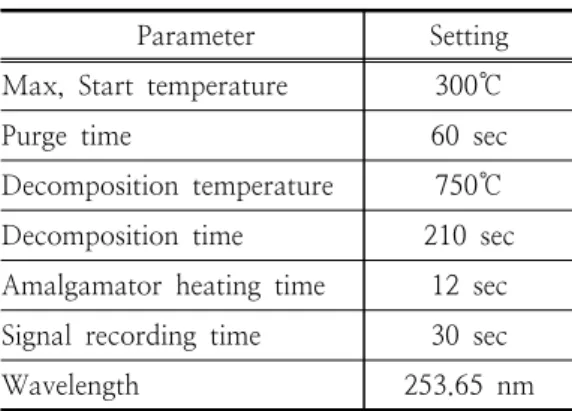
A Milestone DMA 80 Mercury Analyzer (Milestone Inc., Shelton, CT 06484, USA) was applied for the mercury analysis. The mercury analysis did not require any sample preparation. The Table 3 presented the mercury analysis conditions.

2.4. Standard Solutions and Reagents

Multi-element, internal standard, standard

stock solutions were purchased from Agilent

Technologies (Santa Clara, CA 95051, USA),

70% nitric and 50% hydrochloric acid were

purchased from Sigma-Aldrich (Sigma-Aldrich,

St. Louis, MO 63103, USA), and D.I water

was produced by using a Milli-Q system

(Millipore, Bedford, MA).

(4)

Table 2. ICP-MS Instrument Conditions

Parameter Setting

RF power (W) 1,350

Coolant flow (L/min) 16 Nebulizer flow (L/min) 0.99 Auxiliary flow (L/min) 1.2

Spray chamber PFA

Nebulizer Teflon nebulizer

Torch Quartz torch

Injector Alumina injector

Table 3. Mercury Analyzer Instrument Conditions

Parameter Setting

Max, Start temperature 300℃

Purge time 60 sec

Decomposition temperature 750℃

Decomposition time 210 sec

Amalgamator heating time 12 sec Signal recording time 30 sec

Wavelength 253.65 nm

2.5 Calibration Curve

The four calibration standards, including 0, 10, 50, and 100 ㎍/L, were utilized for the measurement of antimony, arsenic, cadmium, lead, nickel and thallium, and lower range sets of calibration standards, including 0, 2.5, 5, and 10 ㎍/L, were applied for the mercury analysis. Four point external calibrations with standards were used to quantify the elements in the digestate. The value of each R

2

was ranging from 0.9992-0.9999, which showed the very close relationship between concentration and peak area. Each calibration standard graph was presented in the Fig 1.

2.6. LOD and LOQ

LOD (Limit of Detection) is defined as 3×SD

0

, where SD

0

is the value of the standard deviation as the concentration of the

analysis approaches to zero. The value of SD

0

can be obtained by extrapolation from a plot of standard deviation versus concentration where three concentrations are analyzed. On the other hand, LOQ (Limit of Quantification) is defined as 10×SD

0

. The LOQ on arsenic, mercury and nickel is 007, 0.08, and 0.33 ㎍ /L, respectively, and the rest of them are 0.03

㎍/L. The LOD and LOQ were shown in the Table 4.

Table 4. LOD and LOQ of Heavy Metal Elements (unit; ㎍/L) Elements LOD LOQ Instruments

As

75

0.02 0.07

ICP-MS Cd

111

0.01 0.03

Ni

60

0.11 0.33 Pb

208

0.01 0.03 Sb

121

0.01 0.03 Tl

205

0.01 0.03

Hg 0.025 0.80 Mercury Analyzer

3. Results and Discussions

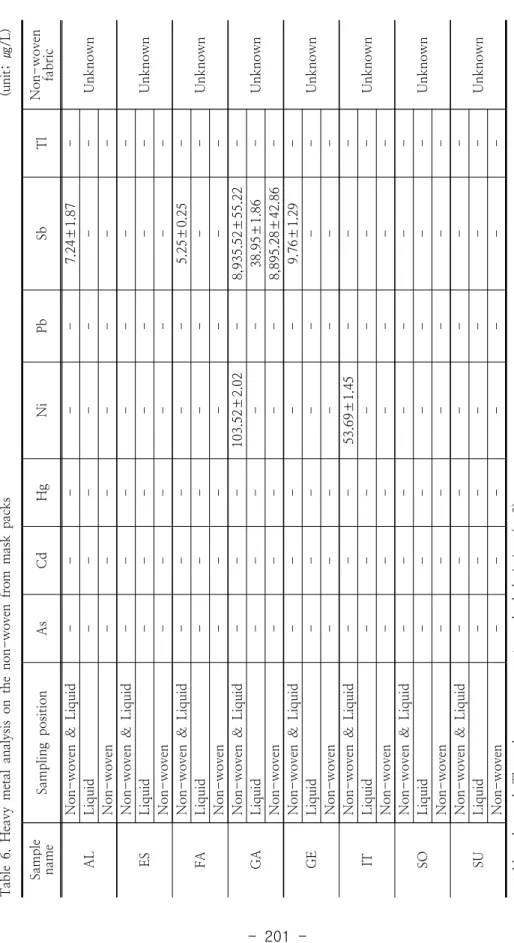
The heavy metals analysis on the

non-woven from 24 kinds of wet wipes and 8

kinds of mask packs showed that arsenic was

ranging from 47.1±1.13 to 71.75±1.64 ㎍/L

on the 3 wet wipe products, nickel was

261.26±5.14 and 1,242.63±43.71 ㎍/L on the

2 wet wipe products, 53.69±1.45 and

103.52±2.02 ㎍/L on the 2 mask pack

products, lead was ranging from 7.23±0.32

through 55.67±1.46 ㎍/L on the 6 wet wipe

products, antimony was ranging from

187.86±5.24 to 19,558±3,537.30 ㎍/L on the

12 wet wipe products, and 5.25±0.25 to

8,936±55.22 ㎍/L on the 2 mask pack

products. No heavy metals, such as cadmium,

mercury, or thallium were found from the all

products. Test results on the wet wipes and

mask packs were presented in the Table 5,

and 6, respectively.

(5)

Fig 1. Calibration standard graph of As, Cd, Ni, pb, Sb, Tl, and Hg.

(6)

le 5 . H ea vy m et al a na ly sis o n th e no n- w ov en f ro m w et w ip es ( un it; ㎍ /L ) Sa m pl e N am e A s Cd H g N i Pb Sb T l N on -w ov en f ab ri c Us e BE - - - - - 29 8.9 3± 11 .8 6 - R ay on +Po ly es te r In fa nt BO - - - - - 10 ,4 28 .7 7± 23 1.2 8 - R ay on +Po ly es te r In fa nt BU - - - - - - - R ay on +Po ly es te r In fa nt D R - - - - 11 .0 8± 0.5 1 8,2 08 .0 0± 53 .2 0 - R ay on +Po ly es te r In fa nt EC - - - - 36 .7 7± 0.9 3 28 1.3 4± 11 .7 1 - R ay on +Po ly es te r In fa nt G U - - - - - - - R ay on +Po ly es te r In fa nt M A - - - - - 18 7.8 6± 5.2 4 - R ay on +Po ly es te r In fa nt T O - - - - - - - R ay on +Po ly es te r In fa nt CR - - - - - - - R ay on +Po ly es te r G en er al FR - - - - - 35 2.1 7± 12 .7 8 - R ay on +Po ly es te r G en er al JA - - - - - 3,8 67 .0 5± 51 .8 9 - R ay on +Po ly es te r G en er al SE - - - - - - - R ay on +Po ly es te r G en er al BA - - - - 17 .9 7± 0.4 3 8,9 04 .7 1± 20 .4 3 - R ay on +PE T In fa nt O G - - - - - - - R ay on +PE T In fa nt GO - - - - - - - R ay on +PE T G en er al KR - - - - - 12 ,6 69 .9 7± 44 5.4 6 - R ay on +PE T G en er al PE - - - - - - - R ay on +PE T G en er al M O - - - 26 1.2 6± 5.1 4 55 .6 7± 1.4 6 11 ,6 92 .7 7± 61 0.2 6 - R ay on +Po ly es te r+ Co tt on In fa nt M L - - - - - 19 ,5 58 .3 5± 3,5 37 .3 - R ay on In fa nt H A - - - - - - - Pu lp +Po ly pr op yl en e In fa nt PU* 71 .7 5± 1.6 4 - - - - - - Co tt on Un kn ow n PA * 47 .1 4± 1.1 3 - - 1,2 42 .6 3± 43 .7 1 25 .0 0± 1.4 2 3,6 55 .5 2± 53 .4 5 - C lo th L ik e Un kn ow n SC* 49 .8 7± 1.4 8 - - - 7.2 3± 0.3 2 - - Un kn ow n Un kn ow n DE - - - - - - - Un kn ow n In fa nt ; N on d et ec te d, * ; M ad e in U SA , T he v al ue s ar e m ea ns ± st an da rd d ev ia tio n (n =3 ).

(7)

T ab le 6 . H ea vy m et al a na ly sis o n th e no n- w ov en f ro m m as k pa ck s (u ni t; ㎍ /L ) Sa m pl e na m e Sa m pl in g po si tio n A s Cd H g N i Pb Sb T l N on -w ov en fa br ic A L N on -w ov en & L iq ui d - - - - - 7.2 4± 1.8 7 - U nk no w n Li qu id - - - - - - - N on -w ov en - - - - - - - ES N on -w ov en & L iq ui d - - - - - - - U nk no w n Li qu id - - - - - - - N on -w ov en - - - - - - - FA N on -w ov en & L iq ui d - - - - - 5.2 5± 0.2 5 - U nk no w n Li qu id - - - - - - - N on -w ov en - - - - - - - GA N on -w ov en & L iq ui d - - - 10 3.5 2± 2.0 2 - 8,9 35 .5 2± 55 .2 2 - U nk no w n Li qu id - - - - - 38 .9 5± 1.8 6 - N on -w ov en - - - - - 8,8 95 .2 8± 42 .8 6 - GE N on -w ov en & L iq ui d - - - - - 9.7 6± 1.2 9 - U nk no w n Li qu id - - - - - - - N on -w ov en - - - - - - - IT N on -w ov en & L iq ui d - - - 53 .6 9± 1.4 5 - - - U nk no w n Li qu id - - - - - - - N on -w ov en - - - - - - - SO N on -w ov en & L iq ui d - - - - - - - U nk no w n Li qu id - - - - - - - N on -w ov en - - - - - - - SU N on -w ov en & L iq ui d - - - - - - - U nk no w n Li qu id - - - - - - - N on -w ov en - - - - - - - - ; N on d et ec te d, T he v al ue s ar e m ea ns ± st an da rd d ev ia tio n (n =3 ).

(8)

4. Conclusion

Wet wipe is categorized as a cosmetic under the regulation of the 2014-230 from the Ministry of Food and Drug Safety. The risk assessment was tested and proved safety on wet wipes by the National Institute of Food and Drug Safety Evaluation and the Korean Agency for Technology and Standards. Twenty four kinds of wet wipes and eight kinds of mask packs were collected and found that the following materials are used in the non-woven: rayon+polyester for the 12 wet wipe products, rayon+PET for the 5 wet wipe products, and rayon, cotton, rayon+polyester+

cotton, pulp+polypropylene for the rest of the wet wipe product. No further information was available on the materials used for the 3 wet wipes and 8 mask packs. Polyester may be applied for the non-woven in wet wipe, because PET is part of the polyester group.

The LOQ on antimony, cadmium, lead, and thallium was 0.03 ㎍/L, and arsenic was 0.07

㎍/L, and nickel was 0.33 ㎍/L, and mercury was 0.80 ㎍/L. The heavy metal analysis in 24 kinds of wet wipes and 8 kinds of mask packs revealed the following: arsenic was ranged from 47.14±1.13 to 71.75±1.64 ㎍/L on the 3 products, the amount of nickel in the 2 products was 261.26±5.14 and 1,242.63±43.71 ㎍/L, 53.69±1.45 and 103.52±2.02 ㎍/L on the 2 mask packs. It was also revealed that lead was ranged from 7.23±0.32 to 55.67±1.46 ㎍/L on the 6 wet wipes, antimony was ranged from 187.86±5.24 to 19,558.35±3,537.30 ㎍/L on the 12 wet wipes, and 5.25±0.25 and 8,936±55.22 ㎍/L on the 2 mask packs. No cadmium, mercury, or thallium were detected from all the products. Relatively high concentration of antimony from the non-woven may come from the process. A catalyst, such as antimony trioxide or antimony glycolate, was added into the process when manufactured polyester, which is the material of non-woven. The toxicity of

antimony trioxide was reported; it caused pneumoconiosis, or fibroma on the reproductive toxicity and acute oral toxicity [15]. It is regulated by the Toxic Chemical Control Act [16], IARC group 2B (International Agency for Research on Cancer group 2B: possibly carcinogenic to humans) by US EPA (United States Environmental Protection Agency) and ACGIH A2 (The American Conference of Governmental Industrial Hygienists: Suspected human carcinogen) [17].

In summary,

1. Even though the amount found from non-woven was not considered toxic or hazard, it is still recommended to control the non-woven material that is used in wet wipes or mask packs.

2. It is recommended to clarify which materials are used in non-woven in wet wipes or mask packs.

3. It is suggested to use a heavy metal free catalyst during the process of non-woven manufacture.

Acknowledgement

This paper was supported by Daejeon Health Sciences College in 2015.

References

1. Enforcement regulations of the Cosmetic Act, Pre-announcement of legislation No 2014-230, Minister of Food and Drug Safety. (2014.8.19.).

2. Cosmetic Act, Partially amended from legislation No 13117, (2015.1.28.).

3. Enforcement regulations of the Cosmetic

Act, Article 12(7), Partially amended by

prime minister decree No 1182,

(9)

(2015.7.29.).

4. Self-regulatory safety confirmation annex 49, Wet wipe (Wet tissue), Notification No. 2012-170 of Korean Agency for Technology and Standards, (2012.4.17.).

5. J. H. Wang, Comprehensive risk assessment report of household chemical products Part 1. Risk assessment of wet wipes, National Institute of Food and Drug Safety Evaluation, ISBN 11-1471057-000117-01, (2015.4).

6. Korean Agency for Technology and Standards, Result of actual condition survey on the wet tissue - Cetrimonium group cosmetics are detected within the safety limit, Press release of Ministry of Trade, Industry and Energy, (2014.12.1.).

7. A. Sannino, C. Demitri, and M.

Madaghiele, Biodegradable cellulose-based hydrogels: Design and applications, Materials , 2(2), 353-373(2009).

8. J. W. Lee, D. S. So, and H. S. Su, Nanofibers : Preparations and applications, KIC News , 13(1), 32-50(2010).

9. M. Catel-Ferreira, H. Tnani, C. Hellio, P.

Cosette, and L. Lebrun, Antiviral effects of polyphenols: Development of bio-based cleaning wipes and filters, J. Virol.

Methods , 212, 1-7(2015).

10. ezcostec, Manufacturing method of cosmetic biocellulose sheet and cosmetic biocellulose sheet by using therof, Korea patent 10-1385501(2014.04.09.).

11. KAERI, Microbial fermentation of cellulose porous filters and manufacturing method thereof, Korea patent 10-1583058 (2015.12.30.).

12. KRICT, SKchemicals, Development of clean process technology for preparing PET, Ministry of Environment, (2003.

7.21.).

13. Smithers Apex Market Intelligence, The future of nonwoven wipes to 2019, Smithers Apex, (2014.12).

14. TechNavio, Global baby wipes market 2015-2019, Infiniti Research Ltd., (2015.

2.25).

15. M. K. Noh, Result report of actual condition survey on the use and distribution of chemical materials (Antimony), Korea Occupational Safety and Health Agency, (2010.4.).

16. Antimony trioxide : Toxic material, Notification No. 2005-21 of the National Institute of Environmental Research (Amendment Notification), (2005.6.28.).

17. EPA Document # 740‐Z1‐4001, Antimony

trioxide, United States Environmental

Protection Agency, (2014.8).

수치

Table  1.  Microwave  Digestion  Programoxides  or  their  organic  compounds  due  to their  harmful  side  effects
Table  4.  LOD  and  LOQ  of  Heavy  Metal  Elements                                (unit;  ㎍/L) Elements LOD  LOQ  Instruments
Table 6. Heavy metal analysis on the non-woven from mask packs                                                               (unit; ㎍/L) Sample  nameSampling positionAsCdHgNiPbSbTlNon-wovenfabric ALNon-woven & Liquid-----7.24±1.87-UnknownLiquid-------

참조

관련 문서

Food and Drug Administration announced today that the agency is recommending removing the breast cancer indication from the label for Avastin (bevacizumab) because the drug has

Hagen, “The Efficacy Requirements of the Food, Drug and Cosmetic Act”, Food Drug Cosm.. Bodenheimer, “The drug Amendments of 1962 : The anatomy of a Regulatory

1 John Owen, Justification by Faith Alone, in The Works of John Owen, ed. John Bolt, trans. Scott Clark, "Do This and Live: Christ's Active Obedience as the

Stavins, Benefit-Cost Analysis in Environmental, Health, and Safety Regulation, American Enterprise Institute, The Annapolis Center, and Resources for the

The Analysis of Characteristics of Heavy Rainfall over the Korean Peninsular, through Case Studies of Heavy Rainfall Events.. during the On - and Off -

And the objective of radiation safety control is to ensure radiation safety by limiting the probability of stochastic effects below the acceptable ALARA

In this thesis, a methodology using the VISSIM simulation model and surrogate safety assessment model (SSAM) was utilized to quantify the impacts of the leading

In conclusion, the result that the walk-using safety educational activities designed for young children had effects on their safety problem solving ability