• 검색 결과가 없습니다.

The Development of Science Education Program Based on Culturally Responsive Teaching

N/A
N/A
Protected

Academic year: 2021

Share "The Development of Science Education Program Based on Culturally Responsive Teaching"

Copied!
13
0
0

로드 중.... (전체 텍스트 보기)

전체 글

(1)

The Development of Science Education Program Based on Culturally Responsive Teaching

Choong-duk Chung∙Kyung-hee Kang*

Abstract: The purpose of this study was to design a development frame for multicultural science program and develop a corresponding program using the frame. This study organized a development frame to design a multicultural science education program based on the culturally responsive teaching theory. This development frame consisted of the elements of purpose, teaching examples, teaching and learning methods, and assessment. This program consisted of the guideline for class teaching courses, reading materials, student worksheet, and teachers' reference materials. Based on this development frame, a multicultural science education program was developed, which was comprised of seven activities for elementary and middle school students. Each activity of the program included the concept and inquiry related to science education. In particular, by connecting the concept of science with the cultural characteristics of various countries, the activity made students aware of cultural diversity and the commonness of science principles. Compared to other subjects, the science education field has not actively undertaken studies on multicultural education. In term of dealing with universal principles, science education is suitable for making students aware of commonness. Accordingly, this gives rise to the need to draw cultural characteristics based on basic studies such as the analysis of science textbooks in various countries and develop culturally responsive programs utilizing the outcomes.

Key words: culturally responsive teaching, multicultural science education program, cultural diversity Jeju National University

Ⅰ. Introduction

Today, most countries are multicultural countries that have diversity in terms of culture, race, language, and religion. The Korean society is not an exception. The number of foreigners registered in Korea increased 120,000 people in 1995 to 1,409,000 people in 2012 (Asia Economics, 2012). At this fast rate, the Korean society is entering into a multicultural society. In particular, students from multicultural families have steadily increased in elementary, middle, and high schools, including children from international marriages and the children of foreign workers. Such social changes are heightening the need for multicultural education in the education field (Kivisto, 2002).

Regarding the concept of multicultural education, various views are suggested. Using the term ‘multicultural education’ , Grant &

Sleeter (1985) emphasized the meaning of a comprehensive reform that covers educational processes and environments in order to embrace diversity. Kim (2000) viewed multicultural education as understanding various world cultures and cultivating the qualities of individuals to become a member of global communities.

In addition, Yang (2008) defined multicultural education as the education based on democratic beliefs and values to facilitate cultural diversity in a culturally diverse society. Such viewpoints suggest that multicultural education is an attempt to improve people’ s quality of life as the members of society by providing equal educational opportunities regardless of their ethnicity or culture.

In relation to multicultural education, one of the effective methods suggested for the cultivation of multicultural competence is

*Corresponding author: Kyung-hee Kang ([email protected])

**Received on 5 February 2013, Accepted on 20 April 2013

***This work has been studied by the 2013 research grant from Jeju National University.

(2)

culturally responsive teaching. Banks (2007) defined the culturally responsive teaching as an equity pedagogy that leads students from various racial and cultural groups to effectively participate in the society to which they current belong to. He also explained it as a strategy that can obtain the knowledge, functions, and attitudes necessary to create and sustain a democratic society. In addition, Ramsey (2009) stressed the importance of cultural accordance between school and home in culturally responsive teaching. In other words, he insisted that culturally responsive teaching is to teach ethnically and culturally diverse students utilizing their merits and strengths. In particular, a study (Ladson-Billings, 1995) reported that the academic achievement of students from socially neglected multicultural backgrounds were improved through culturally responsive teaching. Therefore, culturally responsive teaching can be defined as acknowledging the various cultural backgrounds of students and teach them by actively utilizing the backgrounds.

Unlike such an emphasis on the necessity for culturally responsive teaching, in the real education field, detailed discussions on the direction and methods of multicultural education are limited (Park, 2011). Moreover, it is pointed out that the currently implemented multicultural education programs lack systematic approaches as they are mostly short-term programs (Kwang

& Yang, 2008). In particular, the Revised Educational Curriculums in 2007 lay the ground for the implementation of multicultural education by including it as one of ‘cross- curricular learning’subjects (Ministry of Education, Science & Technology, 2007).

However, it is another fact that the implementation of multicultural education among a number of cross-curricular subjects is still problematic.

Particularly, in light of the opinions that to improve the effectiveness of multicultural education, responsive teaching should be

implemented on a consistent basis toward all learners (Banks, 2002; Duplass, 2004; Parker, 2001), the efforts to implement cultural education in a systematic manner may be necessary. In relation to this, a study emphasized the relationship between multicultural education and subject matter education (Chang, 2006), while another study suggested the necessity for the review of multicultural education methods that reflect the characteristics of learners (Eun, 2009). Therefore, it is highly meaningful to run various discussions on multicultural education in the field of subject matter education and develop multicultural education programs based on them.

In Korea, studies on multicultural education has rather been concentrated on the education of children from multicultural families. In May 2006, the Ministry of Education and Human Resources announced through the Measures to Support the Education of Children from Multicultural Families that it would review the previous textbooks and curriculums based on the ideology of a homogeneous nation. The contents of the corresponding mullticultural education are focused on the education targeted at children from multicultural families, including support for the opening of ‘after-school programs’ , prevention of the lack of learning in the children of foreign workers or from international marriages, and the preferred selection of children from multicultural families as the subjects for the mentoring of university students. However, systematic studies regarding how to establish the concept of multicultural education, who would be the recipients of the education, and what would be its detailed teaching methods still remain inadequate.

Studies related to multicultural education in the field of subject matter education (Kim, 2000;

Kim, 2006; Lee, 2003; Seol, 2004) have been

focused on the subjects of social science, art,

moral, and Korean language. Studies on subject

matter education (Hong, 2011; Kim, 2003; Kim,

2006) have been undertaken revolving around

(3)

various keywords such as anti-prejudice education, education for international understanding, global education, and education for the understanding of different cultures. The recent studies have also shown the trend that each class subject is integrated into multicultural education (Yang, 2008). Unlike this trend, however, in Korea’ s science education field, studies related to multicultural education have rarely been undertaken.

Multicultural science education can be interpreted as the ‘science education for learners from multicultural families’. Particularly, muticultural science education acknowledges diversity and supports migrant students to well adapt to science education in their school. At the same time, it may also include the incorporation of their home country’ s science culture besides Western science that is currently positioned as mainstream science (Oh, 2010).

In overseas countries, the study findings that the cultural and ethnic backgrounds of students influence their academic achievement and attitude in science learning have continuously been proposed. Aikenhead (1997) stressed that the cultural background to which a student belongs influences his/her understanding on the development and essential nature of science. In addition, Cunha (2005) asserted that a major element that affects students’understanding of science is the culture to which the students belong. Notably, Atwater et al (2010) reported that the learning attitudes of ethnic minority students were improved through multicultural science classes.

In addition, Wallace & Brand (2012) conducted a qualitative study on two middle school science teachers. Based on the study results, they highlighted the importance of teachers’own sociocultural awareness in order to run multicultural classes and manage various relationships. Cunha (2011) pointed out that teachers lack the perception that they can support students from the cultural backgrounds that differ from their own, and insisted that in

order to overcome this, teachers should understand various social and idealogical backgrounds. Holocker (2010) emphasized the responsibility of teachers in multicultural education based on their analysis of the correlation between teachers’attitudes and students’academic improvement in classes that applied the culturally responsive teaching theory.

The above studies emphasized the importance of culturally responsive teaching based on students’diverse cultural backgrounds and showed the importance of teachers’mindset in the process of implementing multicultural education in science classes. Moreover, they demonstrated the improvement in learning attitudes and the understanding of science among students through culturally responsive teaching.

In Korea’ s science education field, studies on multicultural education have revolved around the studies that performed a comparative analysis on the science textbooks of various countries (Kim, 2012; Lee & Ahn, 2005; Oh, 2010; Shim & Choe, 2005; Suh, 2007). Therefore, the development of programs that can implement multicultural education in science classes is meaningful in terms that they are applicable to the real education field. In this regard, the present study intends to design a development frame for multicultural science education programs and develop a corresponding program.

Ⅱ. Methods

1. Principles of program development

In this study, to develop multicultural science

education programs, existing studies on

muticultural curriculum development models

(Banks, 2008; Bennett, 2007; Gay, 2004) were

reviewed. Gay (2004) stressed the maintenance

of ‘reality and suitability’ aimed at strengthening

the connection between multicultural education

(4)

and regular subjects. In addition, Bennett (2007) insisted that students’native culture and history should be utilized as learning contexts. Banks (2008) proposed a concept-oriented multicultural curriculum model and emphasized the organization of multicultural curriculum centered on the core concepts and generalization drawn from regular subjects.

In particular, Irvine & Armento (2001) insisted the ‘ principle of culturally responsive curriculums’based on culturally responsive teaching. This principle suggested the characteristics of culturally responsive teaching across the three areas of instructional examples (IE), student engagement (SE), and assessment (A). The principle’ s contents suggested by the authors are shown in Table 1. They also designed a program development frame based on this principle.

2. Research procedure

The present study was conducted through the following procedure.

Firstly, this study analyzed domestic and overseas precedent studies related to multicultural education and designed a program

development frame. In particular, as the program that this study intended to develop is based on culturally responsive teaching, its development items were established in a way to include the characteristics of culturally responsive teaching.

Secondly, the study reviewed the science curriculums of elementary, middle, and high schools under the 2009 Revised Educational Curriculums. Among the contents of science education, the contents considered to be suitable for culturally responsive teaching were screened and relevant materials were investigated.

Thirdly, the study organized the selected contents into a concrete program using a development frame for science education programs based on culturally responsive teaching. This program consisted of the guideline for class teaching courses, reading materials, student worksheet, and teachers’

reference materials.

Fourthly, the development frame and the contents of curriculum analysis were reviewed by two middle school science teachers and two elementary school teachers. Based on their suggested opinions, the program was modified and strengthened. Among the teachers who Table 1

Culturally responsive curriculum principles(Irvine & Armento, 2001)

Instructional Examples(IE)

IE1 Cultural examples used in the curriculum: Inclusion

IE2 Alternative perspectives

IE3 Diversity and commonalities

IE4 Culturally relevant and student-generated images/metaphors/examples

Student Engagement(SE)

SE1 Purpose/curiosity/anticipation

SE2 Multiple learning preferences

SE3 Individual/unison/team communications SE4 Cooperative/competitive/individual goals

SE5 Student choices/decision making

Assessment(A)

A1 On-going assessment, using a range of materials

A2 Assessment information to provide feedback and inform instruction

A3 Special accommodations for special learners

(5)

participated in a review of multicultural education, the elementary and middle school teachers had previously conducted studies related to multicultural education at a multicultural education research school. In addition, the middle school science teachers were experienced in developing science education programs, and therefore, were considered eligible for the review on the analysis of development tools and curriculums.

Ⅲ. Results and Discussion

1. Design of a development frame for multicultural science education programs for culturally responsive teaching

This study performed a review of precedent studies related to culturally responsive teaching (Cunha, 2011; Irvine & Armento, 2001; Taylor, 2011; Wallace & Brand, 2012). As a result, essential elements for the development of multicultural science education programs aimed at culturally responsive teaching were extracted.

Moreover, the components of the development frame were screened by reviewing studies related to the development of education programs (Lee & Jang, 2010; National Youth

Policy Institute, 2007).

Particularly, in order to reflect the diversity of each country and region, the presentation of cases involving cultural elements was included in the program development frame. The designed development frame was revised by two middle school science teachers and two elementary school teachers, and then amended and strengthened based on the teachers’opinions.

The development frame emphasized the point of how science teachers would connect various cultural examples with science class contents in developing multicultural science education programs. Thus, the tool intended to provide a clue to how to run classes by establishing teaching and learning methods as an element of the development frame. The detailed contents of the designed program development frame are shown in Table 2.

2. Review of science curriculum

In order to develop a culturally responsive education program, the 2009 Revised Education Curriculums were reviewed in relation to science education. Based on the learning contents suggested for each grade group, the contents appropriate for culturally responsive education

Component Category Symbol Contents

Purpose

Knowledge PK understanding of science knowledge Inquiry PI development of science process skill

Attitude PA openness, interest, curiosity

Instructional Examples

Cultural examples IC application of cultural examples Diversity and commonalities ID various phenomenon and common

science principle

Teaching- learning methods

Cooperative learning TC cooperation of students with diverse cultural backgrounds Interactin between teacher and

student TI the role of teacher to encourage cooperation and communication Assessment Assessment methods AA performance assessment on the activities Table 2

The development framework

(6)

were screened. An important perspective in culturally responsive education is to help students recognize commonalities while utilizing cultural diversity. Therefore, among the contents of science curriculums, the contents that can explain various phenomena that occur in various regions all around the world with an identical science principle were extracted. In the review of the curriculums, this study attempted to extract the themes that reflected not only the diversity of mere phenomena, but the cultural characteristics of respective regions. The review of the curriculums was performed by the researcher and the resulting analysis contents were examined by the teachers who participated in the review of the development tools. The contents of the curriculum utilized in our

program are shown in Table 3.

3. Development and assessment of a culturally responsive science education program

In accordance with the development frame proposed earlier, a science education program for culturally responsive teaching was developed.

This program consisted of seven activities including three activities for elemental school students and four activities for middle school students.

The activities for elementary school students were comprised of Constellations of the northern and southern hemispheres, Finding constellations, and Science principles contained in proverbs. The activities for middle school students were

Table 3

Curriculum content related to program

Grade band domain Learning contents achivement

standard Inquiry activity

5th-6th Life and earth

�Learners know what the stars are.

Learners understand the constellation(connection of stars).

�Learners can find Polaris using the Big Dipper and Cassiopeia.

Finding bright planets such as Venus, Jupiter, Saturn and Browse in the night sky.

Finding Polaris using the Big Dipper and Cassiopeia.

Middle school

1st-3rd Matter and energy

�Learners know that the three primary colors of light can be synthesized by a variety of light.

Learners know that this principle is to take advantage of the imaging device.

�Learners observe images appearing through several mirrors and lenses.

Learners should understand the principles generated by the lens on the convex and flat mirrors

�Learners understand the phenomena of reflection and refraction from the proceeds of the wave

�The learners understand the process of sounds being heard, as well as the amplitude of sound waves, the number of vibrations, the intensity of sounds from wave patterns, the high and low of sounds, and the style of sounds.

Exploring the principle of the synthesis of a computer monitor using the three primary colors of light and color

Finding kind and characteristics of mirrors and lenses that are used in everyday life.

Observing the nature of wave through the water-wave experiments

Performing an analysis on the

characteristics of various

instruments through the

analysis of wave patterns

(7)

comprised of The world’ s magic using light, How is the rainbow formed?, The world’ s shadow puppet shows, and The world’ s traditional music instruments.

Constellations of the northern and southern hemispheres was organized for students to examine the constellations of the northern and southern hemispheres and recognize differences in observed constellations according to varied regions during the course of presentation.

Particularly, it was developed to help students from various regional backgrounds compare how their experiences differ one another and understand the reasons that constellations appear differently according to individual regions.

Finding constellations was organized to help students understand the principle of astronomical observation during the course of making constellation boards on their own. In particular, by introducing the stories of individual countries all around the world, the activity intended to have students recognize the origins of constellations, as well as culturally different and common features related to the origins. Notably, this activity emphasized cultural diversity by instructing students to research each country’s stories related to constellations and make presentations. In particular, an activity paper was organized in a manner that enables the learners to think about the modes of expressing historical and cultural differences in varied countries through the names of constellations. In addition, creative thinking was induced through the activity of Making my own names of constellations.

Science principles contained in proverbs was comprised of sub-activities that examine the proverbs that contain science principles among the proverbs of various countries. This activity was designed to help students understand how identical science principles are expressed in mutually different cultural backgrounds and acknowledge the correlations between science and culture.

The world’ s magic using light is the activity to understand the nature of light through various magic images that use the refraction and reflection of light. In particular, various examples of utilizing the nature of light were suggested by introducing magic performances in China and the Arab region in which traditional magic has been passed down.

How is the rainbow formed? is the activity to understand the nature of light dispersion and the phenomena resulting from it. In this activity, unique rainbows observed in countries such as the Ukraine, China, and UK were introduced, including broken and ice rainbows. In addition, it was suggested that various shapes of rainbows are observed according to geographical features and conditions. This activity is to make students aware of the fact that various phenomena experienced in their surroundings can be explained by an identical science principle.

The world’s shadow puppet shows is the activity in which students write scripts for shadow puppet shows based on traditional shadow puppet shows that are frequently performed in China, Thailand, Iran, Turkey, and Indonesia, and make their own performance.

This activity is designed to make students understand that various puppet shows have been performed using the science principle of the synthesis of light.

The world’ s traditional instruments is the activity to examine string and percussion instruments performed in the world’ s various countries, including Gayageum in Korea, Kandele in Finland, Kamanche in Turkey, and Dan da in Vietnam. This activity involves the process of understanding the principle of making sound in each instrument and play music using items around them.

In particular, this program was developed to

make students aware of various backgrounds in

terms of culture, history, and religion, accept

mutual diversity and discover common aspects

while learning together. Accordingly, the

program was organized in a way to encourage

(8)

students to express various experiences and use such experiences as the subjects of classes. It was also designed for students to utilize not only verbal expressions, but also various other styles of expressions including images, sounds, and metaphors. Such detailed expressions play the role of creating meanings in connection with culture for both students and teachers (Wittrock, 1986).

Notably, this study was focused on not limiting the subjects of the multicultural education program to children from multicultural families, but having all students in their usual science classes participate in the program. The question of how to decide the subjects of multicultural education is of great importance. This is because the purpose and contents of its programs can change according to their subjects. The present study viewed that multicultural education should be provided not as after-school activities or non-school programs, but in actual school classes. Accordingly, all students in the respective classes were selected as the subjects.

In addition, this program emphasized the participation and cooperation of students. This is because when the classes of cooperative learning are run, the mutual understanding and communication among students become further facilitated. Particularly, by applying various inquiry activities including research, presentation, and experiments to the teaching and learning methods among the program elements, the program was organized to cultivate an open attitude and understanding toward multiple cultures during the course of inquiry activities.

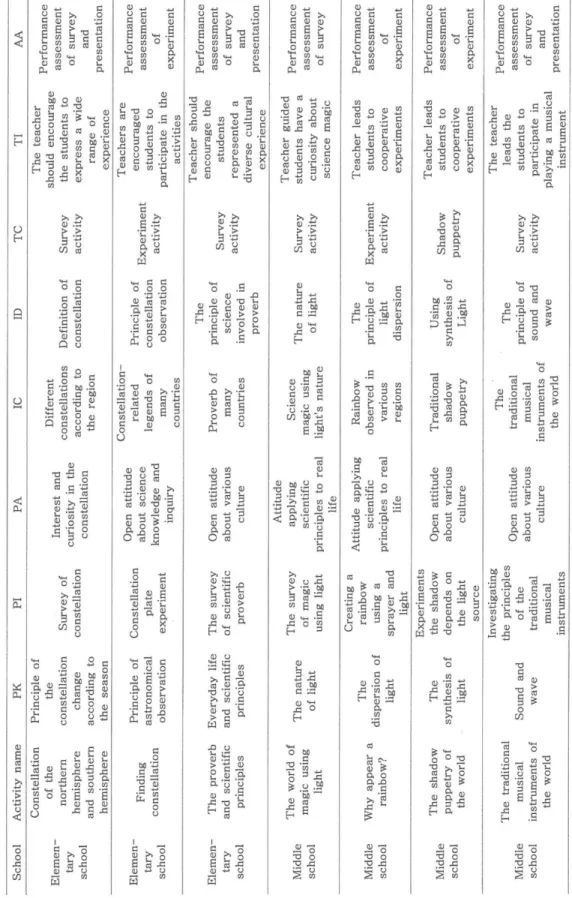
The detailed contents of each activity that constitutes this program is listed in Table 4.

Each activity was comprised of the guideline for class teaching courses, reading materials, student worksheet, and teachers’reference materials. The examples of the student worksheet and reading materials are shown in Figure 1.

Two middle school science teachers and one

university professor performed a validity test on the program developed through this study. Two middle school science teachers who participated in a validity test had been selected as excellent teachers in the past. Therefore, they were considered capable of evaluating the developed multicultural education program from the viewpoint of applicability in the actual school environment. In addition, a university professor who joined the test had the experience of researching culturally responsive teaching methods. The assessment results on each program element is shown in Table 5. The validity of each element was high, ranging from 7.0 to 8.2. However, the testers suggested the opinion that the provision of more various teaching examples would be preferred.

Ⅳ. Conclusion and suggestion

The purpose of this study was to design a development frame for multicultural science programs and develop a corresponding program using the tool. In order to consistently implement multicultural education, an approach from the education and pedagogy field is essential (Chang, 2006; Park, 2008). Therefore, this study organized a development frame to design a multicultural science education program based on the culturally responsive teaching theory. This development frame consisted of the elements of purpose, teaching examples, teaching and learning methods, and assessment.

Based on this development frame, a

multicultural science education program was

developed, which was comprised of seven

activities for elementary and middle school

students. Each activity of the program included

the concept and inquiry related to science

education. In particular, by connecting the

concept of science with the cultural

characteristics of various countries, the activity

made students aware of cultural diversity and

the commonness of science principles. The

introduction of students’various cultural

(9)

Table 4 The analysis of program activities

(10)

backgrounds in science classes is highly meaningful in terms of culturally responsive teaching.

While the necessity for multicultural education is rising, the programs that are applicable to the

actual education field are fairly limited.

Therefore, the development of multicultural education programs that can be applied to science classes in school is important. In particular, the establishment of the concept of Table 5

The results of validity evaluation

Component Score

Purpose 8.2

Instructional Examples 7.0

Teaching- learning methods 7.5

Assessment 8.0

Total average 7.7

◎ Example of student worksheet

* ‘Shadow puppet’ , designing together!

<Preparation process>

① Materials: wire, cellophane paper, thick paper, wooden chopsticks, lantern, white fabric

② The desired shape of the doll is made of wire. Wrapping the wire on a wooden chopsticks.

③ Fitting wiry frame with several cellophane paper.

④ Cutting thick paper to create the background you want. It is attached to a wooden chopsticks.

⑤ Spreading a white cloth. Installing background paper on cloth.

⑥ Installing dolls and lights on the back of white cloth.

1. Let's shadow puppet

2. Did you use some colored lights?

3. What did you feel during the shadow puppet?

◎ Example of reading material

<India>

◆ Wheat grows well around farm loads and rice grows well in low marshes.

= This proverb has the meaning that when a person does something, he/she should have a suitable location and a proper place.

India that owns a vast territory exhibits regionally distinguished climates. Water-rich southeastern India mostly does rice farming, whereas water-deficient northwestern India mostly does wheat farming. This proverb well represents the connection between climates and crops.

◆ If an east wind blows in the fifth lunar month, sell cows and buy milk cows.

= This proverb has the meaning that when a person handles a matter, he/she should act wisely.

In the middle of the lunar fifth month, India's rainy season sets in. The rice crop that grows in watered rice paddies grows fast once the rainy season comes. Thus, when the time nears a rainy season, cows that do not help farming become unnecessary, and therefore, farmers had better gain milk by buying milk cows.

Fig. 1 Examples of student worksheet and reading material

(11)

typical Korean circumstances is considered essential to develop multicultural science education programs. Therefore, multicultural education programs should be developed based on studies on their philosophy and subjects.

Korea’s current multicultural education programs are frequently operated as non- regular classes on children from multicultural families. However, a social consensus has not yet been formed as to whether this pattern of multicultural education is desirable. Consequently, multicultural education programs should be developed based on various class subjects after going through sufficient levels of discussions and studies. In addition, this should be accompanied by studies aimed at developing multicultural education programs in patterns suited to elementary and middle school curriculums.

In particular, in today’ s education field in which cultural diversity increases and students’

cultural differences widen, the preparation for multicultural education can no longer be delayed. Compared to other subjects, the science education field has not actively undertaken studies on multicultural education. In this sense, a science education program based on culturally responsive teaching developed through this study is expected to increase the potential for multicultual science education. In term of dealing with universal principles, science education is suitable for making students aware of commonness. If the cultural characteristics of various countries around the world are utilized in science classes while students are learning the concept of science, cultural diversity can also be presented to students alongside. Accordingly, this gives rise to the need to draw cultural characteristics based on basic studies such as the analysis of science textbooks in various countries and develop culturally responsive programs utilizing the outcomes. In particular, to facilitate multicultural education in the field of science education, supports to boost the interest in multicultural education and facilitate

consistent studies should be provided.

References

Aikenhead, G. S. (1997). Student views on the influence of culture on science. International Journal of Science Education. 19(4), 419-428.

Asia Economics. http://view.asiae.co.kr.

Accessed on 2012. 8. 9.

Atwater, M. M., Freeman, T. B., Butler, M.

B., & Draper-Morris, J. (2010). A case study of science teacher candidates’understanding and actions relayed to the culturally responsive teaching of “other”students. International Journal of Environment and Science Education, 5(3), 287-318.

Banks, J. A. (2002). An introduction to multicultural education(3rd ed.). Boston, MA:

Allyn & Bacon.

Banks, J. A. (2007). Educating citizens in a multicultural society(2nd ed.). New York:

Teachers College Press.

Banks, J. A. (2008). An introduction to multicultural education(4th ed.). Boston, MA:

Allyn & Bacon.

Bennett, C. I. (2007). Comprehensive multicultural education: Theory and practice(6th ed.), Boston, MA: Allyn & Bacon.

Chang, I. S. (2006). Multicultural education in America abd curriculum. The Journal of Curriculum Studies, 24(4), 27-53.

Cunha, T. B. P. (2011). Teaching science in culturally diverse classrooms: The relevance of multicultural coursework on novice teachers’

instructional choice. Doctoral Dissertation, The University of Arizona.

Duplass, J. A. (2004). Teaching elementary social studies: What every teacher should know.

New York: Houghton Mifflin Company.

Eun, J. Y. (2009). A study on a multicultural learning model based on multicultural character development theories. Theory and Research in Citizenship Education, 41(1), 107-139.

Gay, G. (2004). Curriculum theory and

multicultural education, In J. A. Banks & C. A.

(12)

M. Banks(eds.). Handbook of research on multicultural education(2nd ed., pp. 30-49). San Francisco: Wiley.

Grant, C. A., & Sleeter, C. E. (1985). The literature on multicultural education: Review and analysis. Educational Review, 37(2), 97-118.

Holocker, A. Y. (2010). A methods study of culturally responsive teaching in science and math classrooms. Doctoral Dissertation, Wilmington University.

Hong, K, D. (2011). Investigation into the Future Direction of Multicultural Education to Decrease Bias against Multicultural Students: A Case Study of Kwanju Jeonnam Region, The Journal of the Korean Association of Regional Geographers, 17(4), 381-394.

Irvine, J. J., & Armento, B. J. (2001).

Culturally Responsive Teaching - Lesson planning for elementary and middle grades. New York: McGrawHill.

Kim, H. (2003). Trends and Tasks of Global Education in the U.S. Korean Journal of Comparative Education, 13(2), 41-57.

Kim, H. J. (2006). History education in multicultural society - A case of BC in Canada.

The Research of History Education, 4, 7-46.

Kim, J. W. (2006). The realities of schooling for migrant worker’ s children from Mongolia in South Korea. Korean Journal of Sociology of Education, 16(3), 95-129.

Kim, J. Y. (2012). A study on the contents analysis and improvement of science textbooks for Multicultural education. Master’ s thesis, Kunkook university.

Kim, S. M. (2000). The concept of multicultural education and problems acompanied with its adaption to social studies.

Social Studies Education, 4, 63-81.

Kivisto, P. (2001). Introduction: Multicuitural societies and globalization. In P. Kivisto(ed.).

Multiculturalism in a global society(1-12). MA:

Blackwell Publishing.

Kwang, G. H., & Yang, Y. J. (2008). Issues of multicultural education contents in Korean society. The Journal of Curriculum Studies,

26(2), 57-85.

Ladson-Billings, G. (1995). The case for culturally relevant pedagogy. Theory into practice, 34(3), 161-165.

Lee, H. C., & Ahn, J. H. (2005). The comparative analysis on the illustrations of the elementary science textbooks between Korea and Japan. Elementary Science Education, 24(2), 138-144.

Lee, H., & Jang, S. (2010). Development and application of elementary science education program for changing students’scientific research ethical views. Elementary Science Education, 29(2), 195-206.

Lee, Y. H. (2003). ‘Reading others’in world history teaching - against eurocentrism and ethnocentrism. The Research of History Education, 86, 29-58.

Ministry of Education, Science and Technology (2007). Science Curriculum.

National Youth Policy Institute (2007). The principle of assessment and development for youth. Seoul: Kyoyookbook.

Oh, K. (2010). Analysis of earth science content of elementary school science textbooks in five Asian countries: for the elementary school children of foreign workers. Master’ s thesis, Ewha Womans University.

Parker, W. C. (2001). Social studies in elementary education(11th ed,). Upper Saddle River, New Jersey: Prentice Hall.

Park, S. C. (2008). School curriculum policy in multicultural society. The Journal of Elementary Education, 21(2), 1-19.

Park. Y. K. (2011). Development of multicultural curriculum and lesson plans in elementary social studies. Theory and Research in Citizenship Education, 43(2), 57-90.

Ramsey, P. G. (2009). Multicultural education for young children. In Banks, J. A. (ed.). The Routledge international companion to multicultural education. London: Routledge.

Seol, K. J. (2004). The rise of global civil

society and the orientation of multicultural

citizenship education. Social Studies Education,

(13)

43(3), 31-54.

Shim, S., & Choe, Y. (2005). A comparative study on science textbooks for primary and secondary education in Korea and Japan - focusing on the field of physics. Journal of the Korea Association for Research in Science Education, 25(4), 480-493.

Suh, Y. (2007). A comparative study on elementary science textbooks in Korea and the U.S.: focusing on 3rd grade scientific concepts and inquiry process in ‘ matter’ units.

Elementary Science Education, 26(5), 509-524.

Taylor, P. C. (2011). Counter-storying the grand narrative of science education: Towards

culturally responsive teaching. Cultural Studies of Science Education, 6(4), 795-801.

Wallace, T., & Brand, B. R. (2012). Using critical race theory to analyze science teachers culturally responsive practices. Cultural Studies of Science Education, 7(2), 341-374.

Wittrock, M. C. (1986). Students’thought processes. In Handbook of research on teaching.

3rd ed. Ed. M. C. Wittrock. New York:

Macmillan.

Yang, Y. J. (2008). Directions of curriculum

development of multicultural education in

Korean society. Doctoral Dissertation, Ewha

Womans University.

수치

Table 4 The analysis of program activities
Fig. 1  Examples of student worksheet and reading material

참조

관련 문서

Therefore, this study speculated on block building toys that can enhance spatial sense in infants based on the development of creativity and sociability

Walker, D. A naturalistic model for curriculum development. Guidelines for better staff development.. A Study on the Development of Early Childhood Parental

The purpose of this study is to investigate the effect of the employment education program implemented by the Gwangju Education Office Employment Support

A Study on the Development of Ship’s Ballast Water A Study on the Development of Ship’s Ballast Water A Study on the Development of Ship’s Ballast Water A Study on the

As the importance of education through play in modern children's education is emphasized, this study aims to propose an art education program through play

During the course of the green clothes attitude education program, this study identified that the green clothes attitude education program makes positive

The purpose of this study is to develop and apply a program that can develop and expand SW-based AI education by proving the effectiveness of

The Study about Middle School Students' Self-Identity And Dwelling-Identity Development Through House-Meaning Education based on Narrative.. (with Life