생물전환된 품종별 대두 발효물의 주요 지표성분 함량 및 분석법 검증과 항산화 활성 평가
정태동1․신기해1․김재민1․오지원1․최선일1․이진하1․이상종2 허인영2․박선주2․김현태3․강범규3․이옥환1
1강원대학교 식품생명공학과
2(주)에스티알바이오텍
3국립식량과학원 기능성작물부 두류유지작물과
Assessment of Validation Method for Bioactive Contents of Fermented Soybean Extracts by Bioconversion and Their Antioxidant Activities
Tae-Dong Jung1, Gi-Hae Shin1, Jae-Min Kim1, Ji-Won Oh1, Sun-Il Choi1, Jin-Ha Lee1, Sang Jong Lee2, In Young Heo2, Seon Ju Park2, Hyun Tae Kim3, Beom Kyu Kang3, and Ok-Hwan Lee1
1Department of Food Science and Biotechnology, Kangwon National University
2STR Biotech Co., LTD.
3Department of Functional Crop, National Institute of Crop Science, RDA
ABSTRACT The present study evaluated the validation method for isoflavone contents of fermented soybean extracts by bioconversion as well as their antioxidant activities. Our results show that the total isoflavone contents of non-fer- mented and fermented soybean extract ranged between 119.8 to 637.7 μg/g and between 567.3 to 2,074.6 μg/g, respectively. Moreover, fermented soybean extracts had higher contents of isoflavone aglycones, including daidzein, glycitein, and genistein than non-fermented soybean extracts as well as lower contents of isoflavone glucosides such as daidzin, glycitin, and genistin. FRAP and ORAC values ranged between 0.15 to 0.22 and between 195.24 to 753.79 μM Trolox equivalents/g in non-fermented and fermented soybean extracts, respectively. These results indicate that fermented soybean extracts had higher total isoflavone contents and antioxidant activities than non-fermented soybean extracts. Bioconversion process in this study may have the potential to produce isoflavone-enriched natural antioxidant agents with high added value from soybean matrices.
Key words: Glycine max (L.), isoflavone, method validation, antioxidant activity, bioconversion
Received 7 January 2016; Accepted 11 February 2016
Corresponding author: Ok-Hwan Lee, Department of Food Science and Biotechnology, Kangwon National University, Chuncheon, Gangwon 24341, Korea
E-mail: [email protected], Phone: +82-33-250-6454
서 론
활성산소종(reactive oxygen species, ROS)은 생체 내 대사과정 중 끊임없이 발생하며 DNA, 단백질, 지질 등과 같은 분자 내에 산화적 스트레스를 유발하여 노화, 암, 심장 질환, 피부 노화 등의 다양한 질병과 연관이 있는 것으로 알려졌다(1,2). 이러한 활성산소종을 억제하기 위하여 합성 항산화제인 BHT(butylated hydroxytoluene), BHA(bu- tylated hydroxyanisole) 등을 사용했으나 최근 연구 결과 들에 의하면 합성 항산화제는 돌연변이 등의 부작용을 일으 키는 원인이 된다고 보고되고 있다(3). 따라서 합성 항산화 제보다 안전한 천연 유래의 항산화제에 대한 연구가 활발히
진행되고 있다(4).
대두(Glycine max L.)는 40% 이상이 단백질로 구성된 양질의 단백질 식품으로 saponin, lecithin, phytic acid 및 isoflavone 등과 같은 여러 생리활성 물질이 함유되어 있다 (5). Isoflavone은 여성호르몬인 estrogen과 유사한 구조와 활성을 가지고 있어 phyto-estrogen이라고 부르기도 하며 대두에 약 0.1~0.4% 정도 함유되어 있고 품종, 재배지역 등 환경에 따라 함유량의 차이를 나타낸다(6,7). 대두에 존 재하는 isoflavone에는 배당체로 daidzin, glycitin, genis- tin 등이 존재하며, 비배당체로는 daidzein, glycitein, gen- istein 등이 있다. 이러한 isoflavone의 효능으로는 항산화 (8), 유방암(9), 혈청 지질 농도 감소와 항비만 효과(10), 골 다공증(11) 등에 관한 연구가 활발히 진행되고 있다. 하지만 이들 isoflavone은 식품 중에서 주로 배당체 형태로 존재하 게 되는데, 배당체는 분자량이 크고 체내 흡수율이 상대적으 로 낮기 때문에 이를 배당체 형태보다 소화 흡수가 빠른 비 배당체로 전환하는 생물학적 연구가 진행되고 있다(12).
Table 1. The characteristics of soybean by cultivar No. Cultivar Crop year S-1
S-2 S-3 S-4 S-5
Glycine max cv. Daeweon G. max cv. Daepung2 G. max cv. Uram G. max cv. Jinpoung G. max cv. Saedanbaek
2014.10 2014.10 2014.10 2014.10 2014.10 생물전환(bioconversion)이란 미생물 및 효소 등을 이용 한 생물학적 방법을 통하여 기존 천연물이 함유한 물질의 구조적 변화를 유도하여 유용물질을 생산하는 기술이다. 즉 천연물의 생리활성 물질의 변화를 유도하여 유효성분의 함 량 증가 및 흡수율 개선 등을 유도하는 기술이며, 특히 의약 품과 화장품 분야에서 생물전환 공정이 여러 가지 방법으로 수행되어 유용성 및 효과성을 향상한다(13).
건강기능식품을 개발, 생산하기 위해서는 기능성 원료에 대한 표준화 및 규격화가 필요하다. 표준화란 생산품을 제조 할 때 목표성분을 일정하게 유지하기 위한 규범을 말하며 일반적으로 지표성분의 표준화 방법을 사용한다. 지표성분 은 공인된 방법이나 정밀하다고 판단되는 분석법을 사용하 며 반드시 분석방법에 대한 과학적 타당성과 신뢰성이 검증 되어야 한다(14,15).
따라서 본 연구는 생물전환에 의한 대두를 건강기능식품 원료로 개발 시 표준화를 위하여 isoflavone의 분석방법 및 분석법 검증에 대한 연구와 함께 품종별 대두의 기능성 성분 의 증대와 관련된 isoflavone 함량, 총페놀 함량 및 항산화 능을 비교 평가하였다.
재료 및 방법
실험재료 및 시약
본 연구에 사용한 대두(Glycine max L.)는 2014년 10월 에 수확된 대원(Daewone), 대풍2(Daepung2), 우람(Uram), 진풍(Jinpoung) 및 새단백(Saedanbaek) 총 5종으로(Table 1) 국립식량과학원(Miryang, Korea)에서 제공받아 사용하 였다. 표준물질 isoflavone(daidzin, glycitin, genistin, daidzein, glycitein, genistein), Folin-Ciocalteu's phenol reagent, sodium carbonate, gallic acid, acetic acid, 2,4, 6-tripyridyl-s-triazine(TPTZ), ferric chloride, 2,2'- azobis(2-methylpropionamidine) dihydrochloride(AAPH), 6-hydroxy-2,5,7,8-tetramethylchroman-2-carboxylic acid(Trolox) 등은 Sigma-Aldrich Co.(St. Louis, MO, USA)에서 구입하였으며, fluorescein sodium salt는 Junsei Chemical(Tokyo, Japan)에서 구입하여 사용하였다. HPLC 용 용매 methanol, acetic acid는 J.T. Baker(Phillipsburg, NJ, USA)에서 구입하였다.
대두의 생물전환
대두의 생물전환공정은 다음과 같이 품종별 대두에 효소
처리 및 멸균과정을 거쳐 배양배지화한 표고균사를 접종하 여 생물전환 발효공정을 통해 1차 대두발효물을 생산하였 다. 그 후 2차 생물전환 효소처리공정을 실시하였다. 발효미 생물로 선정한 표고버섯 균사의 접종량과 배양시간을 최적 화하기 위하여 종균배양의 growth curve fitting을 통해 각 발효미생물의 배양상태를 확인하고 cell mass 농도에 따라 3 point를 선정한 후, 접종량을 각각 10%, 20%로 하여 본 발효배양에 접종한 다음 배양시간 및 접종량을 비교하여 최 적화를 진행하였다. 효소처리 최적화를 위하여 배양기질인 대두와 발효배양산물인 배양균사체의 세포벽을 구성하고 있는 유용물질을 세포벽으로부터 효율적으로 추출하기 위 하여 β-glucanase, cellulase, hemi-cellulase(DMS Food Specialties, Chilgok, Korea), pectinase, β-glucosidase, amylase, protease(Shin Nihon Chemical Co., Ltd., Aichi, Japan) 등의 다양한 효소를 사용하여 공정 최적화 실험을 진행하였다. 사용된 효소는 0.1~2%로 첨가하여 50~60°C 조건에서 1~3시간 동안 shaker(SI-4000R, Jeio Tech Co., Ltd., Seoul, Korea)를 이용하여 250 rpm에서 효소/기질반 응을 수행하였다.
추출물 제조
품종별 대두 비발효물 및 생물전환에 의한 발효물은 각각 2.5 g의 시료에 50 mL methanol을 첨가하여 30분간 Soni- cator(JAC Ultrasonic, KODO, Hwaseong, Korea)를 이용 하여 추출하였고, 추출 후 원심분리기(416G, Gyrogen Co., Ltd., Daejeon, Korea)를 사용하여 3,000 rpm에서 15분간 원심분리 한 다음 고형성분을 제거하여 -20°C에서 보관하 며 사용하였다.
Isoflavone 분석
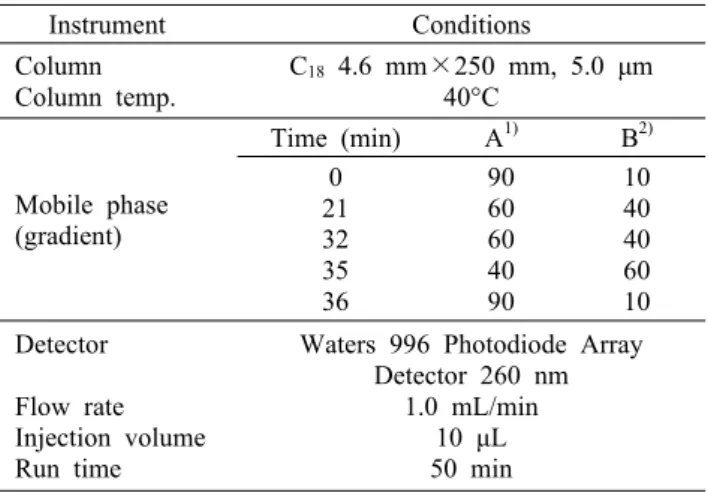
대두에 함유된 isoflavone의 분석을 위하여 추출물 시료 를 0.45 μm syringe filter(Whatman, Maidstone, UK)로 여과 후 HPLC 분석에 사용하였다. 대두의 isoflavone 6종 의 분석은 건강기능식품의 기준 및 규격 대두이소플라본 제 1법(16)을 변형하여 실험하였다(Table 2). 분석에 사용한 기기는 Waters 2695 Separation Module HPLC system과 Waters 996 Photodiode Array Detector(Waters Co., Milford, MA, USA)이며 분석용 column으로는 Capcell Pak C18 MG(4.6×250 mm, 5 μM, Shiseido Co., Ltd., Tokyo, Japan)를 사용하여 분석하였다.
분석법의 유효성 검증
HPLC를 이용한 이소플라본 분석방법은 의약품 등 시험 방법 밸리데이션 가이드라인(17)을 근거로 하여 특이성 (specificity), 직선성(linearity), 정밀성(precision), 정확성 (accuracy), 검출한계(detection limit, DL), 정량한계(quan- titation limit, QL)를 이용하여 분석법의 유효성을 검증하였 다. 먼저 특이성 검증은 표준물질 isoflavone 6종 및 대두
Table 2. HPLC condition of isoflavone analysis for soybean ex- tracts
Instrument Conditions Column
Column temp. C18 4.6 mm×250 mm, 5.0 μm 40°C
Mobile phase (gradient)
Time (min) A1) B2) 0
21 32 35 36
90 60 60 40 90
10 40 40 60 10 Detector
Flow rate Injection volume Run time
Waters 996 Photodiode Array Detector 260 nm
1.0 mL/min 10 μL 50 min
1)Water/MeOH/acetic acid (88:10:2).
2)MeOH/acetic acid (98:2).
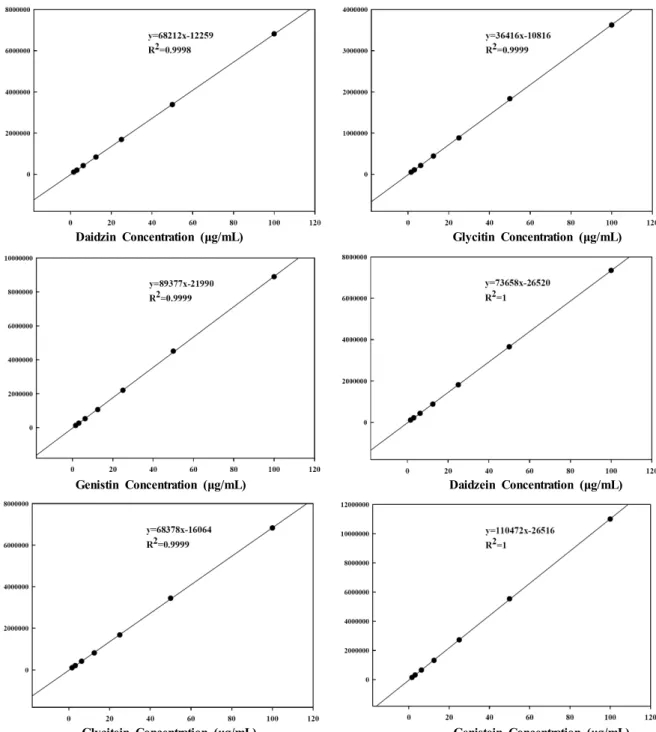
우람 품종(S-3) 비발효물 및 발효 추출물을 HPLC로 분석한 후 chromatogram을 비교하여 daidzin, glycitin, genistin, daidzein, glycitein, genistein이 선택적으로 분리되는지 확인하였으며 Photo diode array(Waters Co.) spectrum 을 이용하여 같은 spectrum을 나타내는지 확인하였다. 직 선성에 대한 검증은 표준물질을 각각 1.625, 3.125, 6.25, 12.5, 25, 50, 100 μg/mL의 단계적으로 희석한 다음 각각의 표준물질을 HPLC로 분석하여 3회 반복 측정하였으며, peak 면적비에 대한 농도비의 관계를 표시하는 검량선을 작성하고 작성된 검량선으로부터 상관계수(R2) 값을 이용하 여 직선성을 확인하였다.
정밀성 검증은 HPLC를 이용하여 우람(S-3) 비발효물 및 발효 추출물을 inter-day(일간)와 intra-day(일내)로 나누 어 정밀성 실험을 진행하였다. Inter-day는 1일 1구간으로 3일간 진행하였고, intra-day는 1일 3구간으로 나누어 진행 하였다. 각 시험은 구간별로 3회, 9반복하여 분석하였다. 분 석하여 얻어진 면적은 검량선을 이용하여 정량하였으며 정 량한 값은 표준편차를 평균으로 나누어 상대표준편차(rel- ative standard deviation)로 백분율로 나타내었다. 정확성 검증은 농도를 알고 있는 대두 시료에 표준물질 daidzin, glycitin, genistin, daidzein, glycitein, genistein을 각각 3.125, 25, 50 μg/mL의 세 가지 농도를 각각 첨가하여 HPLC로 분석하였다. 분석한 결과를 아래 식을 이용하여 회 수율(recovery)로 나타내어 분석방법의 정확성을 확인하였 다.
% recovery= Cf-Cu
Ca ×100
Cf: Concentration of test sample added standard solution
Cu: Concentration of test sample Ca: Concentration of standard solution
Isoflavone의 검출한계와 정량한계는 의약품 등 시험방
법 밸리데이션 가이드라인의 반응의 표준편차와 검량선의 기울기(17)에 근거하여 아래식을 이용하여 나타내었다.
Detection limit (DL) Quantitation limit (QL) DL= 3.3σ
QL= 10σ
S S
σ: The standard deviation of the response S: The slope of the calibration curve
총페놀 함량 측정
생물전환공정에 따른 대두 발효물의 총페놀 함량은 Kaur 와 Kapoor(18)의 방법을 변형하여 측정하였다. 각 대두 비 발효물 및 발효물 1 mL에 10% Folin-Ciocalteu's phenol reagent 1 mL를 첨가한 후 2% Na2CO3 1 mL를 첨가하여 혼합한 다음 암소에서 1시간 동안 반응시켰다. 반응 후 상등 액을 microplate reader(Spectramax i3, Molecular Devi- ces, Sunnyvale, CA, USA)를 사용하여 750 nm에서 흡광 도를 측정하였다. 표준물질은 gallic acid를 사용하였으며 표준 검량선(y=15.541x-0.0257, R2=0.9957)을 이용하여 총페놀 함량을 계산하였다.
항산화 활성 평가
생물전환공정에 따른 대두 발효물의 항산화 활성은 FRAP (ferric reducing antioxidant power) 및 ORAC(oxygen radical absorbance capacity)를 이용하여 측정하였다.
FRAP는 Benzie와 Strain(19)의 방법을 변형하여 측정하였 다. 0.3 M sodium acetate buffer(pH 3.6), 20 mM FeCl3・ 6H2O 및 10 mM TPTZ를 제조하여 10:1:1 비율로 혼합하 여 FRAP reagent를 제조하였다. 제조된 FRAP reagent 1.5 mL에 대두 추출물 시료 50 μL와 증류수 150 μL를 첨가 한 후 37°C에서 5분간 반응시킨 다음 microplate reader를 사용하여 593 nm에서 흡광도를 측정하였다. ORAC 지수는 Zulueta 등(20)의 방법을 변형하여 측정하였다. 시료 및 표 준물질의 농도별 희석은 75 mM sodium phosphate buf- fer(pH 7.4)를 이용하였다. 농도별로 희석된 시료 25 μL, 40 nM fluorescein 150 μL를 96-well black plate에 첨가 한 후 측정 직전에 peroxy radical generator인 144 mM AAPH 25 μL를 첨가한 다음, fluorescence microplate reader(Spectramax i3, Molecular Devices)를 사용하여 excitation 485 nM, emission 535 nM의 조건으로 37°C에 서 3분 간격으로 90분 동안 형광 감소율을 측정하였다. 결과 값은 area under curve(AUC) 값을 나타낸 후 표준물질인 Trolox를 이용하여 표준 검량선(y=1.2072x+0.5832, R2= 0.9926)에 대입하여 계산하였다.
통계처리
실험 결과의 통계처리는 SAS version 9.4(SAS Institute Inc., Cary, NC, USA)를 이용하여 분석하였다. 결과의 통계 적 유의성은 one-way ANOVA 분석을 시행하였으며, Dun-
Table 3. The content of daidzin, glycitin, genistin, daidzein, glycitein, genistein, and total isoflavone for 5 cultivars of non-fermented soybean and fermented soybean (μg/g)
Sample No. Glycoside Aglycone Total
isoflavone Daidzin Glycitin Genistin Daidzein Glycitein Genistein
1 NS1) FS2)
144.6±2.73) ND4)
64.0±1.3 ND
186.2±1.3 ND
ND 746.5±13.2
ND 102.4±1.1
ND 826.4±16.1
394.8±5.03 1,675.3±30.3
2 NS
FS
138.8±1.2 ND
150.5±2.2 ND
236.4±1.1 ND
ND 616.0±15.8
ND 222.2±5.8
ND 866.1±22.4
525.7±2.3 1,704.3±44.0
3 NS
FS
229.9±6.4 ND
71.6±2.4 ND
336.3±3.2 ND
ND 873.8±1.2
ND 110.1±1.0
ND 1,090.6±4.4
637.7±5.6 2,074.6±4.6
4 NS
FS
162.6±1.1 ND
108.2±2.1 ND
369.5±1.3 ND
ND 634.6±4.8
ND 128.6±1.3
ND 1,200.7±8.6
640.3±1.4 1,963.9±14.7
5 NS
FS
38.9±0.4 ND
44.4±0.5 ND
37.0±0.2 ND
ND 227.1±5.4
ND 77.0±1.8
ND 263.3±6.3
119.8±0.6 567.3±13.5
1)Non-fermented soybean. 2)Fermented soybean.
3)Value are mean±SD in triplicate (n=3).
4)Not detect.
can's multiple range test로 유의성은 P<0.05 수준에서 검 정하였다.
결과 및 고찰
생물전환에 의한 대두의 isoflavone 함량 변화
품종별 대두 추출물의 isoflavone을 HPLC로 분석한 결 과 생물전환에 의한 품종별 대두의 isoflavone 함량 변화는 Table 3과 같다. 유산균 및 효소처리 등을 이용한 생물전환 대두의 isoflavone을 비배당체로 전환하는 Kim 등(21)과 Na와 Moon(22)의 연구 결과와 유사한 경향인 대두 비발효 물에서는 배당체인 daidzin, glycitin, genistin이 검출되었 고 비배당체는 검출되지 않았으며, 생물전환에 의한 대두 발 효물에서는 배당체가 비배당체인 daidzein, glycitein, gen- istein으로 전환됨을 확인하였다. Total isoflavone 함량은 생물전환에 의한 발효 대두 우람(S-3)에서 2,074.6 μg/g으 로 가장 높은 함량을 나타냈으며 비발효 대두 새단백(S-5) 에서 가장 낮은 119.8 μg/g의 total isoflavone 함량을 나타 내었다. 생물전환에 의한 대두 발효 후 total isoflavone 함 량이 약 2배 이상 증가하는 경향을 보였다. Kudou 등(23)에 의하면 대두 isoflavone에는 3종류의 비배당체(daidzein, glycitein, genistein)와 각각의 배당체(daidzin, glycitin, genistin) 외에도 각각의 6"-O-acetyl-glucosides, 6"-O- malonyl-glucosides를 포함하여 총 12종류의 대두 iso- flavone이 존재한다고 보고하였다. 따라서 본 연구에서 분석 한 3종류의 배당체(daidzin, glycitin, genistin) 외에도 ma- lonyl, acetyl화 배당체가 비배당체로 전환되어 높은 total isoflavone 함량을 나타내는 것으로 생각된다. Isoflavone 비배당체의 생리활성으로는 고지혈증 흰쥐의 혈청 지질대 사 개선(24), 멜라닌 생성 억제(22) 및 항염증 효과(25) 등 많은 연구 결과에서 배당체보다 비배당체에서 우수한 생리 활성을 나타내었다. 따라서 본 연구의 생물전환을 통해 발효 된 대두에서 더욱 높은 생리활성을 기대할 수 있을 것으로
생각한다.
Isoflavone의 spectrum 및 특이성 확인
대두 우람(S-3) 추출물의 isoflavone 6종을 spectro- photometer를 사용하여 190 nm에서 400 nm까지의 흡수 파장을 분석한 결과 daidzin, daidzein, glycitin은 249 nm, glycitein은 256 nm, genistin, genistein은 260 nm에서 각 각의 최대흡수파장을 나타냈다(Fig. 1). 따라서 isoflavone 의 최대흡수파장을 260 nm에서 분석하였다. Lee 등(26)은 isoflavone을 260 nm에서 분석하였다고 보고하여 본 연구 결과와 유사한 경향을 나타내었다. 특이성 시험을 통해 표준 용액과 대두 추출물의 chromatogram을 비교하여 isofla- vone의 peak를 확인한 결과 isoflavone 6종 모두 특이적으 로 분리되었고, 표준물질과 대두 추출물의 peak 머무름 시 간(retention time, RT)이 같은 것으로 확인되었다(Fig. 2).
검량선을 이용한 직선성 확인
Isoflavone 6종의 표준용액을 1.625, 3.125, 6.25, 12.5, 25, 50, 100 μg/mL로 희석하여 HPLC로 분석한 결과, daid- zin(y=68212x-12259, R2=0.9998), glycitin(y=36416x
-10816, R2=0.9999), genistin(y=89377x-21990, R2= 0.9999), daidzein(y=73658x-26520, R2=1.0000), gly- citein(y=68378x-16064, R2=0.9999), genistein(y=
110472x-26516, R2=1.0000)으로 나타났으며 isofla- vone 6종 모두 우수한 직선성을 보였다(Fig. 3).
정밀성 및 회수율을 이용한 정확성
대두 우람(S-3) 추출물의 정밀성 분석 결과는 Table 4와 같다. Intra-day 정밀도에서 우람(S-3) 비발효물의 경우 0.88%, 우람(S-3) 발효물의 경우 0.22%를 나타내었고 in- ter-day 정밀도에서 각각 1.00%, 0.34%로 5% 이하의 우수 한 정밀도를 보였다. Isoflavone 함량의 경우 intra-day, in- ter-day에서 각각 우람(S-3) 비발효물이 637.73±5.62,
A B
C D
E F
Fig. 1. PDA spectrums of daidzin (A), glycitin (B), genistin (C), daidzein (D), glycitein (E), and genistein (F) in non-fermented S-3 extract and fermented S-3 extract.
642.25±6.40 μg/g으로 나타났으며, 발효물이 2,074.58±
4.55, 2,088.73±7.03 μg/g의 함량을 보였다. 정확성은 회 수율을 측정하여 나타내었다. 농도를 알고 있는 대두 추출물 에 표준용액을 3.125, 25, 50 μg/mL의 농도로 첨가한 뒤 HPLC로 분석하여 농도를 측정하였다. 그 결과는 Table 5와 같다. 배당체인 daidzin의 회수율은 첨가된 농도에 따라 100.55~110.21%를 보였으며 glycitin은 100.26~112.35
%, genistin은 97.67~111.89%를 나타내었다. 비배당체 daidzein은 100.95~110.43%, glycitein은 98.56~106.02
%, genistein은 101.29~110.25%의 회수율을 나타내었다.
검출한계 및 정량한계 확인
검출한계 및 정량한계의 분석 결과 배당체 daidzin, gly- citin, genistin의 검출한계는 각각 0.14, 0.16, 0.20 μg/mL 로 측정되었으며, 비배당체인 daidzein, glycitein, genis- tein의 검출한계는 각각 0.25, 0.29, 0.20 μg/mL로 측정되 었다. 배당체 daidzin, glycitin, genistin의 정량한계는 각각 0.44, 0.48, 0.60 μg/mL로 나타났으며 비배당체인 daid-
A
B C
Fig. 2. HPLC chromatograms of daidzin, glycitin, genistin, daidzein, glycitein, and genistein standard (A), non-fermented S-3 extract (B) and fermented S-3 extract (C).
zein, glycitein, genistein은 각각 0.75, 0.89, 0.61 μg/mL 로 나타났다.
총페놀 함량
식물에 널리 분포된 페놀성 화합물은 2차 대사산물의 일 종으로 페놀성 화합물이 가지는 hydroxyl기(-OH)가 단백 질 등의 거대 분자들과 결합하는 성질을 가지기 때문에 항산 화 등의 생리활성이 보고되고 있다(27). 품종별 대두 추출물의 총페놀 함량을 측정한 결과(Fig. 4) 대두 비발효물은 33.28
~44.96 mg GAE/g의 총페놀 함량을 나타냈으며, 생물전환 에 의한 발효물은 36.58~40.44 mg GAE/g을 나타내었다.
진풍(S-4) 비발효물을 제외한 모든 품종에서 생물전환에 의 한 발효물이 더 높은 총페놀 함량을 나타냈으나, 진풍(S-4) 비발효물이 44.96 mg GAE/g으로 가장 높은 총페놀 함량을 보였다. Pyo(28)의 연구에 의하면 홍국균에 의한 대두 발효 물에서 총페놀 함량이 발효 20일까지는 증가하나 발효 30일 이후로는 감소하는 경향을 나타내었으며, Lee 등(29)의 홍 국균에 의한 대두 발효 시 총페놀 함량은 비발효 대두보다 높은 경향을 보였다. 따라서 대두의 총페놀 함량은 발효조건 에 의해 많은 영향을 받는 것으로 판단된다.
FRAP 및 ORAC 지수
FRAP assay는 시료에 존재하는 항산화 성분에 의해 Fe3+
(ferric ion)이 Fe2+(ferrous ion)로 환원되는 환원력을 측 정하는 비교적 간단하며 신속한 장점이 있는 항산화력 측정 법이다(19). ORAC assay는 수소 전자 전달 이론을 근거로 하여 항산화 물질이 AAPH에 의해 생성된 peroxy radical 소거 능력을 측정하는 방법이며, 시료 내 소수성, 친수성 성 분과 모두 반응하여 감도가 높다(30,31). 생물전환에 의한 대두 발효물의 FRAP 및 ORAC 지수를 측정한 결과는 Table 6과 같다. 대두 발효물의 FRAP는 흡광도 593 nm에서 O.D 값을 측정하여 나타내었으며 대풍2(S-2) 발효물에서 0.22 의 가장 높은 값을 보였다. 가장 낮은 값은 새단백(S-5) 비발 효물에서 0.15로 나타났으며, 총페놀 함량 측정 결과와 마찬 가지로 진풍(S-4) 비발효물이 발효물보다 높은 0.19의 값 을 나타내었다. ORAC 지수의 경우 생물전환에 의한 대두 발효 시 모든 품종에서 함량이 증가하는 경향을 보였고 대풍 2(S-2) 발효물에서 753.79±6.95 μM TE/g으로 가장 높은 값을 나타내었으며, 총페놀, FRAP 측정 결과와 유사하게 새단백(S-5) 비발효물이 195.24±3.08 μM TE/g으로 가장 낮은 ORAC 지수를 보였다.
상관관계 분석
대두 추출물의 isoflavone 함량, 총페놀 함량, FRAP 및 ORAC 지수에 대한 상관관계를 분석하여 R2 값으로 나타낸 결과(Table 7), isoflavone 함량과 ORAC 지수와의 상관성
Daidzin Concentration (μg/mL) Glycitin Concentration (μg/mL)
Genistin Concentration (μg/mL) Daidzein Concentration (μg/mL)
Glycitein Concentration (μg/mL) Genistein Concentration (μg/mL) Fig. 3. Calibration curve of daidzin, glycitin, genistin, daidzein, glycitein, and genistein in standard solution.
Table 4. Precision of isoflavone analysis for non-fermented S-3 extract and fermented extract
Sample Intra-day1) Inter-day2)
Mean±SD (μg/g) RSD3) (%) Mean±SD (μg/g) RSD (%) Non-fermented Uram
Fermented Uram
637.73±5.62 2,074.58±4.55
0.88 0.22
642.25±6.40 2,088.73±7.03
1.00 0.34
1)Three times per day.
2)One time analysis of isoflavone per day for 3 days.
3)Relative standard deviation.
이 0.7749로 가장 높은 상관관계를 나타내었다. ORAC 지 수와 FRAP 간의 상관관계도 0.6356으로 높은 상관관계를
보였다. 총페놀 함량과 ORAC 및 isoflavone 함량과의 상관 관계는 0.0758, 0.0657로 매우 낮은 상관관계를 보였으며,
Table 5. Accuracy of HPLC analysis for isoflavone non-fermented S-3 extract and fermented extract Sample Concentration
(μg/mL)
Intra-day Inter-day
Mean±SD
(μg/g) Recovery
(%) RSD
(%) Mean±SD
(μg/g) Recovery
(%) RSD
(%)
Daidzin
Non-fermented Uram
3.125 25 50
3.43±0.08 27.55±0.43 51.30±1.24
109.62 110.21 102.60
2.22 1.56 2.41
3.29±0.05 26.79±0.69 50.71±1.23
105.15 107.15 101.43
1.46 2.59 2.43 Fermented Uram 3.125
25 50
3.27±0.03 25.96±0.48 50.27±0.67
104.63 103.84 100.55
0.78 1.84 1.32
3.30±0.03 26.07±0.49 50.57±0.73
105.49 104.28 101.13
0.78 1.87 1.44
Glycitin
Non-fermented Uram
3.125 25 50
3.51±0.02 26.61±0.42 51.12±1.49
112.35 106.42 102.23
0.60 1.58 2.92
3.50±0.05 26.14±0.38 50.55±1.59
111.96 104.57 101.10
1.43 1.44 3.15 Fermented Uram
3.125 25 50
3.46±0.08 25.67±0.34 50.13±0.47
110.57 102.69 100.26
2.19 1.33 0.94
3.37±0.06 25.70±0.29 50.49±0.59
107.86 102.80 100.97
1.71 1.12 1.16
Genistin
Non-fermented Uram
3.125 25 50
3.05±0.11 28.80±0.28 52.55±0.73
97.67 115.18 105.09
3.56 0.98 1.39
3.20±0.07 27.97±0.99 52.03±0.95
102.34 111.89 104.05
2.13 3.54 1.83 Fermented Uram 3.125
25 50
3.38±0.02 26.12±0.48 50.88±0.98
108.09 104.50 101.75
0.65 1.85 1.92
3.35±0.03 26.14±0.43 50.84±0.88
107.10 104.54 101.69
0.77 1.65 1.73
Daidzein
Non-fermented Uram
3.125 25 50
3.32±0.04 26.40±0.57 50.56±0.87
106.22 105.61 101.11
1.25 2.17 1.71
3.34±0.03 25.97±0.17 50.48±0.80
106.99 103.89 100.95
0.93 0.64 1.59 Fermented Uram
3.125 25 50
3.45±0.10 26.92±0.84 51.36±1.08
110.43 107.68 102.73
3.03 3.14 2.10
3.57±0.09 27.03±0.86 51.62±1.13
114.23 108.13 103.23
2.56 3.18 2.19
Glycitein
Non-fermented Uram
3.125 25 50
3.17±0.02 26.14±0.48 50.25±0.74
101.35 104.58 100.49
0.52 1.84 1.47
3.08±0.06 25.75±0.13 50.11±0.69
98.56 103.02 100.22
1.79 0.52 1.37 Fermented Uram 3.125
25 50
3.23±0.12 25.88±0.52 50.78±0.80
105.33 103.54 101.57
3.58 2.01 1.58
3.31±0.14 26.09±0.73 51.06±0.86
106.02 104.38 102.12
4.37 2.79 1.69
Genistein
Non-fermented Uram
3.125 25 50
3.26±0.05 26.42±0.53 50.74±0.80
104.27 105.68 101.48
1.60 2.01 1.57
3.20±0.08 26.08±0.06 50.65±0.73
102.43 104.31 101.29
2.60 0.24 1.44 Fermented Uram
3.125 25 50
3.45±0.11 26.85±0.70 51.68±1.11
110.25 107.39 103.36
3.06 2.59 2.14
3.43±0.10 27.01±0.83 51.86±1.14
109.66 108.05 103.72
2.83 3.06 2.20
Fig. 4. Total phenol contents of non-fermented soybean extract and fermented soybean extract. Each value represents mean±
SD (n=3). Means (bar value) not sharing a common letter (a-f) are significantly different (P<0.05).
FRAP와의 상관관계는 0.3878로 나타났다. 이는 Cha 등 (32)의 옥수수수염의 총페놀 함량 및 FRAP 간의 상관계수 인 0.452를 나타낸 결과와 유사하며, Lee 등(33)의 간장의 FRAP와 ORAC 지수 간의 상관관계에서 0.8의 높은 상관계 수를 보였으며, Ma와 Huang(34)의 두유의 isoflavone과 ORAC 지수 간의 상관계수는 0.720으로 나타나 본 연구와 유사한 경향을 보였다. 따라서 대두 isoflavone의 항산화능 은 총페놀 함량 및 FRAP보다 ORAC 지수가 더 밀접한 관계 를 갖는 것으로 확인되었다.
요 약
본 연구에서는 생물전환에 의한 품종별 대두 5종의 iso- flavone 함량, 총페놀 함량, 항산화능 및 isoflavone의 분석 법 검증을 시행하였다. HPLC를 이용한 분석법 검증 결과
Table 7. Correlation coefficients among total phenol content (TPC), FRAP, ORAC value, and isoflavone content of soybean extracts
TPC FRAP ORAC
value Isoflavone TPC
FRAP ORAC value Isoflavone
1 0.3878 0.0758 0.0657
1 0.6356 0.2796
1
0.7749 1
Table 6. Antioxidant activity of non-fermented soybean extracts and fermented soybean extracts
Sample No. FRAP (O.D. 593 nm) ORAC (μM TE1)/g)
NS2) FS3) NS FS
S-1 S-2 S-3 S-4 S-5
0.16±0.00g4) 0.18±0.00ed 0.17±0.00f 0.19±0.01cd 0.15±0.00g
0.20±0.00bc 0.22±0.01a 0.20±0.00b 0.18±0.01ef 0.19±0.01de
350.25±7.12ef 378.74±3.18d 331.93±2.30f 352.90±2.19e 195.24±3.08g
498.69±5.62c 753.79±6.95a 693.97±16.89b 510.83±20.25c 290.89±1.08h
1)Data are expressed as μM Trolox equivalents (TE).
2)Non-fermented soybean. 3)Fermented soybean.
4)Means with the different letters are significantly different (P<0.05) by Duncan's multiple range test.
isoflavone 6종의 표준용액과 우람(S-3) 비발효 및 발효 추 출물의 retention time이 일치하는 것을 확인하였으며, spectrum 분석 결과에서도 같은 spectrum을 보여 특이성 을 확인하였다. 직선성 확인 결과 isoflavone 6종의 검량선 의 상관계수 값은 0.9998~1.0000으로 나타나 우수한 직선 성을 보여주었다. 정밀성 측정 결과 일내 정밀도에서 0.22~
0.88%, 일간 정밀도에서 0.34~1.00%의 높은 정밀도를 나 타냈다. 회수율 측정 결과 daidzin은 100.55~110.21%, glycitin은 100.26~112.35%, genistin은 97.67~111.89
%, daidzein은 100.95~110.43%, glycitein은 98.56~
106.02%, genistein은 101.29~110.25%의 회수율을 나타 내었다. Daidzin, glycitin, genistin의 검출한계는 각각 0.14, 0.16, 0.20 μg/mL로 측정되었으며, daidzein, glycitein, genistein의 검출한계는 각각 0.25, 0.29, 0.20 μg/mL로 나 타났다. Daidzin, glycitin, genistin의 정량한계는 각각 0.44, 0.48, 0.60 μg/mL를 나타냈고 daidzein, glycitein, genistein은 각각 0.75, 0.89, 0.61 μg/mL로 나타났다. 생 물전환에 의한 대두 발효 시 배당체인 daidzin, glycitin, genistein이 모두 비배당체인 daidzein, glycitein, genis- tein으로 전환됨을 확인할 수 있었다. 각각의 isoflavone을 합한 값인 total isoflavone 함량은 대두 우람(S-3) 발효물 에서 2,074.6 μg/g으로 가장 높은 함량을 나타냈으며 비발 효 대두 새단백(S-5)에서 가장 낮은 119.8 μg/g의 total isoflavone 함량을 나타내었다. 총페놀 함량은 진풍(S-4) 비발효물이 44.96 mg GAE/g으로 가장 높은 총페놀 함량을 보였다. 항산화능 측정 결과 FRAP는 대풍2(S-2) 발효물에 서 0.22로 가장 높은 값을 나타냈으며 새단백(S-5) 비발효 물에서 0.15로 가장 낮은 값을 나타내었다. ORAC 지수도 FRAP와 유사하게 새단백(S-5) 비발효물에서 195.24±3.08
μM TE/g으로 가장 낮은 값을 보였으며 대풍2(S-2) 발효물 에서 753.79±6.95 μM TE/g으로 가장 높은 값을 나타내었 다.
감사의 글
본 연구는 2015년도 농림축산식품부 고부가가치식품기술 사업(과제번호 314076-3)에 의해 이루어진 것이며 이에 감 사드립니다.
REFERENCES
1. Samak G, Shenoy RP, Manjunatha SM, Vinayak KS. 2009.
Superoxide and hydroxyl radical scavenging actions of bota- nical extracts of Wagatea spicata. Food Chem 115: 631-634.
2. Aruoma OI. 1998. Free radicals, oxidative stress, and anti- oxidants in human health and disease. JAOCS 75: 199-212.
3. Ito N, Hirose M, Fukushima S, Tsuda H, Shirai T, Tatematsu M. 1986. Studies on antioxidants: Their carcinogenic and modifying effects on chemical carcinogenesis. Food Chem Toxicol 24: 1071-1082.
4. Packer L, Hiramatsu M, Yoshikawa T. 1999. Antioxidant food supplements in human health. Academic Press, New York, NY, USA.
5. Setchell KD. 1998. Phytoestrogens: the biochemistry, physi- ology, and implications for human health of soy isoflavones.
Am J Clin Nutr 68: 13335-13465.
6. Wang H, Murphy PA. 1994. Isoflavone composition of Ame- rican and Japanese soybeans in Iowa: effects of variety, crop year, and location. J Agric Food Chem 42: 1674-1677.
7. Jenkins DJA, Kendall CWC, Connelly PW, Jackson CJC, Parker T, Faulkner D, Vidgen E. 2002. Effects of high- and low-isoflavone (phytoestrogen) soy foods on inflammatory biomarkers and proinflammatory cytokines in middle-aged men and women. Metabolism 51: 919-924.
8. Lee CH, Yang L, Xu JZ, Yeung SYV, Huang Y, Chen ZY.
2005. Relative antioxidant activity of soybean isoflavones and their glycosides. Food Chem 90: 735-741.
9. Khan SA, Chatterton RT, Michel N, Bryk M, Lee O, Ivancic D, Heinz R, Zalles CM, Helenowski IB, Jovanovic BD, Franke AA, Bosland MC, Wang J, Hansen NM, Bethke KP, Dew A, Coomes M, Bergan RC. 2012. Soy isoflavone sup- plementation for breast cancer risk reduction: a randomized phase Ⅱ trial. Cancer Prev Res (Phila) 5: 309-319.
10. Nam EY, Kim DI, Choi MS, Kim HJ. 2015. Effects of fer- mented soybean on body weight, body fat and serum lipid in obese women. J Korean Obstet Gynecol 28: 58-72.
11. Taku K, Melby MK, Nishi N, Omori T, Kurzer MS. 2011.
Soy isoflavones for osteoporosis: An evidence-based ap- proach. Maturitas 70: 333-338.
12. Oh JW, Lee JH, Cho ML, Shin GH, Kim JM, Choi SI, Jung TD, Kim YH, Lee SJ, Lee BJ, Park SJ, Lee OH. 2015.
Development and validation of analytical method for pecto- linarin and pectolinarigenin in fermented Cirsium setidens Nakai by bioconversion. J Korean Soc Food Sci Nutr 44:
1504-1509.
13. Cho YH, Cho JS, Lee GW. 2011. Antioxidant activity of wood vinegar by bioconversion. J Korea Acad Ind Coop Soc 12: 4434-4442.
14. Kim YH, Bae DB, Park SO, Lee SJ, Cho OH, Lee OH. 2013.
Method validation for the determination of eleutherosides and β-glucan in Acanthopanax koreanum. J Korean Soc Food Sci Nutr 42: 1419-1425.
15. KFDA. 2008. Guideline for standard of health functional food. Korea Food & Drug Administration, Seoul, Korea. p 1-146.
16. KFDA. 2013. Health Functional Food Code. Korea Food
& Drug Administration, Seoul, Korea. p 340-343.
17. KFDA. 2012. Analytical method guideline about validation of drugs and etc. Korea Food & Drug Administration, Osong, Korea. p 1-26.
18. Kaur C, Kapoor HC. 2002. Anti-oxidant activity and total phenolic content of some Asian vegetables. Int J Food Sci Technol 37: 153-161.
19. Benzie IFF, Strain JJ. 1996. The ferric reducing ability of plasma (FRAP) as a measure of “antioxidant power”: The FRAP assay. Anal Biochem 239: 70-76.
20. Zulueta A, Esteve MJ, Frígola A. 2009. ORAC and TEAC assays comparison to measure the antioxidant capacity of food products. Food Chem 114: 310-316.
21. Kim IB, Shin S, Lim BL, Seong GS, Lee YE. 2010. Biocon- version of soybean isoflavone by Lactobacillus plantarum and Bifidobacterium longum. Korean J Food Cook Sci 26:
214-219.
22. Na EJ, Moon JS. 2015. Studies on the biological activities of the bioconversioned soybean extracts. J Kor Soc Cosm 21: 82-92.
23. Kudou S, Fleury Y, Welti D, Magnolato D, Uchida T, Kita- mura K, Okubo K. 1991. Malonyl isoflavone glycosides in
soybean seeds (Glycine max Merrill). Agric Biol Chem 55:
2227-2233.
24. Lim AK, Jung HK, Hong JH, Oh JS, Kwak JH, Kim YH, Kim DI. 2008. Effects of the soybean powder with rich aglycone isoflavone on lipid metabolism and antioxidative activities in hyperlipidemic rats. J Korean Soc Food Sci Nutr 37: 302-308.
25. Yamaki K, Kim DH, Ryu N, Kim YP, Shin KH, Ohuchi K. 2002. Effects of naturally occurring isoflavones on pros- taglandin E2 production. Planta Med 68: 97-100.
26. Lee S, Lee YB, Kim HS. 2013. Analysis of the general and functional components of various soybeans. J Korean Soc Food Sci Nutr 42: 1255-1262.
27. Serafini M, Maiani G, Ferro-Luzzi A. 1998. Alcohol-free red wine enhances plasma antioxidant capacity in humans.
J Nutr 128: 1003-1007.
28. Pyo YH. 2007. Comparison of antioxidant potentials in methanolic extracts from soybean and rice fermented with Monascus sp.. Food Sci Biotechnol 16: 451-456.
29. Lee YL, Yang JH, Mau JL. 2008. Antioxidant properties of water extracts from Monascus fermented soybeans. Food Chem 106: 1128-1137.
30. Huang D, Ou B, Prior RL. 2005. The chemistry behind anti- oxidant capacity assays. J Agric Food Chem 53: 1841-1856.
31. Huang D, Ou B, Hampsch-Woodill M, Flanagan JA, Prior RL. 2002. High-throughput assay of oxygen radical absorb- ance capacity (ORAC) using a multichannel liquid handling system coupled with a microplate fluorescence reader in 96-well format. J Agric Food Chem 50: 4437-4444.
32. Cha SM, Son BY, Lee JS, Baek SB, Kim SL, Ku JH, Hwang JJ, Song BH, Woo SH, Kwon YU, Kim JT. 2012. Effect of particle size on physico-chemical properties and anti- oxidant activity of corn silk powder. Korean J Crop Sci 57: 41-50.
33. Lee S, Jeong Y, Yim SB, Yu S. 2015. Antioxidant activity of Korean traditional soy sauce. J Korean Soc Food Sci Nutr 44: 1399-1406.
34. Ma Y, Huang H. 2014. Characterisation and comparison of phenols, flavonoids and isoflavones of soymilk and their correlations with antioxidant activity. Int J Food Sci Technol 49: 2290-2298.