용체화처리 온도 및 시효 시간이 다른 Incoloy 825의 탄성파 특성
Elastic Wave Characteristics of Incoloy 825 with Different Solution Treatment Temperature and Aging Time
이성구
1
, 최병철2
, 남기우1*
Seong-Gu Lee
1, Byoung-Chul Choi
2, Ki-Woo Nam
1*<Abstract>
This study was evaluated the elastic wave properties according to tension of Incoloy 825 alloy with different solution treatment temperature and aging time. Solution treatment was carried out at 700, 800, 900, and 1000
oC for 1 hour, and aging was carried out at 700
oC for 1, 5, 10, and 30 hours. As the solution treatment temperature increased, the tensile strength decreased and the elongation increased.
However, as the aging time increased, the tensile strength increased and the elongation decreased. The dominant frequency decreased as the solution treatment temperature increased, but increased as the aging time increased. The dominant frequency according to the solution treatment and aging time increased as the tensile strength increased, but increased despite the decrease in elongation.
Keywords : Incoloy 825, Solution Treatment Temperature, Aging Time, Elastic Wave
1 부경대학교 재료공학과 대학원생 2 한국폴리텍대학 석유화학공정기술교육원
석유화학공정과 교수
1* 정회원, 부경대학교 재료공학과, 교수 E-mail: [email protected]
1 Deptment of Materials Science and Engineering, Pukyong National University
2 Department of Energy and Chemical Process, Petro Chemical Training Center of Korea Polytechnics.
1* Deptment of Materials Science and Engineering,
Pukyong National University
1. 서 론
석유 및 가스 산업에서 가장 중요한 두 가지 니켈 합금은 Inconel 625와 Incoloy 825이다.
lncoloy 825는 환원 및 산화 산성 물질에 대하여 뛰어난 고내식성 크롬, 니켈, 구리 및 몰리브덴을 함유한 오스테나이트 니켈-철-크롬-몰리브덴-구리 합금으로 열간 가공 및 어닐링 상태로 공급된다.
이 합금은 응력부식균열, 국소적 내공식성 및 틈 새 부식뿐만 아니라, 염화물 응력 부식 균열에 대 하여 우수한 내식성을 갖는다.[1-5] 몰리브덴과 구 리와 결합된 니켈은 스테인리스강보다 부식성 환 경에서 실질적으로 향상된 내식성을 갖는다. 이 합금에 티타늄을 첨가하면 입계부식에 대하여 합 금을 안정화하는 데 도움이 된다. 염화 응력 부식 균열은 해수와 같은 산소 및 염화물이온이 포함된 환경에서 인장을 받는 재료에 국부적인 입계부식 의 한 유형이다.
Incoloy 825는 최대 525 ℃ (AS1210, AS4041), 538 ℃ (ASME Boiler & Pressure Vessel Code, Sections I, III, VIII, IX, Cases 1936, N-188)의 압력 용기 사용 온도에 대하여 승인하였다.[6] 540 ℃ 이상의 온도에서 Incoloy 825은 취성상이 형성될 수 있으나, 냉간가공을 통 하여 크게 강화할 수 있다.[7-9] 이같이 초내열합 금은 고온에서 사용하는 빈도가 증가하고, 이에 따라서 조직의 변화, 석출 및 감육이 나타나는 등 재료의 기계적특성이 변하게 된다.[10-13] 이런 상황을 고려하여 Incoloy 825의 안전성 확보를 위하여 고온에 노출된 거동을 조사할 필요가 있 다.[14-18]
재료의 파괴는 원자 간의 인력이 파괴되어 내 부에너지가 발산하는 현상으로, 이 에너지를 검출 하여 구조물의 안전을 확보할 수 있다. 이와 같은 내부에너지의 발산을 음향방출이라 하고,[19] 음향
방출에 따르는 탄성파를 검출하여 구조 건전성을 평가할 수 있다.[20-22] 탄성파의 주파수 대역은 냉간압연재, 용접, 부식 및 균열 진전 등 재료의 상태에 따라서 다르게 나타난다.[23-25]
본 연구는 자유단조 공법으로 90% 열간 단조한 Incoloy 825 합금을 용체화처리 온도와 시효 시 간을 변화시키고, 인장에 따른 탄성파 특성을 조 사하여, 구조물의 안전성 확보에 기여하고자 한다.
2. 재료 및 실험방법
재료는 시판 중인 두께 2 mm인 Incoloy 825 판재를 사용하였으며, 화학 성분은 Table 1과 같 다. 재료는 조직 변화 및 석출이 발생하는 열화를 고려하여, 700, 800, 900 및 1,000 ℃에서 1시간 용체화처리 후, 수냉하였다.[26] 또한 시간의 영향 을 파악하기 위하여, 700 ℃에서 1, 5, 10 및 30 시간 시효 후, 수냉하였다.[26] 각 조건에 따르는 재료의 미세조직은 4% 옥살산으로 전해부식하여, 주사전자현미경으로 관찰하였다.
C Si Mn S Ni Cr Cu Mo Al Ti Fe
0.03 0.30 0.60 0.01 45.1 22.2 1.7 3.00 0.1 0.1 26.9
Table 1. Chemical composition of Incoloy 825(wt.%)
인장시험은 100 ㎜ 평행부를 갖는 평판시험편
으로 제작한 후, 크로스 헤드 속도 1 mm/min.로
시험하였으며, 인장에서 발생하는 탄성파를 검출
하기 위하여 시험편의 중앙에서 대칭되는 위치(30
mm)에 광대역센서를 부착하였다. 경도는 브리넬
경도시험기(Mitutoyo 810)를 사용하여 3,000 kg
의 하중으로 각각 5회 측정하여, 평균값을 사용하
였다.
탄성파 신호의 파형과 주파수 특성을 검출하기 위한 장비는 최대 8채널까지 지원되는 NI PXI SYSTEM을 사용하여 검출하였다. 인장에서 발생하 는 탄성파는 파형을 디지털화시켜 저장한다. 탄성 파의 디지털화 속도는 하한계 값 0.5V로 하고, 샘 플링 속도는 1 MHz이고, 샘플링 크기는 4096개 이다. 탄성파 검출 센서는 넓은 범위의 주파수 응 답 특성을 가지는 1MHz 광대역센서이며, 28 dB 전치증폭기를 거쳐 검출하였다. 탄성파 신호는 Labview 프로그램을 사용하여 시간-주파수 분석 을 하였다.
3. 결과 및 고찰
3.1 미세조직
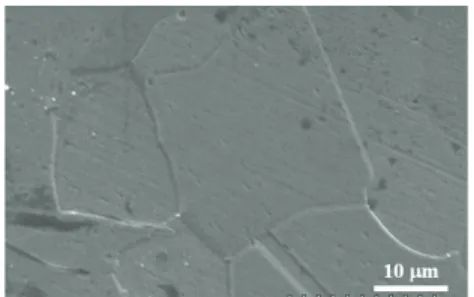
Fig. 2는 Incoloy 825 합금의 모재 조직을 주 사전자현미경으로 관찰한 것으로, 오스테나이트 단상조직이다.
Fig. 3은 700, 800, 900 및 1,000 ℃에서 각각 1시간 용체화처리 후, 수냉한 시험편의 조직을 주 사전자현미경으로 관찰한 것이다.[26] (a)∼(d)는 각각 700, 800, 900 및 1,000 ℃의 시험편이다.
(a)∼(c)는 오스테나이트의 입계 및 입내에 부분적 으로 석출물들이 있다. (d)는 오스테나이트의 입내
및 입계에 석출물들이 없는 오스테나이트 단상조 직으로 되어 있다. 이것은 950 ℃ 이하는 오스테 나이트와 탄화물의 공존 영역이지만, 1,000 ℃는 오스테나이트 단상 영역이기 때문이라 판단된다.
온도가 높을수록 결정립이 커지고, 1,000 ℃의 결 정립은 매우 큰 것을 알 수 있다. 이것은 온도가 높을수록 결정립 성장은 빠르고, 1,000 ℃는 석출 물이 없는 오스테나이트 단상조직으로 석출물의 방해를 받지 않고 빠르게 오스테나이트 결정립의 성장하였기 때문이다.
Fig. 4는 석출물이 가장 많이 석출된 700 ℃에 서 1, 5, 10 및 30시간까지 시효한 시험편의 조
Fig. 1 Schematic diagram of elastic wave detection Fig. 2 SEM observation of the structure of theas-received specimen.[26]
Fig. 3 SEM observation of the structure of the solution treatment specimen during 1h on each temperature. (a) 700 ℃, (b) 800 ℃, (c) 900 ℃, (d) 1,000 ℃
직을 주사전자현미경으로 관찰한 것이다.[26] 그림 에서 (a)∼(d)는 각각 1, 5, 10 및 30시간 시효한 시험편이다. (a)∼(d) 시험편에서 석출물은 오스테 나이트의 입계를 따라 생성되어있는 것을 알 수 있다. 또한 시간이 길어지면 입내에 석출물이 생 성되고 있으며, 생성양도 많아지고 있는 것을 알 수 있다. 그러나 결정립은 시간이 증가하여도 성 장하지 않았다. 이것은 석출물이 결정립의 성장을 방해하였기 때문이라 판단한다.
Fig. 4 SEM observation of the structure of the aging treatment specimen during each times on 700 ℃. (a) 1h, (b) 5h, (c) 10h, (d) 30h
3.2 기계적특성
Fig. 5는 700, 800, 900 및 1,000 ℃에서 1시 간 용체화처리 후, 수냉한 시험편의 인장강도와 연신율을 나타낸 것이다.[26] 온도가 증가함에 따 라서 인장강도는 감소하고, 연신율은 증가하는 것 을 알 수 있다.
이상의 결과로 용체화처리 온도가 높아질수록 인장강도와 경도는 서서히 감소하고, 연신율은 증 가하였다. 이것은 용체화처리 온도가 높아지면 결
정립 크기가 증가하고, 석출물의 양에 따른 석출 강화 효과 때문이라 판단된다.
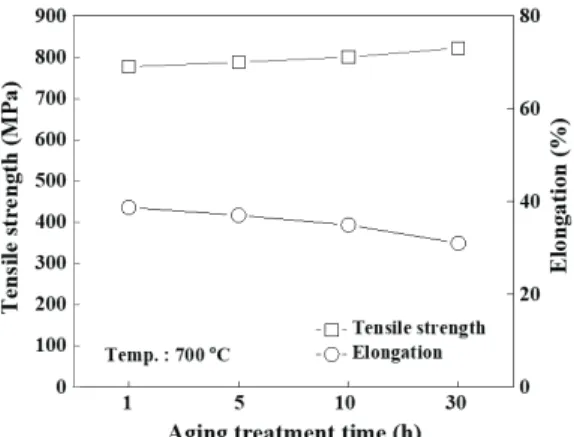
Fig. 6은 700 ℃에서 1, 5, 10 및 30시간 시효 한 시험편의 인장강도와 연신율을 나타낸 것이 다.[26] 시효 시간의 증가와 함께 인장강도는 증 가하고, 연신율은 감소하였다.
Fig. 6 Tensile strength and elongation according to aging treatment time
이상의 결과로 시효 시간이 증가할수록 인장강 도와 경도는 증가하고, 연신율은 감소하였다. 이것 은 시효 시간이 길어지면 석출물의 양이 많아서 석출강화 효과가 크고, 석출물이 커지기 때문이다.
Fig. 5 Tensile strength and elongation according to solution treatment temperature
3.3 웨이블릿(Wavelet; WT)에 의한 시간 -주파수 해석
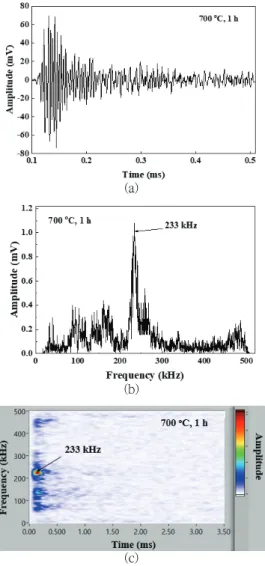
Fig. 7은 700 ℃에서 1시간 동안 용체화처리한 시험편의 인장시험에서 얻어진 파형, 주파수 스펙 트럼 및 웨이블릿 해석 결과를 대표적으로 나타낸
다. 그림에서 (a)는 탄성파의 파형, (b)는 주파수, (c)는 웨이블릿에 의한 시간-주파수를 나타낸다.
Fig. 8은 용체화처리 온도와 탁월주파수의 관계 를 나타낸다. 용체화처리는 각 온도에서 1시간이 다. 탁월주파수는 용체화처리 온도가 상승함에 따 라서 약간씩 감소하였다. 이것은 (a)∼(c)와 같이 오스테나이트의 입계 및 입내에 석출물이 부분적 으로 생성하였으며, (d)와 같이 석출물이 없는 오 스테나이트 단상조직이지만, 결정립은 매우 크기 때문이다. 이와 같은 석출물 및 조대 조직이 탄성 파의 전달을 방해한 것이 원인이라 판단된다.
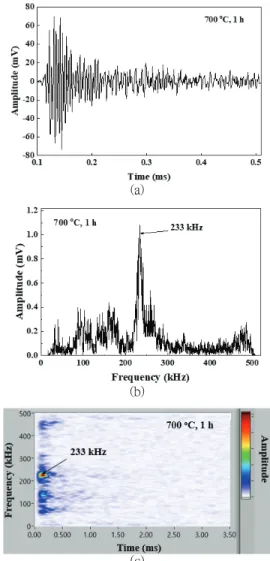
Fig. 9는 700 ℃에서 1시간 동안 시효한 시험 편의 인장시험에서 얻어진 파형, 주파수 스펙트럼 및 웨이블릿 해석 결과를 대표적으로 나타낸다.
그림에서 (a)는 탄성파의 파형, (b)는 주파수, (c) 는 웨이블릿에 의한 시간-주파수를 나타낸다.
Fig. 10은 700 ℃에서 1, 5, 10 및 30시간 시 효 시간에 따르는 탁월주파수를 나타낸다. 시효 처리 시간이 길어짐에 따라서 탁월주파수가 약간 씩 증가하는 것을 알 수 있다. 이것은 조직에서 알 수 있듯이 석출물은 오스테나이트의 입계를 따 라 생성되었으며, 시효 처리 시간이 길어지면 입 내에 석출물이 생성되고, 생성양도 많아졌다. 그러
(a)
(b)
(c)
Fig. 7 Frequency characteristic of elastic wave obtained from solution treatment specimen during 1 h at 700 ℃. (a) Waveform of elastic wave, (b) Frequency and (c) Time-frequency by WT.
Fig. 8 Relationship between dominant frequency and solution treatment temperature
나 석출물이 결정립의 성장을 방해하였기 때문에 탁월주파수가 증가한 것이라 판단된다.
Fig. 11은 700, 800, 900 및 1000 ℃에서 1시 간 용체화처리에 따르는 탁월주파수와 인장강도 및 연신률의 관계를 나타낸다. 탁월주파수는 인장 강도가 증가함에 따라서 증가하였으나, 연신률이
감소함에도 불구하고 탁월주파수는 증가하였 다.[27] 이것은 용체화처리 온도의 증가에 따라서 석출물이 생성되거나 조직이 조대화하여 취화한 것이 원인이라 판단된다.
Fig. 10 Relationship between dominant frequency and aging treatment time at 700 ℃
Fig. 11 Relationship between tensile strength and elongation for dominant frequency depending on solution treatment of 1 h at 700, 800, 900 and 1000 ℃
Fig. 12는 700 ℃에서 1, 5, 10 및 30시간 시 효처리에 따르는 탁월주파수와 인장강도 및 연신 률의 관계를 나타낸다. 탁월주파수는 용체화처리 와 같이 인장강도가 증가함에 따라서 증가하였으
(a)
(b)
(c)
Fig. 9 Frequency characteristic of elastic wave obtained from aging treatment specimen during 1 h at 700 ℃. (a) Waveform of elastic wave, (b) Frequency and (c) Time-frequency by WT.
나, 연신률이 감소함에도 불구하고 탁월주파수는 증가하였다.[27] 이것은 입계 및 입내에 생성된 석출물 때문에 결정립이 성장하지 못하여 탁월주 파수가 증가한 것이라 판단된다.
Fig. 12 Relationship between tensile strength and elongation for dominant frequency depending on aging treatment of 1, 5, 10 and 30 h at 700 ℃
4. 결 론
Incoloy 825 합금의 용체화처리 온도(700, 800, 900, 1000 ℃) 및 시효 시간(700 ℃에서 1, 5, 10, 30시간)을 달리하여 인장에 따르는 탄성파 특성을 평가하여, 다음과 같은 결론을 얻었다.
1) 용체화처리 온도가 증가할수록 결정립은 커 지고, 입계 및 입내의 석출물은 감소하였다.
석출물의 양은 700 ℃의 시효 시간이 증가 할수록 증가하고, 크기도 증가하였으나, 1,000 ℃는 석출되지 않았다.
2) 용체화처리 온도가 증가할수록 인장강도는 감소하고, 연신율은 증가하였다. 그러나 시 효 시간이 길어질수록 인장강도는 증가하고 연신율과 감소하였다.
3) 탁월주파수는 용체화처리 온도가 증가함에 따라서 감소하였으나, 시효 시간이 길어짐에 따라서 탁월주파수가 증가하였다.
4) 용체화처리 및 시효시간에 따르는 탁월주파 수는 인장강도가 증가함에 따라서 증가하였 으나, 연신률이 감소함에도 불구하고 탁월주 파수는 증가하였다.
참고문헌