1
Date Received May 7, 2014, Date Accepted June 18, 2014
2
국립산림과학원 임산공학부. Department of Forest Products, Korea Forest Research Institute
†
교신저자(corresponding author): 이선영(e-mail: [email protected])
폴리인산염 첨가에 의한 폴리프로필렌 기반의 Wood Plastic Composites 열안정성
1
전 상 진
2
⋅이 선 영2,†
Thermal Stability of Polypropylene-Based Wood Plastic Composites by The Addition of Ammonium Polyphosphate 1
Sang-Jin Chun
2⋅Sun-Young Lee
2,†요 약
본 연구에서는 WPC의 열안정성을 향상시키기 위해 폴리프로펠렌 매트릭스에 목분과 폴리인산염(ammonium poly- phosphate, APP)의 삼종혼합 후, 목분과 난연제 첨가에 따른 목재플라스틱 복합재(wood plastic composites, WPC)의 열분해 거동이 조사되었다. 모든 배합비의 WPC 열분해 거동은 질소의 환경에서 분당 10℃ 상승속도로 제어하여 열중 량분석기(Thermogravimetric analyzer)를 통해 분석하였다. 목분의 열분해온도가 PP의 열분해온도 보다 낮기 때문에 목 분에 의해 생성된 char막은 PP로의 열전달 속도를 낮추며, 2차 열분해온도 증가 및 열분해속도를 늦춘다. APP를 첨가 한 WPC의 경우 1차 열분해온도 감소 및 2차 열분해온도의 증가를 보여준다. 목분의 함량이 높은 WPC의 경우, APP 첨가 시 1차 열분해온도 감소 및 2차 열분해속도가 증가하였고, 고온에서 잔여물의 양은 APP 함량이 증가할수록 크게 증가하였다. APP가 첨가된 WPC 경우, 목분의 함량이 10 wt%에서 50 wt%로 증가 시 고온에서 잔여물 양이 증가하였 는데, 이는 APP 및 목질섬유의 char화가 동시에 발생되기 때문으로 보이며 결과적으로 목분 함량이 증가할수록 APP 의 효과가 높게 나타나 열안정 효과를 관찰할 수 있었다.
ABSTRACT
In order to improve the thermal stability of wood plastic composites (WPC), thermal degradation behavior of WPC in this study was investigated by the addition of wood flour and fire retardant after hybridization of wood flour and ammonium polyphosphate (APP) into polypropylene (PP) matrix. Thermal degradation behavior of all formulations was analyzed with thermogravimetric analyzer under nitrogen environment at heating rate of 10℃/min. As the thermal deg- radation temperature of wood flour is lower than that of PP, char layer formed by the wood flour decreases the speed of heat transfer to PP. In addition, the char layer increases the 2nd thermal degradation temperature and decreases the 2nd thermal degradation speed. The WPC treated with APP increases the 1st and 2nd degradation temperatures. In the
case of WPC with high loading level of wood flour, the 1st thermal degradation temperature and 2nd thermal degrada- tion rate were increased by the addition of APP, and then the amount of remnants at high temperature was increased by the increase of the APP loading level. In the case of WPC treated with APP, the amount of the remnants at high temperature was increased with the increase of wood flour content from 10 wt% to 50 wt%, indicating that char for- mation of the APP and wood flour occurred at the same time, resulting in high thermal stability effect by the increase of wood flour content.
Keywords :
polypropylene, wood flour, light stabilizer, UV absorber, weathering
1. 서 론
지난 20년 동안 목분(wood flour)과 같은 천연 원 료를 사용하여 목재⋅플라스틱 복합재(Wood Plastic Composite, WPC) 의 개발에 관한 연구가 활발하게 진행되어왔다. 목분은 가격이 저렴하고, 밀도가 낮으 며, 화학적 개질이 쉽고, 가공장비에 마모성이 적은 점 등의 많은 장점을 가지고 있어 WPC의 원료로 널 리 이용되고 있다(Lee et al. 2004; Lee et al. 2009;
Lee et al. 2009; Kang et al. 2009; Kang et al.
2010). 폴리프로필렌(polypropylene, PP)은 상온에서 이용될 때 우수한 기계적, 물리적 및 열적 특성 때문 에 WPC 원료시장에서 큰 비중을 차지하고 있다 (Karian 2004). WPC 는 치수안정성, 열적 특성, 수분 에 대한 안정성, 재활용, 압축⋅인장⋅전단 강도 및 높은 충격강도와 같은 장점을 가지고 있어서 데크재, 사이딩, 루바, 방음벽 및 울타리 등 다양한 용도로 이용되고 있다(Schlechter 2004; Klyosov 2007).
최근 들어 WPC에 기능성을 부여하여 장기내구성 을 향상시키기 위한 많은 연구가 수행되고 있다. 예 를 들어 UV 안정제와 UV 흡수제와 같은 첨가제를 이용하여 WPC의 변색을 막기 위한 기술개발(Lee 2009; Stark and Matuana 2006), 발포제를 첨가하여 미세한 크기의 기포를 생성시켜 WPC의 밀도를 낮추 어 경량화를 부여하는 연구(Gwon et al. 2012; Faruk et al. 2007), shell과 core층의 새로운 형태를 만들어 서 수분 침투를 낮추고 치수안정성과 기계적 강도를 높이기 위한 공압출(co-extrusion) WPC 제조기술 개 발(Huang et al. 2012; Huang et al. 2013) 등 많은 연구가 이루어지고 있다.
그러나 이들 연구에 비하여 상대적으로 WPC 난 연성 향상에 관한 연구가 미진한 실정이다. 고분자의 난연성능에 관한 연구는 WPC가 다양한 용도로 활용 하기 위하여 난연성능을 향상시키는데 매우 중요한 요소이다. 팽창성(intumescent) 난연제, 무기계(inorganic) 난연제 및 할로겐화(halogenated) 난연제가 고분자의 난연성을 개선하기 위해서 사용되어 왔다(Baker et al. 2010, Feng et al. 2012). 할로겐화 난연제는 불꽃 이 퍼지는 속도를 효과적으로 늦추는 작용을 하나 열분해 시 많은 연기와 유독가스를 방출하여 환경적 규제 때문에 사용이 제한되어 왔다(Feng et al. 2012).
그러므로 무기계와 팽창성 난연제가 다양한 고분자 에 널리 사용되고 있다. 산, char 또는 가스로 구성된 전통적인 팽창성 난연제는 WPC 시스템에 이용하지 않고 있다(Liu et al. 2013; Dai et al. 2013). 일반적 으로, 목분은 char를 형성시키는 물질이고, char 형성 메카니즘은 팽창성 난연제 속에 존재하는 산으로 활 성화될 수 있다(Li and He 2004; Qu et al. 2011;
Seefeldt and Braun 2012). WPC 를 제조할 때 고온에 서 발생하는 목분의 빠른 열분해는 용융된 혼합물이 압출되기 어렵도록 점도가 높아지는 경우가 있으며, WPC 의 기계적 성질을 감소시킨다. 따라서 WPC 시 스템에 인산암모늄과 같은 무기계 난연제의 첨가는 WPC 의 난연성능을 향상시킬 수 있는 좋은 해결책이 될 수 있다.
난연제에 따라 난연 기작을 하는 분해 온도 범위
가 다양하고 난연 기작 또한 다양하기 때문에 WPC
에 난연제 첨가 시 효율적으로 연소를 지연시키는
난연제를 찾는 연구는 매우 중요하다. 본 연구에서는
WPC 의 난연성을 향상시키기 위해 폴리인산염과 목
Fig. 1. Thermal degradation behavior of APP.
Wood (wt%) PP (wt%) Additives (wt%) 10 90, 88, 86, 84, 82, 80 0, 2, 4, 6, 8, 10 30 70, 68, 66, 64, 62, 60 0, 2, 4, 6, 8, 10 50 50, 48, 46, 44, 42, 40 0, 2, 4, 6, 8, 10 Table 1. Compositions of the composites
분의 이종혼합에 초점을 두고 있다. 따라서 본 연구 는 목질 섬유 함량에 따른 WPC의 열분해 거동 및 난연제 함량에 따른 열분해 거동과 분해 메카니즘 (mechanism) 을 살펴보는데 목적이 있다.
2. 실 험 2.1. 공시재료
폴리프로필렌(PP, HJ 700, 삼성토탈)이 고분자 수 지로 사용되었으며, PP의 용융흐름지수(melt flow index) 는 230℃에서 22 g/10 min이고, 밀도는 0.91 g/cm
3이다. 목분(ABOCEL
TMC100, JRS, 독일)이 WPC의 원료로 사용되었는데, 수종은 독일가문비나무이며, 목분의 입자크기는 약 31∼100 µm의 범위이고, 부 피밀도는 172 g/L이다. 사용된 인계 난연제인 am- monium polyphosphate (APP) 는 (주)ESC로부터 구입 하였다.
2.2. 복합재 제조
PP 목분과 APP를 포함하는 복합재 제조를 위한 배합비는 Table 1에서 보여진다. Corotating twin-screw extruder (19 mm diameter, 40 L/D ratio, ( 주)Bautek) 와 pelletizer (Bautek, Korea)가 WPC를 제조하기 위 해서 사용되었다. 목분과 APP는 사용에 앞서서 수분 을 제거하기 위해 건조오븐을 이용하여 80℃에서 24 시간 동안 건조시켰다. 이때 목분의 수분 함수율은 1% 미만이다. 압출(compounding)은 Corotating twin- screw extruder 의 배럴의 온도를 170-185℃의 범위에 서 150 rpm의 압출속도로 시간당 1 kg의 복합재 펠 렛을 제조하였고, 상용화제는 사용하지 않았다.
2.3. 열분석
모든 배합비의 WPC 열분해 곡선은 질소의 환경 에서 분당 10℃ 승온속도를 적용하여 열중량분석기 (Thermogravimetric analyzer, TA instruments Inc.) 를 사용하였다. TGA 분석을 위한 온도의 범위는 30℃
에서 600℃까지 스캔되었다.
3. 결과 및 고찰 3.1. APP와 PP의 열분해 거동
Fig. 1 은 ammonium polyphosphate (APP)의 TGA 분석으로 APP의 열분해 거동을 보여준다. APP의 1 차 분해 거동은 500℃ 이하(보통 270∼500℃)에서 발생하며 약 18%의 중량감소를 보였다. 이 단계에서 는 APP로부터 물과 암모니아가 발생되어 높게 가교 된 다중 인산(polyphosphoric acid)이 형성되며, 50 0 ℃와 600℃ 사이에서 최대 중량 감소율을 보인다 (Klyosov 2007).
Fig. 2 는 순수한 PP 및 PP와 APP를 1 : 1의 배합비
(APP+PP) 로 혼합 후의 열분해 거동을 보여준다. PP
는 약 430℃에서 1.90 wt%/℃의 최대 질량 변화율을
보이며 전체 중량의 70%가 감소하였다. 약 600℃에
서 최종적으로 잔유물이 거의 없으며 대부분의 PP가
분해되는 것을 확인할 수 있었다. 한편 APP+PP의
Fig. 2. Thermal degradation behavior of PP:APP (1 : 1) blends.
Fig. 3. Thermal degradation behavior of WF:APP (1 : 1) blend.
열분해 거동을 살펴보면, 두 단계의 열분해 거동이 나타나며 약 300℃와 410℃에서 각각 0.13 wt%/℃
및 0.25 wt%/℃의 중량감소 속도를 보였다. 중량변 화는 300℃와 410℃에서 각각 5% 및 22%가 감소하 였으며, 최종적으로 약 590℃에서 전체 질량 중 38% 만이 감소하였다. PP와 APP 혼합 시, 약 300℃
에서 1차분해 거동을 보이는데, 이는 Fig. 1에서 살 펴본 바와 같이 APP의 열분해가 발생하는 것으로 판단된다. PP 단독 사용 및 PP와 APP 혼합사용 시 400 ℃∼500℃에서 발생되는 열분해 거동을 보면 PP 의 경우 약 1.90 wt%/℃의 중량감소 속도를 보이며 APP+PP 의 경우 0.25 wt%/℃의 중량감소 속도를 나 타낸다. 결과적으로 APP+PP는 약 300℃에서 APP분 해를 통한 다중인산 생성 및 PP의 back bone과 분해 및 반응을 통한 char막 형성이 발생되는 것으로 사료 된다. 일반적으로 APP를 포함하는 플라스틱이 화재 나 고온에 노출되었을 때, 난연제는 polyphosphoric acid 와 ammonia로 분해되기 시작한다. Polyphosphoric acid 는 수산기와 결합하여 불안정한 phosphate ester 로 분해되고, 다음단계에서 phosphate ester의 탈수화 반응이 일어난다. 플라스틱의 표면에서 char막이 발 생되며, 이러한 char막은 절연층 역할을 하여 플라스 틱의 열분해를 막아준다(Klyosov 2007). 따라서 이러 한 char막 형성은 PP의 분해속도를 1.90 wt%/℃에서 0.25 wt%/ ℃로 중량감소 속도를 감소시켜 열적으로 더 안정되게 만든다.
3.2. 목분과 APP의 열분해 거동
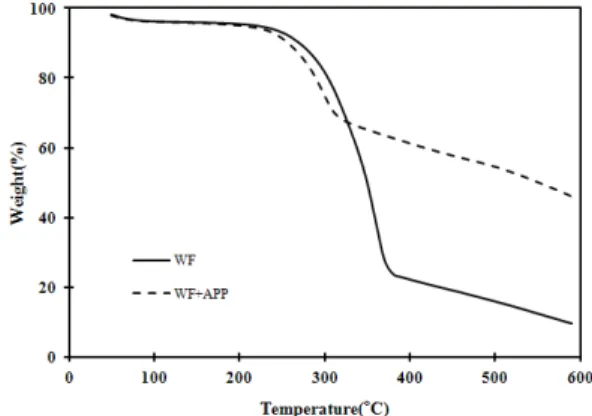
Fig. 3 은 목분 및 목분+APP 혼합물의 열분해 거동 을 보여주는데, Fig. 2에서 살펴본 PP 및 APP+PP의 열분해 거동과 비슷하다. 그러나 목분의 경우 APP+PP 와 다르게 2차 열분해 거동이 발견되지 않는다. 이는 APP 의 열분해 초기에 발생되는 다중 인산과의 반응 을 통해 빠르게 목분 전체에 char화가 발생되는 것으 로 판단된다. 최대 중량감소 속도는 목분의 경우 약 360 ℃에서 1.20 wt%/℃, 300℃에서 목분+APP의 경 우 0.50 wt%/℃이다. 목분 및 PP의 열분해 거동에서 APP 첨가 시 초기 열분해온도(5% 중량감소 시점의 온도)는 목질섬유의 경우 약 272℃에서 258℃로 감 소하였고, PP의 경우 340℃에서 300℃로 감소하였 다. 이는 APP 첨가 시 목질섬유 및 PP 모두 분해를 촉진시켜 char를 만들지만, 결국 Figs. 2와 3에서 살 펴본 바와 같이 char층의 형성으로 인한 열전달속도 를 감소시켜 높은 온도에서 열적으로 안정한 상태를 만든다는 것을 의미한다.
3.3. 목분, PP와 APP 첨가된 WPC의 열분해 거동
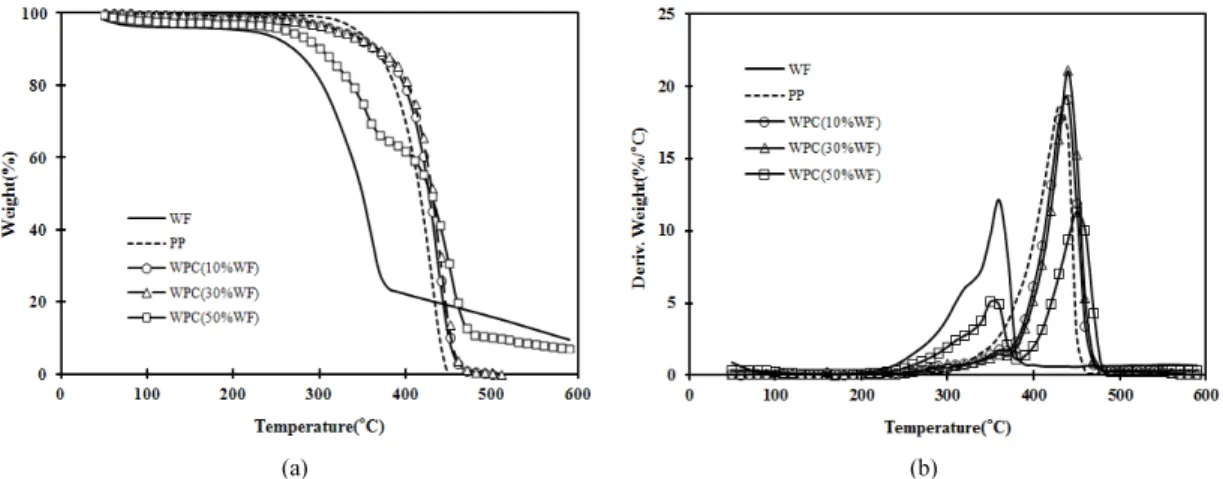
Fig. 4 와 Table 2는 목분과 PP 수지만으로 구성된
WPC 의 TGA와 DTG (TGA 미분 그래프) 결과를 보
여준다. PP의 경우 열분해가 주로 400℃ 이상에서
Sample T
DTGmaxat 1
ststep ( ℃)
Mass loss at 1
ststep (%)
R
maxat 1
ststep (%/ ℃)
T
DTGmaxat 2
ndstep ( ℃)
Mass loss at 2
ndstep (%)
R
maxat 2
ndstep (%/ ℃)
Char residue at 600 ℃ (%)
1 432.1 77.0 1.89 - - - 0
2 360.8 62.2 1.21 - - - 9.4
3 356.4 8.7 0.17 437.2 68.4 1.97 0
4 355.6 17.3 0.34 449.5 71.6 1.57 1.8
5 354.8 27.6 0.54 453.1 73.0 1.16 7.1
T
DTGmax andR
maxindicate the Maximum peak temperature and maximum degradation speed, respectively. Sample: 1 = PP, 2 = WF, 3 = 10 wt% WF filled PP, 4 = 30 wt% WF filled PP, 5 = 50 wt% WF filled PP.
Table 2. Thermal degradation results of constituents for WPCs
(a) (b)
Fig. 4. Thermal degradation behavior of WPCs without APP. (a) TGA, (b) DTG.
발생되고 목분의 경우 400℃ 이하에서 발생됨을 알 수 있다(Fig. 4 (a)). 목분은 일반적으로 약 200℃∼
350 ℃에서 탄화가 이루어지며, 이 구간에서 목분의 조성분인 hemicellulose와 cellulose가 대부분 분해되 어 char 잔여물을 생성시키고, CO
2, CO, CH
4, CH
3OH, 및 CH
3COOH 를 생성시킨다(Qu et al. 2011). 또한 370 ℃∼550℃의 구간에서 lignin이 분해된다. 따라 서 WPC의 열분해 거동은 크게 두 단계로 볼 수 있 으며 첫 번째 단계는 대부분이 목질 섬유의 구성 성 분이 분해되는 단계이며, 두 번째 단계는 PP의 분해 단계로 볼 수 있다(Fig. 4 (b)). 목질 섬유와 PP 혼합 시 목질 섬유의 열분해 및 char의 형성 온도가 미약 하게 감소함을 알 수 있다. 이와 동시에 PP의 최대 열분해 속도 온도 또한 증가함을 확인할 수 있었다.
이는 목분으로부터 char의 형성이 일찍 발생할수록
열전달속도가 감소하기 때문에 PP의 열분해온도를 증가시키는 것으로 판단된다. Table 2에서 보듯이 목 분의 함량이 증가할수록 1차 열분해온도가 감소하고 2 차 열분해온도가 증가함을 알 수 있다. 그리고 1차 열분해속도 또한 목분의 함량이 증가할수록 증가하 였고 2차 열분해속도는 감소하였다. 목분의 열분해 온도가 PP의 열분해온도 보다 낮은 것을 고려하였을 때, 목분에 의해 생성된 char막은 PP로의 열전달 속 도를 낮추기 때문에 2차 열분해온도 증가 및 열분해 속도를 늦추게 만드는 것으로 보인다.
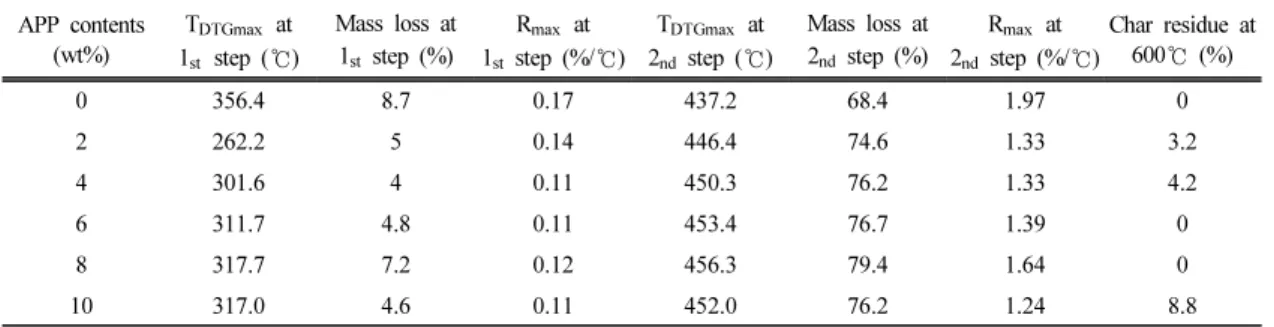
Fig. 5 와 Table 3은 10 wt%의 목분과 0∼10 wt%
APP 가 첨가된 WPC의 TGA와 DTG를 비교한 결과
이다. APP 함량(2∼10 wt%)과 열분해온도 및 열분
해속도, 잔여물의 양 사이에 일정한 경향성은 보이지
않지만 대부분의 난연제를 처리한 WPC의 경우 1차
APP contents (wt%)
T
DTGmaxat 1
ststep ( ℃)
Mass loss at 1
ststep (%)
R
maxat 1
ststep (%/ ℃)
T
DTGmaxat 2
ndstep ( ℃)
Mass loss at 2
ndstep (%)
R
maxat 2
ndstep (%/ ℃)
Char residue at 600 ℃ (%)
0 356.4 8.7 0.17 437.2 68.4 1.97 0
2 262.2 5 0.14 446.4 74.6 1.33 3.2
4 301.6 4 0.11 450.3 76.2 1.33 4.2
6 311.7 4.8 0.11 453.4 76.7 1.39 0
8 317.7 7.2 0.12 456.3 79.4 1.64 0
10 317.0 4.6 0.11 452.0 76.2 1.24 8.8
Table 3. Thermal degradation results of WPCs (10 wt% WF) with 0-10 wt% APP
APP contents (wt%)
T
DTGmaxat 1
ststep ( ℃)
Mass loss at 1
ststep (%)
R
maxat 1
ststep (%/ ℃)
T
DTGmaxat 2
ndstep ( ℃)
Mass loss at 2
ndstep (%)
R
maxat 2
ndstep (%/ ℃)
Char residue at 600 ℃ (%)
0 355.6 17.3 0.34 449.5 71.6 1.57 1.8
2 274.9 10.2 0.28 457.6 71.3 0.85 8.5
4 262.9 8.9 0.20 457.1 68.8 1.31 11.6
6 279.1 10.7 0.25 457.4 64.7 1.33 14.7
8 283.5 11.2 0.25 454.5 62.2 1.18 17.4
10 288.9 10.9 0.23 455.6 63.2 1.26 17.1
Table 4. Thermal degradation results of WPCs (30 wt% WF) with 0-10 wt% APP
(a) (b)
Fig. 5. Thermal degradation behavior of WPCs with 10 wt% WF and APP. (a) TGA, (b) DTG.
열분해온도 감소 및 2차 분해온도의 증가를 보여준 다. Fig. 6과 Table 4는 30 wt%의 목분과 0∼10 wt% APP 가 첨가된 WPC의 TGA와 DTG를 비교한 결과이다. 10 wt%의 목분이 첨가된 WPC와는 다르 게 APP를 첨가 시 1차 열분해온도의 감소와 2차 열
분해속도가 상승하는 DTG 그래프의 변화가 나타났
으며(Fig. 6 (b)), 약 600℃에서 잔여물 또한 크게 증
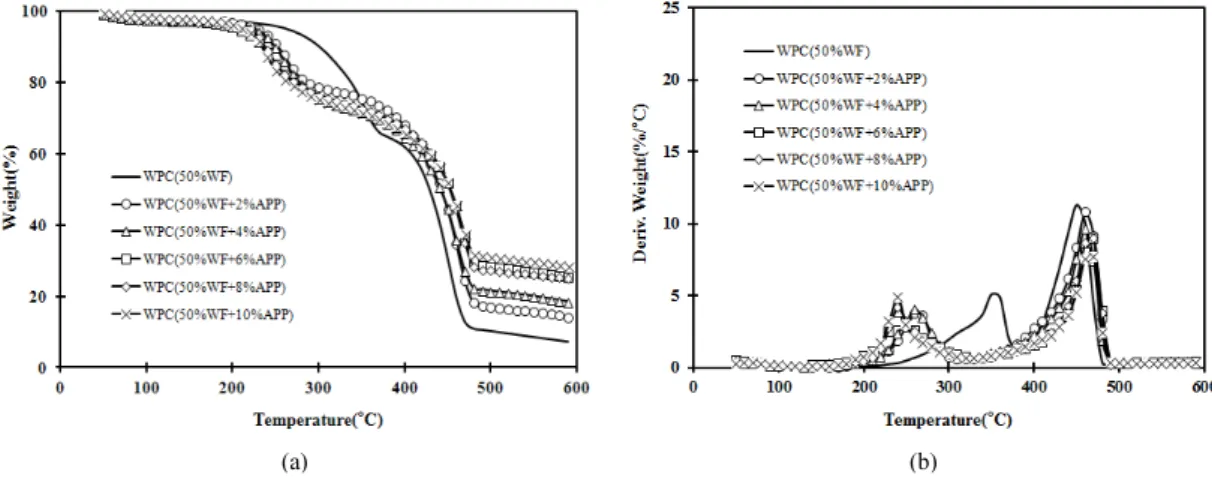
가하는 것을 확인할 수 있었다. 50 wt%의 목분이 첨
가된 WPC의 경우에서도 APP 첨가 시 1차 열분해온
도 감소 및 2차 열분해속도가 증가하는 DTG 그래프
APP contents (wt%)
T
DTGmaxat 1
ststep ( ℃)
Mass loss at 1
ststep (%)
R
maxat 1
ststep (%/ ℃)
T
DTGmaxat 2
ndstep ( ℃)
Mass loss at 2
ndstep (%)
R
maxat 2
ndstep (%/ ℃)
Char residue at 600 ℃ (%)
0 355.6 17.3 0.34 449.5 71.6 1.57 1.8
2 274.9 10.2 0.28 457.6 71.3 0.85 8.5
4 262.9 8.9 0.20 457.1 68.8 1.31 11.6
6 279.1 10.7 0.25 457.4 64.7 1.33 14.7
8 283.5 11.2 0.25 454.5 62.2 1.18 17.4
10 288.9 10.9 0.23 455.6 63.2 1.26 17.1
Table 5. Thermal degradation results of WPCs (50 wt% WF) with 0-10 wt% APP
(a) (b)
Fig. 6. Thermal degradation behavior of WPCs with 30 wt% WF and APP. (a) TGA, (b) DTG.
(a) (b)
Fig. 7. Thermal degradation behavior of WPCs with 50 wt% WF and APP. (a) TGA, (b) DTG.
변화를 나타냈으며, 잔여물 양 또한 난연제 함량이 증가할수록 눈에 띄는 증가를 보여주고 있다(Fig. 7
과 Table 5). 난연제가 첨가된 WPC 간의 결과를 비
교할 때, 목분의 함량이 10 wt%에서 50 wt%로 증가
시 잔여물 양이 증가했다. 이는 난연제 및 목질섬유 의 char화가 동시에 발생하기 때문으로 보이며 목분 함량이 증가할수록 이러한 효과가 더욱 상승하는 것 으로 판단된다.
4. 결 론
목분과 PP 수지만으로 제조된 WPC의 열분해 거 동을 보면, 목분의 함량이 증가할수록 1차 열분해온 도가 감소하고 2차 열분해온도가 증가하였다. 목분 의 함량이 증가할수록 1차 열분해속도 또한 증가하 였고 2차 열분해속도는 감소하였다. 목분의 열분해 온도가 PP의 열분해온도 보다 낮은 것을 고려하였을 때, 목분에 의해 생성된 char막은 PP로의 열전달 속 도를 낮추기 때문에 2차 열분해온도 증가 및 열분해 속도를 늦추는 것으로 사료된다. APP 함량(2∼10 wt%) 과 열분해온도 및 열분해속도, 잔여물의 양 사 이에 일정한 경향성은 보이지 않지만 APP를 첨가한 WPC 는 1차 열분해온도 감소 및 2차 열분해온도의 증가를 보여준다. APP가 첨가된 WPC의 경우 APP 및 목분의 char화가 동시에 발생되어 목분 함량이 증 가할수록 높은 열안정 특성을 나타낸다.
REFERENCES