• 검색 결과가 없습니다.

A Case Study on Productivity Analysis and Methods Improvement for Masonry Work

N/A
N/A
Protected

Academic year: 2021

Share "A Case Study on Productivity Analysis and Methods Improvement for Masonry Work"

Copied!
10
0
0

로드 중.... (전체 텍스트 보기)

전체 글

(1)

pISSN 1598-2033 eISSN 2233-5706

Journal of the Korea Institute of Building Construction, Vol. 13, No. 4

http://dx.doi.org/10.5345/JKIBC.2013.13.4.372 www.jkibc.org

A Case Study on Productivity Analysis and Methods Improvement for Masonry Work

Chang, Chul-Ki

1

Yoo, Wi Sung

2*1)

Department of Architectural Engineering, Hannam University, Daedeok-Gu, Daejeon, 306-791, Korea

1

Construction Management Division, Construction & Economy Research Institute of Korea,

Gangnam-Gu, Seoul, 135-701, Korea

2

Abstract

In the construction industry, a great deal of research has been focused on productivity improvement because a minor change in labor productivity can often make the difference between a profit and a loss. This study shows how productivity measurement methods can be applied in practice, step by step, to analyze and identify potential problems both in productivity and methods performance for masonry work. A work sampling technique was conducted to determine the nature and extent of an observable activity as an aid to measuring overall performance. Also, a method productivity delay model was used to identify non-productivity in individual cycle times. From the work sampling technique, it was found that the masonry crew had a Labor Utilization Factor of 47.1%, and from the videotape analysis, it was found that the material and dumpster location need to be adjusted to reduce the travelling distance. We have found that efforts to improve the productivity of masonry work should be focused almost exclusively on machine and labor delays, based on the result from the method productivity delay model.

Keywords : labor, delay, masonry work, productivity analysis, work sampling

1. Introduction

1.1 Background

Labor productivity has been a hot topic in the construction industry. Compared to the growth in productivity in other industries, the productivity growth in construction has been much lower[1].

Construction productivity has a major influence on overall project cost[2,3]. A minor change in labor productivity can often mean the difference between a profit and a loss. Effective productivity can make or break companies competing in a field

Received : January 23, 2013 Revision received : May 14, 2013 Accepted : May 28, 2013

* Corresponding author : Yoo, Wi Sung

[Tel: 82-2-3441-0860, E-mail: [email protected]]

©2013 The Korea Institute of Building Construction, All rights reserved.

where the profit margins are getting smaller every day. Labor productivity is one area in the construction industry that can be improved, and approaches to enhancing it have been researched in the past[4]. A key prerequisite to improving productivity is to measure it. To this end, the research team has employed several acceptable methods for measuring the productivity of a specific project that will be used as a case study, which is the initial phase of a ‘downtown’ retail development that many people hope to lead to further retail development in the immediate area.

The first stage of the project includes a

neighborhood retail center, and structures for

professional and retail offices. In this study, the

productivity and methods improvement for masonry

work was focused in the construction of the

neighborhood retail center. Specifically, the work

(2)

activities of the masonry crew constructing the rear wall of the neighborhood retail center were analyzed in this study.

1.2 Objective and scope

The objectives of this study are to isolate one aspect of the construction process and to apply productivity measurement and improvement techni- ques to analyze and identify potential problems with regard to productivity and methods.

Suggestions for improvement will then be provided based on the results of the study. This study was limited to two testing methods, which are sum- marized as follows:

Ÿ A work sampling technique is conducted to determine the nature and extent of an observable activity as an aid to the measurement of overall performance. Specifically, the work sampling will be used to identify productivity problems within the masonry crew.

Ÿ A method productivity delay model (MPDM) will be used to identify non-productivity in individual cycle times.

2. Literature review

A work sampling technique, sometimes referred to as a productivity rating, was the first task to be completed in the analysis process. This is a measurement technique for the quantitative analysis, in terms of time, the activity of men, machines, or any observable state or condition of operation[6,7]. The technique, in general, consists of a large number of observations taken at a random interval over a sufficient period of time.

During each observation, the state or condition of the object of the work sampling technique is noted, and this information is classified into one of three predefined categories of activities

pertinent to the particular work situation. The three major work classifications that are most commonly used are categorized into effective, essential contributory and ineffective work.

Effective work, or direct work, is defined as the actual process of putting together or adding to the unit being constructed[5]. This category includes tasks such as placing block, applying mortar, and placing reinforcement. In a perfect world, with productivity rates at 100%, all of the tasks completed would contribute to the unit being constructed and thus would be classified as direct work. Certainly this is not the case, as many tasks completed have limited or no direct benefit to the unit being constructed. This leads to the other two categories of work classification of essential contributory and ineffective work.

Essential contributory work is defined as work that is not directly adding to the unit being constructed, but that through an associated process, is essential to the finishing of the work unit[5]. This commonly includes reading plans, receiving or giving directions, clean up, building scaffolding, or handling tools and materials, such as moving block or mixing mortar, within the immediate work area.

Ineffective work is defined as simply doing nothing, or doing something that is not necessary to complete the unit being constructed[6]. Unexplained idle time, talking, walking empty handed, and coffee breaks are examples of activities in this category.

Improvement in ineffective work as well as essential contributory work is the key to overall productivity improvement on the project.

Based on the proportions of observations

obtained in each category, inferences can be drawn

to determine the approximate amount of time

spent in each category over the entire length of

the work activity. The degree of reliability of work

sampling is based on a fundamental statistical

(3)

A Case Study on Productivity Analysis and Methods Improvement for Masonry Work

approach. To put it simply, as the number of observations in the work sampling technique increase, the associated statistical error of the study decreases. The required number of observations to meet predetermined statistical requirements can be determined prior to conducting the technique. Since the work sampling is based on statistical principles, recognized statistical procedures must be followed to make the results valid. The most important of these statistical principles to be followed in a work sampling study is randomness, or more specifically, the randomness associated with each observation.

Randomness in an observational work sampling is an important requirement that allows for the following:

Ÿ Any given instant of time has an equal like- lihood of selection as the time for observation as any other instant.

Ÿ There is no apparent order of the times of observations.

Ÿ One time of observation is independent of all other times of observations.

If all of the above requirements are achieved, the work sampling can provide an overall understanding of the activities involving people and machines associated with the construction project under observation. The results will also allow management to make decisions to improve the distribution of activities in the process and to maximize overall performance.

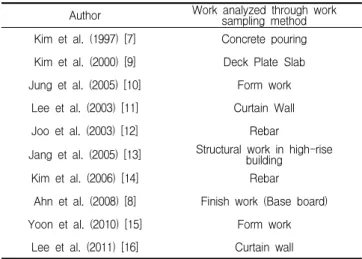
A technique called work sampling has been proven not only to be a very effective tool for work efficiency or productivity measurement but also to be a powerful and applicable tool for productivity improvement when used with systematic work improvement methods[8]. Thus, as shown in Table 1, this technique has been widely used to analyze and improve productivity in

various work elements consisting of building construction projects. However, most of the previous studies considered structural work such as form work, rebar work, deck plate slab, and concrete pouring work, with the exception of Ahn ’s research (2008), in which a work sampling technique was applied to finishing work like base board. There have been very few studies on masonry work.

Table 1. Previous studies on work sampling method

Author Work analyzed through work

sampling method Kim et al. (1997) [7] Concrete pouring Kim et al. (2000) [9] Deck Plate Slab

Jung et al. (2005) [10] Form work

Lee et al. (2003) [11] Curtain Wall

Joo et al. (2003) [12] Rebar

Jang et al. (2005) [13] Structural work in high-rise building

Kim et al. (2006) [14] Rebar

Ahn et al. (2008) [8] Finish work (Base board)

Yoon et al. (2010) [15] Form work

Lee et al. (2011) [16] Curtain wall

3. Work sampling

3.1 Procedures

3.1.1 Initial site visit

Before the main body of the work sampling can be completed, an initial site visit must be conducted. To this end, the research team made an initial site visit to obtain an understanding of the project, and observed the activities being con- ducted prior to collecting preliminary information for the proper application of a method productivity delay model (MPDM).

Photographs were taken and thoroughly reviewed

to assist in the set-up and development of the

required data collection forms and test methods.

(4)

The application and analysis of the work sampling technique will be focused on the masonry crew, which is constructing the west wall of the neighborhood retail center. This wall constitutes the rear of the structure. The crew to be studied consists of 4 masons and 2 laborers. The activities were selected because of their labor intensiveness as well as the critical nature of their completion on the overall construction schedule of the project.

Only one geographically based sample zone exists, and the work sampling area is not restricted due to the rather small size of the construction site area and the confined work area of the masonry crew.

3.1.3 Categorizing and defining activities

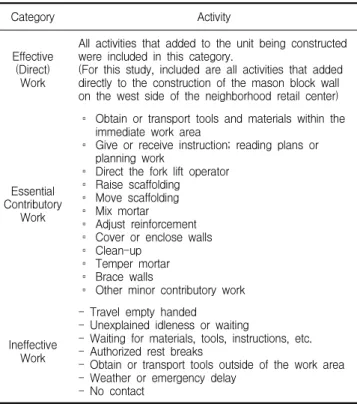
Two working days prior to the work sampling, the research team members reviewed the project site. This allowed them to become familiar with the process, activities, and the men doing the work. The masonry activities were carefully analyzed with the idea of developing a list of activities that met each of the categories of effective, essential contributory and ineffective work, as presented in Table 2.

Careful attention was paid to be sure that the activities selected for each category were defined in sufficient detail so that they could clearly and easily be instantaneously identified in each observation. Activities were also selected to ensure that the results would provide meaningful information to the project management regarding the nature of the work. Based on this initial project review, a clear understanding of the mason ’s activities, and a study of the literature, the following categories and activities were selected for the work sampling technique.

The majority of the activities listed above are self-explanatory. Other minor contributory work

essential contributory work as a safety measure in case of unexpected activities that were not allowed elsewhere were experienced. No contact (item 7) listed under ineffective work simply means that the worker previously observed was not present during the current observation.

Category Activity

Effective (Direct) Work

All activities that added to the unit being constructed were included in this category.

(For this study, included are all activities that added directly to the construction of the mason block wall on the west side of the neighborhood retail center)

Essential Contributory

Work

▫ Obtain or transport tools and materials within the immediate work area

▫ Give or receive instruction; reading plans or planning work

▫ Direct the fork lift operator

▫ Raise scaffolding

▫ Move scaffolding

▫ Mix mortar

▫ Adjust reinforcement

▫ Cover or enclose walls

▫ Clean-up

▫ Temper mortar

▫ Brace walls

▫ Other minor contributory work

Ineffective Work

- Travel empty handed

- Unexplained idleness or waiting

- Waiting for materials, tools, instructions, etc.

- Authorized rest breaks

- Obtain or transport tools outside of the work area - Weather or emergency delay

- No contact

Table 2. Classification of activities

3.1.4 Determination of confidence limits and observations Eq. (1) was used to calculate the number of random observations required for this study:

2 2
S P) (1 P

N K ´ ´ -

= ---(1)

N = number of random observations required P = decimal equivalent of the percentage expected in a given category

S = decimal equivalent of the degree of accuracy K = number of standard deviations required for a

given confidence level

(5)

A Case Study on Productivity Analysis and Methods Improvement for Masonry Work

It was determined that this study would be conducted to assure a 94% confidence level, which is more than a commonly significant confidence level (90%) in statistical applications, limiting the error to approximately ± 6%. This would make “S”

equal to (100% - 94%) or (1.00 - 0.94) which is equal to 0.06. The category proportion, “P”, was assumed to be 28% (0.28) based on previous studies of similar activities. Using a table listing the probabilities of the standard normal distribution, for a 94% confidence level, “K” is equal to 1.88. Thus, the number of required random observations are calculated as {(1.88)

2

0.28 (1-0.28)}/0.06

2

. The minimum observation is 198, which is required in the 4-hour study period to ensure that the statistical assumptions underlying the work sampling procedure are valid.

3.1.5 Random time determination

Knowing that 198 observations are required for this study, the number of random observations can be determined. With the 6 man masonry crew and a 4 hour study period, the total number of random observations can be calculated as follows.

Sample/hr 8.5

Sample Crew

Obs.

hrs.) 6 (4

Obs.

198 =

´

Thus, 33 samples (8.5 samples per hour × 4 hours) are collected during 4 hours. Knowing that the study would be conducted over a 240 minute period and would start at 8:00 a.m., the random sampling time was estimated as follows.

ns.

Observatio of

Time am) (8 10,000 240

No.

Random

= +

´

A numerical example for 1

st

observation can be

presented as below, and observation time can be 9:51:36 am (= 8:00 am +1.86 hrs.).

hrs.

60 1.86 111.6 10,000 240

4,650 Obs.

1

th

= ´ = =

A random number generator was used to generate the random numbers for the above equations. The numbers were then sorted by time so the sequence of observations could be viewed.

3.1.6 Orientation of observers

While performing the work sampling technique, it is important that the activities of the data collectors do not in any way affect the flow of work and activities of the project. If the observations are properly conducted during the data collection, one can assume the same work and activities will be completed with or without the observers being present. Thus, no bias in the observed results can be attributed to the presence of the observers.

To ensure their inconspicuousness, the research team selected an appropriate observation location.

From the location, the activities of the crew members could clearly be seen, and the observers did not have any impact on the flow of activities of the workers.

3.1.7 Data collection

The next step is to develop a work sampling data collection form that is tailored to the work being studied. The form created for this work sampling technique has incorporated the categories and activities identified earlier in this study, and provided all of the necessary information such that the observed data could be recorded accurately.

The research team arrived on the project site

approximately an hour before the observations

were scheduled to begin. A number of trial

(6)

that the data collection form and the orientation of observation were accurate. To eliminate as many potential sources of bias in the observational procedure as possible, the following rules were established for the observers, and hence, a work sampling explaining the overall crew productivity levels was achieved with the following rules.

Ÿ Each crew member should be observed whenever a sample is taken; this should also include the working foreman if present.

Ÿ Men or women assigned to a crew but not present during the observation must be accounted for in the appropriate category (usually no contact).

Ÿ A mental snapshot of the activity should be taken at the time of observation. Record what each masonry crew member was doing at that instance. Great care must be taken not to anticipate what the worker is going to do, nor to categorize what he/she previously did.

Ÿ Do not bias the data recorded even if it is felt that the sample is not representative. The principle behind the random sampling procedure guarantees a representative sample when sufficient observations are taken. It is important to categorize the first impression observed at the scheduled time.

Ÿ The observation should not perform movements or activities to draw the workers attention. Loud discussions, finger pointing, and excessive activity should be avoided. Observers should be as ‘invisible’ as possible.

3.2 Results and analysis

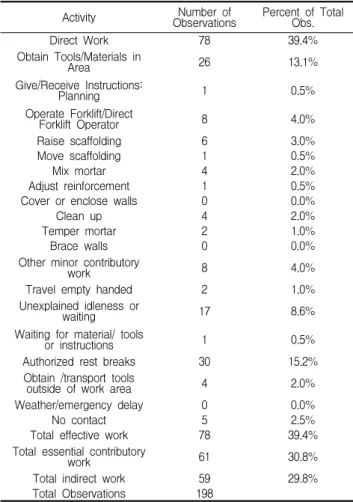
Table 3 summarizes the list of activities and number of observations observed within each activity. Three activities, such as cover or enclose walls, brace walls, and weather or emergency delays, were not observed. Figure 1 shows

3. The Labor Utilization Factor (LUF) is computed using Eq. (2) with the collected data of direct work (39.39%) and essential contributory work (30.81%).

Figure 1. Proportion of masonry work activities ry Contributo Essential

(1/4) work Direct

LUF = + ´ --(2)

Table 3. Summary of work sampling results

Activity Number of

Observations Percent of Total Obs.

Direct Work 78 39.4%

Obtain Tools/Materials in

Area 26 13.1%

Give/Receive Instructions:

Planning 1 0.5%

Operate Forklift/Direct

Forklift Operator 8 4.0%

Raise scaffolding 6 3.0%

Move scaffolding 1 0.5%

Mix mortar 4 2.0%

Adjust reinforcement 1 0.5%

Cover or enclose walls 0 0.0%

Clean up 4 2.0%

Temper mortar 2 1.0%

Brace walls 0 0.0%

Other minor contributory

work 8 4.0%

Travel empty handed 2 1.0%

Unexplained idleness or

waiting 17 8.6%

Waiting for material/ tools

or instructions 1 0.5%

Authorized rest breaks 30 15.2%

Obtain /transport tools

outside of work area 4 2.0%

Weather/emergency delay 0 0.0%

No contact 5 2.5%

Total effective work 78 39.4%

Total essential contributory

work 61 30.8%

Total indirect work 59 29.8%

Total Observations 198

(7)

A Case Study on Productivity Analysis and Methods Improvement for Masonry Work

4. Method productivity delay model (MPDM)

4.1 Application of the MPDM

The method productivity delay model (MPDM) is a method of assessing construction productivity.

The MPDM is applied to a single construction activity by measuring multiple cycle times and identifying which cycles have delays. After collection is complete, data is proposed to help determine the effect or severity of the delay on project performance.

In this study, the MPDM model is applied to masonry construction. In particular, the process of placing a single Concrete Masonry Unit (CMU) was examined. To complete this study, a video camera was employed to collect data. Once data collection was completed, the research team played the videotape, measured the cycle times, and identified those cycle times with delays. Before the MPDM can be implemented, the types of delays must be identified. For the project, the following types of delays were identified:

Ÿ Environment delays – caused by obstructions that impede the construction process such as mud, wind, rain, and other events caused by nature.

Ÿ Equipment delays – caused by equipment such as forklift during its normal operating process.

Ÿ Labor delays – Delays caused by the masons not being ready to work.

Ÿ Material availability – affected by a delay caused from the non-availability of materials such as bricks or mortar.

Ÿ Lack of supervision or management – affected by a delay caused by a lack of supervision or leadership on the construction site.

4.2 Result analysis

All the times were taken from the videotape.

Delays were identified and categorized into their

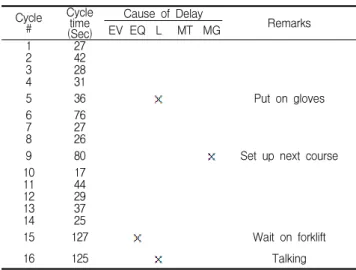
respective categories. The results of the data collection process are shown in Table 4, where environmental delay, equipment delay, labor delay, material availability, and lack of supervision or management are denoted “EV”, “EQ”, “L”, “MT”, and “MG”, respectively, and Table 5 contains the results and their analysis. In this study, the productivity equation is presented as follows:

D5) - D4 - D3 - D2 - D1 - (1 ty) Productivi (Idea

ty Productivi Method

Overall

´

= --(3)

In Eq.(3), D1, D2, D3, D4, and D5 are expected delay times expressed as a percentage for “EV”,

“EQ”, “L”, “MT”, and “MG”, respectively. Using the data from the project, the overall method productivity can be calculated as follows:

blocks/hr.

59.97

0) - 0.059 - 0.12 - 0.12 - 0 - (1 ) blocks/hr.

(74.13

=

´

As shown in Table 4, equipment and labor delays have the most significant effect on overall productivity. Based on this analysis of a masonry construction operation, the research team suggests that all efforts in productivity be focused exclusively on machines and labor.

Table 4. Data taken for the MPDM study Cycle

# Cycle

(Sec) time

Cause of Delay

Remarks EV EQ L MT MG

1 27

2 42

3 28

4 31

5 36 Put on gloves

6 76

7 27

8 26

9 80 Set up next course

10 17

11 44

12 29

13 37

14 25

15 127 Wait on forklift

16 125 Talking

(8)

Based on observations taken at the construction site, several opportunities for productivity improvement were identified. These opportunities are related to “crew size”, “use of forklift”,

“location of dumpster”, “location of material”,

“laborer slowdown”, and “length of crew breaks”.

In this section, the research team has summarized each opportunity for productivity improvement.

5.1 Crew size

During the review of the video tape, it was noted that everyone was busy during the time period studied. The three man crews were also working on a relatively small section of the entire building. This leads to the question as to whether or not the masonry laborer could have supported another team of masons. The masonry laborer was involved in many “Essential Contributory Work”

tasks, including mixing and re-supply of mortar, adjusting of scaffolding, and re-supply of blocks.

The vast majority of the time involved in the re-supply of blocks was a result of travel time between the work and storage areas. Travel time is also a factor in the cleanup and refuse disposal task. As with the re-supply of blocks, travel time to and from the dumpster comprised a majority of the time required to complete the task.

Without any changes to the locations of the storage and waste disposal site or with the assigned tasks for the masonry laborer, it is safe to say that the masonry laborer probably could not have supported another team of masons. Because the construction site was fairly muddy during the time of observation, the site may have been a factor in the location of the storage and waste disposal areas. It is possible that the block supplier (or the refuse handler) would not allow

the trucks getting stuck. If the owner constructed a temporary haul road to the site with good materials (i.e. with crushed aggregate base course), it is likely that the storage and waste disposal areas could have been placed closer to the actual construction. This certainly would have reduced the travel time involved.

5.2 Use of forklift

During the time period studied, it was noted that the forklift was only used twice to re-supply the masons on the scaffolding with block. Other than this, the forklift remained idle for the majority of the time. There was not enough work ongoing on the site to support the constant use of the forklift during that day. It is also not known if the masonry contractor had other projects that may have also needed a forklift. Because the forklift was idle most of the time, it is expected that it was not being used effectively. The only way the forklift could have been used more frequently would have required an increase in the crew size on this project. Given the progress of the project during the time of observation, this is probably not a realistic suggestion.

5.3 Dumpster location

The masonry laborers were observed hauling trash to a dumpster with an all-terrain forklift.

This dumpster was located at least 300 feet from

the actual construction area. With this current

arrangement, workers must haul trash a

considerable distance, with a tremendous cost in

time and effort. An improved scenario would

involve the dumpster being closer to the work

area. This location would have to be a central

location, so that all may be able to use the

dumpster more efficiently.

(9)

A Case Study on Productivity Analysis and Methods Improvement for Masonry Work

Summary of the MPDM Delay Information

Description Production

Total Time Number of

Cycles Mean Cycle

Time Delay Type Env. Equip’t Labor Mat’l Mgt.

Non-delayed production

cycles 409 12 34.08 Occurrences 0 1 2 0 1

Total Added Time 0 93 93 0 46

Overall production

cycles 777 16 48.56

Probability of

Occurrence 0 0.063 0.125 0 0.063

Relative Severity 0 1.92 0.957 0 0.947

Expected % Delay

time per cycle 0 12 12 0 5.9

Table 5. Results and summary of the MPDM

5.4 Location of material

The masonry laborers had to haul their block at least 250 feet to the location of the construction.

This meant that the masons must spend a considerable amount of time driving their all-terrain forklift to get blocks. A more efficient method may involve placing the material closer to the work at various locations. This would be done by having the supplier drop the material at regular intervals around the construction site to ensure more optimal productivity.

5.5 Length of crew breaks

The masonry crew took a 45 minute mid-morning break. The site superintendent indicated that this has been a daily occurrence.

This practice appears to be very costly in terms of productivity because the crew was on the payroll while performing ineffective work. A typical union contract allows for one 15 minute paid break. The research team recommends that all breaks be limited to the times typically allowed by union contract.

5.6 Laborer slowdowns

During a site visit, the research team noticed that two of the laborers slowed down and then stopped work approximately 15 minutes before the noon hour. This slowdown may have been due a reduced demand for blocks and mortar. The

reduced demand for the mortar can be attributed to the fact that mortar will dry out and become unusable before the lunch break is over. The research team recommends that the mason helpers find some sort of activity such as cleaning tools or picking up trash to fill the time.

6. Conclusions

The goal of this study was to apply a productivity analysis method to increase the efficiency of a masonry crew. The study produced the following findings and recommendations.

The work sampling technique has produced values for the amounts of crew times spent on various activities. Overall, 39.4% of the crew ’s time was spent in performing effective work, 29.8%

performing ineffective work, and 30.8% performing essential contributory work. This means that the masonry crew had a Labor Utilization Factor (LUF) of 47.1%. In order for the crew to reach peak efficiency, methods must be found to maximize time spent on effective work or essential contributory work. The most likely source for a productivity improvement is a shift in time spent on ineffective work to time spent on effective work.

From the MPDM, it was determined that all

efforts to improve productivity should be focused

(10)

reducing the travelling distance and by analyzing the sources of the ineffective work, an overall improvement in productivity can be achieved by the masonry crew.

The results of this study cannot be applied to all work elements and cannot represent masonry work in all circumstances. However, a construction manager can follow the process and method applied in this study to his/her own project to measure a crew ’s productivity and determine where and what kind of actions should be taken in the work.

Acknowledgements

This work has been supported by 2013 Hannam University Research Fund.

References

1. Reinschmidt K, Trejo D. Economic Value of Building Faster.

Journal of Construction Engineering and Management. 2006 Jul; 132(7):759-66.

2. Tommelein ID, Riley DR, Howell GA. Parade Game: Impact of Work Flow Variability on Trade Performance. Journal of Construction Engineering and Management. 1999 Sep;125(5):304-10.

3. Thomas H, Maloney W, Horner R, Smith G, Handa V, Sanders S. Modeling Construction Labor Productivity. Journal of Construction Engineering and Management. 1990 Dec;116(4):705-26.

4. Sanders S, Thomas H. Masonry Productivity Forecasting Model. Journal of Construction Engineering and Management.

1993 Mar;119(1):163–79.

5. Oglesby CHP, Henry W, Howell GA. Productivity Improvement in Construction. New York (NY): McGraw-Hill; 1989. 343 p.

6. Prokopenko J. Productivity management: A Practical Handbook. Geneva (switzerland): International Labour Organization; 1987. 291. p.

7. Kim YS, Cha TS, Hwang KN, Choi YS. A study on the Improvement of Construction Work Efficiency by Work

8. Ahn SH, Yu JH, Kim CD. The Work Condition Management Method for Improvement of Work Efficiency. Journal of Architectural Institute of Korea. 2008 Apr;24(4):183-90.

9. Kim TH, Joo JK, Kim SK. Proposal of Plan for the Deck Plate Slab Construction on Productivity Improvement.

Journal of Architectural Institute of Korea. 2000 Dec;16(12):

75-82.

10. Jung HK, Yun YW, Yang KY. A Study on the Productivity of Form Work by Using Work Analysis Method. Journal of the Korea Institute of Building Construction. 2005 Dec;5(4):131-7.

11. Lee JN, Son CB. An Analysis of Work Ration for Construction Curtain Wall by Work Sampling Technique.

Proceeding of Annual Conference; 2003 Oct 24-25;

Pukyong National University. Seoul (Korea): Architectural Institute of Korea; 2003. p. 519-22.

12. Joo JK, Kim TH, Kim SK. A Work Model for Enhancing the Productivity of Rebar Work. Journal of Architectural Institute of Korea. 2003 Dec;19(12):189-96.

13. Jang JS, Shin YS, Kang KI. A Work Process for Productivity Improvement of Concrete Structural Frame Work in Tall Building. Journal of the Korea Institute of Building Construction. 2005 Mar;5(1):161-4.

14. Kim BJ, Shim HW, Lee, UK, Choi HB, Kang KI. Rebar Work Improvement Method using Work Measurement in Apartment Building Construction-Focusing on Work Sampling and Crew Balance Study. Proceeding of Annual Conference; 2006 Oct 26-27; Yeungnam University. Seoul (Korea): Architectural Institute of Korea; 2006. p. 441-4.

15. Yoon JY, Kim YS, Kim JJ. Suggestion Improvement Based on Form Work Productivity Analysis in Apartment Housing Construction. Journal of the Korea Institute of Building Construction. 2010 Oct;12(5):49-56.

16. Lee TH, Ko YH, Kim YS, Han SW. Comparison of the Application of Various Productivity Analysis Methods for a Curtain Wall Operation in High-rise Building Construction.

Proceeding of Korea Institute of Building Construction;

2011 May 20; Dong-Eui University. Seoul (Korea): the

Korea Institute of Building Construction; 2011. p. 211-2.

수치

Table 1. Previous studies on work sampling method
Table 2. Classification of activities
Figure 1. Proportion of masonry work activities ryContributoEssential(1/4)workDirectLUF=+´ --(2)
Table 4. Data taken for the MPDM study Cycle # Cycle (Sec)time Cause of Delay RemarksEV EQ L MT MG 1 27 2 42 3 28 4 31 5 36 Put on gloves 6 76 7 27 8 26
+2

참조

관련 문서

대한의사협회 회원자율징계제도에 회원자율징계제도에 대한 대한 토론회 토론회 개최하 개최하 여 여 전문가단체의 전문가단체의 회원징계제도에 회원징계제도에 대한

 Modified version of PVW : “a particle is in static equilibrium if and only if the virtual work done by the externally applied forces vanishes for all

– Contractors work on the project and get reimbursed by the owner for costs, plus additional agreed-upon fees. – Usually used when the scope of work is difficult to define –

In this regard, this study analyzes the effect of the job characteristics and work environment of workers with physical disabilities on job satisfaction

Objectives: The present study was conducted to determine the relationship between degree of work performance and job satisfaction in NICU nurses.. Methods: The subjects of

– Contractors work on the project and get reimbursed by the owner for costs, plus additional agreed-upon fees. – Usually used when the scope of work is difficult to define –

Resource Based Construction Rate Work Based. Construction

– Late Finish (LF): latest possible time an activity can finish based on the logic and durations identified in the network without extending the completion date of the