서 론
가자미목(Pleuronectiformes), 가자미과(Pleuronectidae) 어 류는 전 세계적으로 40속 103종(Eschmeyer and Fong, 2015), 일본에 17속 33종(Nakabo, 2013), 국내에 15속 27종이 분포 한다(Kim, 2011). 이중, 갈가자미속(Tanakius)에는 갈가자미
(Tanakius kitaharae) 1종이 알려져 있고, 기름가자미속 (Glyptocephalus)에는 기름가자미(Glyptocephalus stelleri),
Glyptocephalus cynoglossus, Glyptocephalus zachirus 3종이 알려져 있다(Kim, 2011; Eschmeyer and Fong, 2015).
갈가자미와 기름가자미는 형태적으로 유사하여 속 간 경계 에 대한 논란이 많은 분류군 중 하나이다. 갈가자미와 기름가 자미는 Jordan and Starks(1904)와 Schmidt(1904)에 의해 최 초 Microstomus kitaharae와 Microstomus stelleri로 각각 보 고되었다. 이후 Norman(1934)은 눈꺼풀에 비늘이 있고 두 부 무안측에 점액강을 가지지 않은 점에 의거 M. kitaharae 를 갈가자미속(Tanakius)으로 이전하였고, 두부 무안측에 점 액강이 있으며 두개골 내에 큰 구멍을 가지는 점에 의거 M.
stelleri를 기름가자미속(Glyptocephalus)으로 이전하였다. 이
—164 — http://www.fishkorea.or.kr
* Corresponding author: Jin-Koo Kim Tel: 82-51-629-5927, Fax: 82-51-629-5931, E-mail: [email protected] ISSn: 1225-8598(Print), 2288-3371(online)
accepted: September 26, 2016
갈가자미 , Tanakius kitaharae와 기름가자미, Glyptocephalus stelleri (가자미과) 자어의 형태 비교
장서하·정경미1·박정호2·김진구*
부경대학교 자원생물학과, 1국립수산과학원 독도수산연구센터, 2국립수산과학원 연근해자원과
Comparative Morphology of Tanakius kitaharae and Glyptocephalus stelleri(Pleuronectidae) Larvae by Seo-Ha Jang, Kyung-mi Jung1, Jeong-Ho Park2 and Jin-Koo Kim* (Department of Marine Biology, Pukyong national university, Busan 48513, republic of Korea; 1Dokdo fisheries research center, national Institute of fisheries Science, Pohang 37709, republic of Korea; 2coastal Water fisheries resources research Division, national Institute of fisheries Science, Busan 46083, republic of Korea)
ABSTRACT Tanakius kitaharae and Glyptocephalus stelleri, belonging to the family Pleuronectidae, were very similar in external morphology not only during adult periods, but also during larval periods.
In this study, we compared larval development and growth of the two pleuronectids species in detail.
Fifty-eight specimens of T. kitaharae larvae and five specimens of G. stelleri larvae were collected from the East Sea, southern Korean Strait, and the adjacent waters of Jeju Island during 2014~2016, and were identified using morphological and molecular markers. Flexion larvae of T. kitaharae (10.23~16.77mm total length, TL) and G. stelleri(14.33mm TL) were similar in morphometrics, but can be distinguished by the melanophores in the fin membranes(present in the former vs. absent in the latter), and the melanophores at posterior margin of shoulder girdle (absent in the former vs. present in the latter). Postflexion larvae of T. kitaharae(17.12~24.92mm TL) and G. stelleri(27.71~32.95mm TL) differed in the number of melanophores on the mid-lateral caudal region(two in the former vs. five in the latter), and that on the dorsal and anal fin pterygiophores(five or six in the former vs. one row in the latter). Tanakius kitaharae and G. stelleri larvae differed in size at the beginning of metamorphosis.
The left eye of T. kitaharae larvae between 23.13~24.92mm TL reached the dorsal margin of the head while that of G. stelleri larvae between 38.66~42.67mm TL did not reached yet.
Key words: Tanakius kitaharae, Glyptocephalus stelleri, identification, larval development
후 Mori(1952), Chyung(1977), Sakamoto(1984), Chiu(1987), Kim and Yoon(1994), Nakabo(2013)는 이 분류체계를 따랐다.
한편 Cooper and Chapleau(1998)는 갈가자미를 기름가자미 속으로 이전시키면서 갈가자미속을 인정하지 않았으며 최근 Nelson(2016)이 이를 받아들여 두 속의 분류학적 위치가 매 우 혼란스러운 상태이다.
갈가자미와 기름가자미에 대한 연구로 국외에서는 갈가자 미와 기름가자미 자치어의 형태발달과 초기생활사(Okiyama 1963; Fujita, 1965; Okiyama and Takahashi, 1976; Minami, 1983), 기름가자미의 섭식특성(Pushchina, 2000), 오호츠크해 기름가자미의 분포와 생태(Tokranov, 2008), 갈가자미의 성숙 과 산란(Narimatsu, 2007) 등이 수행되었다. 국내에서는 기름 가자미의 성숙과 산란(Cha et al., 2008), 동해 왕돌초 해역에 서 기름가자미 어란과 자어 출현(Lee et al., 2014), 동해에 분 포하는 가자미과 어란의 형태(Lee and Kim, 2016) 등 단편적 인 연구가 수행되었으나 두 종을 대상으로 초기생활기의 외 부형태 발달을 비교한 연구는 수행되지 않았다. 개체발생에서 나타나는 많은 형질들은 종 고유의 특성을 보이기 때문에 유 사분류군과의 유연관계를 추정하는 데 중요한 단서를 제공한 다(Blaxter, 1974; Blaxter, 1984; Kim et al., 2000; Pack et al., 2005). 또한, 자치어기의 성장단계별 분류형질을 파악함으로 써 정확한 종 동정이 가능하고 나아가 수산자원학적 연구에 중요한 기초자료로 활용할 수 있다(Kim et al., 2000; Pack et al., 2005).
따라서, 본 연구는 2014년 2~3월 및 2016년 3~6월 동안 통영 욕지도 연안, 경상북도 영덕 연안, 동해 중·남부 근해, 제주 근해에서 채집된 갈가자미와 기름가자미 자어를 분자 수 준에서 검증하였으며, 발달단계별 외부형태를 면밀히 관찰하 여 자어기의 종 동정을 위한 정보를 제공함과 함께 두 종의 계통학적 관계를 추론하였다.
재료 및 방법
1. 재료
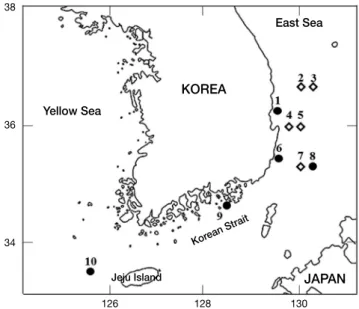
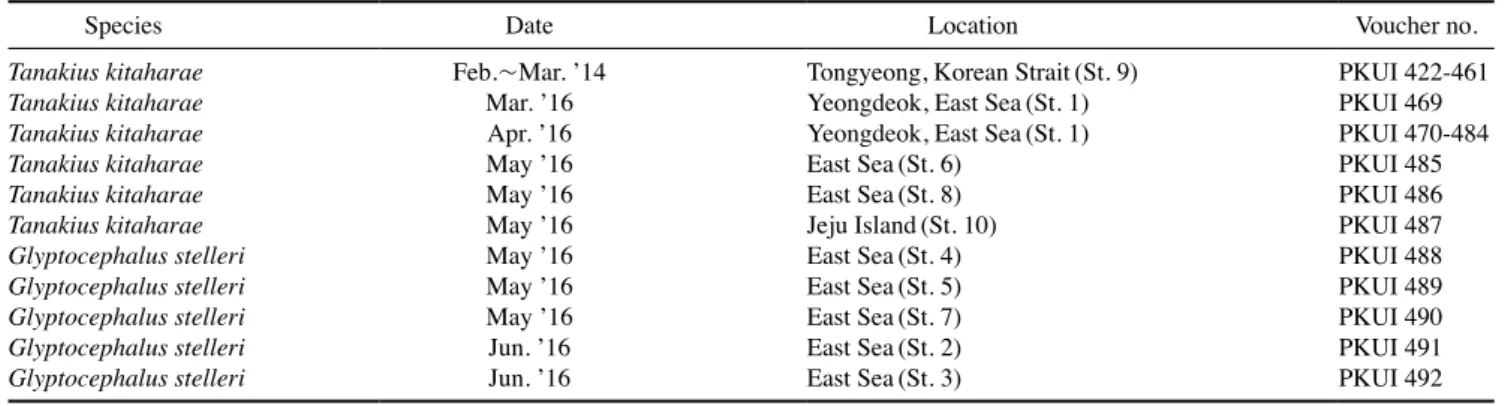
가자미 자어는 58개체(PKUI 422-461, 469-487)로 2014년 2~3월 경상남도 통영시 욕지도 연안, 2016년 3~6월 경상북 도 영덕 연안, 동해 중·남부 근해, 제주도 근해에서 RN80 net 와 Bongo net로 수평·경사인망으로 채집되었다(Fig. 1). 기 름가자미 자어는 5개체(PKUI 488-492)로 2016년 5~6월 동 해 중·남부 근해에서 Bongo net로 경사인망으로 채집되었 다. 채집된 표본들은 선상에서 95% 에탄올 용액으로 고정하 였으며, 분석이 끝난 표본은 부경대학교 어류플랑크톤 표본 실(Pukyong National University Ichthyoplankton Collection,
PKUI)에 등록, 보관하였다(Table 1).
2. 형태분석
종 동정과 자어의 각 부위별 용어는 Russel(1976), Okiyama (2014), Kim et al.(2011) 등의 문헌을 참고하였고, 총 17개 형 태형질을 측정 및 계수하였다. 계측형질로 전장(Total length, TL), 체장(Body length, BL), 항문전장(Preanal length, PAL), 체고(Greatest body depth, GBD), 몸 중앙부 체고(Body depth at middle of the body, BDM), 두장(Head length, HL), 두고 (Head depth, HD), 안경(Orbit diameter, OD), 문장(Snout length, SNL), 후안와장(Post-orbital length, POL), 상악장 (Upper jaw length, UJL), 하악장(Lower jaw length, LJL)의 12 가지 형질을 입체해부현미경(SZH-10, Olympus, Japan) 하에 서 관찰하였으며, 현미경용 사진촬영장치(Image-Pro plus 2.0, Media Cybernetics)로 0.1mm 단위까지 측정하였다. 계수형질 로 등지느러미 줄기(Dorsal fin rays, D), 뒷지느러미 줄기(Anal fin rays, A), 꼬리지느러미 줄기(Caudal fin rays, C), 가슴지느 러미 줄기(Pectoral fin rays, P1), 배지느러미 줄기(Pelvic fin rays, P2)의 5가지 형질을 입체해부현미경(SZH-10, Olympus, Japan) 하에서 계수하였다. 발달단계별 개체는 현미경에 부착 된 Lucida를 이용하여 정밀 스케치 하였다.
3. 분자분석
Total DNA는 갈가자미 자어 31개체와 기름가자미 자 어 3개체의 왼쪽 눈알에서 추출하였다. Mitochondrial DNA
초록
38
36
34
126 128 130
Fig. 1. Map showing the sampling area of Tanakius kitaharae and Glyptocephalus stelleri larvae(●: Tanakius kitaharae, ◇: Glypto- cephalus stelleri).
KOREA
JAPAN East Sea
Yellow Sea
Korean Strait Jeju Island
cytochrome c oxidase subunit I(mtDNA COI) 영역은 VF2(5′- TCA ACC AAC CAC AAA GAC ATT GGC AC-3′)와 FishR2 (5′-ACT TCA GGG TGA CC G AAG AAT CAG AA-3′) primer (Ward et al., 2005)를 이용하여 증폭하였다. Polymerase chain reaction(PCR)은 10X PCR buffer 3μL, 2.5mM dNTP 2.4μL, VF2 primer 1μL, FishR2 primer 1μL, Takara Taq polymerase 0.1μL를 섞은 혼합물에 total DNA 3μL를 첨가한 후, 총 30 μL가 될 때까지 3차증류수를 넣고 Thermal cycler(Bio-rad MJ mini PCT-1148, USA)를 이용하여 다음과 같은 조건에 서 PCR을 수행하였다; Initial denaturation 95℃에서 5분;
PCR reaction 35 cycles(denaturation 95℃에서 1분, annealing 52℃에서 1분, extension 72℃에서 1분); final extension 72℃
에서 5분, 정제는 DNA purification kit(LaboPassTM Gel and PCR Clean-up Kit, Cosmo genetech, Korea)를 이용하였 다. 염기서열은 ABI 3730XL DNA Analyzer에서 ABI Prism BigDye Terminator v3.1 Ready Reaction Cycle Sequencing Kit (Applied Biosystems, Foster City, USA)를 이용하여 얻었다.
MtDNA COI 염기서열의 정렬은 BioEdit(ver. 7)(Hall, 1999) 의 CLUSTAL W(Thompson et al., 1994)를 이용하여 정렬하 였으며, 염기서열을 비교하기 위하여 부경대학교(Pukyong National University, PKU)와 NCBI에 등록된 갈가자미(T.
kitaharae), 기름가자미(G. stelleri), G. cynoglossus, G. zachirus 의 염기서열을 이용하였다. 외집단으로는 가자미과의 물가 자미(Eopsetta grigorjewi)와 찰가자미(Microstomus achne), 넙치과의 넙치(Paralichthys olivaceus)를 함께 비교하였다:
T. kitaharae(PKU 6062), G. stelleri(PKU 5922; JP952743), G. cynoglossus(KC015407), G. zachirus(JQ354110), E. gri- gorjewi(KP835299), M. achne(KR052261), P. olivaceus (KP835312), 유전거리는 MEGA 5(Tamura et al., 2011)의 Pairwise distance를 Kimura-2-parameter 모델(Kimura, 1980) 로 계산하였다. 근린결합수(Saitou and Nei, 1987)는 MEGA 5 (Tamura et al., 2011)에서 작성하였으며 bootstrap은 1000번 수행하였다.
결 과
1. 외부 형태 발달 1) 전기자어 (1) 갈가자미
전장 4.93~7.11mm의 자어는 몸이 가늘고 길며 항문전장은 체장의 28.6~39.1%이었다. 막지느러미가 몸통을 감싸고 있 으며 가슴지느러미는 막지느러미로, 부채 모양이었다. 위턱의 후단은 눈의 중앙에 달하였다. 눈에 흑색소포가 발달하였으며 막지느러미의 가장자리에 작은 흑색소포군이 불규칙하게 분 포하였다. 아래턱의 가장자리와 두정부에 점모양의 흑색소포, 소화관의 표면에 점과 별모양의 흑색소포가 불규칙하게 분포 하였다. 꼬리를 감싸는 2개의 흑색소포 가로띠가 있었으며 뒷 지느러미 기저부에 등간격으로 3개, 척색말단에 1개의 흑색소 포군이 분포하였다(Fig. 2A).
전장 8.74~9.84mm의 자어는 머리와 복부가 발달하며 체 고가 다소 높아졌다. 소화관이 발달함에 따라 복부는 아래쪽 으로 약간 돌출하였다. 항문전장은 체장의 31.8~33.7%이었 다. 하미축골이 형성 중이며 꼬리지느러미 줄기 원기가 5~6 개 관찰되었다. 체표의 흑색소포는 이전 단계와 같았으나 다 소 진해졌다. 위턱과 아래턱의 가장자리, 아래턱의 후단, 새개 부, 협부에 별모양의 흑색소포가 분포하였다. 하미축골과 척색 말단에 점모양의 흑색소포가 분포하였다. 복부의 흑색소포는 별모양으로, 복강을 가로질러 소화관의 위쪽과 배쪽에 진하게 분포하였다.
2) 중기자어 (1) 갈가자미
전장 10.23~13.04mm의 자어는 이포가 발달하고 두정부가 볼록한 형태를 띠었다. 전새새골의 뒷부분과 아랫부분에 미세 한 극이 몇 개 출현하였다. 항문전장은 체장의 28.3~33.2%이 었다. 하미축골의 기저 부분이 부풀어 오르고 척색말단의 굴 곡이 관찰되었다. 꼬리지느러미 줄기는 4~9개가 관찰되었다.
Table 1. List of specimens of the present study
Species Date Location Voucher no.
Tanakius kitaharae Feb.~Mar. ’14 Tongyeong, Korean Strait(St. 9) PKUI 422-461
Tanakius kitaharae Mar. ’16 Yeongdeok, East Sea(St. 1) PKUI 469
Tanakius kitaharae Apr. ’16 Yeongdeok, East Sea(St. 1) PKUI 470-484
Tanakius kitaharae May ’16 East Sea(St. 6) PKUI 485
Tanakius kitaharae May ’16 East Sea(St. 8) PKUI 486
Tanakius kitaharae May ’16 Jeju Island(St. 10) PKUI 487
Glyptocephalus stelleri May ’16 East Sea(St. 4) PKUI 488
Glyptocephalus stelleri May ’16 East Sea(St. 5) PKUI 489
Glyptocephalus stelleri May ’16 East Sea(St. 7) PKUI 490
Glyptocephalus stelleri Jun. ’16 East Sea(St. 2) PKUI 491
Glyptocephalus stelleri Jun. ’16 East Sea(St. 3) PKUI 492
등지느러미 및 뒷지느러미의 담기골이 꼬리의 앞에서부터 형 성되기 시작하였으며 등지느러미 원기가 4~5개, 뒷지느러미 원기가 3~6개 관찰되었다. 가슴지느러미와 배지느러미는 막 상의 형태를 띠었다. 두정부의 흑색소포는 별모양으로 띠를 이루었다. 미부 측면에는 작은 점모양의 흑색소포가 드물게 분포하였다. 등지느러미와 뒷지느러미 말단에는 작은 흑색소 포군이 불규칙하게 분포하였다(Fig. 2B).
전장 13.42~16.77mm의 자어는 체고가 더욱 높아졌으 며 항문전장은 체장의 30.1~32.9%이었다. 척색말단이 약 30~60° 정도로 위로 휘고 하미축골의 분화가 관찰되었다. 전
새개골의 미세한 극은 수적으로 다소 증가하였다. 꼬리지느러 미 줄기는 6~18개가 관찰되었다. 등지느러미 및 뒷지느러미 의 담기골이 꼬리의 앞쪽부터 척색말단 부근까지 형성되었으 며 등지느러미 줄기가 21~36개, 뒷지느러미 줄기가 13~32개 관찰되었다. 전장 16.77mm의 자어는 꼬리의 흑색소포 가로띠 가 꼬리 측면 중앙으로 모이는 경향을 보였다. 척색말단과 꼬 리지느러미의 기저부에 점과 별모양의 흑색소포가 밀집하였 다.
(2) 기름가자미
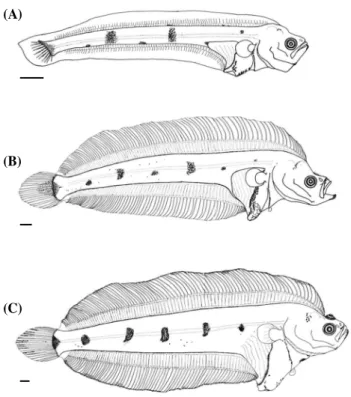
전장 14.33mm의 자어는 몸이 가늘고 길며 두정부는 약간 볼록한 형태를 띠었다. 위턱의 뒤끝은 눈의 중앙 아래에 도달 하였다. 소화관의 길이는 짧으며 아래쪽으로 돌출하였다. 항문 전장은 체장의 29.2%이었다. 척색말단이 약 60°로 휘었고 하 미축골의 분화가 관찰되었다. 전새개골의 뒷부분과 아랫부분 에는 미세한 극이 여러 개 관찰되었다. 등지느러미와 뒷지느 러미의 담기골이 꼬리의 앞쪽부터 척색말단 근처까지 형성되 었다. 꼬리지느러미 줄기는 11개가 관찰되었으며 등지느러미 원기는 56개, 뒷지느러미 원기는 41개가 관찰되었다. 아래턱 의 선단과 두정부에 점모양의 흑색소포가 분포하였으며 두정 부의 것은 작은 띠를 형성하였다. 견대 부근에는 점모양의 흑 색소포가 열을 이루었다. 복부의 흑색소포는 작은 별모양으로 Fig. 2. Development of larvae of Tanakius Kitaharae (A) preflexion
stage, PKUI 427, 6.41 mm BL; (B) flexion stage, PKUI 446, 12.65 mm BL; (C) postflexion stage(pre-metamorphosis), PKUI 455, 17.43 mm BL; (D) postflexion stage(early-metamorphosis), PKUI 461, 22.30 mm BL; (E) postflexion stage(middle-metamorphosis), PKUI 485, 16.92 mm BL.
(A)
(B)
(C)
(D)
(E)
Fig. 3. Development of larvae of Glyptocephalus stelleri (A) flexion stage, PKUI 490, 13.01mm BL; (B) postflexion stage(pre-meta- morphosis), PKUI 491, 24.98mm BL, (C) postflexion stage(mid- dle-metamorphosis), PKUI 488, 37.25mm BL.
(A)
(B)
(C)
소화관의 위쪽과 뒤쪽에 진하게 분포하였으며 복부의 배쪽에 는 작은 점모양의 흑색소포가 일렬로 분포하였다. 꼬리의 측 면에는 2개의 흑색소포 가로띠가 있었으며 뒷지느러미 기저 부에 등간격으로 3개, 척색말단에 1개의 흑색소포군이 분포하 였다. 등지느러미와 뒷지느러미 말단에는 흑색소포가 없었다 (Fig. 3A).
(3) 식별형질
갈가자미와 기름가자미의 중기자어는 체형과 체표의 흑색 소포 분포형태에서 형태적으로 유사하였으나 갈가자미는 견 대 부근에 흑색소포열이 없었지만 기름가자미는 견대 부근 에 점모양의 흑색소포가 열을 이루고 있는 점, 갈가자미는 등 지느러미와 뒷지느러미 말단에 여러 개의 흑색소포군을 가지
고 있지만 기름가자미는 가지고 있지 않은 점에서 구별되었다 (Table 2)(Figs. 2B, 3A).
3) 후기자어 (1) 갈가자미
전장 17.12~19.70mm의 자어는 소화관이 발달함에 따라 복부가 아래쪽으로 현저히 돌출하였다. 항문전장은 체장의 30.6~35.0%이었다. 이 시기에 와서 척색말단의 굴곡이 완료 되었다. 꼬리지느러미는 중앙이 볼록한 부채 모양으로 꼬리 지느러미 줄기는 12~18개가 관찰되었다. 등지느러미 줄기는 57~84개, 뒷지느러미 줄기는 48~62개가 관찰되었다. 꼬리를 감싸는 2개의 흑색소포 가로띠가 꼬리 측면 중앙으로 모여 2 개의 흑색소포군을 형성하였다. 각 흑색소포군 사이 미부의 Table 2. Comparison of morphological differences among Tanakius kitaharae and Glyptocephalus stelleri larvae with growth
Species stage Tanakius kitaharae Glyptocephalus stelleri
Preflexion
4.93~9.84mm TL(4.65~9.52mm BL) No fins
Notochord not flexed Melanophores
·Primordial finfold: Yes
·Trunk: 3 transverse stripes
·Dorsal head: Yes
·Tip of the lower jaw: Yes
·Isthmus: Yes
·Pectoral girdle: No
·Surface of abdomen: Yes
·Posterior end of notochord: Yes
Flexion
10.23~16.77mm TL(9.83~15.69mm BL) 14.33mm TL(13.01mm BL) Notochord flexion: 30~60 degrees Notochord flexion: 60 degrees
Caudal fin: 4~18 rays Caudal fin: 11 rays
Dorsal fin: 4~36 rays Dorsal fin: 56 rays
Anal fin: 3~32 rays Anal fin: 41 rays
Melanophores Melanophores
·Marginal fins: Yes ·Marginal fins: No
·Pectoral girdle: No ·Pectoral girdle: Yes
Postflexion
17.12~19.70mm TL(15.81~18.19mm BL) 27.71~32.95mm TL(24.98~28.49mm BL) Notochord flexion: 90 degrees Notochord flexion: 90 degrees
Caudal fin: 13~23 rays Caudal fin: 22 rays
Dorsal fin: 57~84 rays Dorsal fin: 89~93 rays
Anal fin: 48~62 rays Anal fin: 76~78 rays
Melanophores Melanophores
·Pterygiophore: 4~5 pigments dot ·Pterygiophore: 1 raw at base
19.74~22.80mm TL(18.31~21.22mm BL) 38.66~42.67mm TL(34.06~37.25mm BL)
Caudal fin: 19~23 rays Caudal fin: 22 rays
Dorsal fin: 82~92 rays Dorsal fin: 89~91 rays
Anal fin: 68~79 rays Anal fin: 74~76 rays
The left eye moved toward the dorsal margin of head The left eye moved toward the dorsal margin of head
Pelvic fin fold developed Pelvic fin fold not developed
23.13~24.92mm TL(21.43~23.05mm BL) Caudal fin: 21~23 rays
Dorsal fin: 88~92 rays Anal fin: 71~79 rays
The left eye reached the dorsal margin of head
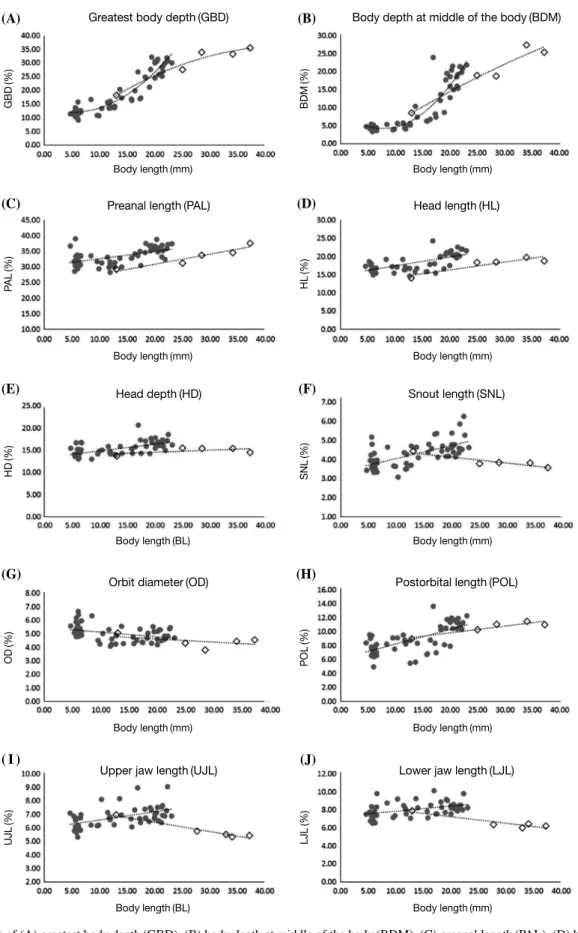
Fig. 4. Changes of (A) greatest body depth(GBD), (B) body depth at middle of the body(BDM), (C) preanal length(PAL), (D) head length(HL), (E) head depth(HD), (F) snout length(SNL), (G) orbit diameter(OD), (H) postorbital length(POL), (I) upper jaw length(UJL), (J) lower jaw length(LJL) expressed as percent of body length(BL) with growth in Tanakius kitaharae(solid circle, ●) and Glyptocephalus stelleri(open dia- mond, ◇) larvae.
gBD(%)
Body length(mm)
greatest body depth(gBD) Body depth at middle of the body(BDM)
Preanal length(Pal) head length(hl)
head depth(hD) Snout length(Snl)
orbit diameter(oD) Postorbital length(Pol)
upper jaw length(uJl) lower jaw length(lJl)
Body length(mm)
Body length(Bl)
Body length(mm)
Body length(Bl)
Body length(mm)
Body length(mm)
Body length(mm)
Body length(mm)
Body length(mm)
BDM(%)
Pal(%) hl(%)
hD(%) Snl(%)
oD(%) Pol(%)
uJl(%) lJl(%)
(A) (B)
(C) (D)
(E) (F)
(G) (H)
(I) (J)
배쪽에도 흑색소포군이 관찰되었다. 등지느러미 및 뒷지느러 미의 담기골 기부에는 점모양의 흑색소포가 드물게 분포하였 다. 등지느러미 및 뒷지느러미의 말단에는 작은 흑색소포군이 불규칙하게 분포하였다. 복부에는 별 또는 도넛 모양의 흑색 소포가 배쪽까지 폭넓게 분포하였다(Fig. 2C).
전장 19.74~22.80mm의 자어는 체고가 급격하게 증가하 여 체형이 가자미과 어류와 유사하게 보였다. 항문을 기점으 로 측정한 체고는 체장의 21.3~32.3%, 몸 중앙부를 기점으 로 측정한 체고는 체장의 12.9~21.7%이었고, 항문전장은 체 장의 33.4~38.8%이었다. 이 시기에는 왼쪽 눈의 이동이 진행 중이며 복부의 돌출이 두드러졌다. 왼쪽 콧구멍이 우측으로 이동하여 몸의 오른쪽에서도 관찰되었다. 꼬리지느러미 줄기 는 19~23개, 등지느러미 줄기는 82~92개, 뒷지느러미 줄기는 68~79개가 관찰되었다. 배지느러미는 원기가 발달하였고 드 물게 1~2개의 줄기가 관찰되었다. 가슴지느러미는 막상으로 부채 모양이었다. 두정부의 흑색소포 띠는 이전보다 진해졌다.
꼬리의 측면에는 2개의 큰 흑색소포군과 함께 작은 흑색소포 군이 불규칙하게 분포하였다. 등지느러미 및 뒷지느러미의 담 기골에는 4~6개의 흑색소포군이 관찰되었다. 등지느러미 및 뒷지느러미의 말단에는 작은 흑색소포군이 불규칙적으로 분 포하였으며 꼬리지느러미의 기부에서 중앙 부근까지 점모양 의 흑색소포가 분포하였다(Fig. 2D).
전장 23.13~24.92mm의 자어는 몸이 좌우 비대칭으로 왼 쪽 눈이 머리의 등쪽 정중선 위에 위치하였다. 항문을 기점으 로 측정한 체고는 체장의 25.4~32.0%, 몸 중앙부를 기점으로 측정한 체고는 체장의 15.6~24.1%이었다. 항문전장은 체장 의 32.5~37.5%이었다. 가슴지느러미에는 원기가 출현하였다.
가슴지느러미를 제외한 각 지느러미의 줄기는 거의 정수에 도 달하였다. 꼬리지느러미 줄기는 21~23개, 등지느러미 줄기 는 88~92개, 뒷지느러미 줄기는 71~79개, 배지느러미 줄기는 4~5개가 관찰되었다. 몸의 좌측에 분포하는 흑색소포는 우측 에 비해 옅어지는 경향을 보였다(Fig. 2E).
(2) 기름가자미
전장 27.71~32.95mm의 자어는 두정부가 볼록해지고 머리 의 등쪽은 약간 오목한 형태를 띠었다. 소화관이 발달함에 따 라 복부는 아래쪽으로 현저히 돌출하였으며 체고가 다소 높아 졌다. 항문을 기점으로 측정한 체고는 체장의 27.7~34.1%, 몸 중앙부를 기점으로 측정한 체고는 체장의 18.8~19.1%이었다.
항문전장은 체장의 31.3~33.8%이었다. 척색말단의 굴곡이 완 료되었다. 꼬리지느러미는 중앙이 볼록한 부채 모양이었으며 꼬리지느러미 줄기는 22개가 관찰되었다. 등지느러미 줄기는 89~93개, 뒷지느러미 줄기는 76~78개가 관찰되었다. 협부에 는 별모양의 흑색소포가 새롭게 출현하였다. 견대 부근의 흑 색소포열은 다소 진해졌다. 복부에는 점모양의 흑색소포가 소
화관의 뒤쪽과 아래쪽에 밀집되어 분포하였다. 꼬리 측면 중 앙에는 등간격으로 5개의 흑색소포군이 관찰되었다. 등지느러 미 및 뒷지느러미의 담기골 기부에는 점모양의 흑색소포가 일 렬로 분포하였다. 등지느러미와 뒷지느러미의 말단에는 점모 양 흑색소포 또는 흑색소포군이 불규칙하게 분포하였다. 꼬리 지느러미 기부에는 1개의 흑색소포군이 분포하였으며 꼬리지 느러미 줄기에는 점모양 흑색소포가 드물게 관찰되었다. 전장 32.95mm의 자어에서 왼쪽 눈이 미세하게 이동한 것이 관찰 되었다.
전장 38.66~42.67mm의 자어는 체고가 급격하게 증가하 여 체형이 가자미과 어류와 유사하게 보였으며 복부가 아래 Fig. 5. Neighbor-joining tree based on partial mtDNA CO1 sequenc- es, showing the relationships among larvae of Tanakius kitaharae and Glyptocephalus stelleri larvae from the off Tongyeong, Jeju, the coastal waters of Yeongdeok, and the coastal waters of the Middle and Southern East Sea. Species abbreviations are given in Table 1.
The tree was constructed using the Kimura 2-parameter model and 1000 bootstrap replications. The bottom bar indicates a genetic dis- tance of 0.02.
쪽으로 더욱 돌출하였다. 항문을 기점으로 측정한 체고는 체 장의 33.4~35.6%, 몸 중앙부를 기점으로 한 체고는 체장의 27.5~25.5%이었다. 항문전장은 체장의 34.6~37.7%이었다.
왼쪽 눈의 이동이 진행 중이며 머리의 등쪽 정중선보다 약간 아래에 도달하였고 몸의 오른쪽에서도 윗부분이 관찰되었다. 왼쪽 콧구멍이 우측으로 이동하여 몸의 오른쪽에서도 관찰되 었다. 등지느러미와 뒷지느러미 줄기는 각각 89~91개, 74~76 개로 거의 정수에 도달하였으며, 꼬리지느러미 줄기는 22개가 관찰되었다. 가슴지느러미는 막상으로 원기가 출현하지 않았 으며 배지느러미는 3~5개의 줄기가 관찰되었다(Fig. 3B).
(3) 식별형질
기름가자미와 갈가자미의 후기자어는 체표의 흑색소포 분 포형태, 체장에 대한 각 부위의 계측비, 변태기로 이행할 때의 크기에서 차이를 보였다(Table 2). 갈가자미는 등지느러미와 뒷지느러미의 담기골에 4~6개의 흑색소포군이 분포하였지만 기름가자미는 등지느러미와 뒷지느러미의 기부를 따라 흑색 소포열이 분포하는 점에서 잘 구별되었다(Figs. 2D-E, 3B-C).
또한 기름가자미는 갈가자미에 비해 상대적으로 작은 계측 비를 나타내었으며(Fig. 4C-J) 갈가자미는 전장 19.74~22.80 mm에서 눈의 이동이 시작되어 전장 23.13~24.92mm에서 왼 쪽 눈이 머리의 등쪽 정중선에 도달하였으나 기름가자미는 전 장 38.66~42.67mm에서 왼쪽 눈의 이동이 관찰되어 변태기 로 이행할 때의 크기에서 차이를 보였다(Figs. 2E, 3C).
2. 분자분석
갈가자미 자어 31개체와 기름가자미 자어 3개체로부터 mtDNA COI 영역 413bp를 얻을 수 있었다. 갈가자미 자 어는 갈가자미 성어와 유전거리(d)가 d =0.000~0.007로 잘 일치하였고, 기름가자미 성어와는 d =0.097~0.103, G.
cynoglossus 성어와는 d =0.091~0.102, G. zachirus 성어와 는 d=0.072~0.083로 잘 구분되었다. 갈가자미 자어는 갈가 자미 성어와 d =0.000~0.007로 잘 일치하였다(Fig. 4). 기 름가자미 자어는 기름가자미 성어와 d =0.010~0.012로 개 체 간 유전적 변이가 확인되었으며, G. cynoglossus 성어와는 d=0.022~0.025, G. zachirus 성어와는 d=0.035~0.037로 잘 구분되었다(Fig. 5).
고 찰
갈가자미와 기름가자미 자어의 발달단계별 외부형태와 계 측값은 일본에서 연구된 이전결과(Okiyama 1963; Fujita, 1965; Okiyama and Takahashi, 1976; Minami, 1983)와 대부분 잘 일치하였다(Table 3). Okiyama and Takahashi(1976)에 따 르면, 갈가자미 자어는 견대 뒷가장자리에 흑색소포가 출현하 지 않거나 아주 드물게 1개의 점모양 흑색소포가 나타나지만, 기름가자미 자어는 점모양 흑색소포가 열을 이룬다고 언급하 였다. 또한 체장에 대한 체고, 항문전장, 두장 등의 비율에서 종 간 차이를 보인다고 하였다. 본 연구에서 관찰한 두 종의 자어 또한 이와 잘 일치하는 결과를 보였다.
변태가 완료되고 착저기에 도달하는 시기는 갈가자미가 체 장 25~27mm(Okiyama and Takahashi, 1976; Minami, 1983), 기름가자미가 체장 40~50mm(Okiyama, 1963)일 때로, 노랑 가자미(Aritaki et al., 2000)의 전장 25.75mm, 찰가자미(Byun et al., 2009)의 전장 19.91mm, 돌가자미(Han and Kim, 1997) 의 전장 14.24mm, 문치가자미(Han et al., 2001)의 전장 10.3 mm 등 다른 속의 종들에 비해 긴 부유 유생 기간을 거쳐 저서 생활로 이행하는 것으로 사료되며(Okiyama, 2014) 이러한 성 장 패턴의 차이는 형태 발달에 있어서 종간의 독특한 생활사 Table 3. Morphometric characters of Tanakius kitaharae and Glyptocephalus stelleri
Tanakius kitaharae Glyptocephalus stelleri
Present study Okiyama and Takahashi(1976) Present study Okiyama(1963)
No. of specimens 58 9 5 5
Total length(TL) 13.92(4.93~24.92) 14.10(6.09~24.30) 31.26(14.33~42.67) 36.56(19.1~58.00) Body length(BL) 13.04(4.65~23.05) 12.54(5.91~20.30) 27.56(13.01~37.25) 31.04(17.20~48.20) In %BL
Greatest body depth 18.74(9.29~32.28) 21.48(12.69~32.68) 29.82(18.33~35.63) 31.44(19.19~37.80) Body depth at the middle of body 9.54(3.24~24.05) - 19.89(8.56~27.48) 24.52(11.62~31.02) Preanal length 33.35(28.27~39.13) 33.83(31.45~38.64) 33.29(29.21~37.65) 32.76(29.05~38.14)
Head length 18.22(14.71~24.36) 20.34(16.41~23.73) 17.94(14.14~19.82) -
Head depth 15.35(13.05~20.70) - 14.91(13.68~15.51) -
Snout length 4.27(3.09~6.28) - 3.89(3.58~4.44) -
Orbit diameter 5.03(4.11~6.68) 5.46(5.13~6.01) 4.44(3.80~5.07) -
Postorbital length 7.93(4.31~11.76) - 10.57(8.98~11.48) -
Upper jaw length 6.78(5.33~9.06) - 5.81(5.33~6.96) -
Lower jaw length 8.06(6.55~10.14) - 6.59(6.02~7.92) -
적 특징이라 생각된다.
가자미과 어류의 분류학적 혼란은 오랜 기간 지속되어 왔 으며 성어를 대상으로 한 연구와 자치어를 대상으로 한 연구 에서 학자들 간에 이견이 팽배하다. Norman(1934)은 가자 미과 내 Microstomus속, Embassichthys속, Tanakius속, Glyp- tocephalus속의 4속이 길고 측편된 체형을 가지는 점, 입이 작 고 무안측에 비해 유안측의 이가 발달되지 않은 점, 상대적 으로 많은 척추골 수와 지느러미 줄기 수를 가지는 점에서 근연속으로 간주하였으며 Microstomus속과 Embassichthys 속, Tanakius속과 Glyptocephalus속이 각각 자매 관계에 있 다고 보았다. 이후 Cooper and Chapleau(1998)는 Norman (1934)이 제시한 Microstomus속, Embassichthys속, Tanakius 속, Glyptocephalus속의 근연 관계를 인정하였으나 Tanakius 속을 Glyptocephalus속으로 이전시켰다. Pertseva-Ostroumova (1961)는 이들 4속의 자치어기 형태형질을 바탕으로 한 계통 학적 연구에서 Norman(1934)의 의견을 따랐다. Richardson (1981)은 자치어기에 이들 4속만이 공유하는 형질로 꼬리에 3 개 또는 4개의 가로띠를 가지는 점(등쪽과 배쪽의 가장자리부 터 중앙까지 연속적인 무늬 또는 등쪽과 배쪽의 가장자리 부 근에 집중된 불연속적인 무늬), 전기자어기에 매우 가늘고 긴 체형을 가지는 점, 턱의 경사가 심하게 위를 향하는 점 등을 제시하였으며 Microstomus속과 Glyptocephalus속이 자매 관 계에 있다고 보고하여 Norman(1934)과 Pertseva-Ostroumova (1961)의 연구와 상이한 결과를 제시하였다. 이후 Ahlstrom et al.(1984)는 갈가자미속과 기름가자미속은 자치어기에 꼬리 의 등쪽과 배쪽의 가장자리부터 중앙까지 연속된 형태의 가로 띠를 가지는 점, 각 가로띠 사이의 배쪽에 흑색소포군을 가지 는 점, 전새개골에 미세한 극을 가지는 점 등을 공유한다는 점 에서 두 속이 근연 관계에 있음을 제시하였다. Okiyama and Takahashi(1976)에 따르면, 갈가자미와 기름가자미의 자치어 는 왼쪽 눈이 반대쪽으로 이동하는 시기와 흑색소포의 모양 과 분포에서 차이를 보이지만, Pertseva-Ostroumova(1961)와 Ahlstrom et al.(1984)의 연구처럼 두 속은 자치어기에 특징 적인 형질을 공유하며 외부형태에서 속 간 뚜렷한 식별 형질 을 보이지 않는 점에서 Cooper and Chapleau(1998) 및 Nelson (2016)의 의견이 타당해 보인다. 나아가 Ji et al.(2016)의 한국 산 가자미과 및 좌대가자미과 어류의 분자계통학적 연구에 의 하면 두 속은 mtDNA COI 및 16S rRNA 염기서열에서 자매 관계에 있는 것으로 보고하여 두 속은 별속이 아닐 가능성이 높다. 따라서, 향후 두 속의 추가적인 초기생활사 및 분자계통 연구를 통해 속 간 유연관계를 재정립할 필요가 있다.
요 약
가자미과(Pleuronectidae)에 속하는 갈가자미(Tanakius
Kitaharae)와 기름가자미(Glyptocephalus stelleri)는 성어기 뿐만 아니라 초기생활기에도 외형적으로 매우 유사하여 오 동정의 가능성이 높다. 따라서, 본 연구는 두 종의 자어 시기 의 형태발달과정을 상세히 비교하여 종 동정의 기초자료를 제 공하고자 한다. 2014~2016년 동안 동해, 남해 및 제주 근해 에서 채집된 갈가자미 자어 58개체 및 기름가자미 자어 5개 체를 대상으로 분자동정 및 형태 비교를 수행하였다. 갈가자 미의 중기자어(10.23~16.77mm total length, TL)와 기름가 자미의 중기자어(14.33mm TL)는 계측값에서 중복되나 지 느러미 가장자리 흑색소포의 유무(갈가자미는 있음 vs. 기 름가자미는 없음)와 견대 뒤쪽 흑색소포열의 유무(갈가자미 는 없음 vs. 기름가자미는 있음)에서 구분되었다. 갈가자미 의 후기자어(17.12~24.92mm TL)와 기름가자미의 후기자어 (27.71~42.67mm TL)는 계측값에서 잘 구분되었으며, 나아 가 꼬리 측면 중앙부 흑색소포군의 개수(갈가자미는 2개 vs.
기름가자미는 5개), 등지느러미와 뒷지느러미 담기골의 흑색 소포 형태(갈가자미는 5~6개의 흑색소포군이 등간격으로 분 포 vs. 기름가자미는 담기골 기부를 따라 점모양 흑색소포가 불규칙하게 분포)에서 차이를 보였다. 갈가자미 자어는 전장 23.13~24.92mm에서 왼쪽 눈이 머리의 등쪽 정중선에 도달 하는 반면 기름가자미 자어는 전장 38.66~42.67mm에서 왼 쪽 눈이 머리의 등쪽 정중선에 도달하지 못하여 변태시기에서 차이를 보였다.
사 사
이 논문은 2016년도 국립수산과학원 수산과학연구사업 (R201626)의 지원으로 수행된 연구입니다.
REFERENCES
Ahlstrom, E.H., K. Amaoka, D.A. Hensley, H.G. Moser and B.Y.
Sumida. 1984. Pleuronectiformes: development. In: Moser, H.G. et al.(eds.), Ontogeny and Systematics of Fishes. Am.
Soc. Ichthol. Herpetol, Spec. Publ. 1. Allen Press, Law- rence, KS, pp. 640-670.
Aritaki, M., S. Suzuki and K. Watanabe. 2000. Morphological de- velopment and growth of laboratory reared barfin flounder Verasper moseri. Nippon Suisan Gakk., 66: 446-453.
Blaxter, J.H.S. 1974. The early life history of fish. Spring-Verlag Berlin, Heidelberg, 765pp.
Blaxter, J.H.S. 1984. Ontogeny, systematic and fisheries. In: Moser, H.G., W.J. Richards, D.M. Cohen, M.P. Fahay, A.W. Kend- all Jr and S.L. Richardson(eds.), Ontogeny and systematic of fishes based on an international symposium dedicated to the memory of Elbert Halvor Ahlstrom. ASIH Spec. Publ.
No. 1, 760pp.
Byun, S.G., S.H. Lee, J.H. Hwang, K.H. Han, K.W. Kang, J.D.
Kim, Y.C. Kim and B.I. Lee. 2009. Embryonic and larva development of slime flounder, Microstomus achne. Dev.
Reprod., 13: 281-289.
Cha, H.K., H.C. Kwon, J.H. Yang, D.S. Chang and Y.Y. Chun.
2008. Maturity and spawning of Korean flounder Glypto- cephalus stellri(Schmidt) in the East Sea of Korea. Kor. J.
Ichthyol., 20: 263-271.
Chiu, T.S. 1987. Phylogeny and zoogeography of Glyptocephalines (Pisces: Pleuronectidae). Ore. State Univ., 276pp.
Chyung, M.K. 1977. The fishes of Korea. Ilchisa, Seoul, p. 576.(in Korean)
Cooper, J.A. and F. Chapleau. 1998. Monophyly and intrarelation- ships of the family Pleuronectidae(Pleuronectiformes), with a revised classification. Fish. Bull. 96: 686-726 Eschmeyer, W.N., R. Fricke and J.D. Fong. 2015. Species by fam-
ily/subfamily in catalog of fishes. Calif. Acad. Sci., http://
researcharchive.calacademy.org/research/ichthyology/cata- log/speciesbyfamily.asp. Accessed February 2016.
Fujita, S. 1965. Early development and rearing of two common flatfishes, Eopsetta grigorjewi(Herzenstein) and Tanakius kitaharai(Jordan and Starks). Nippon Suisan Gakk., 31:
258-262.
Hall, T.A. 1999. BioEdit: A user-friendly biological sequence align- ment editor and analysis program for Windows 95/98/NT.
Nucleic Acids Symp., 41: 95-98.
Han, K.H. and Y.U. Kim. 1997a. Development of larva and juvenile of the stone flounder, Kareius bicoloratus. Bull. Mar. Sci.
Yosu Nat. Fish. Univ., 6: 39-47.
Han, K.H., J.T. Park, D.S. Jin, S.I. Jang and J.K. Cho. 2001. Mor- phological Development of Larvae and Juveniles of the Marbled sole, Limanda yokohamae. Kor. J. Ichthyol., 13:
161-165.
Ji, H.S., J.K. Kim and B.J. Kim. 2016. Molecular phylogeny of the families Pleuronectidae and Poecilopsettidae(PISCES, Pleuronectiformes) from Korea, with a proposal for a new classification. Ocean Sci. J., 51: 299-304.
Jordan, D.S. and E.C. Starks. 1904. List of fishes dredged by the Steanler Albatross off the coast of Japan in the summer of 1900, with descriptions of new species and a review of the Japanese Macrouridae. Bull. U. S. Fish. Comm., 22: 577- 630.
Kim, B.J. 2011. Fish species of Korea. In: National Institution of Biological Resources(ed), National list of species of Korea:
vertebrates. Nat. Ins. Biol. Res., Incheon, pp. 54-56.
Kim, I.S. and C.H. Youn. 1994. Taxonomic revision of the flounders (Pisces: Pleuronectiformes) from Korea. Kor. J. Ichthyol., 6:
99-131.
Kim, I.S., Y. Choi, C.L. Lee, Y.J. Lee, B.J. Kim and J.H. Kim. 2005.
Illustrated book of Korean fishes. Kyo-Hak Publishing Co., Seoul, 615pp.(in Korean)
Kim, J.K., Y.U. Kim and S.G. Byun. 2000. Egg and larval devel-
opment of Chelon lauvergnii from Korea. Kor. J. Ichthyol., 12: 137-145.
Kim, J.K., J.H. Ryu, S. Kim, D.W. Lee, K.H. Choi, T.Y. Oh, K.S.
Hwang, J.N. Kim, H.J. Kwun, H.S. Ji and J.N. Oh. 2011.
An identification guide for fish eggs, larvae and juveniles of Korea. Hangeul graphics, Busan, 275pp.
Kimura, M. 1980. A simple method for estimating evolutionary rates of base substitutions through comparative studies of nucleotide sequences. J. Mol. Evol., 16: 111-120.
Lee, H.W., S.J. Lee, J.H. Yang, J.B. Lee, H.K. Cha and J.K. Kim.
2014. Occurrence of eggs and larvae of blackfin flounder Glyptocephalus stelleri(Pleuronectidae, Pisces) off Wang- dol-cho, East Sea. Kor. J. Fish. Aquat. Sci., 47: 654-658.
Lee, S.J. and J.K. Kim. 2016. Morphological characteristics and distribution of Pleuronectidae(Pisces) eggs in the western margin of the East Sea. Ocean Sci. J., 51: 13-20.
Minami, T. 1983. The early life history of a flounder Tanakius kitaharai. Bull. Jap. Soc. Sci. Fish., 49: 527-532.(in Japa- nese)
Mori, T. 1952. Check list of the fishes of Korea. Hyogo Univ. Ag- ric., Biol., 1: 1-228.
Nakabo, T. 2013. Fishes of Japan with pictorial keys to the species.
3rd ed. Tokai University Press, Hadano, pp. 1675-1683(in Japanese).
Narimatsu, Y., A. Yamanobe and M. Takahashi. 2007. Reproduc- tive cycle, age, and body size at maturity and fecundity of female willowy flounder Tanakius kitaharai. Fish. Sci., 73:
55-62.
Nelson, J.S. 2016. Fishes of the world. 5th ed. John Wiley and Sons, Inc., Hoboken, NJ, pp. 399-400.
Norman, J.R. 1934. A systematic monograph of the flat fishes(Het- erosomata). Vol. I. Psettodidae, Bothidae, Pleuronectidae.
British museum(Natural History), London, pp. 1-459.
Okiyama, M. 1963. Young of the witch flounder, Glyptocephalus stelleri(Schmidt) at metamorphosis stages. Bull. Jpn. Sea.
Reg. Fish. Res. Lab., 11: 101-108.
Okiyama, M. and K. Takahashi. 1976. Larval stages of the right eye flounders(Subfamily Pleuronectinae) occurring in the Japan Sea. Bull. Jpn. Sea. Reg. Fish. Res. Lab., 27: 11-34.(in Jap- anese, English abstract)
Okiyama, M. 2014. An atlas of the early stage fishes in Japan. Tokai University Press, Tokyo, Japan, pp. 1450-1479.
Park, K.D., J.G. Myoung, Y.J. Kang and Y.U. Kim. 2005. Seasonal variation of abundance and species composition ichthyo- plankton in the coastal water off Tongyoung, Korea. J. Kor.
Fish. Soc., 38: 385-392.
Pertseva-Ostroumova, T.A. 1961. The reproduction and develop- ment of far-eastern flounders. Tr. Inst. Okeanol. Akad. Nauk SSSR. Mosk., pp. 1-484.
Pushchina, O.I. 2000. Specific features of feeding of the Glypto- cephalus stelleri and Acanthopsetta nadeshnyi in the north- western Sea of Japan. J. Ichthyol., 40: 247-252.
Richardson, S.L. 1981. Pelagic eggs and larvae of the deep sea sole,
Embassichthys bathybius(Pisces: Pleuronectidae), with comments on generic affinities. Fish. Bull., 79: 163-170 Russell, F.S. 1976. The eggs and planktonic stages of British marine
fishes. Academic Press, London, pp. 1-524.
Saitou, N. and M. Nei. 1987. The neighbor-joining method: a new method for reconstructing phylogenetic trees. Mol. Biol.
Evol., 4: 406-425.
Sakamoto, K. 1984. Interrelationships of the family Pleuronectidae (Pisces: Pleuronectiformers). Mem. Fac. Fish. Hokkaido Univ., 31: 95-215.
Schmidt, P.J. 1904. Fishes of the eastern seas of the Russian Em- pire. Scientific results of the Korea-Sakhalin Expedition of the Emperor Russian Geographical Society 1900~1901. St.
Petersburg. xi+1-466, 6pls.(in Russian)
Tamura, K., D. Peterson, N. Peterson, G. Stecher, M. Nei and S.
Kumar. 2011. MEGA5: Molecular evolutionary genetics
analysis using maximum likelihood, evolutionary distance, and maximum parsimony methods. Mol. Biol. Evol., 28:
2731-2739.
Thompson, J.D., D.G. Higgins and T.J. Gibson. 1994. CLUSTAL W:
improving the sensitivity of progressive multiple sequence alignment through sequence weighting, position-specific gap penalties and weight matrix choice. Nucl. Acid Res., 22: 4673-4680.
Tokranov, A.M. 2008. Specific features of distribution and some features of biology of Korean flounder Glyptocephalus stelleri(Pleuronectidae) in waters off Kamchatka in the Sea of Okhotsk. J. Ichthyol., 48: 759-769.
Ward, R.D., T.S. Zemlac, B.H. Innes, P.R. Last and P.D. Hebert.
2005. DNA barcoding Australia’s fish species. Philos.
Trans. R. Soc. London B., 360: 1847-1857.