HS호 유류유출사고에 따른 다환방향족탄화수소의 장기변동
황다혜·김진현·박정원·장성건·정원옥·정병관*
국립공원연구원 유류오염연구센터
Long-term Variation of Polycyclic Aromatic Hydrocarbons (PAHs)
according to Hebie Spirit Oil Spill
Da Hye Hwang, Jin Hyun Kim, Jung Won Park, Seong Geon Jang,
Won ok Jeong and Byungkwan Jeong*
Oil Pollution Research Center, National Park Research Institute, Taean 32105, Korea
요 약 :허베이 스피리트(Hebei Spirit)호 유류 사고 이후 국립공원 지역 조하대 퇴적물의 다환방향족탄화수소 (Polycycilc Aromatic Hydrocarbons; PAHs) 변동을 관측하기 위해 2008년부터 2017년까지 모니터링을 실시하였다. 10년간 tPAHs는 ND~438.454 ng/g-dry wt.의 범위를 보였으며, 춘계에 높게 분포하였다. 16종의 PAHs 구성비는 naphthalene이 25.1%로 가장 높았고, Dibenzo(a,h)anthracene이 0.5%로 가장 낮았다. PAHs와 환경인자와의 상관분석 에서는 용매추출유분(Total Petroleum Hydrocarbon; TPH) 및 입도와 연관성을 나타냈다.
주요어 :다환방향족탄화수소, 장기모니터링, 허베이 스피리트 유류유출
Abstract : Monitoring was carried from 2008 to 2017 to observe the change in Polycycilc Aromatic Hydrocarbons (PAHs) of subtidal sediment in national park area after the Hebei Spirit oil spill. For 10 years, tPAHs ranged from ND to 438.454 ng/g-dry wt. and were highly distributed in the spring. The relative composition of 16 PAHs was highest in naphthalene (25.1%) and lowest in divenzo (a, h) anthracite (0.5%). Result of the correlation analysis, PAHs showed correlation with Total Petroleum Hydrocarbon (TPH) and particle size of sediment.
Key words : PAHs, Long-term monitoring, Hebie spirit oil spill
서
론
다환방향족탄화수소(Polycycilc Aromatic Hydrocarbons; PAHs)는 산불, 화산 폭발 등에 의한 자연적 발생요인과 유 류 사고, 물질 및 연료 등의 연소에 의한 인위적 발생요인 으로 구분된다(Bresnick et al. 1983; IARC 1983; Arey et al. 1989). 2개 이상의 벤젠고리를 가지는 탄화수소 화합물로서 이론적으로 200여 물질이 존재한다. 유류 내에 포함된 주요 물질 중 하나로 용해성이 낮고 비교적 낮은 증기압을 가지 고 있어 입자상 물질에 쉽게 흡착하는 특성을 가진다(Baek 1999). 잘 분해되지 않으며 생물체 내 농축이 큰 이유로 미 국 독성물질 질병 등록국(Agency for Toxic Substances and Disease Registry; ATSDR)과 환경보호청(Environmental Pro-tection Agency; EPA)에서는 독성, 인체노출, 검출빈도 등을
고려하여 벤조피렌(Benzo[a]pyrene)을 포함한 16종의 PAHs 를 우선관리대상 오염물질로 지정하였다(EPA 1991). 또한 국내의 환경보건법에서도 PAHs를 위해성평가 대상 환경유 해인자로 포함시켰다. 해양생태계에서 PAHs의 주된 유입원은 유류사고에 의한 것으로, 유출된 원유는 풍화작용(확산, 증발, 분산, 용해)을 통해 휘발성 및 극성 화합물은 제거되고, PAHs를 포함한 일 부 저분자량 방향족탄화수소들은 수중에 용해되거나 퇴적층 으로 침전하여 장시간 잔류하게 되어(Guzzella and De Paolis 1994), 해양생물의 생리적 교란을 유발하거나 먹이사슬을 통 해 상위 포식자들에게 악영향을 끼치게 된다(ITOPF 2002; Lee et al. 2011). 따라서 유류사고 발생시 PAHs의 거동을 추적하고 모니터링하는 것은 생태계 영향을 평가하기 위해 선행되어야 한다. 본 연구지역인 태안해역은 원유 12,547 ㎘
*Corresponding author E-mail: [email protected]
가 유출되는 유류사고가 발생하였고 태안해안국립공원으로 유류가 확산되어 생태계 전반에 걸쳐 교란이 예상되는 지역 이었다. 유류오염에 대한 생태계 영향을 파악하고자 10년간 의 장기 연구계획이 수립되었고, 그 일환으로 PAHs에 대한 모니터링을 실시함으로써 회복과 복원에 대한 근거 자료를 확보하고자 하였다.
재료 및 방법
1. 조사지역 및 시료채취 태안해안국립공원 내 15개 정점을 선정하여 2008~2017년 (2013년 하계, 추계만 조사)까지 계절조사를 진행하였다 (Figure 1). 퇴적물 시료는 반빈 그랩(Van Veen grab sampler) 으로 채취한 후 스테인레스(stainless) 스푼을 이용하여 미리 세척된 50 mL의 차광용기에 담아 분석 전까지 20oC 이하에서 냉동 보관하였다. 2. 전처리 및 분석
가. 시료 전처리
PAHs 분석 전처리는 EPA 시험방법(Method 3540, 3611) 과 해양환경공정시험기준(2018)에 준하여 16 PAHs를 분석 하였다(Table 1). 추출에 이용된 유기용매는 잔류농약분석용 등급을 사용하였고, 추출하기 전 모든 초자기구는 세제와 초음파세척기를 이용하여 세척한 후 600oC에서 2시간 이상
강열하였다. 추출은 속슬렛(soxhlet) 추출방법을 이용하였으 며 원통형 여과지(Thimble filter, R84, Advantec®)에 시료 10
g을 넣고 시료 내 존재하는 수분을 제거하기 위해 Na2SO4
를 첨가한 후, 2 ppm 농도의 내부표준물질(surrogate) 100
Figure 1. Sampling station of the sublittoral zone in Taeanheaan National Park.
Table 1. Physicochemical characteristics of Polycyclic Aromatic Hydrocarbons.
Compound Abbreviation Chemical Formula Molecular Weight(g) Melting Point(oC) Boiling Point(oC) Vapor Pressure(mmHg, 25oC)
Napthalene Nap C10H8 128.16 80 218 7.1×10⁻² Acenaphthylene AcPy C12H8 152.20 93 275 6.7×10⁻³ Acenaphthene AcP C12H10 154.21 96 279 2.2×10⁻³ Fluorene Flu C13H10 166.22 117 295 6.0×10⁻⁴ Phenanthrene PhA C14H10 178.22 100 340 1.2×10⁻⁴ Anthracene AnT C14H10 178.22 218 342 6.0×10⁻⁶ Fluoranthene FluA C16H10 202.26 110 393 9.2×10⁻⁶ Pyrene Pyr C16H10 202.26 156 404 4.5×10⁻⁶ Benzo(a)anthracene B(a)A C18H12 228.29 159 435 2.1×10⁻⁷ Chrysene Chr C18H12 228.29 256 448 6.4×10⁻⁹ Benzo(b)fluoranthene B(b)F C20H12 252.32 168 393 Benzo(k)fluoranthene B(k)F C20H12 252.32 217 480 9.6×10⁻¹¹ Benzo(a)pyrene B(a)P C20H12 252.32 177 496 5.6×10⁻⁹ Indeno(1,2,3-cd)pyrene InP C22H12 276.34 162 534 Dibenzo(a,h)anthracene DbA C22H14 278.35 262 535 Benzo(g,h,i)perylene BghiP C22H12 276.34 273 542 1.01×10⁻¹⁰
μL를 주입하였다. 시료와 내부표준물질이 담긴 원통형 여과 지를 Dichloro methane:Hexane (3:1v/v) 혼합 유기용매 200 mL를 넣은 환저플라스크가 연결된 속슬렛 추출장치에 담고, 1회 용매순환 속도가 15분이 되도록 Heating mentle의 온도 를 맞추어 16시간 이상 추출하였다. 속슬렛 추출장치로 추 출된 혼합 유기용매 전량은 자동시료농축기(turbo storm, scinco®)를 이용하여 1 mL까지 농축하고, 질량분석기 이용 시 방해물질이 되는 황을 제거한 후 최종 10 mL가 되도록 농축하였다. 정제(clean-up)단계는 고체상 카트리지(sep-pak florisil, Waters®)를 사용하였고, 농축된 시료 10 mL를 카트 리지에 충진 시킨 후 시료가 충진된 카트리지에 Dichloro methane : Hexane (2:3v/v) 혼합 유기용매 25 mL를 흘려 용 리시켰다. 용출된 혼합 유기용매 25 mL를 자동시료농축기 로 1 mL까지 농축하고, 다시 농축된 용액에 Hexane 20 mL 를 넣어 용매치환하여 최종 1 mL 되도록 농축 하였다. 나. 기기분석 본 연구에서는 기체크로마토그래피-질량분석기(GC-MS, Agilent® 7890B-5977A)를 이용하여 선택적 이온 모니터링
(Selected Ion Monitoring, SIM) 방법으로 분석하였으며, 칼 럼(column)은 모세관 칼럼(capillary column, Agilent J&W, DB-5MS)을 이용하였다. 칼럼 승온조건은 처음 60oC에서 2
분간 머무르게 하고, 분당 6oC씩 상승시켜 300oC까지 올린
후 13분간 머무르게 하였다. 시료 주입방법은 비분할 주입 법(splitless mode)을 사용하였고, 운반기체(carrier gass)는 초 고순도 헬륨(He: 99.999%)을 사용하였다(Table 2).
결과 및 고찰
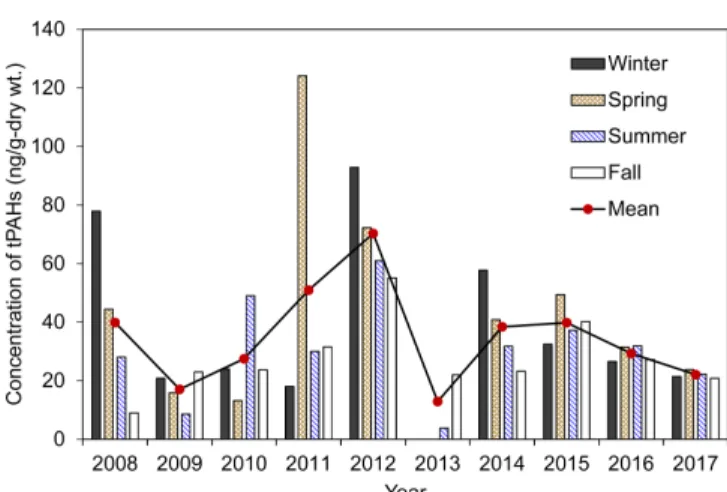
태안해안국립공원 인근 해역에서 선박 충돌에 의한 유류 사고가 발생하였고, 유출된 유류가 공원지역으로 확산됨에 따라 생태계 변화를 장기적으로 모니터링 하기 위해 본 연 구가 시작되었다. 해양에서 유류사고가 발생할 경우, 유출된 유류로 인하여 독성을 포함한 다양한 물질들에 의해 오염이 발생되며(Bence et al. 1996), 이는 환경뿐만 아니라 다양한 생물들에게 막대한 영향을 미치기 되고, 영양단계를 거쳐 생태계 전반에 걸쳐 교란을 초래한다(Peterson et al. 2003). 유류사고 시 해양으로 유입되는 다양한 화합물 중 PAHs 는 독성을 가진 난분해성 물질로, 흡착이 용이하며 생물농 축이 크게 일어나는 것으로 알려져 있다(Weissenfels et al. 1992; Guzzella and De Paolis 1994). 따라서 해양에서 유류 오염이 발생하게 되면, 그 지역의 해수와 퇴적물 그리고 생 물에 포함된 PAHs의 시·공간적인 변화를 파악함으로써 오 염의 수준과 회복의 정도를 평가하는 지표로 활용된다(Bence et al. 1996; Ke et al. 2002; Yim et al. 2002; Tronczyński et al. 2004; Diercks et al. 2010; Allan et al. 2012). 본 연구에 서도 유류사고 이후 공원 지역의 조하대 표층 퇴적물을 대 상으로 PAHs에 대해 지속적으로 모니터링을 진행하였다. 유류사고 이후 2008년부터 2017년의 총 다환방향족탄화수 소(Total Polycylic Aromatic Hydrocarbons; tPAHs)의 연 평 균농도는 12.881~70.279 ng/g-dry wt. 범위로 2013년도에 가 장 낮고 2012년도에 가장 높았다(Figure 2). 유류사고 발생 1달 후인 첫 조사(2008년 1월)에서 PAHs의 정점 평균값은 77.903 ng/g-dry wt.(44.256~149.330 ng/g-dry wt.)로 Yim et al. (2007)에 의해 보고된 사고 이전 농도인 13.7 ng/g-dry wt.에 비해 5.7배 정도 높았으나, 1년 동안 뚜렷한 감소를 보였고, 추계에는 정점 평균 8.992 ng/g-dry wt.로 사고 이전 보다 낮은 농도가 검출되었다. 2009년에 연 평균농도가 17.058 ng/g-dry wt.로 계절변화가 크지 않았으며, 2010년에 는 하계의 농도 증가의 원인으로 전년에 비해 농도(27. 481 ng/g-dry wt.)가 다소 증가하는 결과를 나타냈다(Figure 2). 3 년간의 조사결과를 토대로 퇴적물의 PAHs가 점진적으로 감 소하며 안정화 될 것이라 예상했지만, 2011년 춘계(124.115 ng/g-dry wt.)와 2012년 전 계절에 걸쳐 농도가 급격히 증가 하였고, 2012년에는 연평균 농도(70.279 ng/g-dry wt.)가 가 장 높게 나타났다(Figure 2). 2011년도 춘계에는 16종 PAHs 중 napthalene, phenanthrene, anthracene, chrysene, benzo(b)-fluoranthene, bonzo(k)benzo(b)-fluoranthene, benzo(a)pyrene이 높은 농Table 2. Analytical condition of GC/MS for Polycyclic Arocatic Hydrocarbons.
Item Conditions
Detector Agilent GC/MS(7890B/5977A) Column Capillary Column DB-5MS / 30 m×0.25 mm I.D. 0.25 μm Carrier gas He (99.999%)
Carrier gas flow rate 1.0 mL/min Injector temp. 250oC
Initial temp. 60oC (2 min)
Temperature rate 6oC/min
Final Temperature 300oC
Injection mode Splitless
도를 나타냈고, 2012년에는 phenenthrene, fluoranthene, pyrene 의 농도가 크게 증가하였다(Figure 4). Lee et al. (2013)에 의한 연구에서도 태안 북부해안의 만(bay) 지역에서 PAHs 가 사고 직후보다 2012년에 급격히 증가하는 결과가 보고되 었는데, 이는 퇴적물 속에 갇혀있던 성분들이 재 용출 되었 거나, PAHs 농도가 높은 지역의 퇴적물들이 물리적 요인에 의해 조하대로 이동했을 가능성이 있다. 하지만 이와 같은 현상을 명확히 파악하기 위해서는 다양한 환경 및 생물학적 요인들과 함께 추가적인 분석이 필요할 것으로 판단된다. 대기의 PAHs 분포는 화석연료 사용(난방)이 많아지는 동 계와 춘계에 증가하고, 기온과 광량이 높은 하계와 추계의 경우 광분해에 의한 요인등으로 감소하는 경향이 보고되었 다(Kaupp and McLachlan 1998; Kim et al. 2012; Masclet et
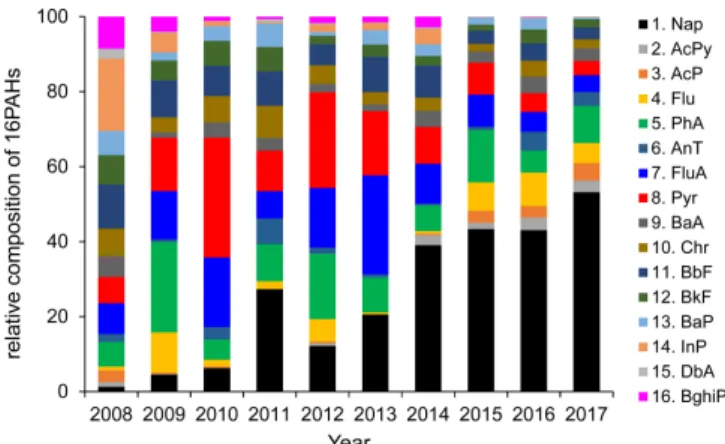
al. 1986). 또한 대기와 해양의 PAHs 기체 교환 플럭스(flux) 이동에 대한 연구에서는 하계에는 해양에서 대기로, 동계에 는 대기에서 해양으로 PAHs가 이동한다고 발표하였다(An et al. 2009). 본 연구에서도 tPAHs의 계절 평균 농도는 동계 37.624 ng/g-dry wt., 춘계 44.284 ng/g-dry wt., 하계 28.402 ng/g-dry wt., 추계 25.816 ng/g-dry wt.로 동계와 춘계에 높 고 하계와 추계에 낮은 분포를 보임으로써 선행연구들과 유 의한 결과를 확인하였다. 2013년 역시 하계와 추계 조사만 을 진행함으로써 가장 낮은 연평균 농도(12.881 ng/g-dry wt.) 를 나타낸 것으로 사료된다. 2014년 이후에는 계절별로 큰 변화 없이 안정적으로 감소하는 추세를 나타냈다(Figure 2). 본 연구지역의 조하대 퇴적물에서 검출된 PAHs는 naph-thalene이 평균 25.1%로 16개 화합물중에서 가장 높은 구성 비를 나타냈으며, Dibenzo(a,h)anthracene이 0.5%로 가장 낮 았다(Figure 3). You et al. (2007)에 의해 수행된 광양만 주 변해역 표층퇴적물의 PAHs 오염에 관한 연구에서도 naph-thalene이 16개의 화합물 중 높은 분포를 유지하고 있었다. Naphthalene은 용해성이 낮은 물질로 방충제 또는 살충제 성분으로 사용되며, 다량 노출시 간 손상, 빈혈, 구토, 어지 럼증등의 부정적 영향을 초래할 수 있기 때문에 이 물질에 대한 지속적인 관찰이 요구된다(Keith and Walker 1995; Hall et al. 1998). PAHs에 포함된 16종의 화합물에 대한 장기 변 화를 살펴본 결과, napthalene은 사고 초기에는 낮았지만 이 후 지속적으로 높은 농도가 검출되었고, benzo(a)anthracene, indeno(1,2,3-cd)pyrene, dibenzo(a,h)anthracene, benzo(g,h,i)-perylene은 반대 경향을 보였다(Figure 4). 사고 초기에 높은
Figure 4. Temporal variation of each 16 PAHs concentration in subtidal sediment. Figure 3. Relative composition of 16 PAHs during 2008~2017.
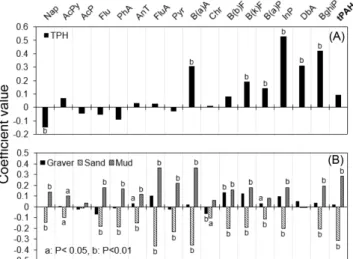
농도를 보인 benzo(a)anthracene, indeno(1,2,3-cd)pyrene, di-benzo(a,h)anthracene, benzo(g,h,i)perylene을 TPH와 상관분석 한 결과, 유의한 양의 상관관계(R=0.307, 0.529, 0.311, 0.423; P < 0.01)를 나타냄으로써 다른 성분들에 비해 유류 성분과 밀접한 연관성을 나타냈다(Figure 6A). 조하대 퇴적물의 조성비에 따른 PAHs의 농도분포를 보면 사질(sand)이 우세한 북부해역에서 상대적으로 낮았으며, 니 질(mud)이 우세한 남부해역에서 높은 분포를 나타내고 있었 다(Figure 5). 입도와 16종의 PAHs와의 상관분석 결과에서 사질과 모든 항목이 음의 상관관계를 보인 반면, 니질은 양 의 상관관계(Dibenzo(a,h)anthracene 제외)를 보였다(Figure 6B). 국내 여수해만과 한강하구와 산업시설이 밀집한 경기 만에서는 본 연구지역과 마찬가지로 PAHs가 니질지역에서 우세한 분포를 보였으며, 미국 메사추세츠주에 위치한 Maine bay에서도 본 연구와 유사한 결과를 나타냈다(Larsen et al. 1986; Kim et al. 1999). 하지만 일부 연구에서는 퇴적물의 조성보다는 퇴적물 내의 식물기원의 유기물 또는 저서생물 의 분변과 같은 유기입자들이 PAHs의 농도를 결정하는데 중요한 영향을 주며, 이와 같은 결과는 장기적으로 환경에 서도 큰 영향을 줄 것이라고 보고하였다(Kim et al. 1999; Wang et al. 2001). 따라서 유류사고에 따른 생태계 영향과 회복을 보다 명확히 평가하기 위해서는 환경적인자 뿐만 아 니라 생물학적인자를 포함한 복합적인 해석이 병행되어야 할 것으로 판단된다.
사
사
본 연구는「HS호 유류유출 사고에 따른 생태계 영향 장기 모니터링」사업의 일환으로 수행되었습니다.참고문헌
Allan SE, BW Smith, KA Anderson. 2012. Impact of the Deepwater Horizon Oil Spill on Bioavailable Polycyclic Aromatic Hydrocarbons in Gulf of Mexico Coastal Waters. Environmental Science & Technology 46: 2033-2039. An, JG, UH Yim, WJ Shim, BG Kim, SK Kim, HI Yi. 2009.
Seasonal Variation of Atmospheric Polycyclic Aromatic Hydrocarbons (PAHs) on Anmyeon Island. Ocean and Polar Research 31: 189-198.
Arey J, R Atkinson, B Zielinska, PA McElroy. 1989. Diurnal concentrations of volatile polycyclic aromatic hydrocarbons and nitroarenes during a photochemical air pollution episode in Glendora, California. Environmental Science & Technology 23: 321-327.
Baek SO. 1999. Atmospheric Polycyclic Aromatic Hydrocarbons -Environmental Implications. Journal of Korean Society for Atmospheric Environment 15: 525-544.
Bence AE, KA Kvenvolden, MC Kennicutt. 1996. Organic geo-chemistry applied to environmental assessments of Prince William Sound, Alaska, after the Exxon Valdez oil spill—a review. Organic Geochemistry 24: 7-42.
Bresnick E, M Anderson, F Gorse Jr, D Grosjean, R Hites, A Kappas, R Kouri, M Pike, J Selkirk, L White. 1983. Polycyclic aromatic hydrocarbons: evaluation of sources and effects. Chaps 1: 4.
Diercks AR, RC Highsmith, VL Asper, D Joung, Z Zhou, L Guo, AM Shiller, SB Joye, AP Teske, N Guinasso, TL Wade, SE Lohrenz. 2010. Characterization of subsurface polycyclic aromatic hydrocarbons at the Deepwater Horizon site. Geophysical Research Letters 37.
EPA. 1991. Pollutants of concern in puget sound. EPA 910/9-91-003.
Guzzella L, A De Paolis. 1994. Polycyclic aromatic hydrocarbons in sediments of the Adriatic Sea. Marine pollution bulletin 28: 159-165.
Hall D, R Doel, R Jørgensen, D King, N Mann, P Scorletti, P Heinze. 1998. Polycyclic aromatic hydrocarbons in automotive exhaust emissions and fuels. Concawe Report.
Figure 5. Distribution of tPAHs concentration according to sediment particle size composition (graver, sand and mud).
Figure 6. Correlation between 16 PAHs and TPH and sediment particle size (graver, sand and mud).
IARC. 1983. Polynuclear Aromatic Compounds. Lyon France 32. ITOPF. 2002. Fate of Marine Oil Spills. Technical Information
paper 2.
Kaupp H, MS McLachlan. 1998. Atmospheric particle size di-stributions of polychlorinated dibenzo-p-dioxins and dibenzofurans (PCDD/Fs) and polycyclic aromatic hydrocarbons (PAHs) and their implications for wet and dry deposition. Atmospheric Environment 33: 85-95.
Ke L, TWY Wong, YS Wong, NFY Tam. 2002. Fate of polycyclic aromatic hydrocarbon (PAH) contamination in a mangrove swamp in Hong Kong following an oil spill. Marine pollution bulletin 45: 339-347.
Keith LH, M Walker. 1995. Handbook of air toxics: sampling, analysis, and properties. CRC Press.
Kim DK, TJ Lee, SC Kim, DS Kim. 2012. Sources Apportionment Estimation of Ambient PM2.5 and Identification of Combustion Sources by Using Concentration Ratios of PAHs Journal of Korean Society for Atmospheric Environment 28: 538-555. Kim GB, KA Maruya, RF Lee, JH Lee, CH Koh, S Tanabe. 1999.
Distribution and sources of polycyclic aromatic hydrocarbons in sediments from Kyeonggi Bay, Korea. Marine pollution bulletin 38: 7-15.
Masclet P, G Mouvier, K Nikolaou. 1986. Relative decay index and sources of polycyclic aromatic hydrocarbons. Atmospheric Environment (1967) 20: 439-446.
Larsen PF, DF Gadbois, AC Johnson. 1986. Polycyclic aromatic hydrocarbons in gulf of maine sediments: Distributions and mode of transport. Marine Environmental Research 18: 231-244.
Lee CH, JH Lee, CG Sung, SD Moon, SK Kang, JH Lee, UH Yim, WJ Shim, SY Ha. 2013. Monitoring toxicity of polycyclic aromatic hydrocarbons in intertidal sediments for five years after the Hebei Spirit oil spill in Taean, Republic of Korea. Marine pollution bulletin 76: 241-249.
Lee HJ, GB Kim, YS Choi. 2011. Proposal of Standard Method for the Analysis of Polycyclic Aromatic Hydrocarbons in Marine Sediments. Journal of the Korean society for marine environ-mental engineering 14: 163-175.
Peterson CH, SD Ric e, JW Short, D Esler, JL Bodkin, BE Ballachey, DB Irons. 2003. Long-Term Ecosystem Response to the Exxon Valdez Oil Spill. Science 302: 2082.
Tronczyński J, C Munschy, K Héas-Moisan, N Guiot, I Truquet, N Olivier,S. Men, A Furaut. 2004. Contamination of the Bay of Biscay by polycyclic aromatic hydrocarbons (PAHs) following the T/V “Erika” oil spill. Aquatic Living Resources 17: 243-259.
Wang XC, YX Zhang, RF Chen. 2001. Distribution and Partitioning of Polycyclic Aromatic Hydrocarbons (PAHs) in Different Size Fractions in Sediments from Boston Harbor, United States. Marine pollution bulletin 42: 1139-1149.
Weissenfels WD, HJ Klewer, J Langhoff. 1992. Adsorption of polycyclic aromatic hydrocarbons (PAHs) by soil particles: influence on biodegradability and biotoxicity. Applied Micro-biology and Biotechnology 36: 689-696.
Yim UH, SH Hong, WJ Shim. 2007. Distribution and characteristics of PAHs in sediments from the marine environment of Korea. Chemosphere 68: 85-92.
Yim, UH, JR Oh, SH Hong, SH Lee, WJ Shim, JH Shim. 2002. Identification of PAHs Sources in Bivalves and Sediments 5 Years After the Sea Prince Oil Spill in Korea. Environmental forensics 3: 357-366.
You YS, HS Cho, YC Choi. 2007. A Study on the Pollution of Polycyclic Aromatic Hydrocarbons (PAHs) in the Surface Sediments Around Gwangyang Bay. Journal of the Korean society of marine environment & safety 13: 9-20.
(2019년 11월 11일 접수; 2019년 11월 24일 수정; 2019년 12월 14일 채택)