ORIGINAL ARTICLE
물 자원 생산을 위한 Coal Seam Gas Water Management Study의 평가 및 분석
1. 용수 생산
신춘환*
동서대학교 에너지환경공학과
Assessment and Analysis of Coal Seam Gas Water Management Study for Water Resource Production
1. Water Production
Choon-Hwan Shin*
Department of Energy & Environmental Engineering, Dongseo University, Busan 617-716, Korea
Abstract
Coal seam gas (CSG) production involves extracting methane from coal seams with ground water which is so called a primary by-product of this process, and is often rich in salts and other constituents. The predicted large volume and variable quality of this water make water management a topic associated with CSG production. In the past, the amount of this water used to be pumped into the vacant aquifer, or into the river during the life of individual production wells.
Australian government make a strategies for management and beneficial use of the water. From this point of view, a detailed assessment has not been undertaken, it is necessary for water resource production to analysis the "Coal Seam Gas Water (CSG Water) Management Policy Study" published in Queensland, Australia.
Key words : CSG water management policy, Water resource, Water quality, Assessment and analysis
1. 서 론1)
석탄층의 메탄은 지하수와 함께 회수 된다. 메탄은 여 러 가지 방법으로 회수하여 연료로서의 이용이 가능하지 만 메탄가스와 동반 회수되는 지하수는 염분 등이 포함 된 수질 성분으로 인하여 그동안 빈 대수층에 공급하거
나 인근 강이나 바다로 흘려보내는 등 수자원으로서의 가치는 인정받지 못하고 있었다(Randol, 2013; Chris, 2013; Paul 등, 2014 ).
그러나 근래의 기상이변으로 인한 홍수, 가뭄 등의 자 연재해가 빈번하여 식수를 비롯한 용수 부족현상을 초래 하게 되자 호주의 퀸스랜드 주 정부에서는 석탄층으로부
Received 18 June, 2014; Revised 14 July, 2014;
Accepted 15 July, 2014
*Corresponding author : Choon-Hwan Shin, Department of Energy &
Environmental Engineering, Dongseo University, Busan 617-716, Korea
Phone: +82-51-624-9910
E-mail: [email protected]
ⓒ The Korean Environmental Sciences Society. All rights reserved.
This is an Open-Access article distributed under the terms of the Creative Commons Attribution Non-Commercial License (http://
creativecommons.org/licenses/by-nc/3.0) which permits unrestricted non-commercial use, distribution, and reproduction in any medium, provided the original work is properly cited.
Underground
Power Plant
Coal/Gas
Captured CO2
Coalbed Purification Water
CH4
CO2 CH4
CH4
Flue gas
(a) (b)
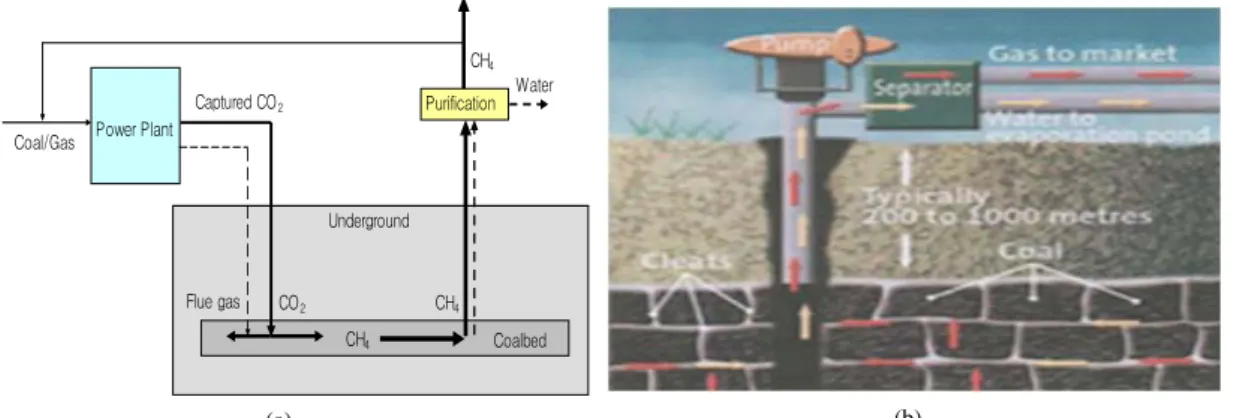
Fig. 1. Schematic diagram of CH4 and CSG water recovery(a: schematic, b: field).
터 유출되는 지하수를 수자원으로 개발하기 위한 정책을 수립하고 기후변화 및 강수량 감소에 대비하기 위하여 Coal Seam Gas Water (CSG Water)의 지속가능하고 안전한 수자원으로서의 활용에 초점을 맞추게 되었다 (New's on CSG water, 10 Jan. 2013, QLD's CSG water policy to benefit environment). 이와 함께 Queensland 주정부는 Coal Seam Gas Water Management Policy (AUS Dept. Natural Resource, 2012)를 통해 석탄층 지하수의 관리 및 자원화를 위한 입법화, 국제공동연구, 사업화 등을 추진하고 있다.
이러한 주 정부의 정책에 힘입어 석탄층 지하수의 발 생량은 CSG 개발 확대에 따라 매년 큰 폭으로 증가하고 있으며(Paul 등, 2008, 2009; Shin, 2009) 2012년 퀸스 랜드 주의 전략사업으로 설정되어 있는 현실에 비추어 주정부의 석탄층 지하수 관리 정책을 평가, 분석함으로 써 국내 기술의 접목 가능성 및 국내기술의 해외 진출기 회를 창출할 수 있는 기초자료를 제시하고자한다.
특히 석탄층 지하수의 유출량은 용수로서의 충분한 수량을 제공하고 있기 때문에 처리기술 및 관리 계획 등 후속 조치의 필요성을 제시하고 있다(Origin Energy, 2013; APLNG, 2013). 따라서 수량 및 수질에 따른 처 리기술의 방향 제시가 국내 기술 범위에서 가능할 것으 로 예상되기 때문에 호주의 Queensland 주에서 발간한 Coal Seam Gas Water Management Policy을 기술적 접근 방법, 유지관리 방법으로 분류하여 요구 수질을 만 족하는 용수로서의 생산 가능성을 확인함과 동시에 국내 의 각종 용수에 대한 요구 수질과 비교함으로서 국내 기
술의 적용 방향 설정 및 요구수질별 용수의 분류 등에 대 한 평가, 분석이 국내 기술의 접목 가능성을 진단하는 일 차적인 단계일 것으로 판단할 수 있으며 저비용 고효율 수처리 시스템 적용을 을 통해 석탄층에 대한 오염부하 를 저감시키고 안정적인 수자원으로 활용할 수 있는 방 향 설정에 대한 가능성도 진단하고자 한다.
2. 자료 분석 및 평가 방법
2.1. CSG water 발생 및 동향
Fig. 1에 나타난 바와 같이 석탄층의 지하수는 메탄을 회수하기 위한 공정에서 발생하는 2차 생산물로 정의한 다. 메탄은 석탄층에 CO2나 연도 가스 등을 주입하는 방 법 이외에도 여러 가지 방법을 이용하여(Shin, 2008;
Paul, 2014) 회수되어 연료로서의 이용이 가능하지만 지 하수는 그동안 빈 대수층에 공급하거나 인근 강이나 바 다로 흘려보내는 등 수자원으로서의 가치는 인정받지 못 하고 있었다. 그러나 CSG 개발 확대에 따라 석탄층 지 하수의 발생량이 매년 큰 폭으로 증가하게 되자 2012년 호주의 퀸즈랜드 주는 물 부족 현상을 해결하고자 하는 일환으로 CSG water의 이용에 관한 정책(AUS Dept.
Envir. & Herit., 2013)을 마련하면서 전략사업으로 추 진하기 시작하였다.
2.2. CSG water의 발생량 분석
Surat basin의 CSG water 발생량에 대한 자료는 Table 1에서 나타난 바와 같이 CSG water의 요구량에 대한 공급량은 수자원으로서의 충분한 수량을 확보 하고
Demand Summary (Ml/Y) Supply Summary (Ml/Y)
Year Upper Demand Average Demand Lower Demand Upper Supply Average Supply Lower Supply
2004 1,000 950 900 1,300 950 600
2005 1,000 950 900 8,250 7,565 6,880
2006 4,200 3,350 2,500 17,050 12,190 7,330
2007 6,400 5,350 4,300 24,950 17,590 10,230
2008 10,700 9,150 7,850 32,850 22,990 13,130
2009 12,200 10,225 8,250 42,150 29,090 16,030
2010 13,100 10,750 8,400 42,150 29,090 16,030
2011 13,950 11,175 8,400 42,150 29,090 16,030
2012 14,800 11,600 8,400 42,150 29,090 16,030
2013 15,700 12,050 8,400 42,150 29,090 16,030
2014 15,700 12,050 8,400 42,150 29,090 16,030
2015 15,700 12,050 8,400 42,150 29,090 16,030
Table 1. Assumed water demand and supply volume(Surat basin)
Water quality Unit Concentration(ppm)
pH 8 - 9
Total Dissolved Solids mg/L 1,200 - 4,300
Calcium mg/L 3 - 9
Magnesium mg/L 1 - 3
Sodium mg/L 300 - 1,700
Chloride mg/L 590 - 1,900
Sulphate mg/L 5 - 10
Bicarbonate mg/L 580 - 950
Table 2. Characteristics of CSG water quality(Bowen basin) 있음을 확인 시키고 있다. 즉, CSG water의 이용에 관한 정책 수립 당시인 2012년의 평균 요구량이 연간 11,600,000 Ton 인데 비해 공급량은 29,090,000 Ton 으로서 지속 가능한 수자원으로서의 확인이 가능하기 때 문에 본 연구의 평가, 분석 자료로서 활용하고자 한다 (Origin Energy, 2013).
2.3. CSG water의 수질 특성
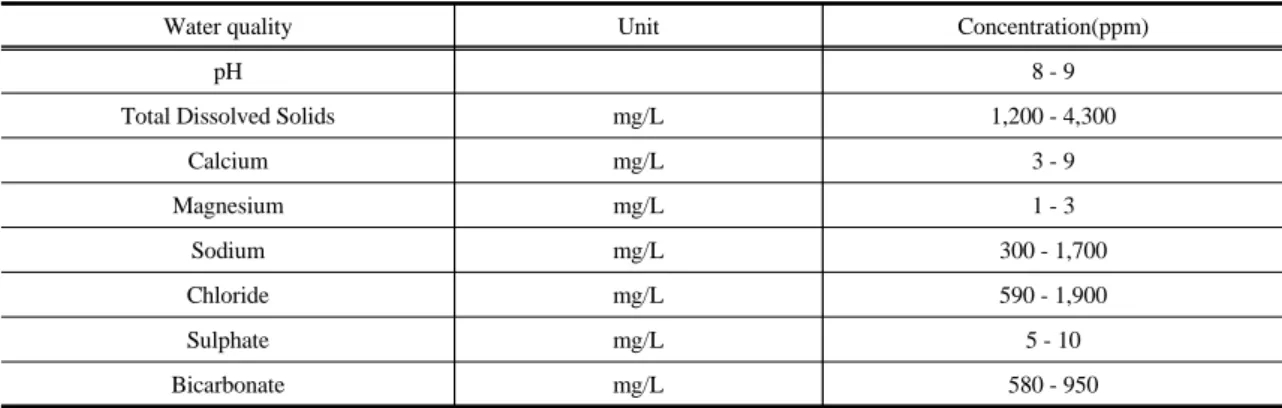
브리즈번 인근의 Bowen basin에서 발생하는 연간 30,000,000 Ton의 수질 특성은 아래 Table 2와 같이 보 고되어 있다( AUS Dept. Natural Resource, 2012). 여 기서 TDS, sodium chloride, bicarbonate의 농도가 다 른 항목에 비해 높다는 사실이 확인되기 때문에 CSG
water를 이용한 용수 생산을 위해서는 이들의 농도저감 이 필수적임을 알 수 있으며 더욱 상세한 수질 분석 자 료와 함께 처리 기술을 설계 할 수 있는 정보를 제공하 고 있다.
2.4 CSG water의 수익적 이용 방안
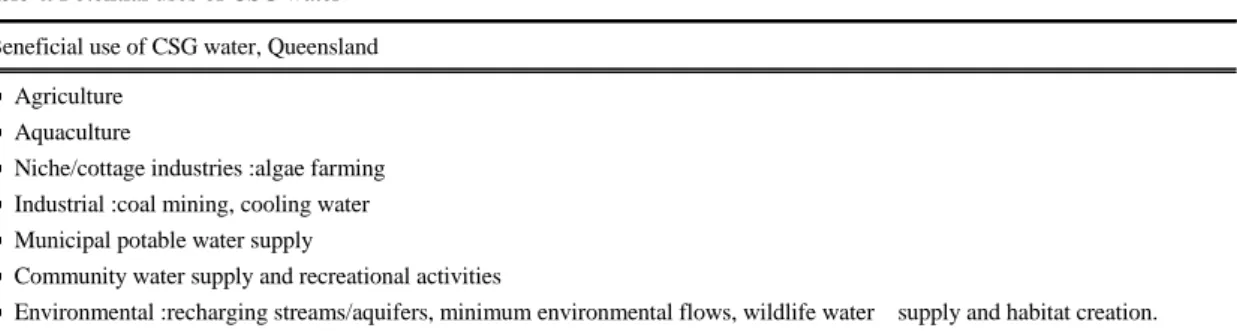
Coal Seam Gas Water Management Policy에 따르 면 농·수산용수, 산업용수, 레크레이션 용수 생산을 1차 목표로 하며 나아가서는 음용수 생산을 수익적 이용 방 안의 최종목적으로 제시하고 있다. 또한 용수 생산을 위 해 CSG water는 다음 조건을 만족해야 한다는 유지관리 및 선택사양에 대한 지침을 제시하고 있다(Higgins 등, 2012; AUS Envir. Prot. Agency, 2012).
Beneficial use of CSG water, Queensland Agriculture
Aquaculture
Niche/cottage industries :algae farming Industrial :coal mining, cooling water Municipal potable water supply
Community water supply and recreational activities
Environmental :recharging streams/aquifers, minimum environmental flows, wildlife water supply and habitat creation.
Table 4. Potential uses of CSG water
Water management options will be site-specific and influenced by some or all of the following factors Location of production area and proximity to communities, industries, and agricultural lands
Confidence in the water extraction rates that can be guaranteed for beneficial use Water quality
Environmental sensitivity of surroundings
Responsibility for capital costs for beneficial use scheme
Philosophy of the CSG producing company in accordance with Government policy/legislative framework.
Table 3. CSG water management option
2.5 용수 생산을 위한 처리기술의 분석 방법
CSG water를 이용한 용수 생산의 전략사업은 Table 4에 정리한 잠재적인 용도를 중심으로 전개한다는 기본 방침으로부터 처리기술의 방향을 설정하고자한다.
3. 결과 및 고찰
3.1. CSG water의 지속 가능한 발생량 평가
Table 1에 나타난 Surat basin의 발생량 추이는 용수 생산을 위한 지속 가능한 CSG water의 공급이 가능할 것으로 예상은 가능하다. 다만, Fig. 1에 나타난 바와 같 이 석탄층으로부터 가능한 한 많은 양의 메탄을 회수하 기 위해서는 메탄보다 석탄층에 대한 흡착능이 우수한 이산화탄소를 주입하여 석탄층으로의 경쟁흡착을 시키 면서 탈착되는 메탄을 회수하는 공정을 거치게 된다 (Shin 2008, Paul 등, 2008;2014). 이 때 지하수로부터 야기되는 수압을 제거하는 공정은 원활한 메탄의 회수를 위해 필요한 공정으로 도입되고 있다. 다만, Bowen, Surat 등의 석탄층 중 Fairview Field-well의 중심으로 나타낸 Fig. 2에서 볼 수 있는 바와 같이 시추공 증가에 따른 메탄-지하수 발생양의 경향은 시추공이 증가 할수 록 메탄회수 량은 감소하고 지하수회수 량은 증가하고
있기 때문에 무분별한 CSG 생산에 대한 경고의 의미도 포함하고 있다. 따라서 메탄 회수 량에 대한 지하수 회수 량의 적정 비율은 지속 가능한 CSG water의 공급량을 예측하는 자료가 될 수 있기 때문에 Fairview Field-well 의 자료에서 볼 수 있는 바와 같이(Santos, 2013) 1.63 TJ/day/well의 메탄 생산과 385 bbls/day/ well의 지하 수 발생양의 평균 생산 범위는 용수 개발을 위한 원수의 공급량을 산정할 수 있는 충분한 자료로서의 가치를 가 지고 있는 것으로 평가 할 수 있다.
Well count
Fig.2. CSG and CSG water production of Fairview Field-well performance in mid, 2013.
16 14 12 10 8 6 4 2 0
16000 14000 12000 10000 8000 6000 4000 2000 0
또한 Fig. 3에 나타난 Roma well의 경우에는 0.5 TJ/day/well의 메탄생산과 450 bbls/day/well의 범위를 보이고 있어 석탄층에 산재한 시추공에 따라 지하수 발 생양이 다소 차이를 보이고 있음을 알 수 있다(Metgasco Energy, 2013). 따라서 각 시추공 별 용수생산 시설을 설치하는 경우와 각 시추공에서 발생하는 CSG water를 수송하여 저류한 저류지에 용수생산 시설을 설치 할 경 우를 분리하여 용수생산 시설을 설계할 필요가 있을 것 으로 판단이 가능하다.
Well count
Fig.3. CSG and CSG water production of Roma-well performance at october, 2013.
3.2. CSG water의 대표 수질 평가 및 용수별 수질기준 분석
3.2.1 CSG water의 대표 수질 평가
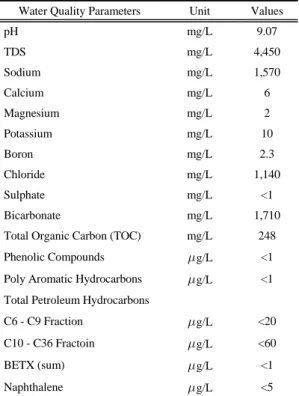
CSG water는 well의 위치, 깊이 그리고 형태에 따라 수질의 변동 폭이 크기 때문에 CSG Water Management Policy에 나타난 아래 Table 5의 대표 수질을 중심으로 평가하였다. Table 5는 전형적인 CSG water의 염분농 도는 TDS로서 200~10,000 mg/L, 중탄산 농도는 500~2,000 mg/L의 범위를 나타낸다는 결과와 일치하 고 있으며 특히 나트륨의 농도가1,570 mg/L인 경우에는 sodium absorption ratio(SAR)가 141로 나타나 10 이 상이면 농·수산 용수 및 관개용수 등으로는 직접 사용이 불가능하기 때문에 염분, 중탄산, 나트륨의 농도 저감 기 술의 접목이 우선되어야 한다는 사실을 알 수 있으며 식 수로 사용하기위해서는 TDS를 500 mg/L 이하로 낮추 기 위한 처리 방법도 제시할 필요가 있음을 알 수 있다.
여기서 호주의 환경·유산 보호국(Department of Environment and Heritage Protection: AUS Dept.
Envir. & Herit.)이 정한 CSG water의 처리과정에서 발생하는 폐기물의 처리에 관한 법안(AUS Dept. Envir.
& Herit., 2013)이 발효되기 시작했기 때문에 처리기술 이 처리 법안을 만족하는지도 검토가 필요할 것으로 생 각된다.
Water Quality Parameters Unit Values
pH mg/L 9.07
TDS mg/L 4,450
Sodium mg/L 1,570
Calcium mg/L 6
Magnesium mg/L 2
Potassium mg/L 10
Boron mg/L 2.3
Chloride mg/L 1,140
Sulphate mg/L <1
Bicarbonate mg/L 1,710
Total Organic Carbon (TOC) mg/L 248
Phenolic Compounds
g/L <1Poly Aromatic Hydrocarbons
g/L <1 Total Petroleum HydrocarbonsC6 - C9 Fraction
g/L <20C10 - C36 Fractoin
g/L <60BETX (sum)
g/L <1Naphthalene
g/L <5Table 5. CSG water quality
3.2.2. 용수별 수질 기준 분석
CSG water management policy에는 물 자원으로서 의 가치창출을 위해서는 농업용수, 생활용수, 공업용수 등 각종 용수에 대한 유용한 추진방향을 제시하고 있다.
다만, 환경·유산 보호국에서는 각종 용수에 대한 엄격한 수질을 요구하고 있기 때문에(AUS Dept. Envir. &
Herit.2013, Higgins 등, 2012) 요구 수질 범위를 만족 하는 기술적 접근이 우선되어야한다. 이에 본 연구에서 는 다양한 용수에 대한 광범위한 수질 항목을 정리하여 먼저, 경작용 농업용수에 대한 요구수질을 중심으로 분 석·평가 자료를 제시하였다. 즉 Table 6과 7에서 볼 수
Roma well performance as at 1 October 2013
Quality Criterion Guideline Level Comment Refer
Chloride <100 mg/L Up to 100 mg/L and 350 mg/L is suitable for spray or flood irrigation respectively. >350 mg/L is unsuitable for irrigation
TAS (2002)
Not specified Depends on plant type and irrigation method. Refers to NWQMS(2000b) for details.
NSW (2003)
Chlorine, total residual 1 mg/L Monitor chlorine residual or UV equipment Inspection frequency does not apply to lagoon systems.
NWQMS (2002a)
1 mg/L
After 30mins or equivalent level of pathogen reduction.
Monitor chlorine residual or UV equipment. Inspection frequency does not apply to lagoon systems.
NSW (2003) Table 6. Chemical criteria for agricultural use
있는 바와 같이 경작을 위한 농업용수 혹은 관개용수의 요구 수질 중, Table 5에 나타난 CSG water의 대표 수질 을 중심으로 분석하면 TDS, sodium, chloride, TOC, hydrocarbon(organic carbon), alkalinity, BOD, SAR, hardness 등의 제거가 우선적임을 알 수 있기 때문에 Table에는 이들 항목을 중심으로 표시하였다. 먼저 화학 적 수질 기준을 나타낸 Table 6에서 보면 대표수질에서 1,140 mg/L 를 나타내고 있는 chloride의 경우, TAS 주 에서는 100 mg/L 이하의 농도를 농업용수의 가이드라 인으로 정하여 350 mg/L 까지는 관개용수로서 가능한 범위로 지정하고 있음을 확인 할 수 있다. 또한 NSW 주 는 특별한 가이드라인은 정하고 있지는 않지만 경작물 종류나 관개방법에 따라 별도로 정하는 농도범위가 있음 을 밝히고 있어 거의 같은 내용으로 해석이 가능하다. 여 기서 잔류 염소는 소독을 위해서 1 mg/L의 농도를 권장 하며 sodium의 경우는 0-450 mg/L 범위임을 감안하면 CSG water의 대표수질에서 나타난 4,450 mg/L의 TDS 는 염분에서 기인하는 부분이 많을 것으로 판정이 가능 하기 때문에(Shin 등, 2012;2014) TDS 저감기술을 적 용하여 염화물 및 잔류염소, sodium의 허용 한계농도에 접근하는 것이 바람직함을 암시하고 있다. 특히 독성물 질 범위는 따로 정하지는 않았지만 살충제를 비롯한 합 성 유기물 또는 석유화합물은 재이용수 생산에서는 제거 대상이 되는 독성물질로 규정하고 있기 때문에 CSG water의 대표수질에서 TOC로 표시된 유기화합물의 농 도가 248 mg/L, C6 - C9 가 <20 mg/L, C10 - C36가
<60 mg/L 인 점을 감안하면 TOC 저감 기술 특히, 분자 량이 상대적으로 큰 C10 - C36의 처리에 초점을 맞추어
야한다는 결론에 도달할 수 있다(Shin 등, 2012;2014).
Table 7의 물리적 수질 분석표에서 볼 수 있는 바와 같이 알칼리도에 대한 가이드라인은 특별히 설정되어 있 지는 않지만 대표수질에서 중탄산 농도가 1,710 mg/L로 확인이 가능하기 때문에 탄산염 생성에 의한 알칼리도 유발 가능성도 배제 할 수 없다(Galiee Energy, 2013).
따라서 Ca+2(6 mg/L), Mg+2(2 mg/L) 의 농도에 따라 경 도제거 공정의 도입이 필요할 것으로 판단된다. 특히 Ca+2와 Mg+2는 Na+의 농도와 함께 SAR을 결정하는 인 자가 되며 이 값이 10 이상이면 농업용수 및 관개용수로 서는 직접 사용하지 않을 것을 권장하고 있다. Table 7에 서도 이와 같은 의미로 NSW 주에서는 6이하를 가이드 라인으로 정하고 있으며 SA주에서는 2-102의 범위에서 는 여과 등의 2차 처리를 거친 후에 사용할 수 있지만 경 작물의 sodium에 대한 저항성을 고려하여 사용 할 것을 권장하고 있는 기준에 비추어 TDS 저감에 따른 Ca+2, Mg+2, Na+ 각각의 농도 저감비율을 산정하여 경도가 60 mg/L as CaCO3 이하로표준화 할 필요가 있음을 알 수 있다.
3.3.3 처리공정 설계
Table 7에서 볼 수 있는 바와 같이 SS는 고품질의 재 이용수 생산을 위해서는 < 5 mg/L, 일반 재이용수는 < 30 mg/L를 기준으로 정하고 있어 여과 기능을 가진 공정 도 입이 필요할 것으로 예상된다(Shin, 2009). 여기서 탁도 는 CA 주는 2 NTU, NSW 주는 2 NTU 로 규정하고 있어 같은 농도 범위로 해석이 가능하다. 따라서 주로, TDS로 산정되지 않는 유기화합물과 석유화합물 등에서 유래된 탁도는 SS의 제거를 위해 도입되는 여과공정의
Quality Criterion Guideline Level Comment Refer
Alkalinity Not specified Alkalinity measured as bicarbonate TAS
(2002)
Hardness as CaCO3
<60 mg/L
Trigger value for corrosion. >350 mg/L may increase fouling.
Trigger values for other corrosion indices listed for corrosion and fouling
NWQMS (2000b)
Oxygen demand,
biochemical <10 mg/L Class A reclaimed water.
Annual median.
VIC (2002) Sodium
absorption ratio <6 Varies with soil structure. Refers to NWQMS(2000b) for details. NSW (2003)
2-102 Depends on sodium tolerance of plants SA
(1999) Solids,
suspended <5 mg/L Annual median. Class A Reclaimed water. VIC
(2002)
<30 mg/L Application method and harvest controls apply. Mean value. Class B or C may contain algae and need not be measured.
SA (1999) Table 7. Physical and aggregate criteria for agricultural use
시너지효과를 검토하여 SS와 탁도의 동시 저감 효과를 제시하는 것이 바람직하다는 평가를 할 수 있다. 또한 BOD는 TOC농도 중 일정 부분을 차지 할 것이기 때문 에 대표수질에 나타난 탄화수소계의 일부가 BOD를 유 발 할 것으로 예상이 가능하지만 A 등급의 재이용수를 위해서는 <10 mg/L를 기준으로 하며 재이용수 등급에 따라 차등을 두고 있음을 감안하면 용수의 등급 구별을 위한 BOD 조절 기술의 도입도 필요함을 알 수 있다. 결 론적으로, TDS, 경도, 알칼리도 및 탄화수소에서 유래 된 유기물, 염분 위주의 염소화합물 등의 농도 저감과 SAR 값의 조절을 위한 sodium 농도 조절 등을 위한 처 리공정은 단일 반응 시스템으로는 요구수질을 만족 할 수 없음을 예상 할 수 있다. 따라서 CSG water를 이용한 경작용 농업용수를 비롯한 각종 용수 생산을 위해서는 여과, 산화, 분해 공정 등의 요소기술을(Shin, 2012a) 병 합한 시스템의 설계(Shin, 2014)가 바람직 할 것으로 판 단되며 이러한 병합시스템은 각 반응조의 유입, 유출 속 도, 반송율 등의 운전 조건이 변수로 작용할 것이기 때문 에 국내 기술 형 pilot plant에 의한 후보 재 이용수의 생 산으로 국내기술의 접목 가능성을 검증하는 단계도 필 요 할 것으로 생각된다. 또한 CSG water의 발생 현장과 저류지 인근에 국내 시스템으로 구성된 test bed를 설치 하고 현지 환경에 적응하는 맞춤형 운전기술을 개발함
으로서 기술수출을 유도할 수 있는 로드맵 설계를 제안 하고자 한다.
3.4. CSG water management option의 분석 및 평가
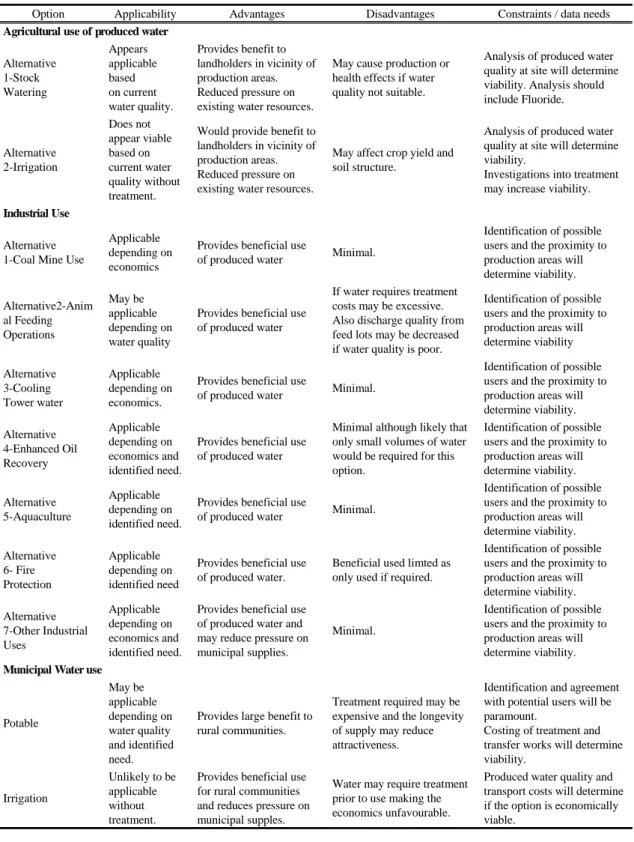
Surat basin을 예시한 Table 8에서 볼 수 있는 바와 같이 CSG water의 관리를 위한 option은 지표수에 충 진, 지하수로 유입, 저류지에 저장, 농업용수로 사용, 공 업용수로 사용, 생활용수로 사용 등으로 구분하여 정리 하고 있다. 지표수 충진의 경우에는 유량의 증가를 위한 방법으로 선택하지만 CSG water의 수질에 따라 단점으 로 작용 할 수 있음을 밝히고 있으며 지하수 유입의 경우 에는 일반 대수층과 석탄층 주변의 대수층으로 구분하여 선택사양을 정하고 있음을 확인 할 수 있다. 또한 공업용 수의 경우는 용도에 따라 세분하여 선택 사양을 정하고 있으며 농업용수는 가축 사육용, 관개용으로 구분하여 장단점을 구분하고 있다는 내용으로 미루어 처리 기준도 다양하게 설정 할 필요가 있음을 알 수 있다. 특히 모든 재이용수는 발생 단계의 수질과 처리수의 수질에 따라 용도를 확정해야 하기 때문에 Table 8의 정리 자료는 생 산된 재이용수의 등급에 따라 용도를 구분할 수 있는 기 본적인 방향을 제시하고 있다고 판단 할 수 있다.
Option Applicability Advantages Disadvantages Constraints / data needs Agricultural use of produced water
Alternative 1-Stock Watering
Appears applicable based on current water quality.
Provides benefit to landholders in vicinity of production areas.
Reduced pressure on existing water resources.
May cause production or health effects if water quality not suitable.
Analysis of produced water quality at site will determine viability. Analysis should include Fluoride.
Alternative 2-Irrigation
Does not appear viable based on current water quality without treatment.
Would provide benefit to landholders in vicinity of production areas.
Reduced pressure on existing water resources.
May affect crop yield and soil structure.
Analysis of produced water quality at site will determine viability.
Investigations into treatment may increase viability.
Industrial Use Alternative 1-Coal Mine Use
Applicable depending on economics
Provides beneficial use
of produced water Minimal.
Identification of possible users and the proximity to production areas will determine viability.
Alternative2-Anim al Feeding Operations
May be applicable depending on water quality
Provides beneficial use of produced water
If water requires treatment costs may be excessive.
Also discharge quality from feed lots may be decreased if water quality is poor.
Identification of possible users and the proximity to production areas will determine viability
Alternative 3-Cooling Tower water
Applicable depending on economics.
Provides beneficial use
of produced water Minimal.
Identification of possible users and the proximity to production areas will determine viability.
Alternative 4-Enhanced Oil Recovery
Applicable depending on economics and identified need.
Provides beneficial use of produced water
Minimal although likely that only small volumes of water would be required for this option.
Identification of possible users and the proximity to production areas will determine viability.
Alternative 5-Aquaculture
Applicable depending on identified need.
Provides beneficial use
of produced water Minimal.
Identification of possible users and the proximity to production areas will determine viability.
Alternative 6- Fire Protection
Applicable depending on identified need
Provides beneficial use of produced water.
Beneficial used limted as only used if required.
Identification of possible users and the proximity to production areas will determine viability.
Alternative 7-Other Industrial Uses
Applicable depending on economics and identified need.
Provides beneficial use of produced water and may reduce pressure on municipal supplies.
Minimal.
Identification of possible users and the proximity to production areas will determine viability.
Municipal Water use
Potable
May be applicable depending on water quality and identified need.
Provides large benefit to rural communities.
Treatment required may be expensive and the longevity of supply may reduce attractiveness.
Identification and agreement with potential users will be paramount.
Costing of treatment and transfer works will determine viability.
Irrigation
Unlikely to be applicable without treatment.
Provides beneficial use for rural communities and reduces pressure on municipal supples.
Water may require treatment prior to use making the economics unfavourable.
Produced water quality and transport costs will determine if the option is economically viable.
Table 8. Summary of water management options for the surat Basin
Option Applicability Advantages Disadvantages Constraints / data needs Sterilisation
Ultraviolet Light
Applicable where sterilisation only is required and no improvement in water quality is required.
Provides assurance that there is no risk to public health in terms of pathogens.
Provides limited improvement in water quality with respect suspended solids and TDS.
No increase in water quality other than sterilisation
Chemicla Treatment
Applicable where sterilisation only is required and no improvement in water quality is required.
Provides assurance that there is no risk to public health in terms of pathogens.
Provides limited improvement in water quality with respect suspended solids and TDS.
No increase in water quality other than sterilisation
Desalination
Reverse Osmosis
Applicable for improvements in water quality.
Provides effective removal of bacteria, salts, sugars, proteins, particles, dyes, and other constituents that have a molecular weight of greater than 150-250 daltons.
Significant pre-treatment may be required.
High concerns with fouling and cleaning of membranes.
A concentrated waste stream requires disposal.
Relatively expensive with significant operating and maintenance costs.
Ion Exchange
Applicable for improvements in water quality.
Provides softening of water or removal of salts.
Limited pre treatment.
Less waste stream than RO.
Does not provide removal of constituent other than charged ions.
Preferential removal of divalent ions therefore SAR adjustment required on treated water.
Relatively expensive with significant operating and maintenance costs.
Capacitive Desalination (CDI) or Deionization
Applicable for improvements in water quality.
Provides the removal of charged ions.
No use of cleaning chemicals therefore reduced waste stream.
New technology with no commercial record.
Does not provide removal of constituents other than charged ions.
Application effectiveness and costs unknown.
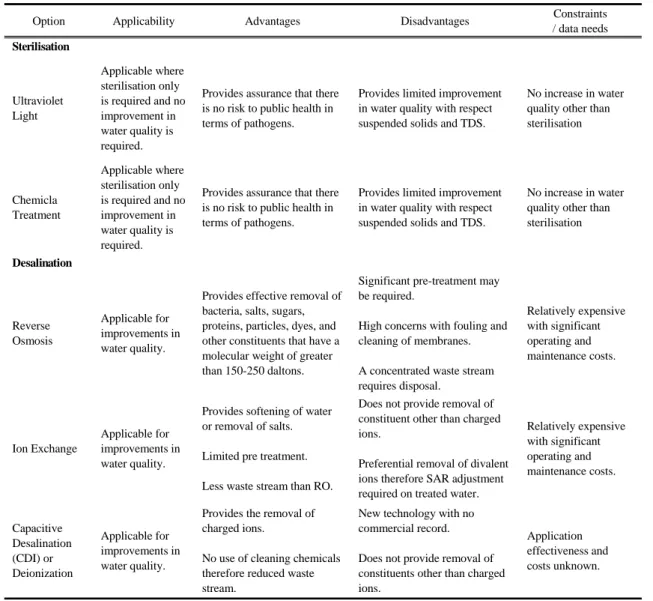
Table 9. Summary of water management options for the surat Basin
3.5. CGG water 처리를 위한 선택 기술의 분석 및
적용 기술 평가
Table 9에는 회수된 CSG water에 대한 물리·화학적 으로 처리가 가능한 기술을 제시하고 있다. 여기서 위생 처리, 탈염, 여과의 세부분으로 만 크게 나누어 정리하고 있다는 점에 주목 할 필요가 있으며 재고의 여지가 있음 을 알 수 있다. 여기서 소독공정을 포함한 위생처리를 보 면 자외선 및 화학처리의 필요성을 제시하고 있는 점을 미루어 보아 Table 5의 대표수질에서는 기록되지 않은 미생물 농도에 대한 처리가 추가되어야 할 것으로 판단
이 가능하다. 특히 탈염은 RO, 이온교환, CDI, EDR, 증 발 등으로 세분한 사실은 대표수질에 나타난 TDS, sodium, chloride, bicarbonate, hardness 등의 농도 조 절을 위해 선택하여 적용해야 한다는 점을 제시하고 있 으며(Origin Energy, 2013b) 재이용수의 용도 및 등급 에 따라 적용 기술이 달라질 수 있다는 점을 암시하고 있 다. 또한 특이한 점으로는 일반적인 여과 방법 외에 인공 습지에 의한 부유물질이나 영양염류를 침전 혹은 여과하 는 기술을 선택 사양으로 제시하고 있어 우리나라의 강 변여과 기능과의 유사점이 발견된다.
Option Applicability Advantages Disadvantages Constraints / data needs
Electrodialysis Reversal (EDR)
Applicable for improvements in water quality.
Requires a lower level of pretreatment than RO and thus lower associated capital costs.
Less concern with fouling of membranes.
Higher capital cost of EDR plant than RO.
Does not provide removal of constituents other than charged ions.
Relatively expensive with significant operating and maintenance costs.
Distillation
Applicable for improvements in water quality.
Provides removal of all but constituents with similar boiling points to water such as some organics. pesticides and volatile solvents.
Limited pre treatment.
High energy requirements.
Relatively expensive with significant operating and maintenance costs.
Freeze- Thaw/Evaporat ion
Process
Not applicable
Filtration
Physical filtration
Limited applicability
Traditional water treatment method providing removal of suspendied particles.
Does not provide significant reduction in TDS or SAR or nutrient loadings.
Limited effectiveness in reduction of constituents relevant to CSG water re-use
Artifical Wetlands
Limited applicability
Provides settlement of suspended particle and some reduction in nutrient concentration.
May provide some reduction in iron and barium
Does not provide significant reductions in TDS or SAR
Limited effectiveness in reduction of constituents relevant to CSG water re-use
3.6. CSG water의 수익적 재이용 방안
Table 10에는 호주의 산업 특성에 맞게 CSG water의 공급 대상을 구분하고 있다. 즉 Surat basin을 중심으로 광산지역 공급, 도시지역 공급, 가축사육지역 공급으로 구분하면서 이에 따른 CSG water의 수송비용, 수송 거 리별 관로 설치비용 등을 제시하고 있다. 이러한 비용은 저류지 건설비용, 추가증축 비용, 유량 조절용 예비 저류 지 건설비용, 증발 연못 건설비용 등과 경우에 따라서는 현장 처리시설 비용 등의 부대시설 비용을 모두 총괄하 는 비용으로서 수익창출을 위한 기본 투자비용으로 설정 하고 있다. 따라서 공급 지역에 따른 수익적 재이용은 CSG water 의 직접사용 혹은 처리수의 사용 등에서 발 생하는 수요량, 사용비용 등으로 환산되는 경제성 분석 (Shin, 2012b)이 필요할 것으로 판단된다.
4. 결론
CSG water management study를 분석· 평가하여 다 음과 같은 결론을 얻었다.
1. Bowen basin의 경우, 메탄과 지하수의 평균 생산 범위는 각각1.63 TJ/day/well과 385 bbls/day/well를 나타내며 Roma well의 경우에는 0.5 TJ/day/well과 450 bbls/day/well의 범위를 나타내고 있어 용수 생산을 위한 충분한 수량은 확보 할 수 있으나 석탄층의 위치에 따라 지하수 발생양이 다소 차이를 보이고 있음을 알 수 있다. 따라서 각 시추공 별 용수생산 시설을 설치하는 경 우와 각 시추공에서 발생하는 CSG water를 수송하여 저 류한 저류지에 용수생산 시설을 설치 할 경우를 분리하
Proposed scheme Assumptions and requirements of proposed scheme Approximate cost for scheme
Mine supply
A number of cases have been presented, as the location of an appropriate CSG produced water supply is uncertain in terms of both distance from the proposed mine and the available quantity of water
The two assumed cases for the location of the CSG production are are:
100 km from the proposed mine; and 10 km from the proposed mine.
Two supply cases have been included
1500 ML/a;and 3000 ML/a
The viability of supplying CSG produced water to a proposed mine will depend on the generic constraints including:
the costs transportation of water.
the need for an additional reliable supply of water of the quality of the CSG produced water; and
the timing of supply being in line with coal mine demands
The acceptable costs associated with the transfer of water to the mine will in part be dependant on the other sources of water supply to the mine. If the mine cannot meet the required water demand for construction and operation with a 95%
reliability from the other identified water sources then the mining company will be wiling to contribute a higher cost to the construction of a pipeline.
Commercial agreement will need to be made as to which company contributes to the transfer costs and the operation and maintenance of the pipeline.
Capital Cost (transport only)
$40.26M to $4.37M
Capital Cost Per ML 100 km pipeline supply of 3000 ML/a
$13,420/ML 10 km pipeline supply of 1500 ML/a
$2,900/ML
Supply to a Municipal Council
A number rural centres are located in the Surat basin in the vicinity of proposed CSG production areas including Daldy.
Miles, Chinchilla, and Wandoan.
This case study presents an example of the supply of produced water to a municipal council for supplementation of their water supply.
The supply of produced water to a nearby community would require:
construction of a transfer pipeline from the production area to the existing town water treatment plant.
construction of a buffer storage at the treatment plant to enable regulation of supply
augmentation of the existing plant to include a desalination unit such as an RO unit; and construction of an evaporative pond to receive concentrated waste from the RO unit It is assumed that.
The addition of the desalination unit would be on the grounds of the current water treatment plant and a location suitable for the construction of a concentrate disposal pond exists approximately 5 km for the water treatment plant
If it is assumed that the desalination plant is designed with a capacity of 20 L/s treated water, the rate of supply of produced water will be required to be at least an average of 25 L/s(756 ML/a assuming the plant operated 350 days per year).
For the case study it is assumed that the CSG production area is approximately 40 km from the rural centre.
Capital Cost (transport/
treatment/disposal)
$12.9M*
Capital Cost Per ML 40 km pipeline; 20 L/s Desalination plant and Disposal Ponds (~20 ha)
$20,450/ML Table 10. Examples of beneficial reuse of CSG water for the surat Basin
여 용수생산 시설을 설계해야 한다는 결론을 도출하 였다.
2. CSG water의 대표수질에서 나타난 4,450 mg/L의 TDS는 염분에서 기인하는 부분이 많을 것으로 판정이 가능하기 때문에 TDS 저감기술을 적용하여 염화물 및 잔류염소, sodium의 허용 한계농도에 접근해야하며 특 히, 독성물질 범위는 따로 정하지는 않았지만 살충제를 비롯한 합성 유기물 또는 석유화합물은 재이용수 생산에 서는 제거대상이 되는 독성물질로 규정하고 있기 때문에 TOC로 표시된 유기화합물의 농도가 248 mg/L, C6 - C9 가 <20 mg/L, C10 - C36가 <60 mg/L 인 점을 감 안하면 TOC 저감 기술 특히, 분자량이 상대적으로 큰 C10 - C36의 처리가 우선되어야 한다는 결론에 도달할 수 있다.
3. 나트륨의 농도가 1,570 mg/L인 경우에는 sodium absorption ratio (SAR)가 141로 나타나 10 이상이면 농·수산 용수 및 관개용수 등으로는 직접 사용이 불가능 하기 때문에 염분, 중탄산, 나트륨의 농도 저감 기술의 접 목이 우선되어야 한다는 사실을 알 수 있으며 식수로 사 용하기위해서는 TDS를 500 mg/L 이하로 낮추기 위한 처리 방법도 제시할 필요가 있음을 확인하였다.
감사의 말씀
이 논문은 2013년 동서대학교 “Dongseo Frontier Project"에 의해 작성되었으며 연구비 지원에 감사드립 니다.
참고문헌