262 http://dx.doi.org/10.7850/jkso.2012.17.4.262
Free Access
국내 양식어장 퇴적물과 생물 중 잔류성유기오염물질 분포
백승홍·이인석*·김혜선·최민규·황동운·김숙양·최희구 국립수산과학원 어장환경과
Distribution of Persistent Organic Pollutants(POPs) in Sediment and Organism Collected from Various Culturing Grounds, Korea
SEUNG-HONG BAEK, IN-SEOK LEE*, HYE-SEON KIM, MINKYU CHOI, DONG-WOON HWANG, SOOK-YANG KIM AND HEE-GU CHOI
Marine Environment Research Division, National Fisheries Research and Development Institute (NFRDI), Busan 619-705, Korea
국내 연안의 다양한 양식장의 퇴적물과 양식생물에 대하여 다이옥신류(PCDD/Fs), 다이옥신류피씨비(DLPCBs), 및 브롬화방염제(PBDEs)의 잔류수준을 조사하고 분포를 평가하였다. 양식장 퇴적물 중 PCDD/Fs, DLPCBs, PBDEs는 각각 0.03~2.9(평균±표준편차, 1.2±0.89) pg WHO2005-TEQ g-1건중량(dw), 불검출~1.1(0.09±0.19) pg WHO2005- TEQ g-1 dw, 불검출~16.6(2.96±3.53) ng g-1 dw 수준으로 검출되었다. 또한 양식생물 체내 함유량은 각각 불검출
~0.24(0.07±0.06) pg WHO2005-TEQ g-1습중량(ww), 불검출~0.11(0.04±0.04) pg WHO2005-TEQ g-1 ww, 0.05~0.29 (0.13±0.06) ng g-1 ww 수준이었다. 국내 연안 중 동해안과 남해안에 위치한 양식장 퇴적물 중 총다이옥신류(PCDD/
Fs+DLPCBs)와 PBDEs의 농도는 서해안보다 약 4~7배 높은 수준을 보였다. 퇴적물에서는 총다이옥신류에 대한 PCDD/Fs 기여율이 대부분(평균 94%)을 차지했지만, 양식생물에서는 DLPCBs가 약 33% 수준으로 퇴적물에 비해 높은 기여율을 보였다. PBDEs 중에서는 양식장 퇴적물과 생물 모두에서 BDE209가 가장 높게 검출되었다. 이전 연 구와 비교했을 때, 국내연안 퇴적물과 양식생물 중 PCDD/Fs, DLPCBs, PBDEs의 잔류수준은 대체로 감소하는 추 세에 있는 것으로 판단된다.
We investigated the concentration levels and evaluated the distributions of 17 polychlorinated dibenzo-p-dioxins and furans(PCDD/Fs), 12 dioxin-like polychlorinated biphenyls(DLPCBs) and 24 polybrominated diphenyl ethers (PBDEs) in sediment and organism from various culturing grounds in Korean coast. The levels of PCDD/Fs, DLPCBs, and PBDEs in sediment samples ranged from 0.03 to 2.9(Mean±SD, 1.2±0.89) pg WHO2005-TEQ g-1 dry weight(dw), ND(not detected) to 1.1(0.09 ± 0.19) pg WHO2005-TEQ g-1 dw, and ND to 16.6(2.96 ± 3.53) ng g-1 dw, respectively. Also, the levels of PCDD/Fs, DLPCBs, and PBDEs in culturing organisms ranged from ND to 0.24(0.07 ± 0.06) pg WHO2005-TEQ g-1 wet weight(ww), ND to 0.11(0.04 ± 0.04) pg WHO2005-TEQ g-1 ww, and 0.05 to 0.29(0.13 ± 0.06) ng g-1 ww, respectively. The levels of total dioxins(PCDD/Fs+DLPCBs) and PBDEs in sediments from East and South sea were four to seven times higher than those from West sea. PCDD/Fs had dominant contribu- tion(mean, 94%) for TEQ concentration in sediment, whereas relatively higher contribution of DLPCBs(33%) were shown in culturing organism than sediment. BDE209 was a dominant congener in both matrix. The concentrations of PCDD/Fs, DLPCBs and PBDEs were in decreasing trends in Korea coasts compared to previous results.
Key words: POPs, PCDD/Fs, DLPCBs, PBDEs, Culturing organism, Sediment, Culturing ground
서 론
잔류성유기오염물질(Persistent Organic Pollutants: POPs)은 독 성, 난분해성, 축적성 및 장거리 이동 특성을 가져 스톡홀름협약
에 의해 전 세계적으로 규제되고 있는 물질로 우리나라의 경우 1999년부터 내분비계장애 추정물질 조사사업을 통해 국내의 다양 한 환경매체(대기, 수질, 토양 등)에 대한 POPs 모니터링이 시행 되고 있다(MLTM, 2011).농약류를 포함한 22종의 POPs 중 다이 옥신/퓨란(Polychlorinated dibenzo-p-dioxins and furans, PCDD/
Fs)과 다이옥신류피씨비(Dioxin-like polychlorinated biphenyls, Received November 5, 2012; Revised November 20, 2012; Accepted November 20, 2012
*Corresponding author: [email protected]; [email protected]
DLPCBs)는 주로 산업체 공정부산물로 육상환경에서 배출되어 하 천수 유입이나 대기침적 등의 과정을 통해 수산환경으로 유입되 며, 먹이사슬을 통해 인체에까지 악영향을 미친다(Choi et al., 2010;
Munschy et al., 2008; Hsu et al., 2007). 브롬화난연제로 알려진 PBDEs (polychlorinated diphenyl ethers)는 전기전자제품, 도료, 직물 등의 화재예방을 위한 난연제로 첨가되어 사용되고 있으며, PCDD/Fs, DLPCBs와 유사한 물리화학적 특성으로 인해 환경 중 에서 유사한 거동을 한다(Eljarrat et al., 2005). POPs 물질은 물 리화학적 특성상 유기탄소가 풍부한 매체나 지질에 축적성이 높 기 때문에 퇴적물과 양식생물에 잔류하게 된다(Wang et al., 2009;
Pan et al., 2007; Okumura et al., 2004). 특히 퇴적물에 대한 POPs 물질의 잔류수준 및 분포 특성의 파악은 발생원 조사 및 생 태 위해성 관리 차원에서도 중요하게 인식되고 있으며(Park et al., 2011), 양식생물의 경우 먹이사슬에 따른 인체로의 전이 문제로 연구의 필요성이 높아지고 있다(Min, 2010). 이러한 이유로 수산 환경내 퇴적물과 양식생물에 대한 POPs 물질의 잔류수준에 대한 연구가 수행되고 있으나(Choi et al., 2010; 2011; Oh et al., 2003;
Terauchi et al., 2009; Moon et al., 2007a), 기존의 연구는 일반 해양환경 내 퇴적물과 부착 서식생물에 대한 결과들로써 어장환 경내 퇴적물과 양식생물에 대한 연구는 미비한 실정이다. 또한 우 리나라의 경우 양식의 입식밀도가 높고 대부분 연안에 분포하고 있기 때문에 육상에서 기인하는 POPs 물질의 영향을 크게 받는 다(NFRDI, 2010; MLTM, 2008).
이에 본 연구는 국내 연안어장내 퇴적물과 양식생물 중 PCDD/
Fs, DLPCBs 및 PBDEs의 잔류수준과 분포 특성을 파악하였으며, 양식생물 섭취를 통한 다이옥신류 일일노출량을 산정하였다. 또한, 국내외 일반 해양환경에 대해 이루어진 선행연구 및 국제기준과의 비교를 통하여 국내 연안어장내 PCDD/Fs, DLPCBs 및 PBDEs의 잔류실태 및 경향성을 파악하여 향후 POPs 물질에 대한 연안어 장 관리를 위한 기초자료를 제공하고자 하였다.
재료 및 방법 조사정점 및 시료채취
국내 연안어장내 퇴적물과 양식생물에 잔류하는 POPs 물질의 농도와 분포 특성을 파악하기 위해, 2011년 31개 정점에서 채취 한 퇴적물과 27개 정점의 연안어장내 양식생물에 대하여 PCDD/
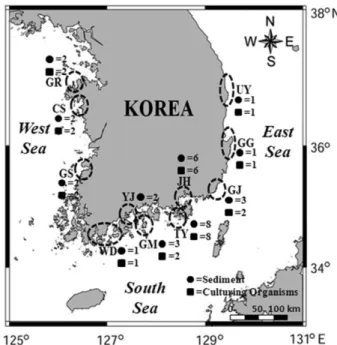
Fs, DLPCBs 및 PBDEs를 분석하였다. 동해의 울진-영덕(UY)과 구룡포-감포(GG), 남해의 기장(GJ), 진해만(JH), 통영연안(TY), 가 막만(GM), 여자만(YJ), 완도-득량만(WD) 및 서해의 곰소만(GS), 천수만(CS), 가로림만(GR)을 조사대상 연안어장으로 하였으며, 연 안어장 정점별 채취한 양식생물을 Fig. 1과 Table 1에 나타내었다.
퇴적물 시료는 반빈그랩(van Veen grab) 샘플러를 이용하여 표층 (< 0.5 m)을 채취하였으며, 생물시료는 연안어장내 양식생물을 채 취하여 분석하였다. 채취한 퇴적물과 생물시료는 실험실로 운반한 후 -20oC에서 분석 전까지 냉동보관하였다.
시료전처리 및 기기분석
본 연구의 조사대상 POPs 물질인 PCDD/Fs, DLPCBs 분석은 Moon et al.(2008)의 방법으로, PBDEs는 Moon et al.(2007b)의
방법에 따라 수행하였다. 간단히 서술하면, 퇴적물의 경우 동결건 조 속슬렛 추출한 후 황 제거를 위해 구리 처리를 하였으며, 생물 시료는 균질화한 가식부를 액-액(알칼리 분해) 추출하였다. 추출한 시료는 농축 후 PCDD/Fs 분석용(퇴적물 15 g, 양식생물 25 g)과 DLPCBs와 PBDEs 분석용(퇴적물 15 g, 양식생물 25 g)으로 분리 하였다. 분리한 시료에 정제용 내부표준물질(PCDD/Fs, EPA-1613LCS;
DLPCBs, WP-LCS; PBDEs, MBDE-MXE; Wellington laboratories, Canada)을 주입한 후 PCDD/Fs 분석용 시료는 다층실리카겔+활 성탄 컬럼으로 정제하였으며, DLPCBs와 PBDEs 분석용 시료는 다층실리카겔 컬럼 정제만을 거쳤다. 용출액은 농축한 후 실린지 첨가용 내부표준물질(PCDD/Fs, EPA-1613ISS; DLPCBs, WP-ISS;
PBDEs, BDE-CVA-EISS, Wellington laboratories)을 주입한 후 기기분 석용 시료로 하였다. 기기분석은 HRGC/HRMS(High resolution gas chromatography/high resolution mass specrometer, JMS-800D, JEOL, Japan)를 사용하였으며, 전자충격이온화법으로 분해능 10,000 이상(10% valley 기준)의 고분해능에서 분석하였다. PCDD/
Fs를 분석하기 위하여 SP-2331 모세관 컬럼(60 m, 0.25 mm i.d., 0.2 um d.f., Supelco)과 DB-5MS(60 m, 0.25 mm i.d., 0.25 um d.f., J&W Scientific)를 사용하였으며, DLPCBs와 PBDEs는 HT-8(50 m, 0.22 mm i.d., 0.25 um d.f., SGE)와 DB-5MS(15 m, 0.25 mm i.d., 0.1 um d.f., J&W Scientific)를 사용하였다. 기기분석조건은 PCDD/
Fs, DLPCBs는 Moon et al. (2008)의 분석조건으로, PBDEs는 Moon et al. (2007b)에 따라 수행하였다. 측정하고자 하는 이온의 질량은 각 동족체마다 2개의 선택이온을 사용하였으며, 선택이온 모니터링(Selected ion monitoring: SIM)방법으로 검출하고 내부 표준법으로 정량하였다. 퇴적물과 양식생물의 습중량은 Moon et al. (2007b; 2008)에 따라 각 시료의 동결건조 전후 무게차를 이용 하여 산출하였으며, 양식생물의 지방량은 가식부를 동결건조 후 지방추출장치를 이용하여 전후 무게차로 산출하였다.
Fig. 1. Sampling sites of sediment and organisms corrected from various culturing grounds in this study.
QA/QC(Quality assurance/quality control)
대상물질의 정량을 위해 각 동족체마다 2개의 선택이온을 사용하 였으며, 선택이온의 피이크(peak)와 체류시간이 크로마토그램상의 것과 같고, 선택이온의 피이크 면적비가 동위체의 면적비에 대하여
±15% 이내의 것으로 하였다. 각 분석대상물질별 정제용 내부표준물 질의 평균회수율은 PCDD/Fs 65~86%, DLPCBs 94~100%, PBDEs 65~97%였다. 검출한계(Limit of detection)는 신호 대 잡음 비(Signal to noise: SN)가 3인 농도로 정의하였으며, SN비가 3 미만인 값은 ND로 표시하였다. 독성등가량(TEQs) 산정을 위한 독성등가계수 (Toxic Equivalent Factor: TEF)는 WHO-TEF(2005)를 사용하였다.
다이옥신 일일섭취량(Estimated dietary/daily intake, EDI) 산정 본 연구의 양식생물은 실질적으로 우리나라 국민이 섭취하기 때 문에 PCDD/Fs와 DLPCBs의 분석결과와 수산물 섭취 통계량 자 료(MW, 2006)를 이용하여 두족류(멍게)와 이매패류(굴, 담치, 바
지락)에 대한 다이옥신 일일섭취량을 계산하였다. 보건복지부의 일일 섭취 통계량 자료는 2005년 우리나라 국민 약 9000명을 대 상으로 한 자료로써, 하루 섭취되는 음식물 재료와 양을 조사하여 통계적으로 분석한 결과이다. 본 연구에서는 보건복지부 자료에서 수산물 중 두족류 8.4 g day-1, 이매패류 5.0 g day-1의 값을 각각 사용하였으며, EDI의 계산 방법은 식 (1)과 같다.
다이옥신 일일섭취량(pg WHO-TEQ day-1)
= 다이옥신의 농도(pg WHO-TEQ g-1 wet weight)
×일일섭취량(g day-1) (1)
결과 및 고찰 퇴적물과 생물시료 특성
31개 정점에서 채취된 퇴적물의 함수율과 26개 정점의 양식생 Table 1. Characteristics of the corrected sediment and culturing organisms in this study
Sampling station
Sediment Culturing Organisms
Sample name
Moisture
(%) Sample name Species Length (cm)
Height (cm)
Weight (g)
Moisture (%)
Lipid (g/100g) East
coast
Uljin-Yeongdeok S-UY 52.3 C-UY H. roretzia 6.3 3.7 23.0 85.9 2.2 Guryongpo-Gampo S-GG 59.3 C-GG H. roretzia 6.2 3.7 20.6 78.1 2.8 South
coast
Gijang S-GJ1 53.1 C-GJ1 U. pinnatifidab 105.4 - - 89.8 0.2
Gijang S-GJ2 52.3 C-GJ2 L. japonicac 170.4 - - 92.1 0.1
Gijang S-GJ3 54.9
Jinhae S-JH1 58.7 C-JH1 C. gigasd 5.8 9.3 89.1 84.6 0.9
Jinhae S-JH2 49.6 C-JH2 M. edulise 7.3 3.9 24.6 83.0 1.5
Jinhae S-JH3 58.7 C-JH3 M. edulise 6.2 3.2 20.7 80.5 1.8
Jinhae S-JH4 65.3 C-JH4 C. gigasd 5.8 13.1 119.5 87.8 2.6
Jinhae S-JH5 56.5 C-JH5 C. gigasd 5.3 8.9 60.7 79.0 1.2
Jinhae S-JH6 57.6 C-JH6 M. edulise 5.6 3.1 12.3 82.3 1.5
Tongyeong S-TY1 59.0 C-TY1 H. roretzia 7.4 4.7 61.9 89.3 0.9 Tongyeong S-TY2 61.0 C-TY2 C. gigasd 4.8 9.0 56.8 86.1 2.1 Tongyeong S-TY3 59.9 C-TY3 H. roretzia 5.5 3.5 25.9 88.6 1.7 Tongyeong S-TY4 61.3 C-TY4 C. gigasd 4.8 7.3 42.3 82.8 2.5 Tongyeong S-TY5 67.5 C-TY5 C. gigasd 5.0 9.3 54.0 81.8 2.6 Tongyeong S-TY6 50.5 C-TY6 C. gigasd 5.1 9.7 52.2 79.2 1.3 Tongyeong S-TY7 49.3 C-TY7 C. gigasd 4.6 6.9 27.5 69.4 0.8 Tongyeong S-TY8 52.6 C-TY8 C. gigasd 4.5 5.6 24.6 76.7 1.0
Gamak S-GM1 49.6 C-GM1 C. gigasd 7.3 3.9 33.0 73.0 1.2
Gamak S-GM2 43.7 C-GM2 C. gigasd 7.9 4.2 42.6 78.4 0.9
Gamak S-GM3 40.3 Yeoja S-YJ1 47.2 Yeoja S-YJ2 41.4
Wando-Deukryang S-WD 41.9 C-WD U. pinnatifidab 213.8 - - 85.2 0.4 West
coast
Gomso S-GS1 41.2 C-GS1 T. philippinarumf 4.0 2.7 12.1 80.6 1.5 Gomso S-GS2 26.9 C-GS2 T. philippinarumf 3.8 2.5 14.0 76.1 1.4 Chunsu S-CS1 50.9 C-CS1 T. philippinarumf 4.2 1.7 12.1 79.9 1.2 Chunsu S-CS2 43.3 C-CS2 T. philippinarumf 4.2 1.7 13.9 79.4 1.2 Garorim S-GR1 36.8 C-GR1 T. philippinarumf 3.4 2.4 8.2 82.3 1.1 Garorim S-GR2 20.1 C-GR2 T. philippinarumf 3.6 2.5 10.4 83.1 1.0 Cephalopod,aHalocynthia roretzi; Seaweed, bUndaria pinnatifida, cLaminaria japonica; Bivalve, dCrassostrea gigas, eMytilus edulis, fTapes philippinarum
물에 대한 체장, 각고, 중량, 함수율, 지방량을 Table 1에 나타내 었다. 퇴적물의 함수율은 대부분의 정점이 40~70% 수준이었으며, 갯벌 분포가 높은 서해의 일부 정점에서 40% 이하로 나타났다.
양식생물의 지방량 분석결과, 해조류(미역, 다시마)가 0.1~0.4(0.2
±0.1) g g-1, 두족류(멍게)가 0.9~2.8(1.9±0.8) g g-1그리고, 이매패 류(굴, 담치, 바지락)에서 0.8~2.6(1.5±0.6) g g-1범위로, 두족류와 이매패류의 지방량이 해조류보다 약 7배 이상 높게 나타났다.
퇴적물과 양식생물 중 POPs 농도수준
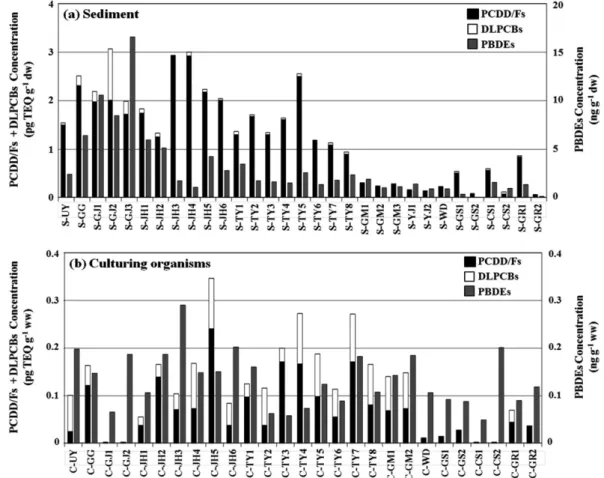
퇴적물과 양식생물 중 POPs 농도수준을 Fig. 2에 나타내었다.
31개 정점 퇴적물 중 PCDD/Fs 농도수준은 0.03~2.9(1.2±0.89) pg WHO2005-TEQ g-1 dw(dry weight, 건중량), DLPCBs는 ND(not detected, 불검출)~1.1(0.09±0.19) pg WHO2005-TEQ g-1 dw, 그리 고 PBDEs는 ND~16.6(2.96±3.53) ng g-1 dw로 나타났다. 이중 S- JH3과 -4에서 PCDD/Fs의 농도수준이 2.9 pg WHO2005-TEQ g-1 dw으로 가장 높았으며, DLPCBs와 PBDEs는 S-GJ2와 S-GJ3에서 각각 1.1 pg WHO2005-TEQ g-1 dw와 16 ng g-1 dw로 높게 나타 났다. 다이옥신류는 31개의 퇴적물 시료 중 65%가 캐나다 ISQGs (Interim sediment quality guidelines, 0.85 pg WHO1998-TEQ g-1 dw)를 초과했으나, 모든 정점에서 PEL(Probable effect level, 21.5 pg WHO1998-TEQ g-1 dw) 미만이었다(Canadian Council of Ministers of the Environment, 2001). 또한, 총다이옥신류(PCDD/Fs+DLPCBs) 는 0.06~3.2(1.3±0.96) pg WHO1998-TEQ g-1 dw 수준으로 캐나다 브
리티시컬럼비아주의 해양 퇴적물질 예비기준(Level 1: 100 pg WHO1998-TEQ g-1 dw, Level 2: 190 pg WHO1998-TEQ g-1 dw)에 비해 낮은 수준으로 나타났다(KEI, 2000).
양식생물에서 PCDD/Fs는 ND~0.24(0.07±0.06) pg WHO2005- TEQ g-1 ww(wet weight, 습중량), DLPCBs는 ND~0.11(0.04±0.04) pg WHO2005-TEQ g-1 ww의 농도수준을 보였다. 총다이옥신류의 농도가 C-JH5(0.35 pg WHO2005-TEQ g-1 ww), C-TY4(0.28 pg WHO2005-TEQ g-1 ww) 그리고 C-TY7(0.28 pg WHO2005-TEQ g-1 ww)의 굴에서 타 정점에 비해 높은 것으로 나타났다. 조사된 양 식생물 시료의 분석결과는 유럽연합에서 제시한 총다이옥신류의 최대 농도(6.5 pg WHO2005-TEQ g-1 ww)의 1.8% 이하 수준으로 나타났다(EU, 2011). PBDEs의 경우, 0.05~0.29(0.13±0.06) ng g-1 ww의 범위였으며, C-JH3의 담치시료에서 가장 높은 농도(0.292 ng g-1 ww)로 나타났다.
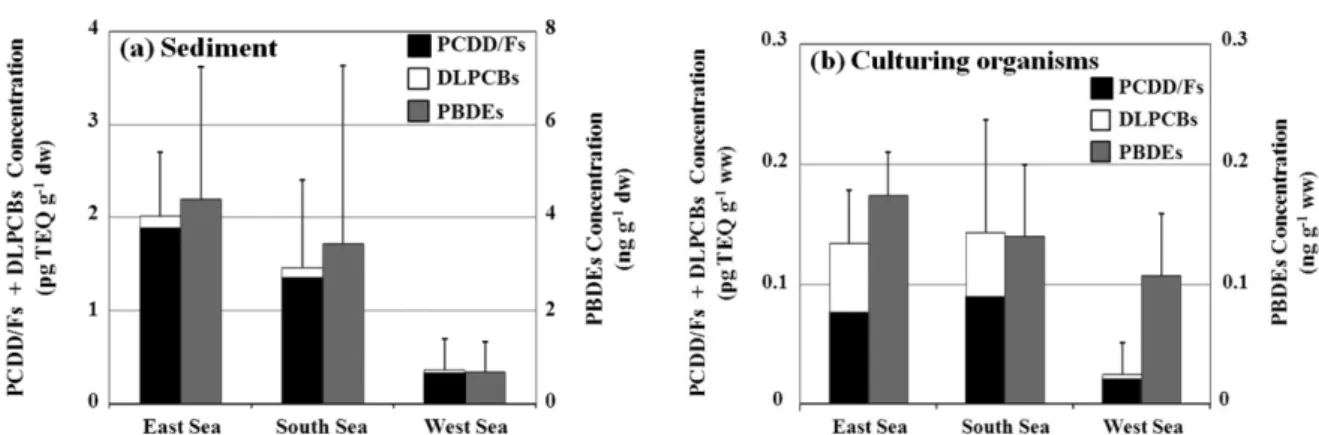
해역별 비교결과, 동해와 남해 그리고, 서해의 퇴적물에서 총다 이옥신류와 PBDEs의 농도는 각각 2.01, 1.45, 0.36 pg WHO2005- TEQ g-1 dw, 4.38, 3.43, 0.67 ng g-1 dw으로 나타났으며, 양식생 물에서는 0.13, 0.14, 0.03 pg WHO2005-TEQ g-1 ww와 0.17, 0.14, 0.11 ng g-1 ww로 나타났다(Fig. 3). 남해에 비해 동해와 서해의 시료수가 적어 통계적인 유의성을 판단하기 어려우나, 대체로 서 해의 퇴적물 중 총다이옥신류(PCDD/Fs+DLPCBs)와 PBDEs의 농 도가 동해와 남해에 비해 4~7배 낮은 경향을 보였다. 각 정점과 해역별 농도분포 비교결과 시, PCDD/Fs, DLPCBs 및 PBDEs 농
Fig. 2. Concentrations of PCDD/Fs, DLPCBs and PBDEs in (a) sediment and (b) culturing organisms in this study.
도분포는 해역에 의한 특성보다 각 양식장이 위치한 해역 내 지 리적 특성에 영향을 받는 것으로 판단되었다. 한편, 양식생물의 종 별 비교 결과에서는, PCDD/Fs와 DLPCBs가 두족류(멍게)와 이매 패류(굴, 담치, 바지락)에서 해조류(미역, 다시마)보다 20배 이상의 높은 농도를 나타냈다(Fig. 4). 이는 대상물질이 지방에 주로 축적 되는 특징으로 인해 해조류에 비해 상대적으로 지방량이 높은 두 족류와 이매패류에서 높게 나타난 것으로 판단된다. 그러나 PBDEs 의 경우 대체로 유사한 농도수준을 보였는데, 이는 PBDEs 사용 량의 97% 이상이 deca-BDE이며(Moon et al., 2007a), 이는 분자 량이 높아 생물체에 비교적 축적이 잘되지 않기 때문으로 판단된다.
다이옥신 일일섭취량(EDI)
조사대상 양식생물인 두족류(멍게)와 이매패류(굴, 담치, 바지락)에 대한 총다이옥신류 EDI는 2.2 pg WHO-TEQ day-1로 나타났으며, 각 생물종별로 두족류 1.5 pg WHO-TEQ day-1, 이매패류 0.7 pg WHO-TEQ day-1로 계산되었다. 대상물질 중 PCDD/Fs가 1.6 pg WHO-TEQ day-1로, 조사된 양식생물에 대한 EDI 값의 약 74%를 차지하는 것으로 나타났다. 국내 선행연구 중 Moon and Ok(2006)의 2002년과 2003년 EDI 결과에서 두족류가 3.8 pg WHO-TEQ day-1, 이매패류 1.4 pg WHO-TEQ day-1로 나타났으며, 본 연구의 EDI 값에 비해 약 2.5배 높아 감소되는 경향을 보였다. 국외 이매패류
만을 통한 EDI의 비교자료는 부족하지만, 아시아 국가인 타이완 의 남녀성별에 따른 EDI가 있으며, 일일섭취량은 각각 4.3(남), 4.6(여) pg WHO-TEQ day-1로 나타났다(Hsu et al., 2007). 본 연 구의 EDI 산출 값과 비교 시, 타이완의 이매패류에 대한 총다이 옥신류의 농도수준(0.16 pg WHO-TEQ g-1 ww)은 본 연구와 큰 차이를 나타내지 않았으나, 대상 수산물 일일평균섭취량은 타이완 이 약 6배 많다는 점을 착안하면, 수산물 섭취량이 다이옥신류 노 출량 산정에 대한 중요한 인자임을 보여주는 결과로 판단된다.
퇴적물과 양식생물 중 POPs 분포 특성
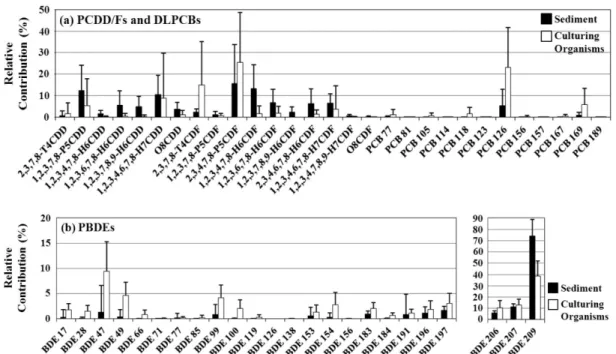
양식장 퇴적물의 대상물질별 이성질체 분포 특성을 Fig. 5에 나 타내었다. 총다이옥신류(PCDD/Fs+DLPCBs) TEQ 농도에 대한 기 여율은 PCDD/Fs가 94%, DLPCBs가 6%를 차지하였다. PCDD/Fs 중에서는 PCDFs의 비율이 56%로 다소 높았으며, PCDD/Fs 이성질체 중에서는 2,3,4,7,8-P5CDF, 1,2,3,4,7,8-H6CDF, 1,2,3,7,8-P5CDD가 각각 16%, 13%, 12%로 비교적 높게 나타났다. DLPCBs 중에서는 PCB126이 총다이옥신류 TEQ 농도에 대해 5%의 기여율로 가장 높게 나타났다. PBDEs의 경우, 선행연구에서 퇴적물 중 deca- BDE(209)가 대부분을 차지하는 것으로 보고되고 있으며(Eljarrat et al., 2005; Moon et al., 2007b; Mai et al., 2005), 본 연구에서도 평균 74%의 높은 기여율을 보였다.
양식생물의 각 이성질체 점유율은 퇴적물과 다소 차이를 보였다.
특히 총다이옥신류 TEQ 농도에 대한 DLPCBs의 기여율은 33%로 퇴적물에 비해 상대적으로 높았으며, 그 중 PCB126이 높은 기여율 (23%)을 보여 매체간 농축 특성이 다름을 나타냈다. PCDFs(70%)가 PCDDs(30%)보다 높은 기여율로 나타났으며, 2,3,4,7,8-P5CDF와 2,3,7,8-T4CDF가 각각 26%, 15%의 큰 기여율을 나타내었다. PBDEs 중 deca-BDE(209)는 여과 섭식하는 패류의 체내에 작은 입자상으로 흡수되어, 내장에 잔존하기 때문에 높은 분포율을 나타내는 것으로 보고되고 있다(Moon et al., 2007b). 여과 섭식하는 양식생물이 대부 분을 차지하는 본 연구에서도 deca-BDE(209)의 분포율이 약 40%로 높은 분포율을 나타내었으며, 저분자량 PBDEs도 상대적으로 높 은 기여율을 보여 퇴적물과는 다른 분포 특성을 보였다.
국내외 연구결과 비교
본 연구의 연안어장 퇴적물과 이매패류 중 PCDD/Fs와 DLPCBs Fig. 3. Comparisons of PCDD/Fs, DLPCBs, PBDEs concentrations in (a) sediment and (b) culturing organisms from East sea, South sea, and West sea.
Fig. 4. Comparisons of POPs concentrations in each culturing organ- isms.
Fig. 5. Distribution patterns of (a) PCDD/Fs and DLPCBs and (b) PBDEs in sediment and culturing organisms.
Table 2. Concentrations of PCDD/Fs and DLPCBs in sediment and culturing organisms from various coastal locations in Korea and other countries
Location Sampling year Concentration
Reference
PCDD/Fs DLPCBs
Marine Sediment (pg TEQ g-1 dw) Korea
East Sea 2011 1.6~2.8a(1.5~2.3)b 0.05~0.20a(0.04~0.20)b This Study South Sea 2011 0.10~3.1a(0.11~2.9)b ND~1.1a(ND~1.1)b This Study West Sea 2011 0.03~0.92a(0.03~0.82)b ND~0.04a(ND~0.04)b This Study
East Sea 2005 2.3~12.5 0.07~5.3 Terauchi et al., 2009
South Sea 2005 3.9~20.7 0.71~1.2 Terauchi et al., 2009
West Sea 2005 2.8 0.05 Terauchi et al., 2009
Other Countries
Koreaa 2011 0.03~3.1a(0.03~2.9)b ND~1.1 This Study
Hong Kong 2004 5.5~13.1 0.03~0.65 Terauchi et al., 2009
Japana 2000 3.1~49 0.18~3 Hosomi et al., 2003
Spaina 2002 0.1~48 0.2~63 Eljarrat et al., 2005
Kuwaitb - 0.2~3.2 - Gevao et al., 2009
Marine bivalves (pg TEQ g-1 ww) Korea
South Seaa 2011 0.05~0.29 0.02~0.11 This Study
West Seaa 2011 ND~0.04 ND~0.03 This Study
East Seaa 1987~1999 0.13~199.2 0.06~8.64 Oh et al., 2003
South Seaa 1987~1999 0.06~13.44 0.07~42.56 Oh et al., 2003
West Seaa 1987~1999 0.15~0.92 0.07~1.31 Oh et al., 2003
Other Countries
Koreaa 2011 ND~0.29a(ND~0.24)b ND~0.11a,b This study
Egypta 2002, 2003 0.13~0.29 0.31~0.33 Loutfy et al., 2006
Italya 1997~1998 0.11~0.24 - Bayarri et al., 2001
Spain 2005 0.13 - Bocio et al., 2007
Franceb 2004, 2005 0.05~4.27 - Munschy et al., 2008
Chinab - 00.28 - Shen et al., 2009
aWHO-TEF(1998); bWHO-TEF(2005)
농도와 국내외 연구결과를 비교하였다(Table 2). 국내 퇴적물과 이 매패류 중 총다이옥신류(PCDD/Fs+DLPCBs)의 농도는 조사년도 에 따라 대체로 감소하는 경향을 보였으며(Terauchi et al., 2009), 두 연구 모두 서해 퇴적물 중 농도수준이 남해나 동해보다 상대 적으로 낮은 것으로 나타났다. 본 연구의 분석결과는 국외 자료와 비교 시, 시료와 채취시기 및 대상정점수의 차이로 직접적인 비교 는 어려우나, 대체로 낮은 수준인 것으로 평가되었다. 국내 연안 어장내 퇴적물 중 PCDD/Fs와 DLPCBs 농도범위는 쿠웨이트와 유사한 수준이었으나, 스페인과 일본에 비해 낮았으며, 홍콩의 경 우 PCDD/Fs는 본 연구결과의 약 4배 수준이었으나, DLPCBs는 상대적으로 낮은 농도를 나타내었다(Eljarrat et al., 2005; Terauchi et al., 2009; Hosomi et al., 2003; Gevao et al., 2009).이매패류 중 PCDD/Fs와 DLPCBs의 농도수준은 프랑스에 비해 낮았으며 (Munschy et al., 2008), 그 외 국가들과 비교했을 때 큰 농도차이 를 나타내지는 않았다(Loutfy et al., 2006; Bayarri et al., 2001;
Bocio et al., 2007; Shen et al., 2009).
국내 퇴적물과 이매패류 중 PBDEs 잔류수준은, 2005년 조사 결과(Ramu et al., 2007)에 비해 감소하는 경향을 보였다. 본 연 구결과의 퇴적물 중 PBDEs 농도범위는 홍콩, 스페인, 미국의 조 사결과에 비해 비교적 낮은 수준이었으며(Eljarrat et al., 2005; Liu et al., 2005; Hoenicke et al., 2007), 이매패류 또한 같은 아시아 지역인 중국과 일본보다 낮은 것으로 평가되었다(Pan et al., 2007;
Miyake et al., 2008; Mizukawa et al., 2009)(Table 3).
결 론
본 연구는 국내연안 양식어장에서 채취된 퇴적물과 생물 내 PCDD/Fs, DLPCBs, PBDEs의 잔류수준과 물질별 이성질체 분포 특성을 조사하였으며, 양식생물 중 이매패류와 두족류의 다이옥신 류 EDI를 산출하였다. 또한, 국내외 연구결과들과 비교하여 국내 연안 양식어장의 농도수준을 파악하였다. 연구결과, 조사정점 중 서해의 양식장 내 퇴적물과 양식생물의 잔류농도수준이 동해와 남 해에 비해 낮았으며, 양식생물 중 지방함량이 낮은 해조류에서 낮
게 나타났다. 퇴적물과 양식생물 중 POPs 분포 특성은 다소 차이 를 보였으나, 대상물질별로 2,3,4,7,8-P5CDF와 PCB126 그리고 BDE209 등 특정 이성질체의 높은 분포율을 보였다. 다이옥신류 EDI 산정결과, 국외 이매패류에 대한 다이옥신류 EDI에 비해 낮 은 수준이었다. 국내연안 양식어장 퇴적물과 이매패류의 PCDD/
Fs, DLPCBs, PBDEs 잔류수준은 대체로 감소하는 경향을 보였다.
국외 자료 및 국제 기준에 비해 전반적으로 양호한 수준인 것으 로 판단되나, 국민의 안전한 먹거리를 위해 수산환경에 대한 지속 적인 POPs 모니터링은 필요하며, POPs 물질 저감방안 관련연구 도 병행되어야 할 것으로 판단된다.
사 사
본 연구는 국립수산과학원(RP-2012-ME-060)의 연구지원에 의 해 수행되었습니다
참고문헌(References)
Bayarri, S., L.T. Baldassarri, N. Iacovella, F. Ferrara, A. di Domenico, 2001. PCDDs, PCDFs, PCBs and DDE in edible marine species from the Adriatic Sea. Chemosphere, 43: 601−610.
Bocio, A., J.L. Domingo, G. Falc, J.M. Llobet, 2007. Concentrations of PCDD/PCDFs and PCBs in fish and seafood from the Catalan (Spain) market: Estimated human intake. Environ. Int., 33: 170−175.
Canadian Council of Ministers of the Environment, 2001. Canadian Sediment Quality Guidelines for the Protection of Aquatic Life.
Choi, H.-G., H.-B. Moon, M. Choi, J. Yu, 2011. Monitoring of organic contaminants in sediments from the Korean coast: Spatial distri- bution and temporal trends (2001−2007). Mar. Pollut. Bull., 62:
1352−1361.
Choi, H.-G., H.-B. Moon, M. Choi, J. Yu, S.-S. Kim, 2010. Mussel watch program for organic contaminants along the Korean coast, 2001-2007. Environ. Monit. Assess., 169: 473−485.
Eljarrat, E., A.D.L. Cal, D. Larrazabal, B. Fabrellas, A.R. Fernandez- Alba, F. Borrull, R.M. Marce, D. Barcelo, 2005. Occurrence of Table 3. PBDEs concentration in sediment and culturing organisms from various coastal locations in Korea and other countries
Location Sampling year Σn Concentration Reference
Marine Sediment (ng g-1 dw)
Korea 2011 24 ND~16.6 This study
2005 13 0.4~110 Ramu et al., 2007
Other Countries
Hong Kong 2004 15 1.68~53.6 Liu et al., 2005
Spain 2002 12 2.7~134 Eljarrat et al., 2005
USA 2002, 2003 5 0.2~211.8 Hoenicke et al., 2005
Marine bivalves (ng g-1 lipid wt)
Korea 2011 24 0.73~85.76 This study
2005 13 6.6~440 Ramu et al., 2007
Other Countries
Korea 2011 24 0.738~5.76 This study
China 2002 21 0.75~9.01 Pan et al., 2007
China 2003, 2004 10 0.66~18.9 Miyake et al., 2008
Japan 2005 20 42.6~120 Mizukawa et al., 2009
polybrominated diphenyl ethers, polybrominated dibenzo-p- dioxins, dibenzofurans and diphenyls in coastal sediments from Spain. Environ. Pollut., 136: 493−501.
EU, 2011. COMMISSION REGULATION(EC) No 1259/2011 of 2 December 2001.
Gevao, B., F.M. Jaward, S. Uddin, A.N. Al-Ghadban, 2009. Occurrence and concentrations of polychlorinated dibenzo-p-dioxins (PCDDs) and polychlorinated dibenzofurans (PCDFs) in coastal marine sediments in Kuwait. Mar. Pollut. Bull., 58: 424−455.
Hoenicke, R., D.R. Oros, J.J. Oram, K.M. Taberski, 2007. Adapting an ambient monitoring program to the challenge of managing emerging pollutants in the San Francisco Estuary. Environ. Res., 105: 132−144.
Hosomi, M., T. Matsuo, S. Dobashi, S. Katou, H. Abe, 2003. Survey of dioxins in Tokyo Bay bottom sediment. Mar. Pollut. Bull., 47:
68−73.
Hsu, M.S., K.Y. Hsu, S.M. Wang, U. Chou, S.Y. Chen, N.C. Huang, C.Y. Liao, T.P. Yu, Y.C. Ling, 2007. A total diet study to estimate PCDD/Fs and dioxin-like PCBs intake from food in Taiwan.
Chemosphere, 67: S65−S70.
KEI (Korea Environment Institute), 2000. Study on the development of environmental guideline in aquatic sediment.
Liu, Y., G.J. Zheng, H. Yu, M. Martin, B.J. Richardson, M.H.W. Lam, P.K.S. Lam, 2005. Polybrominated diphenyl ethers (PBDEs) in sediments and mussel tissues from Hong Kong marine waters.
Mar. Pollut. Bull., 50: 1173−1184.
Loutfy, N., M. Fuerhacker, P. Tundo, S. Raccanelli, A.G.E. Dien, M.T. Ahmed, 2006. Dietary intake of dioxins and dioxin-like PCBs, due to the consumption of dairy products, fish/seafood and meat from Ismailia city, Egypt. Sci. Total Environ., 370: 1−8.
Mai, B., S. Chen, X. Luo, L. Chen, Q. Yang, G. Sheng, P. Peng, J.
Fu, E.Y. Zeng, 2005. Distribution of Polybrominated diphenyl ethers in sediments of the Pearl River Delta and adjacent South China sea. Environ. Sci. Technol., 39: 3521−3527.
Min B.-Y., 2010. A Study on Polybrominated Diphenyl Ethers and Organochlorine Compounds Residues Persistent in Korean Coastal Bivalves. J. Env. Hlth. Sci., 36(2): 118−127.
Miyake, Y., Q. Jiang, W. Yuan, N. Hanari, T. Okazawa, B. Wyrzykowska, M.K. So, P.K.S. Lam, N. Yamashita, 2008. Preliminary health risk assessment for polybrominated diphenyl ethers and polybrominated dibenzo-p-dioxins/furans in seafood from Guangzhou and Zhoushan, China. Mar. Pollut. Bull., 57: 357−364.
Mizukawa, K., H. Takada, I. Takeuchi, T. Ikemoto, K. Omori, K.
Tsuchiya, 2009. Bioconcentration and biomagnification of polybrominated diphenyl ethers (PBDEs) through lower-trophic- level coastal marine food web. Mar. Pollut. Bull., 58: 1217−1224.
MLTM (Ministry of Land, Transport and Maritime affairs), 2008.
Study on the establishment of management step for inland originated pollutants.
MLTM (Ministry of Land, Transport and Maritime affairs), 2011.
Research on the safety assessment of micropollutants in marine ecosystem.
Moon, H.-B. and G. Ok, 2006. Dietary intake of PCDD, PCDFs and dioxin-like PCBs, due to the consumption of various marine organisms from Korea. Chemosphere, 62: 1142−1152.
Moon, H.-B., H.-G. Choi, P.-Y. Lee, G. Ok, 2008. Congener-specific characterization and sources of polychlorinated dibenzo-p-dioxins, dibenzofurans and dioxin-like polychlorinated biphenyls in marine sediments from industrialized bays of Korea. Environ. Toxicol.
Chem., 27: 323−333.
Moon, H.-B., K. Kannan, M. Choi, H.-G. Choi, 2007a. Polybrominated diphenyl ethers (PBDEs) in marine sediments from industrialized bays of Korea. Mar. Pollut. Bull., 54: 1402−1412.
Moon, H.-B., K. Kannan, M. Choi, H.-G. Choi, 2007b. Polybrominated diphenyl ethers (PBDEs) in sediments and bivalves from Korea coastal waters. Chemosphere, 66: 243−251.
Munschy, C., N. Guiot, K. Heas-Moisan, C. Tixier, J. Tronczyjsk, 2008.
Polychlorinated dibenzo-p-dioxins and dibenzofurans (PCDD/Fs) in marine mussels from French coasts: Levels, patterns and temporal trends from 1981 to 2005. Chemosphere, 73: 945−953.
MW (Ministry of Health and Welfare), 2006. Survey on national health and nutrition (III).
NFRDI (National Fisheries Research and Development Institute), 2010. Survey on the environmental conditions of fisheries.
Oh, J.R., M.G. Ikonomou, M.P. Fernandez, S.H. Hong, 2003. PCB and PCDD/F Totals, TEQs, and Congener Patterns in Korean Coastal Marine Environments, 1987, 1988, 1990, and 1996-1999.
Arch. Environ. Contam. Toxicol., 44: 224−236.
Okumura, Y., Y. Yamashita, Y. Kohno, H. Nagasaka, 2004. Historical trends of PCDD/Fs and CO-PCBs in a sediment core collected in Sendai Bay, Japan. Water Res., 38: 3511−3522.
Pan, J., Y.-L. Yang, Q. Xu, D.-Z. Chen, D.-L. Xi, 2007. PCBs, PCNs and PBDEs in sediments and mussels from Quingdao coastal sea in the frame of current circulations and influence of sewage sludge. Chemosphere, 66: 1971−1982.
Park, J.-E., J.-G. Kim, S.-Y. Ahn, 2011. Distribution and Source Identification of PCDD/Fs and Co-PCBs in Sediments from the Geum River. Korean Society of Environ. Engineers, 900−906.
Ramu, K., N. Kajiwara, T. Isobe, S. Takahashi, E.-Y. Kim, B.-Y. Min, S.-U.
We, S. Tanabe, 2007. Spatial distribution and accumulation of brominated flame retardants, polychlorinated biphenyls and organochlorine pesticides in blue mussels (Mytilus edulis) from coastal waters of Korea. Environ. Pollut., 148: 562−569.
Shen, H., C. Yu, Y. Ying, Y. Zhao, Y. Wu, J. Han, Q. Xu, 2009.
Levels and congener profiles of PCDD/Fs, PCBs and PBDEs in seafood from China. Chemosphere, 77: 1206−1211.
Terauchi, H., S. Takahashi, P.K.S. Lam, B.-Y. Min, S. Tanabe, 2009.
Polybrominated, polychlorinated and monobromo-polychlorinated dibenzo-p-dioxins/dibenzofurans and dioxin-like polychlorinated biphenyls in marine surface sediments from Hong Kong and Korea. Environ. Pollut., 157: 724−730.
Wang, Z., X. Ma, Z. Lin, G. Na, Z. Yao, 2009. Congener specific distributions of polybrominated diphenyl ethers (PBDEs) in sediment and mussel (Mytilus edulis) of the Bo Sea, China.
Chemosphere, 74: 896−901.
2012년 11월 5일 원고접수 2012년 11월 20일 수정본 접수 2012년 11월 20일 수정본 채택 담당편집위원: 이충일