• 검색 결과가 없습니다.

Growth Promotion of Tobacco Plant by 3-hydroxy-2-Butanone from Bacillus vallismortis EXTN-1

N/A
N/A
Protected

Academic year: 2021

Share "Growth Promotion of Tobacco Plant by 3-hydroxy-2-Butanone from Bacillus vallismortis EXTN-1"

Copied!
6
0
0

로드 중.... (전체 텍스트 보기)

전체 글

(1)

http://dx.doi.org/10.7585/kjps.2013.17.4.388

Open Access

388

Growth Promotion of Tobacco Plant by 3-hydroxy-2-Butanone from Bacillus vallismortis EXTN-1

Mi Na Ann, Yung Eun Cho, Ho Jin Ryu, Heung Tae Kim

1

and Kyungseok Park*

Microbial Plant Activation Lab, Division of Agricultural Microbiology, Department of Crop Life Safety, National Academy of Agricultural Sciences, Rural Development Administration, Suwon 441-707, Republic of Korea

1

Department of Plant Medicine, College of Agriculture, Life and Environment Science, Chungbuk National University, Cheongju 361-763, Chungbuk, Korea

(Received on November 22, 2013. Revised on December 6, 2013. Accepted on December 13, 2013)

Abstract It has been well documented that Bacillus vallismortis strain EXTN-1, a beneficial rhizosphere bacterium, could enhance plant growth and induce systemic resistance to diverse pathogens in plants.

However, the molecular mechanisms for how the EXTN-1 promote plant growth and induce resistances to diverse pathogens. Here, we show that 3-Hydroxy-2-butanone, a volatile organic compound (VOCs) emitted from the EXTN1, is a key factor for the bacteria-mediated beneficial effects on plant growth and defense systems. We found that the presence of volatile signals of EXTN-1 resulted in growth promotion of tobacco seedlings. The identification and analysis of EXTN-1-secreted volatile signals by solid-phase microextraction (SPME) and gas chromatography/mass spectrometry (GC/MS) indicated that a 3-hydroxy-2-butanone could provide not only the plant growth promotion, but also higher resistance against Pectobacterium carotovorum SCC1. These results suggest that a volatile compound released from EXTN-1 enhances the plant growth promotion and immunity of plants.

Key words Bacillus vallismortis EXTN-1, volatile, 3-Hydroxy-2-butanone

Introduction

Plant growth-promoting rhizobacteria (PGPR) are a group of root-colonizing bacteria in the rhizosphere of various plant species. The PGPR make plant productivity better and usually induce plant immunity against plant pathogens, a process called induce systemic resistance (ISR) (Ryu et al., 2004). These beneficial bacteria have been applied to a variety of agricultural fields to enhance the plant biomass and disease resistance (Kloepper et al. 1980, 1999).

The molecular mechanisms for commensal plant-microbe interactions have been exclusively explored. Although many microbe-plant interactions are on the basis of the microbe’s direct contact to the plants, microbial-derived volatile materials have recently appeared as a new way of interactions between microbe and plants at a distance (Ryu et

al., 2003). Interestingly, natural chemicals are main components of plants and microorganisms, and many of them are organic volatiles (Farag et al., 2013). Bacterial volatiles are found to be a rich source for new natural chemical compounds (Marco et al., 2009). Mixtures of volatile chemicals emitted from certain strains of PGPR, in spite of absent of physical interaction with plant roots, also induced growth promotion in Arabidopsis (Pare et al., 2005;

Ryu et al., 2003, 2004). Furthermore, Ryu et al.(2004) reported that several airborne chemicals from certain soil bacteria which are the physically separating PGPR from their host plant have been identified as effective signals for triggering plant growth and ISR. Studying the com- prehensive chemical profile of PGPR volatiles further showed that more than 30 different volatiles are emitted from Bacillus spp.(Farag et al. 2006; Lee et al. 2012). Recent data from another PGPR strain, Paenibacillus polymyxa E681, showed that long-chain bacterial VOCs, i.e., the C13 hydrocarbon tridecane, also can induce ISR, as can C4 alcohols such as 2,3-butanediol (Lee et al. 2012). These

*Corresponding author

Tel: +82-31-290-0424, Fax: +82-31-290-0406 E-mail: [email protected]
ORIGINAL ARTICLES / CONTROL

(2)

indicate that many kinds of bacterial-derived volatiles are broadly involved in communicating between microbe and plants and enhancing plant growth and immunity.

In this study, we report that one of the VOCs, released from a specific PGPR strain B. vallismortis EXTN-1 (EXTN-1) triggers plant growth promotion and immune responses in tobacco. Among the secreted volatiles, a 3- Hydroxy-2-butanone act as a stimulator in plant growth and immunity.

Materials and Methods

Bacteria and media preparation

Strain EXTN-1 was originally isolated from red pepper (Park et al., 2007). In order to store for a long time, bacterial cultures were maintained at -80 in tryptic soy broth (TSB) (Difco Laboratories, Detroit, MI, USA) that contained 20%

glycerol. B. vallismortis EXTN-1 were streaked onto tryptic soy agar (TSA, Difco Laboratories, Detroit, MI, USA) plates and incubated for 24 h in darkness at 28.

The strain EXTN-1 cultured in different kinds of media.

The media are Tryptic soy agar (TSA), Nutrient agar (NA), Luria bertani agar (LBA), King’s B agar (KBA), Potato dextrose agar (PDA). All the media were purchased from Difco Laboratories, Detroit, MI. Water agar (WA) media was used as control.

Assessment of plant growth promotion by bacterial volatiles One-week-old germinated tobacco seedlings (5 seedlings per plate) were transferred to one side of the I-plates that prepared with MS solid medium. The other side of those I- plates contained six different media. Thirty microliter of EXTN-1 suspensions (10

9

cells/ml) or sterile distilled water (SDW) onto the center of the other side of I-plate that did not contain the seedlings. Plates were sealed with parafilm and arranged in a completely randomized design. One-week after inoculation, the total fresh weight and dry weights were recorded.

CO

2

experiments

One-week-old germinated tobacco seedlings (5 seedlings per plate) were transferred to one side of the I-plates that prepared with MS solid medium. On the other side of those I-plates are round shaped plates that contained six different media and was filled with 7 ml 0.1 M Ba(OH)

2.

One-week after inoculation, the total fresh weight were recorded.

GC-MS analysis of bacterial volatile compounds

The strain EXTN-1 was cultured in 20 ml headspace vial contained KBA medium and incubated for 24 h at 28

o

C. The bottles were sealed with a steel srimp cap fitted with a Teflon/silicon septum that was previously conditioned at 100

o

C for 30 min. The extracts were analyzed by capillary gas chromatography (GC), Bruker Scion-SQ with Combi-Pal Auto sampler on a 15 m × 0.25 mm fused silica columm [BR-5ms (30 m × 0.25 mm × I.d = 0.25 df) ] with a 0.25-µm- thick bonded methyl siloxane (Quadrex, New Haven, CT).

Oven temperature was held at 40

o

C for (5 min), 50

o

C-220

o

C at a rate of 10

o

C/min, 220

o

C/7min, with detector and back- flush flow rates of 1 ml/min and analysis time of 85 s. MS- transfer Line temp : 250

o

C, MS-source Temp : 200

o

C and with a scan range of 40-300 nm.

Assessment of plant growth promotion and ISR by bacterial chemicals

One-week-old germinated tobacco seedlings (5 seedlings per plate) were transferred to the half side of the I-plates that prepared with MS solid medium. The other side of those I- plates contained Water agar. Dilutions of volatile chemicals were made in sterile distilled water (SDW) with final concentration of 0.001 ppm, 0.01 ppm, 0.1 ppm, 1 ppm, 10 ppm. Thirty microliter of each compound was dropped on sterile paper of I-plate that did not contain the seedlings.

Plates were sealed with parafilm and arranged in a completely randomized design. One-week after inoculation, the total fresh weight were recorded. For assessing ISR activity against P. carotovorum SCC1 by bacterial volatile, one week after the exposure to VOCs, ISR activity against P.

carotovorum SCC1 (10

9

cells/ml) was dropped on each leaf of plants. The percent of disease severity was measured after the incubation for 24 h at 28. The percent diseased leave per total leave was calculated.

Statistical analysis

Data were analyzed (mean ± SE) with JMP software.

Significant differences in treatment means on each sample data were determined using LSD at P = 0.05.

Results

Plant growth promotion by bacterial volatiles

To investigate the positive effects of volatiles emitted from

B. vallismortis EXTN-1 on plant growth, we co-cultured

(3)

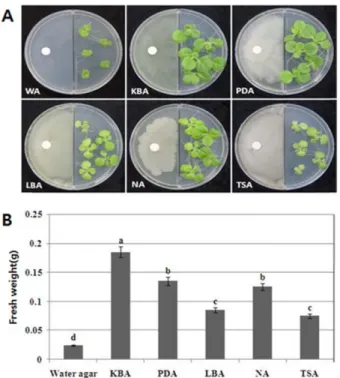
tobacco seedlings with EXTN-1 on an I-plate containing five different culture media including LBA, NA, TSA, PDA and KBA. As shown in Fig. 1A, all seedlings co-cultured with the EXTN-1 displayed growth promotion compared to WA.

Interestingly, the co-cultured seedlings with EXTN-1 on KBA showed the highest average fresh weight of tobacco seedling as 0.184 g, but that of seedlings on LBA, NA, TSA, PDA was recorded as 0.092 g, 0.12 g, 0.076 g, 0.13 g, respectively (Fig. 1B). These results suggested that unidentified volatile signals would be the key factors in B. vallismortis EXTN-1-mediated tobacco plant growth promotion.

Bacterial CO

2

and volatile production promote plant growth Recent studies proposed that the CO

2

production from PGPR could enhance plant growth promotion. To avoid the effects of bacterial produced CO

2

, we treated Ba(OH)

2

to remove the external CO

2

. As reported prior studies, we also confirmed that the lower CO

2

concentration significantly reduced the EXTN-1-mediated plant growth promotion in

normal condition (Fig. 2A). However, when used LBA, PDA and TSA as a bacterial culture medium, the fresh weight of tobacco seedling was still increased 2.3-fold 2.6-fold and 3- fold, respectively, compared with mock treated control plants. On the other hand, NA and KBA medium were significantly reduced when exposed to Ba(OH)

2

which captures CO

2

.

Profiling of volatiles released by B. vallismortis EXTN-1 Our results suggest that volatile signals emitted by EXTN- 1 could enhance plant growth. To identify the volatiles of EXTN-1, we carried out SPME-GC/MS. Three different VOCs were identified in an EXTN-1 strain, which are 2,3- Butanedione, 3-Hydroxy-2-butanone and Benzaldehyde (Fig.

3). We found that 3-hydroxy-2-butanone (acetoin) is mostly emitted from EXTN-1. 3-hydroxy-2-butanone (acetoin) was previously identified as one of volatile compounds derived from Bacillus sp. which related to plant growth promotion and induced systemic resistance on various plant (Ryu et al.

2003; 2004).

Fig. 1. In vitro plant growth promotion in tobacco seedlings by exposure of VOCs from Bacillus vallismortis EXTN-1 cultured on different laboratory media using I-plate assay. A.

The plant growth promotion effects of EXTN-1. Bacterial suspension of EXTN-1 strain (10

9

cells/ml) were dropped on sterile paper on the one side of I-plate containing different laboratory media. One-week-old seedlings were transferred onto other side of the I-plate. Water agar was used as a control.

B. After co-cultivation on one week, average fresh weight of tested seedlings in Fig. 1 A was plotted (n = 25). Error bars indicate standard errors.

Fig. 2. Growth promotion differences of tobacco plants in the

presence of Ba(OH)

2.

A. Representative growth phenotypes of

tobacco seedlings grown on Ba(OH)

2

containing media. Right

plates showed mock treated control and left ones are Ba(OH)

2

containing media. WA : negative control (no bacteria), NA :

positive control. B. Average value of fresh weights shown in

Fig. 2A (n = 25). Error bars indicate standard errors.

(4)

Plant growth promotion and ISR effects by 3-hydroxy-2- butanone from EXTN-1

3-hydroxy-2-butanone (acetoin) is one of the most abundant compounds that is emitted from EXTN-1. We next investigated whether the acetoin is responsible to the EXTN- 1-mediated plant growth promotion and ISR. The treatment of acetoin to tobacco seedlings displayed plant growth promotion in a dosage dependent manner (Fig. 4). We also

Fig. 3. Identification of B. vallismortis EXTN-1 producing VOC by SPME GC/MS. A. GC/MS spectrum. a; 2,3-Butanedione, b; 3- hydroxy-2-butanone, c; Benzaldehyde B. GC/MS data analysis of 3-hydroxy-2-butanone (C

4

H

8

O

2

, MW:88, CASNO : 513-86-0).

* The volatile compounds were identified to compound of the reference data library (NIST 140).

Fig. 4. In vitro plant growth promotion in tobacco seedlings by exposure of 3-hydroxy-2 butanone (acetoin). Thirty microliter of indicated concentration of acetoin was dropped on sterile paper on the one side of I-plate. One-week-old seedlings were transferred onto another side of the I-plate. DW was used as a negative control (Control). The fresh weight was recorded one week after the inoculation.

Fig. 5. The disease severity of tobacco plants exposed to acetoin with indicated concentration for 1 week was measured.

A. Pathogen SCC1(10

9

cells/ml) was dropped on each leaf of

plants. Water agar was used as a control. B. The disease

severity of tobacco plants exposed to acetoin with indicated

concentration for 1 week was measured. Error bars indicate

standard errors.

(5)

found that the growth promotion effects of acetoin were saturated at over 1 ppm concentration. The average fresh weight of plants treated with concentration of 1ppm was highest and about 2.5-fold higher than control plants. Plants treated with concentration of 10 ppm also significantly increased 2.4-fold (Fig. 4).

Next, we tested the ISR by acetoin treatment. With a growth promotion benefit, acetoin could also increase the disease resistance to P. carotovorum SCC1. The severity of disease was reduced after exposure of tobacco seedlings to acetoin. Plants treated with concentration of 10 ppm reduced disease severity (45%) when compared with 90% disease severities in water-treated control plants(Fig. 5).

Discussion

Recently, the great mystery of pathogenic, parasitic and commensal interactions among microbe and higher eukaryotic organisms has been explored. In plants, many receptor genes for microbe pattern recognition have been cloned and their downstream signaling components are also exclusively studied. Since the effects of PGPR on plant growth and immunity have been discovered, many scientific research groups have exerted to decipher the molecular mechanisms of interactions between host plants and PGPR.

Surprisingly, it has been reported that micro-organisms produce over 20,000 metabolites, and these rich sources are sometimes used for influencing the survival of themselves or the growth controls. In this study, we elucidated the beneficial effects of B. vallismortis EXTN-1 producing VOCs on plant growth promotion and immunity. We found that at least three VOCs were produced from EXTN-1, and an acetion (3-Hydroxy-2-butanone) act as an active signal molecule for influencing plant growth promotion and disease resistance (Fig. 3, 4 and 5). SPME-GC-MS revealed that 3- Hydroxy-2-butanone is one of the most abundant compounds that is emitted from EXTN-1 (Fig 3). Interestingly, the 3- hydroxy-2-butanone (acetoin) was already reported as a beneficial volatile compound produced from a PGPR strain Bacillus sp. (Ryu et al. 2003; 2004). As well as an acetoin, some other volatile metabolites such as Indole, 1-hexanol and pentadecane are also appeared to promote plant growth (Blom et al., 2011). These lead to speculate that the plant growth promoting effects by Bacillus sp. are commonly induced by similar active metabolites, and these signal molecules are recognized and activated by diverse plant species.

Although we here identified an active volatile metabolite to promote plant growth and immunity from a well-known PGPR, EXTN-1, we could not exactly investigate the downstream signaling pathways of the volatile-mediated plant growth promotion. It is possible that the bacterial- emitted volatiles are commonly recognized by similar signaling pathways and components. Plant hormone Brassinosteroids are broadly involved in plant growth promotion and various stress tolerances. Auxin acts also as an essential factor for plant growth and organogenesis. These support some possibilities that bacterial-derived metabolites could effect to plant growth and immunity through directly influencing the signaling or metabolic pathways of plant hormones. The strain B. vallismortis EXTN-1 showed strong plant growth promotions in various crops under field conditions. Even though our study discovers the plant growth promotion by treatment with EXTN-1 is due to the production of acetoin, many details of the molecular basis of plant responses to bacterial-released metabolites including VOCs remains to be explored.

Acknowledgements

The authors are greatful to National Academy of Agricultural Sciences(NAAS), RDA,441-707 South Korea for providing financial assistance with the support of Cooperative Research Program for Agricultural Science &

Technology Development (Project No. PJ008412)

Literature Cited

Bailly, A. and L. Weisskopf (2012) The modulating effect of bacterial volatiles on plant growth: current knowledge and future challenges. Plant Signal Behav 7:79-85.

Blom, D., C. Fabbi, E. C. Connor, F. P. Schiestd, D. R. Klauser, T. Boller, L. Eberl and L. Weisskopf (2011). Production of plant growth modulating volatiles is widespread among rhizosphere bacteria and strongly depends on culture conditions. Environ Microbiol. 13:3047-58.

Farag, M. A., C. M. Ryu, L. W. Sumner and P. W. Paré (2006) GC-MS SPME profiling of rhizobacterial volatiles reveals prospective inducers of growth promotion and induced systemic resistance in plants. Phytochemistry. 67:2262- 2268

Kloepper, J. W., J. Leong, M. Teintze and M. N. Schroth (1980) Enhanced plant growth by. siderophores produced by plant growth promoting rhizobacteria. Nature. 286:885-886.

Kloepper, J. W., R. Rodriguez-Kabana, G. W. Zehnder, J.

(6)

Murphy, E. Sikora and C. Fernandez (1999) Plant root- bacterial interactions in biological control of soilborne diseases and potential extension to systemic and foliar diseases. Australas. Plant Path. 28:21-26.

Lee, B., M. A. Farag, H. B. Park, J. W. Kloepper, S. H. Lee and C. M. Ryu (2012) Induced resistance by a long-chain bacterial volatile : elicitation of plant systemic defense by a C13 volatile produced by paenibacillus polymaxa, PLoS One. 7:e48744.

Leong, J. (1986) Siderophores : Their biochemistry and possible role in the biocontrol of plant pathogens. Annu.

Rev. Phytopathol. 24:187-209.

Marco, K., H. Maria, M. Francia, P. Anja, S. Birte and P. Birgit (2009) Bacterial volatiles and their action potential. Appl.

Microbiol. Biotechnol. 81:1001-1012.

Paré, P. W., M. A. Farag, V. Krishnamachari, H. Zhang, C. M.

Ryu and J. W. Kloepper (2005) Elicitors and priming agents initiate plant defense responses. Photosynth. Res. 85:149-159.

Park, K. S., D. Paul, Y. K. Kim, K. W. Nam, Y. K. Lee, H. W Choi and S. Y. Lee (2007) Induced Systemic Resistance by Bacillus vallismortis EXTN-1 Suppressed bacterial Wilt in Tomato Caused by Ralstonia solanacearum. Plant Pathol J.

23:22-25.

Ryu, C. M., M. A. Farag, C. H. Hu, M. S. Reddy, H. X. Wei, P.

W. Paré and J. W. Kloepper (2003) Bacterial volatiles promote growth in Arabidopsis. Proc. Natl. Acad. Sci.

100:4927-4932.

Ryu, C. M., M. A. Farag, C. H. Hu, M. S. Reddy, J. W.

Kloepper and P. W. Paré (2004) Bacterial volatiles induce systemic resistance in Arabidopsis. Plant Physiol. 134:

1017-1026.

Ryu, C. M., M. A. Farag, P. W. Paré and J. W. Kloepper (2005) Invisible signals from the underground: bacterial volatiles elicit plant growth promotion and induce systemic resistance. Plant Pathol J. 21:7-12.

⊙ ··· ⊙

바실러스 발리스모르티스 EXTN-1 균이 생산하는 3-hydroxy-2-butanone에 의한 담배 생육촉진

안미나·조영은·류호진·김흥태

1

·박경석*

농촌진흥청 국립농업과학원 농업미생물과,

1

충북대학교 농업생명환경대학 식물의학과

요 약 Bacillus vallismortis strain EXTN-1은 근권세균으로써 생육촉진 효과와 함께 광범위한 식물 병 방제효과가 보고되어있다. 본 연구에서 EXTN-1으로부터 방출되는 휘발성 유기 화합물도 식물의 생육촉진과 방어시스템에 관여 를 하는지 확인하기 위해 수행되었다. I-plate 시스템에서 각기 다른 배지(TSA, LBA, NA, KBA, PDA)에 EXTN-1 을 배양하였을 때, KBA배지에서 가장 높은 생육촉진현상이 확인되었고 TSA, LBA, NA, PDA 배지에서도 생육촉진 을 확인할 수 있었다. 생육촉진 현상에 CO

2

가 관여 할 수 있지만 TSA, PDA, LBA의 배지에서는 CO

2

와의 관계없음 을 확인 할 수 있었다. SPME-GC/MS를 이용해 휘발성 유기화합물을 확인한 결과, 가장 많이 방출되는 휘발성 유기 화합물은 3-Hydroxy-2- butanone으로 각 농도 (10 ppm~0.001 ppm)에서 생육차이와 발병도를 확인하였다. 1 ppm에 서 생육은 무처리에 비해 2.6배 증가한 반면에 0.001 ppm에서 1.2배로 가장 적게 증가하였고 발병도는 10 ppm에서 46%, 0.001 ppm에서 65%로 가장 높게 발병되었지만 무처리(91%)에 비해 낮았다. 이러한 효과는 EXTN-1으로부터 방출되는 휘발성 유기 화합물이 식물의 생육촉진과 병에 대한 저항성 발현에 관여한다고 볼 수 있다.

색인어 바실러스, EXTN-1, 휘발성생육촉진물질

⊙ ··· ⊙

수치

Fig. 2. Growth promotion differences of tobacco plants in the presence of Ba(OH) 2.  A
Fig. 4. In vitro plant growth promotion in tobacco seedlings by exposure of 3-hydroxy-2 butanone (acetoin)

참조

관련 문서

Design Theories of Ship and Offshore Plant, Fall 2015, Myung-Il Roh 1.. Design Theories of Ship and Offshore

[r]

자석 팽이는 볼록한 두 부분에는 고리 자석이 들어 있고, 받침대에는 팽이의 고 리 자석 위치와 일치하는 부분에 삼각형 모양의 자석이 네 개 들어 있다.. 그리고

회원국의 영토밖에서 다른 회원국의 , 영토내에서 회원국의 서비스 소비자에게

판단되는 경우에는 즉시 의사의 의료지도에 따를 것 다만 통신장애 등으로 인해 의사의 의료지도가 불.. 사람 외국에 있는 교육기관에서

[r]

Design Theories of Ship and Offshore Plant, Fall 2016, Myung-Il Roh 1.. Design Theories of Ship and Offshore

등록제 민간자격 운영 사실을 특정한 등록 기관에 비치된 장부에 2. 기재하는 행위로서 등록한 경우에만 민간자격으로