36
and Safety
Available online at http://www.foodhygiene.or.kr
http://dx.doi.org/10.13103/JFHS.2016.31.1.36
배양 조건이 Aspergillus sp. 의 독소 생산에 미치는 영향
이유나1·김남연1·이승은1·지근억1,2*
1서울대학교 생활과학대학 식품영양학과, 2㈜비피도
Effect of Various Culture Conditions on the Production of Mycotoxin by Aspergillus sp.
Yu Na Lee1, Nam Yeun Kim1, Seung Eun Lee1, and Geun Eog Ji1,2*
1Department of Food and Nutrition, Research Institute of Human Ecology, Seoul National University, Seoul 08826, Korea
2Research Institute, Bifido Inc., Hongcheon, Gangwon-do 25117, Korea (Received December 17, 2015/Revised January 5, 2016/Accepted January 15, 2016)
ABSTRACT - Ochratoxin A and aflatoxin may be detected from naturally fermented foods due to the contami- nation of the mycotoxin-producing molds or un-prudential use of the mycotoxin producing starter strains during the fermentation. This study was carried out to analyze the production of ochratoxin A and aflatoxin under the various environmental conditions. For the experiment, the effects of different temperature, culture media, and fermentation time on the production of ochratoxin A by Aspergillus usamii KFRI 999 and A. awamori KFRI 983 were analyzed.
Additionally, the production of aflatoxin was assessed under the various temperature, initial pH, fermentation time and culture media during fermentation by A. flavus KACC 41403 and A. oryzae KACC 46471. The levels of ochratoxin A and aflatoxin were analyzed by HPLC. The result showed that the production of mycotoxin was greatly affected by the fermentation temperature. A. oryzae KACC 46471 did not produce aflatoxin. All of the mycotoxin producing strains showed the highest level of mycotoxin at 30oC. A. awamori KFRI 983 showed the lowest level of ochratoxin A in PDA media among the experimental medium. The results of the present study may be useful for the reduction of ochratoxin A and aflatoxin in various foods.
Key words : ochratoxin, aflatoxin, immunoaffinity column, soybean
곰팡이 독소는 곰팡이에 의해 2차 대사산물로 생산되며 여러 종류 식품에서 발견된다1,2). 식품에서의 곰팡이 독소 오염은 발암, 급성 간염, 기형아 출산 등의 문제를 야기하 며 특히 국제암연구소(International Agency for Research on Cancer)에 의해 ochratoxin (OTA)는 group 2B의 발암물질 로, aflatoxin B1 (AFB1)은 group 1으로 지정되어 있다3). 곰팡이 독소의 섭취에 의한 피해를 방지하기 위해 국가적 으로 식품에서의 곰팡이 독소 함량에 대한 제한을 설정해 두고 있다4). 곰팡이의 생장과 곰팡이 독소 생산은 온도, pH, 생장 기간에 영향을 받는다5-7). 따라서 식품에서 곰팡 이 독소의 오염에 주의하며 적절한 환경을 유지하여 곰팡이 독소가 생산되는 조건을 피하는 것은 식품의 안전을 위해
서, 그리고 경제적으로도 중요하다.
AFB1의 최적 생산 온도는 20-30oC이며8), OTA는 15-40oC 에서 검출되는 것이 보고되었다9,10). 전통식 메주의 제조는 25-30oC의 온도에서 발효하며11) 장류에서 분리된 곰팡이 중 AFT를 생산 할 수 있는 A. flavus가 동정되었다12). 그 러므로 메주를 생산하는 온도에서의 곰팡이 독소 생산량 에 대한 연구가 중요하다. 13oC의 저온에서는 장기간 배양 시 곰팡이 독소가 생산되며 41oC의 고온에서는 생산되지 않는다는 보고가 있다13). 따라서 저온에서의 곰팡이 독소 연구는 장기간 배양하여야 하며 비록 고온에서는 곰팡이 독소가 생산되지 않았으나 다양한 조건 하에서도 곰팡이 독소가 생산되지 않는지 확인하여야 한다. AF는 넓은 범 위의 pH에서 생산되는 것으로 알려져 왔으므로14)산성, 중 성, 염기성 범위에서의 독소 생산에 관하여도 연구할 필 요가 있다. 그러나 pH, 온도, 배양기간 등의 여러 요소를 여러 배지에서 한 번에 비교한 연구는 부족하며 각 조건 들 간의 상호작용에 대해서는 잘 알려져 있지 않다. 이번
*Correspondence to: Geun Eog Ji, Department of Food and Nutrition, Research Institute of Human Ecology, Seoul National University, Seoul 08826, Korea
Tel: 82-2-880-8749, Fax: 82-2-884-0305 E-mail: [email protected]
연구에서는 OTA와 aflatoxin (AF)의 생산량을 여러 조건 에서 비교하며 조건들의 영향에 대해 연구하였다.
또한 한국의 식단에서 콩은 메주나 청국장과 같이 삶아 서 곰팡이나 균으로 발효하여 섭취된다. 그렇기에 콩에서 의 곰팡이 독소 생산량은 식품의 안전에 있어 중요하다.
그러나 콩에서 OTA와 AF의 분석에 대한 연구는 부족한 실정으로 추가적인 연구가 필요하다. 또한 식문화는 현재 시대에 다른 지역에 전파될 수 있으며 지역에 따라 온도 의 차이가 발생하므로 한국에서 배양하는 온도 외에 다른 온도에서의 곰팡이 독소 생산에 대한 연구도 필요하다. 따 라서 본 연구에서는 OTA와 AF이 생산되는 조건을 분석 하여 식품에서 곰팡이 독소의 오염을 줄일 수 있는 조건 을 탐색하였다.
Materials and Methods
사용 균주
사용된 균주들은 한국식품연구원(KFRI: Gyeonggi-do)와 농업미생물은행(KACC: Gyeonggi-do)에서 제공받았다. OTA 생산균주로는 Aspergillus usamii KFRI 999 (A. 999)와 A.
awamori KFRI 983 (A. 983)를 사용하였다15). AF 생산 균 주로는 Aspergillus flavus KACC 41403 (A. 41403)이 사 용되었으며 음성 대조군으로는 Aspergillus oryzae KACC 46471 (A. 46471)을 사용하였다16). 위의 균주들은 서울대 학교 식품영양학과 식품미생물연구실에서 보관 중인 균주 를 사용하였다.
배지 제조 및 배양 조건
Ochratoxin A 배양에는 potato dextrose agar (PDA) (DifcoTM, Detroit, MI, USA), czapek yeast extract agar (CYA), 메주를 사용하였다. CYA는 1 L의 증류수에 K2PO4 1 g, czapek concentrate 10 ml, yeast extract 5 g, sucrose 30 g, agar 15 g을 녹였다17). Czapek concentrate는 100 ml의 물에 NaNO3 30 g, KCl 5 g, MgSO4·7H2O 5 g, FeSO4·7H2O 0.1 g을 녹였다17). 콩(soybean, glycine max)은 경기 농협에 서 국내산을 구매하여 실온에서 보관하였다. 메주는 물에 불린 콩을 고압 멸균기에서 멸균하고 둥글게 성형하였다.
포자현탁액은 1.00 × 10⁵spores/g을 접종하였다. 15oC, 30oC, 40oC에 호기적으로 10일, 20일, 30일간 배양하였다.
Aflatoxin 배양에는 potato dextrose broth (PDB) (DifcoTM, Detroit, MI, USA), czapek yeast extract broth (CYB), soy- bean milk (SBM)를 사용하였다. CYB는 CYA배지에서 agar 를 제외하고 제조하였다. SBM는 콩 분말과 물을 혼합하여 사용하였다. 최종적으로 1 N NaOH (Samchun, Pyeongtaek city, Gyeonggi-do, Korea), 5 N NaOH, 1 N citric acid (Samchun)에 의해 pH 4.0, pH 6.0, pH 8.0로 조절하였다.
포자 현탁액은 6.00 × 10⁶ spores를 접종하였고 진탕 배양
기에서 배양하였다. 온도는 15oC, 30oC, 40oC 였으며 150 rpm에서 호기적으로 배양하였다. 10일, 20일, 30일간 배양 하였다.
곰팡이 독소 추출
Ochratoxin A는 고성능 액체 크로마토그래피(HPLC)와 면역 친화성 컬럼을 이용해 추출하였다18). 수거된 시료를 cell strainer (BD Biosciences, Bedford, MA, USA)로 균질 화시켰다. 동량의 추출용매(water-acetonitrile (Duksan Pure Chemeicals Co. Ltd., Korea) (40:60, v/v))와 섞어 100 ml 삼각플라스크와 마그네틱바를 이용해 5분간 혼합하였다.
혼합된 시료를 Whatman no.4 filter paper (Whatman Inter- national Ltd., Maidstone, England)로 여과하였다. 여과액 5 ml를 phosphate-buffered saline (PBS; pH 7.5)로 50 ml가 되도록 희석하였다. 희석액은 Whatman GF/A glass filter paper (Whatman)를 이용해 여과하고 OchraTest WB column (Vicam Co., Milford, MA, USA)에 1초에 1 drop의 속도로 통과시켰다. 컬럼을 10 ml의 증류수로 세척하고 1 ml의 methanol에 녹여서 추출하였다. 컬럼에 통과시킨 1 ml의 methanol은 50oC에서 완전히 건조시켰다. 건조 후 1 ml의 acetonitrile-water-acetic acid (99:99:2, v/v/v)에 녹이고 0.2 µm pore size membrane filter로 여과하였다.
Aflatoxin을 추출하고 HPLC로 정량 분석하였다16). 시료 와 동량의 추출용액(Methanol, 0.1% NaCl)을 추가하여 5분 간 혼합하였다. 혼합액을 Whatman no.4 filter paper에 여과 하고 1% tween 20으로 4배 희석하였다. 희석한 후 Whatman GF/A glass filter paper로 여과하였다. 20 ml의 여과액을 면역 친화성 컬럼(AflaTest WB, Vicam Co.)에 1초당 1 drop의 속도로 통과시켰다. 컬럼을 10 ml의 증류수로 세척 하고 3 ml의 acetonitrile로 aflatoxin을 추출하였다. 추출물을 50oC에서 완전히 건조시킨 후 trifluoroacetic acid 200 ul를 첨가하여 암소에서 15분간 방치하였다. 15분 후 800 µl의 acetonitrile-water (20:80, v/v)용액을 추가하였다. 최종 시 료는 0.45 µm pore size membrane filter로 여과하여 HPLC 분석에 사용하였다.
Ochratoxin A와 aflatoxin의 정량 분석
곰팡이 독소 분석을 위해 Polaris C18 column (250 mm long, 4.6 mm inside diameter, 5µm particle size; Agilent Technologies)과 Ultimate 3000 HPLC systems (Thermo Fisher Scientific, Waltham, MA)를 사용하였다.
Ochratoxin A는 20 µl의 시료를 주입하여 이동상으로는 acetonitrile-water-acetic acid (99:99:2, v/v/v)이며 1 ml/min 의 속도로 15분간 흘려주었다. Ochratoxin A의 검출에는 형광 검출기(fluorescence detector)를 사용하였다(333 nm excitation, 460 nm emission). 사용된 OTA 표준물질은 Sigma Chemical Co. (St. Louis, MO) 에서 구입하였다.
Aflatoxin G1, G2, B1, B2 표준물질(25 µg/ml)은 Trilogy Analytical Laboratory (Washington, MO)에서 구입하였다. 이 동상(acetonitrile-water (25:75, v/v))을 1 ml/min의 속도로 흘려주었다. 시료는 20 µl를 주입하였고 형광 검출기(360 nm excitation, 450 nm emission)를 사용하여 25분간 검출하였다.
통계처리
통계분석은 Statistical Package for the Social Science (SPSS, Ver. 22.0, SPSS Inc., Chicago, IL, USA) 를 사용 하였다. 각 배지, 온도, 배양 기간, pH간의 관련성을 파악 하기 위하여 Kuskal-Wallis test를 이용하였고 균주 간의 비교는 Mann-Whitney U test로 검정하였다. p값이 0.05 미 만인 경우를 유의수준으로 고려하였다. 군간에 유의적인 차이가 있을 때는 Mann-Whitney U test를 Bonferroni 보 정하여 사후 검정하였다.
Results and Discussion
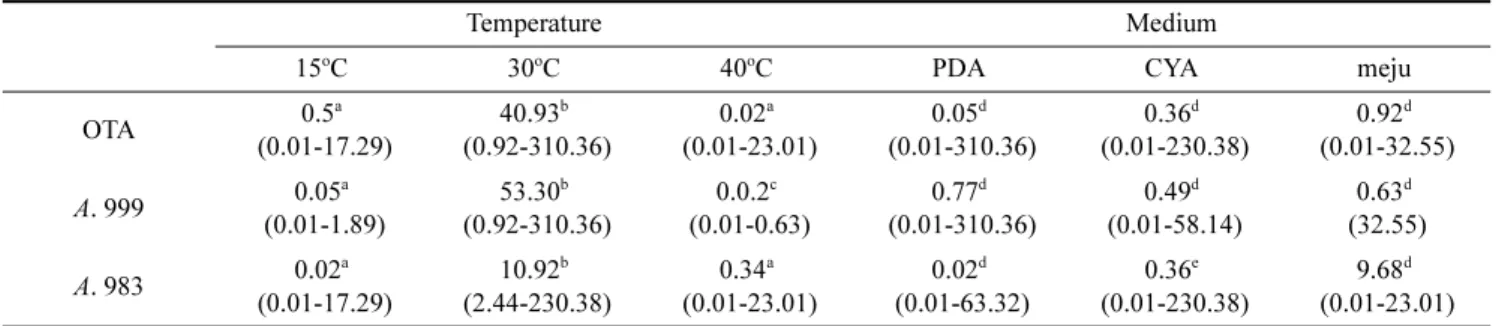
배양조건의 변화에 따른 곰팡이 독소 생산량 비교 A. 999와 A. 983를 온도, 배양 기간, 배지를 달리하여 배양하였다(Table 1, Table 2). PDA 배지에서 30oC에서 10 일간 배양했을 때 310.4 ± 18.2 µg/kg로 가장 높은 값을 보 였다.
HPLC 분석 결과 온도 조건이 ochratoxin 생산량에 영향
을 미치는 것으로 확인되었다(p < 0.05). A. 999와 A. 983 은 30oC에서 배양했을 때 가장 많은 양의 OTA가 생산되 었다. 15oC와 40oC에서의 생산량의 차이는 A. 983에서는 유의하지 않았으나 A. 999를 배양하였을 때는 15oC에서 생산된 OTA의 양이 40oC에서 생산된 OTA의 양보다 유 의하게 많았다. 배양 기간은 두 균주 모두에서 OTA의 생 산에 유의미한 영향을 미치지 못하였다. 배지를 다르게 하 였을 경우는 균주에 따라 그 영향이 바뀌었다. A. 999를 배양한 경우 배지의 종류는 OTA 생산에 유의한 차이를 보이지 않았으나 A. 983을 배양한 경우는 PDA에서 생산 된 OTA의 양이 CYA와 메주에서의 OTA 생산량에 비해 유의적으로 낮게 나타났다. 따라서 연구 결과에 의하면 A.
999이 A.983 보다 온도에 더 민감한 영향을 받았으며 배 지 조성에서는 A. 983이 영향을 받았다.
OTA의 경우 기존의 연구에서는 yeast extract sucrose agar (YES)와 CYA에 배양하였을 때 20-25oC가 최적의 생 산 온도로 보고되었으며19), A. niger를 견과류에 접종한 연 구에서는 aw가 0.92일 때 15oC 였다고 보고하였다10). 그러 나 aw에 따라 OTA의 최적 생성 온도는 변한다는 연구가 있다20).
A. 41403, A. 46471의 배양 결과는 Table 3과 Table 4에 나타내었다. HPLC를 이용한 분석 결과 A. 46471은 어떤 조건에서도 aflatoxin을 생산하지 않는다는 것을 확인하였 다(data not shown). 가장 높은 AF 생산량은 pH 8.0의
Table 1. Median and range of OTA produced in the various temperature and medium (µg/kg)
Temperature Medium
15oC 30oC 40oC PDA CYA meju
OTA 0.5a
(0.01-17.29)
40.93b (0.92-310.36)
0.02a (0.01-23.01)
0.05d (0.01-310.36)
0.36d (0.01-230.38)
0.92d (0.01-32.55)
A. 999 0.05a
(0.01-1.89)
53.30b (0.92-310.36)
0.0.2c (0.01-0.63)
0.77d (0.01-310.36)
0.49d (0.01-58.14)
0.63d (32.55)
A. 983 0.02a
(0.01-17.29)
10.92b (2.44-230.38)
0.34a (0.01-23.01)
0.02d (0.01-63.32)
0.36e (0.01-230.38)
9.68d (0.01-23.01)
a,b,cDifference on the same row among the temperature. Different letter corresponds to statistically significant differences. (p < 0.05)
d,eDifference on the same row among the medium. Different letter corresponds to statistically significant differences. (p < 0.05) Table 2. Median and range of OTA fermented on 10, 20 and 30 days by different strains (µg/kg)
Days Strains
10 d 20 d 30 d
OTA 0.28a
(0.01-310.36)
0.36a (0.01-225.32)
0.49a (0.01-230.38)
0.49 (0.01-310.36)
A. 999 0.63a
(0.01-310.36)
0.02a (0.01-180.26)
0.05a (0.01-174.80)
0.49b (0.01-310.36)
A. 983 0.28a
(0.01-138.52)
10.92a (0.01-225.32)
1.29a (0.01-230.38)
1.29b (0.01-230.38)
aDifference on the same row among the days. Different letter corresponds to statistically significant differences. (p < 0.05)
bDifference on the same row among the strains. Different letter corresponds to statistically significant differences. (p < 0.05)
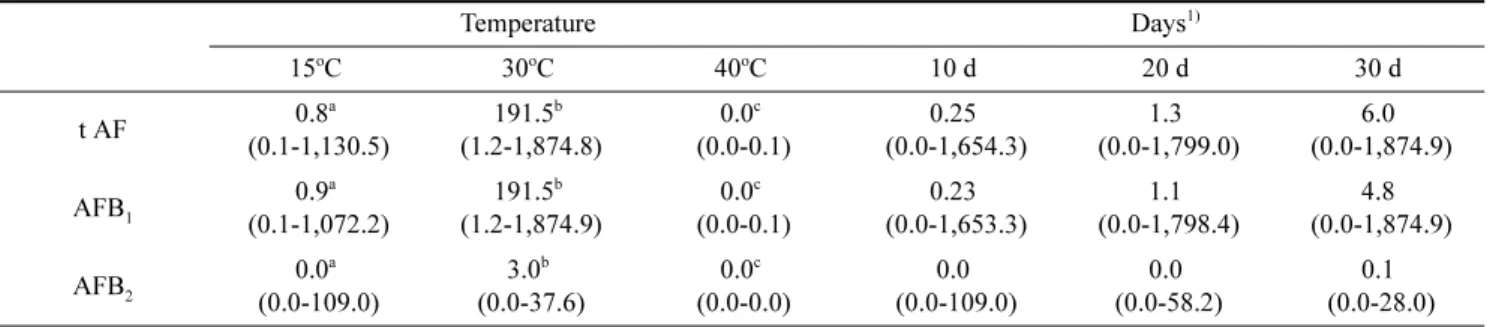
CYB에서 30oC의 온도로 30일간 배양하였을 때 1,874.9 ± 280.2 ng/ml이었다. 15oC에서 가장 많이 검출되었을 때는 pH 8.0의 CYB에서 20일간 배양한 1,072.2 ± 9.0 ng/ml이었 으며 40oC에서는 pH 4.0의 PDB에서 10일 간 배양한 0.1 ± 0.0 ng/ml이었다.
A. 41403는 온도 조건을 다르게 하였을 때에는 유의한 차이가 있었으나 배양 기간이나 pH 조건, 배지의 차이에 의해서는 유의적인 차이를 보이지 않았다. 온도 조건을 보 면 AFB1, AFB2 모두 30oC에서 가장 많이 검출되었다.
15oC와 40oC에서 생산한 AF 양에서는 유의적인 차이를 보여 AF 생산량은 15oC가 두 번째로 높았으며 그 다음은 40oC이었다. A. 41403에 의한 AF의 생산량은 30oC에서 가 장 높았다. 기존의 연구에서 A. flavus를 3가지 종류의 배 지에 접종하였을 때 30oC가 AF 생산에 최적의 온도로 보 고되었다8). 보리와 밀에서 AF를 생산한 연구에서는 aw= 0.98일 때 30oC가 최적온도로 보고되었고 최적 성장 온도 는 35oC이었다21). AF의 경우 15oC에서의 생산량과 40oC 에서의 생산량이 유의적인 차이를 보였다. 13oC의 저온에 서 A. flavus를 장시간 배양 시 AFB1의 생산량이 증가하 였으나 41oC에서는 검출되지 않았다고 보고하였다13). AF 의 생산이 온도에 영향을 받는 이유에 대해 AF 생산 관 련 유전자인 AFLR이 28oC에서는 활발하나 37oC에서는 작 동하지 않아 aflatoxin이 생산되지 않는다고 보고하였다22). 보고에 따르면 AF의 생산이 10일 이전에 끝나게 되므로
더 짧은 배양기간에서의 추가 연구가 필요하다23). 또한 본 연구에서는 aw에 대해서는 고려하지 않아 배양 기간이 길어질수록 배양된 시료마다 aw의 차이가 생기게 되므로 aw를 고려한 후속 연구가 필요하다.
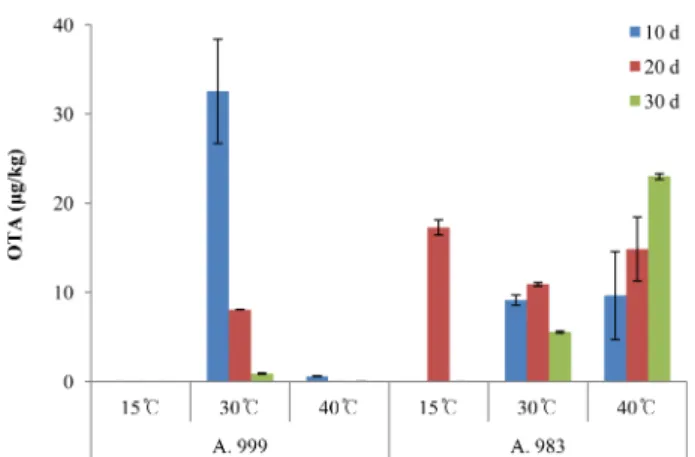
콩 배지에서의 곰팡이 독소 분석
메주에서 배양한 시료들의 결과는 Fig. 1과 Fig. 2에 나 타내었다. 곰팡이 독소의 생산량은 균주 간에 생산량의 차 이가 있었는데 A. 983에서 유의적으로 더 많은 양의 OTA 가 생산되었다. 식품공전에 따르면 식품 내 OTA의 함량은 메주에서 20 µg/kg 이하여야 한다4). 메주배지에서 이 기준 에 만족하지 못하는 시료는 A. 999를 30oC에서 10일간 배 양했을 때와 A. 983을 40oC에서 30일간 배양하였을 때이 었다. 그러므로 생산된 OTA의 양만을 본다면 A. 983에 오염되었을 때 더 위험하다고 볼 수 있으나 20 µg/kg의 기 준치를 초과하는 시료만을 고려했을 때는 A. 999에 오염 되었을 때가 더 위험하다고 할 수 있다.
SBM에서 생산된 total AF (t AF), AFB1의 생산에는 다 른 배지와 같이 온도만이 영향을 미쳤다. SBM에서는 최 고 895.6 ± 43.3 ng/ml의 AFB1이 검출되었다. AF의 함량 기준은 영아용 조제식, 성장기용 조제식, 영·유아용 곡류 조제식, 기타 영·유아식에서는 AFB1의 양이 0.10 µg/kg 이하이어야 하며 그 외의 식품에서 t AF로 15 µg/kg이하, AFB1은 10 µg/kg이하이어야 한다4). SBM 배지에서 이 기 Table 3. Median and range of AF produced from various medium and in fermentation time (ng/ml)
Temperature Days1)
15oC 30oC 40oC 10 d 20 d 30 d
t AF 0.8a
(0.1-1,130.5)
191.5b (1.2-1,874.8)
0.0c (0.0-0.1)
0.25 (0.0-1,654.3)
1.3 (0.0-1,799.0)
6.0 (0.0-1,874.9)
AFB1 0.9a
(0.1-1,072.2)
191.5b (1.2-1,874.9)
0.0c (0.0-0.1)
0.23 (0.0-1,653.3)
1.1 (0.0-1,798.4)
4.8 (0.0-1,874.9)
AFB2 0.0a
(0.0-109.0)
3.0b (0.0-37.6)
0.0c (0.0-0.0)
0.0 (0.0-109.0)
0.0 (0.0-58.2)
0.1 (0.0-28.0)
a,b,cDifference on the same row among the temperature. Different letter corresponds to statistically significant differences. (p < 0.05)
1)No statistic difference by days.
Table 4. Median and range of AF produced from various medium and initial pH by A. 41403 (ng/ml)
Medium1) pH2)
PDB CYB SBM pH 4.0 pH 6.0 pH 8.0
t AF 6.1
(0.0-503.1)
0.5 (0.0-1,875.0)
0.9 (0.0-932.4)
1.3 (0.0-1,312.6)
0.2 (0.0-1,732.0)
1.3 (0.0-1,875.0)
AFB1 4.8
(0.0-478.5)
0.5 (0.0-1,874.9)
0.8 (0.0-895.6)
1.2 (0.0-1,287.0)
0.2 (0.0-1,845.0)
1.1 (0.0-1,874.9)
AFB2 0.1
(0.0-24.6)
0.0 (0.0-109.0)
0.0 (0.0-37.6)
0.1 (0.0-109.0)
0.0 (00-37.6)
0.1 (0.0-58.2)
1)No statistic difference by medium.
2)No statistic difference by pH.
준에 만족하지 못하는 시료는 10개였다. 그 중 30oC에서 배양한 시료가 8개로 가장 많았으며 나머지 2개는 15oC에 서 배양되었다. pH의 경우 pH 4.0, pH 6.0이 각각 3개씩, pH 8.0에서 4개의 시료가 기준을 충족하지 못하였다. 배 양 기간에서는 10일 3개, 20일 2개, 30일 5개였다. 그러므 로 A. 41403에 오염되었다면 30oC에서 30일간 배양하였 을 때가 가장 위험하고 볼 수 있다. 30oC에서 배양한 시 료들에서는 pH, 배양 기간에 의한 유의적인 차이는 없었다.
시판 된장에서 검출된 OTA를 ID-LC/MS/MS를 이용하 여 분석한 경우 검출량은 0.1 µg/kg이하였으나 가정에서 제조한 된장의 경우 7-21 µg/kg의 결과를 나타내었다24). 콩 외 5가지 곡류에 Aspergillus parasiticus를 접종하여 15일 째까지 배양한 결과 콩에서 가장 많은 AFB1이 생산되는 경향을 보였다25). A. flavus 4 균주를 10일 간 여러 온도 와 곡류에서 배양하였을 때 목화씨와 땅콩에서는 최고 1,100 mg/kg의 AFB1이, 현미에서는 최고 680 mg/kg의 AFB1이 생산되었다고 연구되었다23). 또한 ochratoxin A는 곡류, 메주 등 5가지 항목 2,240건 중 203건에서 ochratoxin A가 발견되었으나 4건만이 20 µg/kg을 넘겼다26). 국내 유
통되는 건과일, 견과류, 두류가공품에서의 AFB1의 양은 기 준치 이내에서만 검출되고 있고 보고하였다27,28). 그 외에 도 2011년의 보고에 따르면 시판되고 있는 곡류, 곡류 가 공품, 장류, 두류, 향신료 등 13항목, 5,088건에 중 AF가 검출 된 것은 384건이었으며 부적합 건수는 25건이었다26). 또한 다른 연구에서 가정에서 제조한 된장에서 0.6-42.2 µg/
kg의 t AF가 검출되었다는 보고도 있다29). 아프리카 가나 에서 유통되는 콩이 함유된 이유식에서는 7.9-500 µg/kg의 AFB1가 검출되었다30). 막걸리에서 OTA의 함량을 검사하 였는데 대전, 부산, 광주, 제주에서 제조한 시료에서 Ochratoxin A가 검출되었으며 서울, 대구, 강릉에서 제조 한 시료에서는 검출되지 않아 고온 다습한 환경일수록 ochratoxin A에 오염되기 쉽다고 하였다31). 따라서 국내에 유통되는 콩 제품들은 안전하게 관리되고 있으나 고온의 기후를 가진 지역에서는 주의가 요구된다.
결론적으로, aflatoxin과 ochratoxin A의 생산은 생산 균 주 및 환경 조건에 따라 생산량이 달리 나타나지만 특히 온도에 의한 영향을 크게 받은 것으로 나타났다. 본 연구 의 결과는 곰팡이 독소의 저감화 기술 개발의 기초 자료 로서 활용 될 수 있을 것이다.
Acknowledgement
본 연구는 농림축산식품부 농림수산식품기술기획평가원 고부가가치식품기술개발사업 (관리번호: 113018-3)의 지원 에 의해 이루어진 것이며, 이에 감사를 드립니다.
국문요약
Ochratoxin A와 aflatoxin은 곰팡이 독소 생산 균주가 자 연 발효되는 식품에 오염되거나 발표식품의 종균을 분별 없이 선택했을 때 검출 될 수 있다. 본 연구에서는 다양한 배양 환경이 ochratoxin A와 aflatoxin의 생산에 주는 영향 에 대해 연구하였다. Aspergillus usamii KFRI 999와 A.
awamori KFRI 983의 배양 온도, 배양 배지, 배양 시간을 달리하여 ochratoxin A생산 정도를 분석하였다. 또한 초기 pH, 온도, 배양 시간, 배양 배지를 다르게 하였을 때 A.
flavus KACC 41403와 A. oryzae KACC 46471가 생산하 는 aflatoxin의 양을 평가하였다. Ochratoxin A와 aflatoxin 의 양은 HPLC로 분석하였다. 연구 결과, 곰팡이 독소는 배양 온도에 큰 영향을 받는 것으로 나타났다. A. oryzae KACC 46471는 aflatoxin을 생산하지 않았다. 곰팡이 독소 를 생산하는 균주는 모두 30oC에서 가장 높은 독소 생산 량을 보였다. A. awamori KFRI 983은 PDA 배지에서 가 장 적은 ochratoxin A 생산량을 보였다. 본 연구 결과는 다양한 식품의 ochratoxin A와 aflatoxin 저감화에 유용하 게 활용 될 수 있다.
Fig. 1. Result of ochratoxin A from meju in different temperature and incubation time.
Fig. 2. Aflatoxin B1 produced from SBM in various environments.
References
1. Richard, J.L.: Some major mycotoxins and their mycotoxi- coses—An overview. Int. J. Food Microbiol., 119, 3-10 (2007).
2. Turner, N.W., Bramhmbhatt, H., Szabo-Vezse, M., Poma, A., Coker, R. and Piletsky, S.A.: Analytical methods for determi- nation of mycotoxins: An update (2009-2014). Anal. Chim.
Acta, (2015).
3. Bueno, D., Istamboulie, G., Muñoz, R. and Marty, J.L.:
Determination of mycotoxins in food: a review of bioanalyt- ical to analytical methods. Appl. Spectros. Reviews, 50, 728- 774 (2015).
4. MFDS: Korean Foods Code, (2015).
5. Mitchell, D., Parra, R., Aldred, D. and Magan, N.: Water and temperature relations of growth and ochratoxin A production by Aspergillus carbonarius strains from grapes in Europe and Israel. J. Appl. Microbiol., 97, 439-445 (2004).
6. Holmquist, G.U., Walker, H.W. and Stahr, H.M.: Influence of temperature, pH, water activity and antifungal agents on growth of Aspergillus flavus and A. parasiticus. J. Food Sci., 48, 778-782 (1983).
7. Gourama, H. and Bullerman, L.B.: Anti-aflatoxigenic activ- ity of Lactobacillus casei pseudoplantarum. Int. J. Food Microbiol., 34, 131-143 (1997).
8. Kheiralla, Z.H., Hassanin, N.I. and Amra, H.: Effect of incu- bation time, temperature and substrate on growth and afla- toxin production. Int. Biodeter. & Biodegrad., 30, 17-27 (1992).
9. Astoreca, A., Barberis, C., Magnoli, C., Combina, M. and Dalcero, A.: Influence of ecophysiological factors on growth, lag phase and ochratoxin A production by Aspergillus niger aggregate strains in irradiated corn grains. Int. J. Food Microbiol., 129, 174-179 (2009).
10. Alborch, L., Bragulat, M.R., Abarca, M.L. and Cabañes, F.J.:
Effect of water activity, temperature and incubation time on growth and ochratoxin A production by Aspergillus niger and Aspergillus carbonarius on maize kernels. Int. J. Food Microbiol., 147, 53-57 (2011).
11. Jang, I.H., In, M.J. and Chae, H.J.: Manufacturing method for traditional doenjang and screening of high fibrin clotting inhibitory samples. J. Korean Soc. Appl. Biol. Chem., 47, 149-153 (2004).
12. Lim, E.M., Lee, J.Y., Mohammed, A.A.E., Han, K.H., Lee, B.S., Cho, Y.S. and Kim, H.Y.: Identification and character- ization of Aspergillus oryzae isolated from soybean products in sunchang county. Kor. J. Mycol., 42, 282-288 (2014).
13. Schindler, A.F., Palmer, J.G. and Eisenberg, W.V.: Aflatoxin production by Aspergillus flavus as related to various tem- peratures. Appl. Microbiol., 15, 1006-1009 (1967).
14. Buchanan, R.L.Jr and Ayres, J.C.: Effect on initial pH on aflatoxin production. Appl. Microbiol., 30, 1050-1051 (1976).
15. Kim, N.Y., Lee, I. and Ji, G.E.: Reliable and simple detection of ochratoxin and fumonisin production in black Aspergillus.
J. Food Prot., 77, 653-658 (2014).
16. Kim, N.Y., Lee, J.H., Lee, I. and Ji, G.E.: An evaluation of aflatoxin and cyclopiazonic acid production in Aspergillus
oryzae. J. Food Prot., 77, 1010-1016 (2014).
17. Kwon, J.Y., Jeong, H.W., Kim, H.K., Kang, K.H., Chang, Y.H., Bae, K.S., Choi, J.D., Lee, U.C., Son, K.H. and Kwon, B.M.: cis-fumagillin, a new methionine aminopeptidase (type 2) inhibitor produced by Penicillium sp. F2757. J. Antibiot., 53, 799-806 (2000).
18. Entwisle, A.C., Williams, A.C., Mann, P.J., Slack, P.T. and Gilbert, J.: Liquid chromatographic method with immunoaf- finity column cleanup for determination of ochratoxin A in barley: collaborative study. J. AOAC Int., 83, 1377-1383 (2000).
19. Esteban, A., Abarca, M.L., Bragulat, M.R. and Cabañes, F.J.:
Effects of temperature and incubation time on production of ochratoxin A by black aspergilli. Res. Microbiol., 155, 861- 866 (2004).
20. Gil-Serna, J., Vazquez, C., Sandino, F.G., Valle, A.M., Gonzalez-Jaen, M.T. and Patino, B.: Evaluation of growth and ochratoxin A production by Aspergillus steynii and Aspergillus westerdijkiae in green-coffee based medium under different environmental conditions. Food Res. Int., 61, 127-131 (2014).
21. Niles, E.V., Norman, J.A. and Pimbley, D.: Growth and afla- toxin production of Aspergillus flavus in wheat and barley.
Trans. Br. Mycol. Soc., 84, 259-266 (1985).
22. OBrian, G.R., Georgianna, D.R., Wilkinson, J.R., Yu, J., Abbas, H.K., Bhatnagar, D., Cleveland, T.E., Nierman, W. and Payne, G.A.: The effect of elevated temperature on gene transcrip- tion and aflatoxin biosynthesis. Mycologia, 99, 232-239 (2007).
23. Schroeder, H.W. and Hein, H.Jr.: Aflatoxins: production of the toxins in vitro in relation to temperature. Appl. Micro- biol., 15, 441-445 (1967).
24. Ahn, S.H., Lee, S.Y., Lee, J.H. and Kim, B.J.: Accurate determination of ochratoxin A in korean fermented soybean paste by isotope dilution-liquid chromatography tandem mass spectrometry. Food Chem., 190, 368-373 (2016).
25. Ma, H., Zhang, N., Sun, L. and Qi, D.: Effects of different substrates and oils on aflatoxin B1 production by Aspergillus parasiticus. Eur. Food Res. Technol., 240, 627-634 (2015).
26. Oh, K.S., Choi, E.J., Yoo, S.Y., Lee, C.N. and Hong, H.W.:
Status of the inspection for mycotoxins in foods. Food Sci- ence and Industry, 44, 44-49 (2011).
27. Park, J.W., Yoo, M.S., Kuk, J.H., Ji, Y.A. and Lee, J.H.:
Simultaneous determination and mornitoring of aflatoxin and ochratoxin A in food. J. Fd Hyg. Safety, 28, 75-82 (2013).
28. Oh, K.S., Suh, J.H., Sho, Y.S., Park, S.S., Choi, W.J., Lee, J.O., Kim, H.Y. and Woo, G.J.: Exposure assessment of total aflatoxin in foods. Korean J. Food Sci. Tech., 39, 25-28 (2007).
29. Kim, M.H. and Kim, Y.S.: Detection of foodborne pathogens and analysis of aflatoxin levels in home-made doenjang sam- ples. Prev. Nutr. Food Sci., 17, 172-176 (2012).
30. Kumi, J., Mitchell, N.J., Asare, G.A., Dotse, E., Kwaa, F., Phillips, T.D. and Ankrah, N.A.: Aflatoxins and fumonisins contamination of home-made food (Weanimix) from cereal- legume blends for children. Ghana med. J., 48, 121-126 (2014).
31. Lee, J.G., Kang, Y.W., Jeong, J.H., Noh, M.J., Ahn, E.S., Lee, K.H. and Kim, M.H.: Monitoring of ochratoxin in alco- holic beverages. Korean J. Food Sci. Tech., 44, 235-239 (2012).