─ 331 ─ ISSN: 2288-1115(Print), 2288-1123(Online)
ⓒ The Korean Society of Limnology. All rights reserved.
This is an open-access article distributed under the terms of the Creative Commons Attribution Non-Commercial License(http://creativecommons.org/licenses/by-nc/3.0/), which permits unrestricted non-commercial use, distribution, and reproduction in any medium, provide the original work is properly cited.
남한강 보 구간 유수성 저서성 대형무척추동물의 시 · 공간적 분포 특성
김진영·이승현·이경락·노성유·신유나·이수웅·이재관·원두희1 임성호1·권용주2·공동수2,*
국립환경과학원 물환경연구부, 1(주)생태조사단, 2경기대학교 바이오융합학부
Spatio-temporal Distribution Patterns of Lotic Benthic Macroinvertebrate Communities in Namhan- River Weir Section. Kim, Jin-Young(0000-0002-7146-4510), Seung-Hyun Lee(0000-0002-2794-6037), Kyung-Lak Lee(0000-0001-7276-0445), Seongyu Noh(0000-0001-6396-4497), Yuna Shin(0000-0002-2867-3464), Su-Woong Lee(0000-0001-6827-0769), Jaekwan Lee(0000-0002-1399-8688), Doo-hee Won1 (0000-0002-1435-7743),Sung-ho Lim1 (0000-0002-4365-9695), Yongju Kown2 (0000-0001-9995-9008) and Dongsoo Kong2,*(0000-0001-8438-3229) (Water Environment Research Department, National Institute of Environmental Research, Incheon 22689, Republic of Korea; 1Korea Ecosystem Service, Gwacheon 13814, Republic of Korea; 2Department of Bioconvergence, Kyonggi University, Suwon 16227, Republic of Korea)
Abstract Lotic organisms in streams are affected by natural and anthropogenic disturbances such as increase
of heavy rainfall event caused by climate change and flow regime change caused by weir constructions.Based on domestic and foreign literature, 157 Korean benthic macroinvertebrate taxa were selected species as potential lotic candidates. Three shoreline sites(total 54 samples) were surveyed consecutively before (’08~’09), during(’10~’12) and after(’13~’16) the construction of the weirs(Gangcheon, Yeoju and Ipo weir) in the Namhan-River for tracing changes of lotic communities. As a result, water flow of the Ipo-wier and water quality variables such as T-N, T-P, BOD5, etc. of the weir section revealed no significant changes.
Physical habitat conditions such as the flow velocity and streambed substrate evidently changed. Particulary, flow velocity measured at sampling points along with each microhabitat drastically decreased and particle size of streambed substrate steadily decreased after weir constructions. Lotic organisms also decreased after construction, especially Hydropsychidae(insecta: Trichoptera) acutely decreased from 3,526 ind. m-2 to 2 ind. m-2 As a result of CCA, lotic species such as Hydropsyche valvata, Hydropsyche kozhantschikovi,
Cheumatopsyche brevilineata, Cheumatopsyche KUa, Macrostemum radiatum, etc. correlated with the flow
velocity, streambed substrate. Therefore, the decrease of the flow velocity and substrate size after weir construction seemed to be closely related to the decrease of the individual abundances of the lotic organisms independently of water quality. In order to evaluate the influence of the ecosystem on the flow regime change more accurately, it is necessary to study the indicator species based on the resistance or preference of the flow.Key words: benthic macroinvertebrates, flow velocity, Hydropsychidae, lotic species, weir
Manuscript received 26 October 2018, revised 7 December 2018, revision accepted 12 December 2018
* Corresponding author: Tel: +82-31-249-9649 E-mail: [email protected]
서 론
유속은 하상 기질의 입자크기를 결정하여(Nowell and Jumars, 1984; Allan and Castillo, 2007; Pan et al., 2015), 유속이 빠른 여울에서는 조립질의 자갈 하상이 주를 이루 는(Church, 2002) 반면 유속이 느린 소의 하상은 모래와 같 은 세립질의 입자로 구성된다(Colby, 1964). 왕자갈(6~26 cm)과 굵은 자갈(3~6cm)로 이루어진 조립질 하상은 다양 한 저서성 대형무척추동물이 서식하기에 최적의 공극을 만 들어 내며(Sarver, 2000), 주로 하루살이류, 강도래류, 날도 래류가 서식한다(Duan et al., 2009). 반면 모래 이하의 입 자로 구성된 세립질 하상은 공극이 매우 작아(Platts et al., 1983) 이에 적응한 실지렁이류, 깔따구류 등 일부 분류군들 만이 서식할 수 있다(Pan et al., 2015). 이처럼 대부분의 저 서동물들은 하상 기질에 서로 다른 선호도를 갖기 때문에 (Angradi, 1999; Kaller and Hartman, 2004; Buss et al., 2004) 하상 기질의 종류가 다양할수록 더 많은 종들이 서 식하고(Minshall, 1984), 세립질의 단조로운 하상에서는 낮 은 생물다양성을 보이게 된다(Gorman, 1988; Rankin, 1991).
20세기 말 기준, 전 세계에 산포되어 있는 강 및 하천 내 에는 약 40,000개의 대형 댐(15m 이상)과 800,000개 이상 의 소형 댐들이 축조되어 있으며, 큰 강의 75%는 댐에 의 해 단절되어 있다(Camargo, 2017). 수문의 건설은 하천의 종적 연속성을 인위적으로 단절시켜 유속 감소의 원인이 된 다(Whol et al., 2017; Camargo, 2017). 수문에 의한 유속 감 소는 퇴적물의 이동성을 저해하며(Wilcock et al., 1996), 이 로 인한 퇴적물의 축적은 하상의 기질간 공극을 메움으로 써 하상의 조성을 변화시킨다(Culp et al., 1986; Erman and Ligon, 1988). 또한 퇴적물 내의 유기물질 및 영양염류는 수 중으로 재용출 되어 하천 수질에 직접적인 영향을 미칠 수 있다(Lee et al., 2014). 이에 따라 최근에는 수문에 의해 조 절된 강을 관리하는 데 있어 변화된 유수환경에 대한 평가 방법이 중요하게 인식되고 있다(Chi et al., 2018). 이화학적 수질 측정만으로는 유속 및 하상구조의 변화 등 물리적 서 식처 교란에 따른 수환경의 건강성 변화를 통합적으로 감 지하기 어렵기 때문에(Judy et al., 1984), 물리적 교란 요인 이 생물군집에 어떠한 영향을 미치는지 파악하는 것이 중 요하다(Braccia, 2014). 저서성 대형무척추동물은 환경변화 를 적절하게 대변하는 것으로 인정되어(Tiemann et al., 2004) 하천 생태계의 평가지표로 널리 활용되고 있는(Zonneveld, 1983; Smith et al., 1999) 반면 지표생물을 이용하여 국내 보 구간의 수생태계 변화를 연구한 사례는 미흡한 실정이다.
저서성 대형무척추동물은 지리적 격리에 따라 지역 또는 국가별로 출현하는 종이 매우 다르므로, 특정 환경요인을
성을 대변할 수 있는 지표생물을 우선 선정하여야 한다. 국 내에는 저서성 대형무척추동물에 대해 하천의 유수환경 특 성을 반영한 다양한 문헌(Kim et al., 2013; Kwon et al., 2013;
Park et al., 2013a, b)들이 있다. 하지만 이들 문헌에서는 속 (genus) 또는 종(species) 수준에 일부 차이를 보였다. 또한 유수역 내 발생하는 다양한 미소서식처 특성에 따라 유수 성종을 침식성(erosional)과 퇴적성(depositional)으로 세분 화할 수 있으나(Merritt and Cummins, 2008), 국내 문헌에 서는 이를 심도있게 다룬 바 없다. 따라서 이 논문에서는 국 내·외 문헌에서 공통적으로 제시한 유수성 저서성 대형무 척추동물을 최대한 수렴하여 수생태계의 변화를 분석하는 데 이용하였다.
한강수계의 남한강에는 강천보, 여주보, 이포보 총 3개의 보가 ’09년 10월 착공하여 ’12년 6∼7월 준공되었다. 하천 단 절에 의한 유수체계의 변화, 준설에 의한 하상 교란 등은 하천 생태계에 영향을 미쳤을 것으로 예측되며, 특히 유수 성 분류군의 두드러진 변화가 예상된다. 따라서 본 연구는 남한강 보 구간 유수성 저서성 대형무척추동물의 분포 특 성을 시·공간적으로 분석하고, 이화학적 환경요인들과의 상관분석을 통해 보 공사에 따른 수생태계의 변화를 추적 하기 위한 목적으로 수행되었다.
재료 및 방법
1. 조사 지점 및 시기
환경부·국립환경과학원의 “하천 수생태계 현황 조사 및 건강성 평가” 조사 결과 중 한강수계 남한강 보 구간(강천 보, 여주보, 이포보)에서 공사 전(’08~’09년), 중(’10~’12 년), 후(’13~’16년) 기간 동안 연속적으로 조사되었던 3지 점을 대상으로 하였다(Fig. 1). 해당 조사 지점은 홍수기를 전후로 매년 2회 조사되었으므로 분석에 이용된 표본개수 는 총 54개였다.
2. 조사 방법
수심 50cm 이하는 서버넷(30cm×30cm, 망목: 1mm, 조 사회수: 3회), 수심 50cm 이상은 드렛지(망목: 1mm, 조사 면적: 1m2)를 사용하여 여울부(여울부가 없을 경우 흐름구 간으로 대체)에서 저서성 대형무척추동물을 정량 채집하였 다. 해당 조사정점은 대하천의 수변부에 국한되어 있어 본 결과가 조사구간 전체의 상태를 대변한다고 볼 수 없다는 점에 유의할 필요가 있다. 채집된 시료의 유·무기물로부터
모든 생물을 골라낸 후 동정하였으며, 출현 개체수는 개체 밀도(개체수. m-2)로 환산하여 분석에 이용하였다.
물리적 환경요인 중 유속(U)은 쇠자를 이용하여 수심 (D1: 흐름의 평행방향 수심(cm), D2: 흐름의 수직방향 수 심 수심(cm))을 측정한 후 Craig method(Craig, 1987)의 공식을 이용하여 계산하였다(U=
2 g (D
2- D
1)
, g: 중력가 속도(984cm s-2)). 하상기질의 입경은 육안으로 확인할 수 있는 표면의 면적비를 기준으로 Cummins(1962)에 따라 boulder(Dm>256mm, Φ<
-8; Dm: 입경(mm), Φ = - Log2 Dm), cobble(Dm=64~256mm, Φ = -8~ -6), pebble(Dm=16~64mm, Φ= -6~-4), gravel(Dm=2~16 mm, Φ= -4~-1), sand 이하(Dm≤
2mm, Φ≥
-1)의 5단 계로 산출하였다. 하상구조를 표면비로 분석하는 경우 무 게조성비보다 재현성 및 정밀도는 떨어질 수 있지만 하상 기질의 매몰정도 등 표면 상태를 평가하는 데에는 더욱 용 이하다(IFASG, 1986). 또한, 유속(cm s-1) 및 하상기질의 구성비율(%)은 저서성 대형무척추동물 채집 직전 조사정 점의 미소서식처를 대상으로 측정되었기 때문에 보 구간 의 전체적인 환경 변화를 대변할 수는 없으나 실제로 출현 한 생물군집의 변화 원인을 파악하기에는 적합하다.환경부 물환경정보시스템(www.nier.go.kr)의 수질측정 망(T-N, T-P, BOD5, SS, 수온 등) 및 총량측정망(유량)의 월
별 측정 자료를 이용하였다. 분석에 이용된 자료는 남한강 보 구간에 직접적인 영향을 받는 지점들로 수질은 강천, 여 주1, 대신, 여주2였고, 유량은 이포(한강E)였다. 지표생물은 오염물질의 복합효과에 대한 종합적 영향을 반영할 뿐만 아니라 연간의 평균적인 수질을 대변하기 때문에(Kong, 2002) 수질 변화 및 통계 분석에 있어 지점별 연평균 수질 값을 적용하였다. 남한강 보 구간의 유량에 영향을 미치는 강수량은 기상청(www.kma.go.kr) 충주 관측소, 충주조정지 댐의 방류량은 국가수자원관리종합정보시스템(www.wa- mis.go. kr)의 자료를 이용하였다.
3. 유수성 저서성 대형무척추동물 선정
본 연구에서 사용한 유수성 저서성 대형무척추동물 목록 은 국내·외 문헌을 종합적으로 고려하여 다음의 순서와 방법에 따라 선정되었다. 첫째, 국내 문헌(Kim et al., 2013;
Kwon et al., 2013; Park et al., 2013a, b)에서 공통적으로 제 시한 유수성 저서성 대형무척추동물을 제1순위로 고려하 였다. 둘째, 속 수준(genus level)에서 일부 분류군이 문헌별 차이를 보인 경우 국외 문헌(Merritt and Cummins, 2008)을 기준으로 동일한 서식 특성을 갖는 것으로 간주하였다. 최 종적으로 저서성 대형무척추동물 157 분류군을 유수성 지 Fig. 1. Map of Namhan-River, the tributary of Han-River, of South Korea. The location of benthic macroinvertebrate sampling sites(red
circles), water quality measurement sites(light blue triangle), water flow measurement sites(dark blue diamond) and thick lines show the three weirs(Gangcheon-weir, Yeoju-weir and Ipo-weir).
표 후보종으로 선정하였다(Appendix 1). 이 중 하루살이목 (Ephemeroptera)이 49 분류군(31%), 날도래목(Trichpo- tera)이 46 분류군(29%), 강도래목(Plecoptera)이 26 분류군 (17%)으로 전체의 77%를 차지 하였다. 그 밖에 파리목(Dip- tera) 11 분류군(7%), 잠자리목(Odonata) 8 분류군(5%), 연 체동물문(Mollusca) 7 분류군(4%), 딱정벌레목(Coleoptera) 6 분류군(4%), 뱀잠자리목(Megaloptera) 2 분류군(1%), 노 린재목(Hemiptera)과 편형동물문(Platyhelminthes)은 각각 1 분류군(1%) 이었다.
4. 통계 분석
보 구간 내 유수성 저서성 대형무척추동물 종수 및 개체 밀도의 단순 증감이 이화학적 환경요인의 변화와 어떠한 정성적 관계를 보이는지 확인하기 위해 스피어만의 순위 상 관계수(Spearman’s rank crrealtion coefficient)를 이용하였 다. 분석에 이용된 프로그램은 PASW(SPSS Inc., version 6.3, Chicago, IL, USA)였다.
보 공사 전후 지점 간 유사도를 확인하기 위해 각 조사
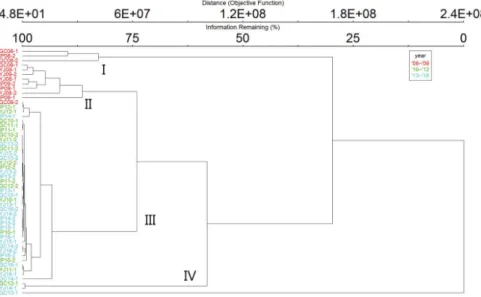
표본별 저서성 대형무척추동물의 개체밀도(개체수 m-2)를 바탕으로 Euclidian(Pythagorean) 거리 측정법과 Ward’s 그 룹 연결법을 적용하여 계층적군집분석(Hierarchical cluster analysis, HCA; Johnson, 1967)을 수행하였다. 군화 방식은 상향식 절차(Hierarchical agglomerative procedure)에 따랐 다. 수직선은 연도별 조사 지점들을, 수평선은 조사지점들 또는 조사지점 그룹 간 거리를 나타내었다.
보 공사 전후 유수성 저서성 대형무척추동물의 군집 변 화에 영향을 미친 환경요인을 확인하기 위해 정준상관분석 (Canonical correspondence analysis, CCA; Ter Btraak, 1986)을 수행하였다. 종속변수군은 조사지점별 출현 분류 군(총 110 분류군)의 개체밀도(개체수 m-2)로 구성하였다.
독립변수군은 지점별 환경요인(유속, 하상, BOD5, T-N, T-P 등)으로 구성하였다. 이를 바탕으로 Weighted average (WA) score를 이용하여 조사지점의 좌표를 나타내었다. 피 어슨 상관관계 분석을 이용해 CCA 결과의 각 축이 어느 환경요인에 대해 가장 뚜렷한 설명력을 갖는지 확인하였 다. HCA와 CCA는 PC-ORD(MjM Software, version 6.19, Glenede beach, OR, USA)를 사용하였다.
Fig. 2. Box and whisker plots of measures of anual mean environmental variables for amount of rain fall (a), total outflow (b), water flow (c), suspended solid (d), BOD5 (e), total nitrogen (f), total phosphorus (g), flow velocity (h), substrate (i). 10th and 90th percentiles(vertical dashed line), quartiles(box ends), medians(solid horizontal lines within boxes), and averages(dotted horizontal lines within boxes).
Amount of rain fall(mm)Suspended solid(mg/L)Total phosphorous(mg/L) Flow velocity(cm/s)BOD5Total outflow(m3/s) Water flow(m3/s)Total nitrogen(mg/L)Substrate(phi)
Years
결 과
1. 남한강 보 구간 환경요인 변화
보 구간 상류에 위치한 충주지역의 연평균 강수량은 다 른 연도에 비해 ’11년에 특히 많았다(Fig. 2a). 충주댐의 방
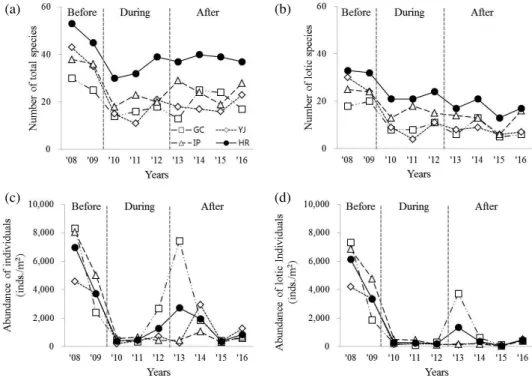
류량(Fig. 2b) 및 이포보의 유량(Fig. 2c)은 강우의 영향으 로 공사기간에 많았으며, 공사 전후로는 큰 차이를 보이지 않았다. 수질요인 중 부유물질(SS, mg L-1)은 강우량과 유 량이 많았던 ’11년에 가장 높았으며(Fig. 2d), 생물학적산소 요구량(BOD5, mg L-1)은 강우량이 적었던 보 공사 전후 시 기에 상대적으로 높은 반면, 총인(T-P, mg L-1)은 낮은 경향 Fig. 3. Distribution patterns of total and lotic benthic macroinvertebrate communities along with duration of weir construction(before,
during and after). Number of total species (a), number of lotic species (b), abundance of total individuals m-2 (c) and abundance of lotic individuals m-2 (d).
Table 1. Distribution patterns of Hydropsychidae and other lotic abundance of individuals m-2 along with duration of weir construction construction(before(’08~’09), during(’10~’12) and after(’13~’16)).
Lotic species Before During After Variation
(before → after)
Mean Hydropsychidae 3,526 59 2 ↓ 3,524
Other lotic species 1,201 192 553 ↓ 648
Total 4,727 251 555 ↓ 4,172
GC Hydropsychidae 3,881 1 0 ↓ 3,881
Other lotic species 714 208 1,212 ↑ 498
Total 4,595 209 1,212 ↓ 3,383
YJ Hydropsychidae 2,730 1 0 ↓ 2,730
Other lotic species 1,045 181 250 ↓ 795
Total 3,775 182 250 ↓ 3,525
IP Hydropsychidae 3,969 176 5 ↓ 3,964
Other lotic species 1,844 187 197 ↓ 1,647
Total 5,813 363 202 ↓ 5,611
(a) (b)
(c) (d)
을 보였다(Fig. 2e). 총질소(T-N, mg L-1) 등 기타 수질 환 경요인은 뚜렷한 변화경향을 보이지 않았다(Fig. 2f, g). 저 서성 대형무척추동물의 채집 정점에서 측정된 유속은(cm s-1) ’11년에 급감하였으며, 하상기질의 평균 입자 크기는
’11년에 세립질이 다소 증가 하였으나 이후 점차 감소하는 경향을 보였다.
2. 저서성 대형무척추동물 시 · 공간적 분포 변화
총 종수는 보 공사가 시작된 이후(’10년) 감소한 후 시간 이 지남에 따라 비유수성종의 가입과 함께 소폭 증가하는 경향을 보였다(Fig. 3a). 반면 유수성종은 공사 직후(’10년) 감소한 후 큰 변화가 없었다(Fig. 3b). 전체 및 유수성 개체 밀도(개체수 m-2)는 보 사업이 시작된 이후 급감하였다 (Fig. 3c, d). 가장 큰 폭으로 감소한 유수성 분류군은 줄날 도래과(Hydropsychidae)의 흰점줄날도래(Hydropsyche
valvata), 줄날도래
(Hydropsyche kozhantschikovi) 등으로 보공사 전 평균 3,526개체 m-2에서 보 공사 후 2개체 m-2로 급감하였으며, 이는 세 보 구간 모두에서 유사한 결과를 보 였다(Table 1, Fig. 4). ’10년부터 강천보, 여주보의 줄날도래 류가 급감한 것과 달리 이포보는 상대적으로 ’12년까지 지 속적으로 감소하는 경향을 보였다(Fig. 4b). 강천보는 ’13 년에 작은강하루살이(Potamanthus formosus)를 비롯한 전 체 개체밀도가 일시적으로 급상승하였으나 이후 다시 감소 하였다(Fig. 4c). 유수성 저서성 대형무척추동물 종수 및 개체밀도는 유속(r=0.578∼0.598, p
<
0.01) 및 하상(r=0.346, p
<
0.05)과 다소 높은 상관관계를 보였다(Table 2).세부적으로 강천보(r=0.488~0.558, p
<
0.05), 여주보(r=0.637~0.694, p
<
0.01), 이포보(r=0.607~0.658, p<
0.01) 모두 유속과 가장 유의미한 상관관계를 보였다.3. 환경요인과 저서성 대형무척추동물의 상관관계
남한강 보 구간 저서성 대형무척추동물 군집과 환경요인 Fig. 4. Contour plots of spatio-temporal distribution patterns of lotic abundance of individuals m-2 for total lotics (a), only Hydropsychidae
(b) and other lotics except for Hydropsychidae (c) along with duration of weir construction(before(’08~’09), during(’10~’12) and after(’13~’16)). GC: Gangcheon-weir, YJ: Yeoju-weir, IP: Ipo-weir.
Table 2. Spearman’s rank correlations(r) physico-chemical environmental variables versus number of lotic species and abundance of lotic individuals on weirs.
Environmental variables
Number of species Abundance of individuals(inds. m-2)
Total GC YJ IP Toatal GC YJ IP
Flow velocity 0.598** 0.558* 0.694** 0.607** 0.578** 0.488* 0.637** 0.658**
Substrate -0.346* -0.267 -0.079 -0.467 -0.254 -0.35 0.022 -0.442
SS 0.229 0.246 0.043 0.197 0.073 0.004 -0.012 0.436
BOD5 0.404** 0.271 0.387 0.617** 0.433** 0.188 0.542* 0.629**
T-N -0.18 -0.161 -0.151 0.157 -0.042 -0.242 -0.327 0.416
T-P -0.205 -0.170 -0.435 -0.050 0.025 0.026 -0.037 0.126
Water temperature 0.044 0.127 -0.547* -0.044 -0.030 0.122 -0.074 -0.114
**p<0.01, *p<0.05
GC: Gangcheon-weir, YJ: Yeoju-weir, IP: Ipo-weir
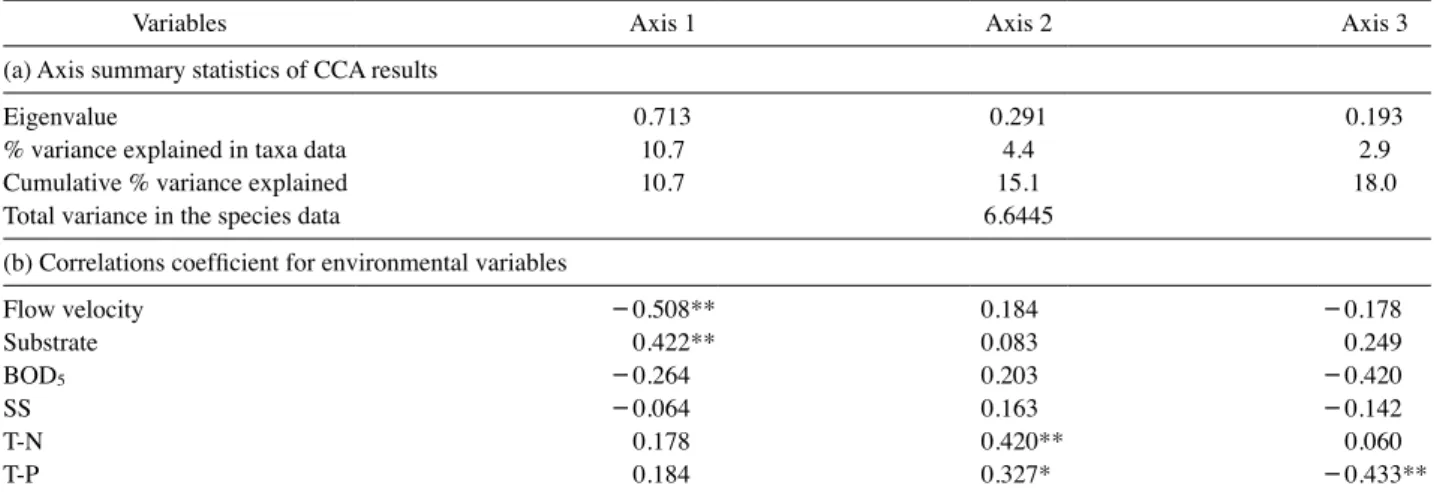
간의 상관관계 확인을 위한 정준상관분석(canonical corre- spondence analysis, CCA) 결과 한강수계 보 구간의 제I주성 분의 고유값(eigenvalue)은 0.713(제II주성분: 0.291, 제III 주성분: 0.193)이었으며, 모든 정준상관분석 결과는 Monte- Carlo test에 따라 유의미하였다(p
<
0.05)(Table 3). 제I주성 분은 유속(r= -0.508, p<
0.01)과 음의 상관관계, 하상(r=0.422, p
<
0.05)과 양의 상관관계가 있었으며 대체로 보 공 사 전(’08∼’09년)과 그 외의 시기를 구별하였다. 또한, 유수 성 분류군 중 흰점줄날도래(Hydropsyche valvata), 줄날도 래(Hydropsyche kozhantschikovi) 등은 제I주성분의 좌측에 분포하여 유속과 하상에 강한 상관관계를 보였다(Fig. 5).저서성 대형무척추동물의 개체밀도를 기반으로 Euclidi- an(Pythagorean) 거리측정법과 Ward’s 그룹 연결법을 이용 하여 집단화(clustring)한 결과 크게 4개의 그룹으로 구별되 었는데 제I군과 제II군은 모두 보 공사 전(’08∼’09년) 조사 지점, 제III군, 제IV군은 거의 모두 공사 중·후(’10∼’16년) 의 지점들이었다(Fig. 6). 특히 제I군과 제II군은 유속에 영 향을 많이 받은 지점들로 이들은 제III, IV군과는 유속에 의 해 구분된다고 볼 수 있다.
고 찰
1. 남한강 보 구간 환경요인 특성
한강수계 남한강 보 공사 전후 기간 동안 수생태계의 변 화를 확인할 수 있는 자료는 생물측정망의 일환으로 수행 된 “하천 수생태계 현황 조사 및 건강성 평가(’08~’16년)”
의 조사결과가 유일하였다. 하지만 해당 연구사업의 조사
지점은 보 직상류에서는 다소 거리가 떨어져 있으며, 매년 여름 홍수기 전후 수변부에서 총 2회만 수행되기 때문에 본 연구에서 제시한 결과들을 보 구간 미소서식처 전체의 Fig. 5. Canonical correspondence analysis(CCA) multivariate ordi-
nation diagram relating sampling sites to physico-chemical environmental variables in Namhan-River weir section. The plots present the ordination of sampling sites with symbol of red(’08~’09), green(’10~’12), light blue(’13~’16) circles and species with symbol of dark blue diamonds. Ar- row length is proportional to relative importance of the flow velocity(cm s-1), substrate(phi), BOD5, etc.
Table 3. Result of ordinations by canonical correspondence analysis(CCA) of data on 54 sampling sites within environmental variables (a) and Pearson correlation coefficients for the first three axes(b).
Variables Axis 1 Axis 2 Axis 3
(a) Axis summary statistics of CCA results
Eigenvalue 0.713 0.291 0.193
% variance explained in taxa data 10.7 4.4 2.9
Cumulative % variance explained 10.7 15.1 18.0
Total variance in the species data 6.6445
(b) Correlations coefficient for environmental variables
Flow velocity -0.508** 0.184 -0.178
Substrate 0.422** 0.083 0.249
BOD5 -0.264 0.203 -0.420
SS -0.064 0.163 -0.142
T-N 0.178 0.420** 0.060
T-P 0.184 0.327* -0.433**
**p<0.01, *p<0.05
계절별 변화를 반영하는 결과로 보기에는 어려움이 있다. 따라서 시기에 따라 변화가 심한 수질은 환경부 수질측정 망의 월별 자료를 연간으로 평균내어 분석한 것이다. 또한, 본 논문에서 제시한 유수성 후보종들은 장기간 축적된 분 류군별 유속 저항성 또는 선호도를 바탕으로한 지표치 연구 를 통해 지속적으로 수정·보완 되어져야 할 것이다.
보 공사가 시작된 이후(’10~’16년) 유량변화에 따른 수 질요인(T-N, T-P, BOD5 등)의 연간 변동은 관찰되었지만, 보 에 의한 특별한 변화 경향은 확인할 수 없었다. 낙동강 보 구간의 연구 사례에서도 보 설치 후 강정고령보와 달성보 의 T-N, T-P, COD 등은 뚜렷한 변화 경향을 보이지 않았으 며(Lee et al., 2014), 이는 단기적인(’12년~’13년) 조사 결 과였기 때문에 장기적인 유량 변화를 바탕으로 한 검토의 필요성을 제기하였다. 본 연구결과에서는 비록 모든 보 구 간의 유량변화를 확인할 수는 없었지만 보 구간 최하류에 위치한 이포보 직상류의 유량은 공사 전후 큰 변화가 없었 다. 이에 따라 남한강 보 구간의 전반적인 유량 또한 공사 전후 큰 차이가 없었을 것으로 추정된다.
비록 전반적인 유량은 큰 차이가 없었지만 보에 의한 수 위 상승은 공사 전(’08~’09년) 수변부에 존재했던 국부적 인 여울 구간의 복잡한 유속 다양성을 흐름 또는 소 구간 으로 단순화시켰을 것으로 사료된다. 수위 상승에 의해 소 구간의 비율이 증가하면 하상이 세립질로 단순화 되어 서 식처의 다양성이 감소하게 된다(Shields et al., 1998). 세립 질 하상 중 특히 모래 하상은 안정성이 떨어지고 유기물의 양이 부족해 저서동물의 서식처로 가장 부적합하다(Allan
and Castillo, 2007). 본 연구에서도 채집 정점의 미소서식 처를 대상으로 측정한 유속은 공사 중(’11년)에 급감하였 고 하상기질은 다소 세립질화 됨에 따라 개체밀도의 감소 를 야기한 것으로 판단된다.
2. 남한강 보 구간 유수성종 분포 특성
보 공사가 시작된 이후(’10∼’16년) 수질과 관련된 환경 요인(T-N, T-P, BOD5 등)은 특별한 변화 경향을 보이지 않 은 반면, 조사 정점의 유속 감소, 하상 세립질화 등 물리적 서식환경은 변화하였다. 보 공사 전후 가장 두드러진 개체 밀도 변화를 보인 유수성 분류군은 줄날도래과(Hydropsy- chidae)의 생물들(흰점줄날도래(Hydropsyche valvata), 줄 날도래(Hydropsyche kozhantschikovi), 꼬마줄날도래 (Cheumatopsyche brevilineata), 꼬마줄날도래 KUa (Cheu-
matopsyche KUa), 꼬마줄날도래 KUb
(Cheumatopsyche KUb), 큰줄날도래(Macrostemum radiatum))이었다. 줄날 도래류는 여울 및 흐름구간의 유수역에 주로 서식하며 (Schuster and Etnier, 1978), 이 중 흰점줄날도래(Hydropsy-che valvata)는 특히 빠른 유속 120~140
cm s-1 (r=0432,p <
0.001)(Jun et al., 2016)과 조립질의 하상을 선호하는 (Kong and Kim, 2017) 대표적인 유수성 종이다. 이에 따라 보 공사가 시작되었던 ’10년 줄날도래류의 급감은 수질요 인과는 독립적으로 보 공사와 준설 등에 따른 유속과 하상 기질의 복합적인 물리적 변화에 영향을 받았을 것으로 예 측된다.Fig. 6. Dendrogram of sampling sites based on mean individual abundance m-2 of benthic macroinvertebrates using the Euclidian(Pythago- rean) distance measure and Ward’s group linkage method.
여울가의 흐름이 있는 모래와 자갈하상에서 주로 발견되 는 작은강하루살이(Potamanthus formosus)(Argo, 1927)는 강천보에서 ’13년 급증하는 등 연도별 두 번째로 큰 변동을 보였다. 이는 하상의 안정성에 크게 의존하는 저서성 대형 무척추동물의 특성상(Verdonschot, 2001; Jowett, 2003) 보 공사 직후 불안정했던 유수환경에 의한 하상교란이 원인 으로 추정된다. 이에 따라 사업 후 유수성 종이 다소 증가 하게 만드는 원인으로 작용하였으나 그 외 등줄하루살이 (Uracanthella punctisetae), 범꼬리하루살이(Ephemerella
setigera), 명주각다귀 KUa
(Antocha KUa) 등 다른 유수성 종(Kim et al., 2013; Kwon et al., 2013)의 개체밀도는 전반 적으로 감소하였다. 특히 통날도래 KUa(Psychomyia KUa), 깨알하루살이(Acentrella gnom), 긴다리여울벌레류(Sten-elmis sp.)는 공사 이후 더 이상 출현하지 않았기 때문에 이
러한 종들은 향후 남한강 보 구간의 서식처 재자연화 등 복 원사업의 깃대종으로서 활용이 기대된다.하천 생태계의 유수 체계는 저서성 대형무척추동물의 생 산성 및 군집구조에 가장 큰 영향을 미치는 물리적 특성 중 하나로(Allan, 1995), 유수 체계의 교란은 저서성 대형무척 추동물의 개체밀도와 풍부도를 감소시킨다(Konrad et al., 2008). 특히, 유수체계 내 유속과 하상의 변화는 하천의 유 기오염과 더불어 담수 생태계의 무척추동물 군집을 결정하 는 핵심요인이다(Pan et al., 2015). 본 연구결과 줄날도래과 의 생물들은 CCA 제I주성분의 좌측에 분포하여 유속과 하 상에 강한 상관관계를 보였다. 또한 줄날도래과가 높은 출 현 개체밀도를 보였던 보 공사 전(’08~’09년) 지점들이 HCA 에서 높은 유사도를 보임에 따라 여울 소실에 따른 유속의 감소, 하상의 세립질화 등 물리적 서식처의 교란이 유수성 분류군의 개체밀도 감소에 주요한 영향을 미친 것으로 판 단된다. CCA의 제III주성분은 총인과의 가장 높은 상관관 계를 보임에 따라 보 공사 이후 일부 이포보 지점들이 총인 과의 상관관계가 있는 것으로 나타났다. 저서성 대형무척추 동물의 종수 및 개체밀도는 총인 농도와 음의 상관관계를 갖긴 하지만, 0.073mg L-1 이상에서 급격한 변화를 야기하 며 낮은 농도에서는 큰 격차를 보일 수 있다(Wang et al., 2007). 조사 지점 내 총인 농도는 유량이 증가하였던 ’10년 (0.076mg L-1)과 ’11년(0.065mg L-1)에 상대적으로 다소 높았지만, 그 외 조사기간 동안은 연평균 0.033~0.045mg L-1 범위로 전반적으로 양호한 수준을 유지하였다. 따라서 수치의 증감에 따른 저서성 대형무척추동물과 총인의 상관 관계는 나타났지만, 이것을 단순히 총인의 변화가 저서성 대형무척추동물의 군집변화에 영향을 미쳤다는 인과관계 로 보기에는 불충분한 것으로 판단된다.
적 요
한강수계 남한강의 보(강천보, 여주보, 이포보) 공사 후 수변부 여울 구간의 물리적 환경의 변화에 따른 유수성 저 서동물의 군집 변화를 확인한 결과 다음과 같은 결론을 얻 었다. 첫째, 보에 의한 여울구간의 소실은 유속, 하상 등 물 리적 환경의 변화를 야기하여 수질요인과는 독립적으로 수 생태계에 영향을 미칠 수 있다. 둘째, 남한강 보 구간의 수 변부 물리적 서식환경의 복합적인 변화는 유수성 분류군의 군집구성에 영향을 미친 것으로 판단된다. 셋째, 저서성 대 형무척추동물 유수성 지표 후보종 157 분류군은 수생태계 변화의 원인 분석을 비롯한 하천 수생태계 복원 및 재자연 화 등에 유용한 지표로 활용될 수 있을 것으로 기대된다. 넷째, 향후 유속변화에 대한 수생태계 영향을 면밀하게 파 악하기 위해서는 분류군별 유속에 대한 저항성 또는 선호 도를 바탕으로 한 지표연구가 필요할 것으로 사료된다.
사 사
본 논문은 환경부 재원의 하천 수생태계 현황 조사 및 건강성 평가(NIER-SP2016-255)의 일환으로 작성되었습 니다.
REFERENCES
Allan, J.D. 1995. Stream ecology structure and function of run- ning water. Chapman and hall, London.
Allan, J.D. and M.M. Castillo. 2007. Stream ecology: structure and function of running waters. Springer, AA Dordrecht.
Angradi, T.R. 1999. Fine sediment and macroinvertebrate as- semblages in Appalachian streams: a field experiment with biomonitoring applications. Journal of the North Ameri- can Benthological Society 18(1): 49-66.
Argo, V.M. 1927. The North American species of the genus Pota- manthus with a description of a new species. Journal of the New York Entomological Society 35(4): 319-325.
Braccia, A., S.L. Eggert and N. King. 2014. Macroinvertebrate colonization dynamics on artificial substrates along an al- gal resource gradient. Hydrobiologia 727(1): 1-18.
Buss, D.F., D.F. Baptista, J.L. Nessimian and M. Egler. 2004.
Substrate specificity, environmental degradation and dis- turbance structuring macroinvertebrate assemblages in neotropical streams. Hydrobiologia 518(1): 179-188.
Camargo, J.A. 2017. Multimetric assessment of macroinverte-
polluted river of central Spain. Ecological Indicators 83:
356-367.
Chi, S., C. Wei, J. Zheng, J. Hu, M. Li and J. Hu. 2018. Distribu- tion patterns of macroinvertebrate communities in a Chi- nese floodgate-regulated river and their relationships with river longitudinal connectivity. Science of the Total Envi- ronment 631-632: 765-777.
Church, M. 2002. Geomorphic thresholds in riverine landscapes.
Fresh Water Biology 47(4): 541-557.
Colby, B.R. 1964. Scour and fill in sand-bed streams. Vol. 462.
United States Government Printing Office. Washington.
D.C.
Craig, D.A. 1987. Some of what you should know about water or, KISS* for Hydrodynamics (*Keeping It Stupidly Sim- ple). Bulletin of the North American Benthological Soci- ety 4(2): 178-182.
Cummins, K.W. 1962. An evaluation of some techniques for the collection and analysis of benthic samples with special emphasis on lotic waters. American Midland Naturalist
67(2): 477-504.Culp, J.M., F.J. Wrona and R.W. Davies. 1986. Response of stream benthos and drift to fine sediment deposition ver- sus transport. Canadian Journal of Zollogy 64(6): 1345- 1351.
Duan, X., Z. Wang, M. Xu and K. Zhang. 2009. Effect of stream- bed sediment on benthic ecology. International Journal of Sediment Research 24(3): 325-338.
Erman, D.C. and F.K. Ligon. 1988. Effects of discharge fluctu- ation and the addition of fine sediment on stream fish and macroinvertebrates below a water-filtration facility. Envi- ronmental Management 12(1): 85-97.
Gorman, O.T. 1988. The dynamics of habitat use in a guild of Ozark minnows. Ecological Monographs 58(1): 1-18.
Instream Flow and Aquatic Systems Group (IFASG). 1986. De- velopment and evaluation of habitat suitability criteria for use in the instream flow incremental methodology: biolog- ical report, instream flow information paper No. 21. Na- tional Ecology Center.
Johnson, S.C. 1967. Hierarchical clustering schemes. Psycho- metrika 32(3): 241-254.
Jowett, I.G. 2003. Hydraulic constraints on habitat suitability for benthic invertebrates in gravel-bed rivers. River Research and Applications 19(5-6): 495-507.
Jun, Y.C., N.Y. Kim, S.H. Kim, Y.S. Park, D.S. Kong and S.J.
Hwang. 2016. Spatial distribution of benthic macroinver- tebrate assemblages in relation to environmental variables in Korean nationwide streams. Water 8(1): 27.
Judy, R.D., Jr. P.N. Seeley, T.M. Murray, S.C. Svirsky, M.R.
Whitworth and L.S. Ischinger. 1984. National fisheries Survey. Technical report: initial findings, vol. 1. Washing- ton, DC, USA: United States Fish and Wildlife Service;
(FWS/OBS-84/06).
level of fine sediment accumulation for altering benthic macroinvertebrate communities. Hydrobiologia 518(1-3):
95-104.
Kim, M.C., S.P. Chun and J.K. Lee. 2013. Invertebrates in Kore- an freshwater ecosystems. Geobook.
Kong, D.S. 2002. Necessity and approach of establishing biolog- ical water quality standards. Korean Journal of Environ- mental Biology 20(Special issue): 38-49.
Kong, D. and A.R. Kim. 2017. Estimation on the physical habi- tat suitability of benthic macroinvertebrates in the Gapy- eong stream. Journal of Korean Society on Water Envi- ronment 33(3): 311-325.
Konrad, C.P., M.D. Brasher and J.T. May. 2008. Assessing streamflow characteristics as limiting factors on benthic invertebrate assemblages in streams across the western United States. Freshwater Biology 53(10): 1983-1998.
Kwon, S.J., Y.C. Jun and J.H. Park. 2013. An illustrated guide to aquatic organism-Benthic macroinvertebrate. Econature.
Lee, S.H, B.R. Kim and H.W. Lee. 2014. A study on water qual- ity after construction of weirs in the middle area in Nak- dong River. Korean Society of Environmental Engineering
36(4): 258-264.Merritt, R.W. and K.W. Cummins. 2008. An introduction to the aquatic insects of North America (fourth edition). kendall/
hunt publishing company.
Minshall, G.W. 1984. Aquatic insect-substratum relationships, The Ecology of Aquatic Insects, Resh, V. H. and Rosen- berg, D. M. (eds). Praeger Publishers: New York.
Nowell, A.R.M. and P.A. Jumars. 1984. Flow environments of aquatic benthos. Annual Review of Ecology and Systemat- ics 15(1): 303-328.
Pan, B.Z., Z.Y. Wang, Z.W. Li, Y.J. Lu, W.J. Yang and Y.P. Li.
2015. Macroinvertebrate assemblages in relation to envi- ronments in the West River, with implications for man- agement of rivers affected by channel regulation projects.
Quaternary International 384: 180-185.
Park, J.H., J.S. Lee, H.S. Sim, H.K. Lee, G.S. Hwang, D.S. Kim and W.M. Hur. 2013a. an illustrated guide to ecological restoration, Benthic macroinvertebrate, Platyhelminthes
· Nematomorpha·Mollusca·Annelida. Institute of aquatic ecological restoration.
Park, J.H., J.S. Lee, H.S. Sim, H.K. Lee, G.S. Hwang, D.S. Kim and W.M. Hur. 2013b. an illustrated guide to ecological restoration, Benthic macroinvertebrate, Arthropoda. Insti- tute of aquatic ecological restoration.
Platts, W.S., W.F. Megahan and G.W. Minshall. 1983. Methods for evaluating stream riparian and biotic conditions. Gen.
Tech. Rep. INT-138. Forest Service, U.S. Dept. Agricul- ture, Ogden, Utah. 177 pp.
Rankin, E.T. 1991. The use of the qualitative habitat evaluation
index for use attainability studies in streams and Rivers in
Ohio. In George Gibson, editor. Biological Criteria: Re-
search and Regulation, Office of Water, U.S. Environmen- tal Protection Agency, Washington, D.C. EPA 440/5-91- Sarver, R., Environmental Specialist IV, Field Services Section 005.
and ESP. 2000. Stream habitat assessment, Missouri de- partment of natural resources division of environmental quality environmental services program, Project Proce- dure.
Schuster, G.A. and D.A. Etnier. 1978. A manual for identification of the larvae of the caddisfly genera Hydropsyche pictet and Stmphitopsyche ulmer in eastern and central north america (Trichoptera : Hydropsychidae), EPA-600/4-78- 060. U.S. Environmental Protection Agency, Cincinnati, Ohio 45268.
Shields, Jr. F.D., S.S. Knight and C.M. Cooper. 1998. Rehabilita- tionx of aquatic habitats in warmwater streams damaged by channel incision in Mississipi. Hydrobilogia 382(1-3):
63-86.
Smith, M.J., W.R. Kay, D.H.D. Edward, P.J., Papas, K.St.J. Rich- ardson, J.C. Simpson, A.M. Pinder, D.J. Cale, P.H.J. Hor- witz, J.A. Davis, F.H. Yung, R.H. Norris and S.A. Halse.
1999. AusRivAS: Using macroinvertebrates to assess eco- logical condition of rivers in Western Australia. Freshwa- ter Biology 41(2): 269-282.
Ter Braak, C.J. 1986. Canonical correspondence analysis: a new
eigenvector technique for multivariate direct gradient anal- ysis. Ecology 67(5): 1167-1179.
Tiemann, J.S., D.P. Gillette, M.L. Wildhaber and D.R. Edds. 2004.
Effects of lowhead dams on riffle-dwelling fishes and mac- roinvertebrates in a Midwestern River. Transaction of the American Fisheries Society 133(3): 705-717.
Verdonschot, P.F.M. 2001. Hydrology and substrates: Determi- nants of oligochaete distribution in lowland streams (The Netherlands). Hydrobiologia 463(1-3): 249-262.
Wang, L., D.M. Robertson and P.J. Garrison. 2007. Linkage be- tween nutrients and assemblages of macroinvertebrates and fish in wadeable streams: implication to nutrient crite- ria development. Environmental Management 39(2): 194- Wilcock, P.R., G.M. Kondolf, W.V.G. Matthews and A.F. Barta. 212.
1996. Specification of sediment maintenance flows for a large gravel-bed river. Water Resources Research 32(9):
2911-2921.
Wohl, E., S. Rathburn, S. Chignell, K. Garrett, D.A. Laurel, B.
Livers, A. Patton, R. Records, M. Richards, D.M. Schook, N.A. Sutfin and P. Wegener. 2017. Mapping longitudinal stream connectivity in the north St. Vrain Creek water- shed of Colorado. Geomorphology 277: 171–181.
Zonneveld, I.S. 1983. Principles of bio-indication. Environmen-
tal Monitoring and Assessment 3(3-4): 207-217.
No. Scientific name Korean name Reference
1. Phagocata vivida 산골플라나리아 2
2. Clithon retropictus 기수갈고둥 2, 3
3. Koreoleptoxis globus ovalis 띠구슬알다슬기 2
4. Semisulcospira coreana 참다슬기 3
5. Semisulcospira forticosta 주름다슬기 2, 3
6. Semisulcospira libertina 다슬기 2, 3
7. Semisulcospira tegulata 좀주름다슬기 3
8. Lamprotula coreana 두드럭조개 2, 3
9. Siphlonurus chankae 옛하루살이 2, 3
10. Ameletus costalis 피라미하루살이 1, 2, 3
11. Ameletus montanus 멧피라미하루살이 1, 2, 3
12. Acentrella gnom 깨알하루살이 1, 2, 3
13. Acentrella sibirica 콩알하루살이 1, 2, 3
14. Baetiella tuberculata 애호랑하루살이 2, 3
15. Baetis silvaticus 감초하루살이 2, 3
16. Baetis ursinus 방울하루살이 2, 3
17. Nigrobaetis bacillus 깜장하루살이 2, 3
18. Procloeon halla 한라하루살이 2, 3
19. Procloeon maritimum 작은갈고리하루살이 2, 3
20. Procloeon pennulatum 갈고리하루살이 2, 3
21. Isonychia japonica 빗자루하루살이 1, 2, 3
22. Isonychia ussurica 깃동하루살이 1, 2
23. Bleptus fasciatus 맵시하루살이 2, 3
24. Cinygmula grandifolia 봄처녀하루살이 1, 2, 3
25. Cinygmula hirasana 봄총각하루살이 1, 3
26. Ecdyonurus bajkovae 몽땅하루살이 1, 2, 3
27. Ecdyonurus dracon 참납작하루살이 1, 2, 3
28. Ecdyonurus joernensis 꼬리치레하루살이 1, 2
29. Ecdyonurus kibunensis 두점하루살이 1, 2, 3
30. Ecdyonurus levis 네점하루살이 1, 2, 3
31. Epeorus nipponicus 흰부채하루살이 1, 2, 3
32. Epeorus pellucidus 부채하루살이 1, 2, 3
33. Heptagenia kyotoensis 총채하루살이 1, 2, 3
34. Epeorus aesculus 중부채하루살이 1, 2
35. Epeorus maculatus 긴부채하루살이 1, 2
36. Rhithrogena na 산납작하루살이 na 1, 2
37. Choroterpes(Euthraulus) altioculus 세갈래하루살이 2, 3
38. Paraleptophlebia japonica 두갈래하루살이 1, 2, 3
39. Potamanthus formosus 작은강하루살이 2, 3
40. Potamanthus yooni 금빛하루살이 3
41. Potamanthus luteus oriens 가람하루살이 2, 3
42. Rhoenanthus coreanus 강하루살이 2, 3
43. Cincticostella levanidovae 민하루살이 2, 3
44. Cincticostella tshernovae 먹하루살이 2, 3
45. Drunella aculea 뿔하루살이 2, 3
46. Drunella latipes 알통하루살이 2, 3
47. Drunella lepnevae 쌍혹하루살이 2, 3
48. Drunella triacantha 삼지창하루살이 2, 3
49. Ephacerella longicaudata 긴꼬리하루살이 2, 3
50. Ephemerella dentata 알락하루살이 1, 2, 3
51. Ephemerella imanishii 칠성하루살이 1, 2, 3
52. Ephemerella kozhovi 흰등하루살이 1, 2, 3
53. Ephemerella setigera 범꼬리하루살이 1, 2, 3
54. Serratella ignita 쇠꼬리하루살이 1, 3
55. Uracanthella punctisetae 등줄하루살이 2, 3
Appendix 1. Continued.
No. Scientific name Korean name Reference
56. Potamanthellus chinensis 방패하루살이 2, 3
57. Caenis nishinoae 등딱지하루살이 2, 3
58. Calopteryx atrata 검은물잠자리 1, 2, 3
59. Calopteryx japonica 물잠자리 1, 2, 3
60. Davidius lunatus 쇠측범잠자리 2, 3
61. Shaogomphus postocularis 어리측범잠자리 2
62. Lamelligomphus ringens 노란측범잠자리 2, 3
63. Ophiogomphus obscura 측범잠자리 1, 2
64. Boyeria maclachlani 개미허리왕잠자리 1, 2, 3
65. Anotogaster sieboldii 장수잠자리 2, 3
66. Taenionema sp. 메추리강도래류 2
67. Amphinemura KUa 총채민강도래 KUa 1, 3
68. Nemoura tau 토우민강도래 1, 2, 3
69. Nemoura KUa 민강도래 KUa 1, 2, 3
70. Nemoura KUb 민강도래 KUb 1, 2
71. Paracapnia recta 애강도래 2, 3
72. Megaleuctra saebat 새밭강도래 2
73. Rhopalopsole mahunkai 꼬마강도래 2, 3
74. Yoraperla KUa 넓은가슴강도래 KUa 2
75. Yoraperla uchidai 넓은가슴강도래 3
76. Pteronarcys macra 한국큰그물강도래 1, 2
77. Pteronarcys sachalina 큰그물강도래 1, 3
78. Archynopteryx KUa 큰등그물강도래 KUa 2
79. Isoperla KUa 줄강도래 KUa 1, 2
80. Megarcys ochracea 그물강도래 1, 2
81. Perlodes KUa 점등그물강도래 KUa 2, 3
82. Stavsolus japonicus 그물강도래붙이 3
83. Stavsolus KUa 그물강도래 KUa 2
84. Kamimuria coreana 한국강도래 2, 3
85. Kiotina decorata 무늬강도래 2, 3
86. Neoperla coreensis 두눈강도래 1, 2, 3
87. Oyamia nigribasis 진강도래 2, 3
88. Paragnetina flavotincta 강도래붙이 1, 2, 3
89. Alloperla joosti 애민무늬강도래 3
90. Sweltsa lepnevae 여린녹색강도래 1, 3
91. Sweltsa nikkoensis 녹색강도래 1, 2
92. Aphelocheirus nawae 물빈대 2, 3
93. Parachauliodes asahinai 뱀잠자리붙이 2, 3
94. Protohermes xanthodes 노란뱀잠자리 2, 3
95. Stenelmis vulgaris 긴다리여울벌레 1, 2
96. Stenelmis nipponica 곰보긴다리여울벌레 1, 2
97. Zaitzevia nitida 애여울벌레 1, 2
98. Eubrianax KUa 둥근물삿갓벌레 KUa 1, 2, 3
99. Mataeopsephus KUa 넓은물삿갓벌레 KUa 2, 3, 4
100. Psephenoides KUa 물삿갓벌레과 KUa 2
101. Antocha KUa 명주각다귀 KUa 1, 2, 3
102. Dicranomyia KUa 무늬애기각다귀 KUa 2
103. Dicranota KUa 애기각다귀 KUa 2, 3
104. Pedicia KUa 장수각다귀 KUa 2, 3
105. Simulium 먹파리류 2, 3
106. Bibiocephala KUa 물멧모기 KUa 1, 2, 3
107. Philorus KUa 멧모기 KUa 1, 2, 3
108. Deuterophlebia 어리멧모기류 2
109. Atherix KUa 개울등에 KUa 2, 3
110. Suragina KUa 긴개울등에 KUa 3
No. Scientific name Korean name Reference
111. Suragina KUb 긴개울등에 KUb 2
112. Rhyacophila articulata 주름물날도래 1, 2, 3
113. Rhyacophila bilobata 두잎물날도래 1
114. Rhyacophila brevicephala 넓은머리물날도래 1, 2, 3
115. Rhyacophila clemens 클레멘스물날도래 1, 2, 3
116. Rhyacophila impar 거친물날도래 1, 2
117. Rhyacophila KUa 물날도래 KUa 1, 2, 3
118. Rhyacophila KUb 물날도래 KUb 1, 2
119. Rhyacophila kuramana 계곡물날도래 1, 2
120. Rhyacophila narvae 무늬물날도래 1, 2, 3
121. Rhyacophila nigrocephala 검은머리물날도래 1, 2, 3, 4
122. Rhyacophila retracta 용수물날도래 1, 2, 3
123. Rhyacophila shikotsuensis 민무늬물날도래 1, 2, 3
124. Rhyacophila sibirica 시베리아물날도래 1, 2, 3
125. Rhyacophila yamanakensis 곤봉물날도래 1, 2, 3
126. Apsilochorema KUa 긴발톱물날도래 KUa 2, 3
127. Agapetus KUa 큰광택날도래 KUa 1, 2, 3
128. Glossosoma KUa 광택날도래 KUa 1, 2, 3, 4
129. Dolophilodes KUa 넓은입술날도래 KUa 1, 2, 3
130. Wormaldia KUa 입술날도래 KUa 1, 2
131. Stenopsyche bergeri 연날개수염치레각날도래 2, 3
132. Stenopsyche marmorata (국명미정) 2, 3, 4
133. Arctopsyche ladogensis 곰줄날도래 1, 2, 3
134. Cheumatopsyche brevilineata 꼬마줄날도래 1, 2, 3, 4
135. Cheumatopsyche KUa 꼬마줄날도래 KUa 1, 2, 3
136. Cheumatopsyche KUb 꼬마줄날도래 KUb 1, 2, 3
137. Diplectrona KUa 산골줄날도래 KUa 1, 2, 3
138. Hydropsyche kozhantschikovi 줄날도래 1, 2, 3, 4
139. Hydropsyche orientalis 동양줄날도래 1, 2, 3, 4
140. Hydropsyche valvata 흰점줄날도래 1, 2, 3
141. Hydropsyche KD 줄날도래 KD 1, 2, 3
142. Macrostemum radiatum 큰줄날도래 2, 3
143. Plectrocnemia KUa 깃날도래 KUa 2, 3
144. Psychomyia KUa 통날도래 KUa 1, 2, 3
145. Micrasema KUa 둥근얼굴날도래 KUa 2, 3
146. Asynarchus KUa 검은날개우묵날도래 KUa 2, 3
147. Goera japonica 일본가시날도래 1, 2
148. Goera parvula 그물가시날도래 1, 3
149. Neophylax ussuriensis 가시우묵날도래 1, 2, 3
150. Apatania KUa 애우묵날도래 KUa 2, 3
151. Apatania maritima 큰애우묵날도래 2
152. Lepidostoma KUa 네모집날도래 KUa 1, 2, 3
153. Lepidostoma KUb 네모집날도래 KUb 1, 2, 3, 4
154. Gumaga KUa 털날도래 KUa 1, 2, 3
155. Psilotreta kisoensis 바수염날도래 3
156. Psilotreta locumtenens 수염치레날도래 2, 4
157. Anisocentropus minutus (국명미정) 1, 2