• 검색 결과가 없습니다.

The Influence of Online-Store Cue on Consumers Perceived Quality and Online Purchase Intention

N/A
N/A
Protected

Academic year: 2021

Share "The Influence of Online-Store Cue on Consumers Perceived Quality and Online Purchase Intention"

Copied!
9
0
0

로드 중.... (전체 텍스트 보기)

전체 글

(1)

The Influence of Online-Store Cue on Consumers Perceived Quality and Online Purchase Intention

2)

Fei Liu*, Yang Sun**, Seung-Hwa Na***

Abstract

Purpose - The purpose of this research is to find out the relation- ship between cue utilization and perceived website quality and pur- chase intention for an online store. To achieve this, we suggest a conceptual model that examines the relationship among product in- troductions, online communications, online reviews, perceived quality, and online purchase intention.

Research design, data, and methodology - This research utilizes SPSS 19.0 and AMOS17.0 to analyze the data. We used factor anal- ysis to shape the structure of the original data and saved the in- formation with multiple dimensions. We then deployed the AMOS software to analyze the model. We performed both factor analysis and structural equation analysis.

Results - The findings of this study show that graphic and word descriptions, online chatting, and online reviews have a positive influ- ence on perceived quality. Furthermore, perceived quality has a pos- itive influence on purchase intention.

Conclusions - First, detailed product information should be added to influence quality perception. Second, consumers expect a certain level of service while shopping. Simultaneously, online products re- views from consumers deserve attention as they can impact consumer purchase intention.

Keywords : Online Purchase, Cue Utilization Theory, Perceived Quality, Purchasing Intention.

JEL Classifications : M31, M15.

1. Introduction

With the continuous development of information technology and

* First Author. Professor Dept. of Marketing, College of Economics and management, Yanbian University. China. Tel:+86-187-4433-7779, E-mail: [email protected]

** Graduate School of Changwon National University, Korea. Tel:

+82-10-8406-1118, E-mail: [email protected].

*** Corresponding Author. Professor, Dept. of Aviation & Tourism, Koguryeo College, Korea. Tel:+82-10-9440-3001, E-mail: shna@

kgrc.ac.kr

the Internet, e-business has made purchase free from the bondage of time and space. According to the reports from China International Network Information Center (CNNIC), Chinese netters have achieved to 420 million till June of 2010, passing 400 million marks and in- creasing 36 million compared with that in 2009. The Internet pene- tration rate has increased to 31.8% and rising2.9 percent compared with that in 2009. The rate of increase achieves 31.4% for half a year.(“26

th

China Internet Development Statistics Situation Report.”

from CNNIC)

Both tangible products and intangible service have quality as the measurement to measure their value. Jacobson and Aaker (1987) find that product quality can play a strategic role and increase the market- ing share, price and profit of an enterprise and make the enterprise obtain competitive advantage. Because the results of marketing com- petition are determined by the comments and purchase from the con- sumers instead of from enterprises or quality experts. The improve- ment of product quality need to be consumers oriented instead of en- terprises oriented (Brucks, 2000). Therefore, understanding “how con- sumers perceive and review product quality” becomes rather important (Brucks, 2000).

The purpose of this research is to find out the relationship among cue utilization and perceived quality and purchase intention in online store. To achieve this purpose, we suggest a conceptual model which examines the relationship among productions introduction, online com- munication, online review, perceived quality, and online purchase intention.

2. Literature Review

2.1. Basic Concept of S-O-R Model

S-O-R Model is developed from environmental psychology by

Mehrabian and Russell(1974). The model is composed of ante-

cedents (stimulation), mediating variables (organism) and outcome var-

iables (reaction). According to the theoretical base of the model, the

atmosphere created by physical environment can not only affect in-

ternal state of the individual but also behavioral issues of the

individual. Subsequently, Dovonan and Rossiter(1982)firstly in-

troduce it into the retail situation, testing the influence of environ-

ment on the behavior of consumer. On the basis of studies, atmos-

phere in the retail situation affects the emotional states of consumers,

and then changes the cognition and behavior of consumers.

(2)

2.2. S-O-R Model Variable

2.2.1. Stimulus Variable

Among the research of the retail environment, researchers often consider the shopping atmosphere or store environment of the S-O-R Model as the stimulus variable. Here atmosphere refers to

“intentionally control and construct the environmental elements” or

“intentionally design space in order to produce a special effect on purchasers”. The atmosphere elements can influence purchase much more than any other marketing techniques and it even influence the purchasing decision much more than the product itself (Kotler, 1973).

Berman and Evans (1995) classify the atmosphere stimulus or element of the shopping atmosphere into four groups: store external element, internal element, design element and storefront promotion decoration element. However, based on the previous documental research, Turley and Miliman point out that there should be another group-personnel element (Turley and Milliman, 2000).

Along with the appearance of the new shopping form-online-shop- ping, the definition and scope of the shopping atmosphere are quietly changing. Through the research of the online-shopping by scholars, the online atmosphere refers to “intentionally designed online environ- ment, that is, produce positive emotion and cognition during surfing on the Internet to let consumers respond positively” (Dailey, 2004).

Until now, the classification of the Internet environment basically adopts the dichotomy method, such as high task related environment and low task related environment, human factor and computer factor and so on. People like Sevgin (2001) classify the characteristics of the virtual store’s environment into two groups: high task related en- vironment and low task related environment. High task related envi- ronment is defined as the descriptors that appear on the screen and it strengthens the realization and possibility of consumers’ shopping purposes. Low task related environment represents the web site in- formation which is relatively not important for the completion of the shopping tasks. Such kind of classification is widely accepted and applied. Richard (2005) classifies the Internet environment as high task related environment and low task related environment by using SOR Model when he does his research on Internet atmosphere.

Besides, he also summarizes the environmental elements, among which high task related environment includes five elements: navi- gation features, informative, information content validity, structure and organization; low task related environment refers to the entertaining factors.

2.2.2. Organic Variable

In the early SOR Model, researchers mainly study the impact of the environmental stimulation on the store image. Baker, Grewal and Parasurman (1994) develop store environmental elements and study how they influence the store image and consumers’ assessment on product quality. In the research of online-shopping, Richard (2005) al- so adopts SOR Model and considers emotion and cognition as the in- termediate variable. From the point view of emotion, consumers’ atti- tude to the websites can be measured; from the point view of cogni- tion, consumers’ exploratory behavior and websites’ engagement can

be measured. The research finds that the cognitive variable (websites’

engagement and exploratory behavior) is influenced by the central at- mosphere elements (high task related environment) and websites’ atti- tude is influenced by the entertaining elements (low task related envi- ronment), which finally influence consumers’ pre-purchasing and post-purchasing behaviors.

2.2.3. Response Variable

Under the circumstance of shopping, the response variable in SOR Model refers to the final result of the impact of stimulus variable on consumers. Among them, consumers’ approach behavior and avoid- ance behavior are the most researched ones (Chen and Barnes, 2007).

Through the review of the previous documents, we find that SOR Model is widely applied in terms of researching the impact of shop- ping atmosphere on consumers’ behaviors. Until now, the focus of the research is transferring gradually from traditional shopping atmos- phere to online-shopping atmosphere or online-store characteristics.

Avoidance behavior or approach behavior, as the results of consum- ers’ behaviors, are transferring gradually to more specific behaviors like purchasing intention, satisfaction, loyal intention and so on.

Besides, when researchers admit cognition its mediating effect as an organ, at the same time, they find the importance of emotional varia- ble and do further research and study.

2.3. Perceived Quality

2.3.1. Definition of Perceived Quality

Zeithaml (1988) believes that there are two forms: objective quality and perceived quality. Objective quality refers to the advantage and excellence level in terms of actual techniques. In this sense, objective quality could be verified through pre-established idealized standards, but the idealized standards are still difficult to define until now.

Maynes (1976) believe that objective quality does not exist at all and all quality assessments belong to subjective behaviors, which strongly support the other form: perceived quality.

Perceived quality can be classified as the subjective concept for products established before the use of products or service through dif- ferent cues and the subjective judgment after the use of products or service. This paper believes that the online perceived quality can be classified as two kinds. One is a kind of concept of products and their qualities projected by the consumers through various collections and recognitions of lots of information before their purchase. The other is a kind of objective judgment of the products through con- sumers’ use and cognition after their purchase behavior through the Internet.

2.3.2. Model of Perceived Quality

Olson and Jacoby (1973) believe that the process of perceived

quality can be divided into two stages. Firstly, consumers choose the

index that can replace the product quality from some related attributes

of the products and such index is called intrinsic quality hint. Then,

integrate with the extrinsic quality index that is related to the prod-

(3)

ucts, such as price, store image and so on. Such kind of extrinsic quality hint is used for making the final judgment of the product quality.

Gronroos(1981), ascholar from Finland proposes the model of con- sumer perceived quality according to cognitive psychology. He be- lieves that consumer perceived quality is the result of the comparison and contrast between consumers’ expected quality for products and service and the experience quality. Besides, he also points out the el- ements that in fluence consumer perceived quality.

Soruce: Grönroos(1981).

<Figure 1> Entire Perceived Quality Model Gronroos.

2.3.3. Influencing Factors of Perceived Quality

Wheatley and Chiu (1977) discovers that price, store names, color of product appearance, consumers’ income and educational level can influence perceived quality. Olson and Jacoby (1972) discuss about a series of cues that are used by consumers to deduce product quality.

Such cues include extrinsic cues and intrinsic cues. Comparing with intrinsic cues, extrinsic cues are more easily obtained and accessed and their cognitive process is easier. Economists Nelson (1970, 1974), Milgrom and Roberts (1986), Schmalensee (1978) point out that the level of advertisement is related to perceived quality. Under the con- dition that the product quality only can be known by experience, high-intense advertisement means products with high quality. Previous researches also show that the brands with more perceived advertise- ments by consumers is better that those with less perceived advertisements. Dawar and Parker (1994) believe that among the cues for consumers to assess quality, the most important one is brand name, followed respectively by price, product appearance and store names which have little influence. Rao and Monroe (1989) also be- lieve that price and brand have adjusting effects on consumers to per- ceive product quality. However, the store names have little influence.

People like Jacoby (1971) believe that among the many cues re- search, cues have interaction effects with each other. For example, people like Dodds (1991) find that if there is only one cue-price, then consumers will positively correlated it with product quality.

However, when other cues appear, like brand names and store ranks, then the impact of price on quality assessment becomes less.

Therefore, intrinsic cues and extrinsic cues should be both consid- ered at the same time when measure perceived quality.

2.4. Concept of Purchase Intention

Ko and Kim(2008) understanding consumers’ purchasing behavior is a key factor of a firm to attract and to retain customers and to improve the firm’s prospects for survival and growth, and to enhance shareholder’s value.

Online consumption and online purchase are the ultimate purpose of network operators and online stores. Purchase intention has good predictive effect on purchase behavior. Therefore, purchase intention is often used to substitute for the actual purchase behavior in many re- lated researches (Pavlou 2003).

The concept of intention is firstly introduced from the field of psychology. Eagly and Chaiken put forward that intention is “a kind of psychological conception that is different from attitude and it rep- resents the psychological motivation of the individuals for realizing their planned behavior”. Intention is the possibility and estimated val- ue of realizing individuals’ behavior (Lee et al., 2009). Therefore, purchase intention is the predictive index of consumers’ real behavior.

According to the definition of Fishbein (1975), intention is the sub- jective probability for individuals to engage in certain behavior. On the basis of the above definition, Dodds et al,(1991) define intention as the possibility for consumers to purchase a certain product or a certain brand. They believe that consumers’ attitude for a certain product or brand and the effect of the extrinsic factors compose con- sumers’ purchase intention.

Purchase intention has its narrow and broad sense. Its narrow sense refers to buying intention which means the possibility for users to purchase on the websites (Amit et al., 2009). its broad sense refers to the situation in which people are delight and intend to participate in the online interactions (Chen and Barnes, 2007) or the trend and tendency for people to participate in the online purchase (Sukpanich, 2004; Chen and Barnes, 2007). This research adopts its broad sense, that is, purchase intention includes buying intention and revisit intention. Besides, the website recommendation is also closely related to the website purchase intention.

3. Research Method 3.1. Study Model design

According to SOR Model, extrinsic stimulus triggers response through organism. Purchase atmosphere, as extrinsic stimulus, influen- ces consumers’ cognition and emotion and further influence consum- ers’ psychology and behavior.

The classification of online purchase atmosphere often adopts di-

chotomy, for example, high task related environment and low task re-

lated environment, human factors and computer factors. Among them,

high task related environment refers to all the symbols (words or pic-

tures) that appear on the website and can urge consumers to realize

their purchasing targets; low task related environment refers to the

website information that does not closely related to the completion of

purchasing tasks. Relevant factors of high task include words which

is related to the purchasing targets (products description, price, trans-

(4)

action terms, comments, delivery and return policy), product picture, effective samples and so on; relevant factors of low task include words which is not related to the purchasing targets, color, boundary and background type, style and typeface, animation, music, entertain- ment (games or competition), white space, icon, image maps, deco- ration pictures, linkage directives, web unity, visit counter, website re- wards and community alliance (Erogle et al., 2001).

The study of traditional purchase atmosphere is relatively mature.

The traditional environment classification usually adopts trichotomy put forward by Baker (1986): design factors, human factors and sur- rounding conditions. Design factors refer to the essentially visible fac- tors (such as layout, color, cleaning and space and so on); human factors refer to others who appear in stores (salesmen, shopping com- panions and other consumers); surrounding conditions refer to those invisible factors which also exist in the surrounding, such as smell, light and temperature and so on (Hausman and Siekpe, 2009). Online purchase is different from the traditional purchase. Consumers carry on their shopping activities mainly through the computer, therefore, the surrounding condition factors do not exist now. However, with the progress of the technology, the communication among people will become more and more active.

According to cue utilization theory, cues can be divided as in- trinsic cues and extrinsic cues. Intrinsic cues include the size, shape and smell and so on of products; extrinsic cues belong to attributes which is related to the products, including price, advertisement, brand names and so on. Both intrinsic cues and extrinsic cues are the in- formation that the products intend to transmit to the external world.

Consumers perceive products’ quality through the collection and anal- ysis of the cues.

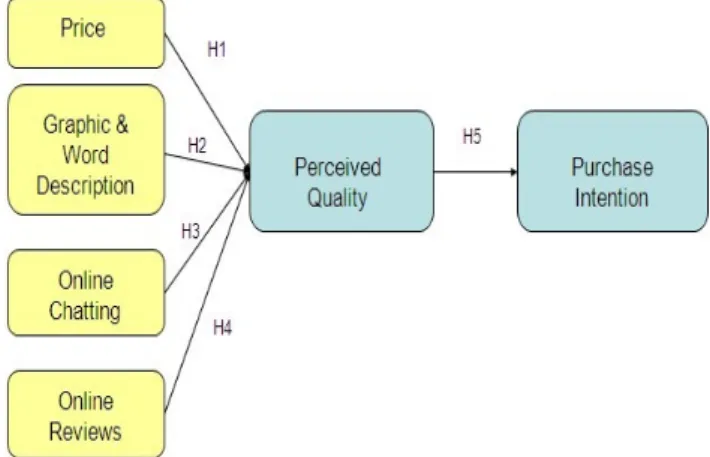
In conclusion, after screening, The relation among these variables shown in the following chart:

<Figure 2> Research Model

3.2. Research Hypothesis

3.2.1 The Influence of Price on Perceived Quality

In economics, price is always considered as the restraint of pur- chase and has negative effects on purchase, for high price only lead consumers buy less products and service. However, from the psycho- logical point of view, price can convey a certain message to consum-

ers, for example quality information. Therefore, price becomes one of the attributes of products (Erickson and Johansson, 1985). Price be- comes a part of products and also one of the basic cues which are used by consumers to assess product quality (Olson, 1972).

Though there are a lot of studies about price-quality (Rao and Monroe, 1989), there is few research that can clearly show when and under what circumstance should consumers’ judgment on quality be attributed to price or other information (Rao, 2005).

People like Wheatley (1981) and Dodds find the relation between price and perceived quality is linear. People like Shiv (2005) find that price can play the role of “placebo” in consumers’ assessment of product quality. High price causes consumers’ higher expectation for quality, thereby, consumers take for granted that products with high quality means products with good quality.

Hypothesis 1: The higher the price, the higher the perceived qual- ity from consumers. Price will have positive influ- ence on perceived quality (+).

3.2.2 The Influence of Graphic and Word Description on Perceived Quality

Kotler and Keller(2009), Advertising is any paid form of non-per- sonal presentation and promotion of ideas, goods or services by an identified sponsor. From the above definition, the graphic and text display of online stores has the same level function of advertisement except for there is no need to pay for it. Besides, the description and photos of online stores not only include the experience of sellers themselves, but also more descriptive words, photos and videos quot- ed by sellers from officials of the products.

Billy Bai (2008) thinks that purchasing information, product in- formation and information quality and so on can influence consumers’

satisfaction and delight and further influence consumers’ purchase intention. Jean Ethier (2008) studies the relation between interface de- sign and emotion of B2C website, finding that website information influences consumers’ whole assessment for online purchase and at the same time, it is influencing consumers’ online estimating ability and controlling ability. Marquardt and McGann (1975) find that prod- ucts with more advertisement have positive correlation with product quality. Consumers take level of advertisement put-in as the signal of product quality. The high advertisement put-in becomes the signal of high quality and the signal of being worth purchasing.

Hypothesis 2 : The more detailed graphic and word description, the higher perceived quality from consumers.

Graphic and word description will have positive influence on perceived quality(+).

3.2.3 The Influence of Online Chatting on Perceived Quality

The sellers own the real information of the products, which can

make them assess the products’ quality objectively. Thus, the in-

formation asymmetry about product quality between purchasers and

sellers are formed (Akerlof, 1970). Because sellers are those who

have the closest relation with consumers, sellers are in the central po-

(5)

sition of establishing and developing good relationship between buyers and sellers (Levitt, 1983; Macintosh et al., 1992; Boles, 2000). With the continuous development of the Internet and the continuous renew- al of network communication methods, the online chatting between the consumers and the sellers has been realized. Sellers, as the carrier of product information, will be firstly asked for the answers needed by the consumers when they doubt on the products.

Hypothesis 3: The more detailed online chatting between consum- ers and sellers, the higher perceived quality. Online chatting will have positive influence on perceived quality (+).

3.2.4. The Influence of Online Reviews on Perceived Quality Stafford (1966) believes that in the process of making purchasing decision, the cognition of consumers themselves plays a leading role.

However, many extrinsic factors can influence consumers on their cognition for products and their purchase intention, among which the influence of reference group on consumers is included. Reviewers, as the reference group of online stores, also belong to the purchasers who buying the same kind of products in the online store. Both the positive and negative comments of stores and products are the related information that is transmitted to the consumers. It is such kind of comments and reviews that compose the reputation of the online stores. All the reviewers have already gotten the products of the on- line stores, then, they can provide relatively objective comments on quality.

Hypothesis 4: The more the quantity and quality of online reviews are, the higher the perceived quality of products from consumers. Online review will have positive influence on perceived quality (+).

3.2.5. The Influence of Perceived Quality on Purchase Intention The conclusion of the previous researches finds that perceived quality mostly together with perceived risk have an impact on per- ceived value, while, perceived value has an impact on purchase in- tention or purchase behavior (Zeithaml, 1988; Dodd et al., 1991).

People like Dodds believe that the relation among perceived quality, perceived value and purchase intention is positive correlated.

However, this paper, which is based on S-O-R Model, believes that perceived quality as the variable, converts into response varia- ble-purchase intention through a series of process like the recognition and analysis of cues and the assessment of products.

Hypothesis 5: The better perceived quality from consumers, the stronger purchase intention.

3.3. Instruments Development Procedure and Measures

There is much extrinsic stimulus influencing consumers’ online shopping. This research integrates the specific situation of consumers’

online shopping with cue utilization theory and chooses product price,

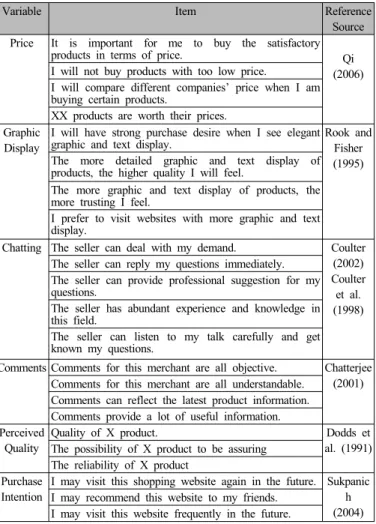
graphic display, online chatting and others comments. Product price can be copied from Ailawadi, Neslin and Gedenk (2001) through four questions to measure; graphic display can take reference from Rook and Fisher (1995) through four questions to measure; online chatting is from Coulter (2002) through five questions to measure; online comments take reference from Chatterjee (2001) through four ques- tions to measure. As to the measurement of organic variable per- ceived quality, this paper mainly based on Dodd et al (1991) through three questions to measure. Response variable purchase intention takes reference from Sukpanich (2004) through four questions to measure.

The questionnaire of this paper mainly uses the five measurements of Likert. There are seventeen questions for the extrinsic stimulus part, three questions for organic variable and response variable respectively to measure.

<Table 1> Summary of Instruments

Variable Item Reference

Source Price It is important for me to buy the satisfactory

products in terms of price. Qi

(2006) I will not buy products with too low price.

I will compare different companies’ price when I am buying certain products.

XX products are worth their prices.

Graphic Display

I will have strong purchase desire when I see elegant

graphic and text display. Rook and

Fisher (1995) The more detailed graphic and text display of products, the higher quality I will feel.

The more graphic and text display of products, the more trusting I feel.

I prefer to visit websites with more graphic and text display.

Chatting The seller can deal with my demand. Coulter (2002) Coulter

et al.

(1998) The seller can reply my questions immediately.

The seller can provide professional suggestion for my questions.

The seller has abundant experience and knowledge in this field.

The seller can listen to my talk carefully and get known my questions.

Comments Comments for this merchant are all objective. Chatterjee (2001) Comments for this merchant are all understandable.

Comments can reflect the latest product information.

Comments provide a lot of useful information.

Perceived Quality

Quality of X product. Dodds et

al. (1991) The possibility of X product to be assuring

The reliability of X product Purchase

Intention

I may visit this shopping website again in the future. Sukpanic h (2004) I may recommend this website to my friends.

I may visit this website frequently in the future.

4. Data Analyses and Result 4.1. Demographic Analyses

This research mainly adopts instant chatting tools and E-mail to finish the issue and collection of the questionnaire. Finally, there are 357 copies being collected.

First of all, most of the informants have ever done online shop-

(6)

Component Cronbach’s

1 2 3 4 α

Description 4 .904 .804

Description 3 .864 Description 1 .858 Description 2 .658

Online Chatting5 .804 .856

Online Chatting2 .795

Online Chatting4 .741

Online Chatting1 .689

Online Chatting3 .675

Online Reviews 4 .837 .808

Online Reviews 2 .786

Online Reviews 3 .780

Online Reviews 1 .771

Price 3 .842 .736

Price 2 .761

Price 4 .747

Price 1 .661

3.694 2.545 2.280 2.199 KMO

.663

% of Variance 21.732 14.970 13.411 50.113 Cumulative % 21.732 36.702 12.938 63.051

Item Component Cronbach’s

α

1 2

1 .927 .904

Perceived Quality 2 .843 Perceived Quality 3 .835

Purchase Intention 3 .855 .859

Purchase Intention 1 .847

Purchase Intention 2 .825

Total 3.914 1.026 KMO

% of Variance 65.238 17.102 .793

Cumulative % 65.238 82.340

ping in Taobao. Secondly, the difference of gender in this research is not significant with the proportion of the female is a little higher than that of the male-129 male (43.0%) and 171 female (57%). The career distribution of the informants is relatively equal with 65 tech- nological workers (21.7%), 62 students (20.7%), 61 the self-employed (20.3%), 53 from sales and service (17.7%), 42 officials (14.0%) and 17 affairs professionals (5.7%). The education level of the informants is mainly bachelors’ degree. As to the income, there are 117 (39.0%) between 3000 and 5000 RMB (1CNY≈165KER), 89 (29.7%) be- tween 2000 and 3000 are 53 (17.7%) below 2000. The current loca- tion of the informants is relatively equal, with 98 (32.7%) in Beijing,95(31.7%) in Shanghai,107(35.7%) in Liaoning. As to the time for visiting websites, there are 212(70.7%) less that 5 hours per week. There are 144(48.0%) buy products like clothes, shoes and hats or something like these.

4.2. Reliability and Validity Analysis

In order to measure the validity of factors, this research adopts the exploratory main elements analysis. In order to extract the structural elements for all factors, it adopts principle component analysis.

Cronbach’s α was used for testing reliability of measures. Based on the benchmark built by Bagozzi and Yi (1988), cronbach’s α over .60 indicates high construct reliability. In the research <Table 3> and

<Table 5> indicated that all the values of cronbach’s α are over .70, which demonstrate adequate construct reliability student data. And Validity of the data was checked through EFA (Exploratory Factor Analysis). KMO are both over 0.6.

<Table 2> Cronbach’s a, KMO and Exploratory Factor Analysis of cues

4.3. Confirmatory Factor Analysis

Our measurement model provides a satisfactory fit to the data, which resulted in χ2 (74) = 194.033, which is statistically significant (p < .001). The fit indices are as follows: Normed fit index (NFI) = .885; incremental fit index (IFI) = .925; comparative fit index (CFI)

= .924; Goodness-of-fit index (GFI) = .926; and root mean square er- ror of approximation (RMSEA) = .074, indicating high level of val- idity of the measures. According to Stevens (1992) it was decided to consider all factor loadings = or > 0.25 as significant. Thus, the measures of the sports customers’ data demonstrate adequate con- vergent validity.

<Table 3> Analysis for Measurement Items

Factor Items Standardized factor

loading Price

Price1 .416

Price2 .649

Price3 .941

Description Description1 .551

Description3 .396

Online Chatting

Online Chatting2 .976

Online Chatting3 .474

Online Chatting4 .450

Online Review

Online Review1 .897

Online Review2 .707

Online Review3 .480

Perceived Quality Perceived Quality2 .756

Perceived Quality3 .695

Purchase Intention Purchase Intention1 .839 Purchase Intention2 .836 Model fit index: χ

2

=194.033,df=74,NFI=.885,IFI=.925,CFI=.924,GFI=.926,RMSEA=.074

4.4. Model and Hypotheses Testing

To test the hypotheses, structural equation modeling with the max- imum likelihood estimation method (Bollen, 1989) is employed, using the model without moderator. Anderson and Gerbing’s (1988) two-step approach is followed in structural equation modeling, for which the estimation of a confirmatory measurement model must pre- cede the simultaneous estimation of the measurement and structural sub-models. Based on confirmatory factor analysis results, the research model is tested with standardized coefficients and other fit statistics.

To assess the differential effects, standardized coefficients are reported as path coefficients.

<Table 4> Results of Model Testing

χ

2

df GFI NFI IFI CFI RMSEA

195.123 76 .924 .884 .926 .924 .072

*p<.05, **p<.01, ***p<.001

(7)

<Figure 3> Results of Hypotheses Testing

4.4.1. Model Testing

Examination of the overall model fit reveals the Chi-square statistic (χ

2

= 195.123, df = 76) at a significant level (p<.001). The fit in- dices are as follows: NFI = .884, IFI = .926, CFI = .924, GFI = .924, RMSEA = .072. Based on the cutoff criteria of Hair, Anderson, Tatham, andBlack(1998),it is concluded that the research model fit the data reasonably well.

4.4.2. Hypotheses Testing

As seen in <Table 5>, the standardized coefficient from price to perceived quality was found to be .051 with C.R of .681, which was not significant. The standardized coefficient from description to per- ceived quality was found to be .383 with a C.R of 2.686 which was significant (p < .01). The standardized coefficient from online chatting to perceived quality was found to be .217 with C.R of 2.545 which was significant. The standardized coefficient from online review to perceived quality was found to be .229, with C.R of 2.255 which was significant (p < .05). Finally, the standardized coefficient from perceived quality to purchase intention was found to be .794 with C.R of 6.068 which was significant (P< .001). Thus, our research hy- pothesis 2, hypothesis 3, hypothesis 4 and hypothesis 5 were sup- ported based on the results of the analyses summarized above.

4.5. Summary of Hypotheses Test

Based on the data analysis results, the summary of the results is concluded in <Table 5> and <Table 6>. For Chinese consumer, H2 (Graphic and word description will have positive influence on per- ceived quality), H3 (Online chatting will have positive influence on perceived quality), H4 (Online review will have positive influence on perceived quality), H5 (Perceived quality will have positive influence on purchase intention) were found to be supported based upon results of analyses mentioned above.

Thus, there analyses in hypotheses testing suggest following find- ing:

a. Price does not have positive influence on perceived quality.

b. Graphic and word description has positive influence on per- ceived quality.

c. Online chatting has positive influence on perceived quality.

d. Online review has positive influence on perceived quality.

e. Perceived quality has positive influence on purchase intention.

<Table 5> Standard Coefficients and T-value for Each Path

No. Hypotheses Standard

Coefficient

C.R. P

1 Price →Perceived Quality .051 .681 .496

2 Description →Perceived Quality .383 2.686 .007 3 Online Chatting →Perceived Quality .217 2.545 .011 4 Online Reviews →Perceived Quality .229 2.255 .024 5 Perceived Quality →Purchase Intention .794 6.068 .000

<Table 6> Summary of Results for Hypotheses Testing

No. Hypotheses Results

1 Price will have positive influence on perceived quality Not Support 2 Graphic and word description will have positive

influence on perceived quality

Support

3 Online chatting will have positive influence on perceived quality

Support

4 Online review will have positive influence on perceived quality

Support

5 Perceived quality will have positive influence on purchase intention

Support

4.5.1. Interpretation of Hypotheses Test Results

As for the cue utilization issue when consumers form the per- ceived quality, although scholars have certain knowledge, their results are greatly different in many aspects. During their studies, scholars use different products and adopt different interviewees. Both the char- acteristics of products and statistics of the interviewees have important effect on cue utilization. As to the problem of the disaccord of price-perceived quality which is studied more among the scholars, Rao and Monroe (1989) do relevant research and put forward four causes that may influence the disaccord, that is, number of cues, ex- perimental design, price manipulation and price level. However, this paper believes that different attitudes towards price according to dif- ferent incomes in different areas can also lead to the disaccord of in- fluence of price on perceived quality.

Through the study, we conclude that cues (information) can also

influence consumers’ judgment on perceived quality under the back-

ground of online stores. Price has no effect on perceived quality dur-

ing the online purchase. While, the graphic and word description of

the products can, to large extent, influence consumers’ cognition of

product quality. Online review has relative less influence on perceived

quality. Although people can provide relatively objective information,

consumers have little trust towards the online strangers. Therefore, on-

line review can only play an influencing role instead of determining

role for consumers’ perceived quality. Similarly, online chatting with

sellers has effect on consumers’ perceived quality. According to con-

sumers’ online purchasing habits, they always firstly browse the rele-

vant information about the products on the websites, and if there are

more detailed or puzzled questions, they communicate with the

sellers. Or if consumers intend to know some information relevant to

purchase not products (logistics, after-service, return policy and so

on), they have to chat with the sellers online. Therefore, online chat-

ting with sellers may have little effect on consumers’ perceived

quality.

(8)

5. Conclusion and Implication 5.1. Summary of the Research

This paper mainly focuses on the influence of cues of online stores on consumers’ perceived quality under the circumstance of on- line-shopping environment.

Based on the data analyses results, the summary of the results are follows.

H2 (Graphic and word description will have positive influence on perceived quality), H3 (Online chatting will have positive influence on perceived quality), H4 (Online review will have positive influence on perceived quality), H5 (Perceived quality will have positive influ- ence on purchase intention) were found to be supported based upon results of analyses.

Model and hypotheses testing was conducted by using AMOS 17.0. Following finding were drawn from results of these analyses:

first, price does not have positive influence on perceived quality.

Second Graphic and word description has positive influence on per- ceived quality. Third, online chatting has positive influence on per- ceived quality. Forth, online review has positive influence on per- ceived quality. Fifth, perceived quality has positive influence on pur- chase intention.

5.2. Implications

With people’s acceptance and approval for the online purchasing form, the number of shopping websites is increasing continuously.

The diversification of shopping websites makes the competition among online stores more and more serious. In order to attract more consumers and promote their purchasing intention, this study has the following guiding significance on the reality:

First of all, product information should be added. As to the prod- uct or service information provided by the websites, if they are com- prehensive, timely, and easy for understanding, then consumers can learn about the relevant information of the products and service quite well. And then, they can know the product quality better and make right decision. What’s more, the online stores should update the prod- uct information in time, provide latest product information and de- scribe products and service clearly and comprehensively in order to let consumers have a thorough knowledge of the products they want.

Secondly, when people are shopping, they hope not only to buy the products they want, but also to obtain good service. The inter- action among online people can let consumers feel like they are ac- tually in the game, as if they are in real stores. It is a timely and effective supplement for the omission of information by communicat- ing with the sellers face to face. Therefore, it is suggested that online stores also should keep closed connection and timely interaction with consumers.

At the same time, online review on the products from consumers deserves a certain attention, which can have an effect on consumers who have purchasing intention. If the online review is more about the positive description of product quality, it will make the products leave better impression to consumers. By contrast, if the online re-

view is more about the negative ones, it will make the products leave negative impression to consumers. The sellers can do advance evaluation of the products through the situation of online review in order to adjust price or reduce the number of the sales of this products.

The academic significance lies in introducing the concept of per- ceived quality into online-shopping environment and testifying that cue utilization can also influence the perceived quality of products.

5.3. Limitations and Future Research Recommendations Although this study has made a certain achievement, there are some shortcomings which are mainly reflected in the following as- pects:

1. This study only focuses on the young group in Beijing, Shanghai and Liaoning anditonly focuses on eastern part of China to do sample analysis.

2. This study does not do further research under the trans-cultural background and does not do comparative study of multicultural background or the consumption status of the transnational consumers.

3. This paper mainly focuses on the influence of cues (information) on perceived quality and the influence of per- ceived quality on purchase intention, without introducing per- ceived risk or perceived value which belongs to other situations that influence consumers’ purchasing intention at the same time.

Based on the above limitation, the author believe that there is still existing some space for further discussion according to the following aspects: 1. Comparative study can be conducted among different re- gions, different cultures and different countries in order to examine wider attitude for perceived quality and purchasing intention among consumers. 2. In the future study, the construction of websites will inevitably have new functions and characters. The elements of online shopping will change. The further study can do some addition or de- letion according to the changes.

Received: February 14, 2013.

Revised: March 22, 2013.

Accepted: April 15, 2013.

References

Ailawadi., K.L., Neslin, S.A. & Gedenk, K. (2001), “Pursuing the Value-Conscious Consumer: Store Brands Versus National Brand Promotions”, The Journal of Marketing, 65(1), 71-89.

Akerlof, G.A. (1970), “The Market for “Lemons”: Quality Uncertainty and the Market Mechanism”, The Quarterly Journal of Economics, 84(3), 488-500

Amit, P. Naveed, D. & Wei, Yujie. (2009), “Web Site Customer Orientations, Web Site Quality, and Purchase Intentions: The Role of Web Site Personality”, Journal of Business Research, 62, 441-450.

Anderson, J.G. & Gerbing, D.W. (1988), “Structural Equation

Modeling in Practice: A Review and Recommended Two-Step

(9)

Approach”, Psychological Bulletin, 103, 411–23.

Bagozzi, R.P. & Yi,Y. (1988), “On the Evaluation of Structual Equation Models”, Journal of the Academy of Marketing Science, 16 (1), 74-94.

Bai, B. & Law, R. (2008), “The Impact of Website Quality on Customer Satisfaction and Purchase Intentions: Evidence from Chinese Online Visitors”, International Journal of Hospitality Management, 27(3), 391-402.

Baker, J. Grewal, D. & Parasuraman, A. (1994), “The Influence of Store Environment on Quality Inferences and Store Image”.

Journal of The Academy of Marketing Science, 22, 328-339.

Bollen, KA. (1989), Structural Equation Modeling with Latent Variables, NewYork: JohnWiley.

Brucks, M. Zeithaml, VA. & Naylor, G. (2000), “Price and Brand, Indicators of Quality Dimensions for Consumer Durables”, Academy of Marketing Science, 28(3), 217—222.

Chatterjee, P. (2001), “Online Review: Do Consumers Use Them?”, Association for Consumer Research, 21, 129-134.

Chen, YH. Barnes, S. (2007), “Initial Trust and Online Buyer Behavior”, Industrial Management & Data Systerms, 107(1), 21-36.

China Internet Network Information Center (2010), “26

th

China Internet Development Statistics Situation Report(CNNIC)”, Retrieved from http://Search.cnnic.cn

Coulter, KS. & Coulter, R.A. (2002), “Determinants of Trust in a Service Provider: the Moderating Role of Length of Relationship”, The Journal of Services Marketing, 16(1), 35-50.

Dailey, L. (2004), “Navigational Web Atmospherics: Explaining the Influence of Restrictive Navigation Cues”. Journal of Business Research, 57, 795-803.

Dawar, N. & Parker, P. (1994), “Marketing Universals: Consumers’

Use of Brand Name, Price, Physical Appearance, and Retailer Reputation as Signals of Product Quality”, Journal of Marketing, 58(2), 81-95.

Erickson, G.M. & Johansson, J.K. (1985), “The Role of Price in Multi-Attribute Product Evaluations”, Journal of Consumer Research, 12(2), 195-199.

Eroglu, S.A. Machleit, K. & Davis, L.M. (2001), “Atmospheric Qualities of Online Retailing A conceptual Model and Implications”, Journal of Business Research, 54, 177-184.

Fishbein,. M. (1975), “Belief, Attitude, Intention, and Behavior: An Introduction to Theory and Research” Behavior Human fac- tors Research,521-562. Retrieved Aug 22, 2012, from the get CITED database.

Grönroos, C. (1981), “Service Management and Marketing the Moments of Truth in Service Competition”, Retailing and Consumer Services, 5, 171-173.

Hair, J.F., Anderson, R. E., Tatham, R.L. & Black, W.C. (1998), Multivariate Data Analysis, 5th ed., Upper Saddle River, NJ:

Prentice-Hall.

Hausman, A. V. & Siekpe, J. S. (2009), “The Effect of Web Interface Features on Consumer Online Purchase Intentions”, Journal of Business Research, 62, 5-13.

Ethier, J. (2008), “Interface Design and Emotions Experienced on B2C Web Sites: Empirical Testing of a Research Model”, Computers in Human Behavior, 24(6), 2771-2791.

Ko, Eunju. Kim, Kyung-Hoon. & Zhang, Hao (2008), “A Cross Cultural Study of Antecedents of Purchase Intention for Sports Shoes in Korea and China”, Journal of Global Academy of Marketing Science, 18(1), 157-177.

Kotler, P., Keller, K.L. & Lu, T. (2009), Marketing Management in china..Pearson. 13th, Beijing, China: Pearson Education, 538.

Marquardt, R.A. & McGann, A.F. (1975), “Does Advertising Communicate Product Quality to Consumers: Some Evidence from Consumer Reports”, Journal of Advertising, 4, 27-31.

Mehrabian, A. & Russell, J.A. (1974), An Approach to Environmental Psychology, Cambridge, MA:M.I.T. press, 222-253.

Monroe, K.B. Grewal, D. (1991), “Effects of Price, Brand, and Store Information on Buyers’ Product Evaluations”. Journal of Marketing Research, 28(3), 307-319.

Olison, J.C. & Jacoby, J. (1973), “Influence of Technology on Perceived Quality”, Advances in Consumer Research, 6, 171-173.

Pavlou, P.A. (2003), “Consumer Acceptance of Electronic Commerce:

Integrating Trust and Risk with the Technology Acceptance Model”, International Journal of Electronic Commerce, 7, 101-134.

Rao, A.R. & Monroe, K.B. (1989), “The Effect of Price, Brand Name, and Store Name on Buyers’ Perceptions of Product Quality: An Integrative Review”, Journal of Marketing Research, 26(8), 351-357.

Rao, A.R. (2005), “The Quality of Price as a Quality Cue”, Journal of Marketing Research, 42(11), 401-405.

Richard, M. (2005), “Modeling the Impact of Internet Atmospherics on Surfer Behavior”, Journal of Business Research, 58, 1632-1642.

Rook, D.W. & Fisher, R.J. (1995), “Normative Influences on Impulsive Buying Behavior”. Journal of Consumer Research, 22(3), 305-313.

Shiv, B., Carmon, Z. & Ariely, D. (2005), “Effects of Marketing Actions: Consumers May Get What They Pay For”, Journal of Marketing Research, 42(11), 383-393.

Turley, L.W. & Milliman, R.E. (2000), “Atmospheric Effects on Shopping Behavior: A Review of the Experimental Evidence”, Journal of Business Research, 49, 193-211.

Wheatley, J.J. Chiu, J.S.T. & Goldman, A. (1981), “Physical Quality, Price, and Perceptions of Product Quality: Implications for Retailers”, Journal of Retailing, 57, (2), 100—116.

Zeithaml, V.A. (1988), “Consumer Perceptions of Price Quality, and

Value: A Means-End Model and Synthesis of Evidence”,

Journal of Marketing, 52(3), 2-22.

수치

Graphic and word description will have positive  influence on perceived quality(+).
Graphic  Display

참조

관련 문서

A Study on the Influence of C4I System Quality on Operational Performance : Role of Perceived Usefulness and User Satisfaction.. Young Sin Jeong 1) ․ Jong Woo Park *,2) ․

Overall, we expect that trust, benefit, shopping enjoyment, and website quality are likely to positively influence purchase intention, and perceived risk negatively

Perceived value has an effect towards purchase intention of smartphone’s users (t=2.09, p&lt; .05), meaning that if consumers perceive the value of the product to be

The Influence of Visual Merchandising Congruity Perception on Brand Attitude and Purchase Intention: Focusing on Mediation Effect of Perceived Risk.. Hyun

In detail, this paper is to examine how customer's perceived value of corporate social media influences CRM quality(CRM trust and CRM commitment), and then

Therefore, current study employed Systemic, Humanic, Physical, and Convenience factors to assess the event quality as perceived by a local food festival participants

Based on a high level of product quality and brand- ing on the international cafes, more satisfied café hoppers are able to be less price perceived which would leads to

First, in terms of quality factors affecting perceived value, literary quality, lev- el, professionalism, and musical quality were shown to have a sig- nificant influence