1. INTRODUCTION
The market of the local event is keep growing each year and planners of the event began to appear in the market and the profession is becoming more specialized. Local festival in- cluding food festival has been known to have a significant influence on the local society and economy in deriving a lot of benefits from the participants and improving the destina- tion image (Jang & Feng, 2007). Visitors of local event parti- cipate in the festival for various reasons. People are more trav- el oriented and enjoy activities or foods, and the visitors are willing to come back the place based on their positive memo-
ries from first visiting (Vajirakachorn & Chongwatpol, 2017).
Food has been recognized one of critical elements to exert a strong influence on people’s positive satisfaction or future intention in diverse sectors. Specifically, food seems to be ac- cepted as a fundamental component to satisfy restaurant cus- tomers (Lee, 2016; Namkung & Jang, 2007; Raajpoot, 2002;
Sulek & Hensley, 2004; Lee, 2016), and tourists (Axelsen &
Swan, 2009; Bessiere, 1998; Son, Lee, & Kim, 2016). For exam- ple, Axelsen and Swan (2009) identified that festival attributes including quality of food can influence on positive consumer perception of general evaluation of food festival. In addition, Kim, Jang, and Kim (2016) found that food involvement can Information available at the Culinary Society of Korea (http://www.culinary.re.kr/)
Culinary Science & Hospitality Research
Journal & Article Management System: https://cshr.jams.or.kr/
http://dx.doi.org/10.20878/cshr.2017.23.6.015
The Influence of Event Quality on Brand Value, Satisfaction and Recommend Intention as perceived by Local Food Event Participants:
Case of Miderdok Festival in Changwon Province
Hee-Seog Kang
1, Jeong-Mee Park
1and Sang-Mook Lee
21
Dept. of Culinary & Foodservice, Kyonggi University, Korea
2
Dept. of Foodservice Management, Kyungsung University, Korea
KEYWORDS ABSTRACT
Event quality, Brand value,
Recommend intention, Local food festival.
The purpose of current study was to identify the influence of event quality on brand value, satis- faction, and recommend intention as perceived by a local food festival participants. Survey was distributed to the Changwon Miderdok festival participants, 350 questionnaire surveys were distri- buted and 330 participants were employed for statistical analysis with erasing invalid responses.
Based on the process of hypothesis verification on the formulated model, it suggested that moti- vation factors have significantly impact on evolvement element. Specifically, humanic and physical elements were significant predictors of both brand value and satisfaction, and all factors of event quality except convenience were critical antecedents of visitors’ satisfaction. In current study, in addition, brand value has positive influence on satisfaction and satisfied visitors tried to recommend the destination to others. This study will help to develop meaningful marketing strategy for local food festival industry. Furthermore, this study will contribute to improve an attractive business model to increase profit for both local society and academic study related to local food festival.
Corresponding author: Sang-Mook Lee, Assistant Professor, Dept. of Foodservice Management, Kyungsung University, 309 Suyeong-ro, Nam-gu,
Busan 48434, South Korea, Tel. +82-10-663-4474, Fax. +82-51-627-6830, E-mail: [email protected]
impact on tourists’ behavior and intension of revisiting in a food festival. In the similar vein, Son et al.(2016) identified food is important factor in tourists’ experiences from domestic tourists’ perspectives. Even though food is clearly obvious fac- tor will influence people’s final decision, limited studies identi- fied the relationship among general quality of event and other significant elements especially in a specific local food festival.
Quality is formed based on the level of satisfaction by con- sumers with the provided services (Kwon, Seo, & Lee, 2011;
Shin, Song, & Lee, 2012). Therefore, quality in the event in- dustry reflects consumer value, and event quality influences to individual reaction and emotion in evaluating service (Jin, Lee, & Lee, 2013). Prior scholars used the concept of event quality as a critical predictor between other factors such per- ceive value, perception, brand and positive future behaviors (Jin et al., 2013; Yoon, Lee, & Lee, 2010; Lim & Lim, 2010).
For instance, Yoon et al. (2010) employed five dimension of festival quality as service, food, informational, program, souve- nir, and convenience, and those elements closely related each other and influence on participants perception. In addition, Lee, Lee, and Choi (2011) identified factors of festival qualities as informational service, festival product, environmental factor, program, and convenience facility. Furthermore, previous stu- dy emphasized the intangible factors related emotional side as well as tangible cues in event industry (Lim & Lim, 2010).
Although the rapid growth of the event market in the re- lated industry, research on the local event is very limited.
Especially, although the local food festival is becoming a ma- jor event in related industry, detailed and logical research on the effects of various event attributes on the brand value, and recommendation intention, among other things, is limited.
Therefore, this study identified attributes of event quality per- ceived by customers who has invited to the local event, and investigated how the event quality influences the brand value, satisfaction, and recommendation intention from the Mider- dok festival participants which is one of famous local food fes- tival in South Korea.
2. LITERATURE REVIEW
2.1. Event Quality
Evaluation is formulated from the general perception about experienced service or products by consumers and quality is formed based on the level of satisfaction experienced that de- veloped by a service provider (Kwon et al., 2011; Shin et al.,
2012). Therefore, quality can be justified as a critical predictor to influence on consumers’ evaluation toward something as perceived by the provider. However, perception of quality is not only developed by assessment of the service or product, but it also effects decision-making of the customer (Jung, 2009). Especially, quality in the event sector reveals people value, and the event quality states to consumer behavior as long as emotional side (Jin et al., 2013). In hence, event qual- ity is particularly highlighted by considering various intangible aspects with few tangible factors (Lim & Lim, 2010). Prior re- searchers who conducted studies about event quality have been performed their research in numerous spaces. For exam- ple, regarding festival-related event quality, Yoon et al. (2010) recognized intangible and tangible factors such as souvenir, informational service, program, food, and facility are sig- nificantly effect on consumers’ satisfaction and behavioral intention. In addition, Lee et al. (2011) examined the role of emotional and functional values in festival evaluation, and identified factors of festival qualities, based on relevant re- search, as informational service, festival program, festival prod- uct, natural environment, and convenience facility. Therefore, current study employed Systemic, Humanic, Physical, and Convenience factors to assess the event quality as perceived by a local food festival participants based on previous studies.
In the event market, quality refers to individual feedback and emotion in evaluating service (Jin et al., 2013), and social sci- ence researchers have agreed on the importance and appro- priateness of using brand value as a concept for understan- ding human behaviors and conducted extensive research on the subject. In sum, present study considered the clues of event quality as significant antecedents of brand value and other dependent variables such as satisfaction and recom- mend intention.
2.1. Brand Value
Aaker (1990) defined brand as a sum of assets and liabilities
related to the relevant symbol, and suggested that it either
increases or decreases the value of a product or service pro-
vided by a company to the customers. Brand value is a cu-
rrency value for which consumers are willing to pay addition-
ally to buy a particular brand over other similar brands. When
consumers perceive a brand value as being higher, the cu-
rrency value is considered as being higher as well. Therefore,
in developed countries, brand values have been converted in-
to price as early as the late 1980s (Simon & Sullivan, 1993).
Simon and Social science researchers have agreed on the im- portance and appropriateness of using brand value as a con- cept for understanding human behaviors and conducted ex- tensive research on the subject. In research related to con- sumer behavior, value is applied as a tool for understanding consumers’ attitude or behavior (Song, 2010). Because of its intangibility, brand value is understood diversely according to the perspective of the researcher. Hence, this study reor- ganized brand recognition and brand association about the local food festival as the value of brand based on the previous research.
2.3. Satisfaction
Satisfaction is a concept for predicting consumer behavior and defined as a summary of psychological state resulting when the emotion surrounding disconfirm expectations is coupled with the consumer's prior feelings about the con- sumption experience (Oliver, 1980). Also, according to pre- vious studies, satisfaction refers to a cognitive state of custom- er in which, considering both the invested costs and effort for purchasing. Previous studies usually acknowledged the im- portance of the relationship between value and satisfaction to better realize consumers’ behavioral intentions (Lee, Petrick,
& Crompton, 2007; McDougall & Levesque, 2000; Ryu & Han, 2010). Customer satisfaction represents a primary determinant of customers’ long-term behavior, and is identified as a sig- nificant measure of customers’ future actions in hospitality re- search (Chen, 2008; Mithas, Krishnan, & Fornell, 2005; Oliver, 1980; Petrick & Backman, 2002). Westbrook and Oliver (1991) defined satisfaction as the level of product or service perform- ance, quality, or overall outputs through an estimative crite- rion. Hence, current study will estimate the concept of sat- isfaction for assessing the cognitive state after participating the local food event, and the current study has employed satisfaction toward a local food festival as a dependent vari- able of event quality; as well as a mediator of customer re- commend intention of the local food festival.
2.4. Recommendation Intention
Intention means determination for a planned action in the future, and represents the probability of carrying out one’s at- titude or belief in action. In addition, in service settings, re- purchase intention can be defined as a possibility that a cus- tomer would use a product or service again in the future
(Oliver, 1980). Whyte Jr. (1954) explained recommendation in- tention as ‘word-of-mouth intention’ or ‘word-of-mouth’ com- munication, and defined it as communication in interpersonal relationships that takes place between two or more people, such as members of a reference group or customer and seller.
Therefore, the recommendation intention is a psychological behavior of recommending only positive information among a variety of types of information exchanged between relatives, acquaintances, colleagues, and neighbors, to other people (Kim, 2010). A decision-making process does not end when purchase is decided, but includes a series of processes in which consumers experience satisfaction or dissatisfaction while using a purchased item, evaluate their own purchase decision, and decide repurchase of the product. Therefore, post-purchase behaviors can lead to repeated purchase along with positive word-of-mouth, and acts as an important pro- cess that determines positive attitude of consumers toward the same and similar service or product.
Event quality has been explained as a feeling or reaction of consumers when they evaluate a product or service based on their experiences, and the quality has been considered im- portant element since the tangible clues of event has only few visible clues (Jin et al., 2013; Lim & Lim, 2010). In addition, the brand value has been employed as a critical component to better understand consumers’ perception toward company, and it has been affected by various quality clues (Song, 2010).
Therefore, current study proposed the following hypothesizes.
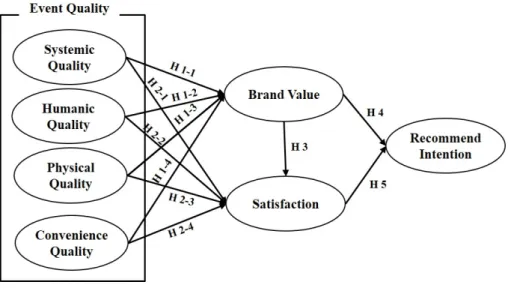
H1: Event quality of local food festival will influence on brand value.
H2: Event quality of local food festival will influence on satisfaction.
H3: Brand value will be critical antecedent of satisfaction and recommend intention.
H4: Satisfied consumers from the local food festival will recommend the event to others.
3. METHODOLOGY
This study designed to find the relationships among event quality, brand value, satisfaction, and recommend intention.
Modification of the preliminary questionnaires developed after
a pilot test with faculty members who are major in hospitality
management and have experienced the local food event. The
validity of the questionnaire checked and subsequently in-
creased by using cross validation. The final survey distributed to participants during a local food event (Miderdok Festival in Changwon Province) in 2017 which is one of famous food festival. First, the designed questions assessed the partic- ipants’ motivation about the experience of festival, which were scored on a Likert seven-point scale ranging from 1 for
“Not important at all”, 4 for “Important”, and 7 for “Very im- portant”. Second, the survey tested to determine the elements of the event quality, four dimensions (Systemic, Humanic, Physical, Convenience) for assessing the local event quality, brand value, satisfaction, and recommend intention estimated by reviewing the previous literature. Data analyzed by using the statistical-analysis program IBM SPSS 22.0 and AMOS 22.0 to identify the relationships on formulated hypotheses.
Demographic statistics tested to verify the participants’ so- cio-demographic elements, and the exploratory and con- firmatory factor analysis conducted to identify the measure- ment model. In addition, structural equation modeling per- formed to confirm the formulated study.
4. RESULTS
4.1. Demographic Information
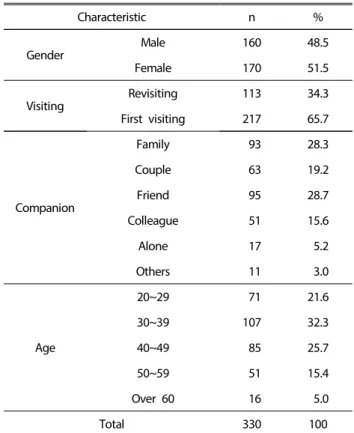
The results of participants’ socio-demographics shown in Table 1. Of the total number of visitors, male constituted 48.5% of the sample, 51.5% were female students. Approxi- mately 34.3% people were revisit consumers and 65.7% partic- ipants are first visiting the festival. In addition, almost 77.9%
respondents visited the festival with friends (28.7%) or family (28.3%), and the thirties (32.3%) are major participants fol- lowed by the forties (25.7%), twenties (21.6%) and so on.
4.2. CFA
To validate the structure of the four constructs for event quality (Systemic, Humanic, Physical, Convenience), and three dependable variables (brand value, satisfaction, and recom- mend intention), present study confirmed reliability and va- lidity of the constructs before conducting the structural model (see Table 2). All factor loadings ranged from 0.680 to 0.961 (Nunnally, 1978), and it was higher than the standard score 0.400. Cronbach’s alpha identified the internal consistency of the factors on the formulated model and checked the reli- ability of the constructs. The results revealed that the ranges of Cronbach’s alpha for the four constructs (0.868 to 0.941)
Characteristic n %
Gender
Male 160 48.5
Female 170 51.5
Visiting
Revisiting 113 34.3
First visiting 217 65.7
Companion
Family 93 28.3
Couple 63 19.2
Friend 95 28.7
Colleague 51 15.6
Alone 17 5.2
Others 11 3.0
Age
20~29 71 21.6
30~39 107 32.3
40~49 85 25.7
50~59 51 15.4
Over 60 16 5.0
Total 330 100
Measurement model and discriminant validity analysis.
Table 1. General characteristics of the participants
are suitable for the appropriate level of internal consistency (Nunnally, 1978). The ranges of composite reliabilities show the appropriate scores (0.849 to 0.944) (Fornell & Larcker, 1981). Average variance extracted (AVE) of the seven factors are sufficient (0.501 to 0.896) by suggested minimum level:
0.500 (Fornell & Larcker, 1981). Assessing the AVE scores with the squared correlation among variables tested discriminate validity (Fornell & Larcker, 1981). Results reported that the range of AVE (0.501 to 0.896) exceeds the range of squared correlations for each pair of measurements (0.11 to 0.92) ex- cept four constructs. To verify the discriminate validity, the ex- ceeded constructs were compared the constrained model and unconstrained model by combining the exceeded variables, and results confirmed the validity. Furthermore, confirmatory measurement models affirmed the reliability of the measure- ment properties (χ
2=165)=404.706; p < 0.001; χ
2/df=2.453;
Incremental fit index (IFI)=0.965; Normed fit index (NFI)=0.943;
Comparative fit index (CFI)=0.965; Tucker Lewis Index (TLI)=
0.955, and Root mean square error of approximation (RMSEA)
=0.066) (see Table 2).
4.3. SEM
Fig. 1. Research model.
Structural equation modeling (SEM) confirmed the devel- oped model and permitted assessment of the hypotheses. The Chi-square statistic for the structural model is 409.938 with 169 degrees of freedom (p < 0.001; CMIN/DF=2.426), and all re- sults of indices identify the model has adequate satisfactory fit (NFI=0.942; GFI=0.894; AGFI=0.855; IFI=0.965; RFI=0.928;
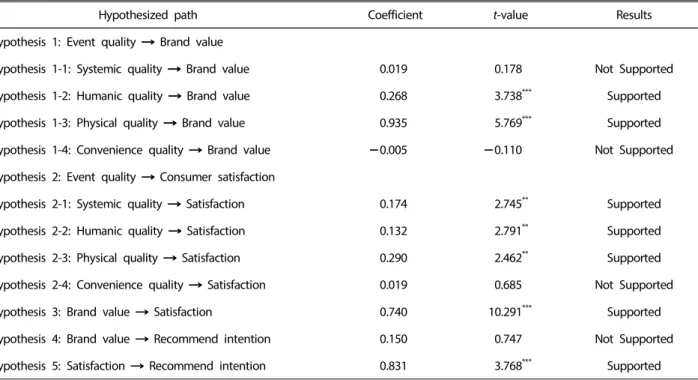
TLI=0.956; RMSEA=0.066) according to the suggested stand- ards (Anderson & Gerbing, 1988). Table 3 shows the path co- efficients for all hypothesized paths in current model. The re- sults shown that the humanic factor and physical factor were significant predictors among event quality, so the Hypothesis 1 was partially supported. In addition, the all of attributes of event quality except convenience factor were positively influ- ence the satisfaction, so the hypothesis 2 was also partially defended. Present study conducted the verify the relation- ships among brand value, satisfaction, and recommend in- tention as perceived by food festival participants. Results re- ported that the brand value was significant factor of customer satisfaction, and satisfied visitors are trying to provide positive recommendation to others. However, the relationship be- tween brand value and recommend intention was not sup- ported in this study. These findings show that important ele- ments of event quality that can differently influence on brand value and customer satisfaction in context of local food fes- tival and positive recommend intention need to be verified through various clues.
5. CONTRIBUTIONS
Increasing desire for leisure activities, present people con-
sidered various festival including food festival. Therefore, this study examined the relationships among quality of local food event, the local festival value of brand, satisfaction and recom- mend intention. The results identify the hypothesis; humanic quality and physical quality among event quality factors sig- nificant influence on both brand value and satisfaction about the food festival. In addition, the systemic quality has been only significant predictor of brand value in this study. In addi- tion, the brand value had appeared as critical antecedent of satisfaction, and the satisfaction was important element of recommend intentions. Therefore, this results can contribute to provide theoretical supporting related academic studies.
Furthermore, current study can provide following practical implication. First, this study found that the humanic quality and physical quality of the food festival were important to im- prove the value of the local festival brand as well as satisfac- tion of visitors. In current study, food quality has been as- sessed as part of physical event quality. Specifically, the taste and quality of the foods using the Miderdock ingredients is most closely affecting customers on the improved the local food festival brand value. In addition, humanic factor such as kindness of the event provider, staffs of the event, and any element related to human can effect of the brand value as well. In sum, the organization of the food festival has to em- ploy proper people and well educate them to provide better service to visitors.
As a result, in this study by founding that positive percep-
tion about the local festival brand caused the most significant
influence on satisfaction. In other way, the brand value was
not significant predictor of recommend intention. Hence, par-
Hypothesized path Coefficient
t-valueResults Hypothesis 1: Event quality Brand value
Hypothesis 1-1: Systemic quality Brand value 0.019 0.178 Not Supported Hypothesis 1-2: Humanic quality Brand value 0.268 3.738
***Supported Hypothesis 1-3: Physical quality Brand value 0.935 5.769
***Supported Hypothesis 1-4: Convenience quality Brand value 0.005 0.110 Not Supported Hypothesis 2: Event quality Consumer satisfaction
Hypothesis 2-1: Systemic quality Satisfaction 0.174 2.745
**Supported Hypothesis 2-2: Humanic quality Satisfaction 0.132 2.791
**Supported Hypothesis 2-3: Physical quality Satisfaction 0.290 2.462
**Supported Hypothesis 2-4: Convenience quality Satisfaction 0.019 0.685 Not Supported
Hypothesis 3: Brand value Satisfaction 0.740 10.291
***Supported
Hypothesis 4: Brand value Recommend intention 0.150 0.747 Not Supported Hypothesis 5: Satisfaction Recommend intention 0.831 3.768
***Supported
χ
2=409.938, d.f.=169, NFI=0.942; IFI=0.965, TLI=0.956, GFI=0.894; RMSEA=0.066.
* p<0.05, **