• 검색 결과가 없습니다.

The Effect of Essential Online Elements on Consumer Purchase Intention: Insights from a Taobao Perspective

N/A
N/A
Protected

Academic year: 2021

Share "The Effect of Essential Online Elements on Consumer Purchase Intention: Insights from a Taobao Perspective"

Copied!
8
0
0

로드 중.... (전체 텍스트 보기)

전체 글

(1)

Abstract

Purpose – Transparency, seller reputation, and website se - curity are considered to be important factors that influence on- line customer purchasing decisions in China. This paper empiri- cally examines the relative influence of Taobao.com on custom- ers’ online purchasing decisions.

Research design, data, and methodology – We perform struc - tural equation analysis, with a sample of 306 observations. The data comes from consumers’ real transaction experiences from a specific website. This gives the results of our study more generalizability than studies using subjects who are not asked to engage in real transactions.

Results – The results of this study reveal that perceived se - curity and perceived reputation are critical factors affecting con- sumer trust and perceived transparency is most closely asso- ciated with purchase intention.

Conclusions – The findings suggest that perceived trans - parency plays a significant role in increasing online consumer’s purchase intention. The knowledge of the relative impacts of these factors and their roles in the customer transaction experi- ence will be useful in developing customized sales strategies.

The results of this study reveal that perceived transparency ex- erts a stronger effect than perceived reputation on consumer purchase intentions.

Keywords: Perceived Transparency, Perceived Reputation, Perceived Security, Customer Trust, Purchase Intention.

JEL Classifications: M10, M20, M30, M31.

* First Author, College of Electronic Information, Shandong Institute of Commerce and Technology, Ji’Nan, 250103, Shandong China. Tel:

+86-150-5318-5007, E-mail: [email protected].

** Corresponding Author, Professor, School of Economic and Business Administration, University of Suwon, Hwaseong, Korea. E-mail:

[email protected].

1. Introduction

The Internet have brought markets closer to the higher level state of perfect information in China,by reducing the information asymmetries between sellers and consumers. For consumers to make a purchase decision, it is a lot easier to search online for product alternatives, prices, product performance, and vendors.

However, Taobao’s venders find that it more difficulty to convert potential customer’s purchase motivation into reality. Because of the physical and temporal distance between consumers and sell- ers, Internet shopping incurs uncertainty and increases risk through the information asymmetry between the two parties.

How to retain existing customers to make purchases becomes a more important concern for online sellers than ever before (Johnson et al., 2008).

In the presence of such risk and uncertainty, lack of trust has been identified as one of the greatest barriers prohibit Internet transactions (Cheskin, 1999; Hoffman et al., 1999;

Pavlou et al. 2007). Many studies have argued that trust in an online store has become a key predictor of customer decisions in Internet shopping (Gefen, 2002; Qureshi et al., 2009).

Actually, previous research has proposed many trust factors, for example, emphasizing transparency clearly to online consum- ers can influence users’ cognition and directly facilitate the shopping goal attainment (e.g., Eroglu et al., 2003; Parboteeah et al., 2009). Seller reputation is also a strong factor influencing returning customers’ trust (Jarvenpaa and Tractinsky, 1999;

Jarvenpaa et al.,2000), the lack of security as perceived by on- line consumers is another of the main obstacles to the develop- ment of e-commerce (Furnell and Karweni, 1999). However, re- searchers have failed to integrate all these factors into a com- prehensive model, the synergy effect of these factors on online purchase decision needs more attention.

Based on the research needs outlined above, this research attempts to address these limitations by aiming to examine the relative influence of essential elements of www.taobao.com--- perceived transparency (i.e., perception the level of availability and accessibility of e-market information from an Internet seller), perceived reputation (refers to the consumer’s belief that the seller’s word of mouth, or e-service provider, or brand has a good public image) and the perceived security (i.e., reflects re- Print ISSN: 1738-3110 / Online ISSN 2093-7717

http://dx.doi.org/10.15722/jds.13.5.201505.15

The Effect of Essential Online Elements on Consumer Purchase Intention:

Insights from a Taobao Perspective

Zhou Feng*, Un-Kon Lee**

2)
Received: March 26, 2015. Revised: May 05, 2015. Accepted: May14, 2015.

(2)

garding the reliability of the payment methods used)have on on- line consumer trust as well as purchasing decisions. Specifically, we seek to answer two research questions: (1) What are the key dimensions of online trust on www.taobao.com? (2) How would perceived transparency, perceived reoutation and per- ceived security affect online purchase intention differently for customers at an Internet store?

This paper is organized as follows. The next section presents the literature review, followed by the research model and hypotheses. We then describe the research methodology. After interpreting the empirical results, we discuss the theoretical and practical implications and conclude with a summary.

This study contributes to our knowledge on customer deci- sions in a number of ways. First, it examines the relative im- portance of perceived transparency, perceived reputation and perceived security when customers make purchase decisions with an Internet seller. Second, while prior research has exam- ined the effect of elements of website on online customer shop- ping, perceived transparency, which has been largely neglected in the literature, our results indicate that perceived transparency indeed plays an important impact on online customer purchase intention in China.

2. Literature Review

Internet shopping is characterized by risk and uncertainty for customers. Therefore, theories that explain human behavior un- der conditions of risk and uncertainty can shed light on custom- er behavior in the context of Internet shopping. With the ob- jective of investigating the effect of perceived transparency, per- ceived reputation and perceived security on consumer trust, we review the theory of reasoned action (Fishbein and Ajzen, 1975) and the prospect theory (Kahneman and Tversky, 1979).

The theory of reasoned action(TRA) (Fishbein and Ajzen, 1975) explains the relationship between attitudes, intentions and behaviors. TRA model posits that human beings make rational decisions based on the information available to them, and the best determinant of a person's behavior is intent which is the cognitive representation of readiness to perform a given behav- ior(Ajzen and Fishbein, 1980). Accordingly, information quality provided by the e-commerce website contents can greatly affect the intention to purchase. Also, if the information provided by the website is reliable and accurate, then this will increase on- line customer trust which will lead the customer to make the ini- tial purchase.

Prospect theory explains human decisions under conditions of risk and uncertainty from a value maximization perspective (Kahneman and Tversky, 1979). This theory suggests that peo- ple put more weight on positive outcomes that are considered certain than positive outcomes that are deemed probable. It is this certainty effect that causes people to be risk-averse when making decisions involving gains, and this effect explains why people tend to prefer an option with certain but lower benefit over an option with uncertain but higher benefit.

Trust appears in risky and vulnerable decisions and favours the reduction of perceived risk in the decision-making process, and it has been traditionally considered as a key element for the acquisition of a long-term, stable and profitable relationship (e.g. Garbarino and Johnson, 1999; Geyskens and Steenkamp, 1995). Consequently, trust has become a strategic objective for a good many players in e-commerce, since the level of con- sumer trust is directly related to an individual’s intention to pur- chase (Koufaris and Hampton-Sousa, 2002) and, more specifi- cally, with the degree of commitment shown by the purchaser (Mukherjee and Nath, 2003).

2.1. Perceived Transparency

Transparency is clearly visible for online consumers, as it conveys the values of product attributes and the relationships among the product attributes, merchandising information that can influence users’ cognition and directly facilitate the shopping goal attainment (Eroglu et al., 2003; Parboteeah et al., 2009).Perceived transparency is perception the level of avail- ability and accessibility of e-market information to its participants (Zhu, 2004). Perceived transparency benefit consumers because they are able to better discern the product that best fits their needs at a better price. On the other hand, the Internet pro- vides sellers with flexibility to strategically determine the in- formation they will provide to consumers via their selling mechanism.

2.2. Perceived Reputation

According to Wang and Vassileva (2007) reputation is a sub- jective assessment of a characteristic or attribute one entity as- cribes to another based on observations or past experiences.

As an intangible asset, reputation signals information about a firm’s quality and performance (Ghosh and John, 2009).Buyers want to perform transactions without revealing details about their privacy or other details, while typically need to know the reputa- tion of the seller they intend to buy from. Reputation is nothing but a combination of the opinions of other people who have had experience with the particular seller. A seller’s reputation is a big concern for buyers prior to placing an order or making a payment.

2.3. Perceived Security

The lack of security as perceived by online consumers is

another of the main obstacles to the development of

e-commerce (Dong-Her et al., 2004). The reason for this is the

possibility that financial data might be intercepted and put to

fraudulent use (Jones et al., 2000). Kolsaker and Payne (2002)

maintain that security reflects perceptions regarding the reliability

of the payment methods used and the mechanisms of data

transmission and storage. Perceived security may be defined as

the subjective probability with which consumers believe that their

personal information (private and monetary) will not be viewed,

(3)

<Table 1> Structure Measurement

Constructs Item Wording References

Perceive Transparency (PT)

PT1 PT2 PT3 PT4

It is easy to search product information from this website In this website everything is in high transparency Information was introduced in detail

The seller does not concealed product information

Zhu. 2004

Granados et al., 2005

Perceive Reputation (PR)

PR1 PR2 PR3 PR4 PR5 PR6

The seller can abide by integrity The seller has a good WOM

The seller's firm provide high quality product The seller offers speedy product delievery This website has a high service quality The seller has higher RenQi

Wang and Vassileva 2007 Ghosh and John 2009

Perceive Security (PS)

PS1 PS2 PS3 PS4

I think this website shows concern for the privacy of its users I think this website abides by personal data protection laws I feel safe when I send personal information to this website I think this website only collects user personal data for its own use

Guinalίu 2005 Wang et al. 1998 Consumer Trust

(CT)

CT1 CT2 CT3

This website keeps its promises and commitments This website does not make false statements This website is trustworthy

Grazioli and Jarvenpaa 2000

Purchase Intention (PI)

PIN1 PIN2 PIN3

The probability that I would consider buying goods from this website is high If I were to buy goods, I would consider buying it from this store

My willingness to buy goods from this website is high Gefen and Devine 2001

stored, and manipulated during transit and storage by in- appropriate parties in a manner consistent with their confident expectations. Websites may increase consumer trust by decreas- ing perceived environmental risk or by raising security (Warrington, Abgrab, and Caldwell, 2000).

3. Research Model and Hypotheses Development

In this section, we develop a research model, thus, our prime focus is to investigate the relationships between consumer trust, perceived transparency, perceived reputation, perceived security and purchase intention. The conceptual model guiding this re- search is depicted in Figure 1. The hypotheses are discussed in detail below.

<Figure 1> Research Model

Consumer trust in e-commerce is a psychological state for consumer’s intention to purchase online. Trusting intentions, that is, intention to engage in trust-related behaviors with the Internet seller. This is not uncommon in TRA-based studies of technol- ogy acceptance (e.g., Agarwal and Prasad, 1998 Karahanna et al., 1999 Venkateshet al., 2000). Prior research has confirmed a

strong correlation between behavioral intentions and actual be- havior (Sheppard et al., 1988 Venkatesh and Davis, 2000).

Based on the above discussion, if the information provided by the website is transparency, reliable and accurate, along with marketer’s reputation, then this will increase online customer trust which will lead the customer to make the initial purchase.

Thus, it can be hypothesized that:

<H1> Consumer trust in an Internet shopping context has a positive effect on purchase intention.

Perceived transparency refers to the perception extent to which information is made available to market participants, in- cluding pricing, product, and supplier information (Granados et al.,2005). Market transparency is negatively affected by sellers’

decisions to bias, conceal,or distort information. A biased market is defined as a market where product and price information from all sellers is not presented equitably. A market that dis- plays only prices but lacks information about product character- istics is not fully transparent because information is incomplete.

On the other hand, a market that distorts information is not fully transparent because the information is inaccurate. Incomplete or distorted information may be driven by a seller’s intentional mar- ketdesigns, or by technological imperatives that limit the quality and quantity of information that can be made available.Perceived transparency may also have a direct effect on purchase intention, as previous research (e.g., Chiu et al., 2010Gefen et al., 2003Grazioli and Jarvenpaa, 2000Jarvenpaa et al., 2000 Lu et al., 2010Pavlou and Gefen, 2004) has reported. In the context of Internet shopping, these relationships are likely to apply to both potential and repeat customers.

Hence, we hypothesize:

<H2> Perceived transparency in an Internet seller has a pos- itive effect on purchase intention.

<H3> Perceived transparency in an Internet seller has a pos-

itive effect on consumer trust.

(4)

Flavia´n and Guinalý´u (2006) demonstrated that trust in the Internet is particularly influenced by the security perceived by consumers regarding the handling of their private data. Websites may increase consumer trust by decreasing perceived environ- mental risk or by raising security (Warrington, Abgrab, and Caldwell, 2000). In the context of Internet shopping, these rela- tionships are likely to apply to both potential and repeat customers. Hence, we hypothesize:

<H4> Perceived security in an Internet shopping context has a positive effect on consumer trust.

Artz and Gil (2007) point out that seller’s reputation is an as- sessment based on the history of interactions with or ob- servations of an entity, either directly with the evaluator (personal experience) or as reported by others (recommendations or third party verification). Good reputation can create trust in e-com- merce and increase consumers’ beliefs about seller competence, benevolence, and integrity (McKnight et al., 2002). Kim et al.

(2008) found that seller reputation positively affected trust in on- line shopping. Potential consumers or repurchases consumers need to expect that seller will have a good reputation. Seller reputation should be increase consumer willingness to purchase online from the Internet sellers. Hence, we hypothesize:

<H5> Perceived reputation has a positive effect on consumer trust.

<H6> Perceived reputation has a positive effect on purchase intention.

4. Research Methodology 4.1. Instrument development

Questionnaire was designed for each construct and the sub- jects were required to answer all the items based on their im- pressions of their most frequently shopped(www.taobao.com) website. Measurement items for perceived transparency were taken from Zhu(2004) and Granados et al. (2005). Items for perceived reputation were adapted from Wang et al. (2007) and Ghosh et al. (2009) to fit the online context. Items for consumer trust were adapted from Grazioli and Jarvenpaa(2000) because of their suitability to the context of this study. Three measure- ment items are for perceived security and four for purchase in- tention respectively. All items were measured on a seven-point Likert scale, from "strongly disagree" to "strongly agree". The measurement items are shown in Table 1.Four information sys- tems scholars and three marketing scholar reviewed the instru- ment for face validity. The initial version of the survey instru- ment was pretested by six university professors, each holding significant expertise in the electronic commerce field. After ob- taining feedback from these experts, the perceived security and perceived transparency of the measurement items were modified. A focus group of ten people also reviewed the instru- ment and provided feedback pertaining to the length of the in- strument, the clarity of the questions, and the completeness of coverage of the questions.

4.2. Sample Selection

The questionnaire addresses the respondents’ descriptive in- formation about the website they frequently accessed in Internet shopping in China. The sample data were collected from the general public over 7 weeks in China. In order to maximize a response rate, both online and offline surveys were conducted to collect data. To maintain external validity, we tried to sample data from various group by visiting schools, companies, govern- ment sectors, and Internet cafes. E-mails and messengers were also employed to collect sample responses. To further prevent biased answers, the survey page assured the respondents that there was no right or wrong answer and that their response would be kept confidential. A total of 410 surveys were dis- tributed, of which a total of 358 were returned (a response rate of 87%). After eliminating 52 responses due to incompleteness or the absence of Internet shopping experience, a sample of 306 (74%) was ultimately employed in our empirical analysis.

5. Empirical Analysis and Result 5.1. Demographic Analysis

This study requested the respondents apply their most fre- quent shopped website www.taobao.com ( ) as the reference in answering the questionnaire. Demographic analysis result are shown in Table 2.The total of female (54.9%) is slightly more than that of male (45.1%). The largest age group was 20 25 – (43.1%), followed by 26 30 (23.5%), over 41 (19.6%), and 31 – – 40 (5.9%). As for the educational background, most of the re- sponsents were college gradutes (54.3%). The sample was com- posed mostly of students (35.3%), employee (39.2%), civil serv- ants (13.7%), and self-employed (9.8%). Income representation was divided four groups, the largest income group was 3001-5000 per month (39.2%), followed by under 2000

¥ ¥

(29.4%), 2001-3000 (23.5%), and over ¥ ¥ 5000 (7.8%).

5.2. Reliability and Validity

The constructs were assessed for convergent and discriminant validity via confirmatory factory analysis (CFA) (Anderson and Gerbing, 1988). We first checked the unidimensionality of each construct. Following the recommended methodological proce- dures (Anderson and Gerbing, 1988 Gefen et al., 2000), we re- vised the measurement model by dropping, one at a time, measurement items that shared a high degree of residual var- iance with other items. The CFA showed an acceptable model fit. The results were as follows: the goodness-of-fit index (GFI)

= 0.869, the normed fit index (NFI) = 0.936, the adjusted good- ness-of-fit index (AGFI) = 0.866, the comparative fit index (CFI)

= 0.853, the index(RMR)=0.718 and the root mean square of

approximation (RMSEA) = 0.784.

(5)

<Table 2> Demographic analysis

Category Frequency %

Gender Male 138 45.1

Female 168 54.9

Total 306 100.0

Age 20 or under 24 7.8

21 25 – 132 43.1

26 30 – 72 23.5

31 40 – 18 5.9

Over 41 60 19.6

Total 306 100.0

Occupation Student 108 35.3

Employee 120 39.2

Public service 42 13.7

Self-employee 30 9.8

Other 6 2.0

Total 306 100.0

Income Under 2000 90 29.4

2001 3000 – 72 23.5

3001 5000 – 120 39.2

Over 5000 24 7.8

Total 306 100.0

Fequently Less than 5 times per year 24 7.8 6 to 11 times per year 126 41.2 1 to 3 times per month 114 37.3

4 to 8 times per month 36 11.8

More than8 times per month 6 2.0

Total 306 100.0

<Table 3> Results of convergent validity test

Item Construct Std. path

loading AVE CR Cronbach's alpha PT1

Perceived Transparency

0.604 0.717 0.866 .901

PT2 0.908

PT3 0.923

PT4 0.909

PS1

Perceived Security

0.791 0.744 0.657 .921

PS2 0.735

PS3 0.97

PS4 0.933

PR1

Perceived Reputation

0.876 0.629 0.896 .906

PR2 0.752

PR3 0.794

PR4 0.809

PR5 0.667

PR6 0.842

CT1

Consumer Trust

0.766 0.869 0.726 .888

CT2 0.845

CT3 0.936

PI1

Perceived Intention 0.936 0.862 0.948 .948

PI2 0.902

PI3 0.946

Internal consistency of the data was evaluated with three dif- ferent measures: Cronbach’s alpha, composite reliability, and average extracted variance (AVE) (Fornell and Larcker 1981). All of the latent variables showed the Cronbach’s reliability co-

efficient higher than the minimum threshold value of 0.65 sug- gested by Lee and Kim (1999) or 0.70 suggested by Nunnally (1978), which indicates satisfactory internal consistency for con- firmation purposes. To provide adequate internal consistency, the value of composite reliability must be greater than 0.7 (Nunnally, 1978). The AVE reports the proportion of the var- iance of the measurement items, which is accounted forby a construct. The AVE values of all constructs were greater than 0.50, indicating that over 50% of the variance is explained by the measurement items (see Table 3).

We examined construct validity by assessing the convergent validity and discriminant validity. We ran a principal component analysis (PCA) with varimax rotation for an exploratory purpose.

This approach is appropriate because it allows us to retain the measurement items that are most relevant to the constructs by extracting the maximum variance for each construct (Tabachnick and Fidell, 2006). The rotation technique provides a clear inter- pretation and confirms the scientific utility of the solution without compromising the mathematical fit between data and the repro- duced correlation matrices. Among orthogonal rotation techni- ques, varimax is considered to be the default choice because of its ability to simplify factors.

<Table 4> Results of principal components analysis

Items Factor group

1 2 3 4 5

PR1 .651 .383 .309 .175 .240

PR2 .716 .267 .091 .206 .067

PR3 .797 .083 .194 .216 .201

PR4 .795 .186 .346 -.077 .181

PR5 .710 .268 .211 .213 -.160

PR6 .732 .319 .101 .106 .325

PS1 .318 .784 .177 .158 .024

PS2 .339 .708 .276 .000 .230

PS3 .215 .883 .084 .195 .191

PS4 .211 .891 .036 .072 .163

PT1 .042 .371 .640 .312 -.081

PT2 .174 .134 .884 .106 .261

PT3 .333 -.065 .870 .099 .146

PT4 .318 .205 .852 .126 -.004

PIN1 .121 .240 .197 .857 .258

PIN2 .237 .066 .099 .824 .359

PIN3 .202 .087 .189 .871 .265

CT1 .127 .073 .094 .218 .854

CT2 .082 .218 .161 .344 .778

CT3 .291 .268 .044 .331 .760

Note: PR: perceived ruptation, PS: perceived security, PT: perceived Trust, PIN: perceived intention, CT: consumer trust.

We employed latent root criteria to perform item culling.

Eigenvalues greater than 1 were selected (Table 4). Factor

loadings greater than ±0.45 were considered to be significant for

a sample size of 200 or above (Hair et al. 1998). Cross-load-

ings were minimal (i.e., well below the standard maximum cutoff

value of 0.4), suggesting that each factor measured its own

concept.

(6)

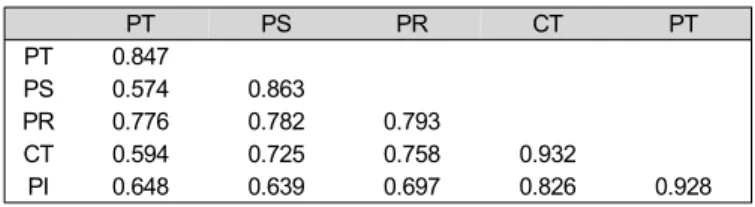
<Table 5> Correlations of latent constructs

  PT PS PR CT PT

PT 0.847      

PS 0.574 0.863    

PR 0.776 0.782 0.793  

CT 0.594 0.725 0.758 0.932

PI 0.648 0.639 0.697 0.826 0.928

Note: Diagonal elements are the square root of AVE. The value should exceed the inter-construct correlations for adequate discriminant validity.

<Figure 2> Results For the Research Model

Structural equation model (SEM) was used to validate the causal relationship among variables in the research model. A two-stage analysis method: measurement model and structural model was used for data analysis. Amos 21 software is was used to perform these analyses. The standardized path loadings

for all of the questions were statistically significant. The compo- site reliability and the Cronbach’s alpha for all constructs ex- ceeded 0.7. Furthermore, the average variance extracted for constructs exceeded 0.7, except for the perceived reputation’s value is 0.629. Hence, the convergent validity for the constructs was established(Table 3). The values of all diagonal elements were greater than those of off-diagonal elements, suggesting that all of the constructs were distinct. As shown in Table 5,the reliability and validity tests on the variables confirmed that the survey items were sufficiently valid and reliable for further analyses. Discriminant validity is established if the square root of a construct’s AVE is larger than its correlation with any other construct (Fornell and Larcker, 1981). The square root of AVE for each construct exceeded the correlation between that con- struct and other constructs. Hence, discriminant validity was established.

5.3. Hypothesis Testing

The second step of SEM is to confirm the hypothesized causal relationships among the constructs under study. The re- sults of SEM are presented in Figure 2. Both perceived security and perceived reputation have a significant positive effect on consumer trust, at the same time, both perceived transparency and customer trust have a significant positive effect on purchase intention. But perceived transparency has no significant effect on the consumer trust, the reason is the consumer believe it is normal that the products’ information should be visibile and clear. No significant relationship has been found between per- ceived reputation and purchase intention(Table 6), the reason may be that consumer more emphasis on the product’s quality other than vendor’s reputation. Thus hypotheses H1, H2, H4, and H6 are supported, while H3 and H5 are not supported.

Table 7 shows the summary of the results of hypothesis tests.

<Table 6> The result of path coefficient

Estimate S.E. C.R. P

Consumer Trust ← Perceived Security 0.214 0.034 6.266 ***

Consumer Trust ← Perceived Reputation 0.308 0.046 6.683 ***

Consumer Trust ← Perceived Transparency 0.058 0.045 1.291 0.197

Purchase Intention ← Perceived Transparency 0.16 0.039 4.072 ***

Purchase Intention ← Perceived Reputation 0.032 0.042 0.756 0.449

Purchase Intention ← Consumer Trust 0.578 0.057 10.168 ***

Notes: * = significant at 0.05. ** = significant at 0.01 level.

<Table 7> Summary of hypotheses test

Factors Hypotheses Result

Consumer Trust H1: Consumer trust in an Internet shopping context has a positive effect on purchase intention . Supported Perceived Transparency H2: Perceived transparency in an Internet seller has a positive effect on purchase intention. Supported H3: Perceived transparency in an Internet seller has a positive effect on consumer trust. Not supported Perceived Security H4: Perceived security in an Internet shopping context has a negative effect on consumer trust. Supported Perceived Reputation H5: Perceived reputation has a positive effect on consumer trust. Not supported

H6: Perceived reputation has a positive effect on purchase intention. Supported

(7)

6. Implications and Conclusion

This study makes several important contributions to the re- search literature on online customer purchase intention. First, our study empirically investigates the impact of perceived trans- parency, perceived security and perceived reputation on a con- sumer’s trust using real-world observations. The data comes from real consumers based on their real transaction experiences from the specific website. This gives the results of our study more generalizability than studies using subjects who are not asked to engage in real transactions.

Second, while prior research has examined the effect of ele- ments of website on online customer shopping, perceived trans- parency, which has been largely neglected in the literature, our results indicate that perceived transparency indeed plays an im- portant impact on online customer purchase intention.

Third, during prepurchase phases, Internet vendors should carefully make product information more transparency and to help potential customers to ascertain product quality and in- formation, especially for selling search goods. Thus, clear layout and variety of selection on the website can reduce the custom- er’s search cost for quality information of experience goods.

As with any research, this paper comes with a number of limitations, which open opportunities for further exploration in fu- ture research. First, trust is a multi-dimension concept, and the processes of online shopping can also be different. In this re- search, we only studied perceived transparency, perceived repu- tation and perceived security as an aggregate measure.

However, conceptually, it is possible that some dimensions play a more significant role than others. Therefore, future theoretical investigations are warranted to understand what dimensions of trust are important to consumers’ purchase intention.

References

Artz, Donovan, and Gil, Yolanda (2007). A survey of trust in computer science and the semantic web. Journal of Web Semantics, 5(2), 58 71. –

Cheung, C., and Lee, M. K. O. (2000). Trust in Internet shop- ping: A proposed model and measurement instrument in Proceedings of the America’s Conference on Information Systems (AMCIS’ 2000). Long Beach, California, USA.

Dennis, A. R., and Valacich, J. S. (2001). Conducting ex- perimental research in information systems.

Communications of the AIS, 7(5), 1 41. –

Davis, F. (1989). Perceived usefulness, perceived ease of use, and user acceptance of information technology. MIS Quarterly, 13(3), 319-340.

Dinev, T., and Hart, P. (2006). An extended privacy calculus model for e-commerce transactions. Information Systems Research, 17(1), 61 80. –

Dong-Her, S., Hsiu-Sen, C., Chun-Yuan, C., and Lin, B. (2004).

Internet security: malicious e-mails detection and protection. Industrial Management & Data Systems,

104(7), 613-623.

Fishbein, M., and Ajzen, I. (1975). Belief, Attitude, Intention, and Behavior: an Introduction to Theory and Research.

Reading, MA: Addison-Wesley.

Gefen, D., Karahanna, E., and Straub, D. W. (2003). Trust and TAM in online shopping: an integrated model. MIS Quarterly, 27(1), 51 90. –

Geyskens, I., Steenkamp, E. M., Scheer, L. K. & Kumar, N.

(1996). The effects of trust and interdependence on rela- tionship commitment: A trans-atlantic study. International Journal of Research in Marketing, 13(4), 303-317.

Ghosh, M., and John. G. (2009). When Should Original Equipment Manufacturers Use Branded Component Contracts with Suppliers?. Journal of Marketing Research, 46(5), 597-611.

Granados, Nelson, & Gupta, Alok. (2013). Transparency Strategy: Competing With Information In A Digital World.

MIS Quarterly, 37(2), 637-642.

Jarvenpaa, S. L., Tractinsky, N., and Vitale, M. (2000).

Consumer Trust in an Internet Store. Information Technology and Management, 1(1-2), 45-71.

Johnson, C., Hult, P., and McGowan, B. (2008). Web Buyers-And Their Expectations-Grow Up: Experienced Web Buyers, Are Becoming the New Mainstream.

Forrester Research, March 11.

Jones, S., Wilikens, M., Morris, P., and Masera, M. (2000).

Trust requirements in e-business. Communications of the ACM, 43(2), 81-87.

Kahneman, D., and Tversky, A. (1979). Prospect theory: an analysis of decision under risk. Econometrica, 47(2), 263

292.

Kim, D. J., Ferrin, D. L., and Rao, H. R. (2008). A trust-based consumer decision-making model in electronic commerce:

The role of trust, perceived risk, and their antecedents.

Decision Support Systems, 44(2), 544-564.

Kolsaker, A., and Payne, C. (2002).Engendering trust in e-com- merce: a study of gender-based concerns. Marketing Intelligence & Planning, 20(4), 206-214.

McKnight, D., Choudhury, V., and Kacmar, C. (2002).

Developing and Validating Trust Measures for E-com- merce: An Integrative Typology. Information Systems Research, 13(3), 334-359.

McKnight, D. H., Choudhury, V., and Kacmar, C. (2002). The impact of initial consumer trust on intentions to transact with a web site: A trust building model. Journal of Strategic Information Systems, 11, 297-323.

Oliver, R. L. (1980). A cognitive model of the antecedents and consequences of satisfaction decisions. Journal of Marketing Research, 17(4), 460-469.

Oliver, R. L. (1997). Satisfaction: A Behavioral Perspective on the Consumer. New York: The McGraw-Hill Companies Inc..

Pavlou, P. A., and Fygenson, M. (2006). Understanding and predicting electronic commerce adoption: an extension of the theory of planned behavior. MIS Quarterly, 30(1), 115 143. –

Pavlou, P. A., and Gefen, D. (2004). Building effective online

(8)

marketplaces with institution based trust. Information Systems Research, 15(1), 37 59. –

Pavlou, P. A., Liang, H. G., and Xue, Y. J. (2007).

Understanding and mitigating uncertainty in online ex- change relationships: a principal-agent perspective. MIS Quarterly, 31(1), 105 136. –

Salam, A. F., Rao, H. R., and Pegels, C. C. (1998). An inves- tigation of consumer-perceived risk on electronic com-

merce transactions: The role of institutional trust and economic incentive in a social exchange framework.

Baltimore, Maryland: Proceedings of Americas Conference on Information Systems(AIS 98).

Wang, Y., & Vassileva, J. (2007). Toward trust and reputation

based web service selection: a survey. Int Trans

SystSciAppl, 3(2), 118 132. –

수치

Table 7 shows the summary of the results of hypothesis tests.

참조

관련 문서

Overall, international logistics service factors have a significant effect on satisfaction with international logistics services provided to trading companies,

The purpose of this study is to analyze the effects of service quality on customer satisfaction and revisit intention perceived by Chinese golf range

The effect of the stress management program on the stress coping and perceived stress of the patients with finger replantation. Unpublished master's

This study selected collectivism as the independent variable and analyzed the effect of organizational trust and organizational commitment on

출처 : IAEA 발표 자료(Comprehensive inspection exercise at bulk handling facilities, “U-235 Enrichment measurements by gamma-ray spectroscopy”) 13.  Uranium

The impact of the trust perceived by soccer players in leaders on empowerment and organizational commitment..

Instead, rational persuasion does not have an significant effect on behavioral resistance to change while coercive persuasion significantly has a positive

The main effect according to the results of the repeated measures ANOVA on physical fitness based on test time showed a significant difference in grip