Environmental Specimen Bank and Ecosystem Assessment
Myungjin Kim· ·Jiyeon Kim· ·Yongjoo Cho· ·Byungho Yoo
Ecosystem Assessment Division, National Institute of Environmental Research. Incheon, Korea (Manuscript received 25 October 2009; accepted 18 December 2009)
Abstract
Environmental specimen bank (ESB) is a new tool to assess ecosystem in environmental impact assessment (EIA). ESB looks at changes in the concentration of pollutants in human and environmental specimens over long periods of time through retrospective analysis of archived samples. Korea started to design its National Environmental Specimen Bank (NESB) in 2007 and planned to launch an operational pilot project by 2010. NESB prepares five Standard Operating Procedures (SOPs) of shoots of Red and Korean pine, leaves of Mongolian oak, Pigeon’s egg, and Common carp’s muscle out of 14 planned specimens in 2009.
ESB contributes to monitoring the effectiveness of EIA projects and policies by providing a time capsule through ecosystem assessment of representative species. This study reviews ecosystem assessment in EIA and the ESB establishment in Korea and probes NESB applications in ecosystem assessment.
Keywords : Environmental Impact Assessment, Environmental Specimen Bank, Ecosystem Assessment
Corresponding Author: Myungjin Kim, Ecosystem Assessment Division, National Institute of Environmental Research, Kyongseodong, Seogu, Incheon 404-708, Republic of Korea Tel: +82-32-560-7421 Fax: +82-32-560-7975 E-mail: [email protected]
연구논문
I. Introduction
Environmental specimen bank (ESB) is a new tool to monitor ecosystem retrospectively through a long-term storage of environmental specimens.
It is defined as a repository of representative environmental specimens, an institution with supporting facilities through retrospective study of banked samples, and an environmental speci- men time capsule to preserve the evidence of
changes in specimens (Schwuger, 1992 and Kim,
2007). Also, ESB can contribute to checking the
environmental status and monitoring the effec-
tiveness of environmental impact assessment
(EIA) projects and plans through assessment of
exposed ecosystem. Assessment methods using ESB
need to develop in EIA. National Environmental
Specimen Bank (NESB) at National Institue of
Environmental Research will become an impor-
tant institution on Korean ecosystem assessment.
II. Research Framework
This paper analyzes the studies related to ESB and existing research results. Some suggestions were obtained from US, Japanese, and German ESB visits from 2006 to 2009. Experince in international ESB design and construction reflect- ed on NESB plan and management. Korean EIA system and methods were analyzed to show cur- rent ecosystem assessment. Research framework is as follows (Figure 1).
III. Ecosystem Assessment in
Environmental Impact Assessment
EIA is a continuously evolving system. EIA in Korea improved markedly over the past three decades by enlarging EIA projects, instituting public participation and environmental monitor- ing, developing methodologies, and introducing strategic environmental assessment (SEA) (Kim and Yoo, 2007). The Prime Minister Decree on environmental review of administrative plan and project like SEA enacted in 1993. It covered envi- ronmentally sensitive projects which were not included in EIA project and administrative plans.
This Decree covered only governmental projects;
hence, the Prior Environmental Review System based on Environmental Policy Act replaced the Decree in 2000. This system covers governmental
and private project (Han and Kim, 2001).
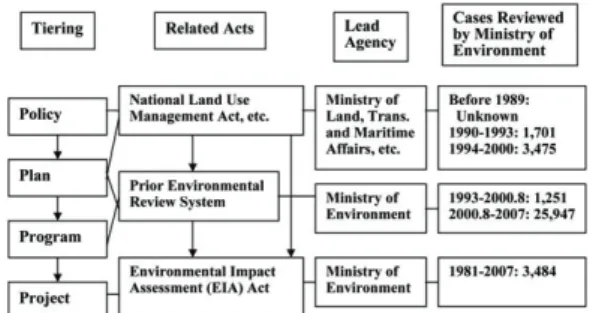
The Korea EIA system has two pillars: the prior environmental review system (PERS) in plan and program and the environmental impact assessment in project (See Figure 2) (Kim, 2002).
These two systems will be integrated into EIA Act by the end of 2009. Environmental impact statement (EIS) from 1981 to 2007 has been pre- pared for about 3,500 cases (Ministry of Environment, 2008b).
Most EIA projects assess impacts on environ- mental criteria for predicted pollutant concentra- tions of air and water. EIA focuses on environ- mental pollutants prediction, constructing mitiga- tion measures, and monitoring processes.
Ecosystem assessment helps identify and avoid biodiversity ‘show stopper’ (Athanas, 2005). It is important to recognize the biological-ecological environment as a dynamic system (Canter, 1996).
Korean ecosystem has about 100,000 species and 29,916 of them have been identified through surveys including 18,117 species of fauna, 8,721 species of flora, and 3,528 species of fungus and protista. Korea has 76 natural parks of 7,809 km
2, covering 7.8% of the total territory and these parks comprise of 20 national parks, 23 provin- cial parks, and 33 county parks (Ministry of Environment, 2008a). In addition, the government has designated 221 endangered animal and plant species for protection in 2005.
Figure 1. Research Framework
Figure 2. Environmental Impact Assessment System in Korea
The development pressure may have negative influnces on Korean ecosystems; thus, EIA dis- cusses mitigation measure and replacement habi- tat to minimize such impacts.
Ministry of Environment conducted the first
‘National Ecosystem Survey’ from 1986 to 1990.
Based on the survey, the Degree of Green Naturality Map was produced to evaluate plant species and vegetation. The second survey from 1997 to 2005 produced the Ecosystem and Nature Map including flora, fauna, and natural features (Kim et al., 2009). These two maps are used for ecosystem impact assessment of development projects and for planning in the screening and scoping stage of PERS and EIA. Most of impact assessment on ecosystem does not assess the pol- lutants of exposed species of the ecosystem.
IV. Environmental Specimen Bank Establishment
Rachel Carson’s widely read book, Silent Spring, refers to a hypothetical future springtime in which birds and other animals are silenced by exposure to synthetic chemicals such as dichlorodiphenyltrichloroethane (DDT). Silent Spring is one of many books written after World War II to alert public to seriousness of ecosystem disruption (Ortolano, 1997). If we can preserve environmental specimens intactly, we have a bet- ter possibility of identifying pollutants in the future. Thus, ESB will become a safe long-term repository for representative environmental speci- mens collected over decades to preserve con- stituent properties. It provides a capability of hindcasting; future investigators will be able to extend their research through retrospective study of banked samples with quality assurance of ana-
lytical results (Kim, 2007).
Environmental specimens in ESB contain a sci- entific history of environmental pollution impacts which can be reinterpreted for pollutants in the future (Kim, 2007). ESB shows an important role in preserving the historical record of flora and fauna impacted by environmental pollutants.
NESB 2007-2010 budget is approximately 8 bil- lion won (6 US million) with ESB building con- struction, storage facilities including cryogenic freezers and electric freezers, vibrating cryomill, vertical liquid nitrogen storage tank, experimental equipment, and standard operating procedures (SOPs) preparation. Korea started to design NESB in 2007 and NESB is envisioned as a two- story building with the basement occupying 2,340 m
2in 2009 (Kim and Yoo, 2007).
V. Ecosystem Assessment Through Environmental Specimen Bank
The NESB acts as a ‘time capsule’ to create a long-term basis of EIA projects and policies on ecosystem. The types of banked specimens should detect the input of substances to the ecos- phere or the human organism. The priority of environmental specimens is to select typical rep- resentatives from every food chain level of ecosystem. For instance, primary producers such as pine trees, consumers such as birds, and decomposers such as earthworms will be chosen.
The specimens for the National Environmental
Specimen Bank will be taken from specific geo-
graphic areas representing the main types of
ecosystems found in Korea: rivers, agricultural
land, managed forests, urban areas, natural
woodland and marine habitats. The specimen
collection locations demonstrate varying degrees
of influences caused by human activities to give an accurate overall picture of the state of the environment (Kim and Yoo, 2007).
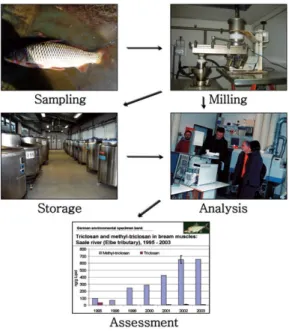
Sampling is necessary to integrate into quality assurance systems for environmental analysis and make sure of getting the information and accura- cy required with appropriate effort (Wagner, 1995). The selection of the sampling procedure has a decisive effect on the quality and quantity of the sample material (Ruedel, et.al, 2009).
The SOPs ensure continuity in the identity of materials and origin of the specimen (Rossbach and Jayasekera, 1996). NESB prepares the SOPs of shoots of Red and Korean pine, leaves of Mongolian oak, Pigeon’s egg, and Common carp’s muscle in terrestrial, riverine and marine environment in 2009. For example, pine has been used as a sensitive effect indicator and an accu- mulation indicator. Earthworm establishes a close relationship between the mostly organic soil cover and the soil horizons below. Consequently, it exhibits the pollution state and status of the medium soil as a whole. Freshwater mussel is
used as an organism for environmental monitor- ing (UBA, 2003). Proposed NESB Specimen List by Ecosystem is shown in Table 1.
Ecological and human exposure assessment in EIA project areas enables researchers or decision- makers to check impacts of all activities over a
Figure 3. General Process of Environmental Specimen Bank
Source: Kim, 2007Table 1. Proposed NESB Specimen List by Ecosystem
Ecosystems Type of Specimen Scientific Name Common Name Food Chain Target Organ
Pine
Pinus densiflora
Red pine Producer First-year shootsPine
Pinus koraiensis
Korean pine Producer First-year shootsOak
Quercus Mongolia
Mongolian oak Producer LeavesTerrestrial Zelkova
Zelkova serrata
Zelkova Producer LeavesSoil Medium
Earthworm
Lumbricus terrestris
Night crawler Decomposer BodyBird
Columba livia
Domestic pigeon Consumer Content of eggSediment Medium
Riverine Freshwater fish
Cyprinus carpio
Common carp Consumer Musculature, Liver MusselUnio (Nodularia) douglasiae Freshwater mussel
Consumer Soft tissue MusselMytilus edulis or
Blue or MediterraneanConsumer Soft tissue
(M. galloprovincialis)
musselMarine Fish
Mugil cephalus
Mullet Consumer Musculature, LiverBird
Larus crassirostris
Black-tailed gull Consumer Content of eggAlgae
Ulva pertusa
Sea lattuce Producer Plant bodaySource: Kim, M. et al., 2008