• 검색 결과가 없습니다.

The Efficacy of the Cystatin C Based Glomerular Filtration Rate in the Estimation of Safe Contrast Media Volume

N/A
N/A
Protected

Academic year: 2021

Share "The Efficacy of the Cystatin C Based Glomerular Filtration Rate in the Estimation of Safe Contrast Media Volume"

Copied!
6
0
0

로드 중.... (전체 텍스트 보기)

전체 글

(1)

Korean Circulation Journal

Introduction

Contrast-induced nephropathy (CIN) has been recognized as a se-

Print ISSN 1738-5520 • On-line ISSN 1738-5555

The Efficacy of the Cystatin C Based Glomerular Filtration Rate in the Estimation of Safe Contrast Media Volume

Hyuck-Jun Yoon, MD 1 , Hyungseop Kim, MD 1 , Jae-Pil Lee, MD 1 , Sang-Woong Choi, MD 1 , Hyun-Ok Cho, MD 2 , Hong-Won Shin, MD 1 , Hyoung-Seob Park, MD 1 , Yun-Kyeong Cho, MD 1 , Chang-Wook Nam, MD 1 ,

Seung-Ho Hur, MD 1 , Yoon-Nyun Kim, MD 1 , and Kwon-Bae Kim, MD 1

1

Division of Cardiology, Department of Internal Medicine, Keimyung University Dongsan Medical Center, Daegu,

2
Department of Cardiology, Andong Medical Group, Andong, Korea

Background and Objectives: The risk of contrast-induced nephropathy (CIN) is significantly influenced by baseline renal function and the amount of contrast media (CM). We evaluated the usefulness of the cystatin C (CyC) based estimated glomerular filtration rate (eGFR

CyC

) in the prediction of CIN and to determine the safe CM dosage.

Subjects and Methods: We prospectively enrolled a total of 723 patients who received percutaneous coronary intervention (PCI) and in- vestigated the clinical factors associated with the development of CIN. Renal function was calculated as eGFR

CyC

and a modified diet in the renal disease (MDRD) equation, respectively. Systemic exposure of CM was calculated as CM volume to eGFR ratio. We conducted a regres- sion analysis to evaluate the predictive role of CM volume to eGFR

CyC

for the risk of CIN.

Results: The incidence of CIN was 4.0% (29/723). The patients with CIN had a lower hemoglobin level, decreased renal function, and a higher CyC value, and had greater CM exposure. Through multivariate regression analyses, hemoglobin {odds ratio (OR) 0.743, p=0.032}, CM volume/eGFR

CyC

(OR 1.697, p=0.006) and CM volume/MDRD (OR 2.275, p<0.001) were found to be independent predictors for CIN. In the re- ceiver operating characteristic curve analysis, fair discrimination for CIN was found at a CM volume/eGFR

CyC

level of 4.493 (C-statics=

0.814), and at this value, the sensitivity and specificity were 79.3% and 80.0%, respectively.

Conclusion: Both the CM volume/MDRD and CM volume/eGFR

CyC

method would be simple, useful indicators for determining the safe CM- dose based on eGFR value before PCI. However, there was no significantly different predictive value between creatinine and CyC based GFR es- timations. (Korean Circ J 2013;43:622-627)

KEY WORDS: Contrast media; Cystatin C; Glomerular filtration rate; Acute kidney injury.

Received: May 25, 2013 Revision Received: July 4, 2013 Accepted: August 19, 2013

Correspondence: Hyungseop Kim, MD, Division of Cardiology, Depart- ment of Internal Medicine, Keimyung University Dongsan Medical Center, 56 Dalseong-ro, Jung-gu, Daegu 700-712, Korea

Tel: 82-53-250-8023, Fax: 82-53-250-7034 E-mail: [email protected]

• The authors have no financial conflicts of interest.

This is an Open Access article distributed under the terms of the Creative Commons Attribution Non-Commercial License (http://creativecommons.

org/licenses/by-nc/3.0) which permits unrestricted non-commercial use, distribution, and reproduction in any medium, provided the original work is properly cited.

rious complication of percutaneous coronary intervention (PCI), and associated with increased short-term and long-term morbidity or mortality.

1-4)

Although many risk factors associated with the development of CIN have been reported,

5-7)

decreased renal function and increased systemic exposure of contrast media (CM) are considered the most potent risk factors of CIN.

8)9)

Considering the importance of the pre- vention of CIN, it is important to determine the safe CM volume.

Accordingly, previous investigators have suggested a safe CM dose regarding renal function.

10-13)

The key concept of those suggestions was reducing or adjusting CM dosage according to individual renal function. Therefore, the accurate estimation of renal function may be necessary to identify high-risk patients and to suggest a reliable pharmacotoxic model.

The most accurate method to estimate renal function is measured

(2)

glomerular filtration rate (GFR) using radioisotope or radioiodine.

However, the measure is both time- and cost-consuming and comes with potential side effects. Therefore, serum creatinine (sCr) itself or estimated GFR (eGFR) based on sCr are the most widely used methods in the clinical assessment of kidney function.

14-16)

Despite its validity, eGFR based on sCr has attracted criticism due to various confounding factors and its level of imprecision.

Recently, cystatin C (CyC) has received a lot of attention and ap- pears to be a promising alternative to sCr for estimating GFR.

17)18)

Contrary to sCr, the CyC level depends almost entirely on the GFR and is less dependent on age, diet, nutritional status, and muscle mass.

19-22)

Moreover, it might be more useful to detect early stage renal dysfunction than sCr.

23)

However, the efficacy of eGFR based on CyC (eGFR

CyC

) for the pre- diction of CIN was not fully evaluated and there was no previous stu- dy regarding safe CM volume estimation using eGFR

CyC

in patients with elective PCI.

Thus, we conducted this prospective study to assess the useful- ness of the CM volume/eGFR

CyC

in predicting the risks of developing CIN and to determine the safe level of CM volume in patients un- dergoing PCI.

Subjects and Methods

Patients

This study was conducted in a single-institution setting of a terti- ary university hospital from September of 2009 to August of 2011.

The eligibility criteria of the present study were an age of 19 years or older and a referral for coronary angiography (CAG) and PCI. Exclu- sion criteria were as follows: cardiogenic shock, pulmonary edema, emergent PCI, end-stage renal disease requiring dialysis, and a previous administration of CM within 72 hours of PCI. This study was approved by the ethics committee of our hospital, and all par- ticipating patients provided written informed consent.

Study protocol

Renal function was assessed by a simultaneous determination of sCr and CyC. Baseline eGFR was calculated as creatinine clearance by a modification of diet in the renal disease (MDRD) study

16)

equ- ation [eGFR=175×{sCr (mg/dL)}

-1.154

×{age (years)}

-0.203

]. A correction factor of 0.85 was used for women and the CyC based equation {eGFR=66.8×(CyC)

-1.30

} suggested by Rule et al.

21)

respectively. A two dimensional echocardiography was performed before PCI, and left ventricular ejection fraction (LVEF) was calculated by the bi- plane modified Simpson’s method. All the patients were given the same hydration regimen with intravenous isotonic saline at a rate of 1 mL/kg/hr for 12 hours prior to and after PCI. Additional prophy-

lactic medications for CIN (e.g., N-acetylcysteine) were not permit- ted to be administered to the patients. In diabetic patients, metfor- min was discontinued on the CAG day and withheld for the follow- ing 48 hours.

After informed consent was obtained, all procedures were per- formed at the operator’s discretion. CAG and PCI were performed using the standard technique, via either a femoral or radial appro- ach. All the patients received aspirin and clopidogrel. They were also administered glycoprotein IIb/IIIa receptor blockers and heparin at the discretion of the operator. In the current study, we used either iso-osmolar, non-ionic CM, or iodixanol (Visipaque

TM

320 mg I/mL;

GE Healthcare Korea, Seoul, Korea). The amounts of delivered CM were measured using an automated contrast delivery injection sys- tem (ACIST

TM

; ACIST Medical Systems, Inc., Eden Prairie, MN, USA).

CIN was defined as a 25% elevation or an absolute increase of >0.5 mg/dL (>44 umol/L) in the sCr level compared to the baseline within 48 to 72 hours after PCI, in accordance with the definition of the CIN consensus working panel.

2)

Statistical analysis

All statistical analyses were performed with Statistical Package for the Social Sciences (SPSS) (release 15.0; SPSS Inc., Chicago, IL, USA). To identify the correlations between CIN and the clinical or laboratory parameters, a univariate analysis was performed using an unpaired t-test or Mann-Whitney U test for the continuous vari- ables, and a chi-square test for the categorical variables, respecti- vely. A multivariate logistic regression analysis was used to assess the correlation among the parameters, whose statistical signific- ance was demonstrated on a univariate analysis at a level of p<

0.05 and through previously well-known risk factors. Models were developed with stepwise techniques, for which the results were expressed as odds ratios (OR) with 95% confidence intervals (CI).

Finally, the CM volume/eGFR

CyC

was added to the model as a sepa- rate predictor to test for any interaction between CM-volume and eGFR. An analysis of the receiver operating characteristic (ROC) was conducted to determine the cut-off value and area under the curve (AUC) of the CM volume/eGFR

CyC

and CM volume/MDRD for predict- ing CIN. We regarded a p<0.05 as statistically significant.

Results

Baseline characteristics of the study patients

A total of 1640 patients were referred for CAG and PCI, between September 2009 and August 2011. Of these, 723 patients were eli- gible for and enrolled into this study.

The study group was composed of 450 men and 273 women, with

a mean age of 63.7±10.4 years old. Among all of the study patients,

(3)

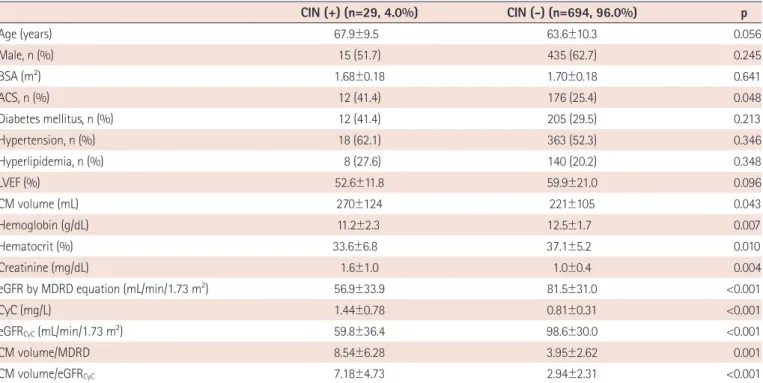
CIN occurred in 29 patients (4.0%). Patients were divided into two groups according the development of CIN: the CIN group (n=29) and the non-CIN group (n=694). Table 1 represents the baseline ch- aracteristics of patients of both groups.

Compared to the non-CIN group, clinical presentation as acute coronary syndromes was significantly more frequent in the CIN group. The CIN group showed significantly lower hemoglobin (Hb) and eGFR levels, and higher BUN, sCr, and CyC levels. They were also

subjected to a higher CM volume, CM volume/eGFR

CyC

, and CM volume/MDRD.

Predictors of contrast-induced nephropathy

As shown in Table 2, reduced LVEF, Hb level, and eGFR using MD- RD and CyC, increased CM volume, CM volume/MDRD and CM vol- ume/eGFR

CyC

were found to be significantly correlated with the de- velopment of CIN in the univariate logistic regression analysis. Cli-

Table 1. Baseline demographic data for CIN and non-CIN patients

CIN (+) (n=29, 4.0%) CIN (-) (n=694, 96.0%) p

Age (years) 67.9±9.5 63.6±10.3 0.056

Male, n (%) 15 (51.7) 435 (62.7) 0.245

BSA (m

2

) 1.68±0.18 1.70±0.18 0.641

ACS, n (%) 12 (41.4) 176 (25.4) 0.048

Diabetes mellitus, n (%) 12 (41.4) 205 (29.5) 0.213

Hypertension, n (%) 18 (62.1) 363 (52.3) 0.346

Hyperlipidemia, n (%) 8 (27.6) 140 (20.2) 0.348

LVEF (%) 52.6±11.8 59.9±21.0 0.096

CM volume (mL) 270±124 221±105 0.043

Hemoglobin (g/dL) 11.2±2.3 12.5±1.7 0.007

Hematocrit (%) 33.6±6.8 37.1±5.2 0.010

Creatinine (mg/dL) 1.6±1.0 1.0±0.4 0.004

eGFR by MDRD equation (mL/min/1.73 m

2

) 56.9±33.9 81.5±31.0 <0.001

CyC (mg/L) 1.44±0.78 0.81±0.31 <0.001

eGFR

CyC

(mL/min/1.73 m

2

) 59.8±36.4 98.6±30.0 <0.001

CM volume/MDRD 8.54±6.28 3.95±2.62 0.001

CM volume/eGFR

CyC

7.18±4.73 2.94±2.31 <0.001

Values are mean±SD. CIN: contrast-induced nephropathy, BSA: body surface area, ACS: acute coronary syndrome, LVEF: left ventricular ejection fraction, CM: contrast media, eGFR: estimated glomerular filtration rate, MDRD: equation of modification of diet on renal disease study group, Cyc: cystatin C Table 2. Univariate and multivariate analysis of risk factors determining CIN

Univariate analysis Multivariate analysis

Odds ratio 95% CI p Odds ratio 95% CI p

Age (years) 1.037 0.997-1.079 0.068 1.001 0.944-1.062 0.954

DM 1.684 0.790-3.589 0.177 1.177 0.410-3.347 0.767

ACS 2.078 0.973-4.436 0.059 2.453 0.944-6.333 0.064

LVEF 0.956 0.926-0.987 0.006 0.989 0.947-1.033 0.608

CM volume 1.009 1.002-1.016 0.016 0.999 0.995-1.003 0.592

Hb 0.694 0.569-0.847 <0.001 0.743 0.566-0.975 0.032

sCr 3.976 2.203-7.174 <0.001 1.071 0.985-2.694 0.884

eGFR

MDRD

0.962 0.946-0.979 <0.001 0.983 0.961-1.005 0.119

CM dose/MDRD 2.193 1.699-2.829 <0.001 1.657 1.156-2.374 0.006

eGFR

CyC

0.961 0.948-0.973 <0.001 0.996 0.972-1.021 0.772

CM dose/eGFR

CyC

4.826 2.890-8.062 <0.001 2.275 1.496-3.461 <0.001

CIN: contrast induced nephropathy, CI: confidential interval, DM: diabetes mellitus, ACS: acute coronary syndrome, LVEF: left ventricular ejection fraction,

CM: contrast media, Hb: hemoglobin, sCr: serum creatinine, eGFR

CyC

: cystatin C based estimated glomerular filtration rate, MDRD: equation of modification

of diet on renal disease study group, eGFR: estimated glomerular filtration rate

(4)

nical presentations as acute coronary syndrome, age, and diabetes were not within the range of statistical significance. In the multiva- riate analysis, decreased Hb (OR 0.743, 95% CI 0.566-0.975, p=0.032) and increased CM volume/MDRD (OR 1.657, 95% CI 1.156-2.374, p=0.006) and CM volume/eGFR

CyC

(OR 2.275, 95% CI 1.496-3.461, p<0.001) remained as significant independent risk factors for the development of CIN.

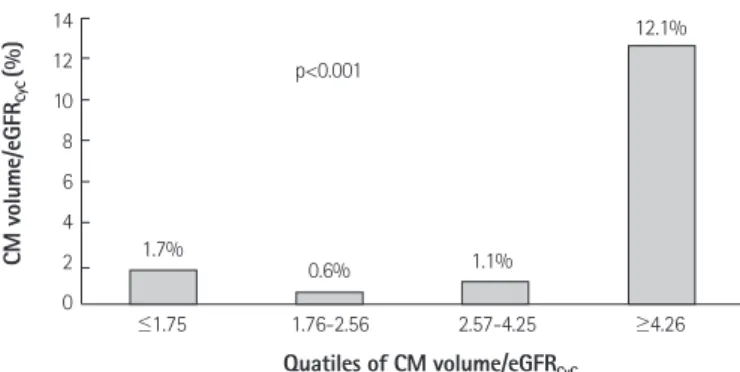
Furthermore, the significantly highest incidence of CIN was de- monstrated in the 4th quartile of CM volume/eGFR

CyC

compared with the 1st, 2nd, and 3rd quartiles (p<0.001) (Fig. 1). The ROC curve was performed using CM volume/eGFR

CyC

to assess its ability to predict the development of CIN. It revealed a modest discrimina-

tion of CIN at a CM volume/eGFR

CyC

level of 4.493 (AUC=0.814; sen- sitivity=79.3%, specificity=80.0%) (Fig. 2). Although there was no statistically significant difference between CM volume/eGFR

CyC

and CM volume/MDRD, AUC of the CM volume/MDRD (0.772) was lower than those of CM volume/eGFR

CyC

. Of those patients (n=169) with CM volume/CyC eGFR ≥4.493, 13.6% (23/169) developed CIN, while those of CM volume/CyC eGFR <4.493 evinced a significantly lower incidence of CIN 1.1% (6/554; p<0.001).

Discussion

In this prospective and observational study, CM volume/eGFR

CyC

was identified as a significantly independent predictor of CIN com- pared with other previously well-known predictors. Therefore, we were able to estimate the safe CM volume via measuring eGFR

CyC

prior to CM administration. The CM volume/eGFR

CyC

can be consid- ered a simple and reliable indicator for determining the safe volume of CM based on the pre-procedural CyC level. Although this simple model has a drawback in that many other variables are not included, this study also showed that other clinical and laboratory factors associated with CIN and CM volume/eGFR

CyC

remained independent predictors of CIN after an adjustment for these confounding factors.

Estimation of safe contrast volume per renal function Many guidelines regarding the prevention of CIN recommend the minimal use of CM.

24-26)

However, it is not easy to determine the ac- ceptable CM amount. In the PCI era, the use of CM is necessary to obtain satisfactory images and to perform PCI. Moreover, high-risk patients usually showed complex lesions and a proneness to the in- evitable use of large amounts of CM. Among a number of CIN, CM volume can be changed and it can be potentially controlled at the discretion of the operator. Therefore, we need to guide individual quantities of safe CM volume prior to PCI.

Several studies have been trying to establish the risk of CIN after exposure to CM via a similar concept using the relationship be- tween the CM exposure and baseline renal function. In 1989, Cigar- roa et al.

10)

proposed a simple formula called maximal acceptable CM volume (CM volume/weight) based on the sCr level. In the ret- rospective study regarding high-risk patients (sCr >2.0 mg/dL or CM volume >300 mL), the cut off value of CM volume/eGFR (by Cock- croft-Gault equation) was defines as 6.0.

10)

Another study conducted in 3179 unselected patients undergoing PCI reported that CM vol- ume/eGFR (by MDRD equation) of <3.27 might be a useful indicator in determining the CM volume which might be considered safe from the CIN.

11)

Previously, we also reported safe CM volume using grams of iodine per eGFR (g-I/eGFR) at a level of 1.42.

27)

However, the abovementioned studies were based on sCr or eGFR Fig. 2. Receiver operating characteristic curve for the prediction of CIN us-

ing CM volume/eGFR

CyC

and CM volume/MDRD. The area under the curve for predicting CIN of CM volume/eGFR

CyC

was 0.814 and CM volume/MDRD was 0.772, respectively. CIN: contrast induced nephropathy, CyC: cystatin C, MDRD: equation of modification of diet on renal disease study group.

100

80

60

40

20

0

100-specificity

Sensitivity

0 20 40 60 80 100 CM volume/eGFR

CyC

CM volume/MDRD

Fig. 1. Incidence of CIN according to the quartiles of CM volume/eGFR

CyC

. Incidence of CIN is significantly higher in the 4th quartile. CyC: cystatin C, eGFR: estimated glomerular filtration rate.

14 12 10 8 6 4 2 0

Quatiles of CM volume/eGFR

CyC

CM volume/eGFR

CyC

(%)

≤1.75 1.76-2.56 2.57-4.25 ≥4.26

1.7% 0.6% 1.1%

12.1%

p<0.001

(5)

using sCr. Although sCr has been the most widely used biomarker of renal function, it has serious limitations in terms of imprecision in reflecting renal function. It is frequently affected by a lot of non- GFR factors, including muscle mass, dietary habit, and age.

15)16)28)

Im- portantly, it has a limitation in detecting mild renal impairment.

18)

Cystatin C is a non-glycosylated 13-kDa basic protein of the cy- statin super-family of cysteine proteinase inhibitors.

17)

CyC shows a consistent production rate and is eliminated by glomerular filtra- tion. It is less dependent on age, sex, race, and muscle mass.

19)

Th- erefore, CyC is considered to be a potential alternative to sCr for es- timating GFR, and CM volume/eGFR

CyC

also suggested a better esti- mation of GFR that sCr based eGFR.

The CM volume/CyC eGFR represents both the amount of CM and individual renal function. It is obvious that an accurate measure- ment of renal function is required to make the model more reliable.

From such a point of view, the method used in previous studies re- garding safe CM volume estimation may have many limitations from the perspective of accuracy in GFR estimation.

In this study, using CyC, we demonstrated that CM volume/eG- FR

CyC

could both represent individual renal function. In addition, both CM volume/MDRD and CM volume/eGFR

CyC

could be identified as independent predictors of CIN.

Another significant risk factor of contrast-induced nephropathy; Anemia

Apart from CM volume and renal function, another issue relating to CIN is anemia. Several studies also demonstrated a significant association of anemia and CIN. Thus, anemia could be deemed a risk factor for mortality in cardiovascular disease.

6-8)29)

Moreover, anemia is commonly combined with chronic kidney disease (CKD) and it can present as a complication of CKD. In this study, anemia was identified as an independent predictor of CIN after an adjustment for other risk factors. Yet, there remains limited data as to whether the correction of anemia can be helpful to prevent CIN, whereas, periprocedural blood loss was considered as a potent risk factor of CIN.

30)

Therefore, further data on anemia and baseline renal function prior to PCI is required to definitely determine their effects on the development of CIN.

Clinical Implications

In general, cardiovascular diseases often share many risk factors with renal disease. Therefore, a careful consideration of the safe CM volume would be mandatory for patients who are at an increased risk of developing CIN based on a decreased eGFR prior to the PCI. Mo- reover, PCI treatment for complex lesions is often prone to large doses of CM administration. In these high-risk patients, we should consider the measurement of CyC prior to PCI and pay attention

to the safe CM volume, particularly based on the eGFR

CyC

, to prevent CIN when performing PCI.

Our present study consisted of controlled patients who were sch- eduled for elective PCI with appropriate hydration and had other nephrotoxic agents avoided. Contrary to emergency situations, in scheduled PCI, physicians can obtain sufficient information for a safe CM volume estimation prior to PCI. Therefore, results of the current study have more potent clinical implications than previous retrospective studies about unselected populations.

Limitations

There are some potential limitations to the current study. Alth- ough this study was a prospective controlled study, it cannot be considered free from its limitation as a single institution study. Th- erefore, caution should be exercised in generalizing the findings to more mixed populations. Furthermore, there remains debate regard- ing the differential safety of CM among various types of CM (iso- osmolar CM and low-osmolar CM, ionic CM and non-ionic CM). Fur- ther studies with various types of CM are required to confirm the efficacy of this equation using eGFR

CyC

.

The most significant limitation is the reliability of CyC. Although the CyC based equation showed a better estimation of GFR com- pared with sCr, there was little validated data about eGFR

CyC

in Asian populations. Additionally, the incremental cost of improving GFR us- ing CyC may also be considered. Future studies may provide an an- swer to this question.

Conclusions

Systemic exposure of CM was identified as an independent pre- dictor of CIN after PCI. The delivered CM volume to eGFR calculated from both sCr and CyC, expressed as CM volume/MDRD and /eGFR

CyC

, both showed a predictive value for the occurrence of CIN. Based on the current results, we could suggest a safe acceptable CM vol- ume of 4.493 mL (iodixanol 320 mg-I/mL) per 1 U of eGFR (mL/min/

1.73 m

2

) and a pre-interventional determination of acceptable CM volume based on eGFR

CyC

, which might be helpful in avoiding CIN.

In comparison of the predictive value of the sCr based and CyC based equation, there was no statistically significant difference be- tween both methods.

Acknowledgments

This study was supported by a research grant from the Korean Society of Cardiology (2009).

References

1. McCullough PA, Wolyn R, Rocher LL, Levin RN, O’Neill WW. Acute renal

(6)

failure after coronary intervention: incidence, risk factors, and relation- ship to mortality. Am J Med 1997;103:368-75.

2. McCullough PA, Adam A, Becker CR, et al. Epidemiology and prognostic implications of contrast-induced nephropathy. Am J Cardiol 2006;98:

5K-13K.

3. Murphy SW, Barrett BJ, Parfrey PS. Contrast nephropathy. J Am Soc Nephrol 2000;11:177-82.

4. Rihal CS, Textor SC, Grill DE, et al. Incidence and prognostic importance of acute renal failure after percutaneous coronary intervention. Circu- lation 2002;105:2259-64.

5. Weisbord SD, Mor MK, Resnick AL, et al. Prevention, incidence, and outcomes of contrast-induced acute kidney injury. Arch Intern Med 2008;168:1325-32.

6. Mehran R, Aymong ED, Nikolsky E, et al. A simple risk score for predic- tion of contrast-induced nephropathy after percutaneous coronary in- tervention: development and initial validation. J Am Coll Cardiol 2004;

44:1393-9.

7. Mehran R, Nikolsky E. Contrast-induced nephropathy: definition, epi- demiology, and patients at risk. Kidney Int Suppl 2006:S11-5.

8. Dangas G, Iakovou I, Nikolsky E, et al. Contrast-induced nephropathy after percutaneous coronary interventions in relation to chronic kidney disease and hemodynamic variables. Am J Cardiol 2005;95:13-9.

9. Kim U, Kim YJ, Lee WJ, et al. The estimated glomerular filtration rate with using the Mayo clinic quardratic equation as a new predictor for developing contrast induced nephropathy in patients with angina pec- toris. Korean Circ J 2008;38:301-4.

10. Cigarroa RG, Lange RA, Williams RH, Hillis LD. Dosing of contrast ma- terial to prevent contrast nephropathy in patients with renal disease.

Am J Med 1989;86(6 Pt 1):649-52.

11. Altmann DB, Zwas D, Spatz A, et al. Use of the contrast volume to esti- mated creatinine clearance ratio to predict renal failure after angiog- raphy. J Interv Cardiol 1997;10:113-9.

12. Freeman RV, O’Donnell M, Share D, et al. Nephropathy requiring dialy- sis after percutaneous coronary intervention and the critical role of an adjusted contrast dose. Am J Cardiol 2002;90:1068-73.

13. Laskey WK, Jenkins C, Selzer F. Volume-to-creatinine clearance ratio: a pharmacokinetically based risk factor for prediction of early creatinine increase after percutaneous coronary intervention. J Am Coll Cardiol 2007;50:584-90.

14. Cockcroft DW, Gault MH. Prediction of creatinine clearance from se- rum creatinine. Nephron 1976;16:31-41.

15. Levey AS, Greene T, Schluchter MD, et al. Glomerular filtration rate measurements in clinical trials. Modification of Diet in Renal Disease Study Group and the Diabetes Control and Complications Trial Re- search Group. J Am Soc Nephrol 1993;4:1159-71.

16. Levey AS, Bosch JP, Lewis JB, Greene T, Rogers N, Roth D. A more ac- curate method to estimate glomerular filtration rate from serum cre-

atinine: a new prediction equation. Modification of Diet in Renal Dis- ease Study Group. Ann Intern Med 1999;130:461-70.

17. Kyhse-Andersen J, Schmidt C, Nordin G, et al. Serum cystatin C, deter- mined by a rapid, automated particle-enhanced turbidimetric method, is a better marker than serum creatinine for glomerular filtration rate.

Clin Chem 1994;40:1921-6.

18. Newman DJ, Thakkar H, Edwards RG, et al. Serum cystatin C measured by automated immunoassay: a more sensitive marker of changes in GFR than serum creatinine. Kidney Int 1995;47:312-8.

19. Dharnidharka VR, Kwon C, Stevens G. Serum cystatin C is superior to serum creatinine as a marker of kidney function: a meta-analysis. Am J Kidney Dis 2002;40:221-6.

20. Tangri N, Stevens LA, Schmid CH, et al. Changes in dietary protein in- take has no effect on serum cystatin C levels independent of the glo- merular filtration rate. Kidney Int 2011;79:471-7.

21. Rule AD, Bergstralh EJ, Slezak JM, Bergert J, Larson TS. Glomerular fil- tration rate estimated by cystatin C among different clinical presen- tations. Kidney Int 2006;69:399-405.

22. Madero M, Sarnak MJ, Stevens LA. Serum cystatin C as a marker of glomerular filtration rate. Curr Opin Nephrol Hypertens 2006;15:610-6.

23. Perkins BA, Nelson RG, Ostrander BE, et al. Detection of renal function decline in patients with diabetes and normal or elevated GFR by serial measurements of serum cystatin C concentration: results of a 4-year follow-up study. J Am Soc Nephrol 2005;16:1404-12.

24. Benko A, Fraser-Hill M, Magner P, et al. Canadian Association of Radi- ologists: consensus guidelines for the prevention of contrast-induced nephropathy. Can Assoc Radiol J 2007;58:79-87.

25. Lepanto L, Tang A, Murphy-Lavallée J, Billiard JS. The Canadian Associ- ation of Radiologists guidelines for the prevention of contrast-induced nephropathy: a critical appraisal. Can Assoc Radiol J 2011;62:238-42.

26. Stacul F, van der Molen AJ, Reimer P, et al. Contrast induced nephropa- thy: updated ESUR Contrast Media Safety Committee guidelines. Eur Radiol 2011;21:2527-41.

27. Yoon HJ, Hur SH. Determination of safe contrast media dosage to esti- mated glomerular filtration rate ratios to avoid contrast-induced ne- phropathy after elective percutaneous coronary intervention. Korean Circ J 2011;41:265-71.

28. Hatano M. [Clinical study of tubular creatinine secretion in renal dys- function]. Nihon Jinzo Gakkai Shi 1991;33:1097-104.

29. Chong E, Poh KK, Liang S, Tan HC. Risk factors and clinical outcomes for contrast-induced nephropathy after percutaneous coronary inter- vention in patients with normal serum creatinine. Ann Acad Med Sin- gapore 2010;39:374-80.

30. Lee KH, Lee SR, Kang KP, et al. Periprocedural hemoglobin drop and

contrast-induced nephropathy in percutaneous coronary intervention

patients. Korean Circ J 2010;40:68-73.

수치

Table 1. Baseline demographic data for CIN and non-CIN patients
Fig. 1. Incidence of CIN according to the quartiles of CM volume/eGFR CyC .  Incidence of CIN is significantly higher in the 4th quartile

참조

관련 문서

As a result, the development of Internet media allowed netizens to participate in Internet journalism, which is limited through media convergence, but can

_____ culture appears to be attractive (도시의) to the

Filtration: Water, nutrients, 1 and wastes are filtered from the glomerular capillaries into the Bowman’s capsule of the nephron. blood leaving

The index is calculated with the latest 5-year auction data of 400 selected Classic, Modern, and Contemporary Chinese painting artists from major auction houses..

To answer this question an aqueous fraction of the Pfzer, Moderna, Astrazeneca and Janssen vaccines were taken from each vile and then viewed separately under pHase

1 John Owen, Justification by Faith Alone, in The Works of John Owen, ed. John Bolt, trans. Scott Clark, &#34;Do This and Live: Christ's Active Obedience as the

• In itself, this decline poses little danger however it renders the aging kidney more vulnerable to acquired insults (volume depletion, nephrotoxins, contrast dye). •

Cowley (1969): for the same lenses, apertures and system dimension the image contrast must be the same for CTEM and STEM..