Vascular Specialist International
Vol. 33, No. 2, June 2017
pISSN 2288-7970 • eISSN 2288-7989
INTRODUCTION
Currently, less number of infrainguinal bypass surgeries is being performed because of advances in endovascular therapy; however, a significant portion of patients still require arterial bypass as a definitive treatment in limb- threatening ischemia. Infrainguinal arterial reconstruction for limb salvage in the absence of an adequate great sa- phenous vein (GSV) remains challenging [1,2]. Furthermore, the patients undergoing bypass surgery for limb salvage, especially after failed endovascular therapy, are usually el- derly, and the absence of a usable GSV is a common clinical scenario. High incidences of coronary artery bypass graft-
ing and reoperative lower extremity bypass surgery are also common risk factors in patients lacking an adequate saphe- nous vein graft.
In the absence of an adequate GSV, the use of a compos- ite graft combining a polytetrafluoroethylene (PTFE) graft with an autogenous vein is an option; however, this is not a widely used option, and reports regarding this unusual combination of graft materials are rare. In this article, we report our experience with composite grafts combining a PTFE graft and an autogenous vein in infrainguinal bypass surgery.
Results of Infrainguinal Bypass with a Composite Graft Combining Polytetrafluoroethylene and Vein Graft in Absence of Appropriate Saphenous Vein Graft
Myung Jae Jin1, Ui Jun Park2, Hyoung Tae Kim2, and Young-Nam Roh2
1Department of Surgery, Ilsan Paik Hospital, Inje University College of Medicine, Goyang, 2Division of Transplantation and Vascular Surgery, Department of Surgery, Keimyung University Dongsan Medical Center, Daegu, Korea
Received March 25, 2017 Revised (1st) May 7, 2017
(2nd) May 22, 2017 Accepted May 22, 2017
Corresponding author: Young-Nam Roh Division of Transplantation and Vascular Surgery, Department of Surgery, Keimyung University Dongsan Medical Center, 56 Dalseong-ro, Jung-gu, Daegu 41931, Korea
Tel: 82-53-250-7325 Fax: 82-53-250-7322
E-mail: [email protected] Conflict of interest: None.
Purpose: Use of a composite graft combining a polytetrafluoroethylene graft with an autogenous vein is an option for limb salvage in the absence of an adequate single segment vein graft. We aimed to investigate the results of infrainguinal bypass with a composite graft.
Materials and Methods: We retrospectively reviewed 11 infrainguinal arterial bypasses on 11 limbs which underwent surgery from March 2012 to November 2016.
Results: Critical limb ischemia was common (63.6%) indication of bypass surgery and most (90.9%) of the patients had history of failed previous treatment including endovascular treatment (36.4%) and bypass surgery (72.7%). At the 2 years after graft implantations, primary patency and amputation-free survival of below-knee bypasses using composite graft were 73% and 76%, respectively.
Conclusion: Infrainguinal arterial bypasses with composite graft had an acceptable patency. In patients without other alternative conduits for revascularization, bypass with a composite graft can be an option.
Key Words:Infrainguinal, Bypass, Composite graft
Copyright © 2017, The Korean Society for Vascular Surgery
This is an Open Access article distributed under the terms of the Creative Commons Attribution Non-Commercial License (http://creativecommons.org/licenses/by-nc/4.0) which permits unrestricted non-commercial use, distribution, and reproduction in any medium, provided the original work is properly cited.
Vasc Spec Int 2017;33(2):65-71 • https://doi.org/10.5758/vsi.2017.33.2.65
MATERIALS AND METHODS
We performed a retrospective review of 11 infraingui- nal arterial bypass surgeries performed on 11 limbs of 10 patients with chronic occlusion of the femoropopliteal ar- teries. The surgeries were performed from March 2012 to November 2016 in Ilsan-Paik Hospital by a board-certified vascular surgeon. Patients undergoing surgery for acute or subacute arterial occlusion or vascular trauma were ex- cluded. A retrospective review of the electronic medical records was performed to identify the following variables:
age, sex, comorbid conditions (diabetes mellitus, hyperten- sion, hyperlipidemia, chronic kidney disease [CKD] stage III-V, ischemic heart disease, previous cardiac intervention, cerebrovascular accident, and tobacco use).
The composite graft was defined as a graft composed of both a PTFE and a segment of autogenous vein (sa- phenous vein or arm vein). Grafts including only a spliced autogenous vein segment (not using PTFE) or a vein patch at the distal anastomosis of the PTFE graft (Fig. 1) were not included in the composite graft group.
Preoperative mapping of the saphenous was done using ultrasonography. When all saphenous veins were exhausted or unavailable, the evaluation for arm veins was made. If a minimum diameter of 2 mm was seen on duplex scan, it was considered to be possible graft material. Our intra- operative criteria for an optimal vein included a minimum diameter of 2.0 mm, distensibility with gentle inflation, and
the absence of sclerotic areas. If luminal diameter of the sa- phenous vein was too small in intra-operative findings, we considered the use of a composite graft in bypasses cross- ing the knee joint.
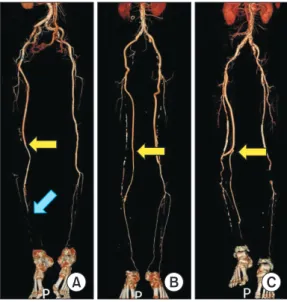
In cases of Trans-Atlantic Inter-Society consensus (TASC) C or D lesions, we preferred bypass surgery to endovascular treatment unless the patients had a severe comorbid condi- tion including recent myocardial infarction (<6 weeks since infarction), symptomatic coronary artery disease, dialysis dependent-renal insufficiency, or severe chronic obstruc- tive pulmonary disease. In lesions crossing the knee joint without an adequate length of GSV to cover the lesion, the author attempted to construct a composite graft with us- able segments of the saphenous vein or arm vein. When there was no usable vein segment, bypass was performed with a PTFE graft, with or without a vein cuff. Fig. 2 shows the configurations of an infrainguinal bypass completed
Fig. 2. Configurations used in infrainguinal bypass surgery with a composite graft in the absence of an appropriate single segment vein graft (yellow arrows: anastomosis be- tween polytetrafluoroethylene graft and vein graft). (A) A 79-year-old female patient who underwent a right femoro- TPT bypass with a composite graft due to acute on chronic ischemia. Run-off vessels were very poor (blue arrow).
Transmetatarsal amputation was needed but the limb was salvaged. (B) A 67-year-old male patient who underwent a right femoro-TPT bypass with a composite graft due to critical limb ischemia caused by a previous bypass graft oc- clusion. (C) A 73-year-old male patient who underwent a right femoro-above knee popliteal and posterior tibial ar- tery graft bypass with a composite graft due to critical limb ischemia caused by a previous bypass graft occlusion. The patient had a history of multiple failed endovascular treat- ments. Transmetatarsal amputation was needed but the limb was salvaged. TPT, tibioperoneal trunk.
A B C
Fig. 1. Vein cuff at distal anastomosis for the anastomosis of the polytetrafluoroethylene graft to the posterior tibial artery (blue arrow). Vein cuff only at the distal anastomosis was not included in the composite graft. This popliteo-pos- teror tibial artery bypass graft was occluded on postopera- tive day 340.
with a composite graft.
Follow-up examinations were performed within the first month of surgery, then at 3-month intervals for the first year, and semiannually thereafter. Duplex ultrasonography or computed tomography was used to image the graft dur- ing follow-up. Outcome variables included primary patency, limb salvage and amputation-free survival. Stenosis was defined as diameter reduction more than 50% on duplex ultrasonography or computed tomography. If the degree of stenosis is not clear on 2-dimensional image, the velocity criteria using peak systolic velocity ratio >2.4 on duplex ul- trasonography was used. The grafts without stenosis were considered patent. Limb salvage was defined by freedom from major amputation (above the ankle). Any amputa- tion at or distal to the Lisfranc level was not considered as a limb salvage failure. Amputation data were obtained though outpatient clinic follow-up.
Hypertension was defined as the use of antihyperten- sive medication for high blood pressure, or a systolic blood pressure ≥140 mmHg and/or diastolic blood pressure ≥90 mmHg. Diabetes mellitus was defined as the use of blood glucose-lowering medication and/or fasting glucose level of
≥126 mg/dL. Dyslipidemia was defined as the use of lipid- lowering medication and/or cholesterol >200 mg/dL and/or low-density lipoprotein-cholesterol >130 mg/dL. CKD stage
≥III was defined as glomerular filtration rate estimated by MDRD (Modification of Diet in Renal Disease) or CKD-Ep- idemiology Collaboration (EPI) equation <60 mL/min/1.73 m2. Smoking included current smoker (non-smoking period
<1 year) and ex-smoker (non-smoking period ≥1 year).
RESULTS
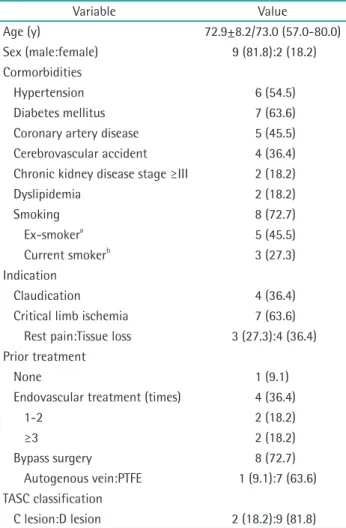
Table 1 shows patient demographics, comorbidities, the indications for revascularization, prior treatment, and the TASC classification. The median (range) age of the patients was 73.0 years (57.0-80.0 years); 63.6% had diabetes and 45.5% had coronary artery disease. A total of 72.7% of the Table 1. Baseline characteristics of the patients (n=11)
Variable Value
Age (y) 72.9±8.2/73.0 (57.0-80.0)
Sex (male:female) 9 (81.8):2 (18.2)
Cormorbidities
Hypertension 6 (54.5)
Diabetes mellitus 7 (63.6)
Coronary artery disease 5 (45.5) Cerebrovascular accident 4 (36.4) Chronic kidney disease stage ≥III 2 (18.2)
Dyslipidemia 2 (18.2)
Smoking 8 (72.7)
Ex-smokera 5 (45.5)
Current smokerb 3 (27.3) Indication
Claudication 4 (36.4)
Critical limb ischemia 7 (63.6) Rest pain:Tissue loss 3 (27.3):4 (36.4) Prior treatment
None 1 (9.1)
Endovascular treatment (times) 4 (36.4)
1-2 2 (18.2)
≥3 2 (18.2)
Bypass surgery 8 (72.7)
Autogenous vein:PTFE 1 (9.1):7 (63.6) TASC classification
C lesion:D lesion 2 (18.2):9 (81.8) Values are presented as mean±standard deviation/median (range) or number (%).
PTFE, polytetrafluoroethylene; TASC, Trans-Atlantic Inter-Society consensus.
aNon-smoking period <1 year, bnon-smoking period ≥1 year.
Table 2. Procedural details of bypass with composite graft (n=11)
Procedural details Value
Concomitant Inflow procedurea 5 (45.5)
Iliac PTA 2 (18.2)
Ilio-fem bypass 2 (18.2)
Aorto-fem bypass 1 (9.1)
Proximal anastomosis
External iliac artery 1 (9.1)
Common femoral artery 8 (72.7)
Superfical femoral artery 2 (18.2) Distal anastomosis
Above knee popliteal artery 0 Below knee popliteal artery 6 (54.5)
Crural 5 (45.5)
Tibioperoneal trunk 2 (18.2) Posterior tibial artery 2 (18.2) Anterior tibial artery 1 (9.1)
Peroneal artery 0
Crossing knee joint
Above knee 0
Below knee 11 (100)
Graft material
PTFE+GSV 10 (90.9)
PTFE+Arm vein 1 (9.1)
PTA, percutaneous transluminal angioplasty; PTFE, polytetrafluo- roethylene; GSV, great saphenous vein.
aInflow procedures which were performed perioperatively.
patients were ex-smoker or current smoker, critical limb ischemia was the indication of treatment in 63.6%. A total of 90.9% of the patients had history of prior treatment in- cluding endovascular treatment (36.4%) and bypass surgery (72.7%). All lesions (100%) were chronic total occlusion and most (81.8%) of the lesions were TASC D lesion.
The procedural details of bypass surgery are shown in Table 2. Concomitant inflow procedures were performed in 45.6%. A total of 72.7% of bypasses had their proximal anastomosis at the common femoral artery, 18.0% at su- perficial femoral artery, and 9.1% at external iliac artery.
The distal anastomoses were to the below knee popliteal artery in 54.5%, tibioperoneal trunk in 18.2%, posterior tibial artery in 18.2%, and anterior tibial artery in 9.1%. All the procedures were crossing the knee joint. The composite grafts were composed of PTFE grafts combined with 10 great saphenous veins and 1 basilic vein.
Patients were followed-up for a mean 506.9 days (range, 182-920 days). There was no perioperative mortality or loss of follow-up. Three bypass graft were occluded, 1 patient required a major amputation, and 1 patient died with a sal- vaged limb during follow-up. The 2-year primary patency and amputation-free survival were 73% and 76%, respec- tively (Fig. 3).
DISCUSSION
Although numerous studies conclusively support the use of saphenous vein grafts for lower extremity arterial recon- struction [3-8], the absence of an acceptable saphenous vein graft with an optimal diameter of appropriate length is common. In the absence of an appropriate GSV graft, other autogenous options include the small saphenous vein or an arm vein. However, data regarding the optimal conduit for below-knee arterial bypass in the absence of a usable single segment GSV are not robust and results have been mixed [1,9-14]. In addition, despite the time-consuming and tech- nically difficult procedure for harvesting unusual autog- enous veins, vein quality cannot be guaranteed in many cases. Therefore, we favored using a composite graft than using an arm vein or a spliced vein graft in the absence of an adequate single segment GSV.
All bypasses in the composite graft crossed the knee joint in this series. Generally, intermediate-term patency of below knee bypasses using PTFE grafts has been reported to be low [15-22]. In the series of this study, the composite grafts were used to minimize the disadvantage of PTFE graft crossing the knee joint. Eight patients (72.7%) had history of previous bypass surgeries; in 7 patients among these, the previous bypasses were using PTFE graft due to lack of appropriate saphenous vein graft. Nevertheless, with the selective combination of PTFE and short segment of vein, we could complete the reoperative bypasses minimiz- ing the disadvantage of PTFE graft.
A composite graft has several advantages. First, the pro- cedures required for completing a composite graft are sim- ple and technically easy. These procedures are illustrated in Fig. 4. We prefer completing the distal anastomosis first because it can be performed easily with good visibility at the anastomosis site. Although composite grafts necessitate an additional anastomosis between a vein graft and a PTFE graft (Fig. 4C), this anastomosis is not technically difficult because it is usually performed in a relatively superficial layer (Fig. 4C). The large caliber and stiff features of the PTFE graft are also helpful in preventing a purse string ef- fect at this anastomosis. Especially in cases of saphenous vein duplication, the duplication site can be used as this anastomosis site using the T-junction technique (making a common channel at the bifurcation site). Second, a com- posite graft can eliminate the risk of juxta-anastomosis site stricture, which is common in the proximal part of a long bypass using a reversed saphenous vein. The large caliber of the ringed PTFE graft allows sufficient proximal graft flow. Third, a composite graft retains the advantages of autogenous vein graft in bypasses crossing the knee joint.
The vein component of the composite graft is flexible and Fig. 3. Kaplan-Meier curve demonstrating primary patency
and amputation-free survival (mean follow-up duration=
506.9±302.9 days, range=182-920 days).
0 1
Amputation free survival Primary patency 100
90 80 70 60 50 40 30 20 10
%
0
Primary patency No. at risk No. of event Amputation free survival
No. at risk No. of event
73%3 76%3 42
2
73%2 76%0 30
1 2
Years Years
makes the distal anastomosis feasible and redundant.
Three conditions are necessary to maintain the patency of a composite graft. First, sufficient inflow must be ob- tained. To overcome the thrombogenic effect of the PTFE graft, inflow should be abundant. In this study, concomi- tant inflow procedures were performed in 45.5% of bypass- es. Second, only an autogenous vein of good quality with a large diameter must be used. Prior studies have reported unfavorable outcomes of composite prosthetic-autogenous grafts [11,23,24]; however, these studies have a possibility of selection bias, and the details of the procedures using composite grafts were not well described. Third, the opera- tion must be performed in a planned manner. Thorough evaluation for the usable vein segment and careful selec- tion of the distal anastomosis site are essential. In our series, bypasses with composite grafts were planed preop- eratively in 9 cases. In other 2 cases, the decision of using composite graft was made intra-operatively, and these 2
bypass grafts were occluded immediately after the surgery postoperatively. We believe precise preoperative planning is a important factor. Our principle is to avoid the placement of an artificial graft crossing the knee joint and to use only a good quality vein in the composite graft. We believe that this strategy is essential to maintain the primary patency of composite grafts. In addition, the composite graft can be used as a type of sequential bypass grafting (Fig. 2C). This sequential bypass graft using PTFE and autogenous vein graft is a useful and safe therapeutic option [25].
In this study, we showed that a composite graft combin- ing a PTFE graft and a segment of autogenous vein is a safe and technically simple option in below the knee bypass.
Although a large scale study is needed to confirm the long–
term patency, the composite graft bypass showed a durable primary patency in the intermediate-term. Although endo- vascular treatments are being provided as a first-line treat- ment, the long term durability of endovascular treatments Fig. 4. Femoro-TPT bypass with composite graft using a PTFE graft and the proximal part of the ipsilateral great saphenous vein. (A) Distal anastomosis of the short segment reversed great saphenous vein at the TPT. (B) Tunneled ringed 6 mm PTFE graft anastomosed proximally to the common femoral artery (green arrow) and saphenous vein graft tunneled to above the knee (blue arrow). (C) Anastomosis between the PTFE and saphenous vein grafts. (D) Completion of anastomosis: above knee segment was composed of PTFE graft and distal segment crossing the knee joint was composed of a reversed saphe- nous vein graft. TPT, tibioperoneal trunk; PTFE, polytetrafluoroethylene.
A B
C D
must be proved especially in chronic long segmental femo- ropopliteal occlusion. Cautious interpretation of the current results of endovascular treatment in femoropopliteal lesion is needed considering the lesion morphology and length. In addition to current endovascular treatment, bypass surgery with composite graft is an option to treat patients with poor vein quality, especially when other therapeutic options fail.
The major limitations of this study are the retrospective design, the small number of patients, and the short follow- up duration. In addition, all the procedures were performed
by one vascular surgeon in single institution; therefore, the reproducibility of the results should be verified in a larger study.
In conclusion, Infrainguinal arterial bypass with a com- posite graft combining an auftogenous vein and a PTFE graft resulted in an acceptable graft patency. In patients without appropriate autogenous vein graft, a composite graft can be used. Even if the vein graft is not of adequate length, a short segment of autogenous vein can be used as a part of composite graft.
REFERENCES
1) Hölzenbein TJ, Pomposelli FB Jr, Miller A, Contreras MA, Gibbons GW, Campbell DR, et al. Results of a policy with arm veins used as the first al- ternative to an unavailable ipsilateral greater saphenous vein for infraingui- nal bypass. J Vasc Surg 1996;23:130- 140.
2) Taylor LM Jr, Edwards JM, Brant B, Phinney ES, Porter JM. Autogenous reversed vein bypass for lower ex- tremity ischemia in patients with ab- sent or inadequate greater saphenous vein. Am J Surg 1987;153:505-510.
3) Londrey GL, Ramsey DE, Hodgson KJ, Barkmeier LD, Sumner DS. Infr- apopliteal bypass for severe ischemia:
comparison of autogenous vein, com- posite, and prosthetic grafts. J Vasc Surg 1991;13:631-636.
4) de Mello AV, Santos CM, Silva JL, Sou- za MT, Portilho MA, Guimarães AV, et al. In situ saphenous vein arterial bypass for infrainguinal revasculariza- tion: initial experience using an open technique. Int Angiol 1991;10:126-132.
5) Taylor LM Jr, Edwards JM, Porter JM.
Present status of reversed vein bypass grafting: five-year results of a modern series. J Vasc Surg 1990;11:193-205;
discussion 206.
6) Leather RP, Shah DM. Experiences with in situ lower extremity saphe- nous vein bypass procedures. Surg Annu 1988;20:257-271.
7) Fogle MA, Whittemore AD, Couch NP, Mannick JA. A comparison of in situ and reversed saphenous vein grafts for infrainguinal reconstruction. J Vasc Surg 1987;5:46-52.
8) Rogers DM, Rhodes EL, Kirkland JS.
In situ saphenous vein bypass for oc- clusive disease in the lower extremity.
Surg Clin North Am 1986;66:319-331.
9) Arvela E, Söderström M, Albäck A, Aho PS, Venermo M, Lepäntalo M.
Arm vein conduit vs prosthetic graft in infrainguinal revascularization for critical leg ischemia. J Vasc Surg 2010;
52:616-623.
10) Armstrong PA, Bandyk DF, Wilson JS, Shames ML, Johnson BL, Back MR.
Optimizing infrainguinal arm vein by- pass patency with duplex ultrasound surveillance and endovascular therapy.
J Vasc Surg 2004;40:724-730; discus- sion 731.
11) Faries PL, Logerfo FW, Arora S, Pull- ing MC, Rohan DI, Akbari CM, et al.
Arm vein conduit is superior to com- posite prosthetic-autogenous grafts in lower extremity revascularization. J Vasc Surg 2000;31:1119-1127.
12) Faries PL, Arora S, Pomposelli FB Jr, Pulling MC, Smakowski P, Rohan DI, et al. The use of arm vein in lower- extremity revascularization: results of 520 procedures performed in eight years. J Vasc Surg 2000;31:50-59.
13) Sesto ME, Sullivan TM, Hertzer NR,
Krajewski LP, O’Hara PJ, Beven EG.
Cephalic vein grafts for lower extremi- ty revascularization. J Vasc Surg 1992;
15:543-549.
14) McPhee JT, Barshes NR, Ozaki CK, Nguyen LL, Belkin M. Optimal con- duit choice in the absence of single- segment great saphenous vein for below-knee popliteal bypass. J Vasc Surg 2012;55:1008-1014.
15) Wijesinghe LD, Beardsmore DM, Scott DJ. Polytetrafluoroethylene (PTFE) femorodistal grafts with a distal vein cuff for critical ischaemia. Eur J Vasc Endovasc Surg 1998;15:449-453.
16) Jakobsen HL, Baekgaard N, Christof- fersen JK. Below-knee popliteal and distal bypass with PTFE and vein cuff.
Eur J Vasc Endovasc Surg 1998;15:
327-330.
17) Calligaro KD, Syrek JR, Dougherty MJ, Rua I, Raviola CA, DeLaurentis DA.
Use of arm and lesser saphenous vein compared with prosthetic grafts for infrapopliteal arterial bypass: are they worth the effort? J Vasc Surg 1997;26:
919-924; discussion 925-927.
18) Parsons RE, Suggs WD, Veith FJ, San- chez LA, Lyon RT, Marin ML, et al.
Polytetrafluoroethylene bypasses to infrapopliteal arteries without cuffs or patches: a better option than amputa- tion in patients without autologous vein. J Vasc Surg 1996;23:347-354; dis- cussion 355-356.
19) Quiñones-Baldrich WJ, Prego AA, Ucelay-Gomez R, Freischlag JA, Ahn SS, Baker JD, et al. Long-term results of infrainguinal revascularization with polytetrafluoroethylene: a ten-year experience. J Vasc Surg 1992;16:209- 217.
20) Veith FJ, Gupta SK, Ascer E, White- Flores S, Samson RH, Scher LA, et al. Six-year prospective multicenter randomized comparison of autolo- gous saphenous vein and expanded polytetrafluoroethylene grafts in in- frainguinal arterial reconstructions. J Vasc Surg 1986;3:104-114.
21) Lundgren F; Swedish External Support Study (SWEXSUS). External support of a polytetrafluoroethylene graft im- proves patency for bypass to below- knee arteries. Ann Vasc Surg 2013;27:
1124-1133.
22) Takagi H, Goto SN, Matsui M, Manabe H, Umemoto T. A contemporary meta- analysis of Dacron versus polytetraflu- oroethylene grafts for femoropopliteal bypass grafting. J Vasc Surg 2010;52:
232-236.
23) Feinberg RL, Winter RP, Wheeler JR, Gregory RT, Snyder SO Jr, Gayle RG, et al. The use of composite grafts in
femorocrural bypasses performed for limb salvage: a review of 108 consec- utive cases and comparison with 57 in situ saphenous vein bypasses. J Vasc Surg 1990;12:257-263.
24) Perler BA, Burdick JF, Williams GM.
The multiple sequential distal bypass graft: seven-year follow-up. J Vasc Surg 1987;6:296-300.
25) Mahmood A, Garnham A, Sintler M, Smith SR, Vohra RK, Simms MH.
Composite sequential grafts for femo- rocrural bypass reconstruction: expe- rience with a modified technique. J Vasc Surg 2002;36:772-778.