• 검색 결과가 없습니다.

First record of Eubroncus Yoshimoto, Kozlov and Trjapitzin (Hymenoptera: Chalcidoidea: Mymaridae) from South Korea

N/A
N/A
Protected

Academic year: 2021

Share "First record of Eubroncus Yoshimoto, Kozlov and Trjapitzin (Hymenoptera: Chalcidoidea: Mymaridae) from South Korea"

Copied!
4
0
0

로드 중.... (전체 텍스트 보기)

전체 글

(1)

A family Mymaridae is commonly known as fairyflies or fairy wasps, and consisting of 1,424 species in 103 genera worldwide (Aguiar et al., 2013). They are common chalcid wasps, but are difficult to recognize because of their extremely small body size (average ca. 0.5 to 1.0 mm) (Gibson, 1997).

Eubroncus Yoshimoto, Kozlov and Trjapitzin, 1972 is a small genus of Mymaridae with only seven species in the worldwide: two from the Eastern Palearctic and five from Oriental regions (Yoshimoto et al., 1972; Hayat and Khan, 2009; Jin and Li, 2014; Palanivel and Manickavasagam, 2015).

However, Triapitsyn and Berezovskiy (2002) briefly mentioned

that additional specimens were exist, and still remained undescribed from the Australian and Afrotropical regions.

In the present study, Eubroncus is newly recognized from South Korea based on E. prodigiosus. A diagnosis and photographs of the diagnostic characters are provided.

Materials and Methods

The terminology used in the present study follows that of Gibson (1997). A female specimen was slide-mounted in Canada balsam using a method described by Noyes (1982) with some modifications. The images were captured with a Leica DFC 495 camera on a Leica M205A Stereozoom stereomicroscope (Leica, Microsystems, Solms, Germany) or

Short communication KOREAN JOURNAL OF APPLIED ENTOMOLOGY

한국응용곤충학회지 ⓒ The Korean Society of Applied Entomology

Korean J. Appl. Entomol. 56(3): 249-252 (2017) pISSN 1225-0171, eISSN 2287-545X

DOI: https://doi.org/10.5656/KSAE.2017.05.0.001

First record of Eubroncus Yoshimoto, Kozlov and Trjapitzin (Hymenoptera: Chalcidoidea: Mymaridae) from South Korea

Chang-Jun Kim, Il-Kwon Kim, Jongok Lim and Jong-Wook Lee 1 *

Division of Forest Biodiversity, Korea National Arboretum, 415 Gwangneungsumokwon-ro, Pocheon, Gyeonggi 11186, Republic of Korea

1

Department of Life-Sciences, Yeungnam University, 280 Daehak-ro, Gyeongsan, Gyeongbuk 38541, Republic of Korea

한국산 미기록속 Eubroncus Yoshimoto, Kozlov and Trjapitzin (벌목: 좀벌상과: 총채벌과)에 대한 보고

김창준ㆍ김일권ㆍ임종옥ㆍ이종욱 1 *

국립수목원 산림생물조사과, 1영남대학교 생명과학과

ABSTRACT: Eubroncus Yoshimoto, Kozlov and Trjapitzin, 1972 belonging to Mymaridae is newly recognized in South Korea based on E. prodigiosus (Yoshimoto, Kozlov and Trjapitzin, 1972). A diagnosis and photographs of the diagnostic characters are provided.

Key words: Eubroncus prodigiosus, Mymaridae, New record, South Korea, Taxonomy

초 록 : 한국산 총채벌과의 미기록종인 긴턱총채벌(Eubroncus prodigiosus (Yoshimoto, Kozlov and Trjapitzin, 1972)) (신칭)을 확인하고, 그에 따라 미기록속인 긴턱총채벌속(Eubroncus Yoshimoto, Kozlov and Trjapitzin, 1972) (신칭)을 처음으로 보고한다. 식별형질의 기재와 주요 형 질에 대한 사진을 함께 제공한다.

검색어: 긴턱총채벌, 총채벌과, 미기록종, 한국, 분류

*Corresponding author: [email protected]

Received January 9, 2017; Revised May 25, 2017 Accepted June 10, 2017

249

This is an Open-Access article distributed under the terms of the Creative Commons Attribution Non-Commercial License (http://creativecommons.org/licenses/by-nc/3.0) which permits unrestricted non-commercial use, distribution, and reproduction in any medium, provided the original work is properly cited.

(2)

250 Korean J. Appl. Entomol. 56(3): 249~252 (2017)

with a Jenoptik ProgRes C14 Plus camera (Jenoptik Corporation, Jena, Germany) on an Olympus BX53 microscope (Olympus, Tokyo, Japan). The multi-stacked pictures were produced using the LAS software (version 4.1.0., Leica Microsystems, Switzerland). The figure plates were prepared in Adobe Photoshop CS6 (Adobe Systems Incorporated, San Jose, United States of America).

All examined specimens have been deposited in the Yeungnam University (YNU), Gyeongsan, South Korea and the Korea National Arboretum (KNA), Pocheon, South Korea.

Systematic accounts

Genus Eubroncus Yoshimoto, Kozlov and Trjapitzin, 1972 긴턱총채벌속 (신칭)

Eubroncus Yoshimoto, Kozlov and Trjapitzin, 1972: 879.

Type species: Eubroncus orientalis Yoshimoto, Kozlov and Trjapitzin, 1972, by original designation.

Stomarotrum Yoshimoto, Kozlov and Trjapitzin, 1972: 879.

Type species: Stomarotrum prodigiosum Yoshimoto, Kozlov and Trjapitzin, 1972, by original designation. Synonymized by Triapitsyn and Huber 2000: 603.

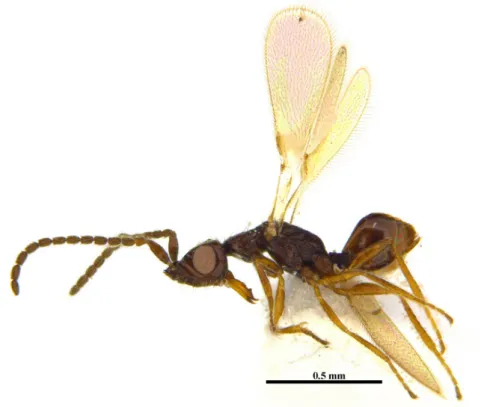
Diagnosis. Head strongly angular in lateral view, with acute angle between face and vertex (Fig. 1D); antenna with short funicle segments (Fig. 1A); mandibles extremely long and narrow, as long as or slightly longer than height of head, with a strong apical tooth and a row of denticles on the ventral margin (Fig. 1C); fore leg with distinctly comb-like protibial spur at the inner margin; male flagellum 11-segmented (Fig. 2).

Distribution. Australian, Afrotropical, Eastern Palaearctic and Oriental regions (Triapitsyn and Berezovskiy, 2002).

Eubroncus prodigiosus (Yoshimoto, Kozlov and Trjapitzin, 1972) 긴턱총채벌 (신칭) (Figs. 1A-G, 2)

Stomarotrum prodigiosum Yoshimoto, Kozlov and Trjapitzin,

Fig. 1. Eubroncus prodigiosus (Yoshimoto, Kozlov and Trjapitzin, 1972), female. A: Antenna; B: Head in dorsal view; C: Mandibles; D: Habitus

in lateral view; E: Mesosoma in dorsal view; F: Legs; G: Metasoma in dorsal view.

(3)

Eubroncus from South Korea 251 1972: 882.

Eubroncus prodigiosus: Triapitsyn and Huber, 2000: 613;

Triapitsyn and Berezovskiy, 2002: 11.

Diagnosis.

Female. Body length 0.95-1.26 mm, fore wing length 0.91-1.03 mm. Body dark brown, except radicle, mandibles, legs yellowish brown to brown. Head in lateral view strongly triangular, in dorsal view 1.25 times as long as wide (Fig. 1B) and, in frontal view 1.33 times as long as high; eyes nearly circular (Fig. 1D), 1.2 times as long as wide; mandibles slightly longer than height of the head in lateral view (Fig. 1B); scape 3.0 times as long as wide; all funicle segments short and transverse; clava 2.6 times as long as wide (Fig. 1A). Mesosoma slightly longer than length of metasoma and slightly more than 2.0 times as long as and slightly longer than mesoscutum (Fig.

1E); median length of propodeum 0.95 times length of mesoscutum and 0.85 times length of scutellum. Fore wing 3.7 times as long as wide. Metacoxa distinctly reticulate (Fig. 1F);

protibial spur comb-like. Petiole as long as wide, with short spine like projection from each side antero-laterally (Fig. 1G).

Tergite I smooth, occupying half length of gaster, with ridges

and carinae near the base (Fig. 1G); ovipositor short, not exserted at apex.

Male. Body length 1.07-1.12 mm, fore wing length 0.99- 1.03 mm. Similar to female, slightly lighter head and body color than female (Fig. 2); flagellar segments slightly longer than its width; fore wing 3.5 times as long as wide.

Material examined (7 ♀♀3♂♂). South Korea: 1♂, Gyeongsangbuk-do, Cheongdo-gun, Gakbuk-myeon, Namsan- 3ri, 35°41'N, 128°35'E, 27.V-9.VI.2013 (Malaise trap), J.W.

Lee leg. (YNU); 2 ♀♀, ditto, 27.III-10.V.2015 (Malaise trap), J.W. Lee leg. (YNU); 1 ♀, Gangwon-do, Bukbang-myeon, Gangwon Prov. Environment Research Park, 37°45'15.6″N, 127°51'01.7″E, 30.III-15.IV.2012 (Malaise trap), S.J. Jang leg.

(YNU); 1 ♀, ditto, 1-16.V.2013 (Malaise trap), S.J. Jang leg.

(YNU); 1 ♀1♂, Gangwon-do, Yanggu-gun, National DMZ Native Botanic Garden, 30.VI-15.VII.2014 (Malaise trap), I.K.

Kim leg. (KNA); 1♀1♂, ditto, 15-30.VII.2014 (Malaise trap), I.K. Kim leg. (KNA); 1 ♀, ditto, 18.VIII-1.IX.2014 (Malaise trap), I.K. Kim leg. (KNA).

Distribution. South Korea (Gyeongbuk, Gangwon; new record), Japan (Fukuoka), Russia (Far East).

Hosts. Unknown.

Fig. 2. Eubroncus prodigiosus (Yoshimoto, Kozlov and Trjapitzin, 1972), male. Habitus in lateral view.

(4)

252 Korean J. Appl. Entomol. 56(3): 249~252 (2017)

Acknowledgements

We thank Seung-Gyu Lee (KNA) for help with slide specimen preparation. This work was supported by a grant from the National Institute of Biological Resources (NIBR), funded by the Ministry of Environment (MOE) of the Republic of Korea (NIBR201701203) and by the Korea National Arboretum (KNA) of the Republic of Korea (as Project no.

KNA1-1-15, 14-3).

Literature Cited

Aguiar, A.P., Deans, A.R., Engel, M.S., Forshage, M., Huber, J.T., Jennings, J.T., Johnson, N.F., Lelej, A.S., Longino, J.T., Lohrmann, V., Miko, I., Ohl, M., Rasmussen, C., Taeger, A., Yu, D.S., 2013. Order Hymenoptera. Zootaxa 3703(1), 51-62.

Gibson, G.A.P., 1997. Morphology and terminology, in: Gibson, G.A.P., Huber, J.T., Woolley, J.B., (Eds.), Annotated keys to the Genera of Nearctic Chalcidoidea (Hymenoptera). NRC Research Press, Ottawa, pp. 16-44.

Hayat, M., Khan, F.R., 2009. First record of Eubroncus from India

(Hymenoptera: Chalcidoidea: Mymaridae), with description of a new species. Journal of Threatened Taxa 1(8), 439-440.

Jin, X.X., Li, C.D., 2014. First record of Eubroncus (Hymenoptera, Mymaridae) from China, with description of three new species.

Zookey 399, 29-41.

Noyes, J.S., 1982. Collecting and preserving chalcid wasps (Hyme- noptera: Chalcidoidea). Journal of Natural History 16, 315-334.

Palanivel, S., Manickavasagam, S., 2015. Description of a new species of Eubroncus Yoshimoto (Hymenoptera: Mymaridae) from India, with a key to world species. Journal of Threatened Taxa 7(5), 7152-7156.

Triapitsyn, S.V., Berezovskiy, V.V., 2002. Review of the Mymaridae (Hymenoptera, Chalcidoidea) of Primorskii Krai: genera Anagroidea Girault and Eubroncus Yoshimoto, Kozlov et Trjapitzin. Far Eastern Entomologist 114, 1-17.

Triapitsyn, S.V., Huber, J.T., 2000. Fam. Mymaridae-mymarids, in: Ler, P.A. (Ed.), Key to the insects of Russian Far East 4(4).

Dal’ nauka, Vladivostok, pp. 603-614.

Yoshimoto, C.M., Kozlov, M.A., Trjapitzin, V.A., 1972. A new sub- family of Mymaridae (Hymenoptera, Chalcidoidea, Mymaridae).

Entomologicheskoe Obozrenie 51(4), 878-885. [In Russian]

[English translation: Entomological Review 51: 521-525]

수치

Fig. 1.  Eubroncus prodigiosus  (Yoshimoto, Kozlov and Trjapitzin, 1972), female. A: Antenna; B: Head in dorsal view; C: Mandibles; D: Habitus in lateral view; E: Mesosoma in dorsal view; F: Legs; G: Metasoma in dorsal view.
Fig. 2.  Eubroncus prodigiosus  (Yoshimoto, Kozlov and Trjapitzin, 1972), male. Habitus in lateral view.

참조

관련 문서

Time series of vertical cross section of potential vorticity and wind vector calculated by Case 1 along the A-A' line indicated at Fig.. Same

Step 2 can be repeated as many times as necessary to produce the desired level of accuracy, that 

Prefinal ending ‘ –– ’ in Jato-seokdokgugyeol materials has long been attracting attention from researchers in that it is used as subject honorific, while

As far as asset accounts in monetary terms are concerned, the link between the accounts of the Economy and the accounts of Nature which is proposed in Part 1 above is the

This designation is without prejudice to positions on status, and is in line with United Nations Security Council Resolution 1244/99 and the Opinion of the International

2재화 2요소 헥셔-올린 모형에서는 어느 한 경제에서 어느 한 요소의 양이 증가하면, 그 요소를 집약적으로 사용하는 산업의 생산량은 증가하고 다른

(Note 3) This value is displayed by timer events set in the event and by the operation type of the external switch input set to the timer start setting. As long as

Archaeopteryx's many features of dinosaurs such as the jaws with teeth, tiny forelimbs with three claws, a long tail and a head covered with scales while body, wings and