Research Report
뿌리혹선충 저항성 토마토를 감염하는 Meloidogyne incognita의 발생 및 이 선충을 이용한 효율적인 저항성 검정법 확립
황성민, 박명수, 김진철, 장경수, 최용호, 최경자*
한국화학연구원 바이오화학연구센터
Occurrence of Meloidogyne incognita Infecting Resistant Cultivars
and Development of an Efficient Screening Method for Resistant Tomato to the Mi-virulent Nematode
Sung Min Hwang, Myung Soo Park, Jin-Cheol Kim, Kyoung Soo Jang, Yong Ho Choi, and Gyung Ja Choi
*Research Center for Biobased Chemistry, Korea Research Institute of Chemical Technology, Deajeon 305-600, Korea
Abstract: Root-knot symptoms were found on a commercial tomato cultivar carrying Mi, a resistance gene to root-knot nematodes including Meloidogyne incognita, M. arenaria, and M. javanica in 2012 at Buyeo, Chungnam Province in Korea. The isolate was identified as M. incognita based on molecular analyses using two species-specific primer sets. Pathogenicity of the isolate on one susceptible and three resistant tomato cultivars to the root-knot nematodes was tested. The nematode isolate showed strong pathogenicity on all the tested cultivars at all tested incubation temperatures. In addition, resistance degree of 33 commercial tomato cultivars, 8 susceptible and 25 resistant cultivars to root-knot nematodes, was also tested. Plants were determined as resistant when they suppressed the nematode reproduction. All the cultivars demonstrated strong susceptibility to the nematode regardless of resistance of the tomato cultivars. To our knowledge, this is the first report on the occurrence of Mi infecting M. incognita isolate in Korea. On the other hand, to construct an efficient screening method for selecting resistant breeding source to the nematode isolate, root-knot development of M. incognita on four tomato cultivars according to several conditions such as inoculum concentration, plant growth stage, and incubation period after transplant was investigated. Reproduction of the nematode on all the tested cultivars according to inoculum concentration increased in a dose-dependent manner. Except for inoculum concentration, there was no significant difference in reproduction level of the cultivars according to the other tested conditions.
On the basis of the results, we suggest an efficient screening method for new resistant tomato to the nematode isolate.
Additional key words: breeding, egg mass, resistance, root-knot nematode, species-specific primer
*Corresponding author: [email protected]
※ Received 21 August 2013; Revised 8 October 2013; Accepted 19 November 2013. 본 연구는 농림수산식품부 생명산업기술개발사업의 채소병리 검정지원사업단(과제번호: 609002-5호)의 지원에 의해 이루어진 것이다.
Ⓒ 2014 Korean Society for Horticultural Science
서 언
뿌리혹선충(Meloidogyne spp.)은 전 세계적으로 각종 작물 에 큰 피해를 주고 있으며, 뿌리혹선충에 감염된 작물은 뿌 리에 혹이 형성되기 때문에 뿌리혹선충에 의한 피해를 쉽게 진단할 수 있다. 뿌리혹선충의 기주는 식량작물, 원예작물,
목본류 등 2,000여 종에 이르고, Meloidogyne 속 선충은 70 종 이상이나 경제적으로 큰 피해를 입히는 것은 Meloidogyne incognita, M. arenaria, M. javanica 및 M. hapla 등 4종으로 알려져 있다(Barham and Winstead, 1957; Choi and Choo, 1978). 시설과채류에서는 M. incognita와 M. arenaria에 의 한 피해가 크고, 노지에서는 M. hapla에 의한 피해가 심하다
(Kim, 2001; Kim et al., 2001; Mitkowski and Abawi, 2003).
뿌리혹선충의 1세대는 약 30-60일 정도이며, 온도나 환경의 변화에 의해서 세대기간이 더 짧아질 수 있으며, 시설에서 한 작물을 연작하면 피해가 더 커지는 특징을 나타낸다(Cho et al., 2000; Kim and Han, 1998). 가지과 작물에 속하는 토 마토(Solanum lycopersicum L.)는 재배 면적 및 생산량이 증 가하는 추세이고, 주로 시설재배에 의존하여 연작재배하기 때문에 뿌리혹선충병 발생이 큰 문제가 되고 있다.
뿌리혹선충병의 방제는 화학적 방제, 물리적 방제(태양열 소독, 온탕 침지법), 재배적 방제(답전윤환, 저항성 품종 재 배, 비기주 작물과 윤작) 및 생물적 방제(살선충 곰팡이, 천 연물) 등의 방법들이 알려져 있다(Chon et al., 1996). 최근 약효가 우수한 살선충제를 이용한 선충 방제가 이루어지고 있지만, 토양 및 물의 이동, 유묘, 농기구 등에 의한 재오염 이 지속적으로 발생되고 있어 근본적인 방제 방법으로 인 식되지 못하고 있다. 최근에는 환경친화적인 측면에서 살선 충 물질을 함유한 식물 추출물을 이용하여 방제하고자 시 도하고 있다(Kim et al., 1998; Oka et al., 2012; Wiratno et al., 2009). 하지만 뿌리혹선충은 기주 범위가 매우 넓어 경 제성이 높은 비기주 저항성 윤작 작물을 찾기가 어렵다. 따 라서 장기적으로는 가장 환경친화적 방제 방법인 저항성 품 종이나 저항성 대목을 이용한 접목 재배가 효과적일 것이다 (Kinloch and Hinson, 1972; Rhoades, 1976).
균류병 및 세균병에 대한 작물의 저항성에서와 달리 선 충에 대한 저항성은 식물에 뿌리혹선충병이 발생하지 않는 immune이 아니고, 선충의 reproduction을 억제하는 것 즉 뿌리 혹에 선충의 난낭(egg mass) 형성이 억제되는 것으로 정의하고 있다(Trudgill, 1991). 토마토 품종에 있어서 뿌리 혹선충에 대한 저항성 유전자는 야생 토마토 품종 Solanum peruvianum에서 보고된 단일 우성유전자 Mi을 도입한 것이 다(Bailey, 1941; Gilbert and McGuire, 1956). 이 Mi 유전자 는 주요 뿌리혹선충 중 M. incognita, M. javanica 및 M.
arenaria에는 저항성을 나타내나, M. hapla에는 저항성을 나타내지 못한다(Barham and Winstead, 1957; Gilbert and McGuire, 1956; Roberts and Thomason, 1986). 이들 뿌리혹 선충은 Mi 저항성과 감수성 토마토 모두를 침입할 수 있으 나, 저항성 품종에서는 침입 이후에 기주의 저항성 반응(HR, hypersensitive reaction)에 의하여 선충은 feeding site를 만 들지 못하고 더 이상 병 진전이 일어나지 않는다(Dropkin, 1969; Ho et al., 1992; Paulson and Webster, 1972). 그리고 이 저항성 반응은 접종 12시간 후에 볼 수 있으며, 선충에
대한 기주의 감수성 혹은 저항성은 접종 후 2-3일 이내에 결 정된다고 알려져 있다(Dropkin, 1969; Paulson and Webster, 1972). 또한 토마토의 Mi 저항성은 28°C 이상의 토양 온도에 서는 뿌리혹선충에 대한 저항성이 발현되지 않는다(Dropkin, 1969).
이 Mi 저항성 유전자는 많은 가공용 및 생식용 토마토 품종에 도입되어 60년 이상 사용되어 왔으나 저항성이 크게 무너지지 않아 상당히 안정적인 저항성 유전자로 평가되어 왔다(Medina-Filho and Stevens, 1980; Sorribas et al., 2005).
그러나 최근에 Mi 저항성 토마토를 침해하는 Meloidogyne spp.의 자연 발생(Bost and Triantaphyllou, 1987; Kaloshian et al., 1996; Riggs and Winstead, 1959; Roberts et al., 1990;
Tzortzakakis and Gowan, 1996)과 실내 및 포장에서 Mi 저 항성 품종에 지속적으로 M. incognita를 넣어 줌으로써 이 저 항성 품종을 가해할 수 있는 Mi-virulent 선충이 발생하였다는 보고들이 있다(Castagnone-Sereno et al., 1993; Tzortzakakis et al., 1999). 따라서 Mi 저항성 토마토 품종의 뿌리혹선충에 대한 저항성은 안심할 수 없는 실정이다. 하지만 우리나라 에서 Mi 저항성 토마토를 감염하는 M. incognita에 관한 보 고는 없었다.
본 연구는 2012년에 우리나라 부여 지방에서, 뿌리혹선충 에 대한 저항성 품종으로 판매되고 있는 토마토 품종인 ‘유 니콘’에 뿌리혹선충병이 발생한 것을 발견하고 이를 채집하 여 뿌리혹선충을 분리하고 동정하였다. 그리고 이 뿌리혹선 충(M. incognita)에 대한 감수성 1개 및 저항성 3개 토마토 품종의 저항성을 발병 온도를 달리하여 조사하였다. 또 시 판 품종 33개(저항성으로 판매되는 25개와 감수성 8개)를 구입하여 이 선충에 대한 저항성 정도를 조사하였다. 그리 고 이 Mi-virulent 선충에 대한 새로운 저항성 육종 소재를 개발하기 위한 효율적인 뿌리혹선충병 저항성 검정 방법을 확립하고자 접종원 농도, 토마토 생육 시기 및 이식 시기 등의 발병 조건에 따른 토마토 4개 품종들의 뿌리혹선충병 발생을 조사하였다.
재료 및 방법
뿌리혹선충의 채집 및 분리
2012년 충남 부여에서 뿌리혹선충 저항성 유전자 Mi를 가지는 토마토 ‘유니콘’ 품종에서 뿌리혹선충병이 심하게 발생하였다. 여기에서 채집한 토마토로부터 뿌리혹선충을 분리하기 위하여 토마토 뿌리의 혹을 흐르는 물로 잘 씻은
후에 개량된 sodium hypochloride 방법을 사용하여 뿌리혹 선충의 알을 분리하였다(Kim and Lee, 2008). 간단히 설명 하면 깨끗이 씻은 뿌리를 1cm 간격으로 잘라서 200mL의 1% sodium hypochlorite(NaOCl) 용액이 들어있는 믹서기에 넣고 고속으로 1분간 회전시켰다. 그리고 믹서기 내의 뿌리 찌꺼기, 알 및 유충을 75µm와 28µm 체에 통과시키고 28µm 체에 걸린 알을 수확하여 부화할 때까지 25°C 상온에서 배 양하였다.
뿌리혹선충의 동정
채집한 뿌리혹선충의 동정을 위하여, 알에서 부화한 유 충으로부터 DNA를 추출하고 M. incognita의 특이적인 프 라이머 2종을 사용하여 PCR 증폭을 통하여 동정하였다.
분리한 유충에 2mL CATB buffer를 넣고 막자 사발을 이 용하여 마쇄하여 60°C에서 1시간 정도 배양한 후 동량의 phenol:chloroform:isoamyl alcohol(25:24:1, v/v/v)를 넣고 잘 섞어 13,000rpm에서 15분 동안 원심분리하여 상징액을 취하였다. 상징액에 0.7vol의 isopropyl alcohol을 넣고 여러 번 업다운한 후 13,000rpm에서 15분간 원심분리하여 DNA pellet을 얻었다. 유충으로부터 얻은 DNA는 PCR-premix (iNtRON Biotechnology, Korea)와 혼합한 후에 종 특이적 프라이머인 Sec 1-F(5'-GGGCAAGTAAGGATGCTCTG-3') 와 Sec 1-R(5'-GCACCTCTTTCATAGCCACG-3')(Tesarova et al., 2003) 프라이머와 Mi-F(5'-GTGAGGATTCAGCTCC CCAG-3')와 Mi-R(5'-ACGAGGAACATACTTCTCCGTCC-3') (Meng et al., 2004)를 iCycler(Bio-RAD, USA)로 증폭하였 다. PCR 증폭은 initial denaturation을 94°C에서 5분간 실시 하고 denaturation(94°C) 1분, annealing(60°C) 1분, extention (72°C) 1분 30초로 40cycle을 실시한 후 final extention을 72°C에서 10분간 실시하였다. 그리고 증폭 산물의 크기를 1% agarose gel에서 확인하였다.
뿌리혹선충의 증식
분리한 뿌리혹선충은 ‘서광’(몬산토코리아) 품종의 토마 토 유묘를 이용하여 온실(25 ± 5°C)에서 증식하였다. 원예 용 상토(쑥쑥이, 농우바이오)와 멸균한 모래의 비율(v/v)이 1:1이 되도록 혼합한 토양을 플라스틱 포트(직경 10.0cm, 높 이 9.0cm)에 넣고, 파종 후 원예용 상토에서 21일 동안 재배 한 토마토 유묘를 이식하고 7일 동안 더 재배한 토마토에 뿌리혹선충의 알을 주 당 10,000개씩 접종하였다. 접종한 토 마토는 온실에서 45-60일 동안 재배한 후에 토마토 뿌리에
혹이 형성된 것을 확인하고 접종원으로 사용하였다.
접종원 준비
뿌리혹선충병이 발생한 토마토 뿌리를 수거하여 개량된 sodium hypochlorite 방법(Barker et al., 1985)을 사용하여 M. incognita의 알을 분리하였다. 깨끗이 씻은 뿌리를 1cm 이하 간격으로 잘라서 250mL의 0.5% sodium hypochlorite 용액이 들어있는 분쇄기에 넣고 90초간 마쇄하였다. 그리고 이를 65µm 체에 걸러 뿌리 찌꺼기를 걸러내고 그것을 통과 한 알들을 25µm 체에 수집한 후에 sodium hypochlorite 성 분을 제거하기 위하여 수돗물로 충분하게 씻어 주었다. 수 확한 M. incognita 알의 농도는 해부현미경을 통해 측정하였 으며, 접종원 농도에 따른 뿌리혹선충병 발생 실험을 제외 한 모든 실험에서는 M. incognita 알을 mL당 5,000개가 되 도록 멸균수로 희석하여 접종원으로 사용하였다. 접종원 농 도에 따른 토마토 뿌리혹선충병 발생을 위해서는 mL당 500, 1,000, 5,000, 10,000 및 30,000개가 되도록 준비하였다.
식물체 준비
다양한 조건에 따른 M. incognita의 뿌리혹선충병 발생을 위해서는 감수성 품종인 ‘서광’(몬산토코리아) 그리고 뿌리 혹선충에 대한 저항성 품종으로 판매되고 있는 ‘롱런’(몬산 토코리아), ‘도태랑마스터’(다이끼종묘) 및 ‘텐텐’(코레곤종 묘)을 구입하여 실험에 사용하였다.
5 × 8 육묘용 연결포트(70mL/pot, 범농)에 원예용 상토 (쑥쑥이, 농우바이오)를 채워 넣고 토마토 종자를 파종하여 온실(25 ± 5°C)에서 3주일 동안 재배하였다. 이 토마토 유묘 를 플라스틱 포트(직경 9cm, 높이 8cm)로 원예용 상토(쑥쑥 이, 농우바이오)와 멸균한 모래를 1:1(v/v) 비율로 혼합한 토 양을 사용해 이식하고 온실에서 7일 동안 더 재배한 토마토 를 실험에 사용하였다.
토마토 생육 시기에 따른 뿌리혹선충병 발생 조사를 위해 서는 4개 품종의 종자를 파종하고 온실에서 2주, 3주 및 4주 동안 재배한 것을 앞에서와 마찬가지로 혼합 토양에 이식하 고 1주일 동안 더 재배한 토마토 유묘를 접종실험에 사용하 였다. 그리고 혼합 토양에 토마토를 이식하고 접종할 때까 지의 재배 기간에 따른 즉 이식 시기에 따른 뿌리혹선충병 발생은 선충을 접종하기 0, 3, 9일 전에 각각 앞에서와 같은 방법으로 토마토를 이식하고 온실에서 재배한 유묘에 선충 을 접종하였다.
그리고 시판 중인 토마토 품종들의 이 M. incognita 선충
에 대한 저항성 차이를 조사하기 위해서는 뿌리혹선충에 대 한 저항성 품종으로 표기된 25개 품종(‘하우스첼린지’, ‘텐 텐’, ‘슈퍼도태랑’, ‘큐티’, ‘스위트’, ‘도태랑프로’, ‘도태랑 레귤러’, ‘도태랑골드’, ‘도태랑챔피온’, ‘도태랑마스터’, ‘도 태랑다이아’, ‘핑크히트’, ‘포세이돈’, ‘유니콘’, ‘롱런’, ‘제 우스42’, ‘조이풀’, ‘서건’, ‘로꾸산마루’, ‘토사마’, ‘마이로 꾸’, ‘하드랑’, ‘키스꿀’, ‘큐피랑’)과 감수성 8개 품종(‘챌린 지틴틴’, ‘챌린지스페셜’, ‘호용’, ‘서광’, ‘슈퍼선로드’, ‘풍 영’, ‘미니찰미니’, ‘요요캡틴’)을 시중에서 구입하여 앞에서 와 동일한 방법으로 파종하고 3주 동안 재배한 후 큰 포트로 이식하여 재배한 토마토 유묘를 실험에 사용하였다.
접종 및 발병
준비한 토마토 유묘에 M. incognita 알을 주당 5,000개씩 토양 3cm 깊이에 접종하였다. 접종한 토마토 유묘는 25°C 생육실에서 하루에 12시간씩 광을 조사하면서 1주일 동안 재배한 후에 온실(25 ± 5°C)로 이동하여 재배하였다.
접종원 농도에 따른 뿌리혹선충병 발생 실험에서는 포트 당 M. incognita 알을 각각 500개, 1,000개, 5,000개, 10,000 개 및 30,000개씩을 접종하고 앞에서와 동일한 방법으로 재배하여 뿌리혹선충병 발생을 유도하였다. 그리고 접종 후 생육 온도에 따른 뿌리혹선충병 발생을 위해서는 M.
incognita를 접종하고 25°C 생육실에서 하루에 12시간씩 광 을 조사하면서 각각 0, 7, 14, 21일 동안 재배한 후에 온실로 이동하여 관행으로 수분관리를 하면서 재배하였다.
병 조사
선충에서의 저항성은 뿌리혹 형성을 저해하는 것이 아니 라 후세대를 생산하는 것을 억제하는 것으로 정의하고 있다 (Trudgill, 1991). 따라서 접종 45일 후에 토마토 유묘의 뿌 리를 수거해 흙을 제거하고 물로 씻은 후에 뿌리에 형성된 난낭(egg mass)의 수를 조사하였다. 난낭 수 조사는 잘 씻은 토마토 뿌리를 erioglaucine disodium 용액(15mg・L-1)에 30 분 동안 침지하여 염색한 후에 뿌리에 형성된 난낭의 수를 측정하였다(Umesh et al., 1994). 토마토 품종의 저항성 판정 은 Taylor and Sasser(1978)의 방법을 참고하여 뿌리에 생긴 주 당 난낭의 수에 따라 결정하였다. 저항성은 주당 0-10개, 중도저항성은 11-30개 그리고 감수성은 31개 이상으로 하 였다. 그리고 혹 지수도 함께 조사하였는데, 토마토 뿌리에 혹이 생긴 정도에 따라 0-10의 지수를 사용하여 11단계로 조사하였다. 0 = 0%, 1 = 1-10%, 2 = 11-20%, 3 = 21-30%,
4 = 31-40%, 5 = 41-50%, 6 = 51-60%, 7 = 61-70%, 8 = 71-80%, 9 = 81-90%, 10 = 91-100%(Bridge and Page, 1980;
Fassuliots, 1985; Taylor and Sasser, 1978).
모든 실험은 3반복으로 2회 실시하였으며, 통계 분석은 SAS(SAS Institute, Inc., 1989, Cary, NC) 프로그램을 이용 하여 ANOVA 분석을 하였으며, 처리 평균간 비교를 위하여 Duncan’s multiple range test(P = 0.05)를 실시하였다.
결과 및 고찰
뿌리혹선충의 동정
부여 토마토 재배 포장에서 채집하여 분리한 뿌리혹선충 을 동정하기 위하여 유충으로부터 얻은 DNA를 M. incognita 에 특이적인 프라이머인 Sec 1-F/R과 Mi-F/R을 이용하여 증 폭하였다(Meng et al., 2004; Tesarova et al., 2003). 그 결과, 특이적인 프라이머인 Sec 1-F/R를 이용하여 증폭한 경우에 는 500bp 정도의 증폭 산물을 얻었고, Mi-F/R를 이용하여 증폭하였을 때에는 1,000bp 정도의 증폭 산물을 얻었다. 따 라서 부여 토마토 재배 포장에서 분리한 뿌리혹선충은 M.
incognita의 특이적인 프라이머인 Sec 1-F/R와 Mi-F/R에서 기 보고된 바와 같이 각각 500bp와 1,000bp의 증폭 산물을 보여 M. incognita로 동정되었다(Meng et al., 2004; Tesarova et al., 2003).
접종 후 재배 온도에 따른 뿌리혹선충병 발생
부여에서 채집한 M. incognita를 저항성 3개 품종과 감수 성 1개 품종에 접종하고 온도를 달리하여 재배한 후에 토마 토 품종들의 뿌리혹선충병 발생을 조사하기 위하여, M.
incognita의 알을 토마토 유묘당 5,000개씩 접종하고 생육실 (25°C)에서 각각 0, 1주, 2주 및 3주 동안 배양한 후에 온실 (25 ± 5°C)로 이동하고 재배하여 뿌리혹선충병 발생을 조사 하였다. 그 결과, 접종하고 온실로 바로 이동한 토마토나 저 항성 발현을 촉진하기 위하여 25°C 생육실에서 1주일, 2주 일 및 3주일 동안 재배한 후에 온실로 이동하여 재배한 토마 토 모두 저항성과 감수성 품종에 관계없이 높은 감수성을 보였다(Table 1). 즉, 재배 온도에 관계없이 그리고 품종에도 관계없이 많은 난낭이 형성되었으며, 또한 높은 혹 지수를 보였다. 이들 결과로부터 부여에서 채집한 뿌리혹선충 M.
incognita는 Mi 저항성 토마토 품종을 감염할 수 있는 선충 으로 생각되었다.
많은 가공용 및 생식용 토마토 품종들의 뿌리혹선충(M.
Table 1. Development of root-knot on tomato seedlings of four cultivars according to incubation conditions after inoculating with Meloidogyne incognita
z.
Tomato cultivar Incubation period in a growth chamber (25°C)
0 1 week 2 weeks3 weeks
Seogwang 99 ± 3.3
ya
x(8.3 ± 0.3
wb
x) 97 ± 4.1 a (8.5 ± 0.5 b) 98 ± 2.9 a (9.0 ± 0.2 ab) 108 ± 6.7 a (9.5 ± 0.7 a) Dotaerangmaster 93 ± 8.7 ab (8.0 ± 0.2 ab) 71 ± 2.9 bc (7.5 ± 0.6 b) 62 ± 5.0 c (7.8 ± 0.4 b) 100 ± 5.2 a (9.2 ± 0.3 a) Longrun 73 ± 5.7 a (9.2 ± 0.7 a) 58 ± 5.4 a (8.8 ± 0.2 ab) 54 ± 4.8 a (7.5 ± 0.5 b) 70 ± 7.6 a (8.2 ± 0.6 ab) Tenten 87 ± 12 a (8.3 ± 0.5 ab) 79 ± 7.6 a (9.2 ± 0.4 a) 66 ± 2.6 a (7.5 ± 0.5 b) 75 ± 2.4 a (8.5 ± 0.2 ab)
Mean 88 (8.5) 76 (8.5) 70 (8.0) 88 (8.9)
z
One week after transplanting, the potted 28-day-old seedlings were inoculated with M. incognita. The inoculated plants were incubated in a growth chamber with 12-h light a day for 0, 1, 2, and 3 weeks and then trans ferred to a greenhous e (25 ± 5°C). Forty five days after inoculation, disease severity of the seedlings was rated on the number of egg masses and gall index of a scale 0 to 10.
y
The number of egg masses/plant. Each value represents the mean ± standard deviation of two runs with three replicates each.
x
Values in the labeled with the same letter in each line are not significantly different in Duncan’s multiple range test at P = 0.05.
w
Each value represents the mean gall index ± standard deviation of two runs with three replicates each.
incognita)에 대한 저항성은 S. peruvianum로부터 도입된 Mi 유전자에 의한 것으로 알려져 있다(Dropkin, 1969; Holtzmann, 1965; Philis and Vakis, 1977, Noling, 2000). 그리고 1940년 대에 도입된 이후부터 오늘날까지 토마토의 뿌리혹선충에 대한 저항성 품종 육성에 사용되어온 Mi 유전자는 상당히 안정적인 저항성을 나타낸다고 알려져 왔으나(Medina-Filho and Stevens, 1980; Sorribas et al., 2005), 최근에 Mi 저항성 토마토를 침해하는 Meloidogyne spp.의 자연 발생이 그리스 Crete와 미국 캘리포니아 등에서 보고되고 있다(Berthou et al., 1989; Bost and Triantaphyllou, 1987; Kaloshian et al., 1996;
Riggs and Winstead, 1959; Roberts et al., 1990; Tzortzakakis and Gowan, 1996).
토마토의 뿌리혹선충병 저항성 정도에 관한 국내 연구결 과로, 당근 뿌리혹선충(M. hapla)에 대하여 ‘강육토마토’ 등 107개 품종이 감수성으로 조사되었고(Cho et al., 1986), 땅 콩 뿌리혹선충(M. arenaria)에 대해 감수성을 보이는 ‘선명’
및 ‘홍도’ 토마토 품종과 중도저항성으로 판별된 ‘알찬’과
‘홍영’ 품종이 보고되었다(Kim and Choi, 2001). 그리고 M.
incognita에 대한 완숙토마토 32종, 방울토마토 11종, 대목 토마토 8종의 저항성 검정을 통해서 ‘홈런킹’, ‘레드체리’,
‘부킹하계’ 및 ‘스페셜’이 저항성 품종으로 보고되었다(Kim et al., 2010). 따라서 부여에서 채집한 M. incognita isolate는 국내에서 기존의 저항성 품종 개발을 위한 병리검정에 사용 된 뿌리혹선충 집단과 다르며, 우리나라 부여 지방에 Mi 저 항성 토마토를 감염할 수 있는 M. incognita가 발생하였다 고 생각되었다. 따라서 이는 우리나라 토마토 재배지역에서 Mi-virulent M. incognita의 발생을 처음으로 보고하는 것이다.
시판 중인 33개 토마토 품종들의 저항성
부여 지방에서 채집한 M. incognita에 대한 시판 중인 토 마토 33개(뿌리혹선충 저항성 25개와 감수성 8개) 품종의 저항성 정도를 조사하기 위하여, 파종하고 28일 재배한 토 마토 유묘에 M. incognita 알을 주당 5,000개씩 접종하고 25°C 항온항습실에서 1주일 동안 배양한 후에 온실(25 ± 5°C) 에서 재배하여 뿌리혹선충병 발생을 조사하였다. 감수성 8 개 품종에 형성된 주당 난낭 수는 평균 109개였다(Table 2).
‘요요캡틴’에서는 다소 낮은 주 당 난낭 수가 76개였으나, 나머지 7개 품종에서는 주 당 98-132개의 난낭이 형성되었 다. 그리고 저항성 품종 25개는 주당 102-137개 그리고 평균 121개의 난낭이 형성되었다. 한편 뿌리에 형성된 혹 형성 정도를 나타내는 혹 지수(gall index)는 감수성 8개 품종들은 5.8-9.0을 그리고 저항성 25개 품종들은 7.0-9.2를 보였다.
따라서 부여 지방에서 채집한 M. incognita에 의한 감수성 및 저항성 품종의 뿌리혹선충병 발생은 차이가 없음을 알 수 있었다.
이상의 결과로부터 부여 지방에서 분리한 M. incognita는 뿌리혹선충병 저항성 토마토를 감염할 수 있는 선충임을 알 수 있었다(Tables 1 and 2). 그리고 25개 저항성 품종의 뿌리 혹선충병 발생이 감수성 품종과 거의 차이가 없으므로 (Table 2), 이미 보고된 바와 같이 Mi 유전자는 단인자 우성 유전자임을 알 수 있었다(Gilbert and McGuire, 1956; Roberts and Thomason, 1986). 그리고 여러 종자회사에서 뿌리혹선 충 저항성 품종으로 판매되고 있는 25개 토마토 품종들은 품종 간에 뿌리혹선충병 발생이 거의 차이가 없었다(Table 2). 그러므로 토마토의 뿌리혹선충병 저항성을 위해 도입한
Table 2. Resistance degree of thirty-three commercial tomato cultivars to Meloidogyne incognita
z.
Tomato cultivar Trait No. of egg mass Resistance reaction
yCutie R
x117 ± 7.0
w(8.2 ± 0.2
v) S
Dotaerangchampion R 109 ± 2.6 (8.7 ± 0.4) S
Dotaerangdia R 128 ± 6.5 (9.2 ± 1.3) S
Dotaeranggold R 127 ± 8.7 (9.2 ± 0.2) S
Dotaerangmaster R 102 ± 2.9 (9.0 ± 0.6) S
Dotaerangpro R 142 ± 3.6 (9.0 ± 0.0) S
Dotaerangregular R 131 ± 5.4 (8.7 ± 0.5) S
Gwangmoung R 113 ± 6.9 (8.2 ± 0.3) S
Hardrang R 126 ± 8.2 (8.3 ± 0.2) S
Housechallenge R 122 ± 7.6 (8.8 ± 0.4) S
Joyful R 109 ± 5.7 (8.8 ± 0.4) S
Kewpierang R 117 ± 8.0 (8.3 ± 0.3) S
Kissggul R 107 ± 2.4 (7.5 ± 0.7) S
Longrun R 102 ± 3.6 (6.8 ± 0.2) S
Mairokku R 137 ± 7.5 (9.0 ± 0.2) S
Pinkhit R 131 ± 4.5 (9.2 ± 1.3) S
Poseidon R 116 ± 8.4 (9.2 ± 0.3) S
Rokkusanmaru R 130 ± 5.9 (8.5 ± 0.4) S
Seogun R 121 ± 6.5 (7.8 ± 0.6) S
Superdotaerang R 118 ± 7.8 (8.8 ± 0.4) S
Sweet R 129 ± 7.5 (8.7 ± 0.2) S
Tenten R 125 ± 4.9 (7.0 ± 0.0) S
Tosama R 125 ± 2.9 (9.0 ± 0.0) S
Unicorn R 129 ± 8.5 (8.8 ± 0.3) S
Zeus42 R 110 ± 7.6 (8.7 ± 0.6) S
Challengtintin - 107 ± 6.8 (8.5 ± 0.5) S
Challengespecial - 132 ± 6.0 (9.0 ± 0.3) S
Hoyong - 103 ± 5.0 (8.2 ± 0.4) S
Minichalmini - 98 ± 5.9 (6.7 ± 0.7) S
Pungyoung - 119 ± 7.4 (8.8 ± 0.2) S
Seogwang - 117 ± 8.7 (9.0 ± 0.3) S
Supersunroad - 124 ± 7.8 (8.0 ± 0.9) S
Yoyocaptin - 76 ± 5.9 (5.8 ± 1.2) S
z
One week after transplanting, the potted 28-day-old seedlings were inoculated with M. incognita. The inoculated plants were incubated in a growth chamber at 25°C for 7 days with 12 h light a day and then transferred to a greenhouse (25 ± 5°C).
Forty five days after inoculation, disease severity of the seedlings was rated on the number of egg masses and gall index of a scale 0 to 1 0.
y
Resistance reaction of tomato cultivar was determined by the number of egg masses per plant. R, resistant, 0-1 0; MR, moderately resistant, 10-30; S, susceptible, more than 31.
x
R, resistant cultivar to root-knot nematode commercialized by seed company.
w
The number of egg masses/plant. Each value represents the mean ± standard deviation of two runs with three replicates each.
v
Each value represents the mean gall index ± standard deviation of two runs with three replicates each.
Table 3. Development of root-knot on tomato seedlings of four cultivars according to inoculum concentration of Meloidogyne incognita
z.
Tomato cultivar Inoculum concentration (the number of eggs)
500 1,000 5,000 10,000 30,000
Seogwang 15 ± 1.6y cx (1.8 ± 0.9w bx) 17 ± 2.9 c (1.8 ± 0.2 b) 106 ± 3.3 b (8.2 ± 0.5 a) 102 ± 6.5 b (9.4 ± 0.2 a) 137 ± 17 a (9.5 ± 0.3 a) Dotaerangmaster 7 ± 0.4 c (0.5 ± 0.0 d) 17 ± 5.0 c (1.5 ± 0.2 c) 80 ± 6.2 b (8.7 ± 0.5 ab) 73 ± 3.3 b (8.2 ± 0.3 b) 122 ± 2.7 a (9.2 ± 0.4 a) Longru n 8 ± 0.8 c (0.5 ± 0.0 b) 12 ± 2.9 c (2.0 ± 0.0 b) 57 ± 5.4 b (7.5 ± 0.8 a) 69 ± 1.2 b (8.8 ± 0.4 a) 99 ± 2.9 a (8.8 ± 0.7 a) Tenten 8 ± 1.6 d (1.0 ± 0.1 b) 13 ± 4.5 d (1.9 ± 0.1 b) 59 ± 6.0 c (8.0 ± 0.4 a) 83 ± 2.0 b (8.7 ± 0.6 a) 111 ± 9.9 a (9.0 ± 0.5 a)
Mean 10 (1.0) 15 (1.8) 75 (8.1) 82 (8.8) 117 (9.1)
zOne week after transplanting, the potted 28-day-old seedlings were inoculated with M. incognita. The inoculated plants were incubated in a growth chamber at 25°C for 7 days with 12 h light a day and then transferred to a greenhouse (25 ± 5°C). Forty five days after inoculation, disease severity of the seedlings was rated on the nu mber of egg masses and gall index of a scale 0 to 10.
yThe number of egg masses/plant. Each value represents the mean ± standard deviation of two runs with three replicates each.
xValues in the labeled with the same letter in each line are not significantly different in Duncan’s multiple range test at P = 0.05.
wEach value represents the mean gall index ± standard deviation of two runs with three replicates each.
유전자는 거의 동일한 것으로 생각되었다. Mi 유전자는 1940 년대에 S. peruvianum으로부터 이종교잡에 의해 도입된 이 후 오늘날까지 지속적으로 뿌리혹선충 저항성 품종 육성을 위해 사용해 온 저항성 유전자인데(Medina-Filho and Stevens, 1980; Smith, 1944), Mi 저항성을 무너뜨리는 새로운 레이스 의 선충이 발견됨에 따라 앞으로 저항성 육종에 사용할 새 로운 저항성 육종 소재를 탐색하는 것이 필요하다. 따라서 부여에서 채집한 Mi 저항성 토마토를 감염하는 이 선충은 새로운 저항성 육종 소재를 탐색하는 연구에 유용할 것으로 생각된다. 따라서 이 선충을 이용한 체계적이고 효율적인 뿌리혹선충병 저항성 검정 방법의 확립이 필요하다.
접종원 농도에 따른 뿌리혹선충병 발생
접종원 농도에 따른 토마토 뿌리혹선충병 발생을 조사하 기 위하여, 파종하고 21일 동안 재배한 토마토를 큰 포트로 이식하고 7일간 더 재배한 4개 품종의 토마토 유묘에 M.
incognita의 알을 주당 500개, 1,000개, 5,000개, 10,000개 및 30,000개씩을 접종하였다. 접종 45일 후에 4개 토마토 품 종들에 형성된 주당 난낭(egg mass)의 수 및 뿌리혹 지수를 조사한 결과, 실험한 모든 품종에서 접종원의 농도가 증가 함에 따라 난낭 수와 혹 지수는 증가하였다(Table 3). 주당 M. incognita의 알을 500개와 1,000개씩을 접종한 토마토 품 종들에서는 접종원 농도 증가에 따른 난낭 수 및 혹 지수는 각각 8-17개 그리고 0.5-2.0으로 상당히 낮았다. 하지만 알 을 5,000개를 접종하였을 때에는 500개나 1,000개를 접종하 였을 때보다 난낭 수와 혹 지수는 모두 크게 증가하였다 (Table 3). 알을 10,000개나 30,000개 접종하였을 때에는 난 낭 수 및 혹 지수가 약간 증가할 뿐이었다. 따라서 접종원
준비를 고려할 때 효율적인 토마토의 뿌리혹선충병 저항성 검정에 적합한 접종원의 농도는 주당 M. incognita 알을 5,000개씩 접종하는 것이라고 생각되었다.
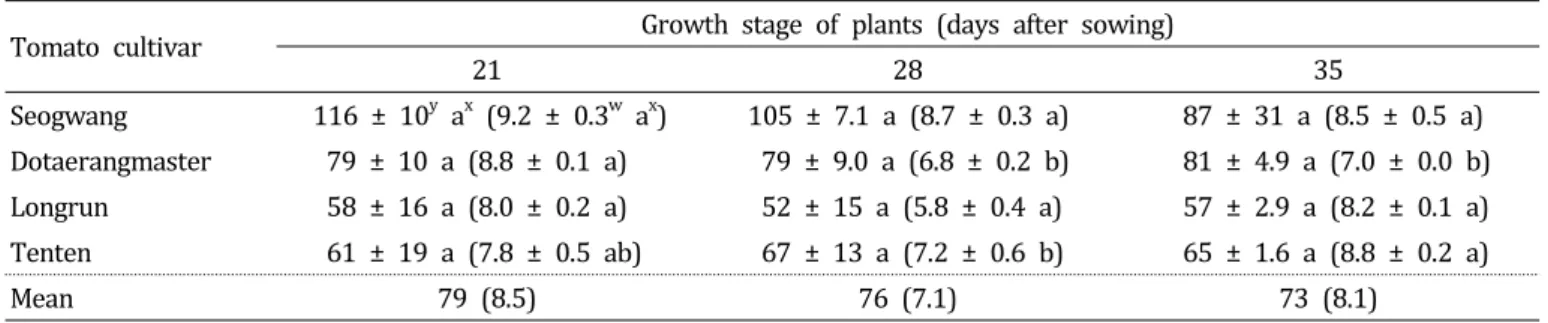
토마토 생육 시기 및 이식 시기에 따른 뿌리혹선충병 발생 토마토 4개 품종을 파종한 후 온실에서 각각 2주, 3주, 4 주 동안 재배한 토마토 유묘를 접종 1주일 전에 큰 포트로 이식하고 재배한 후에 M. incognita 알을 5,000개씩 접종하 여 토마토 생육 시기에 따른 뿌리혹선충병 발생을 조사하였 다. 파종 후 3주, 4주 및 5주 된 토마토 유묘에 선충을 접종 하여 형성된 4개 품종의 평균 난낭 수는 각각 79, 76 및 73 으로 토마토의 생육 시기가 증가할수록 뿌리혹선충병 발생 은 약간 감소하였다(Table 4). 특히 감수성 품종인 ‘서광’에 서는 재배 기간이 3주, 4주 및 5주로 길어짐에 따라 토마토 뿌리에 형성된 난낭 수가 116, 105, 87로 약간 감소하였다.
하지만 통계적으로 유의성 있는 차이는 없었다. 따라서 토 마토의 생육 시기에 따른 M. incognita의 뿌리혹선충병 발생 은 실험한 생육 시기 내에서는 크게 영향을 받지 않는다고 생각되었다.
한편, 토마토 유묘를 큰 포트로 이식하고 재배하는 시간 에 따라 뿌리의 발근 및 활착 정도에 차이가 있으리라 생각 되어 M. incognita를 접종하기 0, 3, 9일 전에 각각 큰 포트 로 이식하였다. 그 결과, 접종하기 0, 3, 9일 전에 이식한 토 마토 4개 품종의 평균 난낭 수는 각각 52, 54, 54이고, 혹 지수는 7.3, 7.5, 7.7로 이식한 후의 재배 기간에 상관없이 뿌리혹선충병 발생은 거의 차이가 없었다(Table 5).
따라서 토마토 뿌리혹선충병 발생에 토마토의 생육 시기 및 이식 후 재배 기간 등은 큰 차이가 없으나, 토마토 재배를
Table 4. Development of root-knot on tomato seedlings of four cultivars according to growth stage of plant
z.
Tomato cultivar Growth stage of plants (days after sowing)
2128 35
Seogwang 116 ± 10
ya
x(9.2 ± 0.3
wa
x) 105 ± 7.1 a (8.7 ± 0.3 a) 87 ± 31 a (8.5 ± 0.5 a) Dotaerangmaster 79 ± 10 a (8.8 ± 0.1 a) 79 ± 9.0 a (6.8 ± 0.2 b) 81 ± 4.9 a (7.0 ± 0.0 b) Longrun 58 ± 1 6 a (8.0 ± 0.2 a) 52 ± 1 5 a (5.8 ± 0.4 a) 57 ± 2.9 a (8.2 ± 0.1 a) Tenten 61 ± 1 9 a (7.8 ± 0.5 ab) 67 ± 1 3 a (7.2 ± 0.6 b) 65 ± 1 .6 a (8.8 ± 0.2 a)
Mean 79 (8.5) 76 (7.1) 73 (8.1)
z
One week after transplanting, the potted seedlings were inoculated with Meloidogyne incognita. The inoculated plants were incubated in a growth chamber with 1 2 h light a day for 7 days and then transferred to a greenhouse (25 ± 5°C). Forty five days after inoculation, disease severity of the seedlings was rated on the number of egg masses and gall index of a scale 0 to 10.
y
The number of egg masses/plant. Each value represents the mean ± standard deviation of two runs with three replicates each.
x
Values in the labeled with the same letter in each line are not significantly different in Duncan’s multiple range test at P
= 0.05.
w
Each value represents the mean gall index ± standard deviation of two runs with three replicates each.
Table 5. Development of root-knot on seedlings of four tomato cultivars according to cultivation period after transplant of seedlings to inoculation of Meloidogyne incognita
z.
Tomato cultivar Cultivation period after transplanting
0 day 3 days 9 days
Seogwang 82 ± 7.1
ya
x(7.5 ± 0.3
wa
x) 68 ± 2.2 ab (8.2 ± 0.5 a) 53 ± 7.0 b (7.8 ± 0.4 a) Dotaerangmaster 48 ± 5.4 a (7.0 ± 0.0 a) 63 ± 4.9 a (7.8 ± 0.6 a) 64 ± 2.4 a (8.3 ± 0.3 a) Longrun 40 ± 4.6 b (7.8 ± 0.2 a) 37 ± 1.2 b (6.7 ± 0.4 a) 54 ± 2.2 a (7.0 ± 0.5 a) Tenten 37 ± 3.7 a (7.0 ± 0.0 a) 48 ± 2.9 a (7.5 ± 0.3 a) 46 ± 3.3 a (7.5 ± 0.2 a)
Mean 52 (7.3) 54 (7.5) 54 (7.7)
z
One, three, and nine days after transplanting, the potted 28-day-old seedlings were inoculated with M. incognita, respectively.
The inoculated plants were incubated in a growth chamber with 12 h light a day for 7 days and then transferred to a greenhouse (25 ± 5°C). Forty five days after inoculation, disease severity of the seedlings was rated on the number of egg masses and gall index of a scale 0 to 1 0.
y
The number of egg masses/plant. Each value represents the mean ± standard deviation of two runs with three replicates each.
x
Values in the labeled with the same letter in each line are not significantly different in Duncan’s multiple range test at P
= 0.05.
w
Each value represents the mean gall index ± standard deviation of two runs with three replicates each.
고려할 때, 효율적인 토마토 뿌리혹선충병 저항성 검정을 위해서는 토마토 종자를 원예용 상토에 파종하고 약 3주 동 안 재배한 후에 모래와 원예용 상토를 동량으로 섞은 혼합 토양을 사용하여 큰 포트로 이식하고 1주일 후에 M. incognita 알을 5,000개씩 접종하고 25°C 생육상에서 하루에 12시간 씩 광을 조사하면서 1주일 동안 배양한 후에 온실에서 재배 하고, 접종 45일 후에 토마토 뿌리에 형성된 난낭의 수를 조사하는 것이 효과적일 것으로 생각되었다.
초 록
2012년 충남 부여에서 뿌리혹선충(Meloidogyne incognita, M. arenaria 및 M. javanica)에 대한 저항성 유전자 Mi를 가 지고 있는 토마토 ‘유니콘’ 품종에서 뿌리혹선충병이 크게 발생하였다. 이로부터 분리한 뿌리혹선충은 종 특이적 프라 이머 2개에 의한 분석한 결과, M. incognita로 동정되었다.
이 선충에 의한 감수성 1개와 저항성 3개 토마토 품종의 뿌 리혹선충병 발생을 조사하였는데, 실험한 모든 온도 조건에
서 실험한 품종 모두는 높은 감수성을 보였다. 그리고 시판 중인 토마토 33개 품종(뿌리혹선충 저항성 25개와 감수성 8개)의 이 선충에 대한 저항성 정도를 조사한 결과, 실험한 모든 품종들은 각 품종의 뿌리혹선충 저항성과 관계없이 유 사한 정도의 높은 감수성을 나타냈다. 본 논문은 우리나라 에서 Mi 저항성 토마토 품종에 뿌리혹선충병을 일으키는 M. incognita 발생을 처음으로 보고하는 것이다. 한편, 새로 운 저항성 육종 소재를 찾기 위한 효율적인 저항성 검정 방 법을 확립하기 위하여, 이 선충의 접종 농도, 토마토 생육 시기 및 이식 시기 등의 다양한 발병 조건에 따른 토마토 4개 품종의 뿌리혹선충병 발생을 조사하였다. 접종원의 접종 농 도가 증가할수록 토마토의 뿌리혹선충병 발생은 농도 의존 적으로 증가하였다. 하지만 토마토의 생육 시기 및 이식 시 기에 따른 토마토의 뿌리혹선충병 발생은 유의성 있는 차이 가 없었다. 이들 결과들을 바탕으로 Mi-virulent M. incognita 에 대한 토마토의 저항성 정도를 검정하기 위한 효율적인 방법을 제안하는 바이다.
추가 주요어 : 육종, 난낭, 저항성, 뿌리혹선충, 종 특이적 프라이머
인용문헌