Journal of the Korean Society for Power System Engineering http://dx.doi.org/10.9726/kspse.2014.18.6.133 Vol. 18, No. 6, pp. 133-139, December 2014
Degradation of a Refractory Organic Contaminant by Photocatalytic Systems
Il-Kyu Kim
*†
(Received 23 September, Revised 28 October, Accepted 28 October)
Abstract: In this research, the photocatalytic degradation of benzothiophene in TiO 2 aqueous suspension has been studied. TiO 2 photocatalysts are prepared by a sol-gel method. The dominant anatase-structure on TiO 2 particles is observed after calcining the TiO 2 gel at 500℃ for 1hr. Photocatalysts with various transition metals (Nd, Pd and Pt) loading are tested to evaluate the effect of transition metal impurities on photodegradation. The photocatalytic degradation in most cases follows first-order kinetics. The maximum photodegradation efficiency is obtained with TiO2 dosage of 0.4 . The photodegradation efficiency with Pt-TiO 2 is higher than pure TiO 2 powder. The optimal content value of Pt is 0.5. Also we investigate the applicability of H 2 O 2 to increase the efficiency of the TiO 2 photocatalytic degradation of benzothiophene. The optimal concentration of H 2 O 2 is 0.05 . The effect of pH is investigated; we obtain the maximum photodegradation efficiency at pH 9. Hydroxy- benzothiophenes and dihydroxy- benzothiophenes are identified as reaction intermediates. It is proposed that benzothiophene is oxidized by OH radical to sequentially form hydroxyl-benzothiophenes, dihydroxybenzothiophenes, and benzothiophene- dione.
Key Words:Photocatalytic systems, benzothiophene, reaction pathway, radical, TiO 2
*
†
Il-Kyu Kim(corresponding author) : Department of Environmental Engineering, Pukyong National University 599-1, Daeyeon3-dong, Nam-gu, Busan, 608-737, KOREA E-mail : [email protected], Tel : 051-629-65281. Introduction
Polycyclic aromatic sulfur hydrocarbons (PASHs) are a group of toxic and/or mutagenic compounds which are abundant in petroleum and coal tars.
These compounds are also present in wastewaters from petroleum and coal liquefaction industries.
PASHs were found to bioconcentrate more significantly than sulfur-free polycyclic aromatic compounds and have been shown to accumulate in sediments, plants and animal tissues.
These PASHs are also among the most refractory compounds in the residuals at contaminated sites. In addition, the conventional activated sludge process dose not effectively degrade these toxic compounds.
The low biodegradability of PASHs suggests that physical-chemical methods may be more effective for degrading PASHs in wastewaters. Benzothiophene was selected for the study because it has the basic structural unit of most PASHs and is relatively soluble in water 1) .
TiO 2 powder suspention system has been
employed to degrade diverse organic pollutants 2,3,4,5,6) .
The primary events occurring on UV-illuminated
TiO 2 relative to the photodegradation of organic
pollutants are summarized that absorption of the
near-UV light by TiO 2 at wavelengths <385nm is followed by electron (e - )–hole (h + ) pair generation.
These charge carriers can migrate rapidly to the surface of catalyst particles where they are ultimately trapped and poised to undergo redox chemistry with suitable substrates. Thus, the trapped hole can react with surface adsorbed organic substrates to produce organic radical cation or with chemisorbed OH- or H 2 O to produce ㆍOH radical species. In aerated systems, oxygen acts as an efficient electron scavenger to trap the conduction band electron to yield superoxide radical anions O 2 ㆍ - . Other Oxidants such as H 2 O 2 can also trap conduction band electrons. 7,8)
In this research, the photocatalytic degradation of benzothiophene(BT) in TiO 2 aqueous suspension has been studied. The effect of parameters such as initial concentration of BT, various transition metals loading, H 2 O 2 concentration and initial pH of TiO 2
on photodegradation has been investigated.
2. Experimental setup and method
2.1 Chemicals
For a series of experiments, TiO 2 photocatalysts are prepared by sol-gel method. Titanium tetraisopropoxide(TTIP) is used as TiO 2 precursor.
The TiO 2 solution is prepared by dissolving TTIP in isopropyl alcohol. The solution is acidified with HCl and mixed at 300rpm for 3hrs. The stabilized TiO 2
suspension is dried in a dry oven at 105℃ for 24hrs and then is calcined at the 500℃ for 1 hour.
TiO 2 photocatalysts with transition metal loading are manufactured with similar method except adding transition metal precursors. For the photocatalysts such as Nd-TiO 2 , Pd-TiO 2 and Pt-TiO 2 , Nd(NO 3 ) 3 . xH 2 O, Pd(NO 3 ) 2 . xH 2 O and H 2 PtCl 6 . 6H 2 O are dissolved in the solution.
2.2 Degradation experiments
Experiments were conducted with 500 batch photocatalytic reactor with a pre-selected initial BT concentration. Annulus type reactor is used. The external tube of reactor is made of acryl equipped with a magnetic stirring bar and a water circulating jacket and inner tude is made of pyrex glass. The UV lamp(15 , Sankyo Denki Com. Blacklight Blue lamp, F15T8BLB, wavelength : 315~400) is placed at the center of the annulus photoreactor.
The reactor was wrapped in aluminum foil to increase reflection. TiO 2 dosage was maintained at 0.4 . At pre-selected intervals, samples are collected. Then the solutions are centrifuged, extracted with hexane, and analyzed with a gas chromatography(Model 5890, Hewlett-Packard) equipped with a flame ionization detector. The oven temperature is maintained at 140℃. The injection port and detector temperatures are maintained at 250℃
and 300℃, respectively.
3. Experimental results and discussion
3.1 XRD pattern of TiO 2
The broad diffraction lines of anatase are located in 25.5°, 38.1°, 48.2°, 53.9°, 55.4° and 62.8°(2θ) while those of rutile are located in 27.4°, 36.1°, 41.2° and 54.3°(2θ) 9) . The dominant anatase- structures on TiO 2 particles are observed after calcining the TiO 2 gel at 400℃ and 500℃ for 1hr.
But both of anatase and rutile were observed after calcining at 600℃. Figure 1 showed the presence of anatase and rutile structures depended on the calcination temperature. In several articles 10) , anatase has shown much better a photocatalytic activity than that of rutile. This is probably due to differences in the extent and nature of the surface hydroxyl groups present in the low temperature anatase structure.
Furthermore, the photoactivity enhancement can
2
In te n sity
0 20 40 60 80 100
120
A 400 , 1hr ℃
A A
2
In te n s ity
0 20 40 60 80 100
120
A 500 , 1hr ℃
A R A
AA A A A
2
In te n s ity
0 20 40 60 80 100
120
A 600 , 1hr ℃
R R A A AR
A AA A R A A
Fig. 1 XRD pattern of photocatalysts calcined at various temperatures (A: anatase, R: rutile)
related to the Fermi level of anatase which is about 0.1 eV higher than that of rutile 7) . The different characteristics between rutile and anatase are attributed to the different position of the conduction band (more positive for rutile) and to the higher recombination rate of electron-hole pairs in rutile.
3.2 Effect of initial concentration of BT The Langmuir-Hinshelwood(L-H) equation has previously been observed to provide an appropriate model for the rate of destruction of various organics by TiO 2 11) . The Fig. 2. is shown that the initial rate r 0 increase with increasing . This variation has been treated according to a (L-H)-type relationship.
(1)
where is the initial concentration of BT, is the reaction rate constant, and is the equilibrium adsorption coefficient. The linear transform of this expression (Fig. 3) according to
(2)
gave
minand
. The value of K has no absolute meaning because it depends on the experimental conditions. The value of the adsorption constant K indicates that the adsorption plays a role in the photocatalytic reaction. Nevertheless, the validity of the (L-H)model confirms that the photooxidation occurs
completely on the TiO 2 surface. 11,12)
0 0.0005 0.001 0.0015 0.002 0.0025
0 0.2 0.4 0.6 0.8 1
C
0×10
4(mo l /L) r
0×1 0
4(m o l/ l. m in )
Fig. 2 Various of BT initial degradation rate as a function of its initial concentration
R2 = 0.9609
0 100 200 300 400 500 600 700 800
0 1 2 3 4 5
(1/C0)×104
(1 / r
0)×1 0
4Fig. 3 Linear transform of the Langmuir-type expression
3.3 Effect of H 2 O 2
H 2 O 2 is a powerful oxidizing agent, reacting
rapidly with UV light (hv) to produce two OH
radicals and OH- as follows: 13,14)
→ · (3)
→ · (4)
In the case of the UV + TiO 2 + H 2 O 2 system there are additional factors that need to be considered. H 2 O 2 can act as an alternative electron acceptor to oxygen (eq. 5) which is a thermodynamically more favorable reaction than oxygen reduction ( for O 2 reduction, for H 2 O 2 reduction). This should consequently increase the rate of the photocatalytic process. The reduction of H 2 O 2 at the conduction band will also produce hydroxyl radials that will be available for attack on the organic compounds. Even if H 2 O 2 is not reduced at the conduction band it can accept an electron from superoxide again producing hydroxyl radicals (eq. 6). 15) → · (5)
· → · (6)
· →
·(7)
· · → (8)
The effect of H 2 O 2 concentration on the rate of
Time(min.)
0 50 100 150 200
C/C
00.0 0.2 0.4 0.6 0.8 1.0
Blank UV alone TiO2 powder TiO2+ H2O2 10-2M TiO2+ H2O2 10-1M TiO2+ H2O2 5× 10⁻²M
Fig. 4 Decomposition of BT at various H 2 O 2
concentration with TiO 2
BT degradation was investigated to determine if an optimal concentration could be found. From Fig. 4 it can be seen that the rate of BT photodegradation is at a maximum 0.05 H 2 O 2. But at over the optimal concentration of H 2 O 2 , the rate of BT photodegradation is reduced. According eq. 6, hydroxyl radicals can also be consumed by excess H 2 O 2, or by HO 2 ·(eq. 7). 16)
3.4 Effect of TiO 2 with various transition metals loading
During the photocatalytic process, the absorption of a photon by TiO 2 leads to the excitation of an electron from the valence band to the conduction band thus producing an electron-hole pair. The electron in the conduction band is removed by reaction with oxygen dissolved in water and the hole in valence band reacts with OH - or H 2 O spaces which are absorbed on the surface of TiO 2 to give the hydroxyl radical, the source for various oxidation reactions 17) . The electron-hole recombination process is in direct competition with space-charge separation of the electron and the hole. The photocatalytic activity of TiO 2 can be enhanced by retarding the electron-hole recombination process.
The electron-hole recombination is through the loading of electron accepting species on the TiO 2
surface 17) .
In this research, investigate the higher photocatalytic activity of transition metals such as Pt, Nd and Pd substituted on TiO 2 . Fig. 5 shows photodegradation of BT by TiO 2 potocatalysts with various transition metals. From the result, the photonic efficiency of Pt(0.5%)-TiO 2 catalysts in the degradation of BT is found to be a maximum point.
But the photonic efficiency of Nd-TiO 2 is similar to
pure TiO 2 and the photonic efficiency of Pd-TiO 2 is
lower than pure TiO 2 . It is also observed that the
photonic efficiency increases in the metal loading up
certain level (optimum metal loading) and then
decreases. The excess loading of metal particles may cover active sites on TiO 2 surface thereby reducing photodegradation efficiency. It is observed that defect site on the TiO 2 surface are necessary for the photooxidation of organic compound.
0 0.002 0.004 0.006 0.008 0.01 0.012 0.014
P t (0.5%)- T iO 2
P t (2%)- T iO 2
TiO 2 P d(2%)- TiO 2
P d(0.5%)- T iO 2
Nd(2%)- T iO 2
Nd(0.5%)- T iO 2
rate constant (k)
Fig. 5 The rate constants for photodegradation of BT by TiO 2 with various transition metals
3.5 Effect of pH
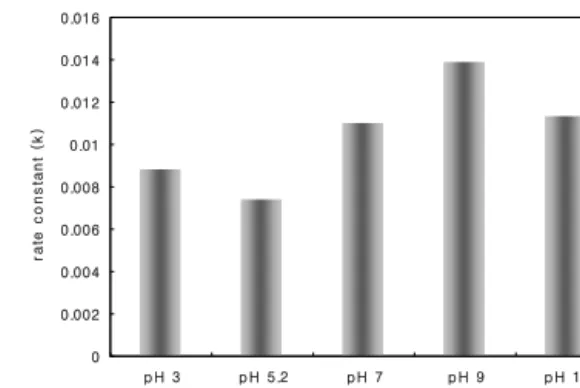
In the experiment of pH effect, HCl and NaOH were used for the initial pH control. For the Pt(0.5%)-TiO 2 used here, the point of zero charge in water is pH 5.2. Fig. 6 illustrates the variation of rate constants, k of BT photodegradation as a function of pH range at 3-11. The degradation efficiency in base pH is higher than that in acid.
There is maximum value at pH 9. Competition for adsorption sites between the substrate and the H 2 O/OH - species at various pH values in expected to influence reaction rates and pathways for photodegradation 11) . Also the increase in rate of photodrgradation with increasing pH can be attributed to the increased number of OH- ions at the surface of TiO 2 , since OHㆍradicals can be formed by trapping photoproduced holes 12) .
3.6 Identification of Benzothiophene Intermediates and Reaction Mechanism The photo-generated electrons and holes can facilitate the production of hydroxyl radicals, and
then these radicals can attack solute molecules. electrons of the aromatic ring are excellent targets for hydroxyl radicals 18) .
0 0.002 0.004 0.006 0.008 0.01 0.012 0.014 0.016
p H 3 p H 5.2 p H 7 p H 9 p H 11
rate constant (k)
Fig. 6 The rate constants for photodegradation of BT by Pt(0.5%)-TiO 2 at various initial pH
The major reaction products retaining the intact benzene ring such as sulfobenzoic acid were obtained from all cases of radical reactions for benzothiophene and methylbenzothiophenes[20, 21].
Our analysis of intermediates and reactions leads to the proposed reaction pathways describing the photocatalytic decomposition of BT in aqueous solution. The photocatalytic reaction is brought about by . OH radicals. The radicals can either directly react with the organic species in the TiO 2 -water interface or diffuse to the solution and then react with the organic species in the solution phase. Both reactions lead to formation of hydroxylated products such as either 2- hydroxybenzothiophene or 3-hydroxybenzothiophene (Figure 7). Eventually, the reaction will mineralize these intermediates to end products such as carbon dioxide and inorganic sulfur species [19]. Figure 8 shows one of the possible reaction pathways involving . OH radicals.
The first step of the possible reaction is the . OH
radical addition which yields either the 3-
hydroxy-2,3-dihydrobenzothiophene or the 2-hydroxy-
2,3-dihydrobenzothiophene . The thiophene ring part
is more attractive to the hydroxyl radicals than the benzene ring part[20, 21]. After the addition of first
. OH radical, 3-hydroxy-2,3-dihydrobenzothiophene can be changed to 3-hydroxybenzothiophene by the elimination of a hydrogen to recover the aromatic resonance stability at the thiophene ring. The electron-releasing property of OH functional group increases the opportunity of attack by the electrophilic . OH radical at the thiophene ring. Then further reaction with . OH radical will generate 2,3-dihydro-xybenzothiophene as a main intermediate product. The 2,3-dihydroxybenzothiophene undergoes hydrogen abstraction, which is the usual reaction with unsaturated organic compounds, then generates the benzothiophene-2,3-dione. Further decomposition of intermediates to the end products, carbon dioxide and inorganic sulfur species is postulated in Figure 7.
O
O
OH
OH 2,3-dihydroxybenzene 2,3-quinone
S OH H S
H
S OH
O O
S benzothiophene
3-hydroxy-2,3-dihydrobenzothiophene
3-hydroxybenzothiophene benzothiophene-2,3-dion
.
.
2,3-dihydroxy-2-hydrobenzothiophene H OH
S
2,3-dihydroxybenzothiophene OH OH
OH
S
COOH
SO3H sulfobenzoic acid Carbon Dioxide
Sulfite